491
Open Access
High Lipoprotein(a) Levels are Associated With Long-Term Adverse Outcomes in Acute Myocardial Infarction Patients in High Killip Classes
Jae Yeong Cho, MD, Myung Ho Jeong, MD, Youngkeun Ahn, MD, Young Joon Hong, MD, Hyung Wook Park, MD, Nam Sik Yoon, MD, Hyun Ju Yoon, MD, Kye Hun Kim, MD, Ju Han Kim, MD, Jeong Gwan Cho, MD, Jong Chun Park, MD and Jung Chaee Kang, MD
Heart Research Center of Chonnam National University Hospital, Cardiovascular Research Institute of Chonnam National University, Gwangju, Korea
ABSTRACT
Background and Objectives: An elevated concentration of lipoprotein(a) {Lp(a)} is associated with an increased preva- lence and increased severity of coronary artery disease. However, the relationship between Lp(a) levels and outcomes after acute myocardial infarction (AMI) is unclear. Subjects and Methods: Between October 2005 and June 2007, we measured serum Lp(a) levels in 832 consecutive AMI patients (age, 62.8±12.4 years, 600 men) on admission. They were divided into tertiles according to their serum Lp(a) levels {Tertile 1 (n=276), Lp(a)<13.8 mg/dL; Tertile 2 (n=279), Lp(a)=13.8-30.6 mg/dL;
Tertile 3 (n=277), Lp(a)>30.6 mg/dL}. Results: There were no differences in baseline clinical characteristics among Tertiles 1, 2, and 3, except for proportions of Killip class III-IV patients (5.8% vs. 10.0% vs. 18.8%, respectively, p<0.001). There were significant differences in left ventricular ejection fractions (57.3±11.4% vs. 55.9±12.3% vs. 53.1±13.1%, p<0.001). Among the laboratory findings, there were significant differences in total cholesterol (173.3±37.2 vs. 183.5±38.9 vs. 185.3±43.8 mg/dL, p=0.001), low density lipoprotein-cholesterol (111.3±34.3 vs. 122.9±34.7 vs. 123.3±39.4 mg/dL, p<0.001), apolipoprotein B (92.8±25.4 vs. 100.8±26.0 vs. 101.9±28.8 mg/dL, p<0.001), and amino-terminal pro-brain natriuretic peptide levels (1805.2±
4343.3 vs. 2607.9±5216.3 vs. 3981.5±7689.7 pg/mL, p<0.001). After adjusting for multiple variables in the high Killip class (III-IV) subgroup, the risk estimate for major adverse cardiovascular events (MACE) at 1-year follow-up was significantly higher in Tertile 3 than in Tertiles 1 or 2 (hazard ratio 6.723, 95% confidence interval 1.037-43.593, p=0.046). Conclusion: In patients in high Killip classes, high serum levels of Lp(a) were significantly associated with long-term adverse outcomes after AMI. (Korean Circ J 2010;40:491-498)
KEY WORDS: Myocardial infarction; Lipoproteins; Prognosis.
Received: February 13, 2010 Revision Received: April 20, 2010 Accepted: April 21, 2010
Correspondence: Myung Ho Jeong, MD, Heart Research Center of Chonnam National University Hospital, Cardiovascular Research Institute of Chonnam National University, 8 Hak-dong, Dong-gu, Gwangju 501-751, Korea
Tel: 82-62-220-6243, Fax: 82-62-228-7174 E-mail: [email protected]
cc This is an Open Access article distributed under the terms of the Cre- ative Commons Attribution Non-Commercial License (http://creativecom- mons.org/licenses/by-nc/3.0) which permits unrestricted non-commer- cial use, distribution, and reproduction in any medium, provided the origi- nal work is properly cited.
Introduction
Lipoprotein(a) {Lp(a)} consists of a low-density lipoprotein
particle covalently bound to a specific glycoprotein, apolipo- protein(a), by apolipoprotein B-100.1) Since apolipopro- tein(a) and plasminogen mutually compete for plasminogen receptors on endothelial cells,2) high concentrations of circu- lating Lp(a) may inhibit thrombolysis and fibrin clearance.3) Moreover, the binding of native Lp(a) to fibrin is significantly enhanced in the presence of homocysteine, glutathione, and cysteine.4)
A number of prospective and retrospective studies have de- monstrated that increased levels of Lp(a) are associated with atherosclerosis, ischemic heart disease, and stroke.5)6) In nu- merous trials, patients with high Lp(a) levels had markedly increased risk of coronary heart disease.7-9) However, the rela- tionship between Lp(a) levels and outcomes after acute myo-
cardial infarction (AMI) is unclear. The purpose of this study was to assess the relationship between high serum Lp(a) levels and major adverse cardiac events after AMI.
Subjects and Methods
Between October 2005 and June 2007, we measured serum Lp(a) levels in 832 consecutive patients with AMI (62.8±
12.4 years, 600 men) upon admission to the Heart Center of Chonnam National University Hospital, Gwangju, Korea. ST- segment elevation myocardial infarction (STEMI) was diag- nosed in patients with 30 minutes of continuous chest pain, a new 2 mm ST-segment elevation on at least two contiguous electrocardiographic leads, and a creatine kinase-MB (CK- MB) level greater than three times the upper limit of normal.
Non-STEMI (NSTEMI) was diagnosed by chest pain and a positive cardiac biochemical marker without new ST-seg- ment elevation. The levels of serum Lp(a), total cholesterol, high density lipoprotein-cholesterol, triglyceride, and rem- nant lipoprotein cholesterol were determined on admission.
Based on their serum Lp(a) levels, patients were classified into tertiles as follows: Tertile 1 (n=276), Lp(a)<13.8 mg/dL;
Tertile 2 (n=279), Lp(a)=13.8-30.6 mg/dL; and Tertile 3 (n=
277), Lp(a)≥30.6 mg/dL (Fig. 1). We also evaluated the fol- lowing as coronary risk factors: hypertension (systolic blood pressure >140 mmHg, diastolic blood pressure >90 mmHg, or receiving antihypertensive drugs), diabetes mellitus (fast- ing glucose level ≥126 mg/dL or random blood glucose level
≥200 mg/dL), current smoking habit, hyperlipidemia (total cholesterol level ≥240 mg/dL, fasting triglyceride level ≥150 mg/dL, or receiving hyperlipidemia medication), and a fam- ily history of coronary artery disease.
Laboratory testing
Peripheral blood samples were obtained by direct venipunc- ture. The blood samples were centrifuged, and serum was re- moved and stored at -70°C until the assays could be performed.
Absolute CK-MB levels were determined by radioimmunoas- say (Dade Behring, Inc., Miami, FL, USA). Cardiacspecific
troponin I levels were measured using paramagnetic parti- cles and a chemiluminescent immunoenzyme assay (Beck- man, Coulter Inc., Fullerton, CA, USA). Serum levels of total cholesterol, triglyceride, and low- and high density lipopro- tein-cholesterol, were measured by standard enzymatic meth- ods. C-reactive protein (CRP) was analyzed by a highly-sensi- tive turbidimetric test using sheep antibodies against human CRP. This test has been validated against the Dade-Behring method. Serum amino-terminal pro-brain natriuretic peptide was measured using an electrochemiluminescence sandwich immunoassay and an Elecsys 2010 analyzer (Roche Diagnos- tics, Mannheim, Germany). Lp(a) was measured by an immu- nonephelometric assay using a latex Lp(a) reagent composed of polystyrene particles coated with a rabbit antihuman Lp(a) γ-globulin fraction. Apolipoprotein A1, apolipoprotein B, and Lp(a) were measured using a Behring Nephelometer II (Dade Behring Inc., Deerfield, IL, USA).
Coronary angiography
Conventional coronary angiography was performed using a digital flat-panel fluoroscopy system (Phillips) via femoral or radial approaches, applying nonionic contrast material (Ul- travist 370, Schering, Berlin, Germany). At least four orthogo- nal views were obtained.
Study outcomes
The primary outcome for this analysis was a composite of major adverse cardiovascular events (MACE), including car- diac death, noncardiac death, nonfatal myocardial infarction, repeat percutaneous coronary intervention, and coronary ar- tery bypass grafting, over one year. Repeat percutaneous cor- onary interventions included target-lesion revascularization (TLR), target-vessel revascularization (TVR), and non-TVR.
Statistical analysis
Continuous variables with normal distributions were pre- sented as means±standard deviation and were compared by 1-way analysis of variance. To test for differences between Lp(a) tertiles, categorical variables were compared using the χ2 test. Cox proportional hazards models were used to cal- culate the hazard ratios (HRs) and 95% confidence intervals (CIs) comparing MACE-free survival rates between Lp(a) tertiles. We used models that adjusted for age, sex, smoking, total cholesterol, low-density lipoprotein cholesterol, high- sensitivity C-reactive protein (hsCRP), apolipoprotein B, Kil- lip class, left ventricular ejection fraction, amino-terminal pro- brain natriuretic peptide, multivessel disease, and number of stents. These variables were selected on the basis of previous studies and multivariable linear regression analyses. We de- termined that the proportional hazard assumption was satis- fied by examining plots of the log-negative-log of the within- group survivorship functions versus log-time. Total cholesterol, Fig. 1. Distribution of serum concentrations of Lp(a) at baseline. Ar-
rows mark the tertile boundaries. Lp(a): lipoprotein (a).
200 150 100 50
0
Lp(a) (mg/dL)
Numbers of patients
0.0 50.0 100.0 150.0 200.0 Arrows indicate
Lower & upper boundary of mid-tertile of Lp(a)
low density lipoprotein-cholesterol, and apolipoprotein B lev- els were adjusted for Lp(a) contribution,10) according to com- positional data in which cholesterol accounts for ≒30% and apolipoprotein B for ≒16% of total Lp(a) mass.11)12) Thus, to-
tal Lp(a) mass was multiplied by 0.3, and this value was sub- tracted from total cholesterol and low density lipoprotein-cho- lesterol values in all individuals. Similarly, total Lp(a) mass multiplied by 0.16 was subtracted from apolipoprotein B Table 1. Baseline clinical characteristics of patients by Lp(a) tertiles
Lp(a) (mg/dL) Tertile 1 (n=276) Tertile 2 (n=279) Tertile 3 (n=277)
<13.8 13.8-30.6 ≥30.6 p
Age (years) 061.7±12.5 062.2±12.6 064.1±12.0 0.059
Male, n (%) 209 (75.7) 197 (70.6) 194 (70.0) 0.136
Body mass index (kg/m2) 024.1±2.90 024.2±3.40 024.0±3.10 0.707
Abdominal circumference (cm) 087.1±7.80 086.6±8.60 086.4±8.00 0.544
Hip circumference (cm) 093.6±6.40 093.1±7.80 092.2±7.50 0.099
Systolic blood pressure (mmHg) 133.5±30.1 134.6±28.9 132.3±29.0 0.640
Diastolic blood pressure (mmHg) 083.1±18.7 084.0±16.9 083.4±17.9 0.811
Heart rate (/minute) 074.4±17.8 077.5±17.7 076.6±19.1 0.109
Killip class ≥III, n (%) 016 (5.8)0 028 (10.0) 052 (18.8) <0.001
Hypertension, n (%) 122 (44.5) 122 (43.9) 133 (48.4) 0.367
Diabetes mellitus, n (%) 077 (28.1) 072 (26.0) 080 (29.2) 0.775
Hyperlipidemia, n (%) 007 (2.5)0 016 (5.7)0 010 (3.6)0 0.519
Smoking, n (%) 188 (68.1) 172 (61.6) 167 (60.3) 0.056
Family history, n (%) 006 (2.2)0 014 (5.0)0 015 (5.4)0 0.058
Aspirin, n (%) 261 (96.0) 259 (97.4) 266 (98.2) 0.123
Clopidogrel, n (%) 245 (90.1) 239 (89.8) 255 (94.1) 0.096
Beta-blockers, n (%) 218 (80.1) 210 (78.9) 219 (80.8) 0.847
Statins, n (%) 208 (76.5) 201 (75.6) 218 (80.4) 0.268
Continuous variables are expressed as means±standard deviation. Lp(a): lipoprotein(a) Table 2. Comparisons of laboratory findings between Lp(a) tertiles
Lp(a) (mg/dL) Tertile 1 (n=276) Tertile 2 (n=279) Tertile 3 (n=277)
<13.8 13.8-30.6 ≥30.6 p
Glucose (mg/dL) 0171.3±77.1 0170.7±77.1 0179.8±89.0 0.339
Creatinine (mg/dL) 0001.1±1.1 0001.1±1.0 0001.2±1.0 0.304
Creatine Kinase (IU/L) 1573.7±1761.7 1563.6±1756.4 1506.2±1845.5 0.891
Creatine Kinase-MB (IU/L) 0096.8±112.4 0093.8±109.7 0095.4±114.7 0.951
Troponin-I (ng/mL) 0065.5±160.7 0057.7±78.8 0051.7±64.1 0.333
Troponin-T (ng/mL) 0005.6±6.6 0005.6±7.9 0005.8±6.8 0.937
Total cholesterol (mg/dL) 0173.3±37.2 0183.5±38.9 0185.3±43.8 0.001
Triglycerides (mg/dL) 0122.3±73.9 0109.9±58.2 0111.4±63.5 0.054
High density lipoprotein-cholesterol (mg/dL) 0046.2±12.9 0046.2±11.9 0046.5±11.6 0.930
Low density lipoprotein-cholesterol (mg/dL) 0111.3±34.3 0122.9±34.7 0123.3±39.4 <0.001
Apolipoprotein A1 (mg/dL) 0130.0±27.8 0128.4±25.7 0126.3±25.9 0.248
Apolipoprotein B (mg/dL) 0092.8±25.4 0100.8±26.0 0101.9±28.8 <0.001
Lp(a) (mg/dL) 0010.5±1.1 0021.5±4.5 0058.9±29.1 <0.001
Apolipoprotein B/A1 ratio 000.74±0.25 000.81±0.26 000.83±0.27 <0.001
High-sensitivity C-reactive protein (mg/dL) 0002.3±4.0 0002.3±3.0 0002.5±3.5 0.694
Amino-terminal pro-brain natriuretic peptide (pg/mL) 1805.2±4343.3 2607.9±5216.3 3981.5±7690.0 <0.001
Left ventricular ejection fractions (%) 0057.3±11.4 0055.9±12.3 0053.1±13.1 <0.001
Lp(a): lipoprotein(a)
values. A p less than 0.05 was deemed significant. Statistical analysis was performed using Statistical Package for the Social Sciences (SPSS) software, version 15.0 (SPSS Inc., Chicago, IL, USA) for Windows (Microsoft Corp., Redmond, Washing- ton, USA).
Results
Baseline characteristics
Baseline characteristics are summarized in Table 1. The mean age was higher in Tertile 3 than in Tertiles 1 and 2 (64.1±12.0 vs. 61.7±12.5 vs. 62.2±12.6 years, respectively, p=0.059) and there was a trend for females to have increased Lp(a) levels. Body mass indices, abdominal circumferences, and hip circumferences, were almost the same between ter- tiles. There were also no differences seen in blood pressures, heart rates, and past medical histories. However, there was a higher incidence of Killip classes III and IV as Lp(a) levels increased {5.8% (Tertile 1) vs. 10.0% (Tertile 2) vs. 18.8% (Ter- tile 3), p<0.001} (Table 1).
Laboratory findings
Laboratory findings are summarized in Table 2. Both se- rum glucose and creatinine levels were highest in Tertile 3, but the increases were not statistically significant. There were no significant differences seen in cardiac enzyme levels. Among Tertiles 1, 2, and 3, total cholesterol was highest in Tertile 3 (173.3±37.2 vs. 183.5±38.9 vs. 185.3±43.8 mg/dL, respec- tively, p=0.001), as was low density lipoprotein-cholesterol (111.3±34.3 vs. 122.9±34.7 vs. 123.3±39.4 mg/dL, respective- ly, p<0.001). There was a trend toward a decrease in mean apolipoprotein A1 levels as Lp(a) levels increased. The mean concentration of apolipoprotein B was highest in Tertile 3 (p<0.001), and therefore the apolipoprotein B/apolipopro- tein A1 ratio tended to increase as Lp(a) levels increased (p<0.001). Although the hsCRP was also increased in Tertile 3, the increase was not statistically significant. Among Ter- tiles 1, 2, and 3, the amino-terminal pro-brain natriuretic pep- tide level was significantly higher in Tertile 3 (1805.2±4343.3 vs. 2607.9±5216.3 vs. 3981.5±7690.0 pg/mL, respectively, p<0.001). The left ventricular ejection fraction was signifi- Table 3. Comparisons of coronary angiographc findings betweeg Lp(a) tertiles
Lp(a) (mg/dL) Tertile 1 (n=276) Tertile 2 (n=279) Tertile 3 (n=277)
<13.8 13.8-30.6 ≥30.6 p
Culprit lesion, n (%) 0.757
Left main 005 (1.8)0 004 (1.4)0 006 (2.2)0
Left anterior descending artery 111 (40.2) 118 (42.3) 110 (39.7)
Left circumflex artery 036 (13.0) 040 (14.3) 046 (16.6)
Right coronary artery 097 (35.1) 091 (32.6) 098 (35.4)
Diseased vessel number, n (%) 0.077
1 149 (54.0) 157 (56.3) 134 (52.9)
2 064 (23.2) 061 (21.9) 071 (23.6)
3 036 (13.0) 035 (12.5) 055 (15.1)
Multi-vessel disease, n (%) 100 (36.4) 096 (34.9) 126 (46.3) 0.017
Lesion type,* n (%) 0.194
B1 077 (27.9) 081 (29.0) 071 (25.6)
B2 094 (34.1) 078 (28.0) 087 (31.4)
C 078 (28.3) 092 (33.0) 102 (36.8)
TIMI flow, n (%) 0.907
0 109 (43.8) 119 (47.2) 112 (43.1)
1 010 (4.0)0 008 (3.2)0 015 (5.8)0
2 064 (25.7) 061 (24.2) 060 (23.1)
3 066 (26.5) 064 (25.4) 073 (28.1)
Percutaneous coronary intervention
Bare metal stent, n (%) 047 (20.5) 048 (21.3) 042 (17.8) 0.458
Number of deployed stents 1.6±0.9 1.5±0.8 1.8±1.1 0.011
Stent diameter (mm) 3.25±0.38 3.20±0.39 3.23±0.44 0.438
Stent length (mm) 24.5±5.80 24.7±5.30 24.6±5.40 0.932
*Lesion type according to American College of Cardiology/American Heart Association. Lp(a): lipoprotein(a), TIMI: thrombolysis in myo- cardial infarction
cantly decreased in Tertile 3 (57.3±11.4 vs. 55.9±12.3 vs. 53.1±
13.1%, p<0.001).
Coronary angiography findings
Coronary angiography findings are summarized in Table 3.
There were no significant differences in occurrences of cul- prit lesions, American College of Cardiology/American Heart Association lesion types, Thrombolysis in Myocardial In- farction flow grades, and stent diameters and lengths. How- ever, among Tertiles 1, 2, and 3, multivessel disease was most common (36.4% vs. 34.9% vs. 46.3%, respectively, p=0.017), and the number of deployed stents was highest in Tertile 3 (1.6±0.9 vs. 1.5±0.8 vs. 1.8±1.1, respectively, p=0.011).
Clinical outcomes
Comparisons of clinical outcomes between groups are sum-
marized in Table 4. In-hospital mortalities were not signifi- cantly different among tertiles, but one-month and six-month outcomes were different. The percent of patients with compos- ite MACE was highest in Tertile 3 at both one-month (4.0% vs.
8.2% vs. 10.5%, p=0.002) and six-month follow-ups (13.3%
vs. 19.2% vs. 22.0%; p=0.009), but by one-year follow-up there were no significant differences between numbers of pa- tients with composite MACE among the tertiles (Table 5).
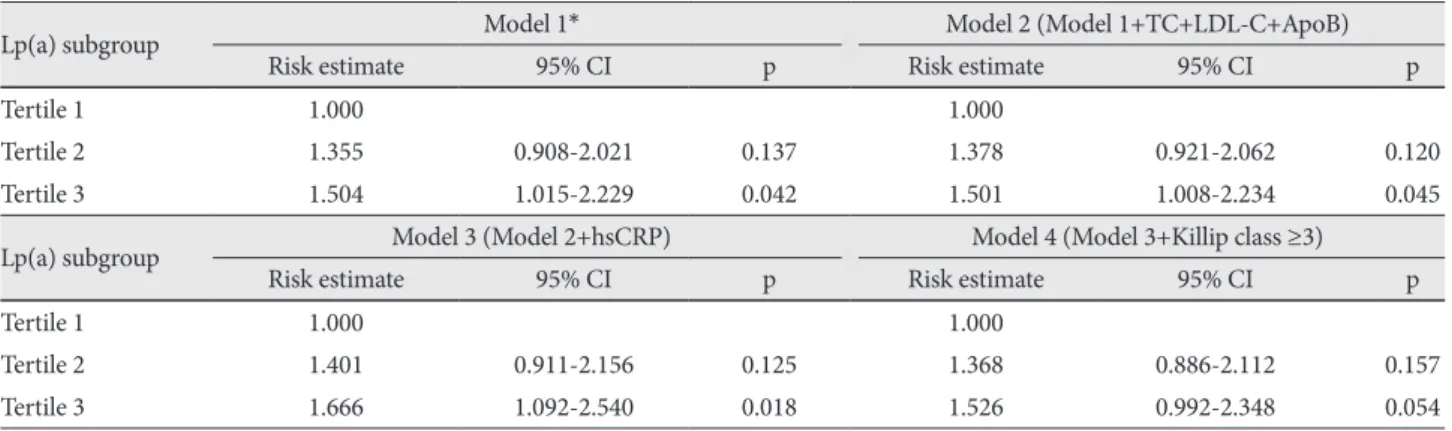
To analyze the association between serum Lp(a) levels and clinical outcomes, the Cox proportional hazards model was applied with adjustment of multiple variables. Higher levels of baseline Lp(a) were associated with increased risk for MACE until levels were adjusted according to hsCRP values (HR 1.666, 95% CI 1.092-2.540; p=0.018). But when adjusted for Killip class, the increased risk for MACE was not significant.
The lack of significance was also seen with adjustments ac- Table 4. Comparisons of clinical outcomes betweeg Lp(a) tertiles
Lp(a) (mg/dL) Lp(a) Tertile 1 (n=276) Lp(a) Tertile 2 (n=279) Lp(a) Tertile 3 (n=277)
<13.8 13.8-30.6 >30.6 p
In-hospital mortality 04 (1.4)0 8 (2.9) 6 (2.2) 0.563
One month after discharge n=276 n=279 n=277
Cardiac death 10 (3.6)0 15 (5.5)0 16 (5.8)0 0.236
Non-cardiac death 0 (0.0) 1 (0.4) 3 (1.1) 0.065
Non-fatal myocardial infarction 0 (0.0) 2 (0.8) 3 (1.1) 0.098
Target lesion revascularization 0 (0.0) 1 (0.4) 2 (0.7) 0.156
Target vessel revascularization 0 (0.0) 0 (0.0) 0 (0.0) 1.000
Non-target vessel revascularization 1 (0.4) 2 (0.8) 4 (1.5) 0.161
Coronary artery bypass graft 0 (0.0) 2 (0.8) 1 (0.4) 0.475
Composite MACE 11 (4.0)0 23 (8.2)0 29 (10.5) 0.002
Six-month outcomes n=271 n=265 n=268
Cardiac death 12 (4.4)0 20 (7.4)0 20 (7.5)0 0.147
Non-cardiac death 1 (0.4) 2 (0.8) 7 (2.8) 0.018
Non-fatal myocardial infarction 2 (0.8) 2 (0.8) 3 (1.2) 0.612
Target lesion revascularization 13 (5.0)0 15 (5.8)0 13 (5.2)0 0.917
Target vessel revascularization 2 (0.8) 3 (1.2) 1 (0.4) 0.643
Non-target vessel revascularization 6 (2.3) 7 (2.7) 14 (5.6)0 0.045
Coronary artery bypass graft 0 (0.0) 2 (0.8) 1 (0.4) 0.462
Composite MACE 36 (13.3)0 51 (19.2) 59 (22.0) 0.009
One-year outcomes n=244 n=251 n=267
Cardiac death 14 (5.7)0 21 (8.4)0 22 (8.2)0 0.271
Non-cardiac death 3 (1.2) 4 (1.6) 9 (3.4) 0.089
Non-fatal myocardial infarction 2 (0.8) 3 (1.2) 3 (1.1) 0.742
Target lesion revascularization 16 (6.6)0 16 (6.4)0 14 (5.2)0 0.529
Target vessel revascularization 2 (0.8) 3 (1.2) 2 (0.7) 0.922
Non-target vessel revascularization 7 (2.3) 10 (4.0)0 14 (5.2)0 0.174
Coronary artery bypass graft 0 (0.0) 3 (1.2) 2 (0.7) 0.311
Composite MACE 44 (18.0) 60 (23.9) 66 (25.1) 0.084
Lp(a): lipoprotein(a), MACE: major adverse cardiac event
cording to amino-terminal pro-brain natriuretic peptide, left ventricular ejection fraction, number of stents, and multives- sel disease. Therefore, we analyzed risk estimates according to Killip class, one of the confounding variables. After com- pletely adjusting for the risk for MACE, the risk in Tertile 3 was 6.723 (95% CI 1.037-43.593; p=0.046) compared to the referent Tertile (Table 6) (Fig. 2). The other three variables did not show significant risk estimates for MACE.
Discussion
The results of this study indicate that high serum levels of Lp(a) are significantly associated with long-term adverse out- comes in AMI patients, especially in those in a high Killip class. Thus, preprocedural Lp(a) levels could provide data for risk stratification in patients with AMI.
Kamstrup et al. 8) have observed stepwise increases in risk for myocardial infarction with increasing levels of Lp(a) in the general population, but we do not know the severities of the conditions of the patients in their study. In the present study, patients with higher Lp(a) levels also had more seri- ous initial presentations. There were more patients in a high Killip class in the highest Lp(a)-level tertile. Left ventricular ejection fraction also decreased linearly with increasing se- rum Lp(a) levels. After multifactorial adjustment using the Cox proportional hazards model, it seems unlikely that the differences in left ventricular ejection fraction among the Lp(a) tertiles were actually of clinical significance; whereas high Killip classes were seen to be an independent risk fac- tor for MACE (HR 1.997, 95% CI 1.220-3.271; p=0.006).
The reason why Lp(a) was only associated with MACE in patients in high Killip classes remains unclear. One potential mechanism may be oxidative stress on Lp(a) in acute heart failure caused by AMI. It has been reported that the biologi- Table 5. Risk estimates for a major adverse cardiac event according to Lp(a) tertile
Lp(a) subgroup Model 1* Model 2 (Model 1+TC+LDL-C+ApoB)
Risk estimate 95% CI p Risk estimate 95% CI p
Tertile 1 1.000 1.000
Tertile 2 1.355 0.908-2.021 0.137 1.378 0.921-2.062 0.120
Tertile 3 1.504 1.015-2.229 0.042 1.501 1.008-2.234 0.045
Lp(a) subgroup Model 3 (Model 2+hsCRP) Model 4 (Model 3+Killip class ≥3)
Risk estimate 95% CI p Risk estimate 95% CI p
Tertile 1 1.000 1.000
Tertile 2 1.401 0.911-2.156 0.125 1.368 0.886-2.112 0.157
Tertile 3 1.666 1.092-2.540 0.018 1.526 0.992-2.348 0.054
*Model 1 adjusted for age, sex, and smoking. Lp(a): lipoprotein(a), TC: total cholesterol, LDL-C: low density lipoprotein-cholesterol, ApoB:
apolipoprotein B, hsCRP: high sensitivity C-reactive protein
Table 6. Risk estimates for a major adverse cardiac event according to Lp(a) tertile and Killip class
Killip class Lp(a) subgroup Model 1* Model 5† (fully adjusted)
Risk estimate 95% CI p Risk estimate 95% CI p
I-II
Tertile 1 1.000 1.000
Tertile 2 1.357 0.877-2.099 0.170 1.512 0.897-2.549 0.120
Tertile 3 1.297 0.823-2.043 0.262 1.181 0.678-2.060 0.557
III-IV
Tertile 1 1.000 1.000
Tertile 2 0.875 0.290-2.640 0.813 1.458 0.186-11.442 0.720
Tertile 3 1.065 0.423-2.684 0.893 6.723 1.037-43.593 0.046
*Model 1 includes age, gender, and smoking, †Model 5 includes age, gender, smoking, total cholesterol, low density lipoprotein-cholesterol, apolipoprotein B, high-sensitivity C-reactive protein, log N-terminal pro-B type natriuretic peptide, multivessel disease, number of stents, left ventricular ejection fraction. Lp(a): lipoprotein(a)
Fig. 2. Fully-adjusted time-to-clinical outcomes by baseline Lp(a) tertiles. Hazard ratios have been adjusted for age; sex; smoking;
total cholesterol; low density lipoprotein-cholesterol; high-sensitiv- ity C-reactive protein; apolipoprotein B; Killip class; left ventricular ejection fraction; amino-terminal pro-brain natriuretic peptide; multi- vessel disease; and number of stents. MACE: major adverse cardio- vascular events, Lp(a): lipoprotein (a).
100 80 60 40 20 0
Time to MACE (days)
MACE-free survival (%)
p=0.046
Tertile 1 Tertile 2 Tertile 3
0 100 200 300 400
cal effects of oxidized Lp(a) are more potent than those of native Lp(a). These effects include stimulation of atheroscle- rosis, inhibition of vessel dilatation, and mitogenic stimula- tion of human vascular smooth muscle cells.13) Therefore, we suggest that high serum Lp(a) is predictive of more adverse outcomes in patients in higher Killip classes than in lower Killip classes. Second, decreased oxygen delivery to the isch- emic myocardium should be considered. Patients in high Kil- lip classes with pulmonary edema or in cardiogenic shock have increased wedge pressure, and thus impaired oxygen and carbon dioxide exchange in the lungs. Since apolipoprotein(a) and plasminogen compete for plasminogen receptors on en- dothelial cells,2) high serum Lp(a) may inhibit thrombolysis and fibrin clearance.3) These two effects could aggravate myocar- dial ischemia and might result in worse outcomes.
Basically, Lp(a) is not easily modified by statin therapy.14) Although there are contradictory findings about the effect of statins on Lp(a) serum concentrations,15) it is uncertain wheth- er statin use prevents the coronary heart disease associated with Lp(a).16) Nearly 80% of patients in our study were adminis- tered statins, and since the numbers of patients taking statins were almost equally distributed among the tertiles, statin th- erapy probably did not influence our results. Some reports have indicated that niacin; certain inhibitors of the cholesteryl ester transfer protein; and mipomersen, an antisense oligonucle- otide directed at human apoB-100; reduce Lp(a) levels about 20%, 40%, and 70%, respectively.17-19) No patients in this study took any of these medications. Therefore, medical therapy seems unlikely to be a confounder in this study.
Some studies have demonstrated association of high serum Lp(a) levels with restenosis after percutaneous coronary an- gioplasty.20)21) However, it has also been reported that serum Lp(a) levels do not influence restenosis after elective coronary stenting.22)23) Hoffmann et al.24) have demonstrated by serial intravascular ultrasound studies that in-stent restenosis re- sults from neointimal tissue proliferation, which has been attributed to Lp(a) in vitro.25) However, Morita et al.26) stud- ied patients with high Lp(a) levels undergoing POBA as well as PCI and found that there was less difference of TLR rate in the PCI group. Although not completely understandable, it has been suggested that the metallic scaffolding in stents strongly inhibits recoil, which results in the suppression of in- stent restenosis in patients with high serum Lp(a) levels. Our results are consistent with this data. The TLR rates were very similar among the tertiles.
With respect to revascularization in newly developed le- sions, it is difficult to determine a causal relationship for Lp(a).
Lp(a) promotes growth of vascular smooth muscles cells and inhibits plasminogen activity, so that it contributes to the development of atherosclerosis and atherothrombosis.26) We suggest that these Lp(a) effects could explain the trend toward a high non-TVR rate in patients with high Lp(a) levels. How-
ever, the incidence of non-TVR was too small to analyze by the Cox proportional hazards model.
Regarding clinical outcomes in this study, there are some results that need to be clarified. First, one- and six-month out- comes showed significant differences among tertiles, but no significant differences were found in the one-year outcomes.
An analysis of the nationwide Korea Acute Myocardial In- farction Registry, which enrolled 13,133 patients with AMI, showed that most adverse cardiac events occurred within the first six-months.27) The less frequent occurrence of adverse cardiac events between the six-month to one-year follow- ups may have influenced our results. Second, there were sig- nificant differences between the tertiles in the number of non- cardiac deaths at the six-month follow-up. These deaths were caused by bleeding, sepsis, and aggravation of underlying dis- eases. However, the number of patients in this group was too small to interpret the results accurately.
The present study was limited in several respects. First, this was a retrospective study, and therefore subject to the limita- tions inherent in this type of clinical investigation. Second, the results of this study should be verified by prospective in- vestigations, because it was a single-center study. Third, there was a problem with laboratory standardization. Internation- al reference material for Lp(a) laboratory standardization only became available in 2000.28) Even after standardization, there might be some variations in Lp(a) measurements. Stan- dardization of serum Lp(a) measurement should be under- taken, and we need to use assay systems that are insensitive to apo(a) isoforms.16) Fourth, Lp(a) tends to increase in AMI or in surgery as an acute phase reactant.29) There was difficul- ty timing the measurements and assessments of Lp(a) levels.
Last, hormone replacement therapy (HRT) in female patients, which can affect serum Lp(a) levels, was not considered in this study. However, the study population comprised mainly men, and it has been recently determined that far fewer Asian women take HRT compared with women in Western coun- tries.30) Nevertheless, HRT should be considered in future studies.
In conclusion, elevated levels of serum Lp(a) are signifi- cantly associated with one-year adverse outcomes in AMI patients in high Killip classes. Since Lp(a) may promote ath- erosclerosis of the vascular wall by its involvement in calcifi- cation,13) in the future it may be determined to be a very im- portant risk factor. Additional prospective studies may determine causal relationships and treatments.
Acknowledgments
This study was supported by grants from the Korea Healthcare Tech- nology R&D project (A084869), Ministry for Health, Welfare, & Family Af- fairs, Republic of Korea, and the Cardiovascular Research Foundation, Asia.
REFERENCES
1) Lee CK. Lipoprotein(a), Lp(a). Korean Circ J 1993;23:631-3.
2) Hajjar KA, Gavish D, Breslow JL, Nachman RL. Lipoprotein (a) mod- ulation of endothelial surface fibrinolysis and its potential role in ath- erosclerosis. Nature 1989;339:303-5.
3) Harpel PC, Gordon BR, Parker TS. Plasmin catalyzes binding of li- poprotein (a) to immobilized fibrinogen and fibrin. Proc Natl Acad Sci U S A 1989;86:3847-51.
4) Harpel PC, Chang VT, Borth W. Homocysteine and other sulfhydryl compounds enhance the binding of lipoprotein (a) to fibrin: a potential biochemical link between thrombosis, atherogenesis, and sulfhydryl compound metabolism. Proc Natl Acad Sci U S A 1992;89:10193-7.
5) Park SH, Shin GJ. Lipoprotein (a) as a risk factor for coronary heart disease: whether related with NIDDM or not. Korean Circ J 1996;26:
507-13.
6) Jürgens G, Taddei-Peters WC, Költringer P, et al. Lipoprotein (a) se- rum concentration and apolipoprotein (a) phenotype correlate with se- verity and presence of ischemic cerebrovascular disease. Stroke 1995;
26:1841-8.
7) Danesh J, Collins R, Peto R. Lipoprotein (a) and coronary heart dis- ease: meta-analysis of prospective studies. Circulation 2000;102:
1082-5.
8) Kamstrup PR, Benn M, Tybjærg-Hansen A, Nordestgaard BG. Ex- treme lipoprotein (a) levels and risk of myocardial infarction in the general population: the Copenhagen City Heart Study. Circulation 2008;117:176-84.
9) Foody JM, Milberg JA, Pearce GL, Sprecher DL. Lipoprotein (a) as- sociated with coronary artery disease in older women: age and gender analysis. Atherosclerosis 2000;153:445-51.
10) Jenner JL, Ordovas JM, Lamonfava S, et al. Effects of age, sex, and menopausal status on plasma lipoprotein (A) levels: the Framingham Offspring Study. Circulation 1993;87:1135-41.
11) Seman LJ, Breckenridge WC. Isolation and partial characterization of apolipoprotein (a) from human lipoprotein (a). Biochem Cell Biol 1986;64:999-1009.
12) Carlson LA, Hamsten A, Asplund A. Pronounced lowering of serum levels of lipoprotein Lp(a) in hyperlipemic subjects treated with nico- tinic-acid. J Intern Med 1989;226:271-6.
13) Morishita R, Ishii J, Kusumi Y, et al. Association of serum oxidized lipoprotein (a) concentration with coronary artery disease: potential role of oxidized lipoprotein (a) in the vascular wall. J Atheroscler Thromb 2009;16:410-8.
14) Kostner GM, Gavish D, Leopold B, Bolzano K, Weintraub MS, Bre- slow JL. HMG CoA reductase inhibitors lower LDL cholesterol with- out reducing Lp(a) levels. Circulation 1989;80:1313-9.
15) Marcovina SM, Koschinsky ML, Albers JJ, Skarlatos S. Report of the National Heart, Lung, and Blood Institute Workshop on Lipoprotein (a) and Cardiovascular Disease: recent advances and future directions.
Clin Chem 2003;49:1785-96.
16) Maher VM, Brown BG, Marcovina SM, Hillger LA, Zhao XQ, Al- bers JJ. Effects of lowering elevated LDL cholesterol on the cardiovas-
cular risk of lipoprotein (a). JAMA 1995;274:1771-4.
17) Insull W Jr, McGovern ME, Schrott H, et al. Efficacy of extended-re- lease niacin with lovastatin for hypercholesterolemia: assessing all rea- sonable doses with innovative surface graph analysis. Arch Intern Med 2004;164:1121-7.
18) Merki E, Graham MJ, Mullick AE, et al. Antisense oligonucleotide directed to human apolipoprotein B-100 reduces lipoprotein (a) levels and oxidized phospholipids on human apolipoprotein B-100 particles in lipoprotein (a) transgenic mice. Circulation 2008;118:743-53.
19) Kastelein JJ, Wedel MK, Baker BF, et al. Potent reduction of apolipo- protein B and low-density lipoprotein cholesterol by short-term admin- istration of an antisense inhibitor of apolipoprotein B. Circulation 2006;114:1729-35.
20) Hearn JA, Donohue BC, Báalbaki H, et al. Usefulness of serum li- poprotein (a) as a predictor of restenosis after percutaneous translu- minal coronary angioplasty. Am J Cardiol 1992;69:736-9.
21) Desmarais RL, Sarembock IJ, Ayers CR, Velmon SM, Powers ER, Gimple LW. Elevated serum lipoprotein (a) is a risk factor for clini- cal recurrence after coronary balloon angioplasty. Circulation 1995;
91:1403-9.
22) Ribichini F, Steffenino G, Dellavalle A, et al. Plasma lipoprotein (a) is not a predictor for restenosis after elective high-pressure coronary stenting. Circulation 1998;98:1172-7.
23) Rhew JY, Jeong MH, Hong YJ, et al. The effects of lipoprotein (a) on coronary stent restenosis. Korean Circ J 2001;31:476-83.
24) Hoffmann R, Minz GS, Dussaillant GR, et al. Patterns and mecha- nisms of in-stent restenosis: a serial intravascular ultrasound study.
Circulation 1996;94:1247-54.
25) Grainger DJ, Kirschenlohr HL, Metcalfe JC, Weissberg PL, Wade DP, Lawn RM. Proliferation of human smooth muscle cells promoted by lipoprotein (a). Science 1993;260:1655-8.
26) Morita Y, Himeno H, Yakuwa H, Usui T. Serum lipoprotein (a) level and clinical coronary tenosis progression in patients with myocardial infarction: re-revascularization rate is high in patients with high-Lp(a).
Circ J 2006;70:156-62.
27) Sim DS, Kim JH, Jeong MH. Differences in clinical outcomes between patients with ST-elevation versus non-ST-elevation acute myocardial infarction in Korea. Korean Circ J 2009;39:297-303.
28) Marcovina SM, Albers JJ, Scanu AM, et al. Use of a reference mate- rial proposed by the International Federation of Clinical Chemistry and Laboratory Medicine to evaluate analytical methods for the deter- mination of plasma lipoprotein (a). Clin Chem 2000;46:1956-67.
29) Kim CJ, Kwak MH, Kim KM, Ryu WS, Park JT, Ryoo UH. Lipopro- tein (a) as an acute phase reactant. Korean J Lipidol 1996;6:111-5.
30) Heinemann K, Rübig A, Strothmann A, Nahum GG, Heinemann LA.
Prevalence and opinions of hormone therapy prior to the Womenʼs He- alth Initiative: a multinational survey on four continents. J Womens Health 2008;17:1151-66.