다양한 발효균주를 이용한 인삼패독산의 생물 전환 성분의 정량 분석
이광진·구민정·노주환·정필문·마진열# 한국한의학연구원 한의신약연구그룹
(Received April 17, 2013; Revised May 23, 2013; Accepted May 27, 2013)
Quantitative Analysis of Bioconversion Constituents of Insampeadock-san Using Various Fermented Bacteria
Kwang Jin Lee, Min Jung Gu, Joo Hwan Roh, Pil Mun Jung and Jin Yeul Ma#
Korean Institute of Oriental Medicine (KIOM), KM-Based Herbal Drug Research Group, Daejeon 305-811, Korea
Abstract — Insampaedoksan (IS) is the decoction of medicinal herbs, which was commonly used for anti-inflammatory and anti-pyretic in the Korean traditional medicine (KTM). Several studies on improving efficiency or searching new efficiency by fermenting traditional herbal medicines are recently in progress. The bioconversion has been conducted on IS using var- ious bacteria. Liquiritin, ferulic acid, hesperidin, liquiritigenin, and glycyrrhizin in IS before and after fermented IS were simultaneously analyzed. These compounds were qualitatively analyzed and quantitatively analyzed using the HPLC-DAD system. The identifications of liquiritin, ferulic acid, hesperidin, liquiritigenin and glycyrrhizin were achieved by comparing the HPLC retention time (Rt) and the UV absorption of five pure compounds in the IS. As a result, the increased con- stituents were identified to be liquiritin, liquiritigenin and glycyrrhizin, while the decreased constituent was ferulic acid and the constituent of hesperidin was similar to before and after fermentation. Insampeadock-san fermented by Lactobacillus plantarum KFRI 144 exhibited the most remarkable changes in all of fermentation.
Keywords □ analysis, bioconversion, fermentation, HPLC-DAD, insampaedoksan (IS)
인삼패독산(人蔘敗毒散)(IS)은 일반적으로 감기, 독감, 발열, 두 통, 비색(鼻塞), 지체통(肢體痛), 성중(聲重) 등 현대의학이 도입 되기 전 동양의 여러 나라에서 사용된 탕제이다. 한의학의 대표 적인 처방으로는 부정해표제(扶正解表劑)이며, 동의보감 잡병편 에 수록되어 있다. 이중에서 인삼패독산은 인삼(人蔘), 시호(柴胡), 천궁(川芎), 생강(生薑), 지각(枳殼), 감초(甘草), 및 금은화(金銀 花)로 구성되었다. 효능 및 효과로는 해열, 면역력 강화, 진통 그 리고 알레르기로 인한 염증 완화에 대해 보고되고 있다.1)주요 성분으로는 인삼의 Rg1 및 Rb1, 시호의 saikosaponin, 천궁의 ferulic acid, 생강의 6-gingerol, 지각의 hesperidin, 감초의 liquiritin, liquiritigenin, glycyrrhizin 등이 알려져 있다. 따라서 유용성분을 효율적으로 얻기 위한 방법으로 한의학계에서는 생 물전환을 통한 발효 한약과 응용산업의 기능성식품 및 소재를 연 구하는 연구자들에게는 새로운 추출 및 발효공정에 대한 관심이
증가되고 있다.2-8)
생물전환(bioconversion)이란 미생물과 효소를 이용한 발효로 부터 여러 가지 대사산물을 생산, 제조하는 기술을 말한다. 생물 전환 공정은 기존의 발효공정과 비교해 볼 때 발효공정이 상대 적으로 간단한 원료물질에서 출발하는 반면, 생물전환 공정은 미 생물 또는 효소의 기질에 대한 선택성을 이용하여 전구물질로부 터 산물을 생산한다는 점에서 차이를 보이고 있다. 이와 같은 점 에서 생물전환 공정은 발효기술을 고도화시킨 에너지 절약형의 첨단기술 분야로 특히, 의약품, 건강기능성식품, 발효식품, 사료 첨가제나 화장품의 개발에 있어서 생물전환 공정은 여러 가지 방 법으로 이용되는 것으로 알려져 있다.9)대표적인 유산균인 Lactobacilli와 Bifidobacteria는 β-glucosidese 활성을 가지고 있 어 여려 식물이 지니고 있는 배당체의 장내 가수분해에 주요한 역할을 하는 것으로 알려져 있다.10,11) 또한 배당체는 생물 전환 및 효소에 의한 방법 등에 의해 당이 가수분해될 수 있으며, 이 렇게 생산된 비배당체는 체내 흡수뿐만 아니라 그 약리 활성 면 에서도 배당체 보다 우수한 것으로 알려져 있다.12)발효한약은 전통적으로 임상에서 사용되어 왔으며 특히, 발효 인삼패독산은
#본 논문에 관한 문의는 저자에게로 (전화) 042-868-9466 (팩스) 042-868-9573 (E-mail) [email protected]
종설
한약의 체내흡수율과 생체이용률을 모두 극대화시켜 약리 기능 성을 향상시킨 새로운 약제제이다.
본 연구에서는 생물전환을 통한 발효 인삼패독산을 제조하고, HPLC-DAD(High performance liquid chromatography-diode array detector)를 이용한 지표성분인 천궁의 ferulic acid, 지각 의 hesperidin, 감초의 liquiritin, liquiritigenin, glycyrrhizin을 선 정하여(Fig. 1) 발효 전, 후 인삼패독산은 균주 변화에 따른 지표 성분의 동시 분석과 함량을 비교하였고 생물전환이 우수한 균주 를 선별하였다. 또한 지표성분은 과학적으로 잘 알려져 있고 상 업적으로 구매가 용이하며 생물전환된 발효 인삼패독산 내에서 가장 뚜렷한 함량 변화 패턴은 보인 것을 선택하였다.
재료 및 방법
실험재료 및 시약
인삼패독산의 제조에 사용된 인삼(人蔘), 시호(柴胡), 천궁(川 芎), 생강(生薑), 지각(枳殼), 감초(甘草), 및 금은화(金銀花)는 모 두 영천현대약업사(2011년 3월 Gyeongbuk yeongcheon, Korea) 에서 구매하였으며, 대한약전에 기술된 각각의 약재 항목에 적 합한 것을 엄선하여 4oC에서 냉장 보관하여 사용하였다. 생물전 환 성분의 확인 및 정량분석에 사용된 표준물질 liquiritin은 Wako Pure Chemical Industries(Ltd. Osaka, Japan), ferulic acid는 Fluka(Buchs, Switzerland), hesperidin는 ICN(California, USA),
liquiritigenin는 Sigma-Aldrich(St. Louis, MO, USA), glycyrrhizin 는 TCI(Tokyo, Japan)에서 각각 구매하였다. 순도는 모두 98%
이상의 표준품이다. HPLC 분석을 위한 ACN(acetonitrile)과 methanol(MeOH)은 HPLC용 특급용매로 J.T Baker(USA)에서 구매하였으며, TFA(trifluoroacetic acid)는 분석용 등급의 용매로 대정화금(Korea, Sihueng)에서 구입하였다. Water는 3차 증류수를 사용했으며, 분석 전에 0.45 µm membrane filter(ADVANTEC, Japan)를 이용하여 여과한 후 사용하였다.
표준액 및 시료 제조
각각의 표준품 5종(liquiritin, ferulic acid, hesperidin, liquiritigenin, glycyrrhizin)을 각각 2 mg씩 취하여 고순도 methanol 10 ml에 녹여 200 ppm의 농도로 제조하였다. 시료 용 액은 동결건조된 인삼패독산과 발효 인삼패독산 50 mg을 100%
methanol 1 ml에 녹여 원심분리한 후 상층액만을 취하여 pore size 0.2µm PVDF membrane filter(Whatman Ltd., Maidstone, UK)를 이용하여 여과하여 분석에 사용하였다.
HPLC 기기 및 분석 조건
HPLC 분석 기기는 Waters HPLC 장비로 pump, autosampler, column oven, photodiode array UV/VIS detector(Waters HPLC system, USA)를 사용하였고, 데이터 수집 및 처리를 위 해 Empower software program을 사용하였다. 실험에 사용된 Fig. 1− Chemical structures of standard compounds bioconversion compounds.
column은 RS-tech Optimapak C18(4.6×250 mm, 5µm)이다.
Column oven의 온도는 40oC를 유지하였고, injection volume은 20µl이며, 용매의 Flow rate는 1.0 ml/min이다. 분석에 사용된 파장은 280 nm로 설정하였다. 이동상 용매 조성은 water에 희석 한 0.1% triflouroacetic acid(A)와 acetonitrile(B)으로 분석 시간 은 60분이며 B를 기준으로 10~40%(0~50 min), 40%(50~60 min)으로 변화시키는 linear gradient 용출법으로 분석하였다.
발효인삼패독산의 제조
인삼패독산의 처방 내용에 따라 전탕 추출법에 의해 열수 추출 하였다. 추출 용매는 식용이 가능한 일반생수를 사용하였고, 비율 은 한약제의 총 중량의 10배(v/w)에 해당하는 양을 넣어 1시간 침 적한 다음 115oC에서 3시간 동안 열탕 추출기(초고속 진공 저온 약탕기, Cosmos-660, KyungSeo Machine Co., Incheon, Korea) 로 추출 후 동결 건조기(IlShin Bio Base FD551, Dongduchen, Korea)로 건조하여 발효에 사용하였다. 발효 인삼패독산에 사용 된 발효 균주는 9종의 Lactobacillus(L. casei KFRI 127, L.
acidophilus KFRI 128, L. casei KFRI 129, L. plantarum KFRI 144, L. amylophillus KFRI 161, L. curvatus KFRI 166, L. plantarum KFRI 402, L. delbruekil subsp. lactis KFRI 442, L. casei KFRI 693)와 1종의 Bifidobacterium(B. breve KFRI 744)의 유산균으로 한국식품연구원(Korea Food Research Institute : KFRI, Seongnam, Korea) 식품미생물 유전자은행에 서 분양받았다. 동결건조 된 인삼패독산을 1 M NaOH로 pH 7.0 으로 조절한 후 멸균하여 유산균을 접종하였다. 사용된 발효 균 주를 초기 1~5×10⁷CFU/ml로 맞춘 후 인삼패독산 열수추출액
의 1%(v/v)를 접종하여 37oC에서 48시간 발효시킨 다음 동결건 조기로 건조하여 실험에 사용하였다.
결과 및 고찰
HPLC 정량 및 정성분석
인삼패독산(IS)을 멸균한 후(AIS), 각각의 유산균으로 발효시 킨 FIS 127, FIS 128, FIS 129, FIS 144, FIS 161, FIS 166, FIS 402, FIS 442, FIS 693, 및 FIS 744를 제조하여 이들의 생 물 변환 성분들을 HPLC-DAD를 이용하여 동시 분석하였다. 분 석은 C18컬럼을 사용 했으며 이동상의 유속과 UV 검출 파장은 각각 1.0 ml/min, 280 nm에서 수행하였다. 분리 능을 높이기 위 하여 0.1% TFA(trifluoroacetic acid)를 첨가한 water(A)와 acetonitrile(B)로 구성된 이동상을 시간대 별로 비율을 달리하는 linear gradient elution system을 실시하여 peak들이 분리되어 검출되도록 HPLC의 조건을 최적화하였다. 본 연구에서 사용한 DAD(diode array detector)는 UV/Vis spectra에서 측정이 가능 한 detector이며, 범위는 190~400 nm 이다. 분석에 검출된 파장 은 liquiritin: 275 nm, ferulic acid: 320 nm, hesperidin: 283 nm, liquiritigenin: 274 nm, glycyrrhizin: 250 nm으로서 정량 분 석을 각 표준품의 최대 흡광도를 기준으로 검출하였다(Fig. 2).
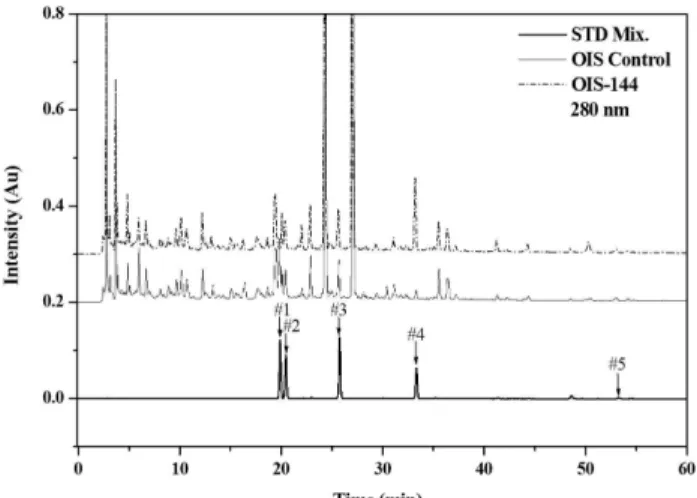
이중에서 유효성분의 표준 물질 5가지를 동시에 정성 분석한 UV 파장은 모두 검출되는 280 nm로 고정하여 나타내었다. 각 표준 물질은 IS 추출물의 UV spectra와 비교하여 확인되었다. 표준 물질 liquiritin(1), ferulic acid(2), hesperidin(3), liquiritigenin(4) 및 glycyrrhizin(5)의 체류시간은 각각 20, 21, 26, 34, 53분(min)
Fig. 2− HPLC-DAD UV Spectrum of compounds.
이였고 IS 추출물의 유효성분은 표준 물질의 체류시간과 비교 확 인하였다(Fig. 3). 정량분석을 위해 각각의 검량선은 주입량 2, 5, 10, 15, 20µl으로 주입하여 peak 면적에 대한 r2 값이 >0.9998 의 높은 상관관계를 나타내었다(Table I).
인삼패독산(IS)의 생물전환 변화
인삼패독산(IS)의 발효에 사용된 10종의 유산균 균주 L. casei KFRI 127, L. acidophilus KFRI 128, L. casei KFRI 129, L.
plantarum KFRI 144, L. amylophillus KFRI 161, L. curvatus KFRI 166, L. plantarum KFRI 402, L. delbruekil subsp. lactis KFRI 442, L. casei KFRI 693, B. breve KFRI 744를 이용하여 발효 인삼패독산을 제조하고 발효 정도를 확인하기 위해 pH의 변화를 측정하였다(Table II). 그 결과 발효 후 인삼패독산의 pH 는 미생물의 발효 산물에 의해 pH 3.83~4.45±0.01로 저하시키 는 것을 확인할 수 있었다. 일반적으로 유산균 발효 중에는 유산 균의 대사산물로서 다양한 유기산 및 아미노산이 생성되며, 이 러한 유기산 및 아미노산에 의해 pH가 내려간다. 즉 pH 변화는 발효 정도를 나타내는 척도로 이용될 수 있을 뿐만 아니라 유산 균에 의한 발효가 이루어졌다는 것을 알 수 있다.13,14)
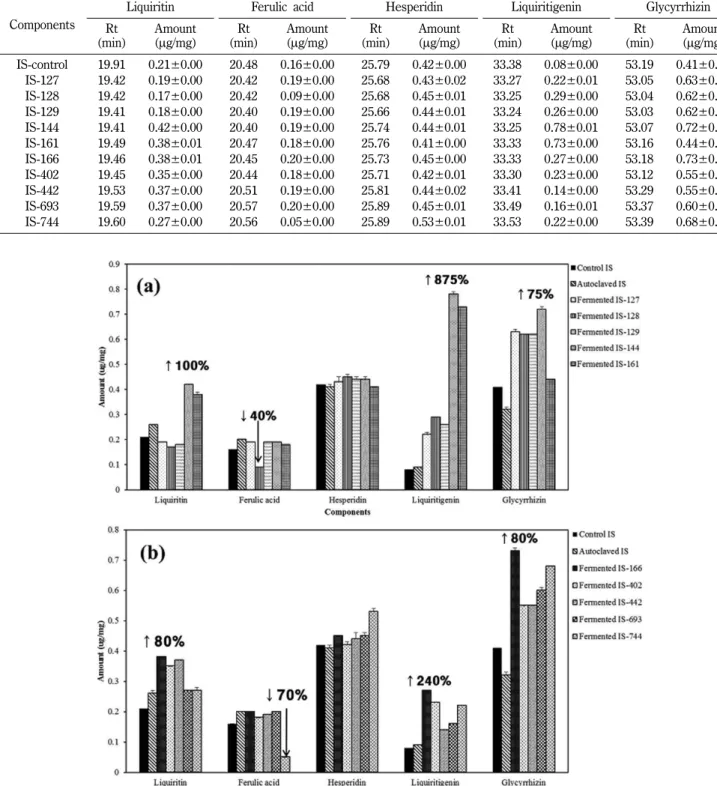
또한 전체 10종의 균주를 적용한 발효공정에서 각 성분의 생 물전환 변화에 따른 함량변화를 나타내었다(Table III). 이 결과, 발효 전, 각 지표성분의 초기 함량은 liquiritin 0.21, ferulic acid
0.16, Hesperidin 0.42, liquiritigenin 0.08, glycyrrhizin 0.41 µg/mg이였다. 각 성분의 최대 변화량을 살펴보면; liquiritigenin 과 glycyrrhizin는 모든 균주에서 증가되었고 이때 liquiritigenin 은 L. plantarum KFRI 144를 사용한 발효물에서 증가 폭이 875.00%(0.78±0.00µg/mg)으로 가장 높았다. 또한 glycyrrhizin 은 L. curvatus KFRI 166을 사용한 발효에서 glycyrrhizin의 함 량이 78.05%(0.73±0.00 µg/mg) 증가하였다. 반면, 특정 균주에 서의 전환관계는; hesperidin는 9종의 발효물에서 증가와 B. breve KFRI 744에서 증가 폭이 26.19%(0.53±0.00 µg/mg)으로 가장 높았고, liquiritin는 7종의 발효 균주에서 증가하였고, 이 중 L.
plantarum KFRI 144를 사용한 발효물에서 100%(0.42±0.00 µg/
mg) 변화 폭이 가장 크게 나타났다. 또한 L. acidophilus KFRI 128에서는 19.05%(0.17±0.00 µg/mg) 감소를 보였다. ferulic acid는 8종의 발효 균주에서 함량이 증가하였고, 이 중 L. curvatus KFRI 166, L. casei KFRI 693를 사용한 발효물에서 25%(0.2
±0.00µg/mg) 증가를 나타냈다. 반면, B. breve KFRI 744에서는 68.75%(0.05±0.00µg/mg) 감소를 볼 수 있었다(Fig. 4). 결론적 으로 발효 공정에서 liquiritin, hesperidin, liquiritigenin 및 glycyrrhizin의 경우 대부분의 균주에서 함량이 증가되었다.15) 따라서 선택적 미생물을 이용한 생물전환기술은 원천 기술을 통 해 체내흡수율과 생체이용율을 극대화시켜 진보적인 융합한 제 제 및 제형 개발이 가능토록 제시될 수 있을 것이다. 또한 연구 결과는 미생물의 특성에 따라 생물전환 대상 물질과 전환 효율 이 다르게 나타내고 주요 성분들의 변화는 일정한 품질관리와 밸 리데이션이 요구될 것이다.
Fig. 3− Analytical HPLC chromatograms of Insampaedok-san (IS) and standard compounds.
Table I− Linearity, regression equation and coefficient (r2)
Compound Linear range (µl) Concentration (µg/ml) Regression equation r2 (n=5)
Liquiritin 2-20 200 y=860073x+3840 0.9999
Ferulic acid 2-20 200 y=1012530x+11294 0.9998
Hesperidin 2-20 200 y=408492x+2615 0.9999
Liquiritigenin 2-20 200 y=496610x+2919 0.9999
Glycyrrhizin 2-20 200 y=260639x+2354 0.9999
Table II− pH in OIS fermented with lactic acid bacteria at 37oC for 48 h
Sample pH
Control 6.00±0.00
L. casei KFRI 127 4.09±0.00
L. acidophilus KFRI 128 4.00±0.01
L. casei KFRI 129 4.00±0.01
L. plantarum KFRI 144 4.03±0.01
L. amylophillus KFRI 161 3.96±0.00
L. curvatus KFRI 166 3.83±0.01
L. plantarum KFRI 402 4.18±0.01
L. delbruekil subsp. lactis KFRI 442 4.31±0.00
L. casei KFRI 693 4.12±0.01
B. breve KFRI 744 4.45±0.01
결 론
본 연구에서는 생물전환을 통한 발효 인삼패독산을 제조하고, 지표성분인 천궁의 ferulic acid, 지각의 hesperidin, 감초의 liquiritin, liquiritigenin, glycyrrhizin을 선정하여 발효 10종의 유
산균 L. casei KFRI 127, L. acidophilus KFRI 128, L. casei KFRI 129, L. plantarum KFRI 144, L. amylophillus KFRI 161, L. curvatus KFRI 166, L. plantarum KFRI 402, L.
delbruekil subsp. lactis KFRI 442, L. casei KFRI 693, B.
breve KFRI 744의 균주 변화에 따른 발효 전, 후 인삼패독산을 비 Table III− Amount and identification of compounds from Imsampaedok-san (IS)
Components
Liquiritin Ferulic acid Hesperidin Liquiritigenin Glycyrrhizin
Rt (min)
Amount
(µg/mg) Rt (min)
Amount
(µg/mg) Rt (min)
Amount
(µg/mg) Rt (min)
Amount
(µg/mg) Rt (min)
Amount (µg/mg) IS-control 19.91 0.21±0.00 20.48 0.16±0.00 25.79 0.42±0.00 33.38 0.08±0.00 53.19 0.41±0.11
IS-127 19.42 0.19±0.00 20.42 0.19±0.00 25.68 0.43±0.02 33.27 0.22±0.01 53.05 0.63±0.02 IS-128 19.42 0.17±0.00 20.42 0.09±0.00 25.68 0.45±0.01 33.25 0.29±0.00 53.04 0.62±0.01 IS-129 19.41 0.18±0.00 20.40 0.19±0.00 25.66 0.44±0.01 33.24 0.26±0.00 53.03 0.62±0.01 IS-144 19.41 0.42±0.00 20.40 0.19±0.00 25.74 0.44±0.01 33.25 0.78±0.01 53.07 0.72±0.01 IS-161 19.49 0.38±0.01 20.47 0.18±0.00 25.76 0.41±0.00 33.33 0.73±0.00 53.16 0.44±0.00 IS-166 19.46 0.38±0.01 20.45 0.20±0.00 25.73 0.45±0.00 33.33 0.27±0.00 53.18 0.73±0.01 IS-402 19.45 0.35±0.00 20.44 0.18±0.00 25.71 0.42±0.01 33.30 0.23±0.00 53.12 0.55±0.00 IS-442 19.53 0.37±0.00 20.51 0.19±0.00 25.81 0.44±0.02 33.41 0.14±0.00 53.29 0.55±0.00 IS-693 19.59 0.37±0.00 20.57 0.20±0.00 25.89 0.45±0.01 33.49 0.16±0.01 53.37 0.60±0.01 IS-744 19.60 0.27±0.00 20.56 0.05±0.00 25.89 0.53±0.01 33.53 0.22±0.00 53.39 0.68±0.00
Fig. 4− Comparison amount of useful compounds in non-fermentation and fermentation Insamapedok-san (IS).
교하였다. 이때 생물전환이 우수한 균주를 선별하여 발효공정의 최적화를 고찰하였다. 이 결과, liquiritin, hesperidin, liquiritigenin 및 glycyrrhizin은 발효 균주에 따라 함량이 최대 26.19~875.00%
증가하였다. 인삼패독산의 발효 과정에서 가수분해율이 높아져 지표물질 중 하나인 배당체 liquiritin이 비배당체인 liquritigenin 으로 변화시켜 liquiritigenin이 증가하였다. 또한 liquiritin 및 glycyrrhizin의 함량의 증가는 발효 과정 중 유산균에 의한 pH의 감소에 따른 추출 효율의 증가로 사료된다. 이 중에서 L.
plantarum KFRI 144 균주를 사용한 발효가 유용성분에 대한 생 물전환이 가장 우수하였다. 따라서 L. plantarum KFRI 144 균 주를 이용한 인삼패독산의 생물전환은 진보적인 융합 제제 및 제 형 개발이 가능토록 제시될 수 있다.
감사의 말씀
본 연구는 한국한의학연구원 한의신약연구그룹 연구지원 (K13050)에 의하여 수행되었으며 이에 감사드립니다.
참고문헌
1) Shim, J. Y. and Kim, B. W. : A study of effects of Insampaedok- san and Kammiinsampaedok san on the analgesia, anipyresis and thioacetamide induced liver damage in rats and mice. K.H.
Univ. O. Med. J. 7, 323 (1984).
2) 박정현, 김호준, 이명종 : 비만에서 장내 미생물 균총의 역할과 발효 한약의 활용. 한방비만학회지 9, 1 (2009).
3) Bae, E. A., Han, M. J., Kim, E. J. and Kim, D. H. : Transformation of ginseng saponins to ginsenoside Rh2 by acids and human intestinal bacteria and biological activities of their transformants. Arch. Pharm. Res. 27, 61 (2004).
4) Park, H. Y., Um, Y. R. and Ma, J. Y. : Quantitative analysis of marker substance in fermented Rehmanniae Radix Preparata.
Korean J. Pharmacogn. 41, 58 (2010).
5) Maraza, J. A., Garro, M. S. and de Giori, G. S. : Aglycone production by Lactobacillus rhamnosus CRL981 during soymilk fermentation. Food Microbiol. 26, 333 (2009).
6) Kim, J. Y., Park, S. J., Yun, K. Y., Cho, Y. W., Park, H. J. and Lee,
K. T. : Isoliquiritigenin isolated from the roots of Glycyrrhiza uralensis inhibits LPS-induced iNOS and COX-2 expression via the attenuation of NF-κB in RAW 264.7 macrophages. Eur.
J. of Pharmacol. 584, 175 (2008).
7) Kim, Y. W., Zhao, R. J., Park, S. J., Lee, J. R., Cho, I. J., Yang, C. H., Kim, S. J. and Kim, S. C. : Anti-inflammatory effects of liquiritigenin as a consequence of the inhibition of NF-kappaB- dependent iNOS and proinflammatory cytokines production.
Br. J. Pharmacol. 154, 165 (2008).
8) Liu, R. T., Zou, L. B., Fu, J. Y. and Lu, Q. J. : Effects of liquiritigenin treatment on the learning and memory deficits induced by amyloid β-peptide (25–35) in rats. Behav. Brain Res. 210, 24 (2010).
9) Fuller, R. : Probiotics in man and animals. J. Appl. Bacteriol. 66, 365 (1989).
10) Choi, Y. B., Woo, J. G. and Noh, W. S. : Hydrolysis of β- glucosidase bonds of isoflavone conjugates in the lactic acide fermentation of soymilk. Korean J. Food Sci. Technol. 31, 189 (1999).
11) Jeon, K. S., Ji, G. E. and Hwang, I. K. : Assay of β-glucosidase activity of bifidobacteria and hydrolysis of isoflavone glycosides by Bifidobacterium sp. Int-57 in soymilk fermentation. J.
Microbiol. Biotechn. 12, 8 (2002).
12) 김동현 : 인삼과 건강, 도서출판 효일 pp. 29-47 (2005).
13) Park, S., Kim, D. H., Paek, N. S. and Kim, S. S. : Preparation and quality characteristics of the fermentation product of ginseng by lactic acid bacteria (FGL). J. Ginseng Res. 30, 88 (2006).
14) Kim, D.-K., Baik, M.-Y., Kim, H.-K., Hahm, Y.-T. and Kim, B. Y. : Manufacture of red ginseng vinegar fermented with red ginseng concentrate and rice wine, and its quality evaluation.
Korean J. Food SCI. Technol. 44, 179 (2012).
15) Kim, S. C., Byun, S. H., Yang, C. H., Kim, C. Y., Kim, J. W. and Kim, S. G. : Cytoprotective effects of Glycyrrhizae radix extract and its active component liquiritigenin against cadmium-induced toxicity (effects on bad translocation and cytochrome c-mediated PARP cleavage). Toxicology 197, 239 (2004).