Superconductivity and Cryogenics
Vol.14, No.4, (2012), pp.12~15 http://dx.doi.org/10.9714/sac.2012.14.4.012
```
Abstract— MgB2 superconductor is highly sensitive to the Mg content. Even if the samples are synthesized with the appropriate looking stoichiometric ratio, the heat treatment leads to the loss of Mg either to ambiance or to MgO. To avoid it, either excess Mg is added in the starting powder or sealed ampoule annealing is employed. In this paper the effect of open Mg sintering ambiance on the ex-situ MgB2
was studied to enhance its superconducting properties. The open Mg ambiance was created to avoid any overpressure of Mg by providing a hole in Fe tube used as sample holder.
The decrease in resistivity of the synthesized sample was observed through the increased temperature dependence of electron-phonon interactions. A clear enhancement in the superconducting cross-sectional area and hence the in-field critical current density is obtained.
Keywords: MgB2, sintering, stoichiometry, critical current density, flux pinning.
1. INTRODUCTION
MgB2 superconductor has been manifested to be highly sensitive to composition and the history of sample preparation. Since its discovery in 2001 [1], MgB2 has been examined in different forms through various processes of synthesis for superconducting properties [2- 6].
MgB2 being a binary intermetallic compound, is considered easy to synthesize. But the vast difference in melting point of B and Mg makes the synthesis a bit tricky. Even if samples are synthesized, it shows widely different properties depending upon the synthesis and used precursor. A fantastic review can be found in [7]
wherein resistivity of various samples prepared by different techniques of synthesis is compared. It is remarkable to see that the samples show 39 K superconducting transition temperature (Tc) even with the room temperature resistivity values of little over 100 mΩcm [8] and also with less than 10 µΩcm [9].
Different level of grain connectivity among the superconducting grains depending upon the extent of impurities, second phases and stoichiometry is anticipated as the reason for the varying superconducting parameters.
Several studies had made it quite clear that unlike high Tc
superconductors there persists a strong intergranular ______________________________________________
*Corresponding author: [email protected]
current flow in MgB2 superconductor [10-12]. Leaving aside the defects and grain boundary effects, the improvement in critical current density of pure MgB2 is related with the improvement in the phase formation and increase in the sample density [13]. The main parameter behind the discrepancies in various MgB2 samples is the high vapor pressure of Mg which results in the instability of Mg content.
In the present investigation an interesting study to improve the superconducting properties of MgB2
superconductor merely by using Mg sintering ambiance is presented. The use of MgB2 powder as a precursor is anticipated towards nullifying the effect of preparative conditions in the synthesis of in-situ MgB2.
2. EXPERIMENTALS
A commercially available magnesium diboride from Alfa Aesar was used as a precursor powder. The as- purchased MgB2 powder with the particle size of 100 mesh and purity of 99% was hand milled in an agate mortar-pestle for about two hours in a glove box filled with ultrahigh pure Ar. This powder was then transferred in a mold to form a pellet of size 10 mm X 10 mm. The pressure used for making pellet was 10 ton/cm2. Further these pellets were introduced into Fe tube with a very small hole on the lid to maintain inert environment. The samples were then heat treated in a tube furnace at 900⁰C for 3 hours. A continuous flow of ultra high pure Ar gas was maintained at 2 liters/min.
Two MgB2 samples were formed using the same process and the only difference in these two samples was the sintering environment. One sample was placed alone, while another sample was placed along with 99% pure Mg powder (Aldrich) in Fe tube. The amount of powder introduced was equal to the weight of pellet, in this case 157 mg and was placed at a distance from pellet. The small hole in the Fe tube was purposely introduced to maintain an inert environment as well as to avoid any over pressure of Mg in the tube. It ensures self diffusion of Mg in pellet and excess Mg will easily pass out through the hole. Thus the overall Mg pressure inside the Fe tube was maintained same as ambient pressure. This will ensure an equilibrium diffusion of Mg in the sample and avoid any forceful Mg infiltration unlike in case of sealed tube. Hence the two types of samples were
Effect of open Mg sintering ambiance on the in-field critical current density of ex-situ MgB
2Bhavesh B. Sinha, S. H. Jang, and Kookchae Chung
Functional nano-materials research department, Korea Institute of Material Science, Changwon, South Korea Received 2 October 2012; accepted 13 November 2012
Bhavesh B. Sinha, S. H. Jang, and Kookchae Chung
prepared and named as A and AM based on the ambiance present during sintering.
The as-synthesized samples were then subjected to X- ray diffraction (Rigaku D/Max 2200, Cu K radiation) to study any variation in the MgB2 crystal structure.
Superconducting transition temperature in the sample was studied by measuring resistivity by collinear four probe technique as well as zero-field-cooled and field-cooled magnetization measurements using Quantum Design physical property measurement system model no. 6000.
The magnetization against field measurements was carried out to determine irreversibility field. The critical current density was estimated by revoking the modified Bean’s critical state model [14] as shown in equation below.
J 20 ∆M
a 1 a
3b
Where, Jc is critical current density in A/cm2, ΔM is the difference in the magnetization in emu/cm3 for increasing and decreasing field, ‘a’ and ‘b’ is the thickness and width of samples.
3. RESULTSANDDISCUSSION 3.1 X-ray diffraction studies
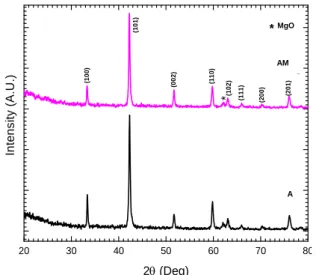
Fig. 1 shows X-ray diffraction patterns (XRD) for the as-synthesized samples. Since MgB2 powder was used as a precursor, the XRD pattern shows all characteristic peaks corresponding to hexagonal crystal structure of MgB2 (JCPDS code: 38-1369). Small peak indicating presence of MgO is unavoidable. It is noteworthy to mention that XRD for sample AM do not show diffraction peaks of Mg. This clarifies the absence of unreacted Mg in the sample even if it is sintered in Mg ambiance. This truly explains the Fe tube arrangement with a small hole to maintain appropriate Mg ambiance. The absence of Mg peaks implies that the Mg diffusing in the sample during sintering process is used up to satisfy any magnesium deficient secondary phases within the sample.
Fig. 2. Temperature-dependent resistivity plots for sample sintered with and without Mg ambiance. Inset shows the reduced resistivity plots.
3.2 Resistivity Studies
Even though excess Mg is not detected in XRD, there is a significant effect of Mg contained sintering ambiance on the temperature-dependent resistivity of the sample.
The behavior of resistivity with respect to temperature is shown in Fig. 2. The sample annealed in Mg ambiance
Fig. 3. Magnetization Vs field plot for samples at (a) 5 K and (b) 20 K.
0 50 100 150 200 250 300
0 50 100 150 200
0 50 100 150 200 250 300
0.0 0.2 0.4 0.6 0.8 1.0
Resistivity (cm)
Temperature (K) Ar
ArMg
RT / R300K
Temperature (K)
Ar ArMg
A AM
A AM
-80000 -60000 -40000 -20000 0 20000 40000 60000 80000 -400
-200 0 200 400
60000 70000 80000
0
Moment (emu/cm3)
Magnetic Field (Oe)
Ar ArMg
(a) 5K
Moment (emu/cm3)
Magnetic Field (Oe) Ar ArMg
A AM
A AM
-40000 -20000 0 20000 40000
-300 -200 -100 0 100 200 300
30000 40000 50000
(b) 20K
Moment (emu/cm3)
Magnetic Field (Oe)
Ar ArMg
Moment (emu/cm3)
Magnetic Field (Oe) Ar ArMg
A AM
A AM
Fig. 1. X-ray diffraction patterns for A and AM samples.
20 30 40 50 60 70 80
* MgO
* (201)
(200)
(111)
(102)
(110)
(002)
(101)
(100) ArMg
Intensity (A.U.)
2 (Deg)
Ar AM
A
13
Effect of open Mg sintering ambiance on the in-field critical current density of ex-situ MgB2
has an overall decrease in the resistivity behavior. This improved conductivity showcase the enhancement in the sample connectivity without any increase in the broadening of superconducting transition temperature observed at around 39 K for both the samples. The higher resistance in case of sample A may be due to the resistive grain boundaries possibly from residual boron and Mg Here the resistivity for sample AM shows more temperature dependence of electron-phonon interaction than sample A. The Rowell’s analysis for the area fraction was carried out for these samples shows an increase in current-carrying-area-fraction (Af) from Af = 0.07 to Af = 0.179 due to sintering in Mg ambiance. Hence it can be concluded that there is an increase in overall current- carrying superconducting area.
3.4 Critical current density
The critical current density was calculated from the magnetization plots by using Bean’s critical state model [14], for samples at 5 K and 20 K are shown in Fig. 4 (a) and (b) respectively. A significant increase in the in-field critical current density for sample AM is observed at 5 K
Fig. 4. Critical current density plots for samples at (a) 5 K and (b) 20 K.
as well as 20 K. It is noteworthy to mention that the critical current density values are comparable to those reported by A. Serquis et al [13] for the samples synthesized by hot isostatic pressing technique, meant for high density samples. This improvement in the in-field critical current density strongly supports the argument of increase in the density and in turn the superconducting cross section in the sample due to sintering in Mg ambiance. This is in line with the resistivity results in which the superconducting transition temperature remains the same and the electron-phonon interaction supports the maximum reduction in the resistivity.
3.5 Flux pinning properties
The flux pinning forces were calculated for both the sample and are as shown in Fig. 5. The enhancement in the flux pinning force is clearly depicted from the plots.
In order to understand the pinning mechanism in the sample, the reduced flux pinning force plot is shown in the inset. The plot shows a peak at around H/Hirr value of 0.2 which is a typical behavior for the grain boundary pinning mechanism in MgB2. It may be noted here that if excess Mg would have existed in an unreacted form, it would have formed an effective point defects giving rise to point pinning. No such effect is observed in the sample.
This is in support to our XRD plot where no peak for Mg has been detected. Also grain boundary pinning is dominant in MgB2 until effective point defects are created to form a point pinning centers. If Mg would have just settled itself at the grain boundary, it would have directly affected the resistivity behavior by more or less straightening it. Instead it has shown an enhanced exponential decrease in resistivity driven by electron- phonon interaction. Hence it can be inferred that an ambient pressure of Mg sintering environment has resulted in a self diffusion of Mg in sample rather than a forced intrusion.
Fig. 5. Flux pinning force plots for samples at 5 K. Inset shows the reduced flux pinning behavior that resembles grain boundary pinning mechanism.
0 10 20 30 40 50 60 70 80
102 103 104 105
Ar ArMg
Critical current density (A/cm2 )
Magnetic Field (kOe) (a) 5K
A AM
0 10 20 30 40 50
102 103 104 105
Magnetic Field (kOe) (b) 20K
Ar ArMg
Critical current density (A/cm2 )
A AM (b) 20K
0 10 20 30 40 50 60 70 80
0 2 4 6 8
0.0 0.2 0.4 0.6 0.8 1.0 0.0
0.2 0.4 0.6 0.8
1.0 Ar
ArMg
Flux pinning force GN/m3
Magnetic field (kOe)
5K
Fp/Fpmax
H/Hirr A AM
Flux pinning force (GN/m3) 14
Bhavesh B. Sinha, S. H. Jang, and Kookchae Chung
4. CONCLUSIONS
The presence of Mg vapors at ambient pressure improved the effective superconducting cross sectional area in the sample. The open tube arrangement instead of the sealed tube configuration ensured the self-diffusion of Mg without creating any excessive Mg defects in the sample. This in turn resulted in considerable increase in the infield critical current density of the sample.
ACKNOWLEDGMENT
This work was supported by the Global Research Laboratory Program from the National Research Foundation of Korea (NRF) through a grant funded by the Korean Ministry of Education, Science & Technology (MEST) (No. 2012-00184).
REFERENCES
[1] J. Nagamatsu, N. Nakagawa, T. Muranaka, Y. Zenitani, and J.
Akimitsu, “Superconductivity at 39K in magnesium diboride,”
Nature, vol. 410, pp. 63, 2001.
[2] K.H.P. Kim, J.H. Choi, C.U. Jung, P. Chowdhury, H.S. Lee, M.S.
Park, H.J. Kim, J.Y. Kim, Z. Du, E.M. Choi, M.S. Kim, W.N.
Kang, S.I. Lee, G.Y. Sung, J.Y. Lee, “Superconducting properties of well-shaped MgB2 single crystals,” Phys. Rev. B, vol. 65, pp.100510, 2002.
[3] A.K. Pradhan, X.Z. Shi, M. Tokunaga, T. Tamegai, Y. Takano, K.
Togano, H. Kito, H. Ihara, “Electrical transport and anisotropic superconducting properties in single crystalline and dense polycrystalline MgB2,” Phys. Rev. B, vol. 64, pp. 212509, 2001.
[4] A.K. Pradhan, X.Z. Shi, M. Tokunaga, T. Tamegai, Y. Takano, K.
Togano, H. Kito, H. Ihara, “Angle-resolved magnetotransport studies in anisotropic MgB2 single crystals,” Phys. Rev. B, vol. 65, pp. 144513, 2002.
[5] S. Okuma, S. Togo, and K. Amemori, “Observation of superconductivity in thick amorphous MgxB1-x films,” Phy. Rev. B, vol. 67, pp. 172508, 2003.
[6] B.A. Glowacki, M. Majoros, M. Vickers, J.E. Evetts, Y. Shi and I.
McDougall, “Superconductivity of powder-in-tube MgB2 wires,”
Supercond. Sci. Technol., vol. 14, pp.193, 2001.
[7] J. M. Rowell, “The widely variable resistivity of MgB2 samples,”
Supercond. Sci. Technol., vol. 16, pp. R17, 2003.
[8] P. A. Sharma, N. Hur, Y. Horibe, C. H. Chen, B. G. Kim, S. Guha, M. Z. Cieplak, and S-W. Cheong, “Percolative superconductivity in Mg1-xB2,” Phys. Rev. Lett., vol. 89, pp. 167003, 2002.
[9] P. C. Canfield, D. K. Finnemore, S. L. Bud'ko, J. E. Ostenson, G.
Lapertot, C. E. Cunningham, and C. Petrovic, “Superconductivity in dense MgB2 wires,” Phys. Rev. Lett., vol. 86, pp. 2423, 2001.
[10] Y. Bugoslavsky, L. F. Cohen, G. K. Perkins, M. Polichetti, T. J.
Tate, R. Gwilliam, and A. D. Caplin, “Enhancement of the high magnetic field critical current density of superconducting MgB2 by proton irradiation,” Nature, vol. 411, pp. 561, 2001.
[11] D. C. Larbalestier, L. D. Cooley, M. O. Rikel, A. A. Polyanskii, J.
Jiang, S. Patnaik, X. Y. Cai, D. M. Feldmann, A. Gurevich, and A.
A. Squitieri, “Strongly linked current flow in polycrystalline forms of the superconductor MgB2,.” Nature, vol. 410, pp. 186, 2001.
[12] T. C. Shields, K. Kawano, D. Holdom, and J. S. Abell,
“Microstructure and superconducting properties of hot isostatically pressed MgB2,” Supercond. Sci. Technol., vol. 15, pp. 202, 2002.
[13] A. Serquis, X. Z. Liao, Y. T. Zhu, J. Y. Coulter, J. Y. Huang, J. O.
Willis, D. E. Peterson, F. M. Mueller, N. O. Moreno, J. D.
Thompson, V. F. Nesterenko, and S. S. Indrakanti, “Influence of microstructures and crystalline defects on the superconductivity of MgB2,” J. Appl. Phys., vol. 92, pp. 351, 2002.
[14] C.P. Bean, “Magnetization of hard superconductors,” Phys. Rev.
Lett., vol. 8, pp. 250, 1962.
15