서 론
갯장어(Muraenesox cinereus)는 뱀장어목(Anguilliformes) 갯 장어과(Muraenesocidae)에 속하는 어종으로 한국의 남.서해, 일본 남부해, 동중국해, 중국 연안의 수심 20-50 m에서 바닥 이 모래진흙이거나 암초지대인 곳에 서식한다(NFRDI, 2004).
또한 갯장어를 비롯한 갯장어과 어류는 세계적으로 4속 8종이 분포하며, 그 중에서 한국에 2속 3종이 서식하는 것으로 알려 져 있다(Kim et al., 2005). 갯장어는 입이 크고 위턱이 아래턱 보다 돌출해 있으며, 양 턱에는 2-3줄의 이빨이 있다. 특히 앞 쪽에는 억세고 큰 송곳니를 가지는 특징이 있다. 암컷은 수컷 보다 성장이 빠르며, 항문장이 약 200 cm까지 성장한다고 알 려져 있다(NFRDI, 2004). 갯장어는 우리나라를 비롯한 동아시 아 지역에서 중요한 상업성 어종으로 우리나라에서 연간 어획 량으로 계측된 자원량을 보면 1990년대에 비해 2000년대에 들 어 비교적 자원량이 줄어들었지만 꾸준히 어획되고 있는 추세 를 보이고 있다(KOSIS, 1990-2010).
갯장어에 대한 과거 연구를 살펴보면 갯장어를 이용한 식품 관련 연구는 비교적 많이 보고되었으나 자원생태학적인 연구 는 미비하였다. 지금까지 이루어진 자원생태학적인 연구에 는 갯장어의 난소발달에 관한 연구(Kim et al., 2009; Liu et
al., 1989; Huang et al., 1981), 이석에 관한 연구(Ling et al., 2005), 난과 자어의 발달에 대한 연구(Akima et al., 1991), 자 어의 식성에 관한 연구(Mochioka et al., 1993)가 있었다. 또 한 대서양 연안 기니만에 위치한 Porto Novo에 서식하는 갯장 어의 식성에 관한 연구(Devadoss et al., 1979)가 이루어 졌으 나 단순한 주 먹이생물만을 언급하였다. 갯장어과 어류 중 갯 장어는 경제적 가치가 뛰어난 어종으로 이들의 생태를 연구하 는 것은 생태적 지위와 생태계의 기능적 측면을 이해하는데 중 요하다.
본 연구는 갯장어의 생태학적인 측면을 이해하기 위한 기초자 료 제공을 위해 경남 고성 주변해역에서 출현하는 갯장어의 위 내용물 분석을 통하여 위내용물 조성, 섭식전략, 성장에 따른 위내용물 조성의 변화를 파악하였다.
재료 및 방법
본 연구에 사용된 갯장어의 시료는 2011년 6월부터 9월까지 매월 경남 고성 주변해역(34°97-N, 128°32-E)에서 정치망(set net)을 이용하여 총 380개체를 채집하였다. 채집된 시료는 냉 동보관하여 실험실로 운반하였으며 각 개체의 항문장(0.1 cm) 과 체중(0.01 g)을 측정하였다. 이 후 위 부분을 분리, 해부현 미경을 이용하여 위내용물을 분석하였다.
위내용물 조사를 위한 충분한 표본크기를 결정하기 위하여
*Corresponding author: [email protected]
76
경남 고성 주변해역에서 출현하는 갯장어 (
Muraenesox cinereus)의 식성
안영수1,4 . 박주면2 . 김현지3 . 백근욱3,4*
1경상대학교 실습선 운영관리 센터, 2전남대학교 해양기술학부, 3경상대학교 해양생명과학과, 4경상대학교 해양산업연구소
Feeding Habits of Daggertooth Pike Conger Muraenesox cinereus in the Coastal Water off Goseong, Korea
1The Training Ship Management Center, Gyeongsang National University, Tongyoung 650-160, Korea
2Division of Marine Technology, Chonnam National University, Yeosu 550-749, Korea
3Department of Marine Biology & Aquaculture/ 4Institute of Marine Industry, Gyeongsang National University, Tongyeong 650-160, Korea
The feeding habits of daggertooth pike conger Muraenesox cinereus were studied using 380 specimens collected in the coastal waters off Goseong, Korea, from June to September, 2011. The M. cinereus ranged from 10.0-23.7 cm in anal length (AL). M. cinereus is a piscivore that consumes mainly fish. Engraulis japonicus was the preferred prey, but its diet also included small numbers of crabs, shrimps, cephalopods, and bivalves. The feeding strategy graphical method revealed that M. cinereus is a specialized feeder with a narrow niche width. All size classes of M. cinereus consumed fish and M. cinereus did not show significant ontogenetic changes in feeding habits. The diet overlap index between size classes was >0.96, indicating high diet similarities. The prey size increased significantly with M. cinereus size.
Key words : Muraenesox cinereus, Daggerthooth pike conger, Feeding habits, Piscivore, Goseong
Young Su An1,4, Joo Myun Park2, Hyeon Ji Kim3 and Gun Wook Baeck3,4*
누적먹이곡선(cumulative prey curve)을 사용하였다(Ferry and Cailliet, 1996). 누적먹이곡선을 만들기 위하여 위내용물 은 어류(Pisces), 게류(Brachyura), 새우류(Macrura), 두족류 (Cephalopoda)로 구분하여 위의 순서를 100번 무작위화 한 뒤, 평균과 표준편차를 그래프상에 나타내었다. 이때 곡선의 점근선은 위내용물 분석을 위한 최소 표본크기를 나타낸다.
위내용물은 가능한 종까지 동정하여 종류별로 크기(전장)를 측정하고 개체수를 계수하였으며 이후 전자저울을 이용하여 습중량을 0.01 g 단위까지 측정하였다. 위내용물 분석 결과는 각 먹이생물의 출현빈도(%F), 개체수비(%N ) 그리고 습중량비 (%W )로 나타내었으며, 다음 식을 이용하여 구하였다.
%F=Ai/N×100 %N=Ni/Ntotal×100 %W=Wi/Wtotal×100
여기서, Ai는 위내용물 중 해당 먹이생물이 발견된 갯장어의 개체수이고, N은 먹이를 섭식한 갯장어의 총 개체수, Ni (Wi) 는 해당 먹이생물의 개체수(습중량), Ntotal (Wtotal)은 전체 먹이 개체수(습중량)이다.
먹이생물의 상대중요성지수(index of relative importance, IRI)는 Pinkas et al. (1971)의 식을 이용하여 구하였다.
IRI=(%N+%W )×%F
상대중요성지수는 백분율로 환산하여 상대중요성지수비 (%IRI)로 나타내었다.
갯장어의 먹이중요도(dominant or rare), 섭식전략(specialist or generalist), 섭식폭(niche width)은 도해적방법(graphical method)을 사용하여 나타내었다(Amundsen et al., 1996). 이 방법은 출현빈도(%F)에 대하여 특정먹이생물우점도(prey–
specific abundance)를 도식화함으로써 나타내며, 특정먹이생 물우점도(prey–specific abundance)는 다음과 같이 구할 수 있 다.
Pi = (∑Si / ∑Sti)×100
여기서, Pi는 먹이생물 i의 특정먹이생물우점도(prey–specific abundance), Si는 위내용물 중 먹이생물 i의 중량, Sti는 먹이 생물 i를 섭식한 개체의 위내용물 중 전체 먹이생물 중량이다.
항문장별 먹이조성의 변화를 파악하기 위하여 갯장어 시료 를 5 cm 간격, 3개의 항문장군으로 구분하여 먹이조성을 조 사하였다. 항문장군별 우점 먹이생물 조성의 통계적 차이를 분석하기 위하여 카이검정(x2-test)을 실시하였으며 항문장과 섭식된 먹이생물 크기 사이의 관계는 선형회귀분석을 실시하 였다. 그리고 항문장에 따른 먹이섭식 특성 파악을 위해 항문 장군별 개체당 먹이의 평균 개체수(mean number of preys per stomach, mN/ST)와 개체당 먹이의 평균 중량(mean weight of preys per stomach, mW/ST)을 구하였으며, 분산분석(analysis of variance, ANOVA)을 이용하여 유의성을 검정하였다.
항문장군 사이에 먹이의 중복도는 Schoener (1970)의 dietary overlap index를 이용하여 다음과 같이 구하였다.
Cxy=1-0.5∑│Pxi-Pyi│
여기서, Pxi 와 Pyi 는 그룹 x와 y의 먹이 중 발견된 i종의 비 율(%N)이다. 이 지수의 범위는 0에서 1까지 이고 1에 가까울 수록 먹이생물의 중복도가 높아지는 것으로 볼 수 있다. 0.6 이상의 값을 유의하게 중복되는 것으로 간주하였다(Wallace, 1981).
결과 및 고찰
본 연구에서 채집된 380개체의 위내용물을 분석한 결과, 공 복은 158개체로 41.6%의 높은 공복율을 나타내었으며 갯장어 항문장은(anal length, AL)은 10.0-23.7 cm (16.17±2.12 cm)의 범위를 보였다. 위내용물이 발견된 222개체를 대상으로 조사 한 누적먹이곡선의 곡선은 점근선에 근접하였으며, 최소 표본 크기는 35개체로 나타났다(Fig. 1). 따라서 본 연구에서 표본 크기는 갯장어의 위내용물을 설명하기에 충분하였다.
먹이를 섭식한 222개체의 위내용물 분석결과(Table 1), 갯 장어의 가장 중요한 먹이생물은 출현빈도 83.33%, 개체수비 79.40%, 습중량비 80.82%, 상대중요성지수비 93.99%를 나타 낸 어류(Pisces)였다. 어류 중에서는 멸치(Engraulis japonicus) 가 전체 위내용물 습중량의 56.94%를 나타내어 갯장어의 가장 중요한 먹이생물이었으며, 그 외 꼬치고기(Sphyraena pinguis), 갈치(Trichiurus lepturus) 등이 발견되었다. 어류 다음으로 중 요한 먹이생물은 29.73%의 출현빈도, 15.47%의 개체수비, 7.88%의 습중량비, 4.89%의 상대중요성지수비를 나타낸 게류 (Brachyura)였다. 그 외 새우류(Macrura), 두족류(Cephalopoda), 이매패류(Bivalvia)가 갯장어 위내용물 중 발견되었으나 상대 중요성지수비가 1% 이하로 그 양은 매우 적었다. 따라서 갯 장어는 어류를 주로 섭식하고 그 외 게류, 새우류, 두족류 등 다양한 먹이생물을 섭식하지만 주로 어류를 섭식하는 어식성 (piscivore) 어류임을 알 수 있었다. 과거 갯장어의 식성 연구
Fig. 1. Cumulative prey curves of prey taxa per stomach of Mu- raenesox cinereus in the coastal waters off Goseong. Dashed line represent standard deviations after 100 permutations.
Cumulative number of prey taxa
Number of stomach samples 5
4
3
2
1
0 0 (35) 50 100 150 200
를 주 먹이생물로 이용한 어류들은 주로 유영능력이 발달한 부 어류였다. 그러나 갯장어는 바닥이 모래진흙이거나 암초지대 인 곳에 서식하는 종으로 위에 언급한 종들과 달리 지속적으로 상층이나 중층에 유영하는 종은 아니다. 과거 연구에 따르면 멸치가 저인망에서 종종 채집된 것으로 보아(Huh and Kwak, 1998; Choo, 2007), 상층 뿐만 아니라 저층까지 유영하며 서식 하는 것으로 판단된다. 따라서 멸치가 저층으로 내려왔을 때 암초지대에 서식하고 있던 갯장어가 자신의 영역 내에 들어온 멸치를 섭식할 수 있었던 것으로 생각된다.
위내용물에 대한 도해적방법을 이용한 결과에 의하면(Fig.
2), 어류는 갯장어의 가장 중요한 먹이생물이었으며 갯장어는 어류를 집중 섭식하는 섭식특화종(specialist predator)임을 알 수 있었다. 새우류는 50% 이상의 특정먹이생물우점도(prey–
를 살펴보면, 대서양 연안 기니만에 위치한 Porto Novo에 서 식하는 갯장어의 주 먹이생물은 어류였으며, 어류 중에서 고 등어(Scomber japonicus)가 우점도비 55.82%로 가장 중요한 먹이생물이었다(Devadoss et al., 1979). 이처럼 갯장어는 서 식하는 해역에 따라 주 먹이생물 종에서는 차이를 보였으나, 모두 어류를 주 먹이로 섭식하고 있음을 알 수 있었다. 본 연 구에서 갯장어의 주 먹이생물이었던 멸치는 우리나라 전 연안 에 출현하며 자원량이 비교적 풍부한 어종으로(NFRDI, 2004) 많은 어식성어류의 먹이생물이 되었다. 한국에 출현하는 어 류 중 멸치를 주로 섭식하는 대표적인 어종은 갈치, 꼬치고기, 삼치(Scomberomorus niphonius), 고등어, 쏨뱅이(Sebastiscus marmoratus) 등이 있었다(Huh, 1999; Baeck and Huh, 2004;
Huh et al., 2006; Yoon et al., 2008; Baeck et al., 2011). 멸치
Table 1. Composition of the stomach contents of Muraenesox cinereus by frequency of occurrence, number of individuals, weight and index of relative importance (IRI)
Prey organisms %F %N %W IRI %IRI
Bivalvia 0.45 0.08 0.04 0.05 +
Mytilus coruscus 0.45 0.08 0.04
Brachyura 29.73 15.47 7.88 694.20 4.89
Portunus sanguinolentus 0.45 0.08 0.11
Unidentified Brachyura 29.73 15.38 7.77
Macrura 9.46 1.90 8.72 100.48 0.71
Alpheus japonicus 3.60 0.74 1.20 Oratosquilla oratoria 4.95 0.91 7.41
Unidentified Macrura 1.35 0.25 0.11
Cephalopod 10.36 3.14 2.54 58.89 0.41
Euprymna morsei 7.66 2.40 1.69
Sepiolidae 0.90 0.17 0.22
Unidentified Cephalopod 2.25 0.58 0.63
Pisces 83.33 79.40 80.82 13352.09 93.99
Acanthogobius flavimanus 0.45 0.08 1.05 Conger myriaster 0.45 0.08 0.88 Dictyosoma burgeri 0.90 0.17 1.04 Engraulis japonicus 71.62 75.52 56.94 Favonigobius gymnauchen 0.90 0.17 0.16 Hyporhamphus sajori 0.45 0.08 1.86
Platycephalidae 0.90 0.17 0.13
Pleuronectidae 0.90 0.17 0.42
Pholis crassispina 1.35 0.25 2.06 Sphyraena pinguis 6.31 1.16 11.04 Trichiurus lepturus 4.05 0.74 4.32
Unidentified Pisces 4.05 0.83 0.90
Total 100.00 100.00 14,205.66 100.00
+ : less than 0.01%
specific abundance)를 보였지만, 위내용물 중 차지하는 비율 이 낮았다. 그 외 먹이생물은 그래프의 왼쪽 아랫부분에 위치 해 있었으며 소수 먹이생물이었다. 출현빈도에 대한 특정먹이 생물우점도(prey-specific abundance)를 그래프 상에 나타내는 방법은 Amundsen 등 (1996)에 의해 제안 되었으며, 많은 연구 에서 어류의 섭식형태 및 섭식전략을 분석하는데 유용하게 사 용되었다. 먹이생물종(또는 분류군)이 그래프에서 상부에 위치 할수록 우점 먹이생물(dominant prey)이며, 좁은 섭식폭을 가 진(high BPC) 섭식특화종임을 나타낸다. 어류의 섭식전략에 서 섭식특화종은 좁은 섭식폭을 가지는 반면, 섭식일반종은 넓 은 섭식폭을 가진다(Pianka, 1988).
성장에 따른 위내용물 조성의 변화를 세 개의 각 항문장군별 로 조사한 결과(Fig. 3), 10-15 cm에서는 80.54%, 15-20 cm에 서 80.39%, 20 cm 이상에서는 84.66%로 모든 항문장군에서 어류를 가장 많이 섭식하였으며 항문장군 간에 위내용물 조 성에 대한 유의한 차이를 나타내지 않았다(x2=4.104, d.f=6, P>0.05). 항문장군별 위내용물 중복도를 Schoener의 중복도지 수를 이용하여 분석한 결과(Table 2), 10-15 cm와 15-20 cm 사 이에서 가장 높은 0.99를 나타내었으며, 10-15 cm와 20 cm 이 상, 15-20 cm와 20 cm 이상 사이에서는 각각 0.96으로 나타나 모든 항문장군에서 비교적 높은 중복도지수 값을 나타내었다.
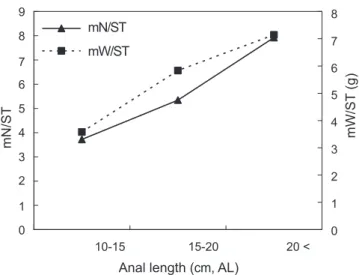
갯장어의 먹이생물 크기와 항문장의 선형회귀분석 결과, 항 문장에 따라 먹이생물 크기는 유의하게 증가하였다(F=5.929, P <0.05). 갯장어의 항문장군별 개체당 평균 먹이생물 개체수 (mN/ST) (ANOVA, F2,219=3.147, P <0.05)와 개체당 평균 먹 이생물 중량(mW/ST) (ANOVA, F2,219=5.083, P <0.05)은 유의
Fig. 2. (A) Graphical representation of feeding pattern of Muraenesox cinereus in the coastal waters off Goseong (Br, Brachyura;
Ma, Macrura; Bi, Bivalvia; Ce, Cephalopoda; Pi, Pisces). (B) Explanatory diagram for interpretation of niche width contribution (axis i , within phenotypic component (WPC) or between phenotypic component (BPC) of the study population, feeding strategy (axis ii), and prey importance (axis iii).
Prey-specific abundance (%)
(B)
High BPC Speicalization Dominant
Rare Generalization High WPC
Frequence of occurrence Frequence of occurrence
100
50
0 0 0.5 1 0 0.5 1
Fig. 3. Ontogenetic changes in composition of stomach contents by wet weight of Muraenesox cinereus. The number above each column is number of individuals examined.
Percentage of weight
100% 52
10-15 15-20 20 <
154 16
50%
0%
Bivalvia Brachyura Macrura Cephalopoda Pisces
Table 2. Proportional food overlap coefficients (Schoener’s index) of the diet among Muraenesox cinereus size classes
Size class
(cm, AL) 10-15 15-20 20<
10-15
15-20 0.99
20< 0.96 0.96
Anal length (cm, AL) (A)
Devadoss P and Pillai PKM. 1979. Observations on the food and feeding habits of the eel Muraenesox cinereus (For- skal) from Porto Novo. Indian J Fish 26, 244-247 Ferry LA and Cailliet GM. 1996. Sample size and data analy-
sis: are we characterizing and comparing diet properly In:
Feeding Ecology and Nutrition in Fish, Symp Proc, D.
MacKinlay, K. Shearer (Eds.). Am Fish Soc San Fran- cisco, CA, 71-80.
Hansen LP and Penthon P. 1985. The food of Atlantic salmon, Salmo solar L., caught by long-line in northern Norwe- gian waters. J Fish Biol 26, 553-562.
Huang F-L, Huang C-J, Lin S-H, Lo T-B and Papkoff H.
1981. Isolation and characterization of gonadotropin iso- hormones from the pituitary gland of pike eel (Muraene- sox cinereus). Int J Pept Protein Res 18, 69-78 .
Huh SH. 1999. Feeding habits of hairtail, Trichiurus lepturus.
Kor J Ichthyol 11, 191-197.
Huh SH and Kwak SN. 1998. Seasonal variations in species composition of fishes collected by an otter trawl in the coastal water off namhae island. Kor J Ichthyol 10, 11-23.
Huh SH, Park JM and Baeck GW. 2006. Feeding habits of spanish mackerel (Scomberomorus niphonius) in the Southern Sea of Korea. J Kor Fish Soc 39, 35-41.
Kim DJ, Kim EC, Son MH, Lee JE, Son SG and Han CH.
2009. Profile of plasma Estradiol-17β according to ovar- ian development of the pike eel, Muraenesox cinereus. J Life Sci 19, 1851-1854.
Kim IS, Choi Y, Lee CR, Lee YJ, Kim BJ and Kim JH. 2005.
Illustrated Book of Korean Fishes. Kyo-Hak Publ Co, Seoul, 615.
KOSIS (Korean Statistical Information Service). 1990-2010.
Statistic Database for Fisheries Production. Retrieved from http://www.kosis.kr/nspotal/
Last JM. 1989. The food of herring, Clupea harengas, in the North Sea, 1983-1986. J Fish Biol 34, 489-501.
Ling YJ, Iizuka Y and Tzeng WN. 2005. Decreased Sr/Ca ratios in the otoliths of two marine eels, Gymnothorax re- ticularis and Muraenesox cinereus, during metamorpho- sis. Mar Ecol Prog Ser 304, 201-206.
Liu C-S, Huang F-L, Chang Y-S and Lo T-B. 1989. Pike eel (Muraenesox cinereus) gonadotropin Amino acid se- quences of both α and β subunits. Eur J Biochem 186, 105-114.
NFRDI (National Fisheries Research and Development In- stitute). 2004. Commercial Fishes of the Coastal and Off- shore Waters in Korea. Hangul Graphics Busan, Korea, Mochioka NT, Iwamizu MS and Kanda TS. 1993. Lepto-333.
cephalus eel larvae will feed in aquaria. Environ Biol Fish 36, 381-384
Pianka ER. 1988. Evolutionary Ecology, 4th ed. Harper Col- lins, New York, 468.
Pinkas L, Oliphant MS and Iverson ILK. 1971. Food habits 한 차이를 보였으며, 항문장 증가에 따라 모두 증가하였다(Fig.
4). Hansen과 Penthon (1985), Last (1989)의 연구에서 지속적 으로 유사한 먹이생물을 섭식하는 어종은 성장함에 따라 먹이 생물 개체수 또는 중량이 증가하는 경향을 보인다고 하였는데 본 연구에서는 갯장어가 성장함에 따라 먹이생물의 크기, 개체 수, 중량이 모두 증가하는 경향을 나타내었다.
경남 고성 주변해역에서 출현하는 갯장어의 위내용물 분석 결 과 주 먹이생물은 어류였으며 섭식특화종이었다. 또한 모든 항 문장에서 주로 어류를 섭식하는 경향을 나타내었다. 그러나 향 후, 갯장어의 전반적인 위내용물 조성과 먹이전환을 정확히 파 악하기 위해서는 가능한 넓은 항문장 범위에 걸쳐 좀 더 많은 시료를 확보하여 분석할 필요가 있다.
참고문헌
Akima U, Tsuguo O, Jun H, Katsumi T and Muneo O. 1991.
Development of the eggs and larvae of the pike eel, Mu- raenesox cinereus. Jap J Ichthyol 1, 35-39
Amundsen PA, Gabler HM and Staldvik FJ. 1996. A new approach to graphical analysis of feeding strategy from stomach contents data modification of Costello (1990) method. J Fish Biol 48, 607-614.
Baeck GW and Huh SH. 2004. Feeding habits of Brown bar- racuda (Sphyraena pinguis, Teleostei) in the coastal wa- ters of Gadeok-do, Korea. J Kor Fish Soc 37, 505-510.
Baeck GW, Yeo YM, Jung JM, Park JM and Huh SH. 2011.
Feeding habits of Scorpion fish, Sebastiscus marmoratus, in the coastal waters of Tongyeong, Korea. Kor J Ichthyol 23, 128-134.
Choo HG. 2007. Species composition and feeding ecology of fishes in the coastal waters off Kori, Korea. PhD Thesis, Pukyong Natl Univ Busan, Korea, 126.
Fig. 4. Variation of mean number of preys per stomach (mN/
ST) and mean weight of preys per stomach (mW/ST) of Muraenesox cinereus among size classes.
mN/ST mW/ST (g)
Anal length (cm, AL)
10-15 15-20 20 <
0 1 2 3 4 5 6 7 8 9
1 0 2 3 4 5 6 7 mN/ST 8
mW/ST
of albacore, bluefin tuna and bonito in California waters.
Fish Bull 152, 1-105.
Schoener TW. 1970. Nonsynchronous spatial overlap of liz- ards in patchy habitats. Ecology 51, 408-418.
Wallace RK. 1981. An assesment of diet-overlap indexes.
Trans Am Fish Soc 110, 72-76.
Yoon SJ, Kim DH, Baeck GW and Kim JW. 2008. Feeding habits of chub mackerel (Scomber japonicus) in the South Sea of Korea. J Kor Fish Soc 41, 26-31.
2011년 11월 16일 접수 2011년 12월 28일 수정 2012년 2월 2일 수리