—349—
INTRODUCTION
The bullet mackerel, Auxis rochei (Risso, 1810) (Perci- formes; Scombridae), is a pelagic teleost widely distrib- uted throughout the tropical and temperate waters, includ- ing the waters of Korea and the Philippines (Kim et al., 2005). A. rochei is a member of the Scombridae, which include approximately 49 species in 15 genera distri- buted throughout the world’s oceans. The genus Auxis contains only two species, A. rochei and A. thazard.
Knowledge of the diet composition of A. rochei is neces- sary for the systematic management and conservation of its stocks, as the species is an economically and ecolog- ically valuable fishery resource in Korea and Southeast Asia, including the Philippines. Many ecological and biological studies of A. rochei have been conducted pre- viously, including research into its age and growth on Turkish Mediterranean coasts (Kahraman et al., 2011), its seasonal distribution and spawning in the northwest- ern Mediterranean (Sabatés and Recasens, 2001), the behavior of A. rochei schools in nurseries and the catch
functions of nursery grounds (Kim and Inoue, 1998), and the molecular identification and morphological develop- ment of Auxis larvae, including A. rochei (Ji et al., 2011).
The stomach contents of A. rochei have been studied by Mostarda et al. (2007), Morote et al. (2008), Plandri et al.
(2009), and Jasmine et al. (2013) in the southern Tyrrhen- ian Sea, Mediterranean Sea, Ligurian Sea, and Indian waters, respectively. However, these studies produced fragmentary information on the feeding habits of A. rochei.
Therefore, this study aims to provide more detailed information on the dietary composition, size-related in diets and feeding strategy of A. rochei in the coastal waters of Iloilo, Philippines.
MATERIALS AND METHODS
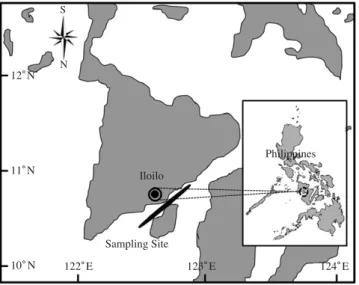
A. rochei specimens of this study were collected month- ly between December 2013 and May 2014 using a purse seine and hook and line in the coastal waters of Iloilo, Philippines (Fig. 1). Iloilo is a province of the Philippines located in the Western Visayas region. The coastal waters of IloIlo were depth about 22 m and annual average tem- perature was 28.5�C (WST, 2014). After collection, A.
rochei specimens collected were fixed immediately in
Diet Composition of Bullet Mackerel, Auxis rochei (Risso, 1810) in the Coastal Waters of Iloilo, Philippines
By Gun Wook Baeck, Gerald F. Quinitio
1, Christopher J. Vergara
1, Hyeon Ji Kim and Jae Mook Jeong*
Department of Marine Biology & Aquaculture, Institute of Marine Industry, College of Marine Science, Gyeongsang National University, 445 Inpyeong-dong, Tongyeong 650-160, Korea
1Institute of Marine Fisheries and Oceanology College of Fisheries and Ocean Sciences University of the Philippines Visayas, Miagao, Iloilo, Philippines
ABSTRACT The diet composition of bullet mackerel, Auxis rochei was studied using 200 specimens collected from December 2013 to May 2014 in the coastal waters of Iloilo, Philippines. The size of A.
rochei ranged from 11.1 to 31.2 cm in fork length (FL). A. rochei was epipelagic feeder that consumed mainly fishes. In addition, A. rochei consumed shrimps, copepods, crab larvae, amphipods and cephalopods. The diet also included small quantities of stomatopods, bivalves, and ostracods. Also, analysis of the prey-specific abundance against the frequency of occurrence shows that A. rochei have a narrow food niche, and are specialized feeder with fish as their dominant prey. Although fishes were the primary in food consumed by all size class. The fishes gradually increased with body size.
Key words : Diet composition, Auxis rochei, bullet mackerel, Iloilo, Philippines
*Corresponding author: Jae Mook Jeong Tel: 82-55-772-9156 Fax: 82-55-722-9159, [email protected]
ISSN: 1225-8598 (Print), 2288-3371 (Online)
Accepted: December 20, 2014
http://www.fishkorea.or.kr
10% formalin solution immediately after collection. Fish were brought to the University of the Phillippines Visayas (UPV) laboratory where fork length (FL) was measured to the nearest millimeter (mm). We analyzed 200 A. rochei specimens ranging from 11.1 to 31.2 cm (FL). Stomachs were removed and preserved in 10% formalin solution.
For each specimen, prey items from the stomach were identified, and counted and weighted. Moisture was re- moved using dehumidification paper before weighing and then wet weight (the nearest 0.001 g) was measured using an electronic scale. Most prey items in the A. rochei stomachs were not fragmented. Some fragmented prey parts were collected and were considered to be parts of a single prey (the head part); prey counts included these considerations.
Diet was quantified by the frequency of occurrence (%F), numerical percentage (%N), and wet weight per- centage (%W), which were calculated by the following equations:
%F==Ai/N×100
%N==Ni/Ntotal×100
%W==Wi/Wtotal×100
where Aiis the number of fish preying on a prey species i, N is the total number of fish examined excluding indi- viduals with empty stomachs, Ni(Wi) is the number (wet weight) of prey i, and Ntotal(Wtotal) is the total number (wet weight) of prey individuals.
The index of relative importance (IRI) (Pinkas et al.
1971) was calculated for each prey item as follows IRI==(%N++%W)×%F
and expressed as a percentage (%IRI):
n
%IRI==IRIi/»IRI×100
i==1
where n is the total number of food items considered at a given taxonomic level.
To assess the feeding strategy of A. rochei, we used the graphical analysis described by Amundsen et al. (1996).
In mathematical terms, the prey-specific abundance is calculated as
Pi==(»Si/»Sti)×100
where Piis equal to the prey-specific abundance of prey i, Si the weight of prey i in stomachs, and Sti the total weight of prey in the stomachs of predators that contain prey i.
Size-related in diet were examined by dividing the A.
rochei specimens into three size classes: small (⁄20 cm), medium (20~25 cm), large (25 cm⁄).
RESULTS
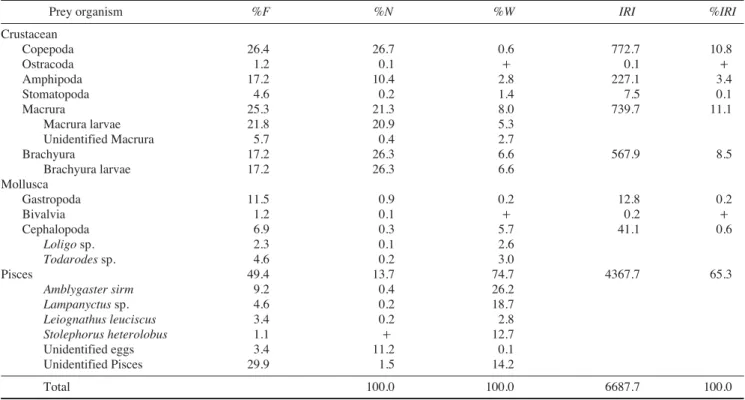
Among the 200 A. rochei stomachs examined, 113 (56.5%) were completely empty and at least ten prey taxa were found in the remaining 87 stomachs (Table 1). The most important prey item of A. rochei was fishes, com- posing 49.4% of the diet by occurrence, 13.7% by num- ber, 74.7% by wet weight, and 65.3% by %IRI. At least six fish taxa were identified. In the fish species consumed, Amblygaster sirm was the principal prey item. Also, Lampanyctus sp., unidentified fishes, Stolephorus het- erolobus, Leiognathus leuciscus, and unidentified fish eggs constituted a portion of the diet. Shrimps were the second largest dietary component, making up 25.3% of the diet by occurrence, 21.3% by number, 8.0% by wet weight, and 11.1% by %IRI. Copepods (%F==26.4; %N
==26.7; %W==0.6; %IRI==10.8) and crabs (%F==17.2; %N
==26.3; %W==6.6; %IRI==8.5) were the next important prey items. A small portion of the prey items was amphi- pods, cephalopods, gastropods, stomatopods, bivalves, and ostracods which constituted less than 3.4% of the diet by %IRI.
The relative prey importance of A. rochei is graphical- ly represented in Fig. 2, where prey-specific abundance (Pi) is plotted against the frequency of occurrence (Fi).
Graphical analysis of the diet composition based on the weight showed that the Pi-Fiplot explains a mixed feed- ing strategy for A. rochei: a specialization for fishes and a generalization for other different prey items. Fishes are located in the upper center of the diagram suggesting a specialization by the A. rochei population and constitut- ing the most important prey item composing of 88.4% by Piand 49.4% by Fiof the stomach contents. However, crabs, copepods, shrimps, amphipods, cephalopods, gas- tropods, stomatopods, bivalves, and ostracods were rare
Fig. 1.Location of the sampling area in the coastal waters of Iloilo, Philippines.
12�N
11�N
10�N S
N
122�E 123�E 124�E
Iloilo
Sampling Site
Philippines
or unimportant prey items, with low values of Pi(less than 47.9%) and Fi(less than 26.4%).
Fishes were the dominant prey item in all size classes, representing more than 64.3% of the diet by wet weight (Fig. 3). Shrimps contributed more to the diets of small size classes (32.4% of the diet by wet weight). The pro- portion of shrimps was decreased as body size increased,
whereas the consumption of fishes increased gradually.
DISCUSSION
In this study, a high percentage (56.5%) of A. rochei stomachs was empty. High percentages of empty A. rochei
Fig. 2. (A) Graphical representation of feeding pattern of Auxis rochei in the coastal waters of Iloilo, Philippines (Pi, Fishes; Ce, Cephalopoda;
Br, Brachyura; Co, Copepoda; Ma, Macrura; Am, Amphipoda; St, Stomatopoda; Os, Ostracoda; Ga, Gastropoda; Bi, Bivalvia). (B) Explanatory diagram for interpretation of niche width contribution (axis i, within phenotypic component (WPC) or between phenotypic component (BPC)) of the study population, feeding strategy (axis ii), and prey importance (axis iii).
100
50
0
High BPC
(i)
Rare
Specialization
(ii)
Generalization
Dominant
(iii)
High WPC
0 50 100
(A) (B)
Pi
Ce Br
MaCo
Am
Os St Bi Ga
Prey-specific abundance(%)
Frequence of occurrence (%) Frequence of occurrence (%)
0 50 100
Table 1.Percentage frequency of occurrence (%F), number (%N), weight (%W) and index of relative importance (IRI) of prey species in the diets of Auxis rochei
Prey organism %F %N %W IRI %IRI
Crustacean
Copepoda 26.4 26.7 0.6 772.7 10.8
Ostracoda 1.2 0.1 ++ 0.1 ++
Amphipoda 17.2 10.4 2.8 227.1 3.4
Stomatopoda 4.6 0.2 1.4 7.5 0.1
Macrura 25.3 21.3 8.0 739.7 11.1
Macrura larvae 21.8 20.9 5.3
Unidentified Macrura 5.7 0.4 2.7
Brachyura 17.2 26.3 6.6 567.9 8.5
Brachyura larvae 17.2 26.3 6.6
Mollusca
Gastropoda 11.5 0.9 0.2 12.8 0.2
Bivalvia 1.2 0.1 ++ 0.2 ++
Cephalopoda 6.9 0.3 5.7 41.1 0.6
Loligo sp. 2.3 0.1 2.6
Todarodes sp. 4.6 0.2 3.0
Pisces 49.4 13.7 74.7 4367.7 65.3
Amblygaster sirm 9.2 0.4 26.2
Lampanyctus sp. 4.6 0.2 18.7
Leiognathus leuciscus 3.4 0.2 2.8
Stolephorus heterolobus 1.1 ++ 12.7
Unidentified eggs 3.4 11.2 0.1
Unidentified Pisces 29.9 1.5 14.2
Total 100.0 100.0 6687.7 100.0
+
+: less than 0.1%
stomachs in other waters, such as the Ligurian Sea (43.4
%) and Indian waters (60.3%) were also reported by sev- eral researchers (Plandri et al., 2009; Jasmine et al., 2013).
This indicates that the high percentage of empty A.
rochei stomachs could be a characteristic of the species.
A. rochei is an epipelagic offshore carnivore, feeding on various prey items such as shrimps, copepods, crab larvae, amphipods, cephalopods, gastropods, stomato- pods, bivalves, and ostracods, while depending primarily on small fish species. Mostarda et al. (2007) and Jasmine et al. (2013) reported that A. rochei foraged mainly on planktonic and small crustaceans in the southern Tyrrhen- ian Sea and Indian waters, respectively. However, the present study and the study of Plandri et al. (2009) from the Ligurian Sea showed different results with the former studies. The most important prey items of A. rochei dif- fered between the former two studies (crustaceans) and this work (fishes). Therefore, A. rochei is considered an opportunistic carnivore, whose prey are selected on the basis of their availability and geographic abundance (Pihl, 1985; Gkenas et al., 2012).
An analysis of prey-specific abundance against the fre- quency of occurrence showed that A. rochei has a narrow food niche, and is a specialized feeder with fish as its dominant prey (Pianka, 1988) as also shown in several other studies of scombridae fishes, such as Thunnus alalunga in the central Mediterranean Sea and A. rochei in Indian waters (Consoli et al., 2008; Jasmine et al., 2013). Fishes, the dominant prey item, shows a high prey- specific abundance value (88.4%). Consoli et al. (2008) described that the feeding strategy of A. rochei could be related to the abundance of dominant prey items and its
ability to take advantage of the most profitable food source at a particular time. The exact biomass of fish in the waters investigated in the present study is unknown.
However, Mostarda et al. (2007) reported that A. rochei is an epipelagic offshore predator feeding on whatever abundant resources are available in the environment.
Therefore, A. rochei in the present study area may feed mainly on fish, because small fish species are abundant in the tropical Philippines waters.
The ontogenetic changes in the diet of A. rochei were significant, as in many scombrid fishes (Tomoyuki et al., 2011; Shimose et al., 2013). Consumption of fishes in- creased in the large size class. Because larger individuals generally have large mouths, digestive ability improve- ment, and because they show faster darting and swim- ming behavior, they may be able to consume a large prey sizes (Hyndes et al., 1997; Yoon et al., 2008).
ACKNOWLEDGMENTS
This work was supported by the Gyeongsang National University Fund for Professors on Sabbatical Leave, 2013.
REFERENCES
Amundsen, P.A., H.M. Gable and F.J. Staldvik. 1996. A new approach to graphical analysis of feeding strategy from stomach contents data modification of Costello (1990) method. J. Fish. Biol., 48: 607-614.
Consoli, P., T. Romeo, P. Battaglia, L. Castriota, V. Esposito and F. Andaloro. 2008. Feeding habits of the albacore tuna Thunnus alalunga (Perciformes, Scombridae) from central Mediterranean Sea. Mar. Biol., 155:
113-120.
Gkenas, C.H., S. Malavasi and I. Leonardos. 2012. Diet and feeding habits of Economidichthys pygmaeus (Per- cifermes: Gobiidae) in Lake Pamvotis, NW Greece.
J. Appl. Ichthyol., 28: 75-81.
Hyndes, G.A., M.E. Platell and I.C. Potter. 1997. Relation- ships between diet and body size, mouth morphology, habitat and movements of six sillaginid species in coastal waters: implications for resource partitioning.
Mar. Biol., 128: 585-598.
Jasmine, S., P. Rohit, E.M. Abdussamad, K.P. Said Koya, K.K. Joshi, S. Kemparaju, D. Prakasan, M.N.K.
Elayathu and M. Sebastine. 2013. Biology and fishery of the bullet tuna, Auxis rochei (Risso, 1810) in Indian waters. Indian J. Fish., 60: 13-20.
Ji, H.S., J.T. Yoo, J.H. Ryu and J.K. Kim. 2011. Molecular identification and morphological development of Auxis (Scombridae) larvae. Korean. J. Aquat. Sci., Fig. 3.Ontogenetic changes in the composition of Auxis rochei diets.
100
50
0
Small (⁄20) Midium (20~25) Large (25⁄) Fork length (cm, FL)
Pisces Macrura Copepoda
Brachyura Amphipoda Others
Percentage of weight(%)
44: 677-683. (in Korean)
Kahraman, A.E., D. Göktürk and F.S. Karakulak. 2011. Age and growth of bullet tuna, Auxis rochei (Risso), from the Turkish Mediterranean coasts. African. J. Biotech., 10: 3009-3013.
Kim, M.K. and Y. Inoue. 1998. Sutdies on the behaviour of fish schools in the main-net of large scale set-net using scanning sonar-IV. The behaviour of trigate macherel Auxis tapeinosoma school in the playground and the catching funcion of the playground. Korean Soc. Fish. Tech., 34: 6-12. (in Korean)
Kim, I.S., Y. Choi, C.H. Lee, Y.J. Lee, B.J. Kim and J.H.
Kim. 2005. Illustrated Book of Korean Fishes. Kyohak Publ. Co., Seoul, 615pp. (in Korean)
Morote, E., M.P. Olivar, P.M. Pankhurst, F. Villate and I.
Uriarte. 2008. Trophic ecology of bullet tuna Auxis rochei larvae and ontogeny of feeding-related organs.
Mar. Ecol. Prog. Ser., 353: 243-254.
Mostarda, E., D. Campo, L. Castriota, V. Esposito, M.P.
Scarabello and F. Andaloro. 2007. Feeding habits of the bullet tuna Auxis rochei in the southern Tyrrhen- ian Sea. J. Mar. Biol. Ass. U.K., 87: 1007-1012.
Pianka, E.R. 1988. Evolutionary Ecology, 4th ed. Harper Collins, New York, 468pp.
Pinkas, L., M.S. Oliphant and I.L.K. Iverson. 1971. Food
habits of albacore, bluefin tuna and bonito in Califor- nia waters. Fish. Bull., 152: 1-105.
Pihl, L. 1985. Food selection and consumption of mobile epibenthic fauna in shallow marine areas. Mar. Ecol.
Prog. Ser., 22: 169-179.
Plandri, G., L. Lanteri, F. Garibaldi and L. Orsi Relini. 2009.
Biological parameters of bullet tuna in the Ligurian Sea. Collect. Vol. Sci. Pap. ICCAT, 64: 2272-2279.
Tomoyuki, I., H. Kemps, J. Totterdell. 2011. Diet of young southern bluefin tuna Thunnus maccoyii in the south- western coastal waters of Australia in summer. Fish.
Sci., 77: 337-344.
Sabatés, A. and L. Recasens. 2001. Seasonal distribution and spawning of small tunas, Auxis rochei (Risso) and Sarda sarda (Bloch) in the northwestern Mediter- ranean. Sci. Mar., 65: 95-100.
Shimose, T., H. Watanabe, T. Tanabe and T. Hubodera. 2013.
Ontogenetic diet shift of age-0 years Pacific bluefin tuna Thunnus orientalis. J. Fish. Biol., 82: 263-276.
WST. 2014. World Sea Temperature. Retrived from http://
www.seatemperature.org
Yoon, S.J., D.H. Kim, G.W. Baeck and J.W. Kim. 2008.
Feeding habits of chub mackerel (Scomber japonicus) in the South sea of Korea. J. Kor. Fish. Soc., 41: 26-31.
필리핀 일로일로 연안해역에 출현하는 몽치다래(Auxis rochei)의 위내용물 조성
백근욱∙Gerald F. Quinitio1∙Christopher J. Vergara1∙김현지∙정재묵
경상대학교 해양생명과학과∙해양산업연구소
1Institute of Marine Fisheries and Oceanology College of Fisheries and Ocean Sciences University of the Philippines Visayas (UPV)
요 약 :필리핀 일로일로 주변해역에 출현하는 몽치다래(Auxis rochei)의 위내용물 조성을 연구하기 위하여 2013년 12월에서 2014년 5월까지 매월 채집하였으며 채집된 몽치다래의 총 개체수는 200개체였다. 이들의 가 랑이체장(FL)은 11.1~31.2 cm의 범위를 보였다. 위내용물을 분석한 결과 몽치다래는 어류(fishes)를 가장 선호 하는 epipelagic feeder로 나타났다. 어류 다음으로 중요한 먹이생물은 새우류(shirmps), 요각류(copepods), 게유 생 (crab larvae), 단각류 (amphipods), 두족류 (cephalopods)로 나타났으며, 갯가재류 (stomatopods), 이매패류 (bivalves), 패충류(ostracods) 등도 섭식하였지만 그 양은 많지 않았다. 몽치다래의 섭식패턴에 대한 도해적방법 의 결과는 몽치다래가 좁은 섭식폭을 가지며, 어류를 주로 섭식하는 specialized feeder임을 보였다. 모든 크기군 에서 어류를 주로 섭식하였으며, 크기가 증가함에 따라 어류의 섭식비율이 증가하는 경향을 보였다.
찾아보기 낱말 :위내용물 조성, Auxis rochei, 몽치다래, 일로일로, 필리핀