Vol. 30, No. 11 (2020)
573
Pulverization and Densification Behavior of
YAG Powder Synthesized by PVA Polymer Solution Method
Hyun-Ho Im
1and Sang-Jin Lee
1,2†1Department of Advanced Materials Science and Engineering, Mokpo National University, Muan 534-729, Republic of Korea
2The Research Institute of Ceramic Industry Technology, Mokpo National University, Muan 534-729, Republic of Korea
(Received September 8, 2020 : Revised September 20, 2020 : Accepted September 24, 2020)
Abstract
YAG (Yttrium Aluminum Garnet, Y3Al5O12) has excellent plasma resistance and recently has been used as an alternative to Y2O3 as a chamber coating material in the semiconductor process. However, due to the presence of an impurity phase and difficulties in synthesis and densification, many studies on YAG are being conducted. In this study, YAG powder is synthesized by an organic-inorganic complex solution synthesis method using PVA polymer. The PVA solution is added to the sol in which the metal nitrate salts are dissolved, and the precursor is calcined into a porous and soft YAG powder. By controlling the molecular weight and the amount of PVA polymer, the effect on the particle size and particle shape of the synthesized YAG powder is evaluated. The sintering behavior of the YAG powder compact according to PVA type and grinding time is studied through an examination of its microstructure. Single phase YAG is synthesized at relatively low temperature of 1,000oC and can be pulverized to sub-micron size by ball milling. In addition, sintered YAG with a relative density of about 98 % is obtained by sintering at 1,650oC.Key words
YAG, PVA solution method, synthesis, sintering, microstructure.1. Introduction
The importance of the semiconductor equipment industry is increasing as the 3D-NAND business begins in the rapidly changing semiconductor market. As major semiconductor manufacturing processes such as deposition and etching are carried out in harsher processing environment, the demands for related plasma-resistant materials is increasing. Particularly in the semiconductor manufacturing process where the plasma process is performed, as the ultra-fine line width progresses, contaminated particles are generated by chemical etching as well as physical etching of the inner wall of the chamber, and various studies are being conducted to prevent the inflow of contaminants caused by the etching of the inner wall of the semiconductor.
1-3)Currently, Y
2O
3is widely used as a plasma-resistant material for the inner wall of the chamber. However, high-purity yttria is expensive and the coating process is not simple. In order
to solve this problem, research and development using Y
2O
3composite oxide, which is cheaper than the existing Y
2O
3and has excellent plasma-resistance is being actively conducted. A typical Y
2O
3composite oxide is YAG (yttrium aluminum Garnet, Y
3Al
5O
12), which is a compound having a cubic Garnet crystal structure and is used in a wide range of fields due to its excellent creep resistance, thermal stability, corrosion resistance, and optical properties.
In addition, it has excellent plasma resistance and is used as an alternative material for Y
2O
3as a chamber coating material in semiconductor processes.
4-6)YAG is a compound of yttria (Y
2O
3) and alumina (Al
2O
3), which is made by a relatively simple process and has been mainly synthesized by the solid phase reaction method.
7,8)However, this method has limitations in reducing the size of the particles. In addition to YAG, which is the final product, YAM (Y
4Al
2O
9, yttrium aluminum Monoclinic) and YAP (YAlO
3, yttrium aluminum Perovskite) exist in yttria and alumina systems, and it is not easy to
†Corresponding author
E-Mail : [email protected] (S.-J. Lee, Mokpo Nat'l Univ.)
©Materials Research Society of Korea, All rights reserved.
This is an Open-Access article distributed under the terms of the Creative Commons Attribution Non-Commercial License (http://creative- commons.org/licenses/by-nc/3.0) which permits unrestricted non-commercial use, distribution, and reproduction in any medium, provided the original work is properly cited.
obtain a pure composition of YAG crystals. In particular, high temperature heat treatment at 1,600 ~ 1,800
oC is required for the synthesis along with a milling process to obtain a fine powder, and this causes agglomeration of particles, non-uniform particle crystal size, and defects in the surface and lattice, resulting in deteriorated optical and mechanical properties. In order to maintain the unique optical and mechanical properties of YAG, spherical particle control and uniform particle size should be achieved as much as possible. A number of methods to this end have been reported such as the combustion synthesis method,
9)the sol-gel method,
10,11)the co- precipitation method,
12)the spray pyrolysis method,
13)the discharge plasma method,
14)and the microwave stimulation method.
15)With these methods, using in a low heat treatment temperature and fine gel state, a uniform synthetic powder having a nanoscale particle form can be obtained. In the application of YAG materials to semiconductor processes, fully densified YAG is required for a plasma-resistant material used for the inner wall of the chamber. According to a recent study by Zhou,
16)densified YAG that has 99 % or higher relative density was fabricated by using sintering agents such as MgO and CaO.
The PVA (polyvinyl alcohol) polymer solution synthesis method,
17,18)a phase synthesis method, not only allows particle size control but also allows synthesis at relatively low temperatures compared to conventional solid state methods. In addition, a soft porous synthetic powder can be obtained by the degreasing effect from the decomposed polymer during the calcination process. The powder synthesis method using PVA polymer improves the dispersion of metal cations in the solution and obtains a stable precursor by using the –(OH) functional group of PVA, which is easily soluble in water. Further, due to the porosity of the particles, it is possible to pulverize them into fine particles through a simple ball milling process, and thus this approach is suitable for manufacturing a dense sintered body by a sintering process. In this study, the effect of the particle size and particle shape of the synthesized YAG powder was estimated by controlling the molecular weight and the amount of added PVA polymer used for YAG synthesis. The densification behavior of the sintered body according to the crushing effect of the synthetic powder was studied by examining the change of microstructure.
2. Experimental Procedure
For the synthesis of YAG powder, high purity Y(NO
3)
3· 6H
2O (reagent grade, Aldrich Chemical Co., St Louis, MO. USA) and Al(NO
3)
3·9H
2O (reagent grade, Aldrich Chemical Co., St Louis, MO. USA) were dissolved in
distilled water at a stoichiometric ratio. A 5 wt% PVA (reagent grade, Aldrich Chemical Co., St Louis, MO.
USA) solution was prepared by dissolving 5 g of PVA powder per 95 cc of distilled water.
18)PVAs (Mw. 9,000
~ 10,000, Mw. 146,000 ~ 186,000) with different molecular weights were used. The amount of PVA added to the sol- type solution, in which metal salts were dissolved, was added in ratios of 4:1 and 2:1 with respect to the total valence ratio of the metal cations. That is, the mixing ratio was determined as the valence ratio of the metal cation to the PVA monomer having one -(OH) functional group based on the metal cation. As an example, since yttrium ions (Y
3+) and aluminum ions (Al
3+) show a three times more in the electrovalence with respect to PVA, when added at a mole ratio of 4:1, the actual ratio of PVA between yttrium and aluminum ions is 12:1, respectively, due to the difference in the charge amount.
18)Accordingly, in order to control the ratio of 4:1, 5 wt%
PVA solution was added so that the ratios of Al
3+: PVA and Y
3+: PVA were each 4:3. In the case of the ratio of 2:1 where the amount of PVA addition was greater, the PVA solution was added so that the PVA ratio for each ion was 2:3. The mixed solution was gelled while stirring at 100
oC on a hot plate and the precursor gel was completely dried at 200
oC for 24 h.
The dried gel was calcined at 600
oC with a heating rate of 5
oC/min in an air atmosphere to remove NO
xgas and burn out the PVA polymer. The powder obtained by calcination was again heated to 1,000
oC for 1 h in an air atmosphere with a heating rate of 5
oC/min for synthesis of YAG powder. For pulverization of the agglomerated particles, ball-milling was conducted by varying the time (0 h, 12 h, 20 h and 30 h) at a speed of 150 rpm using 5 mm ZrO
2balls with isopropyl alcohol as a solvent media. The ball-milled YAG powder was passed through a 150 mesh sieve to minimize agglomeration. Each obtained powder was uni-axially pressed at a pressure of 50 MPa to form a pellet having a diameter of 15 mm, and then cold isostatic pressing was conducted with 200 MPa. The sintering process was carried out at 1,650
oC for 6 h with a heating rate of 3
oC/min in an air atmosphere.
In order to examine the pyrolysis characteristics during
the calcination process, a thermal analyzer (TG-DTA,
Labsys Evo TG-DTA, SETARAM, France) was used in
an air atmosphere with a heating rate of 10
oC/min up
to 900
oC. The crystallization behavior of the gel-type
powders according to various processing factors was
examined by using an X-ray diffractometer (XRD,
SmartLab, Rigaku, Japan) with CuK
αradiation. The
measurements were made with a scanning speed of 10
o/
min and a sampling interval of 0.02
o. The density of the
sintered body was measured by the Archimedes method,
and the relative density was calculated from the theoretical density of YAG of 4.56 g/cm
3. In order to observe the morphology of the prepared powder and sintered body, a field emission scanning electron microscope (FE-SEM, JSM-7100F, Jeol, Japan) was used. For the sintered body, the microstructure was observed after the surface was polished and then thermally etched.
3. Results and Discussion
The pyrolysis behavior of the synthesized YAG precursor gel is shown in Fig. 1. The precursor gel consisting of metal nitrate absorbs moisture at room temperature and when the temperature rises, the moisture from the surface is removed and the weight begins to decrease. As the temperature increases, the weight loss continued, and the weight rapidly decreased from 300
oC. This appears to be due to the removal of NO
xgas from the precursor and thermal decomposition of the PVA polymer. At this time, an endothermic reaction also occurred, and the exothermic reaction observed afterwards was due to the oxidation reaction of the carbon remaining after pyrolysis. The weight loss continued up to about 500
oC and thereafter no further weight loss was observed. Based on these results, the calcination temperature of the precursor was set to 600
oC. In the PVA solution synthesis, during the drying process to remove the solution, the volume of the precursor increased by several times or more. This phenomenon was slightly different depending on the molecular weight and the amount of PVA polymer added.
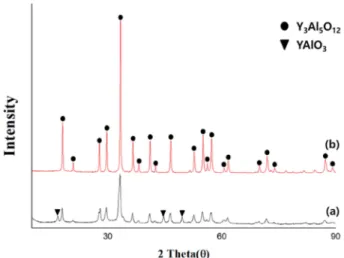
The crystallization behavior of the YAG precursors according to the amount of PVA added and the molecular weight is represented in Figs. 2 to 4. Fig. 2 shows the XRD patterns of YAG powder synthesized at different temperatures of 800
oC and 1,000
oC, derived from a precursor prepared using PVA having a relatively high
molecular weight of 146,000 - 186,000. For the powder synthesized at 1,000
oC, only the YAG phase was observed, while for the powder synthesized at 800
oC, a small amount of YAP(YAlO
3) was observed. In the case of synthesizing YAG powder by the conventional solid phase reaction method, at least 1,200
oC was required to obtain single phase YAG. At lower temperature than this, a complete phase transition to YAG was not achieved, and YAM and YAP were observed.
19,20)According to Kang’s research,
21)when synthesizing YAG powder by spray pyrolysis, it was reported that the synthesis temperature of YAG was 1,100
oC for 5 h. Fig. 3 shows the XRD pattern of the powder synthesized at 1,000
oC by adding PVA having a molecular weight of 146,000 - 186,000 with an addition ratio of 2:1 and 4:1. In both cases, only
Fig. 1. Simultaneous DTA/TG results of precursor gel prepared by PVA (Mw. 146,000 - 186,000) polymer solution method.
Fig. 2. XRD patterns of YAG powder synthesized by PVA (Mw.
146,000-186,000) solution method at different temperature of (a) 800oC and (b) 1,000oC.
Fig. 3. XRD patterns of YAG powder synthesized by PVA (Mw.
146,000 - 186,000) solution method at 1,000oC, with different PVA content of (a) 4:1 and (b) 2:1 ratio.
a YAG phase was observed. At a high amount (addition ratio of 2:1), the crystalline intensity of the peak tended to increase. Fig. 4 shows the XRD results of the powder synthesized with the PVA molecular weight as variables under the same heat temperature and PVA addition amount.
In both synthesized powders, side reaction substances were not observed, and only the YAG crystal phase was observed. When PVA having a high molecular weight was used, a more developed crystal phase peak was seen.
From the above results, it can be estimated that well- developed YAG crystallinity can be obtained at a large molecular weight of PVA and a sufficient amount of PVA with a heating temperature of 1,000
oC or higher.
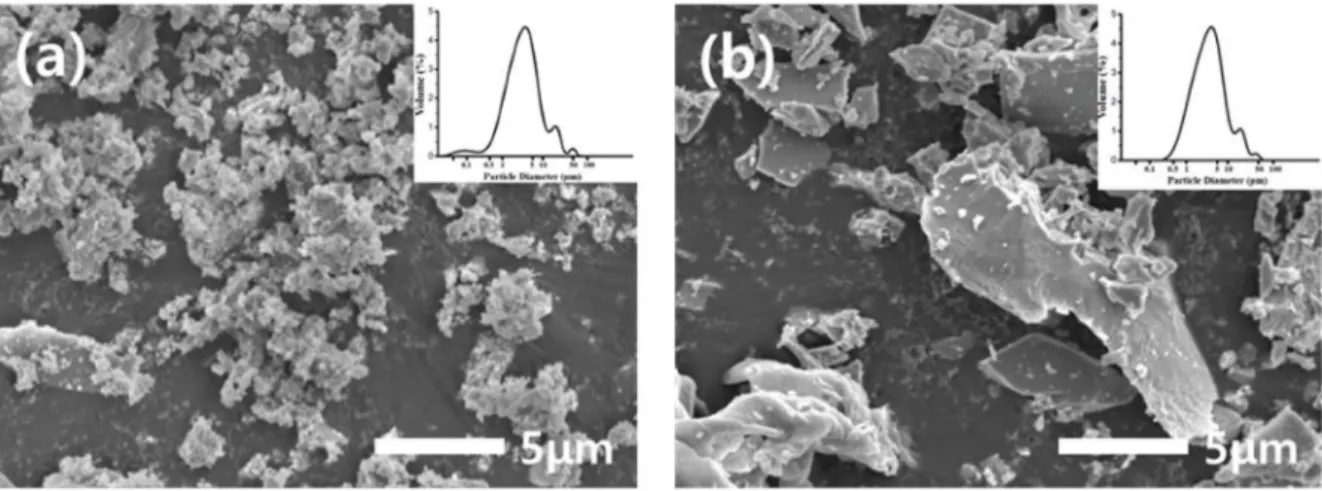
Fig. 5 and Fig. 6 show the microstructures of the synthesized YAG powder after milling for 12 h. Fig. 5 shows the YAG powder by varying the amount of PVA having a low molecular weight. The YAG powder synthesized with a PVA 2:1 ratio had relatively less large agglomeration compared to the powder synthesized with
Fig. 6. FE-SEM microstructures of YAG powder synthesized at 1,000oC with PVA (Mw. 146,000 - 186,000) content of (a) 2:1 and (b) 4:1 ratio (milling time : 12 h).
Fig. 5. FE-SEM microstructures of YAG powder synthesized at 1,000oC with PVA (Mw. 9,000 - 10,000) content of (a) 2:1 and (b) 4:1 ratio (milling time : 12 h).
Fig. 4. XRD patterns of YAG synthesized by PVA (2:1 ratio content) solution method at 1,000oC, with different PVA molecular weight of (a) Mw. 9,000 - 10,000 and (b) Mw. 146,000 - 186,000.
a PVA 4:1 ratio. In addition, sub-micron size particles were observed in the YAG powder synthesized with a PVA 2:1 ratio. As the amounts of added PVA decreased, the particle size increased, and the shape was angular.
Fig. 6 shows the microstructures of the YAG powder synthesized at different amounts using PVA having a high molecular weight. The powder synthesized with a PVA 2:1 ratio was observed to have a smaller particle size than the powder synthesized with PVA 4:1. The YAG powder synthesized using high molecular weight PVA showed a relatively smaller particle size after ball- milling than YAG powder using low molecular weight PVA. Further, in the case of the 2:1 ratio, a powder with sub-micron size particle was observed and the portion of this in particle size distribution increased than the 2:1 ratio of low molecular weight PVA [Fig. 5(a)]. It was thereupon confirmed that relatively soft, porous powders were ground into more fine particles through a pulverization process, when a large amount of high molecular weight PVA was added.
17)It has been reported that MgO and SiO
2as sintering agents improve the densification during YAG sintering to obtain a sintered body close to the theoretical density, and they also promote grain growth. According to research by Ikesue and Tong,
22,23)it was reported that a relative density of about 99 % at 1,650
oC was obtained by adding a sintering agent such as MgO or TEOS, and a transparent YAG sintered body was fabricated by vacuum sintering at 1,750
oC for 20 h. In the present study, densification of YAG powder synthesized by the PVA polymer solution method was attempted without adding any sintering agent. Table 1 shows the relative densities of the sintered YAG which is manufactured by using the YAG powder prepared according to the molecular weight and amount of PVA. All samples were pulverized for 12 h, and sintered for 6 hours at 1,700
oC in an air atmosphere. At a PVA molecular weight of 146,000 and an addition
amount of 2:1, the relative density of the sintered body was 95.7 %, representing the highest value. It is estimated that the high density is due to the smaller particle size of the synthetic powder and relatively round particle shape [Fig. 6(a)]. On the contrary, when a relatively small amount of PVA with low molecular weight was used, the particles in the synthetic powder were angled and the agglomeration was severe [Fig. 5(b)], which resulted in a low relative density of 72.3 %.
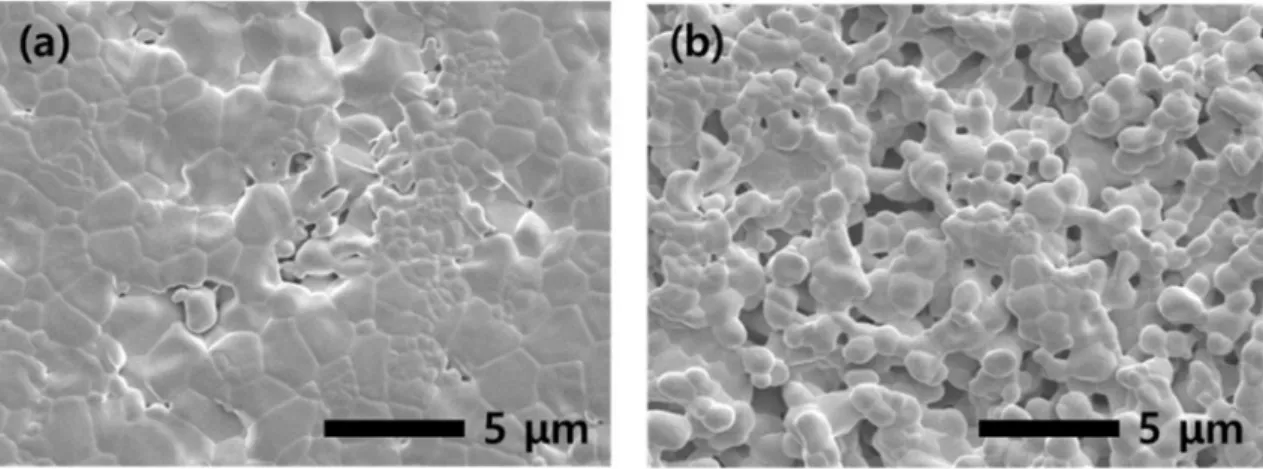
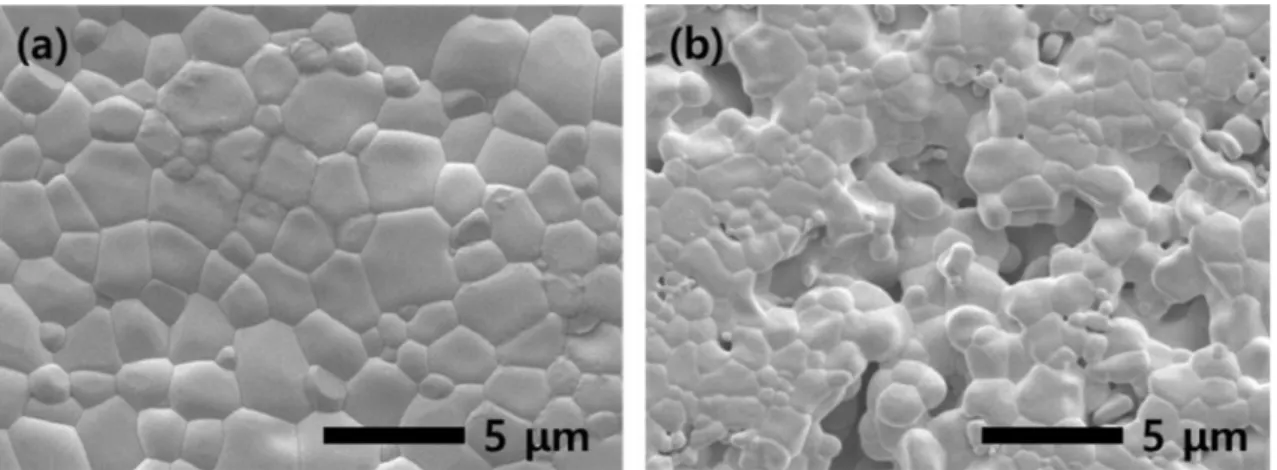
Fig. 7 and Fig. 8 show the SEM microstructures of the surface of sintered YAG according to the PVA molecular weight and the addition amount. In Fig. 7 showing the sintering results obtained using low molecular weight PVA, a denser microstructure was observed when the amount of PVA was large, and a grain size of 1 to 3 μm was observed. In Fig. 8, using high molecular weight PVA, similar results are shown. It shows a relatively dense microstructure with 95.7 % relative density, at 2:1 PVA addition. Grain growth occurred with the grain size of 2 to 5 μm and a well densified surface microstructure was observed. Fig. 9 shows the microstructures of another surface existing pore and fracture surface of Fig. 8(a).
Few large pores were observed on the surface and some smaller pores were observed at the fracture surface. It is speculated that the large pores on the surface are due to the agglomerated large particles caused by insufficient grinding time. In addition, the different microstructure between the surface and the fractured inner surface is
Fig. 7. FE-SEM microstructures of YAG surface sintered at 1,650oC for 6h with PVA (Mw. 9,000 - 10,000) content of (a) 2:1 and (b) 4:1 ratio.
Table 1. Relative densities of sintered YAG samples at different pva molecular weight and content ratio.
PVA content ratio PVA Mw. Relative density (%)
2:1 009,000 91.8
146,000 95.7
4:1 009,000 72.3
146,000 82.4
caused by the difference of oxygen vacancies. The lattice diffusion depending on the oxygen vacancies plays a role in removing closed pores during the sintering process. It is thus assumed that the different concentration of oxygen on the sample surface and inside the sample resulted in the different microstructure.
24)The synthesized YAG powder is very soft and porous due to the PVA solution synthesis method. The particle size and shape of the powder thus can be easily changed by the simple ball-milling process.
25,26)In the case of YAG powder synthesized by using high molecular weight PVA in a ratio of 2:1, the ball-milling effect was significant because of the more porous powder structure [Fig. 6(a)]. Based on these results, the powder prepared by varying the ball milling time was compacted and sintered in order to examine the effect of particle size and shape depending on the milling conditions on densification behavior.
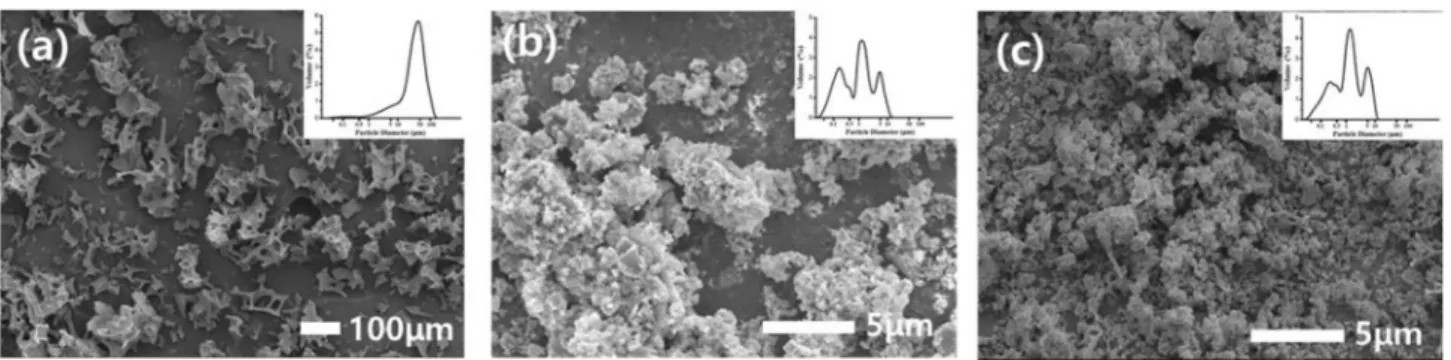
Fig. 10 shows the SEM microstructures of YAG powder without ball-milling and with ball-milling for 20 hours and 30 h, respectively. The YAG powder without
ball-milling was observed to have a porous structure of about 100 μm in size, and the ball-milled YAG powders showed a finer average particle diameter of about 1 μm than that of the ball-milled YAG powder for 12 h, and particles in the sub-micron range increased. In addition, it was found that the grinding effect was little at ball- milling for more than 20 h. Fig. 11 shows the SEM microstructures of the surface of sintered YAG obtained by sintering the YAG powder without ball-milling, and with ball-milling for 20 h and 30 h under the same sintering conditions. In the case of the sintered YAG using the powder without ball-milling, many macro-pores were observed, and the relative density was 80.3 %. This is considered to be the result of uneven density of the press-formed green body due to huge particles of heterogeneous size. The sintered YAG using the powder obtained by ball-milling for 20 h and 30 h showed a finer microstructure compared to the result of ball- milling for 12 h [Fig. 8(a)], and the relative densities were 97.8 % and 97.2 %, respectively. The relative densities of the sintered YAG samples at different processing
Fig. 8. FE-SEM microstructures of YAG surface sintered at 1,650oC for 6 h with PVA (Mw. 146,000 - 186,000) content of (a) 2:1 and (b) 4:1 ratio.Fig. 9. FE-SEM microstructures of Fig. 8(a)): (a) surface with pore and (b) fracture surface.
parameters are summarized in Table 2. Fig. 12 shows the microstructures of the fracture surface of the sintered YAGs (b) and (c), as shown in Fig. 11. Unlike the fully dense surface, micro-pores with intra-granular fracture behavior were observed in the fracture surface. It is speculated that the micro-pores can be removed by control of sintering schedule, such as longer holding time.
4. Conclusions
In the YAG powder using the PVA solution method,
Fig. 10. SEM morphologies of synthesized YAG powder with 2:1 content PVA (Mw. 146,000 - 186,000) according to milling time of (a) no ball-milling, (b) 20 h, (c) 30 h.
Fig. 11. SEM morphologies of sintered YAG surface according to milling time of (a) no ball-milling, (b) 20 h, (c) 30 h (2:1 content PVA with Mw. 146,000 - 186,000).
Fig. 12. SEM morphologies of sintered YAG fracture surface according to milling time of (a) 20 h, (b) 30 h (2:1 content PVA with Mw.
146,000 - 186,000).
Table 2. Relative densities of sintered YAG samples at different processing parameters (Sintering temperature: 1,650oC).
Ball-milling time
PVA content
ratio PVA M.W. Relative
density (%)
12 h 4:1 009,000 72.3
146,000 82.4
2:1 009,000 91.8
146,000 95.7
20 h 2:1 146,000 97.8
30 h 2:1 146,000 97.2
YAG single phase was synthesized at 1,000
oC in an air atmosphere. In the synthesis of YAG, the molecular weight and the amount of PVA affected the shape and particle size and, furthermore, the pulverization and sintering behavior. When the molecular weight of PVA was large and the amount of addition was relatively large, softer and more porous synthetic powders were obtained and it was possible to reduce the particle size to a submicron regime by a simple ball milling process. The YAG powder compact using ball-milled powder was densified, showing a relative density of 97 % or more by sintering at 1,650
oC without adding any sintering agent.
The sintered YAG derived from the powder by ball- milling for 20 hours showed a fully densified surface microstructure but had micro-pores inside, showing an intra-granular fracture surface. Finally, facile YAG synthesis and densification were possible by using the PVA solution method compared to the solid phase method or other synthetic methods.
References
1. H. S. Kwon, Y. J. Kim, H. K. Park and C. H. Lee, Surf.
Coat. Technol., 374, 493 (2019).
2. W. Liu, L. Jin and S. Wang, Mater. Chem. Phys., 232, 471 (2019).
3. H. I. Na, J. W. Park, S. C. Choi and H. J. Kim, Appl.
Surf. Sci., 476, 663 (2019).
4. J. Iwasawa, R. Nishimizu, M. Tokita, M. Kiyohara and K. Uematsu, J. Am. Ceram. Soc., 90, 2327 (2007).
5. D. M. Kim, S. Y. Yoon, K. B. Kim, H. S. Kim, Y. S. Oh and S. M. Lee, J. Korean Ceram. Soc., 45, 707 (2008).
6. K. B. Kim, D. M. Kim, J. K. Lee, Y. S. Oh, H. T. Kim, H. S. Kim and S. M. Lee, J. Korean Ceram. Soc., 46, 456 (2009).
7. J. Zhou, F. Zhao, X. Wang, Z. Li, Y. Zhang and I. Yang, J. Lumin., 119, 237 (2006).
8. H. G. Jung, G. H. Hwang, K. Y. Lim, Y. H. Lee and S.
G. Kang, J. Korean Powder Metall. Inst., 13, 243 (2006).
9. L. Yang, T. Lu, H. Xu and N. Wei, J. Alloys Compd., 484, 449 (2009).
10. X. H. Yan, S. S. Zheng, R. M. Yu, J. Cai, Z. W. Xu, C.
J. Liu and X. T. Luo, Trans. Nonferrous Met. Soc. China, 18, 648 (2008).
11. M. Mostafa, K. Ebnalwaled, H. A. Saied and R. Roshdy, J. Korean Ceram. Soc., 55, 581 (2018).
12. T. M. Chen, S. C. Chen and C. J. Yu, J. Solid State Chem., 144, 437 (1999).
13. Y. C. Kang, I. W. Lenggoro, S. B. Park and K. Okuyama, Mater. Res. Bull., 35, 798 (2000).
14. M. Suarez, A. Fernandez, J. L. Menendez and R.
Torrecillas, J. Alloys Compd., 493, 391 (2010).
15. B. Vaidhyanathan and J. G. P. Binner, J. Mater. Sci., 41, 5954 (2006).
16. T. Zhou, L. Zhang, Z. Li, S. Wei, J. Wu, L. Wang, H.
Yang, Z. Fu, H. Chen, D. Tang, C. Wong and Q. Zhang, Ceram. Int., 43, 3140 (2017).
17. B. Liu, Y. You, H. Zhang, H. Wu, J. Jin and H. Liu, RSC Adv., 6, 110349 (2016).
18. A. R. Kim and S. J. Lee, J. Korean Ceram. Soc., 51, 424 (2014).
19. E. R. Kupp, S. Kochawattama, S. H. Lee, S. Misture and G. L. Messing, J. Mater. Res., 29, 2303 (2014).
20. H. G. Jung, G. H. Hwang, K. Y. Lim, Y. H. Lee and S.
G. Kang, J. Korean Powder Metall. Inst., 13, 243 (2006).
21. Y. C. Kang, Y. S. Chung and S. B. Park, Korean J.
Chem. Eng., 38, 62 (1999).
22. A. Ikesue, T. Kinoshita, K. Kamta and K. Yoshida, J.
Am. Ceram. Soc., 78, 1033 (1995).
23. H. Tong, N. Wang, Y. Zou, Z. Zhang, W. fan, J. Shou and X. Zhang, J. Electron. Mater., 48, 374 (2018).
24. R. Manalert and M. N. R. Rahaman, J. Mater. Sci., 31, 3453 (1996).
25. Y. H. Kim and S. J. Lee, J. Korean Powder Metall. Inst., 20, 37 (2013).
26. S. J. Lee and J. E. Lee, J. Korean Powder Metall. Inst., 18, 35 (2011).
Author Information Hyun-Ho Im
목포대학교 학생