Different Pattern of Chronic Obstructive Pulmonary Disease Assessment Test Score between Chronic Bronchitis and Non-chronic Bronchitis Patients
Sang Hoon Yoo, M.D.
1, Jae Ha Lee, M.D.
2, Kwang Ha Yoo, M.D., Ph.D.
3, Ki-Suck Jung, M.D., Ph.D.
4and Chin Kook Rhee, M.D., Ph.D.
51
Department of Internal Medicine, Daejeon St. Mary’s Hospital, College of Medicine, The Catholic University of Korea, Daejeon,
2
Division of Pulmonology and Critical Care Medicine, Department of Internal Medicine, Inje University Haeundae Paik Hospital, Inje University College of Medicine, Busan,
3Division of Pulmonary, Allergy and Critical Care Medicine, Department of Internal Medicine, Konkuk University School of Medicine, Seoul,
4Division of Pulmonary, Allergy and Critical Care Medicine, Department of Internal Medicine, Hallym University Sacred Heart Hospital, Hallym University College of Medicine, Anyang,
5
Division of Pulmonary, Allergy and Critical Care Medicine, Department of Internal Medicine, Seoul St. Mary’s Hospital, College of Medicine, The Catholic University of Korea, Seoul, Korea
Background: Chronic bronchitis (CB) is an important phenotype in chronic obstructive pulmonary disease (COPD).
The purpose of this study is to evaluate different pattern of COPD assessment test (CAT) score between CB and non-CB patients.
Methods: Patients were recruited from 45 centers in Korea, as part of the Korean COPD Subgroup Study cohort. CB was defined when sputum continued for at least 3 months.
Results: Total 958 patients with COPD were eligible for analysis. Among enrolled patients, 328 (34.2%) were compatible with CB. The CAT score was significantly higher in patients with CB than non-CB, and each component of CAT score showed a similar result. CB was significantly associated with CAT score when adjusted with age, sex, modified Medical Research Council, and post-bronchodilator forced expiratory volume in 1 second. Each component of CAT score between patients with CB and non-CB showed different pattern according to Global Initiative for Chronic Obstructive Lung Disease grade.
Conclusion: CAT score is significantly higher in patients with CB than non-CB. Each component of CAT score was significantly different between two groups.
Keywords: Pulmonary Disease, Chronic Obstructive; Bronchitis, Chronic; Quality of Life
Address for correspondence: Chin Kook Rhee, M.D., Ph.D.
Division of Pulmonary, Allergy and Critical Care Medicine, Department of Internal Medicine, Seoul St. Mary’s Hospital, College of Medicine, The Catholic University of Korea, 222 Banpo-daero, Seocho-gu, Seoul 06591, Korea
Phone: 82-2-2258-6067, Fax: 82-2-599-3589, E-mail: [email protected]
Received: Jul. 30, 2017, Revised: Nov. 15, 2017, Accepted: Nov. 20, 2017, Published online: Mar. 7, 2018
cc
It is identical to the Creative Commons Attribution Non-Commercial License (http://creativecommons.org/licenses/by-nc/4.0/).
Copyright © 2018
The Korean Academy of Tuberculosis and Respiratory Diseases.
Introduction
Chronic obstructive pulmonary disease (COPD) is irrevers- ible airway disease with recurrent exacerbations and is the cause of significant mortality and morbidity around the globe
1. COPD consists of two different phenotypes including chronic bronchitis (CB) and emphysema. CB has serious clinical out- comes, regarding higher risk of frequent exacerbations
2, high- er risk of mortality risk
3, more frequent hospital admission
4, worse quality of life symptom
5, worse mental well-being
5, and accelerated lung function decline
6.
Diagnosis, severity, and treatment of COPD depends on the extent of airflow limitation
1. However, there is no strong correlation between the degree of airflow limitation and health-related quality of life (HRQL)
7. Many disease specific questionnaires have been introduced, including St. George’s Respiratory Questionnaire (SGRQ). SGRQ is a valid, reliable tool to evaluate HRQL. However, this health status measure are long and less practical for clinical routine use
8. COPD as- sessment test (CAT) have been developed to avoid these de- fects. CAT is composed of only eight questions and a key is not needed to calculate a score
9. Moreover, a strong correlation between CAT and SGRQ was shown through two recent large multinational cross sectional studies
10,11.
Although it is known that CB is associated with poor qulity of life, data regarding CB and CAT is limited. Moreover, it is whorth analyzing which component of quality of life is af- fected more in CB patients. Also, little has been known for the pattern of difference in quality of life between CB and non-CB according to Global Initiative for Chronic Obstructive Lung Disease (GOLD) grade. The aim of this study was to evaluate the difference of CAT score and each component of CAT score between CB and non-CB. Additional aim was to discover the tendency of CAT score between two groups could be influ- enced by GOLD grade.
Materials and Methods
This multicenter, cross-sectional, and retrospective study analyzed data obtained from the Korean COPD Subgroup Study cohort. This cohort was initiated in April 2012 and is currently ongoing. We analyzed 985 patients with COPD who answered whether sputm continued for 3 months. Patients were eligible if they were age ≥40 years and a post-bronchodi- lator forced expiratory volume in 1 second (FEV
1)/forced vital capacity (FVC) of <0.7. All patients were subjected to pulmo- nary function test. Parameters collected at the time of recruit- ment included age, sex, smoking history, pulmonary function test results, CAT score, SGRQ score, previous history of exac- erbation, frequency of emergency room visits, admission into intensive care unit, presence of endotracheal intubation and mechanical ventilation, duration since COPD diagnosis, dura-
tion of COPD treatment, education, area of living, biomass fuel exposure, occupational history, present medication for COPD, comorbidities, previous history of disease, weight, height, 6-minute walking distance, and symptoms (dyspnea, chronic cough, and chronic sputum). CB was defined when sputum continued for at least 3 months. CAT score was measured in stable state, not exacerbated. CAT was measured by the research nurse and result of each component was registered in electronic Case Report Form via web. Each component of CAT score was as follows: CAT 1, cough; CAT 2, phlegm; CAT 3, chest tighitness; CAT 4, breathless; CAT 5, limitation of activ- ity; CAT 6, confidence; CAT 7, sleep; and CAT 8, enegy. Post- bronchodilator values were used, the patients were classified according to GOLD
1as COPD grade 1 (FEV
1≥80% pred), COPD grade 2 (50% pred≤FEV
1≤80% pred), COPD grade 3 (30% pred≤FEV
1≤50% pred), and COPD grade 4 (FEV
1≤30%
pred). This study was approved by the ethics committees of hospital’s individual Institutional Review Board and Ethics Committees. Written informed consent was obtained from all
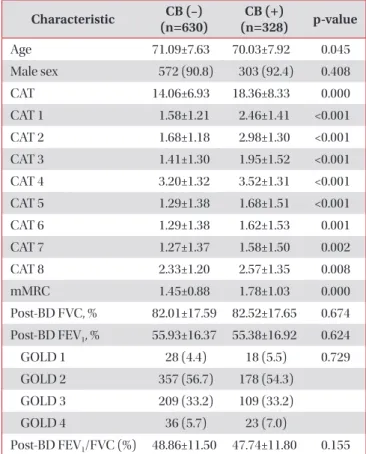
Table 1. Baseline characteristics Characteristic CB (–) (n=630)
CB (+)
(n=328) p-value
Age 71.09±7.63 70.03±7.92 0.045
Male sex 572 (90.8) 303 (92.4) 0.408
CAT 14.06±6.93 18.36±8.33 0.000
CAT 1 1.58±1.21 2.46±1.41 <0.001
CAT 2 1.68±1.18 2.98±1.30 <0.001
CAT 3 1.41±1.30 1.95±1.52 <0.001
CAT 4 3.20±1.32 3.52±1.31 <0.001
CAT 5 1.29±1.38 1.68±1.51 <0.001
CAT 6 1.29±1.38 1.62±1.53 0.001
CAT 7 1.27±1.37 1.58±1.50 0.002
CAT 8 2.33±1.20 2.57±1.35 0.008
mMRC 1.45±0.88 1.78±1.03 0.000
Post-BD FVC, % 82.01±17.59 82.52±17.65 0.674 Post-BD FEV
1, % 55.93±16.37 55.38±16.92 0.624
GOLD 1 28 (4.4) 18 (5.5) 0.729
GOLD 2 357 (56.7) 178 (54.3) GOLD 3 209 (33.2) 109 (33.2)
GOLD 4 36 (5.7) 23 (7.0)
Post-BD FEV
1/FVC (%) 48.86±11.50 47.74±11.80 0.155 Values are presented as mean±SD or number (%).
CB: chronic bronchitis; CAT: chronic obstructive pulmonary dis- ease assessment test; mMRC: modi fied Medical Research Council;
post-BD: post-bronchodilator; FVC: forced vital capacity; FEV
1:
forced expiratory volume in 1 second; GOLD: Global Initiative for
Chronic Obstructive Lung Disease.
the study patients.
All data were performed using SPSS statistical package, version 16, for Windows (SPSS Inc., Chicago, IL, USA). A two- sided p-value of <0.05 was considered statistically significant.
All data were expressed as mean±standard deviation (SD) or number (%). Categrical values were compared between two groups using chi-square test, and continuous values were compared using t test. Multiple linear regression between the CAT score was performed to correct cofounding factors.
Results
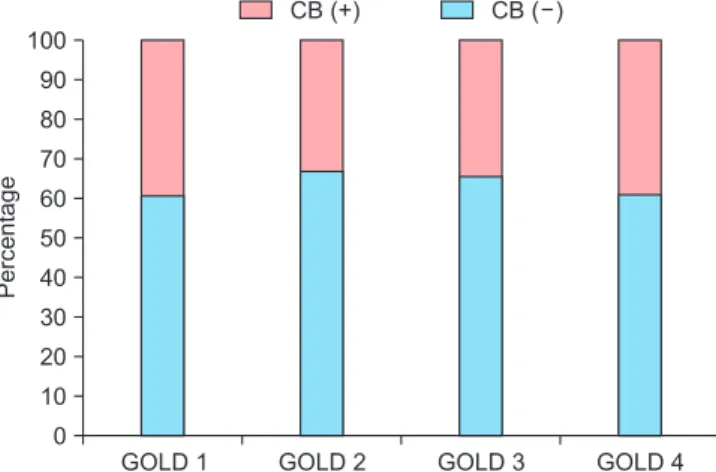
Total 958 patients with COPD were eligible for analysis. Pa- tient demographic and clinical characteristics are presented in Table 1. Among enrolled patients, 328 (34.2%) were compat- ible with CB. There was similar distribution of CB according to GOLD grade (Figure 1). There was significant, however, small difference in age between CB and non-CB groups. The modi- fied Medical Research Council (mMRC) score was signifi- cantly higher in patients with CB than non-CB. There was no
stastically significant difference in post-bronchodilator FVC, FEV
1, and FEV
1/FVC between two groups.
The CAT score was significantly higher in patients with CB than non-CB. Each component of CAT score was significantly different between two groups. Question 2 showed highest gap (differences 1.32), while question 8 showed lowest gap (differ- ences 0.24). CB was significantly associated with CAT score when adjusted with age, sex, mMRC, and post-bronchodilator FEV
1(%) in multiple linear regression analysis (Table 2).
The CAT score classified according to GOLD grade showed a similar trend between two groups. CAT score differed sig- nificantly in GOLD grade 2, grade 3, and grade 4 (Table 3).
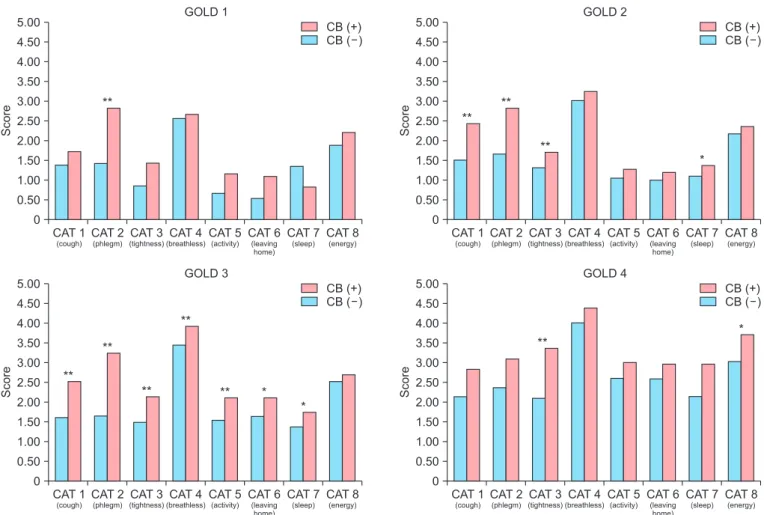
However, interestingly, each component of CAT score be- tween patients with CB and non-CB showed different pattern according to GOLD grade (Figure 2).
Discussion
The pathogenesis of CB is excessive mucus in airway, lead- ing to airway limitation. Hypersecretion of mucus provoke airway obstruction
12, changes surface tension of airway
13, aggravating airway collapse. Several studies showed CB is related with poor clinical consequences, including HRQL
7. We used CAT score to evaluate HRQL because CAT score is simple and has outstanding measurement property
9-11. In present study, patients with CB had higher value of CAT score and each component than non-CB, suggesting patients with CB had worse quality of life.
It is interesting that not only score for questions 1 and 2 (which is question for cough and phlegm) but also other score was also significantly higher in CB group. CB was defined by phlegm in this study. Thus, it is understandable that score 1 and 2 are higher in CB patients. However, not only cough and phlegm but also other components of quality of life differed significantly. This difference was even significant after adjust- ment of age, sex, mMRC, and post-bronchodilator FEV
1(%).
This result suggests that simply cough and sputum are not the whole drivers to decrease quality of life in CB patietns.
Table 2. Multiple linear regression analysis for factors affecting CAT score
Variable Beta p-value
Age 0.004 0.873
Sex –0.702 0.350
Chronic bronchitis 3.275 <0.001
mMRC 2.989 <0.001
Post-BD FEV
1, % –0.088 <0.001 CAT: chronic obstructive pulmonary disease assessment test;
post-BD: post-bronchodilator; mMRC: modified Medical Research Council; FEV
1: forced expiratory volume in 1 second.
Table 3. CAT score according to GOLD grade
GOLD CB (–)
(n=630) CB (+)
(n=328) p-value
1 10.71±5.68 14.00±6.36 0.075
2 12.83±6.25 16.42±7.74 <0.001 3 15.43±6.80 20.59±8.14 <0.001
4 20.94±9.01 26.26±7.53 0.022
Values are presented as mean±SD.
CAT: chronic obstructive pulmonary disease assessment test;
GOLD: Global Initiative for Chronic Obstructive Lung Disease; CB:
chronic bronchitis.
Figure 1. Percentage of chronic bronchitis (CB) according to Global Initiative for Chronic Obstructive Lung Disease (GOLD) grade.
100 90 80 70 60 50 40 30 20 10 0
Percentage
GOLD 1 GOLD 2 GOLD 3 GOLD 4
CB (+) CB ( )
This tendency was statistically significant even if patients were classified to GOLD grade. However, patten of CAT between CB abd non-CB groups was influenced by GOLD grade. This pattern was less prominent in GOLD 1 and most prominent in GOLD 3.
Previous studies focused on the relationship between CAT score and other factors. Pothirat et al.
14showed change in CAT score was valid to detect acute exacerbation. Yoshimoto et al.
15suggested CAT score was related with airflow limitation.
Sarioglu et al.
16demonstrated CAT score was associated with systemic inflammatory marker. In this study, we analyzed the relationship between CAT score and presence of CB. Our find- ing that patients with CB had worse quality of life symptom than non-CB was consistent with former study, although mea- surement was different between two studies (CAT vs. SGRQ)
5. Our study is valuve in that we showed CB can be an inde- pendent factor associated with poor quality of life. Previous studies simply showed that CAT is higher in CB patients.
However, in this study, we performed multiple linear regres- sion and CB was significantly associated with CAT score even adjusted with other confounding factors. Moreover, to our best
knowledge, this is the first report that showed differnet pat- terns of CAT between CB/non-CB according to GOLD grage.
Interestingly, it seemed that CB was more profoundly affect quality of life in GOLD 3 patients than GOLD 1.
In daily clinical practice, CB is very common and can be easily identified by simple questionnaire. However, many phy- sicians often overlooked the importance of CB in practice. The result of our study can be very good evidence that CB patients are suffered by poor quality of life. Thus, physicians should try to find CB phenotype more actively and check each compo- nent of quality of life. Aggressive intervention to improve each component of CAT score is mandatory.
Our study has some limitations. First, this was a cross- sectional, not a longitudinal follow-up study. Second, the definition of CB is not a classic one
17. We defined CB as pa- tients with sputum more than 3 months
18. The reason why we utilized this definition is question for CB is not familiar with Koreans. The question, especially, “two consecutive years”
can not be adquetly translated into Koreans. Because of the language problem, the answer rate for “two consecutive years”
qucestions was very low in our database. It was also evident in
CB (+) CB ( ) 5.00
4.50 4.00 3.50 3.00 2.50 2.00 1.50 1.00 0.50 0
Score
CAT 1
(cough)
GOLD 1
CAT 2
(phlegm)
CAT 3
(tightness)
CAT 4
(breathless)
CAT 5
(activity)
CAT 6
(leaving home)
CAT 7
(sleep)
CAT 8
(energy)
5.00 4.50 4.00 3.50 3.00 2.50 2.00 1.50 1.00 0.50 0
Score
CAT 1
(cough)
GOLD 2
CAT 2
(phlegm)
CAT 3
(tightness)
CAT 4
(breathless)
CAT 5
(activity)
CAT 6
(leaving home)
CAT 7
(sleep)
CAT 8
(energy)
5.00 4.50 4.00 3.50 3.00 2.50 2.00 1.50 1.00 0.50 0
Score
CAT 1
(cough)
GOLD 3
CAT 2
(phlegm)
CAT 3
(tightness)
CAT 4
(breathless)
CAT 5
(activity)
CAT 6
(leaving home)
CAT 7
(sleep)
CAT 8
(energy)
5.00 4.50 4.00 3.50 3.00 2.50 2.00 1.50 1.00 0.50 0
Score
CAT 1
(cough)
GOLD 4
CAT 2
(phlegm)
CAT 3
(tightness)
CAT 4
(breathless)
CAT 5
(activity)
CAT 6
(leaving home)
CAT 7
(sleep)
CAT 8
(energy)
**
**
**
**
*
*
*
**
**
**
** **
*
**
CB (+) CB ( )
CB (+) CB ( ) CB (+)
CB ( )