Research Note Open Access
413
경기북부 논 잡초 분포 특성
오영주1·홍선희2·이욱재1·김창석3·이인용3*
1(주)한반도생물다양성연구소, 2고려대학교 환경생태연구소, 3국립농업과학원 농산물안전성부
Distribution Characteristics of Paddy Weeds in Northern Gyeonggi-do
Young-Ju Oh1, Sun-Hee Hong2, Wook-Jae Lee1, Chang-Seok Kim3, and In-Yong Lee3*
1Korea Biodiversity Reserarch Center Co., Ltd, Pocheon 487-711, Korea
2Institute of Environment and Ecology, Korea University, Seoul 136-701, Korea
3*Department of Agro-Food Safety, National Academy of Science, RDA, Suwon 441-807, Korea (Received on October 28, 2013; Revised on November 28, 2013; Accepted on December 19, 2013)
ABSTRACT. The climate change affects the growth and development of weeds as well as the outbreak of weeds.
Especially, the occurrences of problematic paddy weeds due to climate change might cause the difficulties in weed control. This study therefore, investigated the current dominance and distribution of paddy weeds. As a result of the study on paddy weeds in northern Gyeonggi-do, there were total of 65 taxonomy groups including 23 family, 41 genus, 57 species, 7 subspecies and 1 variety. Among all the plants, 46 species were annual plants and 16 were perennial plants. Echinochloa crus-galli was the highest in importance analysis and the followings were in order of Ludwigia prostrate and Lemna paucicostata. The similarity of different paddy weeds in different regions observed through TWINSPAN analysis was distinguished by Fimbristylis miliacea, Rotala indica and Cyperus flaccidus.
Regional differences shown in CCA analysis using weed species and soil environment revealed that Gimpo-si and Namyangju-si has difference soil and weeds, which are features that distinguished them from other regions. In northern Gyeonggi-do the result of paddy weed research showed the interregional difference not in dominant weeds but in distribution species.
Key words: Paddy weed, Important value, TWINSPAN, CCA
기후변화는 기온, 강수량, 일사량 등의 기후자원의 변화 를 가져와 식물의 생육 및 분포에 변화를 가져올 수 있기 때문에 잡초의 기후에 적응한 변화는 연중 기상변화와 미 세한 기후의 영향에서 유연한 반응을 보여주고 있다(Bradshaw
& Holzapfel, 2001). 네델란드는 1970년대 보다 최근에 이 른 봄이 16일 정도 앞당겨지며 북반구에서 전체에도 봄이 평균 10일 정도 빠르게 오는 것을 대지표면에 식물이 녹 화되는 현상을 위성영상을 통해 관찰되었다(Myneni et al., 1997). 이러한 기후변화는 농업생태계에 아열대 또는 열대 잡초가 침입할 수 있는 기회를 제공하고 토착잡초 중에도 숙근류의 상당수가 월동이 가능해 지기 때문에 잡초방제 가 지금보다 훨씬 복잡하고 어려워질 것으로 알려져 있다
(Lim, 1992).
지구상에 존재하는 식물은 광합성의 유형에 따라 C3 식 물과 C4 식물로 구별되는데(Hatch and Slack, 1966; Black, 1971; Takeda and Fukuyama, 1974), C4 식물의 광합성 경 로가 밝혀지면서 이러한 식물의 기온, 강수량, 건조 등과 같은 환경조건과의 관계에 대해서 많은 연구들이 진행되 어 왔다(Noda and Eguchi, 1973; Collatz et al., 1998; Liu et al., 2004; Ehleringer et al., 1997; Yin and Li, 1997;
Pyankov et al., 2000). C4 식물은 토양수분의 이용 효율이 높고 강한 빛과 건조한 환경조건에서도 좋은 적응능력을 보이기 때문에 C3 식물에 비해 강한 경쟁력을 지닌다(Gifford, 1974; Doliner and Jolliffe, 1979). 논에 발생하는 잡초 중에 돌피, 물피, 털물참새피, 미국개기장, 방동사니, 금방동사 니, 파대가리, 바람하늘지기 등의 많은 종류가 C4 식물로 알려져 있다(Kim et al., 2011).
한국의 기후변화는 빠르게 진행되고 있는 것으로 보고
*Corresponding author:
Phone) +82-31-290-0418, Fax) +82-31-291-0503 E-mail) [email protected]
되고 있어 전국 논에 발생하는 잡초에 대한 발생현황과 분포에 대해서 정확한 정보가 요구되고 있다. 지금까지 경 기지역의 논 잡초발생에 대해서는 25종에 대해서 일년생 과 다년생 잡초의 비율 등에 대해 보고되었고(Kim et al., 1992), 경기지역 340 지점에 대해 유형별 우점 잡초의 변 화 연구가 진행된 바 있다(Kim et al., 1997). 2001년에 경 기지역의 논을 답유형, 이앙시기, 농업지대 등으로 구분하 여 논 잡초 분포를 조사하여 22종의 출현 종에 대해 분석 하여 올방개, 피, 벗풀, 자귀풀, 물달개비, 가막사리 등이 문제잡초라는 것을 발표하였고, 2007년에도 같은 방법으 로 조사하여 거의 같은 종이 문제잡초임이 밝혀져 계속해 서 논 농사에 어려움을 주고 있음이 보고되었다(Park et al., 2001; Park et al., 2007). 따라서 본 연구는 경기북부 지역 논 농사지대를 대상으로 잡초의 분포 및 발생 피도 등급을 조사하여 논에 발생하는 잡초의 종류와 특징을 밝 혀내고 문제잡초의 향후 변화양상에 대비하고자 수행하였다.
논 잡초 조사지역과 방법
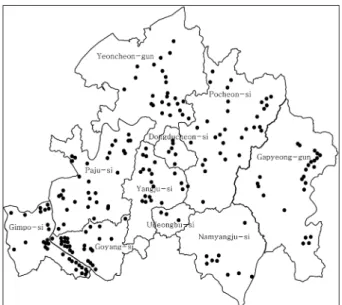
경기북부지역의 가평군, 고양시, 김포시, 남양주시, 동두 천시, 양주시, 연천군, 의정부시, 파주시, 포천시 10개 시 군에 대하여 현지조사를 실시하였고 현지조사는 2013년 7 월부터 9월까지 204필지를 선정하여 진행하였다(Fig. 1).
잡초분포조사는 경기북부 10개 시군의 논의 위치를 위 성으로 파악하여 시군의 논이 고루 조사될 수 있도록 선 정하였고 조사구의 면적은 1필지를 대상으로 하여 식물의 피도와 토양의 EC, 수분, 온도(WT-1000N), pH(Eutech pc300)를 함께 측정하였다. 식물의 피도는 Braun-Blanquet (1964)의 방법으로 7개 등급(r, +, 1, 2, 3, 4, 5)을 기준으 로 조사하였고 피도조사시 식물 층간 높이를 고려하여 부
유잡초, 작은 키의 잡초(초본 2층), 큰 키의 잡초(초본 1 층)의 피도가 모두 기록될 수 있도록 하였다.
논 잡초 조사결과의 분석
잡초조사 결과는 국가표준식물목록(KNA, 2007)에 의거 하여 목록을 작성하였고 외래잡초는 한국귀화식물 원색도 감(Park, 2009)에 의해 표기하였다. 출현한 잡초종에 대해 서는 Raunkiaer(1934)의 생활형을 기준으로 일년생과 다년 생을 구분하였고 과별 분포 비율을 산정하였다. 잡초의 우 점순위를 알아보기 위하여 중요치(IV)분석을 실시하였다 (Curtes and Mc Intosh, 1950).
Important value (IV) = (RF + RC) / 2
지역간의 잡초종의 출현에 따른 차이를 보기 위하여 Hill(1973)의 의한 Two-way indicator species analysis (TWINSPAN)을 이용하여 분석을 수행하였다(Community analysis package 4.0). 또한 토양환경과 식물종과의 관계 를 파악하기 위하여 Canonical correspondence analysis
(CCA)을 수행하여 생태학적 관점에서 환경변수와 종과의
상호관계를 분석하였다(Ter Braak, 1986).
경기북부 발생잡초
경기북부 204개의 논에 발생하는 잡초는 23과 41속 57 종 7변종 1품종, 총 65분류군이 출현하는 것으로 조사되 었다. 이중 김포시가 가장 많은 종이 조사되었으며 고양 시와 연천군 순으로 종이 나타났으며 논이 거의 없는 의 정부시가 적은 수의 잡초가 조사되었다. 이중 다년생과 일 년생의 비율은 지역간의 차이는 거의 없었고 전체적으로 는 다년생이 28.3%, 일년생이 71.7%로 일년생이 많은 종 수를 보였다(Table 1). 이 결과는 2007년에 조사된 경기도지 역의 논 잡초조사에서 일년생과 다년생의 비율이 49.7%:
50.3% 이었던 결과(Park et al., 2007)보다는 일년생 비율이 높게 나타났는데 이는 과거 1 m2 격자조사와 이번 조사 시 기준이었던 1필지단위의 조사와의 차이로 판단된다.
조사된 65분류군의 과별 분포는 사초과가 23%로 가장 많이 출현하였고 다음은 화본과와 마디풀과 그리고 국화 과가 출현하였다(Fig. 2). 우리나라 농경지에 발생하는 433 종에 대한 과별 분류에서 국화과, 화본과, 마디풀과, 사초
Relative frequency (RF) (%) =
Frequency of any species Total frequency of all species ×100
Relative cover (RC) (%) =
Cover of species A Total cover of all species ×100
Fig. 1. 204 sampling sites in the north area of Gyeonggi-do.
과 순인데 비하여(Lee et al., 2007) 논에서만 조사된 이번 결과에서는 사초과가 가장 우점하는 것으로 분석되었다.
발생잡초 별 중요치 분석
출현종에 우점 서열을 판단하기 위한 중요치 분석에서 는 돌피가 가장 많은 논에 출현하였고 높은 피도를 보이 면서 가장 우점하는 것으로 조사되었고 부유식물 중에 논 을 가장 많이 덮고 있었던 좀개구리밥이 다음으로 높은 것으로 분석되었다. 그외에도 여뀌바늘, 물달개비, 사마귀 풀, 자귀풀, 가막사리, 한련초, 미국가막사리, 벗풀, 밭뚝외 풀, 닭의장풀, 올방개, 금방동사니 순으로 조사되었다(Table 2). 이번 조사의 결과는 기존 경기도의 전체의 논 잡초 조 사결과인 올방개, 피, 벗풀, 가막사리, 물달개비, 자귀풀의 우점순위와는 차이가 있게 조사되었다(Park et al., 2007).
이러한 결과는 과거의 밀도를 중심으로 조사한 결과와 피 도를 중심으로 한 이번 조사결과의 차이가 있었을 것으로
여겨지며 과거 조사에서 약 20여종의 논 잡초만 격자조사 로 조사가 되었지만 이번 조사에서는 1필지단위로 출현한 모든 종에 대해서 분석하였기 때문에 다른 결과가 나타난 것으로 판단된다.
경기북부 시군별 우점순위를 알아보기 위하여 시군별 중요치 분석을 한 결과 지역별로는 가평군, 고양시, 파주 시, 의정부시, 김포시, 양주시에서는 돌피의 중요치가 높 았으며 남양주시는 물달개비, 연천군은 사마귀풀, 동두천 시, 포천시는 좀개구리밥의 중요치가 높은 것으로 분석되 었다(Table 3).
논 잡초와 토양의 통계적 분석
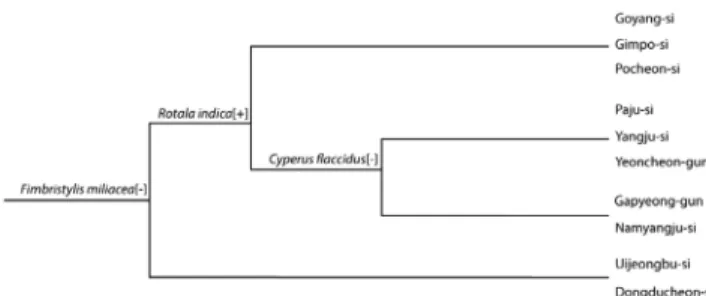
논에 출현한 종을 중심으로 조사지역간의 잡초발생의 차이를 보기 위하여 TWINSPAN분석을 실시하였다(Fig.
3). 분석결과 바람하늘지기의 출현유무에 의해 의정부시와
동두천시가 구별되었고 마디꽃에 의해서 고양시, 김포시, 포천시가 나누어졌다. 병아리방동사니는 파주시, 양주시, 연천군과 가평군, 남양주시를 구별하는 지표종으로 영향 을 미쳐 잡초종의 출현을 통해 지역간 논 잡초발생의 유 사성을 비교할 수 있었다.
논 토양의 환경과 잡초와의 관계를 알아보기 위하여 CCA분석을 실시하여 종의 분포패턴과 토양환경의 기여도 에 대한 정보를 분석하였다(Fig. 4). CCA분석 결과 1축에 서는 김포시가 토양 EC와 양의 상관관계와 토양 수분조 건과의 음의 상관관계를 가지며 파대가리, 애기부들, 검정 말, 황새냉이의 기여도에 의해 다른 시군과 구별되었고 2 축에서는 남양주시가 토양의 pH와 양의 상관관계를 가지 며 미꾸리낚시, 통발의 기여도에 의해 다른 지역과 구별 되었다. CCA분석에 의해서 김포시와 남양주시의 논 토양 환경과 출현하는 잡초종의 차이가 다른 지역과 구별되는 것을 확인할 수 있었다.
경기북부의 잡초조사결과에서 출현한 돌피, 물피, 방동 사니, 금방동사니, 참방동사니, 바람하늘지기, 애기하늘지 기, 검정말 등과 같은 C4식물은 기후변화가 지속될 경우 Table 1. Distribution ratio of annual and perennial weeds in 10 cities/provinces of northern Gyeonggi-do.
Survey areax
GP GY GPO NYJ DDC YJ YC UJB PJ PC
Total No. of Weeds 35 37 43 34 25 33 36 15 31 34
No. of annual weeds (%) 25 (71.4)
25 (67.6)
30 (69.8)
25 (73.5)
18 (72.0)
25 (75.8)
27 (75.0)
11 (73.3)
22 (71.0)
23 (67.6) No. of perennial weeds (%) 10
(28.6) 12 (32.4)
13 (30.2)
9 (26.5)
7 (28.0)
8 (24.2)
9 (25.0)
4 (26.7)
9 (29.0)
10 (29.4)
xGP: Gapyeong-gun; GY: Goyang-si; GPO: Gimpo-si; NYJ: Namyangju-si; DDC: Dongducheon-si; YJ: Yangju-si; YC: Yeoncheon-gun; UJB:
Uijeongbu-si; PJ: Paju-si; PC: Pocheon-si
Fig. 2. Occurrence ratio of family of paddy weeds in northern Gyeonggi-do.
Table 2. Importance value of paddy weeds species in northern Gyeonggi-do, decreasingly ordered by IVx.
Family Scientific name N IV RF RC
Gramineae Echinochloa crus-galli 173 8.79 8.73 8.85
Lemnaceae Lemna paucicostata 124 8.14 6.26 10.03
Onagraceae Ludwigia prostrata 156 7.65 7.87 7.43
Pontederiaceae Monochoria vaginalis var. plantaginea 115 6.25 5.80 6.70
Commelinaceae Aneilema keisak 114 6.13 5.75 6.52
Leguminosae Aeschynomene indica 112 5.41 5.65 5.18
Compositae Bidens tripartita 104 5.17 5.25 5.09
Compositae Eclipta prostrata 104 5.01 5.25 4.77
Compositae Bidens frondosa 86 4.12 4.34 3.90
Alismataceae Sagittaria trifolia 76 3.93 3.83 4.02
Scrophulariaceae Lindernia procumbens 74 3.51 3.73 3.29
Commelinaceae Commelina communis 67 3.12 3.38 2.86
Cyperaceae Eleocharis kuroguwai 61 3.15 3.08 3.23
Cyperaceae Cyperus microiria 59 2.66 2.98 2.33
Gramineae Echinochloa crus-galli var. oryzicola 54 2.98 2.72 3.23
Scrophulariaceae Lindernia dubia 52 2.58 2.62 2.54
Umbelliferae Oenanthe javanica 52 2.43 2.62 2.23
Campanulaceae Lobelia chinensis 52 2.40 2.62 2.17
Polygonaceae Persicaria thunbergii 51 2.37 2.57 2.17
Gramineae Echinochloa oryzoides 30 1.53 1.51 1.54
Cyperaceae Fimbristylis miliacea 29 1.35 1.46 1.24
Cyperaceae Scirpus juncoides 28 1.40 1.41 1.38
Polygonaceae Persicaria hydropiper 21 0.94 1.06 0.81
Cyperaceae Cyperus iria 17 0.75 0.86 0.65
Cyperaceae Cyperus difformis 15 0.69 0.76 0.63
Polygonaceae Persicaria blumei 14 0.63 0.71 0.55
Lythraceae Rotala indica 10 0.49 0.50 0.47
Cyperaceae Cyperus exaltatus var. iwasakii 10 0.46 0.50 0.41
Potamogetonaceae Potamogeton distinctus 9 0.46 0.45 0.47
Lemnaceae Spirodela polyrhiza 9 0.43 0.45 0.41
Hydrocharitaceae Hydrilla verticillata 9 0.48 0.45 0.51
Cyperaceae Cyperus flaccidus 9 0.41 0.45 0.37
Najadaceae Najas minor 9 0.54 0.40 0.67
Hydrocharitaceae Ottelia alismoides 7 0.35 0.35 0.35
Typhaceae Typha orientalis 7 0.33 0.35 0.30
Gramineae Beckmannia syzigachne 6 0.26 0.30 0.22
Gramineae Alopecurus aequalis var. amurensis 5 0.23 0.25 0.20
Pontederiaceae Monochoria korsakowi 5 0.26 0.25 0.26
Cyperaceae Cyperus amuricus 5 0.22 0.25 0.18
Gramineae Leersia japonica 3 0.20 0.15 0.24
Cyperaceae Eleocharis congesta 3 0.13 0.15 0.10
Cyperaceae Eleocharis acicularis for. longiseta 3 0.14 0.15 0.12
Alismataceae Sagittaria pygmaea 3 0.13 0.15 0.10
Gramineae Arthraxon hispidus 3 0.13 0.15 0.10
Polygonaceae Persicaria lpathifolia var. lapathifolia 3 0.14 0.15 0.12
Gramineae Phragmites communis 2 0.09 0.10 0.08
Ranunculaceae Ranunculus sceleratus 2 0.09 0.10 0.08
Table 2. Importance value of paddy weeds species in northern Gyeonggi-do, decreasingly ordered by IVx (continued).
Lythraceae Ammannia coccinea 2 0.10 0.10 0.10
Labiatae Stachys riederi var. japonica 2 0.07 0.10 0.04
Cruciferae Cardamine flexuosa 2 0.08 0.10 0.06
Potamogetonaceae Potamogeton cristatus 1 0.05 0.05 0.04
Gramineae Panicum bisulcatum 1 0.04 0.05 0.02
Polygonaceae Persicaria viscoosa 1 0.08 0.05 0.10
Typhaceae Typha laxmannii 1 0.06 0.05 0.06
Cyperaceae Cyperus globosus 1 0.05 0.05 0.04
Gramineae Pseudoraphis ukishiba 1 0.05 0.05 0.04
Polygonaceae Persicaria sieboldi 1 0.05 0.05 0.04
Molluginaceae Mollugo pentaphylla 1 0.05 0.05 0.04
Cyperaceae Lipocarpha microcephala 1 0.05 0.05 0.04
Typhaceae Typha angustata 1 0.06 0.05 0.06
Cyperaceae Fimbristylis autumnalis 1 0.05 0.05 0.04
Gramineae Miscanthus sinensis var. purpurascens 1 0.05 0.05 0.04
Gramineae Zizania latifolia 1 0.06 0.05 0.06
Lentibulariaceae Utricularia japonica 1 0.06 0.05 0.06
Cyperaceae Kyllinga brevifolia 1 0.04 0.05 0.02
xIV: importance value; N: number of sampling units in which the species was accounted; RF: relative frequency; RC: relative cover
Table 3. Important value (IV) of weed species in teen cities / provinces of northern Gyeonggi-do
Family Scientific name Cities / Provinces
GP GY GPO NYJ DDC YJ YC UJB PJ PC
PotamogetonaceaePotamogeton cristatus - 0.33 - - - - - - - -
Potamogeton distinctus - 0.33 0.31 0.69 1.88 0.62 1.36 - - -
Lemnaceae Spirodela polyrhiza - - 1.27 0.69 - - 0.32 4.98 - 0.37
Lemna paucicostata 10.35 8.00 7.12 8.20 12.15 10.45 5.47 12.86 6.88 8.76
Compositae
Bidens tripartita 7.89 3.24 1.38 5.69 2.63 7.34 6.06 9.96 6.55 6.68 Bidens frondosa 0.80 5.43 6.26 1.24 6.86 4.48 4.23 - 4.12 3.10 Eclipta prostrata 6.83 4.58 5.14 6.53 8.17 4.54 3.04 - 4.53 5.66
Labiatae Stachys riederi var. japonica 0.35 - - 0.54 - - - - - -
Najadaceae Najas minor 0.55 0.41 - 3.95 - - 1.17 - - -
Commelinaceae Commelina communis 2.51 4.43 0.25 2.77 5.54 3.75 4.08 7.79 2.82 4.11 Aneilema keisak 4.12 8.69 5.33 4.90 1.31 2.36 7.40 3.53 7.41 8.60
Polygonaceae
Persicaria blumei 0.90 0.67 0.25 - 1.31 0.50 1.85 3.53 - - Persicaria thunbergii 3.45 1.93 2.22 2.37 1.31 2.02 1.28 7.07 4.53 1.55
Persicaria viscoosa 0.74 - - - - - - - - -
Persicaria sieboldi - - - 0.69 - - - - - -
Persicaria hydropiper 1.00 1.34 1.01 3.02 - 0.50 0.32 - 1.61 - Persicaria lpathifolia var. lapathifolia - 0.33 0.25 - - - - - - 0.37 Pontederiaceae Monochoria vaginalis var. plantaginea 7.61 5.81 6.70 8.65 8.28 6.61 5.91 7.07 4.49 4.69
Monochoria korsakowi - 0.90 0.76 - - - - - - -
Ranunculaceae Ranunculus sceleratus 0.45 - - - - - 0.32 - - -
Onagraceae Ludwigia prostrata 10.31 7.59 7.78 8.11 7.42 7.00 6.17 3.53 8.21 7.21
Table 3. Important value (IV) of weed species in teen cities / provinces of northern Gyeonggi-do(continued).
Gramineae
Phragmites communis - - 0.51 - - - - - - -
Panicum bisulcatum - 0.26 - - - - - - - -
Beckmannia syzigachne - 0.33 0.25 - 1.31 0.39 0.64 - - -
Leersia japonica - - - - - - 0.55 - 1.08 -
Echinochloa oryzoides 0.45 2.42 0.81 1.14 - 2.86 - - 3.50 2.25 Echinochloa crus-galli 8.24 8.91 7.83 5.69 10.16 8.63 7.36 13.50 11.62 10.44 Alopecurus aequalis var. amurensis - 1.00 - - - 0.50 0.32 - - -
Pseudoraphis ukishiba - - - - - 0.50 - - - -
Echinochloa crus-galli var. oryzicola 0.90 4.18 6.67 2.08 1.60 2.13 1.43 - 4.17 0.45 Miscanthus sinensis var. purpurascens - - - - - - - - - 0.37
Arthraxon hispidus 0.45 - - 0.69 1.03 - - - - -
Zizania latifolia - - 0.31 - - - - - - -
Typhaceae
Typha laxmannii - - - - - - 0.40 - - -
Typha orientalis - 0.33 1.07 0.69 - - - - 0.40 -
Typha angustata - - 0.31 - - - - - - -
Lythraceae
Rotala indica 0.90 - - 1.14 2.63 0.50 0.32 3.53 0.81 -
Ammannia coccinea - - - - 1.60 - - - 0.40 -
Cyperus microiria 2.80 4.43 0.81 1.24 2.63 1.51 3.31 - 3.63 3.50
Cyperus globosus 0.45 - - - - - - - - -
Eleocharis congesta 0.45 - - - - 0.50 - - - 0.28
Fimbristylis miliacea 0.90 1.67 1.12 0.69 - 0.50 2.96 - 0.81 1.83
Cyperaceae
Cyperus amuricus - - - - - - - - 0.40 1.38
Cyperus flaccidus - 0.33 0.31 - - 0.39 1.28 - 0.81 -
Lipocarpha microcephala - - - - - - 0.32 - - -
Eleocharis acicularis for. longiseta - - - 1.39 - - - - - 0.37
Cyperus difformis 1.00 1.00 1.21 0.84 - - 0.64 - - 0.73
Fimbristylis autumnalis - - - - - - - - - 0.37
Eleocharis kuroguwai 2.00 3.09 5.46 2.52 1.31 2.97 3.76 - 2.42 2.08 Scirpus juncoides 1.55 - 0.87 3.21 2.63 1.74 2.40 3.53 0.40 1.55 Cyperus exaltatus var. iwasakii - 1.67 0.76 - - - - - - 0.73
Cyperus iria 0.45 - 2.98 1.93 - - - - 0.40 -
Kyllinga brevifolia - - 0.20 - - - - - - -
Umbelliferae Oenanthe javanica 4.60 1.90 2.55 2.23 2.34 4.42 2.10 - 2.02 0.73
Molluginaceae Mollugo pentaphylla 0.45 - - - - - - - - -
Cruciferae Cardamine flexuosa - - 0.25 - - - - - - 0.28
Hydrocharitaceae Hydrilla verticillata - - 1.91 - - - - - 0.81 0.37
Ottelia alismoides - 0.33 0.20 1.14 - 0.50 0.72 - - 0.37
Campanulaceae Lobelia chinensis 4.51 2.16 0.51 2.08 2.63 2.02 4.17 - 1.61 3.01 Leguminosae Aeschynomene indica 4.70 4.84 5.95 3.51 7.99 5.94 6.15 7.07 6.10 4.11 Alismataceae Sagittaria trifolia 3.19 3.58 3.95 2.08 2.63 6.51 4.47 4.98 3.32 4.16
Sagittaria pygmaea - 0.33 0.20 - - 0.50 - - - -
Lentibulariaceae Utricularia japonica - - - 0.84 - - - - - -
Scrophulariaceae Lindernia dubia 1.90 0.49 0.56 1.53 - 3.02 4.89 7.07 2.51 6.29 Lindernia procumbens 2.25 2.68 6.41 5.29 2.63 3.75 2.81 - 1.61 3.26
논 잡초의 분포에서 우점 순위를 차지할 것으로 예상된다.
일반적으로 C3 식물은 기온과 광량이 낮은 봄과 가을에 고 위도 지방에서 높은 생산력을 지닌 반면 C4 식물은 여름 과 저위도 지방에서 높은 생산력을 나타낸다(Takeda et al., 1977). 따라서 기후변화는 평균기온과 강수량에 영향을 많 이 미칠 것으로 예상되고 있어 현재의 잡초분포 결과는 향후 C3 식물인 벼와의 경합에서의 C4 잡초의 우점이 예 상되며 문제잡초의 발생으로 방제의 어려운 상황이 발생 할 수 있을 것으로 판단된다. 향후 기후변화의 의한 C4 잡초의 온도, 광량, 수분 조건 등에 대한 반응기작과 벼와 의 경합에 대한 연구가 진행되어 미래에 잡초변화를 예측
하여 효율적인 잡초 방제가 될 수 있도록 해야 할 것이다.
요 약
기후변화는 기온, 강수량, 일사량 등을 변화시켜 잡초의 생육에 영향을 많이 미치며 잡초발생의 변화를 가져올 것 이다. 논에 발생하는 문제잡초의 대부분이 C4 식물이며 이는 기후변화에 의해 문제잡초 발생이 많아지며 잡초방 제에도 많은 어려움이 있을 것으로 예상되고 있다. 따라 서 본 연구는 논 잡초발생 현황을 조사하여 문제잡초의 향후 변화양상에 대비하고 자 수행하였다.
경기북부 논 잡초 조사결과 23과 41속 57종 7변종 1품 종으로 총 65분류군이 조사되었고 전체 식물중에 일년생 식물은 46종이고 다년생 식물을 16종으로 분석되었다. 이 중 사초과가 23.1%로 가장 비율이 높았으며 벼과, 마디풀 과, 국화과 순으로 나타났다. 중요치 분석에서는 돌피가 가장 높았으며 여뀌바늘, 좀개구리밥, 물달개비, 사마귀풀 순으로 분석되었다. 지역별로는 가평군, 고양시, 파주시, 의정부시, 김포시, 양주시에서는 돌피의 중요치가 높았으 며 남양주시는 물달개비, 연천군은 사마귀풀, 동두천시, 포 천시는 좀개구리밥의 중요치가 높았다. TWINSPAN 분석을 통한 시군의 잡초종의 유사성은 바람하늘지기, 마디꽃, 병 아리방동사니에 의해 지역이 구분되었다. CCA 분석에서 잡 초종과 토양환경을 이용한 지역간의 차이는 김포시가 높 은 토양 EC와 파대가리, 애기부들에 의해 구분되고 남양 주시가 낮은 토양 온도조건과 미꾸리낚시, 통발에 의해 다 른 지역과 구별되었다.
주요어: 논잡초, 중요값, TWINSPAN, CCA
Acknowledgements
This study was carried out with the support of
“Research Program for Agricultural Science & Technology Development” (Project No. PJ009319032013), National Academy of Agricultural Science, Rural Development Administration, Republic of Korea.
References
Black, C.C. 1971. Ecological implication of dividing plants into group with distinct photosynthetic production capacities.
Advanced Ecological Resources volume 7. Academic Press.
Massachusetts. USA.
Bradshaw, W.E. and Holzapfel, C.M. 2001. Genetic shift in Fig. 3. Twinspan analysis diagram obtained for the 204 sampling
plots described by cover value of species. Investigation areas were divided by Fimbristylis miliacea, Rotala indica and Cyperus flaccidus.
Fig. 4. Ordination diagram by CCA of the sampling plots on the cover value of 65 weed species and pH, EC, moisture, temperature of soil. The circle symbol was 65 weed species of investigated sites. The square symbol was 10 areas of investigation from July to September in northern Gyeonggi-do.
photoperiodic response correlated with global warming. P. Natl.
Aca. Sci. 98:14509-14511.
Braun-Blanguet, J. 1964. Pflanzensoniologie. Springer-Verlag, 3rd ed. Vienna, New York.
Collatz, G.J., Berry, J. A. and Clark, J. S. 1998. Effect of climate and atmospheric CO2 partial pressure on the global distribution of C4 grasses: present, past and further. Oecologia 144:441-454.
Curtis, J.T. and McIntosch, R.P. 1950. The interrrelations of certain analytic and synthetic phytosociological characters. Ecol.
31:434-455.
Doliner, L.H. and Jolliffe, P.A. 1979. Ecological evidence concerning the adaptive significance of the C4 dicarboxylic acid pathway of photosynthesis. Oecologia 38:23-24.
Ehleringer J.R., Cerling, T.E. and Helliker, B.R. 1997. C4 photosynthesis, atmospheric CO2 and climate. Oecologia 31:255-567.
Gifford, R.M. 1974. Acomparison of potential photosynthesis, productivity and yield of plant species with differing photosynthetic metabolism. Aust. J. Plant Physiol. 1(1):107- 117.
Hatch, M.D. and Slack, C.R. 1966. Photosynthesis by sugar-cane leaves. A new carboxylation reaction and the pathway of sugar formation. Biochemical J. 101:103-111.
Hill, M.O. 1973. Reciprocal averaging; an eigenvector method of ordination. J. Ecology 61:237-249.
Kim, H.D., Park, J.S., Su, K.K., Moon, M.H., Jo, Y.C., et al. 1997.
Survey of weed population distribution and change of dominant weed species on paddy field in Kyonggi area. Korean J. Weed Sci. 17(1):1-9. (In Korean)
Kim, H.D., Kim, Y.H., Ju, Y.C., Sung, M.S., Choi, Y.J. et al. 1992.
The survey of weed population distribution in Kyonggi area.
Korean J. Weed Sci. 12(1):46-51. (In Korean)
Kim, M.H., Han, M.S., Kang, K.K., Na, Y.E. and Bang, H.S. 2011.
Effects of climate change on C4 plant list and distribution in South Korea. Korean J. Agric. For. Meteorol. 13(3):123-140.
(In Korean)
KNA (Korea National Arboretum). 2007. A synonymic list of vascular plants in Korea. Korea National Arboretum. Pochen.
Korea.
Lee, I.Y., Park, J.E. Kim, C.S., Oh, S.M., Kang, C.K., et al. 2007.
Characteristics of weed flora in arable land of Korea. Korean J.
Weed Sci. 27(1):1-21. (In Korean)
Lim, J.N. 1992. Global warming impact on country agricultural
ecosystems, ecological crisis and environmental problems in South Korea. Ttanim Publishing Ltd. Seoul. Korea.
Liu, X.O., Wang, R.Z. and Li, Y.Z. 2004. Photosynthetic pathway types in rangeland plant species from Inner Mongolia, North China. Photosynthetica 42(2):339-344.
Myneni, R.B., Keeling, C.D., Tucker, C.J., Asrar, G. and Nemani, R.R. 1997. Increased plant growth in the northern high latitudes from 1981 to 1991. Nature 386:698-702.
Noda, K. and Eguchi, S. 1973. Some anatomical characteristics in the leaf blade of principal weeds. J. Weed Sci. Tech. 15:59-65.
Park, J.S., Cho, Y.C., Han, S.W., Lim, G.J., Lee, W.W. et al. 2001.
Weed population distribution and change of dominant weed species on paddy field in Kyonggi region. Korean J. Weed Sci.
21(4):320-3266. (In Korean)
Park, J.S., Kim, H.D., Han, S.W., Lee, J.H., Jang, J.H. 2007. Weed population distribution and change of dominant weed species in paddy field of Gyeonggi region. Korean J. Weed Sci.
27(1):56-65. (In Korean)
Park, S.H. 2009. New illustrations and photographs of naturalized plants of Korea. Ilchokak Inc., Seoul, Korea.
Pyankov, V.I., Gunin, P.D., Tsong, S. and Black, C.C. 2000. C4 plant in the vegetation of Mongolia: their natural occurrence and geographical distribution in relation to climate. Oecologia 123(1):15-31.
Raunkiaer, C. 1937. Plant life forms. Clarendon press. Oxford.
UK.
Takeda, T. and Fukuyama, M. 1974. Studies on the photosynthesis of the Gramineae. 1. Differences in photosynthesis among subfamilies and their relations with the systematics of the Gramineae. Jpn. J. Crop Sci. 40(1):112-20.
Takeda, T., Agata, W., Hakoyama, S. and Tanaka, H. 1977. Studies on weed vegetation in non-cultivated paddy fields II. The relation between the ecological distribution of gramineous C3- and C4-weeds and the soil moisture condition in non-cultivated paddy fields. Jpn. J. Crop Sci. 46(4):558-568.
Ter Braak C.J.F. 1986. Canonical correspondence analysis: a new eigenvector technique for multivariate direct gradient analysis.
J. Ecology 67:69-77.
Yin, L. and Li, M. 1997. A study on the geographic distribution and ecology of C4 plant in China. I. C4 plant distribution China and their relation with regional climatic condition. Acta Ecological Sinica 17(4):350-363.