Introduction
Psychological resilience refers to an individual’s psychosocial ability to recover and return to a prior level of adaptation under adversity.1) Resilience is a dynamic and complex multidimen- sional structure consisting of the interaction among neurobio- logical, social, and personal factors that preserve normal physi- cal and psychological function. Resilience is a protective factor
Association between Childhood Attention Deficit Hyperactivity Disorder Features and Adulthood Psychological Resilience in Patients with Mood Disorders
Sang Hyun Cho, MD,
1Eui-Joong Kim, MD,
1,2Kyu Young Lee, MD,
1,2Soo-Young Bhang, MD,
1,2Jae-Won Choi, MD,
1,2Yunah Lee, MS,
3Eun-Jeong Joo, MD
1,21Department of Psychiatry, Nowon Eulji Meical Center, Eulji University, Seoul, Korea
2Department of Neuropsychiatry, Eulji University School of Medicine, Daejeon, Korea
3Department of Statistics, Korea University, Seoul, Korea
ObjectivesZZPsychological resilience plays a significant role in many aspects of mental health. The aim of this study was to find an as- sociation between childhood attention deficit hyperactivity disorder (ADHD) features and adulthood psychological resilience in pa- tients with mood disorders.
MethodsZZA total of 213 patients with mood disorders including major depressive disorder or bipolar I, II disorder and 909 healthy controls were included. We assessed childhood ADHD features using the Wender Utah Rating Scale (WURS), adulthood psychological resilience using the Connor-Davidson Resilience Scale (CD-RISC), and current depressive mood using the Beck Depression Inventory (BDI). Pearson’s correlation, multiple linear regression and a mediation analyses were performed to examine the relationships between three WURS factor (impulsivity, inattention, and mood instability) scores, the BDI score, and the CD-RISC score.
ResultsZZThe CD-RISC score was negatively correlated with the WURS childhood inattention factor score and current BDI score in patients with mood disorders. BDI score mediated the influence of the inattention factor score on CD-RISC score among patients with mood disorders. The CD-RISC score was significantly lower in patients with mood disorders than in controls even after controlling for age, WURS scores, and the BDI score.
ConclusionsZZAn evaluation of psychological resilience is important for enhancing recovery and quality of life in patients with mood disorders. When assessing psychological resilience, current depression and ADHD features in childhood, particularly inattention, should be considered.
Key WordsZZ Psychological resilience ㆍAttention deficit hyperactivity disorder ㆍBipolar disorder ㆍMajor depressive disorder ㆍ Mood disorder.
Received: April 16, 2020 / Revised: May 20, 2020 / Accepted: July 6, 2020 Address for correspondence: Eun-Jeong Joo, MD
Department of Psychiatry, Nowon Eulji Medical Center, Eulji University, 68 Hangeulbiseok-ro, Nowon-gu, Seoul 01830, Korea Tel: +82-2-970-8611, Fax: +82-2-949-2356, E-mail: [email protected]
cc This is an Open Access article distributed under the terms of the Creative Commons Attribution Non-Commercial License (https://creativecommons.org/licenses/by- nc/4.0) which permits unrestricted non-commercial use, distribution, and reproduc-
Korean J Biol Psychiatry 2020;27(2):74-83 https://doi.org/10.22857/kjbp.2020.27.2.005
against psychiatric disorders2) and varies widely among indi- viduals. Therefore, it is important to identify the various factors that determine psychological resilience. Previous studies have reported that school or parental support, good fear responsive- ness, optimism, self-efficacy, adaptive social behavior, and pos- itive peer relationships in childhood are characteristics associ- ated with enduring adversity and recovering to grow positively.3-6) Characteristics such as chronic illness, poverty, separation from parents, and exposure to violence negatively affect psychologi- cal resilience.3-6)
viduals but also in patients with mental illness. Psychological re- silience plays a crucial role during the entire treatment process, particularly recovery from psychiatric symptoms and rehabili- tation from later illnesses. Some studies indicate that interven- tions to bolster psychological resilience help reduce the severity of traumatic stress and depressive symptoms in veterans of Op- erations Enduring Freedom and Iraqi Freedom with post-trau- matic stress disorder (PTSD).7) Furthermore, psychological re- silience moderates the severity of depressive symptoms in subjects exposed to childhood trauma both as a main effect and in an interaction with trauma exposure.8) In addition, practicing to enhance psychological resilience improves plasticity and the regulation of neural circuits that modulate reward and motiva- tion, fear responses, mood regulation, learning memory, atten- tion, and cognition, thereby improving recovery and adaptation to stress and trauma.9)
Psychological resilience was initially regarded as a trait. In pre- vious studies that assessed the functioning of children and ad- olescents whose parents had psychiatric disorders, psychologi- cal resilience, such as considerable self-understanding, a deep commitment to relationships, and the ability to think and act separately from their parents, is an individual natural tendency that is an important factor in the primary prevention of mental health disorders.10) In other respects, psychological resilience is understood as a state. Psychological resilience changes dynam- ically and is determined by the interaction between an individ- ual’s developmental stage and environment that is reintegrated during crisis and confusion.11-13)
As human traits are based on a genetic predisposition and manifest from childhood, we hypothesized that childhood characteristics would generally influence adulthood psycho- logical resilience. Childhood characteristics were measured us- ing the Wender Utah Rating Scale (WURS), a retrospective sub- jective scale of childhood attention deficit hyperactivity disorder (ADHD) features. The ADHD features of childhood are traits that may influence adulthood and correlate with adult psycho- logical resilience. Several studies have been conducted on the relationship between childhood ADHD and adulthood psy- chological difficulties. Children with ADHD often continue to have ADHD symptoms in adulthood, and adults with a history of childhood ADHD have a comparatively high prevalence of other mental disorders, such as conduct disorder or a mood dis- order, that develop subsequent to ADHD.14)15) Hyperactivity seen in childhood is significantly reduced in adults, and surface ac- tivity is maintained at a comparatively appropriate level. How- ever, a lack of organizational capacity, academic and work per- formance problems, excessive emotional reactions, severe emotional instability, and depressive symptoms remain.16-18) Socioeconom-
ic status and self-esteem are low in adults who have experienced childhood ADHD symptoms, and they suffer from persistent mental health difficulties.19) In addition, childhood ADHD symp- toms are associated with the risk of developing an adult alcohol abuse disorder20) or a smartphone addiction.21)
Therefore, we investigated whether childhood ADHD fea- tures are associated with adulthood psychological resilience not only in health controls but also in patients with mood disorders.
In addition, we investigated whether there is a difference be- tween healthy controls and patients with mood disorders re- garding the effects of ADHD features on psychological resil- ience. Based on our results, we hope to be able to identify more ways to improve psychological resilience in patients with mood disorders and in healthy controls.
Methods
Subjects
This study included 909 healthy controls and 213 patients with mood disorders. Patients with mood disorders included 180 with major depressive disorder, 12 with bipolar disorder type I, and 21 bipolar disorder type II. The patients with mood disor- ders were enrolled from patients who visited the outpatient clinic of the psychiatric department of Nowon Eulji Medical Center (Seoul, Korea) and who agreed to participate in the study after hearing an explanation of the study. Diagnoses were assigned to each patient according to the criteria in the Diagnostic and Statistical Manual of Mental Disorders, Fourth Edition. To reach a consensus on the final diagnosis of each patient, at least two other psychiatrists reviewed the medical records and psychiat- ric interviews conducted by research nurses. Patients who had a substance use disorder, organic brain syndrome, or any other general medical condition that might have a psychiatric mani- festation were excluded. Research nurses enrolled the healthy controls after a brief psychiatric interview. Most of the healthy controls were recruited from among college students, nurses, and fire and public protection officers. The healthy controls were ex- cluded if they reported a history of a psychotic disorder, mood disorder, anxiety disorder, substance use disorder, brain trauma, or intellectual disability. Whether subjects have the diagnosis of ADHD in their childhood and current state was not evaluated in this study. This study was approved by Ethics Committee of Eulji Hospital (Eulji 12-69).
Measurements
To measure childhood ADHD features, we used the WURS, which is a retrospective self-reporting scale that measures ADHD symptoms experienced before the age of 12 years. Each item is
rated on a scale from 0 to 4. We used the short version of the WURS that was translated into Korean. The Korean version con- sists of 25 items extracted from the original WURS that were determined to be valid and reliable in Western countries.16) This version has been tested for internal validity.22) In order to com- pare childhood ADHD symptoms between patients with mood disorders and healthy controls, cut off score was based on WURS total score of 36 suggested in the previous study.23)
We used the Connor-Davidson resilience scale (CD-RISC) to measure adulthood psychological resilience. The CD-RISC was developed by Conner and Davidson as a tool to measure suc- cessful stress coping abilities.24) A total of 25 items were scored based on a five-point scale (0–4), and the higher the score, the higher the resilience. The reliability and validity of the Korean version of the CD-RISC has been verified25)26) and we used this version of the scale. In this study, psychological resilience at the time of the survey was evaluated, and only the total score was used.
We used the Beck Depression Inventory (BDI) to measure cur- rent depressive mood. The BDI is a self-administered question- naire comprising 21 items designed to assess the degree of de- pressive symptoms.27) Each scale is evaluated within the range of 0–3 points. The Korean version of the BDI has proven inter- nal validity.28) Depressive symptoms were evaluated at the time of the survey.
Statistical analyses
A factor analysis was conducted to examine whether the WURS factor score and the total WURS score affected psychological re- silience. Our previous studies have shown that the WURS has a three-factor structure [impulsivity (IMP), inattention (INATT), and mood instability (MOOD)].29) The factor analysis was per- formed based on the condition that the three factors could be extracted for the study subjects (Table 1). This sample was ap- propriate for the factor analysis (Kaiser-Meyer-Olkin measure = 0.95; Bartlett’s test of sphericity < 0.001). Equamax rotation was Table 1. WURS items and scores of the three factors used in this study
WURS items IMP INATT MOOD
Temper outbursts, tantrums 0.726 0.119 0.312
Disobedient, rebellious, sassy 0.706 0.186 0.215
Acting without thinking, impulsive 0.682 0.446 0.042
Hot or short tempered, low boiling point 0.637 0.103 0.477
Stubborn, strong willed 0.632 0.016 0.124
Irritable 0.627 0.136 0.527
Angry 0.607 0.090 0.580
Trouble with authorities and school, visits to principal’s office 0.573 0.195 0.001
Tendency to be or act irrational 0.567 0.411 0.192
Trouble seeing things from someone else’s point of view 0.562 0.402 0.140
Overall a poor student, slow learner 0.087 0.720 0.177
Not achieving up to potential 0.003 0.667 0.327
Trouble with mathematics or numbers 0.038 0.641 0.185
Concentration problems, easily distracted 0.263 0.573 0.107
Tendency to be immature 0.438 0.569 0.188
Loses control of self 0.451 0.565 0.217
Trouble with stick-to-itiveness 0.393 0.532 0.142
Inattentive, daydreaming 0.260 0.511 0.404
Unpopular with other children 0.169 0.486 0.287
Sad or blue, depressed, unhappy 0.221 0.140 0.781
Anxious, worrying 0.104 0.270 0.768
Nervous, fidgety 0.185 0.183 0.752
Low opinion of self 0.020 0.394 0.666
Guilty feeling, regretful 0.077 0.481 0.634
Moody, ups and downs 0.507 0.154 0.552
Initial eigen values 10.136 1.718 2.069
Eigen values after rotation 5.102 4.314 4.507
Percentage of variance 20.408 17.256 18.028
performed to maximize the loading of each variable on one of the extracted factors and to minimize the loading on all other fac- tors. Rotation converged after 18 iterations.
The independent t-test or chi-square test was used to exam- ine the differences in sociodemographic variables and the CD- RISC, WURS, and BDI scores between healthy controls and pa- tients with mood disorders. Pearson’s correlation analyses were performed to investigate the correlations between age, the WURS score, the three WURS factor scores, the BDI score, and the CD- RISC score. A multiple linear regression analysis was conducted to examine the association between the CD-RISC score and in- dependent variables, such as age, the three WURS factor scores, and the BDI score. To verify the mediating effect of the BDI score between the three WURS factor scores and CD-RISC score in patients with mood disorders, we conducted a mediation anal- ysis using the Baron and Kenny mediational model.30) Sobel Test was calculated to test significance of the mediation effect.31) Anal- ysis of covariance (ANCOVA) was performed to detect signifi- cant differences in the CD-RISC score between the healthy con- trols and patients with mood disorders after controlling for sex, age, the three WURS factor scores, and the BDI score. A p-value
< 0.05 was considered significant. These analyses were performed
using IBM SPSS Statistics version 20 software (IBM Corp., Ar- monk, NY, USA).
Results
Comparison of demographic and clinical characteristics between patients with mood disorders and
healthy controls
Of the 1122 total subjects, 448 were males and 674 were fe- males. There were 213 patients with mood disorders (45 males and 168 females) and 909 healthy controls (403 males and 506 females). When we set up a total score or 36 or more as a cutoff point for suspicious childhood ADHD, childhood ADHD symp- toms were found in 62 (29.1%) patients with mood disorder and 129 (14.2%) healthy controls, respectively. The independent t-test revealed that the CD-RISC score was significantly lower in pa- tients with mood disorders than in healthy controls (p < 0.001).
The total WURS score and the MOOD (p < 0.001) and INATT (p = 0.003) scores were significantly higher in patients with mood disorders than in healthy controls. However, the IMP score was higher in healthy controls than in patients with mood disorders (p = 0.016). The BDI score was significantly higher in patients
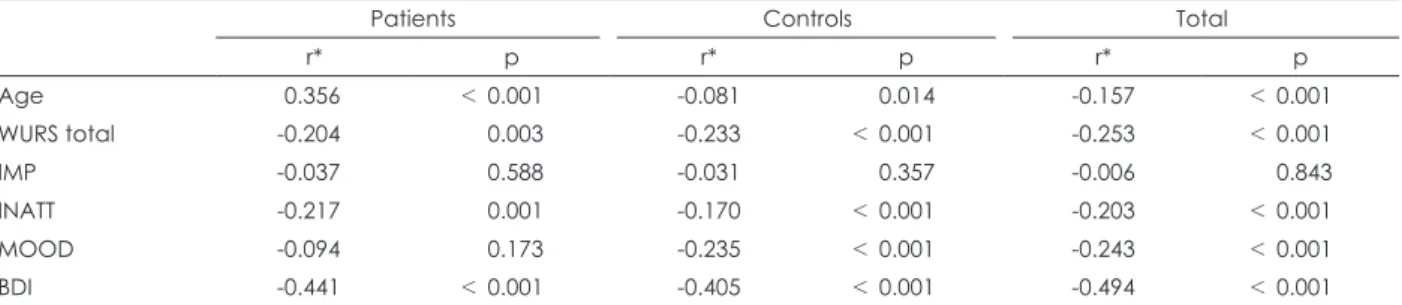
Table 3. Associations between the CD-RISC score of patients with mood disorders and healthy controls, and age, WURS total score, three WURS factor scores, and BDI score
Patients Controls Total
r* p r* p r* p
Age 0.356 < 0.001 -0.081 0.014 -0.157 < 0.001
WURS total -0.204 0.003 -0.233 < 0.001 -0.253 < 0.001
IMP -0.037 0.588 -0.031 0.357 -0.006 0.843
INATT -0.217 0.001 -0.170 < 0.001 -0.203 < 0.001
MOOD -0.094 0.173 -0.235 < 0.001 -0.243 < 0.001
BDI -0.441 < 0.001 -0.405 < 0.001 -0.494 < 0.001
* : Pearson’s correlation coefficient. CD-RISC : Connor-Davidson Resilience Scale, WURS : Wender Utah Rating Scale, BDI : Beck Depression Inventory, IMP : Impulsivity, INATT : Inattention, MOOD : Mood instability
Table 2. Characteristics and comparison of demographic and clinical variables in patients with mood disorders and healthy controls
Patients (n = 213) Controls (n = 909) t p
Sex < 0.001*
Male 45 (21.13) 403 (44.33)
Female 168 (78.87) 506 (55.67)
Age (years) 49.74 ± 16.24 25.38 ± 6.22 -21.53 < 0.001
CD-RISC 50.85 ± 18.14 63.45 ± 14.91 -9.43 < 0.001
WURS 24.94 ± 18.80 19.47 ± 15.08 3.96 < 0.001
IMP -0.17 ± 1.17 0.04 ± 0.95 -2.43 0.016
INATT 0.21 ± 1.18 -0.05 ± 0.94 2.96 0.003
MOOD 0.46 ± 1.36 -0.10 ± 0.86 5.74 < 0.001
BDI 25.31 ± 12.46 10.51 ± 6.99 16.74 < 0.001
Values are presented as mean ± standard deviation or n (%) unless otherwise indicated. * : Chi-square test is used (χ2 = 38.75). CD- RISC : Connor-Davidson Resilience Scale, WURS : Wender Utah Rating Scale, IMP : Impulsivity, INATT : Inattention, MOOD : Mood instability, BDI : Beck Depression Inventory
with mood disorders than in healthy controls (p < 0.001) (Table 2).
Associations between age, childhood ADHD features, current depressive mood, and psychological resilience
Age, the total WURS score, and the BDI score were signifi- cantly correlated with the CD-RISC score in all groups (patients, controls, and total). The INATT score was negatively correlated with the CD-RISC score in all groups, whereas the IMP score was not correlated with the CD-RISC score in any group, and the MOOD score was negatively correlated with the CD-RISC score in the control and total groups (Table 3).Multiple linear regression analyses of clinical variables and psychological resilience
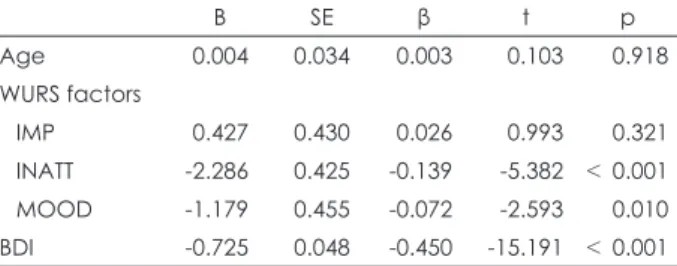
The three WURS factors were significantly associated with resilience in all subjects. Our multiple linear regression model, which considered the CD-RISC score as the dependent variable, and age, the three WURS factor scores, and the BDI score as in- dependent variables, produced significant regression coefficients for the INATT (β = -0.139, p < 0.001), MOOD (β = -0.072, p =
0.010), and BDI (β = -0.450, p < 0.001) scores (Table 4).
Mediating effect of current depressive mood on the relationship between childhood ADHD features and psychological resilience for patients with mood disorders
In our mediation analysis, a mediation model was employed to characterize the effect of the INATT score (independent vari- able) on CD-RISC score (dependent variable) using BDI score as a mediator variable. Simple linear regression model which con- sidered the CD-RISC score as a dependent variable and IMP score or MOOD score as an independent variable, the regres- sion efficient was not statistically significant. Thus, these two variables were not included in the mediation analysis. In first regression analysis model, INATT score (β = -0.217, p = 0.001) was a significant predictor of CD-RISC score. Also in second re- gression analysis model, INATT score (β = 0.159, p = 0.020) was a significant predictor of BDI score. In third regression analysis model, both INATT score (β = -0.151, p = 0.016) and BDI score (β = -0.417, p < 0.001) were significant predictors of CD-RISC score. A Sobel test further confirmed the significance of the me- diation effect (CD-RISC score: z= -2.209, p = 0.027), thus show- ing that BDI score mediated the influence of the INATT score on CD-RISC score among patients with mood disorders (Table 5).
ANCOVA
The ANCOVA showed that the CD-RISC score was signifi- cantly lower in patients with mood disorders than in healthy controls (p < 0.001) after controlling for other covariates. The BDI score (F = 171.017, p < 0.001) and INATT score (F = 15.548, p < 0.001) were significant covariates for the CD-RISC score in the ANCOVA model. However, age (F = 0.529, p = 0.467), the IMP score (F = 1.996, p = 0.158), and MOOD score (F = 2.615, p = 0.106) Table 4. Multiple linear regression analysis of the associations be-
tween the CD-RISC score for all subjects and age, three WURS factor scores, and BDI score
B SE β t p
Age 0.004 0.034 0.003 0.103 0.918
WURS factors
IMP 0.427 0.430 0.026 0.993 0.321
INATT -2.286 0.425 -0.139 -5.382 < 0.001
MOOD -1.179 0.455 -0.072 -2.593 0.010
BDI -0.725 0.048 -0.450 -15.191 < 0.001 The multiple linear regression model was statistically significant (R2 = 0.267, adjusted R2 = 0.264, F = 81.501, p < 0.001). CD-RISC : Con- nor-Davidson Resilience Scale, WURS : Wender Utah Rating Scale, BDI : Beck Depression Inventory, SE : Standard error, IMP : Impul- sivity, INATT : Inattention, MOOD : Mood instability
Table 5. Mediating effect of BDI score on the relationship between three WURS factor scores and CD-RISC score for patients with mood disorders
Variable B SE β t p Adjusted R2 Model p
1st model
Independent : INATT score -3.338 1.033 -0.217 -3.231 0.001 0.043 0.001
Dependent : CD-RISC score - - - - - - -
2nd model
Independent : INATT score 1.679 0.718 0.159 2.339 0.020 0.021 0.020
Dependent : BDI score - - - - - - -
3rd model
Independent : INATT score -2.319 0.951 -0.151 -2.438 0.016 0.209 < 0.001
Mediator : BDI score -0.607 0.090 -0.417 -6.737 < 0.001 - -
Dependent : CD-RISC score - - - - - - -
The Sobel test showed a significant mediation effect (Z = -2.209, p = 0.027). BDI : Beck Depression Inventory, WURS : Wender Utah
were not significant covariates for the CD-RISC score in the mod- el. In addition, in the model, age (p < 0.001), the MOOD score (p = 0.029), and BDI score (p = 0.009) had a significantly differ- ent effect on the CD-RISC score in the patient and control groups.
However, the IMP score (p = 0.412) and INATT score (p = 0.663) had no different effect on the CD-RISC score in the patient and control groups (Table 6).
Discussion
We retrospectively assessed the features of ADHD in child- hood and determined whether these features correlated with current psychological resilience. In our study, childhood ADHD features measured using the total WURS score were correlated significantly with the CD-RISC score in the patients with mood disorders and in healthy controls. ADHD is a risk factor for low- er resilience in adolescence independently of intelligence level, socioeconomic status, depression or anxiety, and age.32) Moreover, personal resilience is associated with better psychosocial func- tioning and less anxiety and depression in patients with ADHD.33) Among childhood ADHD features, the inattention feature was correlated with psychological resilience, and had the same negative effect on psychological resilience in patients with mood disorders and in healthy controls. A study performed on medi- cal students in China reported that only inattention is negative- ly correlated with life satisfaction, and that resilience acts as a mediator between inattention and life satisfaction.34) That study supports our finding that the inattention feature in childhood leads to a lack of complex cognitive ability in a social context, which would make it difficult to cope with psychosocial adver- sity in adulthood. Compared to hyperactivity, inattention contin-
ues to exist and is a dominant feature of ADHD in adulthood.35)36) It is known that inattention is strongly associated with depres- sion and anxiety.37) Taken together, these studies suggest that re- gardless of whether an individual is diagnosed with mood dis- orders or not, evaluating the inattention trait during childhood and in adults in the present state may be useful for assessing psy- chological resilience.
Psychological resilience functions as a mediator and moder- ator between childhood adversity and depression during child- hood and adulthood. The association between adverse child- hood experiences and depression is stronger in subjects with low resilience than in the subjects with high resilience.38) In school- attending adolescents in China, resilience acts as a partial medi- ator and moderator at the same time in the relationship between childhood trauma and depressive symptoms.39) Another study indicated that the incidence of a mental disorder is not depen- dent on childhood trauma, but rather on resilience, indicating that resilience plays a protective role against mental disorders.40) It is expected that mood instability in childhood may affect adult- hood psychological resilience. Problems with childhood emo- tion dysregulation influence social problems in adult life.41) How- ever, the results were mixed in our study. The childhood mood instability feature (MOOD factor) was correlated with psycho- logical resilience in healthy controls but not in patients with mood disorders. Further research on a possible role of childhood mood instability in psychological resilience is needed.
Not all childhood ADHD features affect psychological resil- ience. Low levels of resilience are related to high levels of impul- sivity.42)43) However, in our study, the childhood impulsivity fea- ture was not correlated with psychological resilience in either the patients with mood disorders or in healthy controls. Child- Table 6. Results of analysis of covariance assessing the differences between CD-RISC scores of patients with mood disorders and healthy controls after controlling for age, three WURS factor scores, and BDI score
Source Sum of squares df F p
Group (patients, control) 10061.505 1 54.003 < 0.001
Age 98.472 1 0.529 0.467
WURS factors
IMP 371.811 1 1.996 0.158
INATT 2896.742 1 15.548 < 0.001
MOOD 487.206 1 2.615 0.106
BDI 31862.538 1 171.017 < 0.001
Interaction between group and variables
Group × Age 10565.314 1 56.708 < 0.001
Group × IMP 125.374 1 0.673 0.412
Group × INATT 35.346 1 0.190 0.663
Group × MOOD 887.042 1 4.761 0.029
Group × BDI 1262.106 1112 6.774 0.009
CD-RISC : Connor-Davidson Resilience Scale, WURS : Wender Utah Rating Scale, BDI : Beck Depression Inventory, IMP : Impulsivity, INATT : Inattention, MOOD : Mood instability
hood impulsivity, such as temper outbursts and acting without thinking, may decrease with development. As mentioned previ- ously, hyperactivity and impulsivity symptoms tend to decline with development at a higher rate than inattention symptoms.35)36) This developmental characteristic of impulsivity would be one of the reasons behind our lack of a correlation between impul- sivity in childhood and psychological resilience in adulthood.
The effect of current depressive mood on psychological re- silience was significant. Especially in our analysis, current de- pressive mood mediated the influence of the inattention feature on psychological resilience among patients with mood disor- ders. Many studies have investigated the relationship between psychological resilience and mood in various groups of subjects.
A recent meta-analysis on geriatric populations reported a sig- nificant association between greater resilience and less depres- sive symptoms.44) Another study of people who suffered from a disaster found a significant inverse relationship between psycho- logical resilience and depressive symptoms.45) Low resilience along with high negative symptoms and female gender are di- rectly associated with depression severity in patients with schizo- phrenia,46) and resilience is correlated with hopelessness, self- esteem, spirituality, and quality of life in patients with bipolar disorder and schizophrenia.47) Significant correlations were ob- served between the diagnosis of depressive disorder in the past, current BDI score, and psychological resilience in a Korean pop- ulation.26) Our findings were consistent with all of these previ- ous studies. Evaluating the current mood state is important when assessing psychological resilience not only in the general popu- lation but also in patients with mental disorders.
Psychological resilience was lower in patients with mood dis- orders than in healthy controls. Even after controlling for the effects of age, the three WURS factor scores and the BDI score, which differed significantly between patients with mood disor- ders and healthy controls, psychological resilience remained sig- nificantly lower in the patient group. This result is consistent with our previous study of 301 patients with mood disorders and 958 healthy controls that overlapped with this study.48) The results also support other previous studies that report that individuals with a mental illness have a significantly lower level of psycho- logical resilience compared to the general population.24) Some studies have also shown an association between psychological resilience and quality of life and social functioning in patients with mental disorders. Psychological resilience predicts quality of life in patients with bipolar disorder and schizophrenia.49) Re- silience is significantly and positively associated with quality of life even after controlling for confounders.50) In patients with PTSD, higher resilience is associated with intact social functioning re-
It should be emphasized that psychological resilience can be improved by pharmacological and non-pharmacological psy- chiatric treatments. Treating PTSD significantly improves resil- ience,52) and pharmacological treatment combined with cogni- tive behavioral therapy may increase resilience within 2–3 months in patients with an anxiety disorder.53) As psychological resilience is affected by the current state of depressive mood and the indi- vidual’s childhood ADHD features, mental health professionals should try to improve the patient’s current mood as well as man- age childhood ADHD features.
Despite the crucial role of psychological resilience in mental health, the underlying biological mechanism or biomarker of psychological resilience is not known. The involvement of the hypothalamo-pituitary axis (HPA) and corticosteroids has been suggested for a long time. The mineralocorticoid receptor is an important stress modulator of stress-induced HPA-axis activity.
High mineralocorticoid function may confer resilience to trau- matic stress.54) Glutamate receptor function and glutamate neu- rotransmission are other elements associated with stress vulner- ability and resilience. Inflammation and microglial activation mediate individual differences in psychological resilience and the risk of stress-related depression.55) Our study found that childhood inattention was significantly correlated with adult psychological resilience, indicating that the biological mecha- nism controlling attention during childhood is involved in psy- chological resilience.
Our study had the following limitations. First, the characteris- tics of childhood ADHD were evaluated using the WURS score, which is a retrospective self-survey questionnaire. Thus, recall bias might have occurred. Also using the WURS alone may not be enough to diagnose childhood ADHD. Therefore, WURS scores were used to measure child ADHD features only, and ret- rospective diagnosis of child ADHD was not attempted. Above all, this study focused on ADHD features such as impulsivity, inattention, and mood instability, which are related to psycho- logical resilience in adulthood, and did not focus on the relation- ship between adulthood psychological resilience and ADHD diagnosis itself in childhood. Even if symptoms are not severe enough to be diagnosed as ADHD, having childhood ADHD features may affect adult psychological resilience. Second, most of the subjects with mood disorders were diagnosed with major depressive disorder. Relatively few subjects with bipolar disor- der were included. Also structural interviews, such as mini-in- ternational neuropsychiatric interview, were not conducted on the diagnosis of mood disorders. Third, because the healthy con- trols were limited to nursing students, nurses, and firefighters, care should be taken when generalizing the results. Fourth, the
controls consisted of younger people than the patient group and did not represent the general population. In this case, a propen- sity score matching analysis should be considered. However, we did not apply this method because we could lose too much data through data adjustment. Therefore, the bias due to different dis- tribution of age and sex between patient and control groups should be considered in interpretation of this results.
Our study also has some strengths. First, this is the first study to examine the childhood factors influencing adulthood psy- chological resilience, although only the characteristics of child- hood ADHD were investigated. Second, we examined the effects of childhood ADHD features on adulthood by analyzing three factors (impulsivity, inattention, and mood instability). Third, our study found that childhood ADHD features influenced adulthood psychological resilience not only in a normal population but also in patients with mood disorders. As psychological resilience is important for recovery from psychiatric illness and quality of life in a distressed environment even for healthy people, it is meaningful to identify the various factors influencing psycho- logical resilience from childhood to the current state. In this way, we can find methods to improve psychological resilience, which is very important for mental health.
Humans must adapt to variety of environmental stressors. The responses to stress and trauma vary from individual to individ- ual. Psychological resilience is a crucial factor determining the response of humans to the environment under a multidimen- sional construct.2)9) It is important for patients to recover from mood disorders, improve their functioning, and enhance their quality of life. Psychological resilience plays a significant role in recovery and enhancing quality of life. Therefore, assessments of psychological resilience are essential when clinicians evaluate a patient’s prognosis or set up a rehabilitation plan. Our study suggests that it is necessary to consider the current mood state and childhood ADHD features when assessing psychological re- silience in patients.
Adult psychological resilience in patients with mood disorders was explained by both their current depressive mood state and childhood inattention features. In addition to the degree of de- pressed mood, information about childhood ADHD features, particularly inattention, is significant when evaluating the psy- chological resilience of patients.
Acknowledgments
This research was supported by the Bio and Medical Technology Development Program of the National Research Foundation, which is funded by the Ministry of Science, ICT and Future Planning of Korea (no. 2016M3A9B6904241).
Conflicts of interest
The authors have no financial conflicts of interest.
Author Contributions
Conceptualization: Sang Hyun Cho, Soo-Young Bhang, Jae-Won Choi.
Data collection: Eun-Jeong Joo, Kyu Young Lee. Methodology: Sang Hyun Cho, Eui-Joong Kim, Eun-Jeong Joo. Formal analysis: Sang Hyun Cho, Yunah Lee. Funding aquisition: Eun-Jeong Joo. Writing—original draft: Sang Hyun Cho, Eun-Jeong Joo. Writing—review & editing: Sang Hyun Cho, Eun-Jeong Joo, Eui-Joong Kim, Kyu Young Lee.
ORCID iDs
Sang Hyun Cho https://orcid.org/0000-0002-5087-0093 Eui-Joong Kim https://orcid.org/0000-0002-0156-1964 Kyu Young Lee https://orcid.org/0000-0003-3214-6082 Soo-Young Bhang https://orcid.org/0000-0001-5254-0314 Jae-Won Choi https://orcid.org/0000-0001-6294-7046 Yunah Lee https://orcid.org/0000-0002-4420-4174 Eun-Jeong Joo https://orcid.org/0000-0001-8766-8713 REFERENCES
1) Garmezy N. Children in poverty: resilience despite risk. Psychiatry 1993;56:127-136.
2) Elisei S, Sciarma T, Verdolini N, Anastasi S. Resilience and depres- sive disorders. Psychiatr Danub 2013;25 Suppl 2:S263-S267.
3) Connor KM. Assessment of resilience in the aftermath of trauma. J Clin Psychiatry 2006;67 Suppl 2:46-49.
4) Charney DS. Psychobiological mechanisms of resilience and vulner- ability: implications for successful adaptation to extreme stress. Am J Psychiatry 2004;161:195-216.
5) O’Donnell DA, Schwab-Stone ME, Muyeed AZ. Multidimensional resilience in urban children exposed to community violence. Child Dev 2002;73:1265-1282.
6) Criss MM, Pettit GS, Bates JE, Dodge KA, Lapp AL. Family adver- sity, positive peer relationships, and children’s externalizing behav- ior: a longitudinal perspective on risk and resilience. Child Dev 2002;73:1220-1237.
7) Pietrzak RH, Johnson DC, Goldstein MB, Malley JC, Southwick SM.
Psychological resilience and postdeployment social support protect against traumatic stress and depressive symptoms in soldiers return- ing from Operations Enduring Freedom and Iraqi Freedom. Depress Anxiety 2009;26:745-751.
8) Wingo AP, Wrenn G, Pelletier T, Gutman AR, Bradley B, Ressler KJ.
Moderating effects of resilience on depression in individuals with a history of childhood abuse or trauma exposure. J Affect Disord 2010;
126:411-414.
9) Southwick SM, Charney DS. The science of resilience: implications for the prevention and treatment of depression. Science 2012;338:79- 10) Beardslee WR, Podorefsky D. Resilient adolescents whose parents 82.
have serious affective and other psychiatric disorders: importance of self-understanding and relationships. Am J Psychiatry 1988;145:
63-69.
11) Dyer JG, McGuinness TM. Resilience: analysis of the concept. Arch Psychiatr Nurs 1996;10:276-282.
12) Fine SB. Resilience and human adaptability: who rises above adver- sity? 1990 Eleanor Clarke Slagle Lecture. Am J Occup Ther 1991;45:
493-503.
13) Smith J, Prior M. Temperament and stress resilience in school-age children: a within-families study. J Am Acad Child Adolesc Psychi- atry 1995;34:168-179.
14) Fayyad J, De Graaf R, Kessler R, Alonso J, Angermeyer M, Demyt- tenaere K, et al. Cross-national prevalence and correlates of adult attention-deficit hyperactivity disorder. Br J Psychiatry 2007;190:
402-409.
15) Barkley RA, Fischer M, Smallish L, Fletcher K. Young adult follow- up of hyperactive children: antisocial activities and drug use. J Child Psychol Psychiatry 2004;45:195-211.
16) Koo YJ, Choi KS, Bang YW, Kim OS, Song HJ, Joo EJ. Factor struc- ture of Wender Utah Rating Scale (Korean) in normal female adults.
J Soc Korean Women Psychiatr 2009;7:63-67.
17) Kwon SM. Assessment of psychopathology in anxiety disorder. Ko- rean J Psychopathol 1997;6:37-51.
18) Mannuzza S, Klein RG, Bessler A, Malloy P, LaPadula M. Adult out- come of hyperactive boys. Educational achievement, occupational rank, and psychiatric status. Arch Gen Psychiatry 1993;50:565-576.
19) Song YM, Lee K, Han DH, Lee YS, Min KJ, Park JY, et al. Psychopa- thology, temperament, and character factors of adults with childhood attention-deficit hyperactivity symptoms. J Korean Acad Child Ad- olesc Psychiatry 2013;24:191-198.
20) Eun TK, Kim H, Park S, Lim JY, Chung JK, Kim EJ, et al. Childhood ADHD features are associated with adulthood alcohol use disorder.
J Korean Academy of Addiction Psychiatry 2017;21:30-37.
21) Kim JY, Kim SG, Kim SH, Park SH, Park J. The effect of attention- deficit hyperactivity disorder symptoms, impulsivity, ego-resilience, self-esteem on smartphone addiction in adolescents J Korean Soc Biol Ther Psychiatry 2017;23:206-213.
22) Ward MF, Wender PH, Reimherr FW. The Wender Utah Rating Scale: an aid in the retrospective diagnosis of childhood attention deficit hyperactivity disorder. Am J Psychiatry 1993;150:885-890.
23) Oncü B, Olmez S, Sentürk V. Validity and reliability of the Turkish version of the Wender Utah Rating Scale for attention-deficit/hyper- activity disorder in adults. Turk Psikiyatri Derg 2005;16:252-259.
24) Connor KM, Davidson JR. Development of a new resilience scale:
the Connor-Davidson Resilience Scale (CD-RISC). Depress Anxi- ety 2003;18:76-82.
25) Jung YE, Min JA, Shin AY, Han SY, Lee KU, Kim TS, et al. The Ko- rean version of the Connor-Davidson Resilience Scale: an extended validation. Stress Health 2012;28:319-326.
26) Baek HS, Lee KU, Joo EJ, Lee MY, Choi KS. Reliability and validity of the korean version of the connor-davidson resilience scale. Psy- chiatry Investig 2010;7:109-115.
27) Beck AT, Steer RA. Internal consistencies of the original and revised Beck Depression Inventory. J Clin Psychol 1984;40:1365-1367.
28) Rhee MK, Lee YH, Park SH, Sohn CH, Chung YC, Hong SK, et al. A standardization study of Beck depression inventory I-Korean ver- sion (K-BDI): reliability and factor analysis. Korean J Psychopathol 1995;4:77-95.
29) Joo EJ, Lee KY, Choi KS, Kim SH, Song JY, Bang YW, et al. Child- hood attention deficit hyperactivity disorder features in adult mood disorders. Compr Psychiatry 2012;53:217-223.
30) Baron RM, Kenny DA. The moderator-mediator variable distinction in social psychological research: conceptual, strategic, and statisti- cal considerations. J Pers Soc Psychol 1986;51:1173-1182.
31) Sobel ME. Some New Results on Indirect Effects and Their Stan- dard Errors in Covariance Structure Models. Sociol Methodol 1986;
16:159-186.
32) Regalla MA, Guilherme P, Aguilera P, Serra-Pinheiro MA, Mattos P. Attention deficit hyperactivity disorder is an independent risk factor for lower resilience in adolescents: a pilot study. Trends Psy- chiatry Psychother 2015;37:157-160.
33) Schei J, Nøvik TS, Thomsen PH, Lydersen S, Indredavik MS, Joze- fiak T. What Predicts a Good Adolescent to Adult Transition in ADHD?
The Role of Self-Reported Resilience. J Atten Disord 2018;22:547-
34) Shi M, Liu L, Sun X, Wang L. Associations between symptoms of attention-deficit/ hyperactivity disorder and life satisfaction in med- ical students: the mediating effect of resilience. BMC Med Educ 2018;18:164.
35) Spencer T, Biederman J, Wilens T, Faraone SV. Is attention-deficit hyperactivity disorder in adults a valid disorder? Harv Rev Psychia- try 1994;1:326-335.
36) Biederman J, Mick E, Faraone SV. Age-dependent decline of symp- toms of attention deficit hyperactivity disorder: impact of remission definition and symptom type. Am J Psychiatry 2000;157:816-818.
37) Das D, Cherbuin N, Butterworth P, Anstey KJ, Easteal S. A popula- tion-based study of attention deficit/hyperactivity disorder symp- toms and associated impairment in middle-aged adults. PLoS One 2012;7:e31500.
38) Poole JC, Dobson KS, Pusch D. Childhood adversity and adult de- pression: The protective role of psychological resilience. Child Abuse Negl 2017;64:89-100.
39) Ding H, Han J, Zhang M, Wang K, Gong J, Yang S. Moderating and mediating effects of resilience between childhood trauma and de- pressive symptoms in Chinese children. J Affect Disord 2017;211:
130-135.
40) Talaga MT, Sikorska IM, Jawor M. Resilience in persons with affec- tive and anxiety disorders and the experience of early trauma-pilot studies. Psychiatr Pol 2018;52:471-486.
41) Retz W, Stieglitz RD, Corbisiero S, Retz-Junginger P, Rösler M.
Emotional dysregulation in adult ADHD: what is the empirical evi- dence? Expert Rev Neurother 2012;12:1241-1251.
42) Choi JW, Cha B, Jang J, Park CS, Kim BJ, Lee CS, et al. Resilience and impulsivity in euthymic patients with bipolar disorder. J Affect Disord 2015;170:172-177.
43) Carli V, Mandelli L, Zaninotto L, Alberti S, Roy A, Serretti A, et al.
Trait-aggressiveness and impulsivity: role of psychological resilience and childhood trauma in a sample of male prisoners. Nord J Psychi- atry 2014;68:8-17.
44) Wermelinger Ávila MP, Lucchetti AL, Lucchetti G. Association be- tween depression and resilience in older adults: a systematic review and meta-analysis. Int J Geriatr Psychiatry 2017;32:237-246.
45) Lee J, Blackmon BJ, Cochran DM, Kar B, Rehner TA, Gunnell MS.
Community resilience, psychological resilience, and depressive symptoms: an examination of the mississippi gulf coast 10 years af- ter hurricane katrina and 5 years after the deepwater horizon oil spill. Disaster Med Public Health Prep 2018;12:241-248.
46) Rossi A, Galderisi S, Rocca P, Bertolino A, Rucci P, Gibertoni D, et al. Personal resources and depression in schizophrenia: the role of self-esteem, resilience and internalized stigma. Psychiatry Res 2017;
256:359-364.
47) Mizuno Y, Hofer A, Suzuki T, Frajo-Apor B, Wartelsteiner F, Kem- mler G, et al. Clinical and biological correlates of resilience in pa- tients with schizophrenia and bipolar disorder: a cross-sectional study. Schizophr Res 2016;175:148-153.
48) Chung JK, Choi KS, Kang HG, Jung HY, Joo EJ. The relationship between morningness-eveningness and resilience in mood disorder patients. Compr Psychiatry 2018;87:72-78.
49) Hofer A, Mizuno Y, Wartelsteiner F, Wolfgang Fleischhacker W, Frajo-Apor B, Kemmler G, et al. Quality of life in schizophrenia and bipolar disorder: the impact of symptomatic remission and resil- ience. Eur Psychiatry 2017;46:42-47.
50) Lee D, Cha B, Park CS, Kim BJ, Lee CS, Lee SJ, et al. Effects of resil- ience on quality of life in patients with bipolar disorder. J Affect Dis- ord 2017;207:434-441.
51) Wingo AP, Briscione M, Norrholm SD, Jovanovic T, McCullough SA, Skelton K, et al. Psychological resilience is associated with more intact social functioning in veterans with post-traumatic stress disor-
52) Davidson JR, Payne VM, Connor KM, Foa EB, Rothbaum BO, Hertz- berg MA, et al. Trauma, resilience and saliostasis: effects of treatment in post-traumatic stress disorder. Int Clin Psychopharmacol 2005;20:
43-48.
53) Pollack MH, Stein MB, Davidson JR, Ginsberg DL. New challenges for anxiety disorders: where treatment, resilience, and economic pri- ority converge. CNS Spectr 2004;9:1-4.
54) ter Heegde F, De Rijk RH, Vinkers CH. The brain mineralocorticoid receptor and stress resilience. Psychoneuroendocrinology 2015;
52:92-110.
55) Reus GZ, de Moura AB, Silva RH, Resende WR, Quevedo J. Resil- ience dysregulation in major depressive disorder: focus on gluta- matergic imbalance and microglial activation. Curr Neuropharma- col 2018;16:297-307.