ABSTRACT
Purpose: We aimed to compare the clinical findings, including morbidity, duration of parenteral nutrition, and length of hospital stay between very low birth weight infants (VLBWIs) fed bovine milk-based formula (BOV) and VLBWIs fed human breast milk (HBM) in a neonatal intensive care unit (NICU).
Methods: VLBWIs admitted to the NICU of Dongsan Medical Center, Keimyung University, were enrolled. Infants born from March to August 2014 (n=28) were fed BOV (the BOV group), and those born from September to December 2014 (n=18) were fed HBM (the HBM group). Pasteurized (heating at 62.5˚C for 30 minutes) donor human milk was used if the mother’s own milk was not available because of insuffi- cient breast milk production.
Results: The gestational age (28.0±1.7 weeks vs. 27.8±1.4 weeks) and birth weight (1,055±265 g vs. 1,175±187 g), of the infants in the BOV and HBM, groups were similar.
In addition, perinatal characteristics were similar between the groups. The dura tion of parenteral nutrition (36.4 days vs. 24.1 days, P=0.038), length of hospital stay (74.3 days vs.61.1 days, P=0.037), and incidence of nosocomial sepsis (53.6% vs. 22.2%, P=
0.035), significantly differed between the BOV and HBM groups. Further more, the frequency of feeding intolerance was higher in the BOV group than in the HBM group, but this difference was not significant. Perinatal cytomegalovirus infec tion was not detected in any of the infants fed pasteurized donor human milk.
Conclusion: Human-breast-milk-based diet for VLBWIs significantly reduces the in- ci dence of nosocomial sepsis, duration of parenteral nutrition, and length of hospital stay.
Key Words: Human breast milk, Infant, Very low birth weight
서론
미숙아에서 모유는 식이의 위장 배출 시간이 짧고, lactase와 lipase 등 소화효소의 활성을 개선하며, 수유 불내성(feeding intolerance)이 낮고 완전 장관영양에 도달하는 시간을 단축
Received: 22 September 2015 Revised: 3 December 2015 Accepted: 4 December 2015 Correspondence to:
Chun Soo Kim, M.D.
Department of Pediatrics, Keimyung University School of Medicine, 56 Dalseong-ro, Jung-gu, Daegu 41931, Korea
Tel: +82-53-250-7524 Fax: +82-53-250-7783 E-mail: [email protected]
This article was presented in the pos- ter presentation session at the 22nd annual spring meeting of the Korean society of neonatology, May 2015.
Clinical Findings According to Feeding Diets in Very Low Birth Weight Infants: Human Breast Milk versus Bovine Milk-Based Formula
Sang Hyun Lee, M.D., Jae Hyun Park, M.D., Chun Soo Kim, M.D., and Sang Lak Lee, M.D.
Department of Pediatrics, Keimyung University School of Medicine, Daegu, Korea pISSN 2287-9412 . eISSN 2287-9803
Copyright(c)
By Korean Society of Neonatology.
All right reserved.
This is an Open-Access article distributed under the terms of the Creative Commons Attribution Non-Commercial License (http://creativecommons.org/licenses/
by-nc/4.0), which permits unrestricted non-commercial use, distribution, and repro duction in any medium, provided the original work is properly cited.
시키며, 장점막의 성숙과 재생에 필요한 성장인자를 함유하고 있 을 뿐 아니라 아기의 면역력 개선과 장기적인 신경발달에도 장점 이 있다고 알려져 있다1-3). 미숙아에서 발생하는 괴사성 장염의 다 양한 병리학적 기전에 대하여, 오직 모유만이 개선 효과가 있다는 근거를 배경으로 괴사성 장염 예방에 가장 효과적이고 안전한 예 방적 수단으로 제시되고 있다4,5). Sisk 등6)의 보고에 따르면 초기 에 시행한 모유수유가 괴사성 장염의 발생을 줄인다고 한다. 저온 살균(pasteurization) 처리한 기증모유(donor human milk)를 이 용하여 생후 첫날부터 모유수유한 미숙아는 분유수유를 시행한 아기에 비해 패혈증이나 괴사성 장염 발생과 수술적 치료를 필요 로 하는 장염의 발생 빈도를 줄이고, 입원 중 정맥영양의 기간도 단축하는데 도움이 된다고 알려져 있다7-9). 이러한 근거를 배경으 로 미국소아과학회에서는 모든 미숙아에게 모유수유를 시행하고, 모유를 이용하지 못한다면 저온살균 처리된 기증 모유를 이용하 라고 권고하고 있지만10), 우리나라에서는 극소 미숙아에서 기증모 유 등을 이용한 모유수유의 효과에 대한 연구가 아직 부족한 실정 이다. 저자들은 단일기관의 신생아 집중치료실(neonatal inten- sive care unit, NICU)에 입원한 극소 저체중 출생아(very low birth weight infants, VLBWI)를 대상으로 모유수유군과 분유수 유군에서 정맥영양의 기간과 균혈증이나괴사성 장염의 발생, 수 유 불내성의 빈도, NICU 재원기간 등의 임상소견을 조사하여 비 교하였다.
대상 및 방법
계명대학교 동산의료원 NICU에 입원한 재태기간 25-30주에 해당하며 출생체중 1,500 g 미만인 VLBWI를 대상으로 의무기록 을 통한 후향적 조사를 하였다.
2014년 3월에서 8월까지 출생한 아기는 생후 첫날 미숙아 분유 로 수유를 시작한 후 산모의 모유와 분유를 이용한 혼합수유를 시행하였고, 2014년 9월부터 12월까지 출생한 아기는 생후 첫날 부터 퇴원할 때까지 산모의 모유나 기증 모유를 이용하여 모유수 유를 하였다. 모유의 기증은 본원에서 미숙아를 분만한 산모 중 모유의 거대세포바이러스(cytomegalovirus, CMV) 중합효소 연 쇄반응(polymerase chain reaction, PCR)이 음성인 경우에만 제 공받았다. 기증 모유는 파스퇴르 저온살균(62.5℃ 30분간 중탕)한 다음 -20℃에서 냉동 보관 후 해동하여 사용하였고, 냉동한지 3개 월이 지난 모유는 폐기하였다. 북미 모유은행 연합(Human Milk Banking Association of North America)의 관리지침에 따라 모 유 기증이 제한되는 경우는 제공자 대상에서 제외하였다11). 분유 수유군과 모유수유군 아기의 산모 모유는 CMV PCR 검사 후 음 성이 확인되면 파스퇴르 저온 살균을 중단하였으나 양성인 경우
저온 살균을 지속하였고, 모두 냉동 보관한 후 해동하여 사용하였 다. 모유를 통한 CMV 감염 여부를 평가하기 위하여 대상군 아기 에서 출생 후 1-2주 및 4주 이후에 소변 검체를 이용한 CMV PCR 을 2회 이상 연속적으로 시행하였다.
아기는 출생 후 6시간 이내에 장관영양을 시작하는 것을 원칙 으로 하였고, 수유의 증가는 하루 동안 위 잔류량(gastric resi- dual volume)이 없는 경우에 한하여, 10-15 cc/kg/day 양으로 증 가하였으며, 100 cc/kg/day의 장관영양이 도달될 때 정맥영양을 중단하였다. 모유강화제는 장관영양이 100 cc/kg/day 이상이 되 었을 때 첨가하였고, 완전장관영양은 수유량이 120 cc/kg/day 이 상인 경우로 정의하였다12). 수유 불내성은 Moore 등13)의 문헌에 따라 수유 전에 측정한 위 잔류량이 이전 수유량의 50% 이상이 고, 구토나 복부팽만이 있으며, 장관영양의 중단 또는 지연, 수유 량이 감소할 때로 정의하였다. 두 군에서 수유 불내성을 동반한 아 기는 일시적으로 완전 단백 가수분해 분유(HA®, Maeil dairies Co., Seoul, Korea) 또는 성분 분유(Neocate®, Nutricia, Auck- land, New Zealand)와 같은 특수분유로 변경하여 수유하였다.
산모의 모유와 분유를 혼합 수유한 경우는 분유수유군, 산모의 모유나 기증 모유로 수유한 경우는 모유수유군으로 분류하였다.
조사 기간의 대상 아기를 두 군으로 나누어서 재태기간, 출생체중, 성별, 분만방법, 산전 스테로이드 사용, 조기 양막파수, 임신성 고 혈압, 양수 감소증 및 Apgar 점수를 비교 조사하였다. 또한, 침습 적 또는 비침습적 인공환기기 사용기간, 보조적 산소 투여기간, 정 맥영양의 기간, NICU 재원기간과 퇴원 시 체중을 비교하였고, 호 흡곤란증후군, 교정 연령 36주와 퇴원 시점 중 빠른 시기에 산소 투여가 필요한 것으로 평가한 중등도 이상의 기관지폐 이형성증 (bronchopulmonary dysplasia, BPD)14), McNamara 등15)의 문 헌을 근거로 증상이 있거나 혈역학적으로 유의하다고 판단해서 치료를 시행한 동맥관 개존증, 혈액 배양에서 양성이며 항생제 치 료를 시행한 경우로 규정한 패혈증의 발생빈도를 조사하였다. 괴 사성 장염은 Modified Bell’s staging criteria16)를 이용하여 Stage II 이상의 발생을 조사하였고, 특수분유의 사용이 필요한 수유 불 내성의 동반율을 비교하였다. 두 군에서 특수분유를 사용한 아기 를 대상으로 사용시점과 사용기간에 대해서 조사하였다. 또한 두 군간 모유수유의 정도 차이를 알아보기 위하여 재원기간 중 모유 수유가 50 cc/kg/day인 기간을 조사하여 비교하였다.
VLBWI 대상군에서 치료 중 사망한 경우는 연구에서 제외하였 다. 또한 재태기간 31주 이상인 아기는 일부의 환자에서 부가적인 정맥영양 없이 완전 장관영양에 도달하는 경우가 있어서 모두 대 상군에서 제외하였다. 자료의 통계학적 분석은 SPSS 20.0 (SPSS Inc., Chicago, IL, USA)을 이용하였고, t-test, Chi square test를 이용하여 자료를 분석하였다. P<0.05인 경우 통계학적으로 유의 한 것으로 판정하였다.
결과
주산기 임상소견의 비교에서 두 군의 평균 재태기간과 출생체 중은 차이가 없었다. 출산 전 조기 양막파수의 빈도는 모유수유 군이 61.1%로 분유수유군(21.4%)보다 유의하게 높았으나 성별, 분만방법, 산전 스테로이드 사용, 임신성 고혈압, 양수감소증, Ap- gar 점수 등의 기타 소견은 두 군간 차이가 없었다(Table 1).
수유 식이에 따른 임상소견의 비교에서 호흡곤란증후군의 발생 빈도는 두 군간 차이가 없었으나 침습적 인공호흡기의 사용기간은 분유수유군이 9.1±11.3일로 모유수유군(2.2±1.7일)보다 유의하 게 길었다(P=0.004). 비침습적 인공호흡기 사용기간은 분유수유 군이 22.4±18.4일로 모유수유군(26.9±18.3일)보다 더 짧았으나 통계적인 차이는 없었다. 중등도 이상의 BPD 발생률은 두 군간 비 슷하였고, 장관영양의 진행이나 괴사성 장염의 발생에 영향을 줄 수 있는, 치료가 필요한 동맥관 개존증의 발생도 두 군에서 차이가 없었다. 혈액배양에서 양성이며 항생제 치료를 시행한 패혈증의 발 생은 분유수유군이 15명(53.6%)으로 모유수유군의 4명(22.2%) 에 비해서 유의하게 많았다(P=0.035). 혈액에서 배양된 균주는 대 부분 coagulase 음성 포도알균(coagulase negative staphylo- cocci, CONS)이었고 이외에 장구균과 candida가 각 1례 검출되었 으나 Gram 음성균은 검출되지 않았다. 출생 후 첫수유의 시작시 기는 분유수유군(4.9±1.9시간)과 모유수유군(4.3±1.9시간)이 서 로 비슷하였다. 완전장관영양의 도달시기는 분유수유군이 42.3 ± 21.8일로 모유수유군(30.8±12.9일)보다 더 길었다(P=0.035).
NICU 퇴원 시 아기의 체중은 분유수유군이 2,204±266 g으로 모 유수유군(2,121±323 g)과 통계적인 차이가 없었다(Table 2).
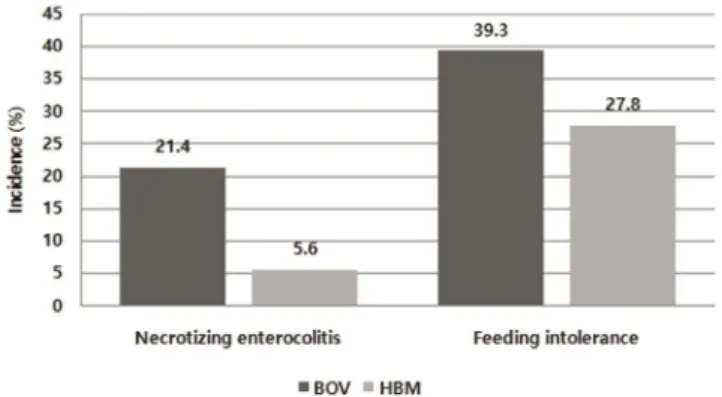
두 군에서 정맥영양의 기간은 분유수유군이 36.4±24.8일로 모 유수유군(24.1±13.2일)보다 유의하게 길었다(P=0.038). NICU 재 원기간도 분유수유군이 74.3±21.5일로 모유수유군(61.1±17.8 일)에 비해서 더 길었다(P=0.037, Figure 1). Stage II 이상의 괴사 성 장염은 모유수유군의 1명(5.6%)에서 발생하여 분유수유군의 6명(21.4%)에 비해서 감소하였으나 통계적 차이는 없었고, 장 천 공이 합병되어 수술을 시행한 경우는 분유수유군에서 3명(10.7
%) 발생하였으나 모유수유군에서는 없었다. 특수분유의 수유가 필요했던 수유 불내성의 발생 빈도는 분유수유군이 11명(39.3%) 으로 모유수유군의 5명(27.8%)보다 더 높았으나 통계적 차이는 없었다(Figure 2). 특수분유를 수유한 경우로 한정한 세부조사에 서 수유시기는 분유수유군이 25.8±10.2일로 모유수유군(16.2±
3.6일)과 비슷하였고, 수유기간은 분유수유군이 40.7±17.9일로 모유수유군(27.6±15.7일)보다 더 길었으나 통계학적 차이는 없었
Table 1.Perinatal Characteristics of the Study Population BOV
(n=28)
HBM
(n=18) P-value Gestational age (wks) 28.0±1.7 27.8±1.4 0.790 Birth weight (g) 1,055±265 1,175±187 0.102
Male, n (%) 13 (46.4%) 13 (72.2%) 0.085
Cesarean section, n (%) 20 (71.4%) 16 (88.9%) 0.161 Antenatal steroid (≥1 dose), n (%) 26 (92.9%) 18 (100.0%) 0.409 PROM(≥24 hours), n (%) 6 (21.4%) 11 (61.1%) 0.007
PIH, n (%) 8 (28.6%) 4 (22.2%) 0.477
Oliogohydramnios, n (%) 3 (10.7%) 1 (5.6%) 0.545 1 min Apgar score 4.1±1.3 5.0±1.6 0.061 5 min Apgar score 6.6±1.3 6.7±1.5 0.886 Plus-minus values are mean±SD.
Abbreviations: BOV, bovine milk-based formula; HBM, human breast milk; PROM, premature rupture of membranes; PIH, pregnancy- induced hypertension.
Table 2. Comparison of the ClinicalFindings and Outcomes BOV
(n=28) HBM
(n=18) P-value
RDS, n (%) 27 (96.4%) 18 (100.0%) 0.459
Invasive ventilation (d) 9.1±11.3 2.2±1.7 0.004 Non-invasive ventilation (d) 22.4±18.4 26.9±18.3 0.422 Supplementary oxygen (d) 0.5±1.6 0.1±0.5 0.355 BPD (≥moderate), n (%) 5 (17.9%) 3 (16.7%) 0.942 PDA (requiring treatment), n (%) 16 (57.1%) 6 (33.3%) 0.155 Sepsis (culture proven), n (%) 15 (53.6%) 4 (22.2%) 0.035 First enteral feeding (h) 4.9±1.9 4.3±1.9 0.375 Arrival to full enteral feeding (d) 42.3±21.8 30.8±12.9 0.035 Body weight at discharge (g) 2,204±266 2,121±323 0.380 Plus-minus values are mean±SD.
Abbreviations: BOV, bovine milk-based formula; HBM, human breast milk; RDS, respiratory distress syndrome; BPD, bronchopulmonary dysplasia; PDA, patent ductus arteriosus.
Figure 1. Duration of parenteral nutrition and length of hospital stay in the BOV-group and the HBM-group infants. Abbreviations:
BOV, bovine milk-based formula; HBM, human breast milk.
다(Table 3). 재원기간 중 모유수유가 50 cc/kg/day 이상인 기간 은 분유수유군(18.7±16.5일)에 비해서 모유수유군(36.7±15.7일) 이 더길었다(P=0.001).
수유 전 산모 모유의 CMV PCR 검사는 분유수유군 중 11명 (39.3%)에서 시행하였고 3례(27.3%)에서 양성이었다. 모유수유군 의 산모 모유는 전례에서 CMV PCR 검사를 시행하였고 4례(22.2
%)에서 양성이었다. 대상군에서 파스퇴르 저온살균 하지 않은 산 모 모유의 수유는 분유수유군 아기 중 25명(89.3%)이었고, 모유 수유군에서는 13명(72.2%)이었다. 대상군 아기 전례에서 출생 후 소변 검체의 CMV PCR 검사를 연속적으로 시행하였으며 모두 음 성이었다.
고찰
저자들은 산모 모유나 기증 모유를 이용한 완전 모유수유를 시 행함으로써 산모 모유와 미숙아 분유를 혼합 수유한 경우로 분류 한 분유수유군에 비해서 정맥영양의 기간과 NICU 재원기간을 유 의하게 단축할 수 있었다. Sullivan 등8)과 Cristofalo 등9)의 연구에 서 미숙아의 모유수유는 괴사성 장염의 빈도나 수술적 처치가 필 요한 장염의 발생을 유의하게 줄인다고 보고하였다. 이 연구에서 는 Stage II 이상의 괴사성 장염은 모유수유군의 1명(5.6%)에서
발생하여 분유수유군의 6명(21.4%)에 비해서 감소하였고, 장 천 공의 합병도 오직 분유수유군에서 3명(10.7%) 발생하였으나 두 군간 통계적 차이는 없었다. 이는 연구기간이 짧고 대상 수가 적었 던 점을 고려하여 추가적인 조사가 필요할 것으로 생각된다.
미숙아에서 조기 양막파수는 출생 후 다양한 합병증과 관련 있 다17). Hanke 등18)은 재태기간 32주 미만의 VLBWI에서 조기 양막 파수가 조기 패혈증과 관련이 없으나 BPD 위험인자가 된다고 하 였다. 이 연구에서 모유수유군이 분유수유군에 비해서 조기 양막 파수의 동반율이 더 높았다(61.1% vs. 21.4%). 대상군에서 조기 패혈증은 두 군 모두 없었으나, 중등도 이상의 BPD 발생률은 두 군간 비슷한 것으로 조사되어 기존의 보고와 차이가 있었다. 이 연 구에서 후기 패혈증의 발생률은 분유수유군이 모유수유군보다 더 높았다(53.6% vs. 22.2%). 패혈증 원인균이 대부분 CONS였고 일부에서 장구균과 candida인 점을 고려하면, 모유수유군에서 패 혈증 발생이 감소한 것은 분유수유군에 비해서 정맥영양의 기간 이 감소(24.1일 vs. 36.4일)함에 따라 중심정맥도관을 조기에 제거 함으로써 카테터 관련 혈류감염의 위험인자 노출기간이 감소한 것 과 관련이 있을 것으로 생각되나 추가적인 연구가 필요하다19-21). 이 연구의 분유수유군의 일부에서 천공된 괴사성 장염으로 인해 수술적 치료가 동반되면서, 모유수유군에 비해서 기도삽관을 통 한 인공환기요법의 기간이 길어진 것으로 생각된다. 두 군간 침습 적 인공호흡기 사용기간의 차이(9.1일 vs. 2.2일)에도 불구하고 BPD 발생률의 차이가 없다는 것은 기존의 보고와 일치한다고 할 수 있다22).
분유수유군 뿐만 아니라 모유수유군의 일부에서도 수유 불내 성이 발생하였다. 이들의 대부분은 우유단백 알레르기 항원이 제 거된 특수분유의 수유로 해결되었던 점을 고려하면, 향후 수유모 에게 우유 등 항원 섭취를 제한하는 식이교육을 함으로써 아기의 수유 불내성을 줄이는데 도움이 될 것으로 생각된다23,24). 미숙아 의 모유수유는 주산기 증상을 동반하는 CMV 감염을 일으킬 수 있다. Yoo 등25)은 초극소 미숙아를 대상으로 영하 20˚C에서 3일 이상 냉동 후 해동한 모유를 수유한 경우 323명 중 27명(8%)에서 CMV 감염에 이환되었으나 63˚C에서 30분간 중탕 처리한 경우 62 명의 아기 중 감염이 발생한 경우는 없었다고 하였다. 이 연구에서 도 기증 모유에 대하여 동일한 방법으로 저온살균 처리하였으며 모유를 통한 CMV 감염은 전례에서 없었다.
모유를 채집하거나 저장백에 담는 과정에서 수유모의 유두 주 위나 채집자의 손에 존재하는 CONS 등의 피부 상재균 등에 의해 서 오염이 일어날 수 있으므로 산모나 기증자에게 손 씻기와 유두 의 청결, 수집 과정의 위생 관리에 대한 교육이 필요하다26). 또한 파스퇴르 저온 살균 후에도 막대균(Bacillus sp.) 등에 의한 오염 이 발생할 수 있으므로 저온 살균 전후에 세균오염에 대한 감시 배 양검사를 시행할 필요가 있다27). 이 연구에서는 모유에 대한 세균 Figure 2. Incidence of NEC (Modified Bell’s stage ≥II) and feed-
ing intolerance according to the feeding diets (BOV vs. HBM) in the study infants. Abbreviations: NEC, necrotizing enterocolitis;
BOV, bovine milk-based formula; HBM, human breast milk.
Table 3. The Use of Special Formulas for Infants with Feeding Intolerance
BOV (n=11) HBM (n=5) P-value
Onset time (d) 25.8±10.2 16.2±3.6 0.064
Duration (d) 40.7±17.9 27.6±15.7 0.198
Plus-minus values are mean±SD.
Abbreviations: BOV, bovine milk-based formula; HBM, human breast milk.
검사를 시행하지 않았으며 향후 개선해야 할 것으로 생각된다.
Sisk 등28)은 수유 상담을 통하여 극소 미숙아를 분만한 산모의 스 트레스와 불안을 줄이고, 모유수유율 향상을 유도하였다고 보고 하였다. 현재 국내 모유수유율은 점차 증가하는 추세이나 다른 나 라에 비하면 여전히 낮은 상태이다29). 따라서 산모에 대한 체계적 인 수유 상담과 타인의 남은 모유를 수집하고 가공, 처리하여 신생 아에게 수유하는 즉, 기증모유의 체계적 관리를 위한 모유은행의 설립과 운영을 적극적으로 검토할 필요가 있다고 생각한다30).
이 연구는 분유수유군과 모유수유군의 연구기간이 달라서 도 출된 결과를 분석하고 해석하는데 제한점이 있다. 또한 단일기관 연구로 대상자 수가 적어서 모유수유의 임상효과를 객관적으로 평가하기에 부족한 점이 있다. 이러한 문제점은 향후 대규모의 다 기관이 참여하는 전향적 연구를 통하여 극복할 수 있을 것으로 생각된다. 이 연구의 결과로 볼 때 VLBWI에서 모유수유는 패혈증 발생을 줄이고, 정맥영양의 기간이나 NICU 재원기간의 단축에도 도움이 될 것으로 생각된다.
REFERENCES
1) Menon G, Williams TC. Human milk for preterm infants: why, what, when and how? Arch Dis Child Fetal Neonatal Ed 2013;
98:F559-62.
2) Bhatia J. Human milk and the premature infant. Ann Nutr Me- tab 2013;62 Suppl 3:8-14.
3) Cho SJ. Enteral nutrition of the premature infant. Korean J Pedi tr 2010;53:7-13.
4) Neu J, Walker WA. Necrotizing enterocolitis. N Engl J Med 2011;364:255-64.
5) Hunter CJ, Upperman JS, Ford HR, Camerini V. Understanding the susceptibility of the premature infant to necrotizing ente- rocolitis (NEC). Pediatr Res 2008;63:117-23.
6) Sisk PM, Lovelady CA, Dillard RG, Gruber KJ, O'Shea TM.
Early human milk feeding is associated with a lower risk of ne- crotizing enterocolitis in very low birth weight infants. J Perinatol 2007;27:428-33.
7) Schanler RJ, Lau C, Hurst NM, Smith EO. Randomized trial of donor human milk versus preterm formula as substitutes for mothers' own milk in the feeding of extremely premature in- fants. Pediatrics 2005;116:400-6.
8) Sullivan S, Schanler RJ, Kim JH, Patel AL, Trawoger R, Kiechl- Kohlendorfer U, et al. An exclusively human milk-based diet is associated with a lower rate of necrotizing enterocolitis than a diet of human milk and bovine milk-based products. J Pediatr 2010;156:562-7. e1.
9) Cristofalo EA, Schanler RJ, Blanco CL, Sullivan S, Trawoeger R,
Kiechl-Kohlendorfer U, et al. Randomized trial of exclusive human milk versus preterm formula diets in extremely pre- ma ture infants. J Pediatr 2013;163:1592-5. e1.
10) Johnston M, Landers S, Noble L, Szucs K, Viehmann L. Breast- feeding and the use of human milk. Pediatrics 2012;129:e827- 41.
11) Human Milk Banking Association of North America (HMBANA).
Donate Milk[internet]. Human Milk Banking Association of North America (HMBANA); 2015. Available from: https://www.
hmbana.org/donate-milk.
12) Salas AA, Cuna A, Bhat R, MoGwin G Jr, Carlo WA, Ambala- vanan N. A randomised trail of re-feeding gastric residuals in preterm infants. Arch Dis Child Fetal Neonatal Ed 2015;100:
F224-8.
13) Moore TA, Wilson ME. Feeding intolerance: a concept analy- sis. Adv Neonatal Care 2011;11:149-54.
14) Jobe AH, Bancalari E. Bronchopulmonary dysplasia. Am J Re- spir Crit Care Med 2001;163:1723-9.
15) McNamara PJ, Sehgal A. Towards rational management of the patent ductus arteriosus: the need for disease staging. Arch Dis Child Fetal Neonatal Ed 2007;92:F424-7.
16) Bell MJ, Ternberg JL, Feigin RD, Keating JP, Marshall R, Barton L, et al. Neonatal necrotizing enterocolitis. Therapeutic de- cisions based upon clinical staging. Ann Surg 1978;187:1-7.
17) Mercer BM. Preterm premature rupture of the membranes.
Obstet Gynecol 2003;101:178-93.
18) Hanke K, Hartz A, Manz M, Bendiks M, Heitmann F, Orliko- wsky T, et al. Preterm prelabor rupture of membranes and out come of very-low-birth-weight infants in the German Neo- natal Network. PLoS One 2015;10:e0122564.
19) Kilbride HW, Powers R, Wirtschafter DD, Sheehan MB, Char- sha DS, LaCorte M, et al. Evaluation and development of po- tentially better practices to prevent neonatal nosocomial bac- teremia. Pediatrics 2003;111:e504-18.
20) Costa SF, Miceli MH, Anaissie EJ. Mucosa or skin as source of coagulase-negative staphylococcal bacteraemia? The Lancet Infect Dis 2004;4:278-86.
21) Kim CR, Kim SY, Park HJ, Ki MR, Yoon HS. Risk factors of nosocomial sepsis in very low birth weight infants. J Korean Soc Neonatol 2010;17:84-93.
22) Morley CJ, Davis PG, Doyle LW, Brion LP, Hascoet JM, Carlin JB. Nasal CPAP or intubation at birth for very preterm infants.
N Engl J Med 2008;358:700-8.
23) Maloney J, Nowak-Wegrzyn A. Educational clinical case series for pediatric allergy and immunology: allergic proctocolitis, food protein-induced enterocolitis syndrome and allergic eosinophilic gastroenteritis with protein-losing gastroentero- pathy as manifestations of non-IgE-mediated cow's milk al- lergy. Pediatr Allergy Immunol 2007;18:360-7.
24) Ko YM, Kim JK, Ahn SY, Yoo HS, Jeon GW, Kim ES, et al. Feed- ing intolerance due to allergic enterocolitis in very low birth weight infants. J Korean Soc Neonataol 2011;18:204-10.
25) Yoo HS, Sung SI, Jung YJ, Lee MS, Han YM, Ahn SY, et al. Pre- vention of Cytomegalovirus transmission via breast milk in extremely low birth weight infants. Yonsei Med J 2015;56:998- 1006.
26) Oh Y, Chung M, Kim YD.Bacterial colonization of breast milk and the presence of infection in premature infants. Korean J Perinatol 2006;17:189-94.
27) Landers S, Updegrove K.Bacteriological screening of donor human milk before and after holder pasteurization. Breastf-
eed Med 2010;5:117-21.
28) Sisk PM, Lovelady CA, Dillard RG, Gruber KJ. Lactation coun- seling for mothers of very low birth weight infants: effect on maternal anxiety and infant intake of human milk. Pediatrics 2006;117:e67-75.
29) Chung SH, Kim HR, Choi YS, Bae CW. Trends of breastfeeding rate in Korea (1994-2012): comparison with OECD and other countries. J Korean Med Sci 2013;28:1573-80.
30) Song KH, Lee YM, Chang JY, Park EY, Park SA, Cho NK, et al. A report on operating a nationwide human milk bank in Korea.
Korean J Pediatr 2010;53:488-94.