quently results in severe cannibalism in farms during the early stage of life. Second, precocious maturation prior to the fish reaching marketable size necessitates an extended cultivation period before sexual maturity. Upon attaining sexual maturity, these fish begin to experience reduced growth rate and decrease feeding efficiency (Choi et al.
1992; Yang et al. 2015). Therefore, the induction of trip- loidy offers more rapid growth and contributes due to the increased production of larger catfish.
Triploidization is a technique used to generate sterile aquatic animals by taking advantage of the incompatibili- ty in pairing the three homologous chromosomes during
https://doi.org/10.11626/KJEB.2020.38.1.106
INT R ODUCTION
The Far Eastern catfish, Silurus asotus belonging to Si- luridae, Siluriformes are distributed in Korea’s all rivers, Japan, China, and Taiwan, and is an important commercial fish in Korea (Chyung 1996). The market demand for this species has gradually expanded in recent years. However, the following two major limitations may reduce the profits of the Far Eastern catfish culture. First, there is a sex-relat- ed dimorphism in the growth rate, i.e., females grow much faster than males (Kim et al. 2001; Seol et al. 2008). This leads to difficulty in effective stock management and fre-
Original article
Morphometric characteristics of diploid and triploid Far Eastern catfish, Silurus asotus
In-Seok Park*
Division of Marine Bioscience, College of Ocean Science and Technology, Korea Maritime & Ocean University, Busan 49112, Republic of Korea
Korean J. Environ. Biol.
38(1) : 106-113 (2020) ISSN 1226-9999 (print) ISSN 2287-7851 (online)
* Corresponding author In-Seok Park
Tel. 051-410-4321 E-mail. [email protected]
*This paper was written based on a doctoral dissertation.
Received: 3 February 2020 Revised: 27 February 2020
Revision accepted: 28 February 2020
Abstract: This study identified the differences in the morphometric characteristics of the
truss and classical dimensions between diploid and triploid Far Eastern catfish, Silurus asotus, and provided methods for sorting diploid and triploid Far Eastern catfish based on morphometric observations. The significant variables were the direct distance between the anterior edge of the lower lip and the anterior insertion of the dorsal fin (DALAD), the horizontal distance between the anterior edge of the lower lip and the anterior insertion of the ventral fin (HALAV), the direct distance between the anterior edge of the upper lip and the first nostril (DAUF), the direct distance between the anterior edge of the upper lip and the second nostril (DAUS), the interorbital width (IW), and the mandible barbel length (ManBL). The more significant variables were HALAV, DALAD, DAUF, IW, and DAUS.
The most useful combination of variables for separating the two groups was DALAD, IW, and DAUF, which correctly classified 85% of the catfish as triploid or diploid, and that percentage was the maximum degree of value possible (p
<0.05). Triploid Far Eastern catfish had a high rate of growth in the head region and body depth during the first year after hatching. Triploid Far Eastern catfish had smaller heads and shorter mandible barbels than diploid Far Eastern catfish.
Keywords: morphometric characteristic, diploid, triploid, Far Eastern catfish
(Silurus
asotus)
meiosis I (Don and Avtalion 1986; Goo et al. 2015; Park 2019). This technique has also been used to enhance the productivity of several fish species because of its assumed ability to increase yield by channeling the energy for go- nadal development into somatic growth (Tave 1993; Gil et al. 2017; Lee et al. 2018; Park 2019). More importantly, it generates fish that are unable to breed and contribute to the local gene pool even if they were to accidentally escape from confinement. In implementing sterility of exotic fish for a certain purpose, triploidy can serve as an effective method for reducing or eliminating the environmental risks of genetically modified organisms (Dunham and Devlin 1999).
In the Far Eastern catfish farming industry, chromosome engineering techniques have been applied using genetic and breeding methods to improve productivity. Prelimi- nary studies on this species have addressed the tempera- ture-dependent somatic cell division cycle (τ
0), nuclear division of the egg, gonadogenesis, production of gyno- genetically diploid, all-female diploid, and triploid strains (Kim et al. 2001; Park et al. 2004). In particular, the induc- tion of triploid sterile catfish by a chromosome-engineer- ing technique is drawing attention as a way to enhance the productivity of fish farming per unit effort in the short term (Cassani et al. 1990).
Triploids generally have similar, if not identical, morpho- logical and meristic characteristics to diploids (Bonar et al.
1988). However, several morphological differences and abnormalities have been associated with triploid fish. A va- riety of deformities were reported in the triploid pejerrey, Odontesthes bonariensis (Str ü ssmann and Takashima 1993), but it is not clear whether these fish were in fact triploid or aneuploid. Changes in the scale pattern and the degree of reduction in the scale cover were observed in the triploid common carp, Cyprinus carpio, and were attributed to dif- ferences in allelic ratios for genes controlling these traits (Gomelsky et al. 1992). Flajshans et al. (1993) described differences in pelvic fin shapes and lengths between the triploid and diploid tench, Tinca tinca, and Tave (1993) observed facial deformities in the triploid bighead carp, Hypophthalmichthys nobilis and grass carp, Ctenopharyn- godon idella. Probably the most conspicuous and frequent- ly described gross morphological difference in triploid fish is the development of lower jaw deformities in the triploid Atlantic salmon, Salmo salar (Lee and King 1994).
Although conclusive data are absent at the present, this de- formity should be linked to rapid growth rate in seawater (Lee and King 1994).
Morphologic differences between species or populations of fish are understood and compared by general figures or specific anatomical shapes (Strauss and Bond 1990; Park et al. 2018). Morphometric characteristics of fish, unlike mer- istic, or countable characteristics, are measured in terms of characteristics; they can be measured in millimeters. Al- though understanding of the morphometric characteristics of fish is limited because they can be modified by the envi- ronment, the general figure of fish is mainly determined by genetic factors (Currens et al. 1989; Park et al. 2004, 2018).
Morphometric characteristics of aquatic animal are used in three major ways: to make distinctions between sex and species and to identify confusing species such as cross- breed hybrids; to study figure modifications in groups and species; to identify and classify biotypic linkages (Park et al.
2004, 2008, 2018). The purpose of this study is twofold;
first, to determine the differences in morphometric charac- teristics of truss and classical dimensions between diploid and triploid Far Eastern catfish so as to provide morpho- metric methods to easily estimate the condition of fish, especially in the aquaculture industry; second, to broaden our knowledge of the morphometric changes that occur during the growth of this species.
MATE R IALS AND METHODS
Triploid induction of the Far Eastern catfish, Silurus aso- tus was carried out according to the method of Kim et al.
(2001). Five mature females (average 325±30.7 g body weight (BW)) were induced to spawn using a single intra- peritoneal (IP) injection of 1,000 IU of human chorionic gonadotropin (hCG, Sigma, USA) per kg BW. Sperm was obtained by cutting the surgically removed testes of three males (average 215±22.9 g BW) that had been given an IP injection of hCG at 500 IU kg
-1BW. Eggs were fertilized with sperm diluted in saline using the wet method. Five minutes after fertilization, the eggs were rinsed rapidly to remove excess sperm and were immediately subjected to cold-shock treatment (4°C) for 60 min to prevent the ex- trusion of the second polar body. Untreated fertilized eggs were used as diploid control.
Fish were periodically sampled and their ploidy was
determined by flowcytometric assessment of the nuclear
DNA content in erythrocytes or fin cells (Francescon et
al. 2004). Diploid and triploid individuals (n = 100) were
cultivated by the method of Kim et al. (2001). All fish were
reared in 450-L tanks under the same hydrological con-
ditions. Water temperature was maintained at 24±1.5°C and the mean water oxygen concentration was kept close to saturation level (mean: 9.4±0.3 mg L
-1). Experimental fish were fed twice daily, a total of 2% food of their average BW during the experimental period (3 years).
During the experiment, to avoid sampling fish with guts that were distended by large quantities of food, fish were starved for 24 hrs before sampling (Park et al. 2001). Sam- ples (n = 50, 1 year after hatching) from each group were randomly captured and anesthetized with a lidocaine-HCl/
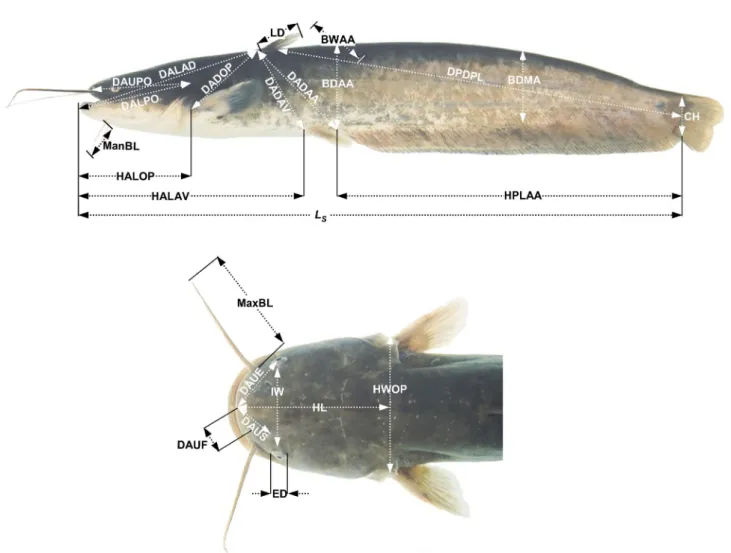
Fig. 1. Morphometric measurements between each landmark for diploid and triploid Far Eastern catfish, Silurus asotus
(after Park et al.
2004). Top: lateral view of the whole body; Bottom: dorsal view of the head region. The measurements included standard length (Ls); cau-
dal peduncle height (CH); head width between the origin of the pectoral fins (HWOP); body width at the anterior insertion of the anal fin
(BWAA); maxilla barbel length (MaxBL); mandible barbel length (ManBL); head length between the anterior edge of the upper lip and the
midpoint of head width (HL); eye diameter (ED); interorbital width (IW); length of the dorsal fin (LD); direct distance between the anterior
edge of the lower lip and the anterior insertion of the dorsal fin (DALAD); distance between the anterior edge of the upper lip and the most
posterior aspect of the operculum (DAUPO); distance between the posterior insertion of the dorsal fin and the most posterior point of the
lateral line (DPDPL); distance between the most posterior point of the lateral line and the anterior insertion of the anal fin (HPLAA); distance
between the anterior insertion of the dorsal fin and the origin of the pectoral fin (DADOP); distance between the anterior insertion of the
dorsal fin and the anterior insertion of the ventral fin (DADAV); distance between the anterior insertion of the dorsal fin and the anterior
insertion of the anal fin (DADAA); distance between the anterior edge of the upper lip and the eye (DAUE); distance between the anterior
edge of the upper lip and the first nostril (DAUF); distance between the anterior edge of the upper lip and the second nostril (DAUS); the
horizontal distance between the anterior edge of the lower lip and the most posterior aspect of operculum (DALPO); distance between the
anterior edge of the lower lip and the origin of the pectoral fin (HALOP); distance between the anterior edge of the lower lip and the anteri-
or insertion of the ventral fin (HALAV); the body depth at the anterior insertion of the anal fin (BDAA); and the midpoint of the anal fin base
(BDMA).
NaHCO
3for photographing and measuring (Fig. 1). All measurements for anesthetized individuals were taken to the nearest 0.01 cm using digital vernier calipers (CD- 20CP; Mitytoyo, Kawasaki, Japan). As in study by Park et al. (2004), body outline measurements of samples at 3 years after hatching (n = 50, average 34±2.5 cm total length, average 187±11.6 g BW) from each group were taken by 25 kinds of distances between landmarks for both truss and classical dimensions (Fig. 1). L s , HALOP, HALAV, and HPLAA indicate horizontal distance, and the others indicate direct distance.
L s measurements were analyzed through arcsine-square root transformation. DAUF, DAUS, IW, and DAUE were analyzed after transforming the measurements relative to head length. Student’s t-test was used to determine the sig- nificance between diploid and triploid among the various parameters (p < 0.05, n = 50). Afterward, the five most sig- nificant variables were used for stepwise discriminant anal-
ysis (n = 50) to provide the maximum separation between groups (Bonar et al. 1988). Differences between means were regarded as significant at p < 0.05.
R ESULTS
At the end of the experiment, accumulated survival was 90% in the triploid Far Eastern catfish, Silurus asotus group, but only 75% in the diploid group. The average standard lengths (Ls) of the diploid and triploid groups were 21.4±
2.91 cm and 19.9±2.48 cm, 1 year after the beginning of the experiment and 33.9±2.94 cm and 38.1±1.70 cm at the end of the experiment respectively.
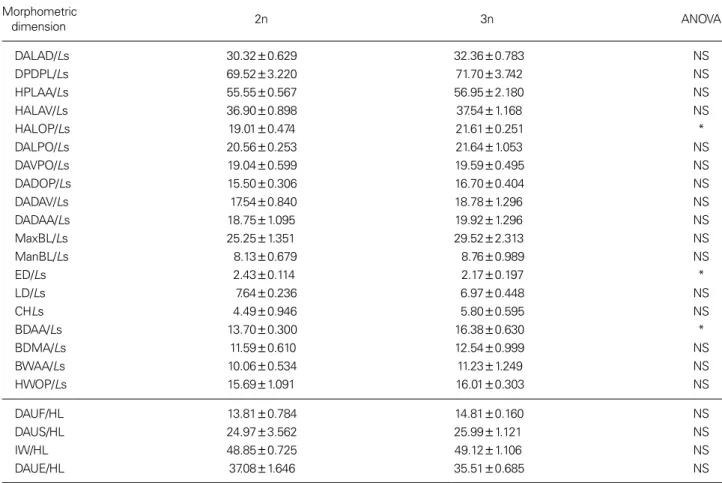
Table 1 shows the means of the morphometric dimen- sions of Far Eastern catfish, 1 year after hatching and re- sults of ANOVA testing for differences among groups.
Differences between the diploid and triploid groups sig-
Table 1. Means and standard deviations for the morphometric dimensions of diploid and triploid Far Eastern catfish, Silurus asotus, one
year after hatching and the ANOVA results between the groups
Morphometric
dimension 2n 3n ANOVA
DALAD/Ls 30.32±0.629 32.36±0.783 NS
DPDPL/Ls 69.52±3.220 71.70±3.742 NS
HPLAA/Ls 55.55±0.567 56.95±2.180 NS
HALAV/Ls 36.90±0.898 37.54±1.168 NS
HALOP/Ls 19.01±0.474 21.61±0.251 *
DALPO/Ls 20.56±0.253 21.64±1.053 NS
DAVPO/Ls 19.04±0.599 19.59±0.495 NS
DADOP/Ls 15.50±0.306 16.70±0.404 NS
DADAV/Ls 17.54±0.840 18.78±1.296 NS
DADAA/Ls 18.75±1.095 19.92±1.296 NS
MaxBL/Ls 25.25±1.351 29.52±2.313 NS
ManBL/Ls 8.13±0.679 8.76±0.989 NS
ED/Ls 2.43±0.114 2.17±0.197 *
LD/Ls 7.64±0.236 6.97±0.448 NS
CHLs 4.49±0.946 5.80±0.595 NS
BDAA/Ls 13.70±0.300 16.38±0.630 *
BDMA/Ls 11.59±0.610 12.54±0.999 NS
BWAA/Ls 10.06±0.534 11.23±1.249 NS
HWOP/Ls 15.69±1.091 16.01±0.303 NS
DAUF/HL 13.81±0.784 14.81±0.160 NS
DAUS/HL 24.97±3.562 25.99±1.121 NS
IW/HL 48.85±0.725 49.12±1.106 NS
DAUE/HL 37.08±1.646 35.51±0.685 NS
For dimensions(Fig. 1), refer to the text for details. Data were analyzed using student’s t-test on data transformed to the arcsine of the square root. *p<0.05, NS: not significant.
nificantly affected both the classical and truss dimensions.
There were significant differences in these dimensions in the diploid group compared to the triploid group. The trip- loid group had drastically increased truss dimensions of BDAA/Ls in the trunk region and showed higher truss di- mensions of BDAA/Ls than the diploid group. In addition, the triploid group had an increased classical dimension of HALOP/Ls in the head region and a higher classical di- mension of HALOP/Ls than the diploid group. However, the diploid group had a higher ED/Ls than the triploid group. Significant differences between the diploid and trip- loid groups were not observed for the other morphometric dimensions (p < 0.05).
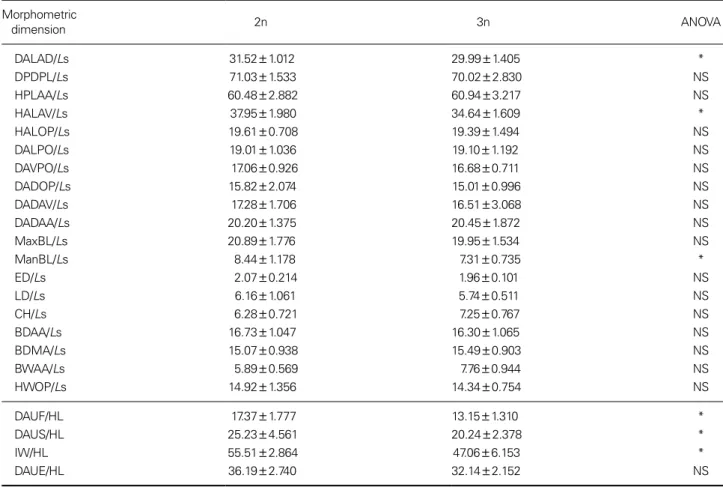
Table 2 shows the means of morphometric dimensions of the fish 3 years after hatching and results of ANOVA testing for differences among groups. The same results appeared as above. Specifically, the diploid group had increased classical dimensions of DALAD/Ls and HALAV/Ls in
the head region, and had higher classical dimensions of DALAD/Ls and HALAV/Ls than those of triploid group.
Also, the diploid group had higher DAUF/HL, DAUS/
HL, and IW/HL in the head region than the triploid group, and had higher ManBL/Ls in mandible barbel length than those of triploid group (p < 0.05). However, there was no significance in any truss dimensions between the two groups.
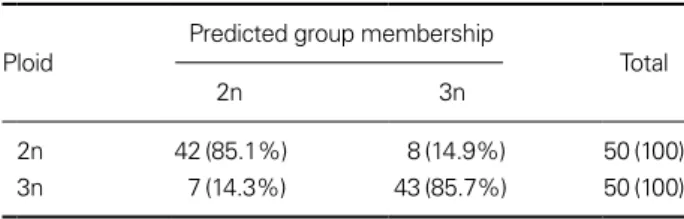
Significant variables were DALAD, HALAV, DAUF, DAUS, IW, and ManBL (Table 3). The most useful combi- nation of these variables for separating the two groups was DALAD, IW, and DAUF, which correctly classified 85% of the Far Eastern catfish, the maximum degree of separation obtained as triploid or diploid. Table 4 shows the classifica- tion function coefficients of the most significant variables.
Classification functions (C) developed by stepwise dis- criminant analysis for Far Eastern catfish were for diploid catfish and for triploid catfish. Classification results of the
Table 2. Means and standard deviations for the morphometric dimensions of diploid and triploid Far Eastern catfish, Silurus asotus, three
years after hatching and the ANOVA results between the groups
Morphometric
dimension 2n 3n ANOVA
DALAD/Ls 31.52±1.012 29.99±1.405 *
DPDPL/Ls 71.03±1.533 70.02±2.830 NS
HPLAA/Ls 60.48±2.882 60.94±3.217 NS
HALAV/Ls 37.95±1.980 34.64±1.609 *
HALOP/Ls 19.61±0.708 19.39±1.494 NS
DALPO/Ls 19.01±1.036 19.10±1.192 NS
DAVPO/Ls 17.06±0.926 16.68±0.711 NS
DADOP/Ls 15.82±2.074 15.01±0.996 NS
DADAV/Ls 17.28±1.706 16.51±3.068 NS
DADAA/Ls 20.20±1.375 20.45±1.872 NS
MaxBL/Ls 20.89±1.776 19.95±1.534 NS
ManBL/Ls 8.44±1.178 7.31±0.735 *
ED/Ls 2.07±0.214 1.96±0.101 NS
LD/Ls 6.16±1.061 5.74±0.511 NS
CH/Ls 6.28±0.721 7.25±0.767 NS
BDAA/Ls 16.73±1.047 16.30±1.065 NS
BDMA/Ls 15.07±0.938 15.49±0.903 NS
BWAA/Ls 5.89±0.569 7.76±0.944 NS
HWOP/Ls 14.92±1.356 14.34±0.754 NS
DAUF/HL 17.37±1.777 13.15±1.310 *
DAUS/HL 25.23±4.561 20.24±2.378 *
IW/HL 55.51±2.864 47.06±6.153 *
DAUE/HL 36.19±2.740 32.14±2.152 NS
For dimensions(Fig. 1), refer to the text for details. Data were analyzed using student’s t-test on data transformed to the arcsine of the square root. *p<0.05, NS: not significant.
most significant variables on diploid and triploid Far East- ern catfish are seen in Table 5.
C=7.269 (DALAD)-6.538 (IW)+34.573 (DAUF)-46.151 C=10.709 (DALAD)-9.262 (IW)+7.112 (DAUF)-49.886
DISCUSSION
The classical dimensions in which diploid and triploid
1-year-old Far Eastern catfish, Silurus asotus showed signifi- cant differences were HALOP/Ls and ED/Ls and those for 3-year-old Far Eastern catfish were DALAD/Ls, HALAV/
Ls, DAUF/HL, and DAUS/HL. For more than 30 years, most morphometric investigations of fish have based char- acteristic selection on the classical dimensions of length, depth and width primarily in the head, and tail regions as described by Hubbs and Lagler (1947). These dimensions are focused on the anterior-posterior body axis and the head and caudal regions and, as a result, produce uneven and biased coverage of the body form (Li et al. 1993; Park et al. 2018).
Truss dimensions in which diploid and triploid 1-year- old Far Eastern catfish showed significant differences were HALOP and BDAA/Ls; that for 3-year-old Far Eastern catfish was IW/HL. The truss dimension consists of a sys- tematically arranged set of distances measured among a set of preselected anatomical landmarks, which are points identified on the basis of local morphological features and chosen to divide the body into functional units (Strauss and Bond 1990). These dimensions, which include com- ponents of body depth and length along the longitudinal axis of the fish, have theoretical advantages over classical morphometric characteristics in discriminating among groups (Humphries et al. 1981; Strauss and Bookstein 1982; Winans 1984; Currens et al. 1989). Both truss and classical dimensions are used to describe fish body shape (Hubbs and Lagler 1947; Strauss and Bookstein 1982;
Park et al. 2001). Currens et al. (1989), studying the body shapes of starved chinook salmon, Oncorhynchus tshawyts- cha and rainbow trout, O. mykiss using both truss and classi- cal dimensions, pointed out that the depth of the trunk re- gion was most affected and the caudal region least affected.
Therefore, measurements of the caudal region of fish are more useful for understanding interspecific variation than are measurements of the trunk region.
Differences between diploid and triploid fish 1 year af- ter hatching were in the head region, body depth, and eye diameter; significant variables 1 year after hatching were HALOP/Ls, BDAA/Ls, and ED/Ls. That is, triploid fish had longer head regions and body depths as well as small- er eye diameters than diploid fish. However, differences between diploid and triploid fish 3 years after hatching differed from those 1 year after hatching. Because the most significant variables 3 years after hatching were DALAD/
Ls, HALAV/Ls, ManBL/Ls, DAUF/HL, DAUS/HL, and IW/HL, differences between diploid and triploid fish 3 years after hatching were in the head region, mandible bar-
Table 3. The standardized canonical discriminant function co-
efficients of the most significant variables providing maximum separation between diploid and triploid Far Eastern catfish, Silurus asotus
Standardized canonical discriminant
function coefficients Function 1
HALAV 0.232
DALAD 0.914
ManBL 0.439
IW 1.032
DAUF 2.169
DAUS 0.418
For dimensions(Fig. 1), refer to the text for details. Data were analyzed using student’s t-test on data transformed to the arcsine of the square root.
Table 4. Classification function coefficients of the most signif-
icant variables providing maximum separation between diploid and triploid Far Eastern catfish, Silurus asotus
Classification function
coefficients 2n 3n
DALAD 7.269 10.709
IW -6.538 -9.262
DAUF 34.573 7.112
(Constant) -46.151 -49.886
For dimensions(Fig. 1), refer to the text for details. Data were analyzed using student’s t-test on data transformed to the arcsine of the square root.
Table 5. Classification results of the most significant variables