Korean J Environ Agric (2010)
Vol. 29, No. 4, pp. 367-373 DOI : 10.5338/KJEA.2010.29.4.367
유기재배와 관행재배 된 배의 과실품질과 항산화 활성 비교
최현석1 ․ 이 웅2* ․ 김월수2 ․ 이 연1
1국립농업과학원 유기농업과, 2전남대학교 원예학과
Comparison of Fruit Quality and Antioxidant Compound of ‘Niitaka’ Pear Trees Grown in the Organically and Conventionally Managed Systems
Hyun-Sug Choi1, Xiong Li2*, Wol-Soo Kim2 and Youn Lee1(1Organic Agriculture Division, National Academy of Agricultural Science, SuWon 441-707, Korea, 2Department of Horticulture, Chonnam National University, GwangJu 500-757, Korea)
Received: 20 September 2010 / Accepted: 7 October 2010
ⓒThe Korean Society of Environmental Agriculture
*교신저자(Corresponding author): X. Li Tel: +82-62-530-2065 Fax: +82-62-530-0673 E-mail: [email protected]
367 Abstract: The study was established to compare fruit qualities and antioxidant compounds in ‘Niitaka’ pear (Pyrus pyriforia) trees grown in the organic and conventional farming systems. Fruits in the organic system appeared to have dark red color on the fruit surface. Fruit weight, soluble solids, acidity, firmness, and stone cells were not different between the farming systems. Organic fruits had a greater potassium concentration than the conventional fruits, but phosphorous, calcium, and magnesium concentrations in fruits were not different between the treatments. Peel, flesh, and juice parts in the organic fruits had greater phenolic compounds compared to the conventional fruits. Peel parts had much greater antioxidant compounds than the flesh parts, regardless of the treated-fruits. All fruits grown in the conventional and organic systems had a similar DPPH (α, α-diphenyl-β -picryl-hydrazyl) radical-scavenging activity in the peel, but flesh parts in organic fruits had a greater DPPH than the conventional fruits. Phenol and flavonoid compounds in the peel and flesh were positively related to the DPPH radical-scavenging activity. There were no significant differences for the nitrite scavenging activity in the peel and flesh parts between the treatments.
Key Words: DPPH radical scavenging activity, Flavonoid, Phenol, Stone cell
서 론
전 세계적으로 국민건강에 관한 관심과 친환경 산업육성 을 유도하는 정책으로 유기농 과실의 가격 프리미엄이 생기 면서 유기농업 재배를 원하는 독농가들이 급격히 증가하는 추세이다(Lotter, 2003). 유기농업으로 재배된 과실을 관행재 배와 비교한 Peck et al.(2006)의 연구에서, 9-10년생의 유기 재배 한 사과의 수확량은 종합관리(Integrated Management) 및 관행재배 사과원에 비해 각각 1/2, 2/3 정도였으며, 기본 적인 품질비교에서는 유기농 사과에서 높은 경도를 나타냈고, 가용성 고형물함량, 산도 및 당산비는 유의성이 나타나지 않 았다고 하였다. 하지만 유기재배 된 항산화 물질은 관행보다 는 10-15%이상, 종합방제보다는 8-25%이상 더 많이 함유하 였다고 보고하였다.
유기농 과실은 화학비료와 농약살포를 금지하고 천연자재 에 의한 병해충방제 및 유기질 퇴비와 멀칭에 의해 재배된다. 이에 따라서 유기농은 관행재배와 비교하여 병해충 발생률이 증가하여 환경적 스트레스에 많이 노출되어 우리 몸에 이로 운 2차 대사산물(폴리페놀, Vitamin C등)이 형성될 수 있다 (Treutter, 2001). 유기재배 한 11개 품종 사과와 관행재배 한 사과를 비교분석 한 연구에서 과피에서는 유의성이 나타 나지 않았으나 과육에서는 관행재배 한 사과보다 높은 폴리 페놀을 함유한다고 보고하였다(Robert et al., 2005). 유기농 복숭아와 서양배에서는 유기재배 한 과실에서 관행재배보다
Open Access Research Article
높은 폴리페놀 함량과 항산화활성이 나타났다(Carbonaro et al., 2002). Lee et al.(2009b)은 동양배 과피에서 과육보다 5 배 정도의 높은 폴리페놀 함량을 보였고, 유기질 퇴비를 많이 처리한 재배구에서 높은 경향이 나타났다고 하였다.
일반적으로 소비자들은 유기농으로 재배된 과실이 건강에 이롭고 친 환경적이며 맛과 무기질이 많다고 믿고 있다(Saba and Messina, 2003). 하지만 Rosen과 Allan(2007)은 이러 한 결과가 일관성 있는 것은 아니라고 하였다. Lombardi-Boccia et al.(2004)은 유기재배 한 자두에서 관행재배 한 과실보다 플라보노이드와 여러 가지 비타민 농도가 높았으나 페놀화합 물과 quercetin의 농도가 낮았다고 보고하였다. 하지만 아직 까지 국내에서 유기농과 관행재배 한 ‘신고’ 배에서 항산화 물질과 기능성을 비교한 논문은 매우 미흡한 실정이며, 기본 적인 자료제공을 위한 연구가 급속히 진행되고 있다. 본 실험 은 관행과 2년간 유기재배 된 ‘신고’ 배의 과실품질 및 항산 화 물질을 비교분석하기 위해서 저장 된 배를 이용해서 수행 되었다.
재료 및 방법
시험재료
전남 보성군 회천면 벌교리(34°40´N, 127°22´E)에 있는 유기농 배 재배농가와 인근에 있는 저농약 관행 재배농가를 2009년에 선정하였다. ‘신고’ 배의 수령은 15-20 년생이고 재 식거리는 5×7 m인 덕식수형이며, 수관하부는 모두 자연 초 생재배를 하였다. 이 지역은 토심이 50-100 cm이고 표토의 토성은 양토이고 심토는 식양토로 자갈함량이 적으며, 15-30%
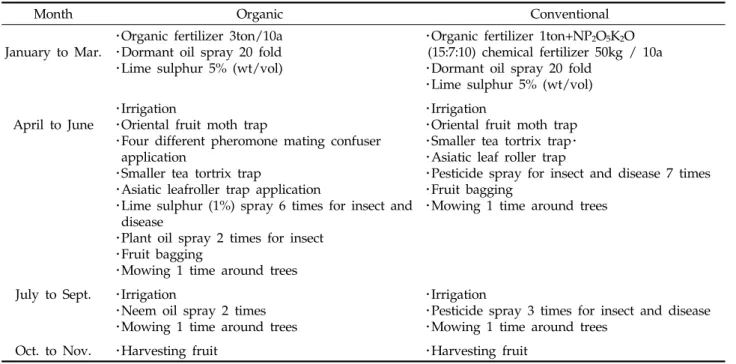
경사지 과원이었다. 2 ha의 유기농 재배 농가는 3년간 무 농 약을 실시한 후, 유기농 전환기 1년을 한 후에 유기농 인증센 터에서 인증을 받았으며, 2009년에 유기농 2년 차인 지역이 었다. 2004년부터 2009년까지 유기와 관행재배를 한 농가의 간략한 재배사항을 표 1에 기술하였다. 배 시료는 유기농가 와 관행농가에서 2009년 10월 10일에 수확해서 0℃ 저온 저 장고에 저장 된 '신고' 배를 50개씩 임의로 선택해서 1개월 후에 조사하였다.
배 과실특성 조사
수확한 과실은 색차계(Minolta CR-300, Japan)를 이용 하여 Hunter value L, a, b 값을 측정하였다(L: light 로서 값이 클수록 밝음을 나타냄, a: +붉은 색 -파란색; b: +노란 색, -푸른색).
배 과실의 가용성 고형물함량(SSC)은 굴절당도계(Refracto- meter, Atago, Japan)를 이용하여 측정하였고 과실의 산도 는 Fruit Refracto-Acidity meter(GML-706R, Korea)를 이용하여 조사하였다.
과실 경도는 물성기(Rheo CR-500DX, Japan)를 이용하 였고 Φ 5 mm probe로 120 mm/min 이동속도 조건에서 측정하였다.
과육의 석세포 함량은 과실의 적도부위의 생체시료 10 g 을 95% CH3OH 35 mL에 담아 균질기를 이용하여 균질화 한 후 Whatman No.1 여과지를 이용하여 감압 여과하여 당 성분을 제거하였다. 그 잔사는 다시 1 N HCl 25 mL에 넣 고 30분간 교반기를 이용하여 진탕 후 다시 감압 여과하여 전분을 제거하였다. 나머지 잔사는 1 N NaOH 25 mL를 넣 고 교반 후 여과하여 단백질을 제거하고 그 잔사를 40℃의 항온기에서 건조시킨 후, 석세포 함량을 측정하였다(Lee and Kim, 2001).
과실의 무기성분 분석을 위해서 적도부위의 과육을 취하 여 동결건조 하였으며, 시료는 잘게 분쇄한 후 H2SO4-H2O2
분해법으로 분해한 후 P는470 nm에서 UV spectormeter (Shimadzu UV-1601, Japan)로 K, Ca, Mg는 ICP(Inductively Coupled Plasma Atomic Emission Spectrometer, Pye- unicam PU 9000, England)로 측정하였다.
총 페놀, 플라보노이드, 전자공여능, 아질산염 소거능 분석 항산화 물질 분석을 위한, 시료의 추출은 배 과실을 과피 와 과육으로 분리한 다음, 과피는 10 g, 과육은 20 g씩 취하 여 80% 에탄올을 첨가하여 균질화 한 후 진공펌프로 감압 여과하였고 최종 용량을 50 mL로 정용하였다.
총 페놀 화합물 함량은 페놀성 물질이 phosphomolybdic acid와 반응하여 청색으로 발색되는 것을 이용한 Folin-Denis 방법(Ribeiro et al., 2008)에 따라 분석하였다. 즉, 정용된 시 료액 1 mL에 10% folin-ciocalteu 시약 2 mL를 넣고 6분 간 반응시킨 후 7% sodium carbonate 용액 2 mL를 첨가 하고 실온에서 1시간 방치 후 분광 광도계(UV-2550, Shimadzu, Japan)를 이용하여 750 nm에서 흡광도를 측정하였다. 측정 된 흡광도는 표준용액 chlorogenic acid를 사용하여 작성한 검정곡선으로부터 총 페놀성 화합물의 함량을 계산하였다.
정용된 추출액 2 mL에 2% AlCl3 2 mL 및 1 M sodium acetate 0.1 mL를 가하고 잘 혼합한 후 30℃에서 1시간 반 응시킨 후 분광 광도계(UV-2550, Shimadzu, Japan)를 이 용하여 420 nm에서 흡광도를 측정하였다(Lin and Tang, 2007). 이때 총 플라보노이드 함량은 표준물질 rutin을 이용 하여 작성한 표준곡선으로부터 함량을 구하였다.
DPPH(α, α-diphenyl-β-picryl-hydrazyl)는 짙은 자주 색을 나타내는 안정화된 상태로 존재하는데 517 nm에서 최 대 흡광도를 나타내며 시료의 환원력에 의하여 흡광도가 감 소한다(Oh et al., 2004). 전자공여능은 DPPH법을 이용하여 시료의 radical 소거효과를 측정하는 방법(Ribeiro et al., 2008)에 따라 조사하였다. 1×10⁻⁴ M DPPH와 농도 별 정용 된 추출물을 각각 1 mL씩 취하여 혼합하고, 30분간 암 상태 에서 방치한 후 517 nm에서 분광 광도계(UV-2550, Shimadzu, Japan)를 이용하여 잔존 radical 농도를 측정하였다. 시료의 환원력의 크기는 라디칼 소거활성(Scavenging activity)으 로 표시하였는데, “DPPH radical 소거활성”은 다음과 같은 식으로 계산하였다.
Table 1. Production system treatment summary from 2004 to 2009
Month Organic Conventional
January to Mar.
・Organic fertilizer 3ton/10a
・Dormant oil spray 20 fold
・Lime sulphur 5% (wt/vol)
・Organic fertilizer 1ton+NP2O5K2O (15:7:10) chemical fertilizer 50kg / 10a
・Dormant oil spray 20 fold
・Lime sulphur 5% (wt/vol) April to June
・Irrigation
・Oriental fruit moth trap
・Four different pheromone mating confuser application
・Smaller tea tortrix trap
・Asiatic leafroller trap application
・Lime sulphur (1%) spray 6 times for insect and disease
・Plant oil spray 2 times for insect
・Fruit bagging
・Mowing 1 time around trees
・Irrigation
・Oriental fruit moth trap
・Smaller tea tortrix trap・
・Asiatic leaf roller trap
・Pesticide spray for insect and disease 7 times
・Fruit bagging
・Mowing 1 time around trees
July to Sept. ・Irrigation
・Neem oil spray 2 times
・Mowing 1 time around trees
・Irrigation
・Pesticide spray 3 times for insect and disease
・Mowing 1 time around trees Oct. to Nov. ・Harvesting fruit ・Harvesting fruit
Table 2. Fruit characteristics as affected by organic and conventional systems of 'Niitaka' pear trees in Boseong, Chonnam, 2009
Treatment FWz
(g) SSC
(%) Acidity
(%) SSCy/
Acidity Firmness
(kg) Stone cell (mg/g FWy)
Yield Color
(kg/10a) L a b
Organic 617ax 11.8a 0.11a 120a 1.2a 14a 3,400a 61b 13a 37b Conventional 627a 11.1a 0.10a 102a 1.1a 12a 3,600a 66a 11b 38a
zFW indicates the flesh weight in a fruit.
ySSC indicates the soluble solid contents.
xMeans comparison among the farming systems within a column for a fruit characteristics; means followed by different letters are significantly different, 5% level.
DPPH radical 소거활성(%)=(1-시료 첨가구의 흡광도/
시료 미첨가 대조구의 흡광도)×100
위의 정용된 추출물을 이용하여 아질산염 소거능은 Kato et al.(1987)과 Kim et al.(1987)의 방법을 변형하여 측정하 였다. 즉, 1 mM 아질산나트륨 용액 0.2 mL에 정용된 추출 물 0.4 mL를 가하고 여기에 0.1 N HCl(pH 1.2) 1.4 mL를 넣고 37℃에서 1시간 동안 반응시켰다. 1 mL 반응액으로 2% 초산용액 5 mL와 Griss 시약(30% 초산으로 1% sulfunilic acid와 1% naphtylamine을 각각 조제하여 1:1 비율로 사 용직전 혼합한 것) 0.4 mL를 가하여 실온에서 15분간 방치 한 후 520 nm에서 흡광도를 측정하여 잔존하는 아질산염의 양을 산출하였다. 대조구는 시료대신 증류수 0.4 mL를 사용 하여 상기와 같은 방법으로 실시하였고, 아질산염 소거능은 추출액 첨가한 경우와 첨가하지 않은 경우의 아질산염 백분 율(%)로 나타내었다.
아질산 염 소거능(%)=(1-시료 첨가군의 흡광도/무첨가 대조군의 흡광도)×100
통계분석
각각의 조사분석은 10반복 이상으로 하였으며, 통계처리 는 SPSS statistics 17.0 프로그램에서 t-test 검정을 실시하 여 처리간의 유의성을 검정하였다. 폴리페놀과 플라보노이드 추출물의 농도에 대한 전자공여능 간의 상관관계 분석은 SPSS statistics 17.0 프로그램 상관관계분석 이변량 분석법 을 사용하였다.
결과 및 고찰
과실품질
유기농 과실과 관행 과실간의 일반적인 특성을 비교한 결 과 과피색을 제외하고는 유의적인 차이는 나타나지 않았다 (P>0.05, Table 2). 이러한 결과는 유기 재배한 사과의 품질 비교에서 가용성 고형물 함량 및 산도등 에서는 유의성이 나 타나지 않았다는 이전의 연구결과(Peck et al., 2006; Roussos and Gasparatos, 2009)와 비슷한 경향을 나타냈다. 일반적 인 관행재배 농가는 과실비대 및 조기생산을 목적으로 gibberellin
Table 3. Nutrient concentrations as affected by organic and conventional systems of 'Niitaka' pear trees in Boseong, Chonnam, 2009
Treatment P K Ca Mg
mg/g DWz
Organic 0.86ay 13.2a 0.28a 0.57a
Conventional 0.88a 11.5b 0.26a 0.55a
zDW indicates the dry weight in a fruit.
yMeans comparison among the farming systems within a column for a fruit characteristics; means followed by different letters are significantly different, 5% level.
Table 4. Phenolic and flavonoid compounds in the peel, flesh, and juice as affected by organic and conventional systems of 'Niitaka' pear trees in Boseong, Chonnam, 2009
Treatment
Phenolic compounds Flavonoid
Peel
ug/g FWz Flesh
ug/g FW Juice
ug/mL Peel
ug/g FW Flesh
ug/g FW Juice ug/mL
Organic 531ay 188a 110a 127a 24a 29a
Conventional 508b 154b 105b 116a 21a 26a
zFW indicates the flesh weight in a fruit.
yMeans comparison among the farming systems within a column for a fruit characteristics; means followed by different letters are significantly different, 5% level.
acid(GA, 과실 비대제)를 살포하는데, 본 관행 농가에서는 GA를 사용하지 않아서 과실의 크기 및 크기 비대에 따른 경 도의 변화는 유기 재배된 과실과 차이가 나타나지 않은 것으 로 생각된다. 이런 결과로부터 재배적인 차이에 따른 ‘신고’
배 과실의 주요 특성에는 별다른 영향이 나타나지 않음을 알 수 있었다. 과실의 씹힘성과 관련된 석세포는 유기농으로 재 배한 과실의 과육이 1 g당 14 mg으로 관행재배의 12 mg보 다 조금 높은 경향을 나타내었다. 이는 유기농 과실이 관행 재배된 과실보다 더 적은 석세포를 나타냈다는 보고(Lee et al., 2009a; Lee et al., 2009b)와 반대되는 결과를 보였지만 본 실험에서는 처리간에 유의차가 없었다(P>0.05). 관행재배 와 유기재배 된 석세포는 이전 보고 된 16-25 mg/g(Lee et al., 2009b) 그리고 16-18 mg/g(Lee et al., 2009a)의 석세 포보다 조금 더 낮은 함량을 나타냈다.
유기농 과원과 관행과원에서 수확한 과실의 과피색 조사 결과에서는 처리간에 유의적인 차이가 나타났다(Table 2).
유기농으로 재배된 과실은 밝은 값을 나타내는 L 값이 관행 과실에 비하여 낮고 붉은 색을 나타내는 a 값은 높게 나타났 으며, 노란색을 나타내는 b 값은 낮게 나타나서, 유기재배 된
‘신고’ 배가 적색의 배를 더 많이 생산했다는 Lee et al.(2009b) 의 보고와 일치하였다.
과육부위의 무기성분 함량을 조사한 결과에서는 P, Ca, Mg 등에서는 처리간에 유의성이 나타나지 않았다(Table 3).
과육 중 K 함량은 유기농 과실에서 유의적으로 높게 나타났다 (P<0.01). 과실 중 K농도의 증가는 과실 당과 산도 증가 그리 고 진한 과피색과 향을 가져오는데(Faust, 1989), 본 실험에서 과육 중 K 농도가 증가한 유기재배 된 과실에는 과실의 적색 을 증가시켰을 뿐 별다른 K 효과가 없었던 것으로 판단된다.
항산화 활성
과실에서의 자연적으로 형성된 식물성 화합물이나 기능성 물질은 현대 인류의 질병인 암, 심장병 및 고혈압 등의 발병 률을 감소시키거나 예방하는 것으로 알려져 있다(Carbonaro et al., 2002). 그러한 식물성 화합물은 폴리페놀, 플라보노이 드, 카로티노이드 및 토코페롤 등으로 알려져 있다. 유기재배 한 과실에서 페놀화합물 함량은 과피, 과육 및 과즙에서 관행 과실에 비하여 유의적으로 높게 나타났다(Table 4). 이는 관 행재배 한 과실에 비하여 유기재배 한 배(Lee et al., 2009b), 사과(Peck et al., 2006), 살구(Carbonaro et al., 2002), 그 리고 자두(Lombardi-Boccia et al., 2004)에서 높은 페놀함 량이 나타났다는 이전 결과와 일치하였다. 그리고 페놀함량 은 과피(508-531 ug/g FW)에서 과육(154-188 ug/g FW) 보다 3배 정도 높은 함량이 나타났다. 이런 결과는 사과 과피 에서 과육보다 5배(Ribeiro et al., 2008), 망고는 7.3배 정도 (Ribeiro et al., 2008)의 높은 폴리페놀 함량을 유지했다는 결과와 비슷해서 배에서도 과피에 폴리페놀이 많이 함유되어 있음을 알 수 있다. 배 과실의 붉은 색은 과피에 존재하는 anthocyanin에 의하여 결정된다고 알려졌는데(Francis, 1970), 과피에서 anthocyanin 합성은 phenylalanine ammonia lyase (PAL)과 밀접한 관련이 있으며(Faragher and Chalmers, 1977) 친 환경 재배를 해서 진한 적색의 과실을 나타낸 것은 (Table 2) 과피의 페놀화합물 함량의 증가로 착색을 부분적 으로 유도하였을 것으로 판단된다. 또한 표1에서 제시한 바 와 같이 관행재배에서 화학비료는 50 kg/10a로 공급하였는 데, 이는 보통 복합비료로 환산할 경우 기존 유기질 비료 1톤 /10a를 포함하여도 유기농에 비해 시비량이 절반 이하로 매 우 낮은 것을 알 수 있다. 따라서, 유기농에서는 비료 공급량
Table 5. DPPH radical-scavenging activity in the ethanol extraction from fruit peel and flesh as affected by organic and conventional systems of 'Niitaka' pear trees in Boseong, Chonnam, 2009
Treatment Peel (%, FWz) Flesh (%, FW)
2 g/L 4 g/L 6 g/L 50 g/L 100 g/L 200 g/L
Organic 45.4ay 85.7a 89.1a 38.9a 48.2a 55.8a
Conventional 45.2a 83.4a 87.8a 38.0a 44.5b 48.7b
zFW indicates the flesh weight in a fruit.
yMeans comparison among the farming systems within a column for a fruit characteristics; means followed by different letters are significantly different, 5% level.
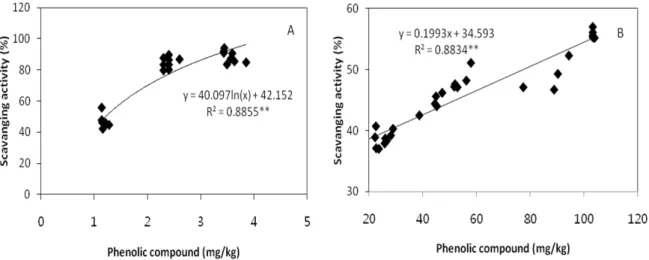
Fig. 1. The relationships between phenolic compounds concentration and DPPH radical scavenging activity of peel (A) and flesh (B) in 'Niitaka' pear fruits.
이 관행보다 높기 때문에 배에서 칼륨 등 무기성분 함량이 높 고 항산화 물질 등의 함량이 높을 수 있을 것으로 판단된다.
과피의 플라보노이드 함량은 관행과 유기재배에서 별다른 차이가 없었지만(P>0.05), 과육과 과즙에서는 유기농 과실이 관행과실보다 통계적으로 유의성 있게 높은 플라보노이드 함 량을 보였다(Table 4). Roussos와 Gasparatos(2009)은 유 기재배 된 사과의 과육 추출물에서 관행재배 한 사과보다 높 은 플라보노이드를 함유하였고, 과피에서 과육보다 5-6배정 도 높은 플라보노이드를 함유했다고 보고하여서 본 연구와 비슷한 결과를 보였다. 하지만 본 실험에서는 단지 한 농가에 서 조사한 결과이기 때문에 보다 다양한 샘플을 조사할 필요 가 있을 것으로 판단되었다. 또한 이러한 성분이 높아지게 된 배경이 표 1에서 제시한 바와 같이 비료투입 양분량의 차이 인지 아니면 병해충 방제를 위해 시용한 유기자재에 의한 차 이인지에 대한 앞으로의 연구가 필요하다고 할 수 있다.
유기농 과실과 관행 과실의 부위별 추출물의 농도별 DPPH 라디칼 제거능을 조사한 결과는 Table 5에 제시하였 다. 과피에서의 DPPH 라디칼 제거능은 일반적으로 유기농 과실에서 다소 높은 경향이 나타났으나 유의적인 차이는 나 타나지 않았다(P>0.05). 재배방법에 상관없이 과피는 낮은 농도(2-6 g/L)에서도 높은 라디컬 제거활성(45-89%)을 보였 다. 과육은 과피에 비해 라디컬 제거를 위해 훨씬 더 많은 농
도를 필요로 해서, 과피에 비해서 항산화 할성 능력이 떨어진 다는 것을 알 수가 있다. 과육 100 g/L와 200 g/L의 추출 농도에서 유기농 과실이 관행보다 유의적으로 높은 제거활성 이 나타났다.
페놀화합물 농도와 DPPH 라디칼 제거능의 상관관계를 Fig. 1에 제시하였는데 과피와 과육 추출물에서 각각 r2=0.886 (P<0.01)과 0.883(P<0.01) 으로 매우 강한 상관관계를 나타 내었다. 플라보노이드 농도 또한 DPPH 라디칼 제거능과 과 피와 과육에서 각각 r2=0.744(P<0.01)와 0.735(P<0.01)로 유의 상관관계를 보였다(Fig. 2). 본 연구에서 과피에서 과육 에 비하여 폴리페놀 함량은 3배, 플라보노이드는 5배 정도의 높은 함량을 나타내었는데, Fig. 1에서 제시하였듯이 과피 추 출물에서는 낮은 페놀농도(약 4 mg/kg)에서 90% 이상의 라디칼 제거능을 나타냈지만 과육에서는 100 mg/kg에서 50% 전후의 라디칼 제거능을 보여주었다. 이로부터 과피에 는 라디칼 제거능이 있는 폴리페놀이나 플라보노이드 이외의 또 다른 기능성 물질이 있을 것으로 판단되며, 앞으로 보다 더 깊은 연구가 필요할 것으로 사료된다.
아질산염 소거효과는, 과피에서는 소량(50 g/L)에서도 94%에 달하는 제거 활성을 보인 반면, 과육에서는 4배에 달 하는 양(200 g/L)에서 90%를 밑도는 활성을 나타냈다 (Table 6). 하지만, 유기농과 관행재배 된 과실의 추출액 농
Fig. 2. The relationships between flavonoid concentration and DPPH radical scavenging activity of peel (A) and flesh (B) in 'Niitaka' pear fruits.
Table 6. Nitrite scavenging activity in the ethanol extraction from fruit peel and flesh as affected by organic and conventional systems of 'Niitaka' pear trees in Boseong, Chonnam, 2009
Treatment Peel (%, FWz) Flesh (%, FW)
50 g/L 100 g/L 200 g/L
Organic 94.3ay 95.8a 86.2a
Conventional 93.8a 95.3a 84.9a
zFW indicates the flesh weight in a fruit.
yMeans comparison among the farming systems within a column for a fruit characteristics; means followed by different letters are significantly different, 5% level.
도별 아질산염 제거에 대한 유의적인 차이가 나타나지 않았 다. 아질산염은 발암과 관련된 nitrosamine을 형성하는 것 으로 알려져 왔다(Greenblatt et al., 1971; Lim et al., 2007).
1년생 덩굴성 박과식물인 여주(Momordica charantia L.)는 기능성 채소 및 약용으로 전 세계적으로 재배되고 있는데 (Grover and Yadav, 2004), 여주 추출물(1000 g/L)의 아 질산염 소거능이 85% 전후로 보고되었다(Boo et al., 2009).
여기에 비추어 보면 배 과육에서 20%(200 g/L)의 추출액만 으로도 이와 상응되는 아질산 소거활성을 나타냄으로 소량의 배 섭취로도 아질산염 제거에 많은 도움이 되리라 생각된다.
요 약
본 연구는 유기재배와 관행재배 된 배 ‘신고’ 과실특성과 항산화 활성을 비교하기 위해서 수행되었다. 유기농으로 재 배된 과실은 진한 적색계열의 과피색을 보였고, 관행과 유기 재배 된 과실의 무게, 당 및 산함량, 경도, 그리고 석세포 함 량은 별다른 유의성이 나타나지 않았다. 과실 중 K는 유기재 배에서 높았고, 다른 무기성분인 P, Ca, 그리고 Mg는 비슷 한 농도를 보였다. 유기농 과실은 관행에 비교해서 과피와 과육 그리고 과즙에서 페놀함량이 유의적으로 높았고, 과피 는 과육보다 재배방법에 상관없이 항산화 물질에서 모두 높 은 함량을 나타냈다. DPPH 라디칼 제거능은 과피에서는 처
리간에 별다른 영향이 없었고, 과육에서는 유기농 과실에서 관 행보다 더 높게 나타났다. 페놀함량과 플라보노이드 모두 DPPH 라디칼 제거능과 강한 유의 상관관계가 나타났다. 배 과육과 과피내 아질산염은 처리간에 비슷한 제거효과를 보 였다.
감사의 글
본 연구는 농진청 지역농업특성화연구개발과제의 지원으 로 수행되었으며, 국립 농업과학원 유기농업과의 지원에도 감사 드립니다.
참고문헌
Boo, H.O., Lee, H.H., Lee, J.W., Hwang, S.J., Park, S.U., 2009. Different of total phenolics and flavonoids, radical scavenging activities and nitrite scavenging effects of Momordica charantia L. according to cultivars, Korean J. Medicinal Crop Sci. 17, 15-20.
Carbonaro, M., Mattera, M., Nicoli, S., Bergamo, P., Cappelloni, M., 2002. Modulation of antioxidant compounds in organic vs conventional fruit (Peach,
Prunus persica L., and Pear, Pyrus communis L.), J.
Agric. Food Chem. 50, 5458-5462.
Faragher, J.D., Chalmers, D.J., 1977. Regulation of anthocyanin synthesis in apple skin, J. Expt. Bot.
34, 1291-1298.
Faust, M., 1989. Nutrition of fruit trees, in: Physiology of temperate zone fruit trees, John Wiley & Sons, USA, pp. 53-132.
Francis, F.J., 1970. Anthocyanins in pears, Hort. Sci. 5, 42.
Greenblatt, M., Mirvish, S., So, B.T., 1971. Nitrosamine studies: induction of lung denomas by concurrent administration of sodium nitrite and secondary amines in Swiss mice, J. Nati. Cancer Inst. 46, 1029-1034.
Grover, J.K., Yadav, S.P., 2004. Pharmacological actions and potential uses of Momordica charantia: A review, J. Ethnopharmacol. 93, 123-132.
Kato, H., Lee, I.E., Chyuen, N.V., Kim, S.B., Hayase, F., 1987. Inhibitory of nitrosamine formation by nondialyzable melanoidins, Agric. Biol. Chem. 51, 1333-1338.
Kim, D.S., Ahn, B.W., Yeum, D.M., Lee, D.H., Kim, S.B., Park Y.H., 1987. Degradation of carcinogenic nitrosamine formation factor by natural food com- ponents-1. Nitrite-scavenging effects of vegetable extracts, Bull. Korean Fish. Soc. 20, 463-468.
Lee, J.A., Kim, W.S., Choi, H.S., 2009a. Effect on fruit quality of 2-year compost application in a convention- ally managed pear orchard, Korean J. Food Preserv.
16, 317-320.
Lee, J.E., Kim, W.S., 2001. Morphological characters of stone cells on the effect on fruit quality of pears, J.
Korean Soc. Hort. Sci. 42, 449-452.
Lee, X., Kim, W.S., Choi, H.S., 2009b. Effect of different fertilizers on fruit quality in a pear orchard, Korean J. Food Preserv. 16, 305-310.
Lim, J.A., Yun, B.W., Beak, S.H., 2007. Antioxidative activity and nitrite scavenging ability of methanol extract from Salvia plebeia R. Br, Korean J. Medicinal Crop Sci. 15, 183-188.
Lin, J.Y., Tang, C.Y., 2007. Determination of total phenolic and flavonoid contents in selected fruits and vegetables, as well as their stimulatory effects on mouse splenocyte proliferation, Food. Chem. 101, 140-147.
Lombardi-Boccia, G., Lucarini, M., Lanzi, S., Aguzzi, A., Cappelloni, M., 2004. Nutrients and antioxidant molecules in yellow plums (Prunus domestica L.) from conventional and organic productions: A comparative study, J. Agri. Food Chem. 52, 90-94.
Lotter, D.W., 2003. Organic agriculture, J. Sustainable Agric. 21, 59-128.
Oh, J.H., Kim, E.H., Kim, J.L., Moon, Y.I., Kang, Y.H., Kang, J.S., 2004. Study on antioxidant potency of green tea by DPPH method, J. Korean Soc.
Food Sci. Nutr. 33, 1079-1084.
Peck, G.M., Andrews, P.K., Reganold, J.P., Fellman, J.K., 2006. Apple orchard productivity and fruit quality under organic, conventional, and integrated manage- ment, Hort. Sci. 41, 99-107.
Ribeiro, S.M.R., Barbosa, L.C.A., Queiroz, J.H., Knodler, M., Schierber, A., 2008. Phenolic compounds and antioxidant capacity of Brazilian mango (Mangifera Indica L.) varieties, Food Chem. 110, 620-626.
Robert, V., Mateja, T., Karin, H., Melanie, H., Dieter, G., Franci, S., 2005. Phenolic compounds in some apple (Malus domestica Borkh) cultivars of organic and integrated production, J. Sci. Food Agric. 85, 1687-1694.
Rosen, C.J., Allan, D.L., 2007. Exploring the benefits of organic nutrient sources for crop production and soil quality, HortTech. 17, 422-430.
Roussos, P.A., Gasparatos, D., 2009. Apple tree growth and overall fruit quality under organic and con- ventional orchard management, Sci. Hort. 123, 247-252.
Saba, A., Messina, F., 2003. Attitudes towards organic foods and risk/benefit perception associated with pesticides, Food Qual. Prefer. 14, 637-645.
Treutter, D., 2001. Biosynthesis of phenolic compounds and its regulation in apple, Plant Growth Regulators 34, 71-89.