785
Copyright © 2014 The Korean Society of Fisheries and Aquatic Science pISSN:0374-8111, eISSN:2287-8815
서 론
해삼류 중에서 돌기해삼(Apostichopus japonicus)은 well-
being 식품으로한국, 일본및중국을포함한동북아시아에서
주로식용으로이용되고있다. 최근에해삼에대한수요가증 가되고있는반면에, 무분별한남획, 해양환경오염, 수온변화 등으로인해해삼생산량이감소되고있어양식에대한관심이 증가되고있다(Conand, 2004). 지금까지해삼의생식(Tanaka, 1958a), 섭식(Tanaka, 1958b), 유생사육(Sui et al., 1986; Sui, 1989), 대사(Kashenko, 2000; Li et al., 2002) 및추출물(Tian et al., 2005)에대한연구가수행되었다. 또한, 해삼양식에필요 한사육기술에관한연구(Seo et al., 2009)와경제적인배합사 료를개발하기위한영양소요구및사료원료의이용성에관한 연구(Choi et al., 2009; Choi et al., 2013; Seo and Lee, 2011;
Seo et al., 2010; Seo et al., 2011a, 2011b)들이꾸준히수행되 고있다.
해삼은해저바닥에주로서식하면서모래나펄에섞여있는
동물과식물의사체를섭취한다. 이러한해삼의서식지와섭식 형태에근거하여양어가들은펄등의부드러운저질을사료에 혼합하여공급하기도한다. 해삼양식시사용되는양성용먹
이로는 자연산해조류분말을단독또는 혼합하여공급(Sui,
1988; Battaglene et al., 1999)하고있는실정이며, 배합사료연 구에사용되는먹이도분말형태의실험사료를공급하면서수 행되었다. 이러한분말상태의사료는해삼이섭취하기전에사 료의영양소가수중으로쉽게유출될수있거나물의흐름에따 라분말사료가유실될가능성이높다. 사료내영양소유출이나 분말사료의유실은사료의원료조성비, 사료성형조건, 사료 형태등에영향을받을수있으므로(Lee et al., 1997a, 1997b), 이에대한고려가필요하다. 또한이러한사료분말의수중유실 은환경오염원이되므로이에대한대책이필요하다.
고형물형태의사료는분말형태의사료와비교하여수중에서 유실되는양과해수에의한수용성영양소의용출이비교적낮 다. 해삼이 pellet이나 crumble 형태의고형사료도적절히섭취 하여소화할수있다면실용사료형태로사용될수있을것으로
배합사료 조성비와 제조 형태(Powder, Crumble 및 Pellet)에 따른 해삼( Apostichopus japonicus)의 성장
이상윤·이상민*
강릉원주대학교 해양생물공학과
Growth of Juvenile Sea Cucumber Apostichopus japonicus Fed Different Formulated Diets with Different Feed Types
(Powder, Crumble and Pellet)
Sang-Yoon Lee and Sang-Min Lee*
Department of Marine Bioscience and Technology, Gangneung-Wonju National University, Gangneung 210-702, Korea An experiment was conducted to investigate the effects of feeding by different feed types (powder, crumble and pellet) of two different feed formulations with simple dried (D) or extruded (E) conditions on growth and body composition of juvenile sea cucumber Apostichopus japonicus. Triplicate groups of sea cucumber averaging 1.2±0.05 g were fed each of the D1, D2, EP1 or EP2 diets for 12 weeks. Survival of sea cucumber fed D2-crumble was higher than that fed EP2-crumble diet (P<0.05). Weight gain of sea cucumber fed EP1-powder was higher than that fed EP1-crumble and EP2-crumble diets (P<0.05). These findings indicated that simple dried feed could use independently feed type for sea cucumber culture and powder type of extruded feed is also good for sea cucumber culture.
Key words: Sea cucumber, Apostichopus japonicus, Feed type, Feed formulation
This is an Open Access article distributed under the terms of the Creative Commons Attribution Non-Commercial Licens (http://creativecommons.org/licenses/by-nc/3.0/)which permits unrestricted non-commercial use, distribution, and reproduction in any medium, provided the original work is properly cited.
http://dx.doi.org/10.5657/KFAS.2014.0785 Kor J Fish Aquat Sci 47(6) 785-789, December 2014
Received 17 November 2014; Revised 6 December 2014; Accepted 8 December 2014
*Corresponding author: Tel: +82. 33. 640. 2414 Fax: +82. 33. 640. 2955 E-mail address: [email protected]
이상윤ㆍ이상민 786
판단된다. 그래서, 본연구는수중에서배합사료의풀림속도 가달라지도록사료조성비를달리하고, 성형조건에따른배합 사료형태가해삼의성장과생존에미치는영향을조사하였다.
재료 및 방법
실험사료
실험사료조성을 Table 1에나타내었다. 실험사료의주요단
백질원료는가리비분말과대두박을사용하였으며, 해조류로 지충이분말, 미역분말및다시마분말을사용하였다. 배합사 료조성물과사료제조조건에따라수중에서풀어지는속도가 달라지도록하였는데, 수중에서잘풀어지는사료1의경우가리 비분말과지충이분말을각각 20%와 50%씩첨가하였다. 수중 에서잘풀어지지않은사료2의경우, 대두박과지충이분말을
각각 14%와 25% 첨가하였으며, 점착력이있는소맥분을 8%
첨가하였다. 또한, 사료2에펄을 15% 첨가하였다. 이와같이배 합사료조성물이다르게설계된 2종류의실험사료제조는각각 의배합사료조성물을소형펠렛기와 extruder로성형하였는데, 실험사료제조방법은다음과같다. D1과 D2 사료의경우, 설 계된사료원료들을잘혼합한후원료 100 g당물 30 g을첨가 하여펠렛제조기로압출성형한후, 실온에서 24시간건조후 pellet, crumble 및 powder 형태로가공하였다(D1-pellet, D1- crumble, D1-powder, D2-pellet, D2-crumble, D2-powder).
EP1과 EP2 사료의경우, 설계된원료들을분말형태로잘혼합 하고 Extruder Pellet Mill (Kahl OEE 08 extruder, Germany) 을사용하여 EP를제조하였다. 제조조건으로 extruder 속도는 60 HZ, 압력은 75-80 bar, 사출구온도는 80-90℃의조건으로 하여사료를압출성형하였으며, 50℃의열풍건조기에서건조 후, crumble 및 powder 형태(EP1-crumble, EP1-powder, EP2- crumble, EP2-powder)로각각분쇄하였다. Extruder를사용하 여가공한 pellet 형태사료는수중에서공급 24시간후에도풀 어짐이없어실험구에포함시키지않았다. 이렇게제조된사료
를 -30℃에보관하면서실험수조에공급하였다.
실험어 및 사육관리
본실험에사용된해삼은전라남도완도에서종묘생산된어 린해삼을구입한후, 강릉원주대학교해양생물연구교육센터 로수송하여 FRP 사각수조(2 ton)에서해삼용상품사료를 2일 1회공급하면서 2주간적응시켰다. 사육실험은총 30개의사각 수조(50 L 사각수조)에외형적으로건강한어린해삼(평균체 중: 1.2±0.05 g)을각수조에 40 마리씩 3반복으로수용한후 실험사료를해삼체중의 5%씩 2일 1회 (17:00 h) 공급하면서 12주간사육하였다. 사육실험기간동안수온은평균 15℃, 비 중은 1.025이였으며, 각수조마다모래로여과된해수를 1 L/
min씩흘려주었다. 샘플채취 및 성분분석
실험종료시에는각실험수조에생존한어린해삼모두를일 반성분분석용으로샘플하여 -75℃에보관하였다. 일반성분분 석은 AOAC (1995)의방법에따라조단백질(N×6.25)은 Auto Kjeldahl System (Buchi B-324/435/412, Switzerland)를사용 하여분석하였고, 조지방은 ether를사용하여추출하였으며, 수 분은 105℃의 dry oven에서 6시간동안건조후측정하였다. 회 분은 600℃ 회화로에서 4시간동안태운후정량하였다. 통계처리
결과의통계처리는 SPSS Version 20.0 (SPSS Inc., Chicago, IL, USA) program을사용하여 One-way ANOVA-test를실시 한후, Duncan’s multiple range test (Duncan, 1995)로평균간 의유의성을검정하였다.
Table 1. Ingredients and proximate composition of the experimen- tal diets
Diets
1 2
Ingredients (%)
Scallop meal 20.0 -
Soybean meal - 14.0
Wheat flour - 8.0
Sargassum thunbergii 50.0 25.0
Undaria powder 10.0 10.0
Laminaria powder 8.0 10.0
Distillers dried grain
powder 5.0 8.0
Squid liver powder 5.0 8.0
Mud 15.0
Vitamin premix1 1.0 1.0
Mineral premix2 1.0 1.0
Proximate analysis (%, dry matter basis)
Crude protein 21.3 21.5
Crude lipid 2.5 2.7
1Vitamin premix contained the following amount which were dilut- ed in cellulose (g kg-1 mix): L-ascorbic acid, 200; DL-α-tocopheryl acetate, 20; thiamin hydrochloride, 5; riboflavin, 8; pyridoxine hy- drochloride, 2; niacin, 40; Ca-D-pantothenate, 12; myo-inositol, 200; D-biotin, 0.4; folic acid (98%), 1.5; p-aminobenzoic acid, 20;
menadione, 4; retinyl acetate, 0.73; cholecalciferol, 0.003; cyano- cobalamin, 0.003.
2Mineral premix contained the following ingredients (g kg-1 mix):
NaCl, 7; MgSO4·7H2O, 105; NaH2PO4·2H2O, 175; KH2PO4, 224;
CaH4(PO4)2·2H2O, 140; Ferric citrate, 17.5; Ca-lactate, 21.8;
ZnSO4·7H2O, 2.8; CuCl, 0.2; AlCl3·6H2O, 0.11; KIO3, 0.05; Na2S- e2O3, 0.007; MnSO4·H2O, 1.4; CoCl2·6H2O, 0.07.
사료 조성과 형태에 따른 어린 해삼의 성장 787
결과 및 고찰
사육실험종료후, 생존율결과를 Fig. 1에나타냈다. 생존율
에있어서 EP2-Crumble 실험구를제외하고모든실험구에서
80% 이상으로나타났고, EP2-Crumble 실험구가 D2-Crumble 실험구보다유의하게낮은생존율을보였다(P<0.05). 본연구 에서나타난어린해삼의생존율의 값은다른연구와비슷하 거나(Seo and Lee, 2011; Seo et al., 2008) 다른연구보다높은 (Choi et al., 2009) 값이다. 이와같이본연구에서의양호한생 존율은해삼이요구하는필수영양소의종류와함량이실험사료 에만족되어있고, 사육밀도및사육환경이해삼의생존에적합 하였기때문으로판단된다.
사육실험 12주후, 증중율의결과를 Fig. 2에나타냈다. EP1- Powder 실험구에서가장높은값을보였으며, EP1-Crumble 과 EP2-Crumble 실험구들보다유의하게 높았으며(P<0.05), D1과 D2의모든실험구들과 EP2-Powder 실험구간에는서로 유의한차이가없었다(P>0.05). 해삼의일반성분분석결과를
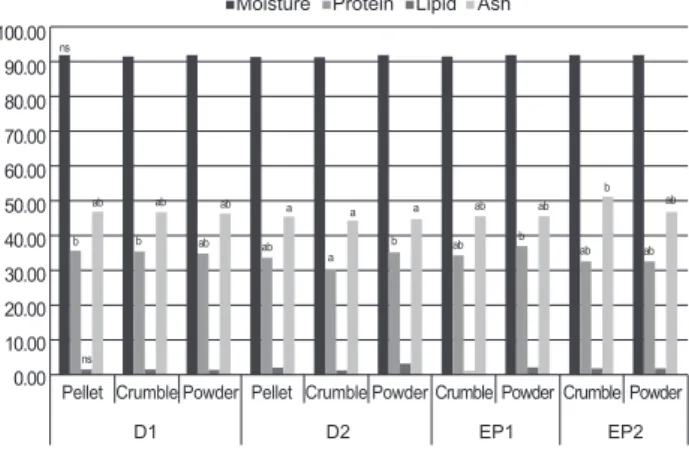
Fig. 3에표시하였다. 수분과지질의경우모든실험구간에서
유의한차이는없었다(P>0.05). D2-Crumble 실험구의단백질 함량은 D1-Pellet, D1-Crumble, D2-Powder 및 EP1-Powder
실험구들보다낮았다(P<0.05). D2-Pellet, D2-Crumble 및 D2- Powder 실험구들의회분함량은 EP2-Crumble 실험구보다낮 았다(P<0.05).
이와같은어린해삼의성장은공급된사료형태에영향을받 았으나, 본연구에사용된배합사료조성비에는영향은받지않 음을알수있다. 본실험에사용한단백질함량은 21.3-21.5%
범위로, 이는 기존 해삼 단백질 요구량 실험(Seo and Lee,
2011)에서사료내단백질함량이 20-22%에서좋은성장을나
타내었다고보고한범위이다. 해저에서퇴적된유기물이나해 조류를섭취하는해삼의식성을고려할때, 해삼은초식또는잡 식성에가깝다는것을알수있다. 이러한점에서볼때, 식물성 원료인지충이와대두박은해삼사료의좋은단백질원료로사 용될수있을것으로생각된다. 우리나라의대부분의양어가들 은지충이를해삼종묘생산에서부터육성단계까지먹이로사 용하고있는실정이다. 하지만, 지충이는공급이불안정하고가 격이상승하는등의불안요소가잠재되어있어, 이원료를대체 할수있는연구가필요하다. 양식사료원료로가장많이연구되 어있는대두박은단백질함량이높게함유하고있을뿐아니라 저렴한가격으로공급도안정적이다(Pham et al., 2005). 그래 서대두박은어분을대체할수있는단백질원으로가장많이이 용되고있는원료로서담수어류(Jackson et al., 1982: Viola et al., 1983) 뿐아니라해산어류(Shimeno et al., 1993; Cowey et al., 1974)를대상으로도많은연구가수행되어왔다. 본연구에 서동물성단백질원인가리비분말이나지충이대신대두박이 나소맥분과같은식물성단백질원료를첨가한실험구에서의 증중율이저하되지않은것으로보아, 대두박과소맥분을어분 과같은값비싼동물성원료와동등한가치를지닌해삼배합사 료의원료로사용할수있을것으로기대된다.
본연구에서배합사료의물성과형태에따라해삼의성장이
Fig. 1. Survival of juvenile sea cucumber fed the experimental di- ets 12 weeks. Bars having different superscripts (a-b) are signifi- cantly different (P<0.05) among group.
Survival(%)
D1 D2
Diets
EP1 EP2
ab
Pellet Crumble Powder Pellet Crumble Powder Crumble Powder Crumble Powder
ab ab ab b ab ab ab a ab
0 40 20 60 80 100
D1 D2
Diets
EP1 EP2
ab
Pellet Crumble Powder Pellet Crumble Powder Crumble Powder Crumble Powder ab
ab ab
ab ab
a b
a ab
0 20 10 30 40 50
Weight gain(%)
D1 D2 EP1 EP2
Pellet Crumble Powder Pellet Crumble Powder Crumble Powder Crumble Powder 100.00
90.00 80.00 70.00 60.00 50.00 40.00 30.00 20.00 10.00 0.00
Moisture Protein Lipid Ash
ns
ns b
ab b
ab ab
ab
ab ab
ab ab ab
b
ab a
a a
b a
b ab
Fig. 2. Weight gain of juvenile sea cucumber fed the experimental diets 12 weeks. Bars having different superscripts (a-b) are signifi- cantly different (P<0.05) among group.
Survival(%)
D1 D2
Diets
EP1 EP2
ab
Pellet Crumble Powder Pellet Crumble Powder Crumble Powder Crumble Powder
ab ab ab b ab ab ab a ab
0 40 20 60 80 100
D1 D2
Diets
EP1 EP2
ab
Pellet Crumble Powder Pellet Crumble Powder Crumble Powder Crumble Powder ab
ab ab
ab ab
a b
a ab
0 20 10 30 40 50
Weight gain(%)
D1 D2 EP1 EP2
Pellet Crumble Powder Pellet Crumble Powder Crumble Powder Crumble Powder 100.00
90.00 80.00 70.00 60.00 50.00 40.00 30.00 20.00 10.00 0.00
Moisture Protein Lipid Ash
ns
ns b
ab b
ab ab
ab
ab ab
ab ab ab
b
ab a
a a
b a
b ab
Fig. 3. Proximate compositions of whole body in sea cucumber fed the experimental diets for 12 weeks. Bars having different su- perscripts (a-b) are significantly different (P<0.05) among group.
Survival(%)
D1 D2
Diets
EP1 EP2
Pellet Crumble Powder Pellet Crumble Powder Crumble Powder Crumble Powder 0
40 20
D1 D2
Diets
EP1 EP2
ab
Pellet Crumble Powder Pellet Crumble Powder Crumble Powder Crumble Powder ab
ab ab
ab ab
a b
a ab
0 20 10 30 40 50
Weight gain(%)
D1 D2 EP1 EP2
Pellet Crumble Powder Pellet Crumble Powder Crumble Powder Crumble Powder 100.00
90.00 80.00 70.00 60.00 50.00 40.00 30.00 20.00 10.00 0.00
Moisture Protein Lipid Ash
ns
ns b
ab b
ab ab
ab
ab ab
ab ab ab
b
ab a
a a
b a
b ab
이상윤ㆍ이상민 788
차이를보였는데, 열을가하지않고성형된배합사료(D1, D2)
들은사료형태에영향을받지않는것으로보아, 해삼을사육하 는양식장의환경조건에따라적절한형태의사료를사용할수 있을것으로전망된다. 반면에, EP 사료의경우에는 powder 형
태의사료를공급한해삼증중율이 crumble 사료를공급한것
보다양호하였다. 이처럼사료성형조건에따라해삼의성장이 다른것은배합사료의 water solubility가다르기때문으로생각 된다. EP 사료는 extruder의 barrel에서고압과고온의조건에 서사료가팽화되면서성형되기때문에물속에서풀어지는속 도가상대적으로늦다. 본연구에서사용된배합사료가수중에 서풀어지는시간을관찰해본결과, 사육수조에서 EP 사료의 crumble의풀어지는시간이펠렛기로성형한 D 사료의 pellet 이나 crumble보다매우느렸다. 따라서물에풀리지못한사료 를해삼이섭취할수있는기회가상대적으로줄어들어성장이 낮아진것으로해석된다.
이상의결과로부터, 어린해삼의배합사료에대두박과소맥분 같은식물성원료를사용할수있을것으로보인다. 또한, 열을 가하지않고성형된배합사료를섭취한해삼은사료형태에영 향을받지않았으므로해삼사육조건에따라적절히사용할수 있을것이다. 반면에 extruder로성형한경우에는 powder 형태 의사료를해삼에게공급하는것이좋을것으로판단된다.
사 사
본연구는중소기업청에서지원하는 2010년도산학연공동기 술개발사업(과제번호 00042312)에의해 수행되었으며, 이에 감사드립니다.
References
AOAC (Association of Official Analytical Chemists). 1995.
Official Methods of Analysis of the Association of Official Analytical Chemists. 16th ed. Association of Official Ana- lytical Chemists, Arlington, VA, U.S.A.
Battaglene SC, Seymour EJ and Ramofafia C. 1999. Survival and growth of cultured juvenile sea cucumbers Holothuria scabra. Aquaculture 178, 293-322.
Choi J, Seo JY and Lee SM. 2009. Effects of sources and levels of dietary carbohydrate on growth and body composition of juvenile sea cucumbers, Apostichopus japonicus. Fish Aquat Sci 12, 203-208.
Choi J, Rahman MM and Lee SM. 2013. Distillers dried grain from makgeolli by-product is useful as a dietary ingredient for growth of juvenile sea cucumber, Apostichopus japoni- cus. Fish Aquat Sci 16, 279-283.
Conand C. 2004. Present status of world sea cucumber resourc- es and utilization: an international overview. (in) Lovatelli A, Conand C, Purcell S, Uthicke S, Hamel J F and Mercier A, eds. Advances in Sea Cucumber Aquaculture and Man-
agement. FAO, Rome, Italy, 13-23.
Cowey CB, Adron JW, Blair A and Shanks AM. 1974. Stud- ies on the nutrition of marine flatfish. Utilization of various dietary proteins to plaice (Pleuronectes platessa). Br J Nutr 31, 297- 306.
Duncan DB. 1955. Multiple range and multiple F-tests. Biomet- rics 11, 1-42
Jackson AJ, Capper BS and Matty AJ. 1982. Evaluation of some plant proteins in complete diets for the tilapia (Sarotheroden mossambicus). Aquaculture 27, 97-109.
Kashenko SD. 2000. Acclimation of sea cucumber Aposticho- pus japonicus to decreased salinity at the blastula and gas- trula stages: its effect on the desalination resistance of larvae at subsequent stage of development. Russian J Mar Biol 26, 422-426.
Lee SM, Jeon IG and Kim KS. 1997a. Effects of extruded-float- ing, slow-sinking, fast-sinking or moist pellet diets on the growth and body composition in Korean rockfish (Sebastes schlegeli). J Aquacult 10, 163-169.
Lee SM, Lee GA, Jeon IG and Yoo SK. 1997b. Effects of ex- perimental formulated diets, commercial diet and natural diet on growth and body composition of abalone (Haliotis discus hannai). J Aquacult 10, 417-424.
Li B, Yang H, Zhang T, Zhou Y and Zhang C. 2002. Effect of temperature on respiration and excretion of sea cucumber Apostichopus japonicus. Oceanol Limnol Sin 33, 182-187.
Pham MA, Lee KJ, Lim SJ, Lee BJ, Kim SS, Park YJ and Lee SM. 2005. Fish meal replacement by cottonseed and soy- bean meal in diets for early juvenile olive flounder (Parali- chthys olivaceus). J Aquacult 18, 215-221.
Seo JY and Lee SM. 2011. Optimum dietary protein and lipid levels for growth of juvenile sea cucumber Aposticho- pus japonicus. Aquacult Nutr 17, e56-e61. http://dx.doi.
org/10.1111/j.1365-2095.2009.00728.x.
Seo JY, Shin IS and Lee SM. 2011a. Effect of various protein sources in formulated diets on growth and body composition of juvenile sea cucumber Apostichopus japonicus (Selenka).
Aquacult Res 42, 623-627.
Seo JY, Shin IS and Lee SM. 2011b. Effect of dietary inclusion of various plant ingredients as an alternative for Sargassum thunbergii on growth and body composition of juvenile sea cucumber Apostichopus japonicus. Aquacult Nutr 17, 549- Seo JY, Kim DG, Kim GU, Cho SS, Park HG and Lee SM. 556.
2009. Effect of different substrates in the rearing tank on growth and body composition of juvenile sea cucumber Apostichopus japonicus. J Aquacult 22, 118-121.
Seo JY, Choi J and Lee SM. 2010. Influences of dietary lipid source on the growth and fatty acid composition of juvenile sea cucumber Apostichopus japonicus. Fish Aquat Sci 13, 127-132.
Shimeno S, Mima T, Yamamoto O and Ando Y. 1993. Effects
of fermented defatted soybean meal in diet on growth, feed conversion and body composition of juvenile yellowtail.
Nippon Suisan Gakkaishi 59, 1883-1888.
Sui X. 1988. Culture and enhance of sea cucumber. Agriculture Press, Beijing, China, 54-55.
Sui X. 1989. The main factors influencing the larval develop- ment and survival rate of the sea cucumber Apostichopus japonicus. Oceanol Limnol Sin 20, 314-321.
Sui X. Hu Q and Chen Y. 1986. A study on technology for rear- ing of postlarvae and juvenile of sea cucumber Aposticho- pus japonicus in high density tanks. Oceanol Limnol Sin 17, 513-520.
Tanaka Y. 1958a. Seasonal changes occurring in the gonad of Stichopus japonicus. Bull Fac Fish Hokkaido Univ 9, 29-36.
Tanaka Y. 1958b. Feeding and digestive processes of Stichopus japonicus. Bull Fac Fish Hokkaido Univ 9, 14-28.
Tian F, Zhang X, Tong Y, Yi Y, Zhang S, Li L, Sun P, Lin L and Ding J. 2005. PE, a new sulfated saponin from sea cu- cumber, exhibits anti-angiogenic and anti-tumor activities in vitro and in vivo. Can Biol Ther 4, 874-882.
Viola S, Mokady S and Arieli Y. 1983. Effects of soybean pro- cessing methods on the growth of carp Cyprinus carpio.
Aquaculture 32, 27- 38.