49(2) : 172∼ 181 (2018)
172
보관 온도 및 기간에 따른 마황탕 전탕액의 지표 성분 함량, 항염증 및 항산화 활성 비교
이나리·하혜경·신현규·서창섭*
한국한의학연구원 한약연구부
Quantification, Anti-inflammatory and Antioxidant Effects of Mahwang-tang Decoction According to the Storage Temperature and Period
Nari Lee, Hyekyung Ha, Hyeun-Kyoo Shin, and Chang-Seob Seo* Herbal Medicine Research Division, Korea Institute of Oriental Medicine,
1672 Yuseong-daero, Yuseong-gu, Daejeon, 34054, Korea
Abstract − This study was designed to investigate the stability for chemical contents and biological activities of Mahwang-tang (MT) depending on the preservation temperature and periods. MT decoction pouches were preserved for 3 months at room tem- perature (RT, 23±1oC) and refrigeration (4oC). To evaluate the stability of MT decoction, pH and sugar content were estimated.
High-performance liquid chromatography analysis were performed to quantify the contents of marker compounds in MT. Anti- inflammatory effects of MT were evaluated to suppress the generation of nitric oxide, prostaglandin E2 and cytokines (tumor necrosis factor-α and interleukin-6) in the RAW 264.7 cells stimulated with lipopolysaccharide. Total antioxidant capacity of MT was determined by ABTS radical scavenging activity. The pH of storage method and period showed a tendency to decrease gradually with time. There were no changes in sugar content depending on the preservation temperature and periods of MT decoction. Among the major components of MT, cinnamaldehyde was reduced time-dependently for 3 months of storage at RT.
The inflammatory effect and antioxidant capacity of MT were reduced time-dependently at both RT and 4oC. Our results sug- gest that the preservation period of MT decoction is recommended in refrigeration within 3 months or less rather than at RT.
Keywords − Mahwang-tang, Anti-inflammation, Antioxidation, Preservation period, Preservation temperature
최근 세계적으로 천연물에 대한 관심이 커지면서 한약의 사용이 증가하고 있으며, 질병의 치료 및 예방 목적은 물론 건강기능식품, 천연감미료 및 신약개발 자원, 한약제제 등 으로 사용범위가 넓어지면서 수요가 점점 증가하고 있다.1,2) 이에 한약의 유효성(efficacy), 안전성(safety) 및 안정성 (stability)에 대한 연구의 필요성이 매우 강조되고 있다.3) 한 약은 약용부위, 저장 온도, 습도, 공기, 빛 등과 같은 환경적 인 요인에 따라 약효의 저하가 발생하는 등 약재의 보관 및 관리방법이 약효에 미치는 영향이 크다.4) 한약의 주 사용형 태는 고온 추출 후 레토르트 파우치에 포장한 탕약 형태로 제공되는데 반해 탕약의 보관방법, 환경조건 등에 따른 안 정성 유지 및 변화에 대한 연구는 여전히 부족한 실정이며,
한약처방의 종류에 따라 지표 성분 함량이나 효능 등의 다 양한 평가지표에 따른 기준설정에 어려움을 겪고 있다. 따 라서 탕약의 안정성 확립을 위해서는 저장 조건에 따른 구 성성분의 함량 및 생리 활성 변화에 대한 평가가 필요하다.
마황탕(麻黃湯, Mahwang-tang, Mahuang-tang, Mao-to)은 후한대(後漢代) 상한론(傷寒論)에 처음 기재된 처방으로 총 6종의 한약 – 마황, 계지, 감초, 행인, 생강, 총백 – 으로 구 성되어 있으며 치태양상한(治太陽傷寒), 두통(頭痛), 신동(身 疼), 백절통(百節痛), 무한(無汗), 오풍한(惡風寒)에 사용된 다. 특히 주요 감기증후군의 초기 오한을 개선하는 주요한 처방으로 쓰여왔으며,5)유행성 감기, 독감 장티푸스, 폐렴, 류마티스 관절염, 천식 등에 활용된다.6-9)
본 연구에서는 이전 연구10)에서 항염증 효능이 확인된 마 황탕을 선정하여 전탕팩 제조 후 저장조건을 달리하여 보 관 온도 및 기간에 따른 지표 성분 함량과 약리 활성 변화
*교신저자(E-mail):[email protected] (Tel): +82-42-868-9361
를 평가함으로써 마황탕 전탕팩의 유통기한 설정을 위한 과 학적 근거를 제공하고자 하였다.
재료 및 방법
실험재료 − Table I과 같이 마황탕을 구성하는 6종의 한약 재는 ㈜광명당제약(Ulsan, Korea)에서 의약품 수준의 규격 품을 구입 후, 본초학 전문가인 한국한의학연구원 한약연구 부 최고야 박사(Daejeon, Korea)로부터 관능검사 후 모든 실 험에 사용하였다. 본 처방의 6가지 구성 생약의 표본(2016-
KE47-1~2016-KE47-6)은 한국한의학연구원 한약연구부에 보관하였다.
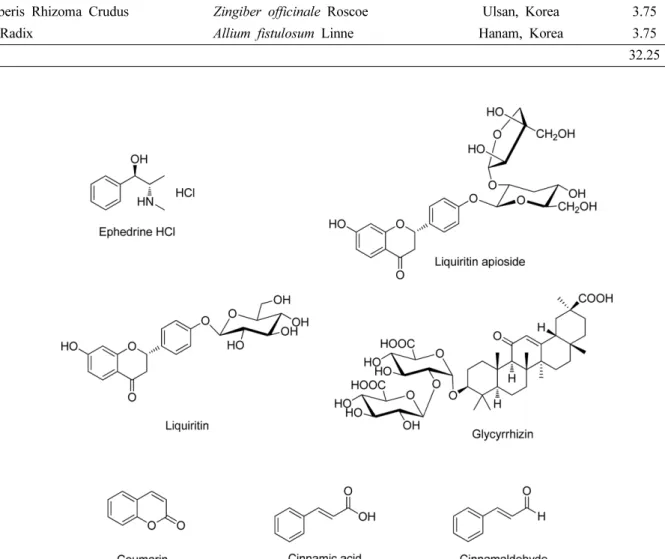
시약 및 기기 − 마황탕의 주요 성분인 ephedrine HCl (95.0%), liquiritin apioside(98.0%) 및 coumarin(99.0%) 등 3종의 표준품은 식품의약품안전처(Osong, Korea), Shanghai Sunny Biotech(Shanghai, China) 및 Merck KGaA (Darmastadt, Germany)로부터 각각 구입하여 사용하였다. 또 한 liquiritin(99.6%), cinnamic acid(98.0%), cinnamaldehyde (98.0%) 및 glycyrrhizin(99.0%) 등 4종 표준품은 Wako (Osaka, Japan)로부터 구입하여 사용하였다(Fig. 1). 표준품
Table I. Composition of Mahwang-tang
Latin name Scientific name Amount (g) Origin
Ephedrae Herba Ephedra sinica Stapf China 11.25
Cinnamomi Ramulus Cinnamomum cassia Presl Vietnam 7.50
Glycyrrhizae Radix et Rhizoma Glycyrrhiza uralensis Fischer China 2.25 Armeniacae Semen Prunus armeniaca Linne var. ansu
Maximowicz
China 3.75
Zingiberis Rhizoma Crudus Zingiber officinale Roscoe Ulsan, Korea 3.75
Allii Radix Allium fistulosum Linne Hanam, Korea 3.75
Total 32.25
Fig. 1. Chemical structures of the seven marker components in MT.
의 용해, 분리 및 정량 분석을 위해 사용된 high-performance liquid chromatography(HPLC)급 용매인 distilled water, acetonitrile 및 methanol은 J.T. Baker(Phillipsburg, NJ, USA)로부터 구입하였으며, trifluoroacetic acid(99.0%이상) 는 HPLC 분석용으로 Merck KGaA(Darmstadt, Germany) 로부터 구입하여 사용하였다. 보관 기간 및 방법에 따른 마 황탕 전탕액 중 주요 성분의 함량 분석은 Shimadzu Prominence LC-20A series HPLC system(Kyoto, Japan)을 사용하였으며, 측정된 데이터는 LabSolution software(version 5.53, SP3, Kyoto, Japan)를 이용하였다. 당도는 Pal-α 디지 털굴절계(Atago, Tokyo, Japan)를 이용하여 측정하였으며, pH는 692 pH/Ion meter(Metrohm, Herisau, Switzerland)를 사용하여 각각 측정하였다. 전탕액 제조를 위해 경서E&P㈜
의 초고속 진공 저온 농축 추출기(COSMOS 660, Incheon, Korea)를 사용하여, 자유조절 롤 포장기(MH 205 Tower, Kyungseo machine, Korea)를 사용하여 전탕액 파우치를 제 조하였다.
약리 활성 평가를 위해 Dulbecco’s modified Eagle’s medium(DMEM), fetal bovine serum(FBS), penicillin- streptomycin 및 phosphate-buffered saline(PBS)은 Gibco BRL(Carlsbad, CA, USA)에서 구입하였으며, lipopolysac- charide(LPS), NG-methyl-L-arginine(L-NMMA), indomethacin 은 Sigma Chemical Co.(St. Louis, MO, USA)에서 구입하 였다. Cell Counting Kit-8(CCK-8)는 Dojindo(Kumamoto, Japan), Griess reagent는 Promega Corp.(Madison, WI, USA), prostagladin E2(PGE2) enzyme-linked immunosorbent assay(ELISA) kit와 antioxidant assay kit는 Cayman Chemical Co.(Ann Arbor, MI, USA) 제품을 사용하였다.
Tumor necrosis factor-alpha(TNF-α) 및 interleukin-6(IL-6) ELISA kit는 BD Biosciences(San Jose, CA, USA) 제품을 사용하였다.
마황탕 전탕액 파우치 제조 및 보관 − 마황탕의 전탕액 은 6종의 구성 생약을 Table I과 같은 무게 비율로 섞어 총 시료 양을 약 2.0 kg(1첩 32.25 g×62.02배)으로 맞춘 후 시 료 무게의 10배수인 20 L의 물을 첨가하였다. 혼합된 시료 를 초고속 진공 저온 추출기를 이용하여 98 kPa 압력으로 100oC에서 2시간 전탕한 후 표준체(No. 270, 53 μm, Chung Gye Sang Gong Sa, Seoul, Korea)를 이용하여 여과한 후 80 mL씩 포장기를 이용하여 포장하였다. 상기와 동일한 방 법으로 총 3개의 로트를 제조하여 상온(23±1oC)과 냉장(4oC) 에 각각 보관하면서 실험에 사용하였다.
pH 및 당도 측정 − 조제된 마황탕 전탕액을 보관 방법 및 기간에 따라 pH와 당도를 측정하였다.
마황탕 지표성분의 HPLC 분석 − 광 다이오드 어레이 (photodiode array, PDA) 검출기가 장착된 HPLC를 이용하 여 제조된 마황탕 전탕액 중 주요 성분인 ephedrine HCl,
liquiritin apioside, liquiritin, coumarin, cinnamic acid, cinnamaldehyde 및 glycyrrhizin 등 7종에 대하여 보관방법 및 기간에 따라 함량을 분석하였다. 주요 성분은 40oC로 유 지되는 SunFire C18 칼럼(250×4.6 mm, 5 µm, Waters, Milford, MA, USA)을 이용하여 분리하였으며, 이동상은 0.1%(v/v) trifluoroacetic acid가 함유된 distilled water(이동 상 A)와 acetonitrile(이동상 B)을 이용하여 다음과 같은 기 울기 용매 조건으로 흘려주었다; 10–60% B(0–-30분), 60–
100% B(30–40분), 100% B(40–45분) 및 100–10% B(45–
50분). 이 후 칼럼과 기기는 출발 용매로 10분 동안 안정화 시켰다. 분당 1.0 mL의 유속으로 흘려주었으며 주입량은 10 μL였다. 함량 분석은 상온과 냉장에 각각 보관 중인 전 탕액을 0.2 μm 멤브레인 필터(Pall Life Sciences, Ann Arbor, MI, USA)로 여과 한 후 검액으로 하였다. 또한 ephedrine HCl과 glycyrrhizin은 전탕액 2.5 mL을 정확히 취하여 물을 이용하여 10 mL로 한 후 분석하였다.
항염증 활성 평가
세포배양 − Mouse macrophage cell line인 RAW 264.7 세포는 American Type Culture Collection(ATCC, Rockville, MD, USA)으로부터 분양 받았으며, DMEM 배지에 5.5%
FBS, penicillin(100 U/mL) 및 streptomycin(100 g/mL)을 첨 가하여 37oC 및 5% CO2 조건에서 배양하였다.
세포 독성 평가 − 마황탕 전탕팩의 상온 및 냉장 보관 기 간에 따른 세포 독성 확인을 위해 RAW 264.7 세포를 96 well plate에 3×10³cells/well씩 분주하여 18 시간 배양한 후, 추출물을 농도별로 처리하여 24시간 동안 배양하였다. 이 후, CCK-8 용액을 10 µL씩 첨가하고 4시간 배양 후 microplate reader(Benchmark Plus, Bio-Rad, Hercules, CA, USA)를 사용하여 450 nm에서 흡광도를 측정하였다. 측정 된 흡광도를 사용하여 다음의 식으로 세포생존률을 계산하 였다.
세포 생존율(%) = (비교군 측정값의 평균)/(대조군 측정값 의 평균) × 100
RAW 264.7 세포에서의 NO, PGE2의 분비량 측정 − 48 well plate에 2.5×10⁵cells/well씩 분주한 후, 18시간 배양 하여 LPS(1 µg/mL)를 처리하기 전 마황탕 추출물을 31.3, 62.5, 125, 250 µg/mL의 농도로 4시간 전처리하였다. 배양 20시간 후, 상등액 내에 존재하는 nitrite는 Griess reagent로, PGE2와 염증성 cytokine인 TNF-α 및 IL-6는 ELISA를 사 용하여 제조사의 방법에 따라 측정하였으며, NO와 PGE2의 양성대조군으로 각각 L-NMMA 및 indomethacin을 사용하 였다.
항산화 활성 평가 − 2,2'-azino-bis(3-ethylbenzothiazoline- 6-sulphonic acid)(ABTS)는 metmyoglobin에 의해 산화되어
ABTS+라디칼을 형성한다. 마황탕의 항산화 활성 평가를 위해 마황탕 추출물의 ABTS+ 라디칼 소거능을 제조사의 방 법에 따라 측정하였다. Trolox(양성 대조군) 및 마황탕 추출 물을 각 농도별로 96-well plate에 10 µL씩 첨가한 다음 10 µL의 metmyoglobin과 150 µL의 chromogen을 각각의 well에 첨가하였다. 이 후, 40 µL의 과산화수소 용액(441 µM)을 첨가하여 실온에서 5분동안 반응시킨 후 microplate reader를 사용하여 750 nm에서 흡광도를 측정하였다. 각 시 료의 ABTS 산화 억제율(라디칼 소거능)을 백분율로 나타 내었다.
통계 처리 − 모든 데이터는 mean±standard error of the mean(SEM)로 표시하였다. SYSTAT 13.0(Systat Software Inc. Chicago, USA)을 이용하여 ANOVA 실시 후, 사후 검 정은 Bonferroni 검정법을 적용하여 P-value가 0.05 미만 일 경우 유의한 것으로 판정하였다.
결 과
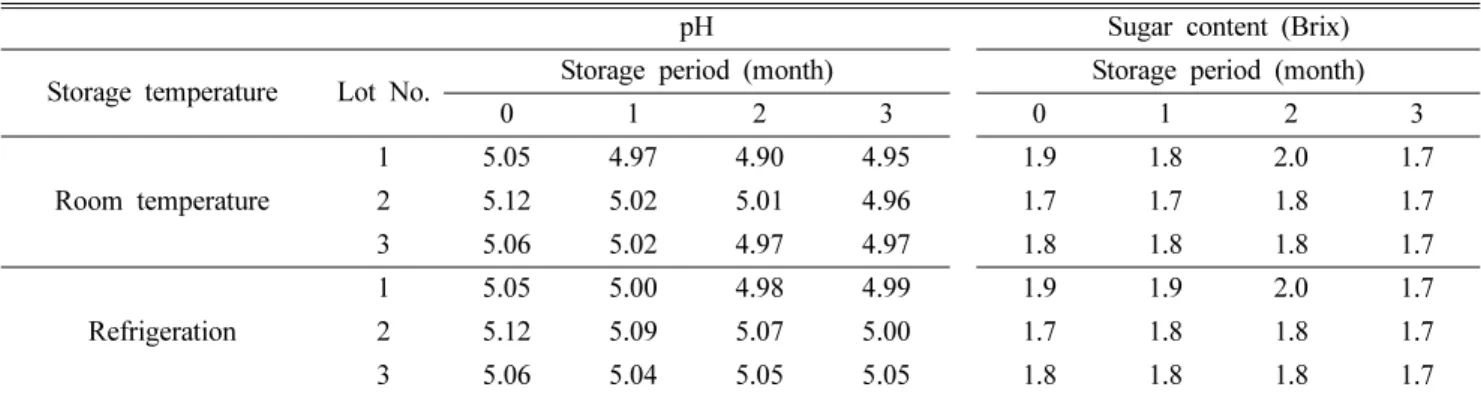
pH 및 당도 측정 − 마황탕의 pH는 Table II와 같이 최초 5.05–5.12로 나타났으며, 각각의 로트별 보관 온도 및 기간
에 따른 pH는 상온에서 4.90–5.12, 냉장에서 4.98–5.12로 시 간이 지날수록 조금씩 낮아지는 경향을 나타냈다. 당도는 최초 1.70–1.90 브릭스로 측정되었으며, 보관기간에 따라 상 온과 냉장 모두 1.70–2.00 브릭스로 나타났다(Table II).
마황탕 중 주요 성분의 함량 분석 − 확립된 HPLC-PDA 분석법을 이용하여 마황탕 전탕액 중 ephedrine HCl, liquiritin apioside, liquiritin, coumarin, cinnamic acid, cinnamaldehyde 및 glycyrrhizin 등 7가지 주요 성분에 대한 함량 분석을 실 시한 결과 모든 성분은 모두 30분 이내로 검출되었다. 이 들 7종에 대한 검량선 작성 결과 상관계수가 0.9999 이상 으로 아주 양호한 직선성을 보여 주었으며(Table III), Fig.
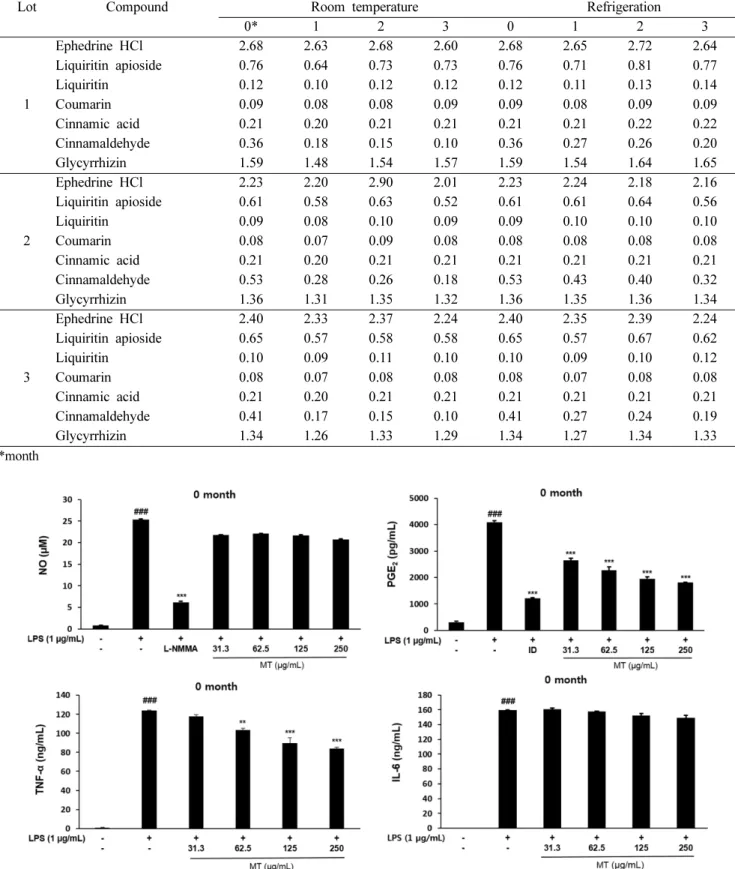
2에서와 같이 ephedrine HCl, liquiritin apioside, liquiritin, coumarin, cinnamic acid, cinnamaldehyde 및 glycyrrhizin 등 9.09, 13.89, 14.29, 20.34, 22.80, 25.49 및 26.20분에서 각각 검출되었다. 설정된 분석법을 이용하여 마황탕 전탕팩 의 보관 기간에 따른 주요 성분의 함량 분석 결과, 상온에 서는 0.08-2.68 mg/mL으로 나타났으며 냉장에서는 0.08-2.72 mg/g으로 나타났다(Table IV). 이들 성분 중 cinnamaldehyde 가 상온과 냉장 모두에서 보관 기간이 지날수록 함량이 줄 어드는 것으로 나타났다.
Table II. pH and sugar content of Mahwang-tang by storage methods and periods
pH Sugar content (Brix)
Storage temperature Lot No. Storage period (month) Storage period (month)
0 1 2 3 0 1 2 3
Room temperature
1 5.05 4.97 4.90 4.95 1.9 1.8 2.0 1.7
2 5.12 5.02 5.01 4.96 1.7 1.7 1.8 1.7
3 5.06 5.02 4.97 4.97 1.8 1.8 1.8 1.7
Refrigeration
1 5.05 5.00 4.98 4.99 1.9 1.9 2.0 1.7
2 5.12 5.09 5.07 5.00 1.7 1.8 1.8 1.7
3 5.06 5.04 5.05 5.05 1.8 1.8 1.8 1.7
Table III. Linear range, regression equation, correlation coefficients, LOD, and LOQ for 7 marker components Compound Linear range
(µg/mL) Regression equationa Correlation coefficient
LODb (µg/mL)
LOQc (µg/mL) Ephedrine HCl 7.81-125.00 y=21151.31x + 8837.74 0.9999 0.16 0.50 Liquiritin apioside 1.56-100.00 y=16795.26x - 4999.15 1.0000 0.36 1.08 Liquiritin 1.56-100.00 y=34977.41x - 5507.76 1.0000 0.17 0.52 Coumarin 1.56-100.00 y=61766.38x - 21853.95 0.9999 0.10 0.29 Cinnamic acid 0.78-50.00 y=85141.39x - 16724.01 0.9999 0.07 0.21 Cinnamaldehyde 1.56-100.00 y=128109.55x - 28516.41 1.0000 0.01 0.02 Glycyrrhizin 1.56-100.00 y=8700.95x - 1917.68 1.0000 0.38 1.16
a
y: peak area (mAU) of compounds; x: concentration (µg/mL) of compounds.
b
LOD = 3.3σ × S.
c
LOQ = 10 σ × S.
σ is the standard deviation of the blank response and S is the slope of the calibration curve
항염증 효능 − RAW 264.7 대식세포에서 마황탕의 세포 독성을 확인한 결과, 상온 및 냉장 보관한 경우 모두 250 µg/
mL 이하의 농도에서 세포 독성이 관찰되지 않았다. 이후 세 포 독성이 나타나지 않는 농도 범위에서 LPS 처리된 RAW 264.7 세포에 대하여 마황탕 추출물의 NO, PGE2, TNF-α 및 IL-6 생성 억제 효과를 확인하였다(Fig. 3-5). 제조시점(0 개월)에서 마황탕 추출물은 LPS 처리군과 비교하여 NO 및 IL-6 억제 활성이 나타나지 않았으며 PGE2의 경우 31.3 µg/
mL 이상의 농도에서, TNF-α는 62.5 µg/mL 이상의 농도에 서 유의적 억제 효과를 보였다(p<0.01). NO와 PGE2의 양 성대조군인 L-NMMA(100 µM) 및 indomethacin(2 ng/mL) 을 처리한 군과 마황탕을 각 농도별로 처리한 군에서는 NO 및 PGE2생성이 유의적으로 감소하였으며 양성대조군을 처 리한 군의 IC50값은 각각 18.37 µM, 0.33 ng/mL로 계산되었
다(p<0.01)(Fig. 3). 마황탕 전탕팩의 상온 및 냉장 보관한 시료 모두 3개월까지 PGE2의 생성이 농도의존적으로 유의 성 있게 억제하였으며(p<0.01), 제조시점인 0개월 차의 IC50 값은 111.44±6.52 µg/mL로 계산되었다(Fig. 4). 또한, 제조 시점의 62.5 µg/mL와 250 µg/mL 농도에서 각각 48.30%와 60.32%의 억제율을 나타내었고 3개월 보관 시 상온 및 냉 장의 250 µg/mL 농도에서 각각 25.44%, 30.61%로 0개월 (60.32%)에 비해 약 50% 감소된 PGE2 생성 억제효과를 보 였다(Fig. 5). 한편, TNF-α 생성 억제 활성의 경우 제조시 점의 250 µg/mL 농도에서 32.15%의 억제율을 나타내었으 나, 0개월 이후에서 통계적으로 유의성 있는 억제효과를 나 타내지 않았다. 따라서 이후 보관 시료에 대한 NO, IL-6 및 TNF-α 생성량은 측정하지 않았다.
항산화 활성 − 마황탕 전탕팩 제조시점의 시료와 상온 및 Fig. 2. Typical HPLC chromatogram of standard mixture (A) and MT sample (B) at UV wavelength 206 nm (I), 254 nm (II), 275 nm (III), and 288 nm (IV). Ephedrine HCl (1), liquiritin apioside (2), liquiritin (3), Coumarin (4), cinnamic acid (5), cinnamal- dehyde (6), and glycyrrhizin (7).
Table IV. Content of the seven marker compounds in Mahwang-tang by storage periods in room temperature and refrigeration
Lot Compound
Content (mg/g)
Room temperature Refrigeration
0* 1 2 3 0 1 2 3
1
Ephedrine HCl 2.68 2.63 2.68 2.60 2.68 2.65 2.72 2.64
Liquiritin apioside 0.76 0.64 0.73 0.73 0.76 0.71 0.81 0.77
Liquiritin 0.12 0.10 0.12 0.12 0.12 0.11 0.13 0.14
Coumarin 0.09 0.08 0.08 0.09 0.09 0.08 0.09 0.09
Cinnamic acid 0.21 0.20 0.21 0.21 0.21 0.21 0.22 0.22
Cinnamaldehyde 0.36 0.18 0.15 0.10 0.36 0.27 0.26 0.20
Glycyrrhizin 1.59 1.48 1.54 1.57 1.59 1.54 1.64 1.65
2
Ephedrine HCl 2.23 2.20 2.90 2.01 2.23 2.24 2.18 2.16
Liquiritin apioside 0.61 0.58 0.63 0.52 0.61 0.61 0.64 0.56
Liquiritin 0.09 0.08 0.10 0.09 0.09 0.10 0.10 0.10
Coumarin 0.08 0.07 0.09 0.08 0.08 0.08 0.08 0.08
Cinnamic acid 0.21 0.20 0.21 0.21 0.21 0.21 0.21 0.21
Cinnamaldehyde 0.53 0.28 0.26 0.18 0.53 0.43 0.40 0.32
Glycyrrhizin 1.36 1.31 1.35 1.32 1.36 1.35 1.36 1.34
3
Ephedrine HCl 2.40 2.33 2.37 2.24 2.40 2.35 2.39 2.24
Liquiritin apioside 0.65 0.57 0.58 0.58 0.65 0.57 0.67 0.62
Liquiritin 0.10 0.09 0.11 0.10 0.10 0.09 0.10 0.12
Coumarin 0.08 0.07 0.08 0.08 0.08 0.07 0.08 0.08
Cinnamic acid 0.21 0.20 0.21 0.21 0.21 0.21 0.21 0.21
Cinnamaldehyde 0.41 0.17 0.15 0.10 0.41 0.27 0.24 0.19
Glycyrrhizin 1.34 1.26 1.33 1.29 1.34 1.27 1.34 1.33
*month
Fig. 3. Effect of MT on LPS-induced NO, PGE2 and cytokine(TNF-α, IL-6) production in RAW 264.7 macrophages at 0 month.
*p<0.05, ***p<0.01, ***p<0.001 compared to the LPS-treated group. L-NMMA; NG-methyl-L–arginine. ID; indomethacin. LPS;
lipopolysaccharide.
냉장에서 1, 2, 3개월 동안 보관한 시료의 ABTS라디칼 소 거능을 비교 분석하였다(Fig. 6-7). 그 결과, 모든 시료에서 농도 의존적인 소거 활성이 나타났으며, 0개월 시료의 1000 µg/mL 농도에서 46.27%의 ABTS 라디칼 소거 활성
을 나타냈다(Fig. 6). 상온 보관의 경우 보관 기간이 증가함 에 따라 라디칼 소거 활성이 감소되었으며, 3개월 보관 시 료의 최고 농도(1000 µg/mL)에서는 25.12%의 억제효과를 보이며 제조시점에 비해 약 50% 감소한 라디칼 소거 활성 Fig. 4. Effect of MT stored with different preservation temperature and periods on LPS-induced PGE2 production in RAW 264.7 macrophages. ###p<0.001 versus vehicle-treated control group; ***p<0.001 versus LPS-treated group. ID: indomethacin. LPS; lipo- polysaccharide.
Fig. 5. Inhibitory Effect of Different Concentrations of MT on PGE2 Production in LPS-induced RAW 264.7 cells depending on different preservation temperature and periods. The results are the mean ± SEM (n=3).
Fig. 6. Inhibition of ABTS oxidation by MT extract. Trolox, an antioxidant, was used as a positive control. The results are the mean ± SEM (n=3).
을 나타내었다. 반면, 냉장 보관의 경우에는 제조시점에 비 해 유의적인 변화가 없어 라디칼 소거 활성이 유지되는 것 으로 나타났다(Fig. 7).
고 찰
한약의 현대화와 대중화를 위하여 제형의 변화, 포제법의 향상, 관련제품의 개발 등 여러 가지 발전방안이 제기되고 있으나 여전히 주 사용형태는 전탕포장이다.11)한방의료기 관에서는 환자에게 한약 파우치를 대체적으로 7, 10, 15일 정도의 복용량으로 제공하며 유효기간을 3개월으로 한다.12) 그러나 환자들이 기간 내에 복용하지 못하고 장기간 보관 및 복용하는 사례가 빈번하며 한약의 보관 기간 및 조건에 따른 성분 함량 변화와 약효성과의 관련하여 명확한 기준 은 없는 실정이다.
본 연구팀에서는 이전 연구에서 다빈도 한약처방 중 평위 산, 쌍화탕, 보중익기탕 등의 보존기간에 따른 pH, 지표성 분의 함량 변화에 대한 연구를 비롯하여,12-14) 청심연자음, 반하사심탕, 곽향정기산 등 처방의 주요 성분 및 효능 변화 에 대한 연구를 진행한 바 있다.15-18) 유 등15)의 연구에서 청 심연자음은 상온 및 냉장 모두 12개월까지 항염증 활성이 유지되며 성분 소실률 기준으로 상온에서 8개월, 냉장보관 의 경우 12개월까지 장기보관 및 복용이 가능한 반면, 진
등16-18)의 연구에 따르면 반하사심탕과 곽향정기산은 2개월
이내, 가미소요산은 3개월 이내로 약효 소실이 되지 않는 기간 내 복용을 권장하고 있다. 이처럼 한약 전탕팩은 각 처 방별 구성 약재 등에 따라 보관방법, 기간 등이 개별적으로 설정되어야 할 것이다.
본 연구에서는 마황탕 전탕팩의 보관방법 및 기간에 따른 성분변화 및 효능 확인을 위해 상온과 냉장에서 각각 0, 1,
2 및 3개월간 보관한 시료를 사용하였다. 상온 및 냉장에서 pH와 당도는 큰 차이가 없었으며, 0개월 차와 비교하였을 때, 보관 기간이 길어짐에 따라 0.1~0.5의 증감은 있었으나 유의성은 없는 것으로 나타났다. 측정기기의 정확도가 ±0.2%
임을 감안하여 큰 변화는 없는 것으로 판단된다.
이전 연구에 따르면 마황탕 전탕액의 주요 지표 성분인 ephedrine HCl,19,20)을 포함하여 liquiritin apioside, liqui- ritin,21,22) coumarin,23) cinnamic acid,24) cinnamaldehyde24,25) 및 glycyrrhizin26)모두 항염증 효능이 있다고 보고된 바 있 다. 염증반응은 조직의 구조와 기능을 회복시키는 유익한 체내의 방어기전으로, 염증 반응 인자로는 prostaglandin(PG), nitric oxide(NO), cytokine 등이 알려져 있다. PGE2는 다양 한 염증성 cytokine 생성 억제 및 항염증성 cytokine의 생성 촉진 등의 면역반응 조절자 역할을 수행하며, 적정농도의 NO는 cytokine 및 chemokine 합성을 억제 하는 등 면역조 절 작용에 중요한 역할을 한다. 반면 TNF-α, IL-6와 같은 염증 인자들이 과잉 생성되는 경우 각종 염증성 질환을 유 발할 수 있다.27,28) 또한, 염증반응과 더불어 면역 및 다양한 질환과 밀접한 연관성을 가지는 항산화의 효능도 중요한 요 소 중의 하나로 free radical 생성 및 소거 사이 불균형은 세 포에 손상을 입혀 산화적 스트레스를 발생시키고 암, 죽상 동맥경화증, 당뇨병, 고혈압, 염증 및 기타 여러 질병의 발 생 기전에 관여한다.29,30)
이에 본 연구에서는 LPS 염증반응을 유도한 RAW 264.7 세포에 마황탕을 처리한 후, 3개월 보관 시 NO, PGE2, 염 증성 cytokine 생성 억제 및 라디칼 감소 효능을 측정하여 항염증 및 항산화 효능이 안정하게 유지되는 기한을 설정 하였다. 보관 온도 및 기간에 따른 약리 활성 평가 결과 보 관 기간이 길어짐에 따라 상온 보관 시 냉장 보관에 비해 PGE2 생성 억제 효과와 ABTS라디칼 소거능의 감소폭이 Fig. 7. The changes of inhibitory effect of ABTS oxidation by MT according to the storage temperatures and periods. The results are the mean ± SEM (n=3 in each batch, ). ***p<0.001 compared to the 0 month at the concentration 250 μg/mL; ##p<0.01 and
###p<0.001 compared to the 0 month at the concentration 500 μg/mL; §§p<0.01 and §§§p<0.001 compared to the 0 month at the con- centration 1000 μg/mL.
더 큰 것으로 나타났으며 냉장 보관에서 항염증 및 항산화 효능이 더 오래 유지되었다.
마황탕 전탕팩의 지표 성분 7종의 함량을 비교한 결과 제 조시점에 비하여 cinnamaldehyde를 제외한 6가지 주요 성 분의 함량에서는 유의적인 감소효과가 나타나지 않았고 cinnamaldehyde 함량은 보관 기간이 길어질수록 지속적으 로 감소했으며, 냉장보다 상온에서 감소폭이 컸다. 3개월 보 관 시 상온과 냉장 시료에서 cinnamaldehyde 함량은 0개월 에 비해 70.77%와 45.38% 수준으로 각각 감소하였고 상온 보관에서 제조시점 함량의 1/2 시점인 반감기가 0.97개월로 나타났다. Cinnamaldehyde는 마황탕의 구성 약재인 계지의 주요 지표성분 중 하나로, 항염증, 항산화, 항암 및 당뇨병 치료제 등과 같은 여러 약리효과를 나타낸다고 알려져 있 다.31) 특히, PGE2, TNF-α 및 IL-6의 분비량을 감소시키고 NO 생성 억제에 대해 8 µM의 IC50 값을 가지는 것으로 보 고되었으며25,33,34) 타 연구에 의하면 계피의 주요 지표 성분 은 빛과 산소 및 수중 분해에 민감하며, cinnamaldehyde의 경우 보관온도가 낮을수록 안정성이 높아진다고 보고되었 다.32) 따라서 cinnamaldehyde와 같이 보관온도 상승에 따라 안정성이 낮아지는 성분들은 냉장 보관보다 상온보관 시 기 간이 증가함에 따라 함량 감소에 더 큰 영향을 받게 되고, 결과적으로 마황탕의 항염증 및 항산화 효능 감소에도 영 향을 준 것으로 추정된다.
결 론
마황탕 전탕팩의 상온 및 냉장 보관 기간에 따른 성분 함 량 변화, 항염증 및 항산화 활성을 평가함으로써 유통기한 을 예측하였다. 그 결과 마황탕 전탕팩은 상온 및 냉장 보 관할 경우 보관 기간이 길어짐에 따라 항염증 활성이 냉장 과 상온 모두 감소하는 비슷한 양상을 나타냈고 특히 3개 월에서 제조시점인 0개월에 비해 약 50% 감소되었으며, 항 산화 활성은 상온보관 시 활성 감소율이 더 높았다. 따라서 마황탕 전탕팩을 구성성분 함량 및 활성이 50% 이상 유지 되는 상태로 보관하기 위해서는 상온보다는 냉장에서 3개 월 이내로 보관하는 것이 더 안정할 것으로 판단된다.
사 사
본 연구는 한국한의학연구원에서 지원하는 ‘한약 처방의 과학적 근거 기반 구축사업(K17251, K18241)’에 의해 수행 되었으며 이에 감사 드린다.
인용문헌
1. Jang, I., Yang, C., Lee, S. and Han, C. (2007) A review of
herbal medicinal products associated with toxic events in Korea. J. Korean Med. 28: 1-10.
2. Jeong, I. H., Kim, J. H., Jeon, J. S., Cho, S. H., Park, S. H., Jo, H. Y. and Kim, Y. S. (2010) Safety Assessment of Ori- ental Medicines and Their Preparations. J. Food Hyg. Saf. 25:
232-237.
3. Man, S. C., Durairajan, S. S., Kum, W. F., Lu, J. H., Huang, J. D., Cheng, C. F., Chung, V., Xu, M. and Li, M. (2008) Sys- tematic review on the efficacy and safety of herbal medicines for Alzheimer’s disease. J. Alzheimers Dis. 14: 209-223.
4. Shin, Y. W. (2012) Changes in the anti-allergic effect of Cit- rus unshii Pericarpium according to storage period. Kor. J.
Herbology 27: 37-44.
5. Heo, J. (2005) Donguibogam. 809. Bubin publishers, Seoul.
6. Kainuma, M., Sakai, S., Sekiya, N., Mantani, N., Ogata, N., Shimada, Y. and Terasawa, K. (2004) The effects of a herbal medicine (Mao-to) in patients with chronic hepatitis C after injection of IFN-β. Phytomedicine 11: 5-10.
7. Saita, M., Naito, T., Boku, S., Watanabe, Y., Suzuki, M., Oka, F., Takahashi, M., Sakurai, T., Sogihara, E. and Haniu, T.
(2011) The efficacy of ma-huang-tang (maoto) against influ- enza. Health 3: 300.
8. Kubo, T. and Nishimura, H. (2007) Antipyretic effect of Mao-to, a Japanese herbal medicine, for treatment of type A influenza infection in children. Phytomedicine 14: 96-101.
9. Chun-Hua, M., Zhan-Qiang, M., Qiang, F. and Shi-Ping, M.
(2014) Ma Huang Tang ameliorates asthma though modu- lation of Th1/Th2 cytokines and inhibition of Th17 cells in ovalbumin-sensitized mice. Chin. J. Nat. Med. 12: 361-366.
10. Seo, C. S., Yoo, S. R., Jeong, S. J. and Ha, H. (2017) Simui- multaneous determination and anti-inflammatory effects of traditional herbal medicine, Mahwang-tang. Afr. J. Tradit.
Complement Altern. Med. 14: 166-180.
11. Han, K., Kwon, D. Y., Lee, S. G., Park, S. K., Kim, C. S. and Kim, Y. K. (2006) The present state of Korean herbal prepa- ration production and possible improvement plan. Herb. For- mula Sci. 14: 30-41.
12. Ha, H., Shin, I. S., Lim, H. S., Jeon, W. Y., Kim, J. H., Seo, C. S. and Shin, H. K. (2012) Changes in anti-inflammatory effect of Pyungwi-san decoction according to the preserva- tion temperature and period. Herb. Formula Sci. 20: 29-35.
13. Seo, C. S., Kim, J. H., Lim, S. H. and Shin, H. K. (2012) Establishment of shelf-Life of Ssanghwa-tang by long-term storage test. Kor. J. Pharmacogn. 43.
14. Seo, C. S., Kim, J. H., Kim, S. S., Lim, S. H. and Shin, H. K.
(2013) Evaluation of shelf-life of Bojungikgi-tang by long- term storage test. Kor. J. Pharmacogn. 44.
15. Yoo, S., Ha, H., Lee, N., Shin, H. and Seo, C. (2017) A Study on Change of Marker Compounds and Biological Activity in Chungsimyeonja-eum Decoction Depending on A Storage Temperature and Periods. Kor. J. Herbology 32: 25-32.
16. Jin, S. E., Kim, O. S., Seo, C. S., Shin, H. K. and Jeong, S.
J. (2016) Comparative study on stability and efficacy of Banhasasim-tang decoction depending on the preservation temperature and periods. J. Korean Med. 37: 21-33.
17. Jin, S. E., Kim, O. S., Shin, H. K. and Jeong, S. J. (2014) Comparative Study on Biological Activities of Gwakhyang- jeonggisan Decoction According to the Preservation Periods.
J. Korean Med. 35: 60-69.
18. Jin, S. E., Seo, C. S., Lee, N., Shin, H. K. and Ha, H. (2018) Comparative study on the contents of marker compounds and anti-inflammatory effects of Gamisoyo-san decoction accord- ing to storage temperature and periods. J. Korean Med. 39:
22-34.
19. Zheng, Y., Yang, Y., Li, Y., Xu, L., Wang, Y., Guo, Z., Song, H., Yang, M., Luo, B. and Zheng, A. (2013) Ephedrine hydrochloride inhibits PGN-induced inflammatory responses by promoting IL-10 production and decreasing proinflam- matory cytokine secretion via the PI3K/Akt/GSK3β pathway.
Cell Mol Immunol. 10: 330.
20. Zheng, Y., Guo, Z., He, W., Yang, Y., Li, Y., Zheng, A., Li, P., Zhang, Y., Ma, J. and Wen, M. (2012) Ephedrine hydro- chloride protects mice from LPS challenge by promoting IL- 10 secretion and inhibiting proinflammatory cytokines. Int.
Immunopharmacol. 13: 46-53.
21. Guan, Y., Li, F. F., Hong, L., Yan, X. F., Tan, G. L., He, J. S., Dong, X. W., Bao, M. J. and Xie, Q. M. (2012) Protective effects of liquiritin apioside on cigarette smoke-induced lung epithelial cell injury. Fundam. Clin. Pharmacol. 26: 473-483 22. Yu, J. Y., Ha, J. Y., Kim, K. M., Jung, Y. S., Jung, J. C. and Oh, S. (2015) Anti-inflammatory activities of licorice extract and its active compounds, glycyrrhizic acid, liquiritin and liquiritigenin, in BV2 cells and mice liver. Molecules 20:
13041-13054.
23. Witaicenis, A., Seito, L. N., da Silveira Chagas, A., de Almeida Junior, L. D., Luchini, A. C., Rodrigues-Orsi, P., Cestari, S. H. and Di Stasi, L. C. (2014) Antioxidant and intestinal anti-inflammatory effects of plant-derived coumarin derivatives. Phytomedicine 21: 240-246.
24. Song, F., Li, H., Sun, J. and Wang, S. (2013) Protective effects of cinnamic acid and cinnamic aldehyde on iso- proterenol-induced acute myocardial ischemia in rats. J. Eth- nopharmacol. 150: 125-30.
25. Chao, L. K., Hua, K. F., Hsu, H. Y., Cheng, S. S., Lin, I. F., Chen, C. J., Chen, S. T. and Chang, S. T. (2008) Cin-
namaldehyde inhibits pro-inflammatory cytokines secretion from monocytes/macrophages through suppression of intra- cellular signaling. Food Chem. Toxicol. 46: 220-231.
26. Fu, Y., Zhou, E., Wei, Z., Song, X., Liu, Z., Wang, T., Wang, W., Zhang, N., Liu, G. and Yang, Z. (2014) Glycyrrhizin inhibits lipopolysaccharide-induced inflammatory response by reducing TLR4 recruitment into lipid rafts in RAW264. 7 cells. Biochim. Biophys. Acta. 1840: 1755-1764.
27. Ji, J. D., Lee, Y. H. and Song, G. G. (2004) Prostaglandin E2 (PGE2): Roles in immune responses and inflammation. J.
Rheum. Dis. 11: 307-316.
28. Guzik, T., Korbut, R. and Adamek-Guzik, T. (2003) Nitric oxide and superoxide in inflammation. J. Physiol. Pharma- col. 54: 469-487.
29. Nencini, C., Giorgi, G. and Micheli, L. (2007) Protective effect of silymarin on oxidative stress in rat brain. Phyto- medicine 14: 129-135.
30. Ko, S. H., Choi, S.-W., Ye, S. K., Yoo, S., Kim, H. S. and Chung, M. H. (2008) Comparison of anti-oxidant activities of seventy herbs that have been used in Korean traditional med- icine. Nutr. Res. Pract. 2: 143-151.
31. Huang, B., Yuan, H. D., Kim, D. Y., Quan, H. Y. and Chung, S. H. (2011) Cinnamaldehyde prevents adipocyte differen- tiation and adipogenesis via regulation of peroxisome pro- liferator-activated receptor-γ (PPARγ) and AMP-activated protein kinase (AMPK) pathways. J. Agric. Food Chem. 59:
3666-3673.
32. Choi, G., Jin, C., Park, B., Lim, S., Rho, J., Moon, B., Kong, S. and Kim, J. (2016) The shelf-life of agricultural organic materials containing cinnamon or derris extract: thermal sta- bility of cinnamyl derivatives and rotenoids. Korean J. Pestic.
Sci. 20: 197-202.
33. Zhang, C., Li, C., Sui, F., Lu, Y., Li, L., Guo, S., Yang, N., Geng, D. and Jiang, T. (2012) Cinnamaldehyde decreases interleukin-1beta induced PGE2 production by down-regu- lation of mPGES-1 and COX-2 expression in mouse mac- rophage RAW264. 7 cells. Zhongguo Zhong Yao Za Zhi 37:
1274-1278.
34. Kim, M. E., Na, J. Y. and Lee, J. S. (2018) Anti-inflammatory effects of trans-cinnamaldehyde on lipopolysaccharide-stim- ulated macrophage activation via MAPKs pathway regula- tion. Immunopharmacol. Immunotoxicol. 40: 219-224.
(2018. 6. 11 접수; 2018. 6. 22 심사; 2018. 6. 26 게재확정)