가미소요산 전탕팩의 보관 온도 및 기간에 따른 지표 성분 함량 및 항염증 효능 비교 연구
진성은1, 서창섭1, 이나리1, 신현규1, 하혜경1*
1한국한의학연구원 한약연구부
Original Article
⋅Received:20 December 2017 ⋅Revised:15 March 2018 ⋅Accepted:16 March 2018
⋅Correspondence to:하혜경(Hyekyung Ha) 대전 유성구 유성대로 1672 한국한의학연구원 한약연구부
Tel:+82-42-868-9513, Fax:+82-42-864-2120, E-mail:[email protected]
Comparative study on the contents of marker compounds and anti-inflammatory effects of Gamisoyo-san decoction according to storage
temperature and periods
Seong Eun Jin1, Chang-Seob Seo1, Nari Lee1, Hyeun-Kyoo Shin1, Hyekyung Ha1*
1Herbal Medicine Research Division, Korea Institute of Oriental Medicine
Objectives: The purpose of this study is to investigate changes of the marker compounds and anti-inflammatory effect of Gamisoyo-san decoction (GMSYS) depending on storage temperature and periods.
Methods: GMSYS was stored at room temperature or refrigeration for 12 months. According to storage temperature and periods, pH and sugar content of GMSYS were measured. To determine the marker compounds of GMSYS, high-performance liquid chromatography analysis was performed. To estimate the anti-inflammatory effect of GMSYS, LPS-induced pro-inflammatory mediators and cytokines were measured in RAW 264.7 cells.
Results: There was no change in pH and sugar content depending on storage temperature and periods of GMSYS.
The contents of gallic acid and mangiferin in both of room temperature and refrigerated decoctions reduced with increasing storage periods. Chlorogenic acid was time-dependently decreased in case of stored at room temperature.
GMSYS significantly inhibited the LPS-induced production of nitric oxide, prostaglandin E2 (PGE2) and IL-6 in RAW 264.7 cells. These effects equally maintained up to 3 months at both of room temperature and refrigeration. Since 4 months, the inhibitory effect of GMSYS on LPS-induced PGE2 production was time-dependently reduced, and the decrease in PGE2 inhibitory effect of decoction stored at refrigeration was lower than that of stored at room temperature.
Conclusions: Our results indicate that the anti-inflammatory effect of GMSYS are maintained up to 12 months, but it shows optimal efficacy up to 3 months. It is recommended to store in a refrigeration for short periods since some components decrease as storage periods becomes longer.
Key Words : Gamisoyo-san decoction; storage temperature; storage period; high performance liquid chromatography; anti-inflammation
서 론
한약의 여러 제형 중 여러 약재를 물에 넣고 끓인 탕약은 체내 흡수가 빨라 약효가 신속하게 나타나며,
임상에서 가장 많이 사용된다
1). 그러나 탕약은 수용
액 상태이기 때문에 건조된 제형인 산제 및 환제에
비해 안정성이 떨어진다는 단점이 있다
2). 또한 탕약
을 장기간 복용하기 위해 파우치에 보관할 경우 역
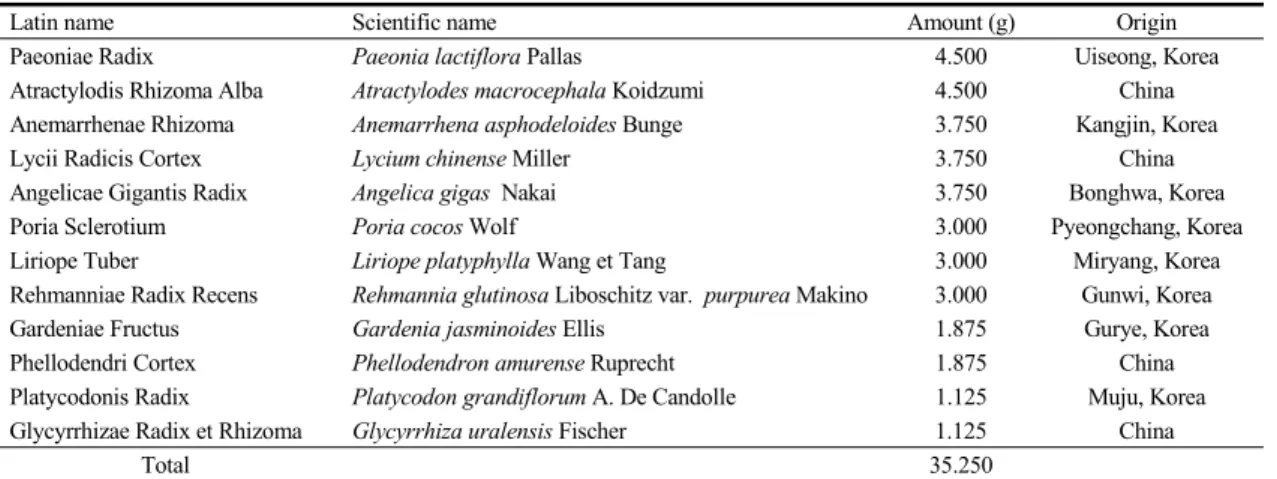
Table 1. Composition of Gamisoyo-san
Latin name Scientific name Amount (g) Origin
Paeoniae Radix Paeonia lactiflora Pallas 4.500 Uiseong, Korea
Atractylodis Rhizoma Alba Atractylodes macrocephala Koidzumi 4.500 China
Anemarrhenae Rhizoma Anemarrhena asphodeloides Bunge 3.750 Kangjin, Korea
Lycii Radicis Cortex Lycium chinense Miller 3.750 China
Angelicae Gigantis Radix Angelica gigas Nakai 3.750 Bonghwa, Korea
Poria Sclerotium Poria cocos Wolf 3.000 Pyeongchang, Korea
Liriope Tuber Liriope platyphylla Wang et Tang 3.000 Miryang, Korea
Rehmanniae Radix Recens Rehmannia glutinosa Liboschitz var. purpurea Makino 3.000 Gunwi, Korea
Gardeniae Fructus Gardenia jasminoides Ellis 1.875 Gurye, Korea
Phellodendri Cortex Phellodendron amurense Ruprecht 1.875 China
Platycodonis Radix Platycodon grandiflorum A. De Candolle 1.125 Muju, Korea
Glycyrrhizae Radix et Rhizoma Glycyrrhiza uralensis Fischer 1.125 China
Total 35.250
가가 높아지거나 산도가 높아지는 등의 문제가 발생 할 수 있다
2). 그러나 탕약의 보관 조건 및 기간 등에 대한 정확한 정보가 부족한 상황에서 잘못된 보관으 로 인해 탕약의 유효성분이 변하여 효능이 감소할 수 있다 . 따라서 탕약의 안전하고 효과적인 복용을 위해 정확한 보관 방법 및 기간에 대한 가이드라인 이 요구된다 .
본 연구진은 이전 연구에서 다빈도 한약처방 중 평위산
2-3), 쌍화탕
4), 보중익기탕
5), 곽향정기산
6), 반하 사심탕
7)및 청심연자음
8)등의 보관 기간에 따른 전 탕액의 pH, 당도, 지표 성분 함량 및 생리 활성 변화 등에 대해 보고한 바 있다 . 박
9)등은 사물탕의 보관 온도 및 기간에 따른 안정성을 평가하기 위하여 부 유물 및 침전물 관찰 , 흡광도 및 pH 변화, 세균 검출 유무 , 구성 성분 함량 및 유효 활성 변화에 대해 보 고하였으며 , 도
10)등은 당귀수산의 보관 조건 설정을 위한 연구의 일환으로 보관 온도 및 기간에 따른 총 페놀과 플라보노이드 및 지표 성분 함량 변화에 대 해 보고하였다 . 그러나 한약처방에 함유된 지표 성분 의 특성이 다르기 때문에 각 처방마다 안정성이 유 지되는 기간에 차이가 있을 수 있다 .
가미소요산 (加味逍遙散, Gamisoyo-san, Jiaweixiaoyao – san, Kamishoyo-san)은 송대 진사문의 태평혜민화 제국방 (太平惠民和劑局方)에 최초로 수록된 처방으 로 , 본 실험에서는 시호, 박하를 거하고 지모, 지골
피 , 생지황, 치자, 황백, 길경을 가미한 동의보감 (東 醫寶鑑 )에 기재된 처방을 기준으로 하였다
11-12). 가미 소요산은 소요산 (逍遙散)에 청열 (淸熱) 효능이 증 가되어 있어 간화상염 (肝火上炎)으로 인한 제반 증 상 , 우울증, 갱년기 장애에 사용된다
12). 또한 부인 혈 허로 번열이 나며 조열이 있고 식은땀이 나며 가래 가 끓고 기침하는 질환에 처방한다
13). 가미소요산의 실험적 연구에서 항산화 , 항염증 및 관절염 효과에 대해 보고되었다
13-14).
본 연구에서는 이전 연구에서
14)항염증 효능이 있 는 것으로 확인된 가미소요산의 장기 보관 시 안정 성을 확인하기 위해 포장한 가미소요산 전탕팩을 상 온 및 냉장에서 보관하여 pH, 당도, 지표 성분 함량 및 항염증 효능 변화를 조사하였다 .
재료 및 방법
1.
실험 재료
Table 1과 같이 가미소요산을 구성하는 12종의
한약재는 모두 의약품용 한약재 전문제조회사인 ㈜
내몸에닿 (Ulsan, Korea)에서 규격품을 구입 후, 본
초학 전문가인 토마토요양병원 이제현 박사 (Jeju,
Korea)와 대전대학교 서영배 교수 (Daejeon, Korea)
로부터 관능검사 후 실험에 사용하였다 . 본 처방의
12가지 구성 생약의 표본 (2012–KE45–1 ∼ 2012–
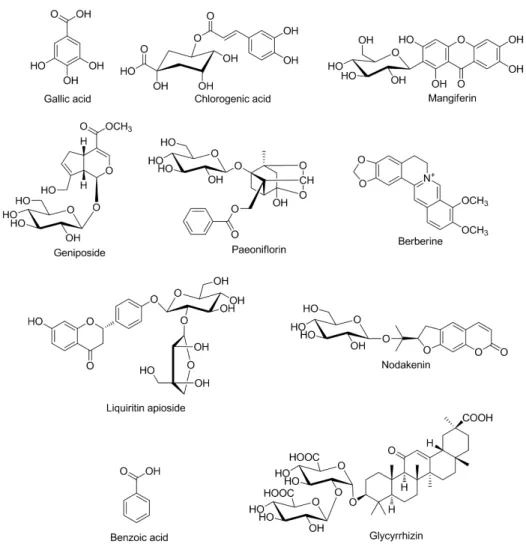
Fig. 1. Chemical structures of the ten marker components in Gamisoyo-san.
KE45–12)은 한국한의학연구원 K-herb연구단에 보관 하였다.
2.
시약 및 기기
가미소요산의 주요 성분인 gallic acid, chlorogenic acid, mangiferin, geniposide, paeoniflorin, berberine chloride, liquiritin apioside, nodakenin, benzoic acid 및 glycyrrhizin 등 10종의 표준품은 Wako (Osaka, Japan), Sigma-Aldrich (St. Louis, MO, USA), Chengdu Biopurify Phytochemicals (Chengdu, China), Acros Origanics (Pittsburgh, PA, USA), Shanghai Sunny
Biotech (Shanghai, China) 및 NPC Bio Technology (Yeongi, Korea)에서 각각 구입하여 사용하였으며, 이들 표준품의 순도는 모두 98.0% 이상이었다 (Fig.
1). 표준품과 시료의 용해, 분리 및 정량 분석에 사
용된 distilled water, acetonitrile 및 methanol은
HPLC용으로 J.T. Baker (Phillipsburg, NJ, USA)로
부터 구입하였으며 , 개미산은 Merck KGaA (Darmastadt,
Germany)에서 특급시약을 구입하여 사용하였다. 가
미소요산 전탕액 중 주요 성분의 함량 분석을 위한
고성능액체크로마토그래피 (high-performance liquid
chromatography, HPLC)는 Shimadzu Prominence
LC-20A series HPLC system (Kyoto, Japan)을 사용 하였으며 , 측정된 데이터는 Lab Solution software (version 5.53, SP3)를 이용하여 수집, 처리 및 분석 하였다 . 당도와 pH 측정은 각각 Atago사의 Pal-α 디 지털굴절계 (Tokyo, Japan)와 Metrohm사의 692 pH/Ion meter (Herisau, Switzerland)를 사용하였다. 시 료는 경서 E&P㈜의 초고속 진공 저온 농축 추출기 (COSMOS 660, Incheon, Korea)를 사용하여 전탕하 였으며 , 전탕액은 자유조절 롤 포장기 (MH 205 Tower, Kyungseo machine, Korea)를 사용하여 포장 하였다 . Dulbecco's modified Eagle's medium (DMEM), fetal bovine serum (FBS), penicillin -streptomycin 및 phosphate-buffered saline (PBS)은 Gibco BRL (Carlsbad, CA, USA)에서 구입하였으며, lipopolysaccharide (LPS), N
G-methyl-l-arginine (L-NMMA), indomethacin 및 triprolidine은 Sigma -Aldrich에서 구입하였다.
Cell Counting Kit-8 (CCK-8)는 Dojindo (Kumamoto, Japan) 제품을 사용하였으며, Griess reagent와 prostaglandin E
2(PGE
2) enzyme-linked immunosorbent assay (ELISA) kit은 각각 Promega Corporation (Madison, WI, USA)와 Cayman Chemical Co. (Ann Arbor, MI) 제품을 사용하였다. Tumor necrosis factor-alpha (TNF-α) 및 interleukin-6 (IL-6) ELISA kit은 BD Biosciences (San Jose, CA, USA) 제품을 사용하였다 .
3.
추출물 조제 및 보관
가미소요산의 물 추출물은 12종의 구성 생약을 Table 1과 같은 무게 비율로 섞어 총 시료 양을 약 3.0 kg (1첩 35.25 g × 85.10배)으로 맞춘 후 물을 시료의 10배 (30 L)로 첨가하였다. 혼합된 시료를 초 고속 진공 저온 추출기를 이용하여 98 kPa 압력으로 100℃에서 2시간 전탕한 후 표준체 (No. 270, 53 μ m, Chung Gye Sang Gong Sa, Seoul, Korea)를 이 용하여 여과하였다 . 여과액은 포장기를 이용하여 포 장하였다 . 이렇게 조제된 시료 전탕팩은 상온 (23±
1℃)과 냉장 (4℃)에 각각 보관하면서 실험에 사용하 였다 .
4. pH
및 당도 측정
가미소요산 전탕팩의 보관 온도 및 기간에 따라 주기적으로 pH와 당도를 측정하였다.
5. HPLC
분석
HPLC–PDA를 사용하여 가미소요산 전탕액 중 주 요 성분인 gallic acid, chlorogenic acid, mangiferin, geniposide, paeoniflorin, berberine chloride, liquiritin apioside, nodakenin, benzoic acid 및 glycyrrhizin 등 10종에 대하여 보관 온도 및 기간에 따라 함량 분석 을 실시하였다 . 성분의 분리는 40℃로 유지된 Water 사의 SunFire C
18칼럼 (250×4.6 mm, 5 μm, Milford, MA, USA)을 이용하였으며, 이동상은 0.1% (v/v) 개 미산이 함유된 물 (이동상 A)과 0.1% (v/v) 개미산 이 함유된 acetonitrile (이동상 B)을 이용하여 다음 과 같은 기울기 용매 조건으로 흘려주었다 ; 5–60%
B (0–-30분), 60–100% B (30–40분), 100% B (40–
45분) 및 100–5% B (45–50분). 유속은 분당 1.0 mL 의 속도로 흘려주었으며 주입량은 10 μL로 하였다.
Geniposide와 paeoniflorin의 함량 분석은 상온과 냉 장에 각각 보관 중인 전탕액 1.0 mL을 정확히 취하 여 총 25 mL이 되도록 물을 첨가하고 HPLC 분석 전에 0.2 μm syringe filter (PALL Life Sciences, Ann Arbor, MI, USA)로 여과 한 후 측정하였다. 나 머지 성분들의 함량 분석은 전탕액 5.0 mL을 정확 히 취하여 총 10 mL이 되도록 물을 첨가한 후 분석 하였다 .
6.
항염증 효능 평가 1) 세포 배양
마우스 대식세포주 RAW 264.7은 American Type Culture Collection (ATCC, Rockville, MD, USA)으 로부터 분양 받았으며 , 5.5% FBS 및 1% penicillin -streptomycin이 포함된 DMEM으로 37°C 및 5%
CO
2조건에서 배양하였다.
2) 세포 독성 평가
Table 2. pH of Gamisoyo-san by storage temperature and periods
Storage period
(months) Storage method pH
0 5.18±0.01
1 Room temperature 4.65±0.00
Refrigeration 4.72±0.02
2 Room temperature 4.50±0.00
Refrigeration 4.58±0.02
3 Room temperature 5.03±0.01
Refrigeration 5.13±0.01
4 Room temperature 5.01±0.01
Refrigeration 5.12±0.01
5 Room temperature 5.00±0.01
Refrigeration 5.09±0.02
6 Room temperature 4.96±0.02
Refrigeration 5.11±0.01
12 Room temperature 4.97±0.01
Refrigeration 5.07±0.01 Data are presented as mean ± SEM (n = 3).
가미소요산 전탕액의 세포 독성을 확인하기 위하 여 RAW 264.7 대식세포를 96 well plate에 3×10
3cells/well씩 분주하여 18시간 동안 배양한 후 각 추 출물을 62.5, 125, 250, 500 및 1000 μg/mL의 농도 로 처리하였다 . 이후 24시간 동안 배양하고 CCK-8 용액을 10 μL씩 첨가하여 4시간 동안 배양하였다.
Microplate reader (Benchmark Plus, Bio-Rad, Hercules, CA, USA)를 사용하여 450 nm에서 흡광도 를 측정하고 대조군과 비교하여 상대적인 세포생존 율 (% of control)을 계산하였다. 이후 실험은 세포 독성이 나타나지 않는 농도로 진행하였다 .
3) NO, PGE
2및 염증성 사이토카인 분비량 측정 보관 온도 및 기간별 가미소요산 전탕액의 항염증 효능을 확인하기 위하여 RAW 264.7 대식세포를 48 well plate에 2.5×10
5cells/well씩 분주하여 18시간 동안 배양한 후 각 추출물을 62.5, 125, 250, 500 및 1000 μg/mL의 농도로 처리하고 4시간 동안 배양하 였다 . 이후 LPS (1 μg/mL)를 처리하여 20시간 동안 배양하고 상등액을 수거하여 nitric oxide (NO) 분비 량은 Griess reagent로, PGE
2및 염증성 사이토카인 TNF-α와 IL-6 분비량은 ELISA kit을 사용하여 각 제조사의 방법에 따라 측정하였다 . NO 및 PGE
2분비 억제에 대한 양성 대조군으로 각각 L-NMMA 및 indomethacin을 사용하였으며, TNF-α 및 IL-6 분비 억제에 대한 양성 대조군으로 triprolidine을 사용하 였다 .
7.
통계 처리
실험값은 mean±standard error of the mean (SEM)으로 표시하였으며, 실험결과에 대한 통계학 적 분석은 SYSTET (Version 10.0, Systat Software Inc., San Jose, CA, USA)을 사용하여 ANOVA 실시 후 Bonferroni 사후 검정을 통해 p 값이 0.05 미만일 경우 유의한 것으로 판정하였다 .
결 과
1. pH
및 당도 측정
가미소요산 전탕액의 pH는 Table 2와 같이 최초 5.17–5.19로 나타났으며, 보관 온도 및 기간에 따라 주기적으로 pH를 측정한 결과 상온에서는 4.50–
5.19, 냉장에서는 4.56–5.19로 나타났다. 당도는 최초 3.70–3.80 Brix로 측정되었으며, 보관 기간에 따라 상온에서는 3.70–4.10, 냉장에서는 3.70-4.03 Brix로 나타났다 (Table 3).
2.
가미소요산 지표 성분의 함량 분석
HPLC를 이용하여 확립된 분석법을 이용하여 가
미소요산 전탕액 중 gallic acid, chlorogenic acid,
mangiferin, geniposide, paeoniflorin, berberine chloride,
liquiritin apioside, nodakenin, benzoic acid 및
glycyrrhizin 등 10가지 주요 성분의 함량 분석을 실
시하였으며 , 10종 성분 모두 30분 이내로 양호한 분
리가 이루어졌다 . 이들 성분에 대한 검량선 작성 결
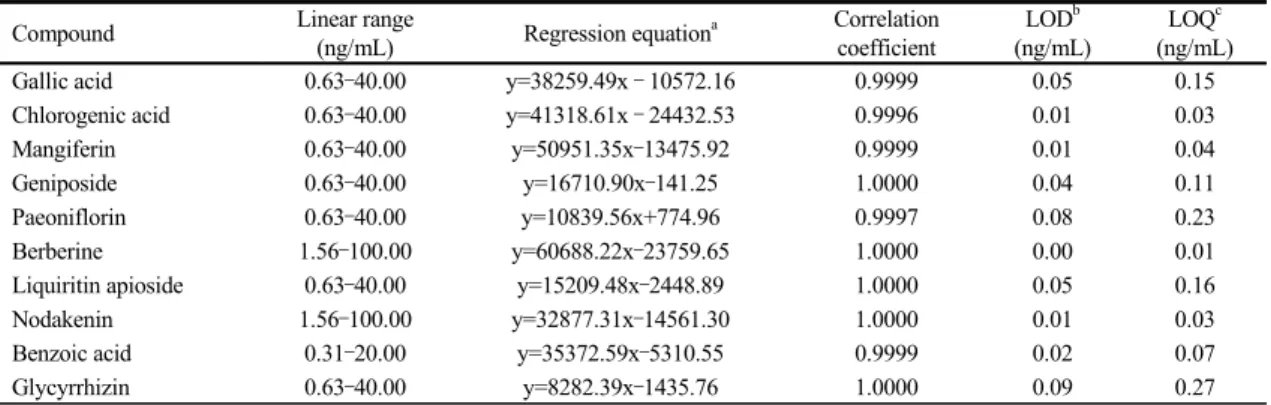
과 상관계수가 0.9996 이상으로 양호한 직선성을 나
타내었으며 (Table 4), gallic acid, chlorogenic acid,
Table 3. Sugar content of Gamisoyo-san by storage temperature and periods
Storage period
(months) Storage method Brix
0 3.77±0.03
1 Room temperature 3.83±0.02
Refrigeration 4.00±0.02
2 Room temperature 3.91±0.01
Refrigeration 3.92±0.03
3 Room temperature 3.92±0.01
Refrigeration 3.89±0.01
4 Room temperature 3.99±0.01
Refrigeration 3.93±0.02
5 Room temperature 3.98±0.03
Refrigeration 3.98±0.01
6 Room temperature 3.91±0.03
Refrigeration 3.87±0.00
12 Room temperature 4.08±0.01
Refrigeration 3.90±0.00 Data are presented as mean ± SEM (n = 3).
Table 4. Linear range, regression equation, correlation coefficients, LOD and LOQ for the ten marker compounds
Compound Linear range
(ng/mL) Regression equationa Correlation coefficient
LODb (ng/mL)
LOQc (ng/mL)
Gallic acid 0.63–40.00 y=38259.49x – 10572.16 0.9999 0.05 0.15
Chlorogenic acid 0.63–40.00 y=41318.61x – 24432.53 0.9996 0.01 0.03
Mangiferin 0.63–40.00 y=50951.35x–13475.92 0.9999 0.01 0.04
Geniposide 0.63–40.00 y=16710.90x–141.25 1.0000 0.04 0.11
Paeoniflorin 0.63–40.00 y=10839.56x+774.96 0.9997 0.08 0.23
Berberine 1.56–100.00 y=60688.22x–23759.65 1.0000 0.00 0.01
Liquiritin apioside 0.63–40.00 y=15209.48x–2448.89 1.0000 0.05 0.16
Nodakenin 1.56–100.00 y=32877.31x–14561.30 1.0000 0.01 0.03
Benzoic acid 0.31–20.00 y=35372.59x–5310.55 0.9999 0.02 0.07
Glycyrrhizin 0.63–40.00 y=8282.39x–1435.76 1.0000 0.09 0.27
ay: peak area (mAU) of compounds; x: concentration (mg/mL) of compounds.
bLOD = 3.3σ × S.
cLOQ = 10σ × S.
σ is the standard deviation of the blank response and S is the slope of the calibration curve.
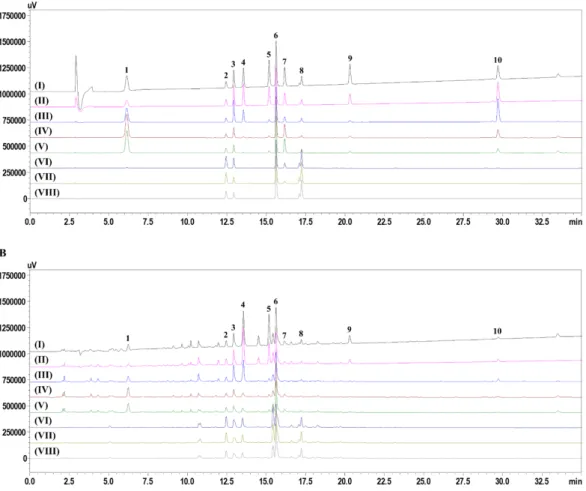
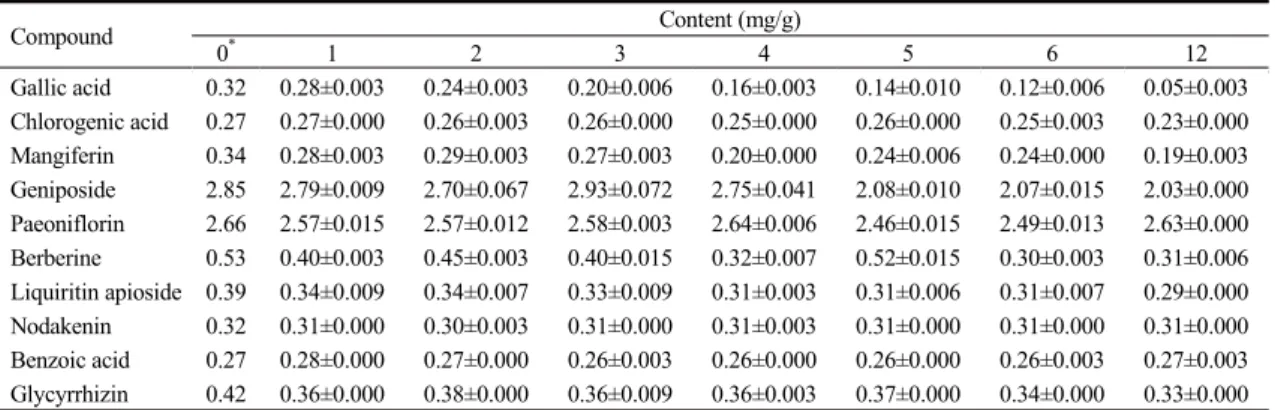
mangiferin, geniposide, paeoniflorin, berberine chloride, liquiritin apioside, nodakenin, benzoic acid 및 glycyrrhizin 등 10가지 주요 성분은 6.26, 12.53, 13.00, 13.56, 15.19, 15.63, 16.22, 17.27, 20.30 및 29.69분에서 각각 검출되었다 (Fig. 2). 설정된 분석 법을 이용하여 보관 기간에 따른 가미소요산 전탕액 내 주요 성분의 함량 분석 결과 상온에서는
0.01-2.85 mg/mL으로 나타났으며 (Table 5), 냉장에 서는 0.04-3.01 mg/g으로 나타났다 (Table 6). 이 중 gallic acid 및 mangiferin의 함량이 상온과 냉장 모 두에서 보관 기간이 길어질수록 감소하는 것으로 나 타났으며 , chlorogenic acid는 상온에서만 보관 기간 이 길어짐에 따라 함량이 감소하였다 .
3.
세포독성
RAW 264.7 대식세포에서 제조 시점의 가미소요 산 전탕액은 1000 μg/mL의 농도까지 세포독성이 없 는 것으로 나타났다 (data not shown). 따라서 이후 실험은 세포독성이 없는 1000 μg/mL 이하의 농도에 서 수행하였다 .
4.
항염증 효능
정상 대조군과 비교하여 LPS 처리에 의해 NO,
PGE
2, TNF-α 및 IL-6 생성이 통계적으로 유의성 있
게 증가하였다 . 반면, 양성대조군으로 사용한
L-NMMA, indomethacin 및 triprolidine은 LPS 처리
군에 비해 각각 NO, PGE
2, TNF-α 및 IL-6의 생성을
농도의존적으로 억제하였다 (Fig. 3). 제조 시점의 가
미소요산 전탕액은 LPS 처리군과 비교하여 NO 생
성을 농도의존적으로 억제하였으며 , 1000 μg/mL에
Fig. 2. Typical HPLC chromatogram of standard solution (A) and Gamisoyo-san decoction (B) at UV wavelength 230 (I), 240 (II), 254 (III), 270 (IV), 275 (V), 325 (VI), 335 (VII) and 345 (VIII). Gallic acid (1), chlorogenic acid (2), mangiferin (3), geniposide (4), paeoniflorin (5), berberine chloride (6), liquiritin apioside (7), nodakenin (8), benzoic acid (9) and glycyrrhizin (10).
서 22.13%의 억제율을 나타내었다 (Fig. 3). 이 효능 은 상온 및 냉장 보관 시 12개월까지 유지되었다.
LPS 처리군과 비교하여 제조 시점의 가미소요산 전 탕액은 PGE
2생성을 농도의존적으로 유의성 있게 억제하였으며 (IC
50= 442.55 μg/mL), 1000 μg/mL에 서 77.78%의 억제율을 나타내었다 (Fig. 3). 이는 상 온 및 냉장 보관 시 3개월까지 동일하게 나타났다 (Table 7). 보관 기간 4개월부터 상온 및 냉장 보관 한 경우 모두 PGE
2억제 효능이 감소하는 경향이 나타났으며 , 상온 보관 시료 (IC
50= 624.98 μg/mL)
가 냉장 보관 시료 (IC
50= 576.33 μg/mL)보다 효능
이 더 크게 감소하였다 (Table 7). 제조 시점의 가미
소요산 전탕액은 LPS 처리군과 비교하여 IL-6 생성
을 고농도에서 통계적으로 유의성 있게 억제하였으
며 , 1000 μg/mL에서 44.57%의 억제율을 나타내었다
(Fig. 3). 이러한 양상은 12개월 보관 시까지 동일하
게 나타났다. 한편, TNF-α 생성 억제에 대해 제조
시점의 가미소요산 전탕액은 1000 μg/mL에서
12.77%의 억제율을 가지며 통계적으로 유의성 있는
억제를 나타내지 않아 이후 보관 시료에 대한 TNF-
Table 5. The content of the five marker compounds in Gamisoyo-san by storage periods in room temperature
Compound Content (mg/g)
0* 1 2 3 4 5 6 12
Gallic acid 0.32 0.10±0.003 0.03±0.003 0.02±0.000 0.01±0.003 0.01±0.006 0.01±0.003 0.01±0.003 Chlorogenic acid 0.27 0.25±0.000 0.23±0.000 0.21±0.003 0.17±0.003 0.18±0.000 0.18±0.000 0.14±0.000 Mangiferin 0.34 0.25±0.000 0.20±0.003 0.17±0.000 0.09±0.000 0.08±0.000 0.12±0.000 0.07±0.013 Geniposide 2.85 2.82±0.030 2.79±0.058 2.98±0.013 2.77±0.007 2.10±0.021 2.12±0.007 2.17±0.000 Paeoniflorin 2.66 2.58±0.006 2.61±0.021 2.62±0.003 2.66±0.012 2.50±0.029 2.54±0.009 2.58±0.003 Berberine 0.53 0.42±0.003 0.40±0.000 0.40±0.003 0.31±0.003 0.47±0.006 0.31±0.003 0.31±0.006 Liquiritin apioside 0.39 0.34±0.007 0.30±0.003 0.32±0.003 0.31±0.003 0.32±0.000 0.32±0.000 0.32±0.006 Nodakenin 0.32 0.31±0.003 0.32±0.000 0.33±0.000 0.33±0.003 0.33±0.000 0.33±0.003 0.34±0.000 Benzoic acid 0.27 0.29±0.003 0.28±0.003 0.27±0.000 0.27±0.000 0.27±0.000 0.27±0.003 0.29±0.000 Glycyrrhizin 0.42 0.37±0.003 0.37±0.000 0.38±0.000 0.36±0.000 0.37±0.006 0.37±0.003 0.37±0.000
*month
Table 6. The content of the five marker compounds in Gamisoyo-san by storage periods in refrigeration
Compound Content (mg/g)
0* 1 2 3 4 5 6 12
Gallic acid 0.32 0.28±0.003 0.24±0.003 0.20±0.006 0.16±0.003 0.14±0.010 0.12±0.006 0.05±0.003 Chlorogenic acid 0.27 0.27±0.000 0.26±0.003 0.26±0.000 0.25±0.000 0.26±0.000 0.25±0.003 0.23±0.000 Mangiferin 0.34 0.28±0.003 0.29±0.003 0.27±0.003 0.20±0.000 0.24±0.006 0.24±0.000 0.19±0.003 Geniposide 2.85 2.79±0.009 2.70±0.067 2.93±0.072 2.75±0.041 2.08±0.010 2.07±0.015 2.03±0.000 Paeoniflorin 2.66 2.57±0.015 2.57±0.012 2.58±0.003 2.64±0.006 2.46±0.015 2.49±0.013 2.63±0.000 Berberine 0.53 0.40±0.003 0.45±0.003 0.40±0.015 0.32±0.007 0.52±0.015 0.30±0.003 0.31±0.006 Liquiritin apioside 0.39 0.34±0.009 0.34±0.007 0.33±0.009 0.31±0.003 0.31±0.006 0.31±0.007 0.29±0.000 Nodakenin 0.32 0.31±0.000 0.30±0.003 0.31±0.000 0.31±0.003 0.31±0.000 0.31±0.000 0.31±0.000 Benzoic acid 0.27 0.28±0.000 0.27±0.000 0.26±0.003 0.26±0.000 0.26±0.000 0.26±0.003 0.27±0.003 Glycyrrhizin 0.42 0.36±0.000 0.38±0.000 0.36±0.009 0.36±0.003 0.37±0.000 0.34±0.000 0.33±0.000
*month
α 농도는 측정하지 않았다 (Fig. 3).
고 찰
한약은 예로부터 치료 , 보기 (補氣) 및 보양 (補 陽)을 위해 복용되고 있으며, 안전성 및 유효성에 대 한 연구가 증가하고 있는 추세이다
15). 그러나 처방되 는 한약은 끓여서 파우치에 제공하는 탕약이 대부분 인데 , 이러한 한약 파우치의 장기 보관에 대한 연구 는 부족한 실정이다. 각 한약을 구성하는 약재마다 효능이 유지되는 조건이 다르기 때문에 처방에 따른 보관 온도 및 기간 등에 대한 과학적인 근거 설정이 필요하다 .
본 연구팀의 이전 연구 결과에 따르면 평위산 전
탕팩을 8개월 동안 보관했을 때 지표 성분인
hesperidin의 함량이 냉장 보관 시료보다 상온 보관
시료에서 더 크게 감소하였으며
2), 냉장 및 냉동 보
관 시 6개월까지 항염증 효능이 유지되었으나 6개월
동안 상온 보관한 경우에는 효능이 상실되었다
3). 곽
향정기산 전탕팩의 유통기한 설정 연구에서는 전탕
팩 보관 기간이 길어질수록 제조 시점에 비해 항산
화 활성이 감소하였으며, 상온에서의 보관 기간이 3
개월 이상 경과하면 항염증 효능이 감소하였다
6). 반
하사심탕 전탕팩 보관에 관한 연구에서는 보관 기간
이 길어짐에 따라 지표 성분인 liquiritin, baicalein
및 wogonin의 함량이 감소하였으며 이는 냉장 보관
시료보다 상온 보관 시료에서 더 크게 감소하였다
7).
반하사심탕의 항산화 활성은 전탕팩을 상온보다 냉
Fig. 3. Effect of Gamisoyo-san on LPS-induced NO (A), PGE2 (B), TNF-α (C) and IL-6 (D) production in RAW 264.7 cells at the time of extraction.
NO level in supernatant was measured using Griess reagent. PGE2, TNF-α and IL-6 in supernatant were measured by ELISA.
L-NMMA and indomethacin were used as positive controls for NO and PGE2, respectively. Triprolidine was used as a positive control for TNF-α and IL-6. The data are presented as mean ± SEM (n = 3). ##p < 0.01 versus negative control cells; *p < 0.05 and *p
< 0.01 versus LPS-treated cells.
장에 보관할 경우 더 오래 유지되었으며 , 장기간 보 관 시 효능이 점차적으로 감소하였다
7). 이처럼 같은 전탕팩 포장을 사용하였음에도 각 처방에 따라 전탕 팩의 안정성이 유지되는 온도 및 기간에 차이가 있 는 것으로 확인되어 본 연구에서는 가미소요산 전탕 팩 보관 온도를 상온과 냉장 두 가지로 설정하고, 성 분 함량 및 효능이 감소되는 시점을 보다 정확하게 설정하기 위하여 0, 1, 2, 3, 4, 5, 6 및 12개월간 보 관 후 개봉하여 안정성을 평가하고자 하였다 .
염증은 체내에 세균이나 바이러스 등의 외부 물질 이 유입되는 경우 면역세포가 이를 인지하여 염증 매개물질을 분비함으로써 생체 방어 및 항상성 유지 기능을 조절하는 기전이다
16). 면역세포 가운데 대식
세포는 동물체내 모든 조직에 분포하며 외부 물질을
탐지 및 포식하여 제거하고, 염증반응이 일어나면
NO, PGE
2, TNF-α 및 IL과 같은 염증 매개물질들을
분비한다
17). NO는 nitric oxide synthase (NOS)에 의
해 L-arginine으로부터 생성되는 인자로 신경전달,
면역조절 및 생체 내 항상성 조절에 중요한 역할을
한다
18). 그러나 NO의 과도한 생성은 혈관 투과성 및
부종 등의 염증반응 유발로 인해 조직 및 신경 손상
과 유전자 변이 등을 초래할 수 있다
19). 또한 대식세
포가 활성화되어 염증반응이 과도하게 일어나면
cyclooxygenase-2 (COX-2)에 의해 arachidonic acid
로부터 prostaglandin이 생성되며
20), 특히 PGE
2는 혈
관생성을 유도하여 종양 생성에 기여한다
21). TNF-α
및 IL-6는 염증반응을 조절하는 전염증성 사이토카 인으로 다양한 염증 매게물질들을 유도하고 면역반 응의 조절에 중요한 역할을 하지만 , TNF-α 및 IL-6 역시 과도하게 생성되면 암세포 성장 및 동맥경화 , 만성 염증 질환 등이 유발된다
22). LPS는 그람 음성 균의 세포 외막에 존재하며 염증 매개물질들을 분비 하도록 대식세포를 자극하는 내독소로 알려져 있다
23-24)
. 따라서 본 연구에서는 마우스 대식세포인 RAW 264.7에서 LPS로 염증반응을 유도하여 가미 소요산 전탕팩의 보관 온도 및 기간별로 NO, PGE
2, TNF-α 및 IL-6 분비량을 측정하여 효능이 안정하게 유지되는 기한을 설정하였다 .
다양한 성분들은 안정성이 유지되는 pH 및 온도 등의 조건이 다르기 때문에 탕액의 pH 및 온도 변화 는 탕액에 함유된 성분의 변화를 초래할 가능성이 있다 . 따라서 가미소요산 전탕팩의 보관 온도 및 기 간에 따른 pH, 당도 및 지표 성분의 함량을 확인함 으로써 장기 보관에 따른 안정성을 확인하였다 .
가미소요산 전탕팩을 상온에 보관할 경우 냉장 보 관하는 것보다 탕액의 pH 및 당도의 변화가 큰 폭으 로 나타났지만 보관 온도 및 기간에 따른 유의성은 없는 것으로 나타나 가미소요산 전탕액의 pH 및 당 도가 지표 성분 함량 및 항염증 효능 변화에 영향을 주지 않을 것으로 사료되었다 .
가미소요산의 지표 성분 gallic acid
25), chlorogenic acid
26), mangiferin
27), geniposide
28), paeoniflorin
29), berberine chloride
30), liquiritin apioside
31), nodakenin
32)및 glycyrrhizin
33)의 항염증 효능은 이미 알려진 바 있다 . 특히 가미소요산 내 비교적 함량이 높은 geniposide 및 paeoniflorin은 RAW 264.7 대식세포 에서 LPS에 의해 생성된 NO와 PGE
2생성 및 IL-6 의 발현을 억제한다고 보고되었으며
28-29), 본 연구에 서 가미소요산 전탕팩을 상온 및 냉장에 12개월까지 보관하더라도 제조 시점에 비해 함량의 유의적인 감 소가 나타나지 않았다 . 반면, gallic acid 및 mangiferin 의 함량은 전탕팩을 상온 및 냉장 보관하는 기간이 길어짐에 따라 점차적으로 감소하였으며 , chlorogenic acid의 함량은 전탕팩을 상온에 보관하는 기간이 길
어질수록 감소하였다 . 이러한 사실로 미루어 보아 가 미소요산 전탕팩을 상온 및 냉장에 보관하더라도 함 량 변화가 없는 geniposide 및 paeoniflorin에 의해 항염증 효능이 유지되기는 하나 보관 기간이 길어짐 에 따라 gallic acid, mangiferin 및 chlorogenic aicd 의 함량이 감소하면서 항염증 효능이 점차적으로 감 소하는 것으로 판단된다 . 또한 가미소요산 전탕팩의 상온 보관 시 냉장 보관에 비해 항염증 활성 성분의 함량이 큰 폭으로 감소하는 것으로 나타나 전탕팩을 냉장 보관할 경우 항염증 효능이 더 오래 유지되는 것으로 사료된다 .
결 론
가미소요산 전탕팩을 상온 및 냉장 보관할 경우 보관 기간 4개월부터 항염증 효능이 점차적으로 감 소하여 3개월 이내에 복용하는 것이 약효의 손실이 없을 것으로 판단된다 . 특히 보관 기간 4개월 이후부 터 상온에 보관할 경우 냉장 보관한 것에 비해 항염 증 효능이 큰 폭으로 감소하여 장기 보관 시 상온보 다 냉장 보관하는 것이 약효 유지에 더 이로울 것으 로 사료된다 . 이러한 연구 결과는 향후 가미소요산 전탕팩의 유통기한 설정 시 기초 자료로 활용될 수 있을 것으로 기대된다 .
감사의 글
본 연구는 한국한의학연구원에서 지원하는 ‘한약 처방의 과학적 근거 기반 구축 사업 (K17251)’에 의 해 수행되었으며 , 이에 감사드린다.
참고문헌
1. The co-textbook publishing committee of Korean Medicine College. Formula Science. Seoul:
Younglimsa. 2009.
2. Seo CS, Shin HK, Kim JH, Shin KS. Changes
of Principal Components and Microbial Population
in Pyungwi-san Decoction According to the Preservation Temperature and Period. J Korean Oriental Med. 2011;32(5):41-9.
3. Ha H, Shin IS, Lim HS, Jeon WY, Kim JH, Seo CS, Shin HK. Changes in Anti-inflammatory Effect of Pyungwi-san Decoction According to the Preservation Temperature and Period.
Formula Science. 2012;20(2):29-35.
4. Seo CS, Kim JH, Lim SH, Shin HK.
Establishment of Shelf-Life of Ssanghwa-tang by Long-term Storage Test. Kor J Pharmacogn.
2012;43(3):257-64.
5. Seo CS, Kim JH, Kim SS, Lim SH, Shin HK.
Evaluation of Shelf-life of Bojungikgi-tang by Long-term Storage Test. Kor J Pharmacogn.
2013;44(2):200-8.
6. Jin SE, Kin OS, Shin HK, Jeong SJ.
Comparative Study on Biological Activities of
Gwakhyangjeonggi-san Decoction According tothe Preservation Periods. J Korean Med. 2014;
35(3):60-9.
7. Jin SE, Kim OS, Seo CS, Shin HK, Jeong SJ.
Comparative study on stability and efficacy of
Banhasasim-tang decoction depending on thepreservation temperature and periods. J Korean Med. 2016;37(1):21-33.
8. Yoo SR, Ha H, Lee NR, Shin HK, Seo CS. A Study on Change of Marker Compounds and Biological Activity in Chungsimyeonja-eum Decoction Depending on A Storage Temperature and Periods. Kor J Herbol. 2017;32(4):25-32.
9. Park IH, Kim YH, Choi SH, Yu SN, Kim SH, Ahn SC, Cho SI, Lee I. Effect of Preservation Conditions on the Stability of Samul-tang Decoctions. J Life Sci. 2015;25(10):1124-31.
10. Do HJ, Shim YS, Lee JH, Ahn YJ, Ha IH, Lee YJ, et al. Stability of Danggwisu-san (Dangguixu-san) Water Extract, a Herbal
Medicine, Under Various Storage Conditions.
Journal of Oriental Rehabilitation Medicine.
2016;26(4):1-8.
11. Jin SM. Taepyunghyeminhwajekukbang. Inminweeseng Publications. 1985;308.
12. Sim TK, Jung IC, Lee SR. The Effect of Gami soyo-san(Jiaweixiaoyaosan) on Serotonin Metabolism.
Journal of Oriental Neuropsychiatry. 2011;22(1):
37-51.
13. Lee SL, Lee IS, Soh KS. Effects of Gamisoyosan(Jiaweixiaoyaosan 加味逍遙散) on Type Ⅱ Collagen-Induced Arthritis. J Oriental Rehab Med. 2001;12(4):167-76.
14. Jin SE, Kim OS, Yoo SR, Seo CS, Kim Y, Shin HK, et al. Anti-inflammatory effect and action mechanisms of traditional herbal formula
Gamisoyo-san in RAW 264.7 macrophages.BMC Complement Altern Med. 2016;16:219.
doi: 10.1186/s12906-016-1197-7.
15. Choi HM, Kim SJ, Kim IS, Lee JB, Kim JB, Moon SO, et al. Evaluation on Anti-oxidant Activity and Anti-inflammatory Effects for the New Formulation of Gamisoyosan. Kor J Herbol. 2016;31(6):1-9.
16. Willoughby DA. Human arthritis applied to animal models. Towards a better therapy. Ann Rheum Dis. 1975;34:471-8.
17. Lee ES, Ju HK, Moon TC, Lee E, Jahng Y, Lee SH, et al. Inhibition of nitric oxide and tumor necrosis factor α (TNF-α) production by propenone compound through blockade of nuclear factor (NF)-κB activation in cultured murine macrophages. Biol Pharm Bull. 2004;
27:617-20.
18. Wink DA. Chemical biology of nitric oxide:
Insights into regulatory, cytotoxic, and
cytoprotective mechanisms of nitric oxide. Free
Radic Biol Med. 1998;25(4-5):434-56.
19. Ryu JH, Ahn H, Kim JY, Kim YK. Inhibitory activity of plant extracts on nitric oxide synthesis in LPS-activated macrophages.
Phytother Res. 2003;17(5):485-9.
20. Funk CD, Fitzgerald GA. Human platelet, erythroleukemia cell prostaglandin G, H synthase: cDNA cloning, expression, and gene chromosomal assignment. FASEB J. 1991;5:
2304-12.
21. Bishop-Bailey D, Calatayud S, Warner TD, Hla T, Michell A. Prostaglandins and the regulation of tumor growth. J Environ Pathol Tox Oncol.
2002;21:93-101.
22. Feldmann M. Role of cytokines in rheumatoid arthritis. Annu Rev Immunol. 1996;14:397-440.
23. Mann JR, Backlund MG, DuBois RN.
Mechanism of disease: Inflammatory mediators and cancer prevention. Nat Clin Pract Oncol.
2005;2:202-10.
24. Guzik TJ, Korbut R, Adamek-Guzik T. Nitric oxide and superoxide in inflammation and immune regulation. J Physiol Phamacol. 2003;
43:469-87.
25. Chiu CS, Deng JS, Chang HY, Chen YC, Lee MM, Hou WC, et al. Antioxidant and anti-inflammatory properties of Taiwanese yam (Dioscorea japonica Thunb. var. pseudojaponica (Hayata) Yamam.) and its reference compounds.
Food Chem. 2013;141:1087-96.
26. Hwang SJ, Kim YW, Park Y, Lee HJ, Kim KW. Anti-inflammatory effects of chlorogenic acid in lipopolysaccharide-stimulated RAW 264.7 cells. Inflamm Res. 2014;63:81-90.
27. Garrido G, Delgado R, Lemus Y, Rodríguez J, García D, Núñez-Sellés AJ. Protection against septic shock and suppression of tumor necrosis factor alpha and nitric oxide production on macrophages and microglia by a standard
aqueous extract of Mangifera indica L.
(VIMANG). Role of mangiferin isolated from the extract. Pharmacol Res. 2004;50:165-72.
28. Shi Q, Cao J, Fang L, Zhao H, Liu Z, Ran J, et al. Geniposide suppresses LPS-induced nitric oxide, PGE
2and inflammatory cytokine by downregulating NF-kB, MAPK and AP-1 signaling pathways in macrophages. Int Immunopharmacol. 2014;20:298-306.
29. Wang QS, Gao T, Cui YL, Gao LN, Jiang HL.
Comparative studies of paeoniflorin and albiflorin from Paeonia lactiflora on anti-inflammatory activities. Pharm Biol. 2014;52(9):1189-95.
30. Jeong HW, Hsu KC, Lee JW, Ham M, Huh JY, Shin HJ, et al. Berberine suppresses proinflammatory responses through AMPK activation in macrophages. Am J Physiol Endocrinol Metab. 2009;296:E955-64.
31. Guan Y, Li FF, Hong L, Yan XF, Tan GL, He JS, et al. Protective effects of liquiritin apioside on cigarette smoke-induced lung epithelial cell injury. Fundam Clin Pharmacol. 2012;26(4):
473-83.
32. Rim HK, Cho W, Sung SH, Lee KT. Nodakenin suppresses lipopolysaccharide-induced inflammatory responses in macrophage cells by inhibiting tumor necrosis factor receptor-associated factor 6 and nuclear factor-kB pathways and protects mice from lethal endotoxin shock. J Pharmacol Exp Ther. 2012;342:654-64.
33. Fu Y, Zhou E, Wei Z, Liang D, Wang W, Wang T, et al. Glycyrrhizin inhibits the inflammatory response in mouse mammary epithelial cells and a mouse mastitis model.
FEBS J. 2014;281:2543-57.
ORCID
Seong Eun Jin https://orcid.org/0000-0002-9224-0735 Chang-Seob Seo https://orcid.org/0000-0002-8156-4464 Nari Lee https://orcid.org/0000-0001-7447-3044 Hyeun-Kyoo Shin https://orcid.org/0000-0003-2319-6678 Hyekyung Ha https://orcid.org/0000-0002-7326-6366