1. 서 론
산업발전과 함께 에너지, 자원 이용이 증가함에 따라 자원생산성 관리의 중요성이 점차 증가하고 있다. 폐기물
발생 저감 및 순환자원 이용 활성화를 위해서도 자원생산 성 관리는 산업 전반으로 확대해 나가야 하는 중요한 관리 지표이다.
우리나라의 정부 차원에서 공식적으로 자원생산성 지
· Received : April 22, 2020 · Revised : May 13, 2020 · Accepted : May 20, 2020
§
Corresponding Author : Hong-Yoon Kang (E-mail : [email protected])
Korea National Cleaner Production Center, Korea Institute of Industrial Technology, Hanshin Intervally24, East B/D 18F, 322 Teheran-ro, Gangnam-gu, Seoul 06211, Korea
ⓒThe Korean Institute of Resources Recycling. All rights reserved. This is an open-access article distributed under the terms of the Creative Commons Attribution Non-Commercial License (http://creativecommons.org/licenses/by-nc/3.0/), which permits unrestricted non-commercial use, distribution and reproduction in any medium, provided the original work is properly cited.
Vol. 29, No. 3, 2020, 24-35 pISSN : 1225-8326 eISSN : 2287-4380
≫ 연구논문 ≪
자원생산성의 국내외 추이 분석 및 관리 방안
§강 홍 윤
한국생산기술연구원
Analysis of Global Trends on Resource Productivity and Its Promotion Strategy
§Hong-Yoon Kang Korea Institute of Industrial Technology
요 약
천연자원 및 에너지 사용 저감을 통한 자원생산성 제고는 순환경제체제 이슈와 함께 그 중요성이 고조되고 있다 . 자원수급을 대부분
해외에 의존하고 있는 우리나라의 상황에서 자원생산성은 모든 산업에서 중점적으로 관리해야 하는 주요 지표이다 . 그럼에도 불구하고
이에 대한 연구와 정책추진은 전반적으로 매우 미흡한 실정이다 . 이에 본 논문에서는 유럽, 일본 등 선진국들의 DMC(자원소비량)와
GDP의 탈동조화(디커플링) 현상 및 자원생산성 관리정책과 수준을 조사하고, 우리나라 실태와의 비교 분석을 통해 향후 자원생산성 제 고를 위한 방안을 제시하였다.
주제어 : 자원생산성 , 자원소비량, 자원투입량, 자원순환, 탈동조화
Abstract
Management of resource productivity is important for the reduction of natural resources and energy consumption. This is closely linked to circular economy which has recently been stressed worldwidely. Resource productivity is a key indicator which is to be managed in various industry sectors. Especially Korea which is heavily dependent on the natural resources import from overseas needs to give attention to this point. Nevertheless resource productivity related domestic researches and policies are extremely rare. This paper thus presents trends on resources productivities and their management policies of European countries and OECD G7 countries compared to the situation of Korea. In addition, the decoupling phenomenon of DMC (domestic material consumption) and GDP of Europe is analyzed and the resource productivity promotion strategy of Korea is proposed.
Key words : Resource productivity, Resource consumption, Resource input, Resource recycling, Decoupling
표에 관한 세부 지침이나 내용을 설정하여 관리하거나 운 영해 오지는 않았다. 다행히 2009년에 산업발전법의 개정 을 통해 산업계 자원생산성 향상을 위한 법적 근거는 마련 하였다. 동 법 제17조에 자원생산성 향상관리에 관하여 전문기관으로 하여금 자원생산성 향상 및 지속가능한 자 원관리에 관한 업무를 할 수 있도록 규정하고 있다. 이를 근거로 산업통상자원부는 한국생산기술연구원에 자원순 환기술지원센터를 설립 운영하여 자원생산성에 관련한 연구를 지원해 오고 있다1).
자원생산성에 대한 기본적 개념은 오래전부터 그 중요 성이 국내외적으로 인식되어 왔지만, 실질적으로 도입, 운영하는 과정에서 다양한 이견과 불확실성을 내포함으 로써 지표의 신뢰성에 대한 우려도 제기되고 있다. 이러 한 우려를 불식시키기 위해서는 자원생산성 관리지표에 대하여 전문가 및 기업 관계자 그리고 정책 담당자 등 다 양한 관계자들의 의견 수렴을 통해 지표의 신뢰성을 제고 하는 방안을 강구하여야 할 것이다.
자원생산성이란 국가 혹은 산업에서의 자원이 얼마만 큼 효율적으로 이용되고 있는지를 나타내는 지표로서 투 입된 자원을 이용하여 유발된 부가가치를 말한다2). 즉,
자원생산성(Resource productivity) =
자원 투입으로부터 창출된 부가가치(Value added) 자원소비량(DMC)
여기서 자원소비량(DMC)은 Fig. 1과 같이 도식화할 수 있다. 다시 말하면, 국내에서 채취한 자원과 수입량에서 수출량을 제외한 것을 말한다3).
따라서 자원생산성은 생산과정에서의 자원사용 저감, 자원손실 및 부산물 배출 저감, 순환계에서의 재자원화(재 생자원 이용) 촉진을 통해 향상을 기대할 수 있다(Fig. 2).
이에 본 논문에서는 국내외의 자원생산성 현황 및 관련 정책·연구동향을 조사·분석하여 시사점을 도출하고, 국내 의 자원생산성 제고를 위한 방안을 제시하고자 한다.
Fig. 1. Definition of domestic resource consumption (DMC).
Fig. 2. Sketch on the promotion of domestic resource productivity.
2. 해외 주요국의 자원생산성 현황 및 정책 추진 동향
2.1. 유럽에서의 자원생산성 관리 및 향상 정책 자원생산성 향상 및 관리는 자원사용 절감을 통한 지속 가능한 발전을 실현할 수 있는 핵심 이슈이기 때문에 EU, OECD, UNEP 등 국제기구를 중심으로 다양한 정책을 추 진해오고 있으며, 협의체 가동을 통한 국제적 협력도 병행 해오고 있다. 그 핵심 내용을 요약하면 Table 1과 같다4,5).
이와 함께 2000년대 들어 유럽의 각 국가별로도 자원
생산성 향상을 위한 목표를 설정하고, 이를 달성하기 위 한 다양한 정책들을 발표하고 추진해오고 있다(Tables 2 및 3).
2.2. 일본에서의 자원생산성 관리 및 향상 정책 일본은 2000년에 “순환형사회형성기본법” 제정을 통 해 체계적으로 3R(Reduce, Reuse, Recycle)정책을 수립, 추진해 왔고, 자원생산성 목표도 설정하여 관리해 오고 있다(Table 4)6).
자원생산성에 대한 지표 및 연구는 그 이전부터 수행되
Table 1. Global management policies of resource productivity (RP)
Policy Main contents
EU
6th Environmental Action Plan (2002~2012)
Strategies such as building natural resource data, developing indicators, and establishing international committees to reduce environmental impacts of resource use and realize economic growth and decoupling of resource use
2011 Roadmap for Resource Efficient
Europe
Suggest the goals to be achieved by 2020 and the vision on the necessary structural and technological changes by 2050 to continue to use resources and reduce environmental impact 7th environmental
action plan (2013~2020)
Establish policies for the transition to a low-carbon economy that is resource-efficient and has high green competitiveness
EU Resource Efficiency Scoreboard
(2015)
The EU publishes a Resource Efficiency Scoreboard for evaluating resource efficiency improvement policies for individual Member States and the EU as a whole.
OECD
Material flow establishment and resource productivity
calculation (2008)
Publication of guidelines to suggest concrete measures for material flow (MF) and resource productivity (RP) adopted by the OECD
Kobe 3R Action Plan (2008)
Suggestion of 3 goals* which G8 countries(G7 at present) are to pursue
*Prioritizing 3R policies & improving resource productivity, international cooperation to improve sound resource circulation, and cooperation to develop 3R capabilities in developing countries
Policy guidelines on resource efficiency
(2015)
Suggest the main resource management status, policy trends and the main principles of resource efficiency policy of G7 countries and OECD members
UNEP UNEP-IRP
Organizing a committee to evaluate sustainable use of natural resources and policies on environmental impact.
- Analysis of transition to a sustainable society, resource efficiency potential and its economic effects
G7/8 Summit
The 34th G8 Summit (2008)
Adopted and agreed on ‘Kobe 3R(Reduce, Reuse, Recycling) Action Plan’
- Promote efficient use of resources and waste through 3R(recycling, reduction, reuse), and achieve the goal of harmonization between environment and economy
The 42nd G7 Summit (2016)
Adopted Toyama Framework on Material Cycles
- Establish resource efficiency policy and action plan based on Kobe 3R action plan and resource efficiency-related G7 alliance
The 43rd G20 Summit (2017)
Adopted ‘5-year Bologna Roadmap’
- Based on the G7 Alliance and the Toyama Framework, the Bologna 5-year plan was adopted
to promote common activities to improve resource efficiency.
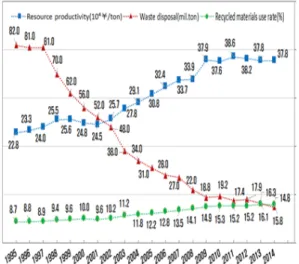
어 왔다. 일본에서는 자원생산성을 최종처분량 및 순환이 용률과 함께 관리하고 있다. 이들 지표들의 연차별 변화 추이를 보면 Fig. 3과 같다.
3. 자원생산성의 국내외 비교 분석
3.1. 국내의 자원생산성 산정
우리나라의 국가 단위 자원생산성 산정을 위해 가용 데
이터의 현황 분석을 실시하였고, 국내 실정에 맞는 산정 방법론을 정립하여 타 국가와의 비교분석을 수행하였다. 본 연구에서 제시하는 자원생산성 산정 절차는 Fig. 4와 같다.
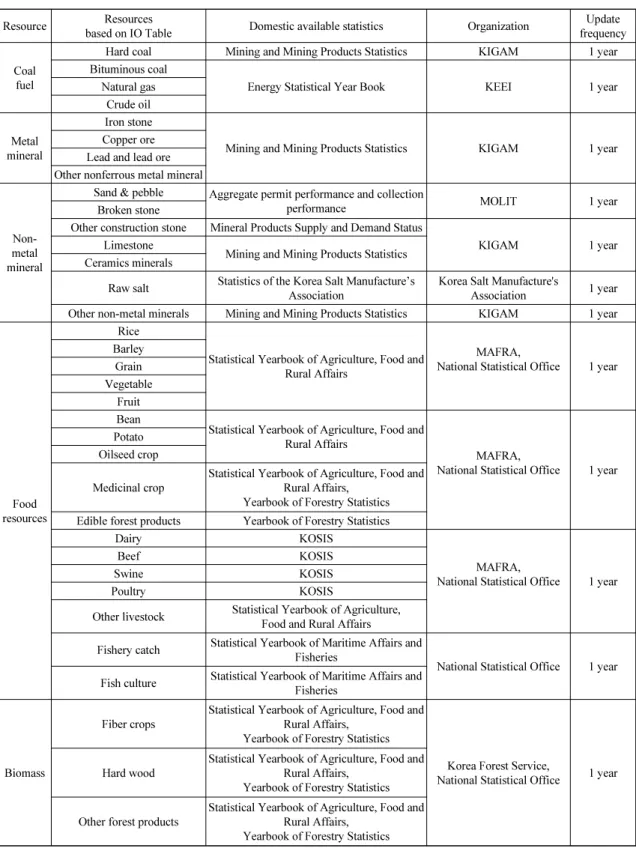
국내의 자원생산성 산정을 위한 자원소비량 관련 통계 현황을 살펴보면 Table 5와 같다7-14).
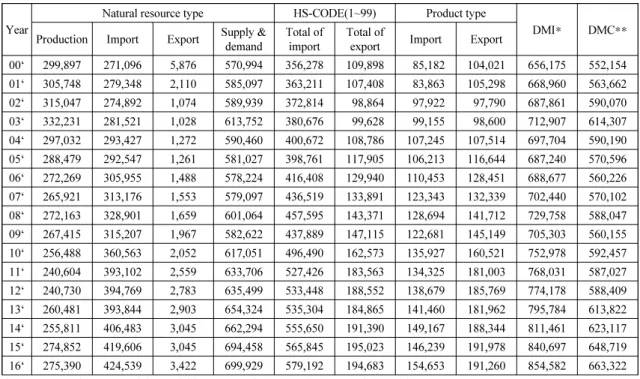
다음은 HS-IO code를 이용한 자원 수출입량을 산정한 결과와 국내 자원투입량(DMI) 및 자원소비량(DMC) 산
Table 2. Resource productivity targets in European countries
Nation Resource productivity goals
Austria • 50% increase in resource productivity in 2020 compared to 2009
• 4~10 times improvement by 2050
Estonia • 10% increase in resource productivity in 2019 compared to 2015 France • 30% increase in resource productivity in 2030 compared to 2010 Germany • Double the productivity of resources in 2020 compared to 1994
Hungary • 80% reduction in resource intensity(DMC/GDP) in 2020 compared to 2007
Latvia • Resource productivity 540 EUR/ton in 2017, 600 EUR/ton in 2020, 710 EUR/ton in 2030 Poland • Resource productivity 450 EUR/ton in 2015, 500 EUR/ton in 2020
Portugal • 170 EUR/ton in 2020, 720 EUR/ton in 2030 Slovenia • 500 EUR/ton in 2023
Table 3. Policies for promoting the resource productivity in European countries
Nation Resource productivity improvement policy
Austria
• National Resource Efficiency Action Plan and the RESET2020 initiative
- The 2012 Resource Efficiency Action Plan (REAP) has been refined and updated to REAP2020.
- Includes measures for resource-efficient production, public procurement, circular flow economy and awareness raising
Hungary
• National Environmental Technology Innovation Strategy
- It aims to increase the share of renewable energy in power generation by 275%, and reduce urban solid waste generation by 30%.
- The employment level of the environmental industry is aimed at twice the level of 2007 Latvia • Sustainable Development Strategy
- Includes comprehensive targets on a variety of topics related to material use, resource and energy efficiency - Publish monitoring reports regularly and open to the public
Portugal • Green Growth Commitment (GGC)
- Includes specific targets such as improving energy efficiency, reducing public administration energy consumption, reducing building energy consumption, and increasing waste recycling
Table 4. Policies for promoting the resource productivity in Japan Indicators 1
stbasic circular plan
(Achieve a goal in 2010) 2
ndbasic circular plan
(Achieve a goal in 2015) 3
rdbasic circular plan (Achieve a goal in 2020)
Resource productivity 390K ¥/ton 420K ¥/ton 460K ¥/ton
Recycled material utilization rate 14% 14~15% 17%
Waste disposal 28 mil. ton 23 mil. ton 17 mil. ton
정결과를 Table 6에 나타내었다7-14).
Table 6을 바탕으로 국내의 명목 GDP를 실질 GDP로 환산하여 자원생산성을 산정한 결과는 Table 7과 같다.
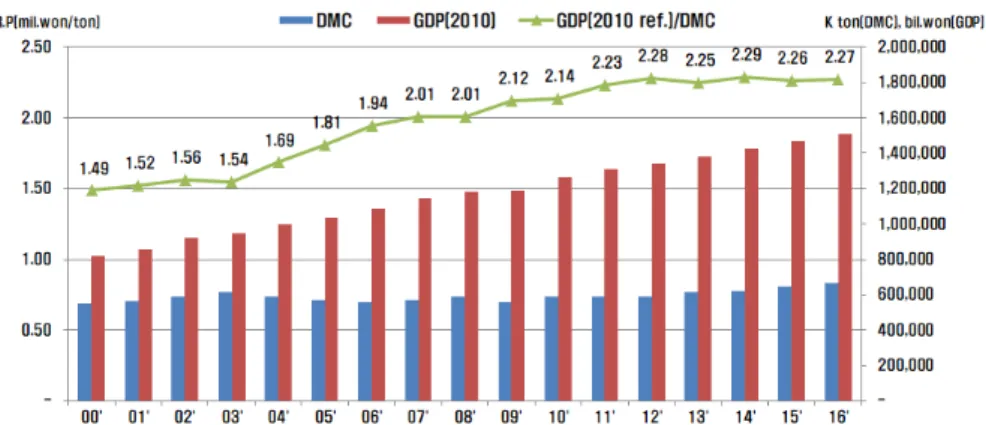
2016년의 자원생산성은 DMC 기준 2.27로서 전년 대비 0.56% 향상되었음을 보여주고 있다. 자원생산성은 2013 년 이후로는 증가와 하락을 반복하는 경향을 보이고 있으 나, 대체로 꾸준히 증가하는 우상향 추세를 보여주고 있다.
하지만 2000년 대비 2016년의 자원생산성은 53% 증 가하는 긍정적인 모습을 보여주고 있으나, 이는 이 기간 동안 GDP 84% 성장이라는 상대적으로 더 큰 요인에 의
하여 향상된 결과로 분석된다. 자원소비량은 이 기간 동 안 오히려 20% 증가하는 양상을 보임으로써 서구 선진국 의 패턴과 같은 GDP와 자원소비량의 관계가 디커플링 (Decoupling)화하는데 실패했다고 할 수 있다. 결국 그동 안 국내의 환경 ∙ 자원순환 관련 법규, 제도 등을 충실히 수립하고 운영해 왔음에도 불구하고 자원생산성 제고에 는 아직까지 실효적이지 못했음을 본 데이터를 통해 입증 하고 있다(Fig. 5).
3.2. 해외 주요국의 자원생산성과 우리나라의 자원생 산성 비교
우선 국가별 자원소비량을 비교해 보면 Table 8과 같 다. 주목해야 할 부분은 캐나다를 제외한 G7 국가는 모두 자원소비량이 감소하는 추세에 있는 반면, 우리나라는 지 속적으로 증가하는 양상을 보여주고 있다.
국가별 GDP를 비교해보면 Table 9와 같다. 2005년 대 비 2016년 OECD 전체 국가들의 GDP 증가율은 18%인 데 반해 우리나라의 GDP 증가율은 46%로 OECD 평균의 약 2.6배이다. 우리나라의 GDP 증가율이 상대적으로 매 우 크다는 것을 보여주고 있다.
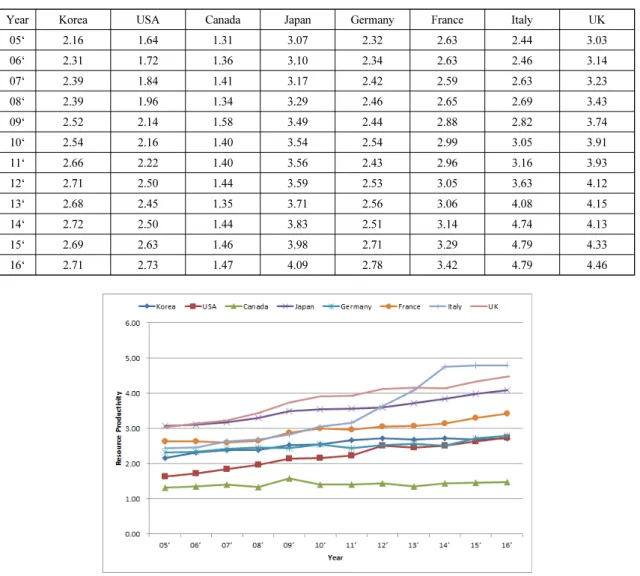
국가별 자원소비량과 GDP 자료가 확보되면 자원생산 성 산정이 가능하므로 상기 국가들에 대한 자원생산성 산 정 결과를 Table 10에 나타내었다. 국가별 자원생산성의 변화 추이는 Fig. 6과 같다.
우리나라의 자원생산성은 G7 국가들의 평균에 비해 약간 못 미치는 수준으로서 표면적으로는 자원생산성 관
Estimation of DMC
① Resource Category set-up
② Estimation of domestic resource consumption (natural resources)
③ Estimation of import/export [Use of HS-IO Code]
Estimation of GDP ④ Nominal GDP → Real GDP → Application of PPPs* exchange rate
Estimation of
Resource productivity ⑤ Estimation of national level resource productivity based on DMC
*PPP: Purchasing Power Parities Fig. 4. Procedure for estimating resource productivity.
Fig. 3. Resource productivity, waste disposal and recycled
material utilization rate in Japan.
Table 5. Domestic statistics related with resource consumption Resource Resources
based on IO Table Domestic available statistics Organization Update frequency Coal fuel
Hard coal Mining and Mining Products Statistics KIGAM 1 year
Bituminous coal
Energy Statistical Year Book KEEI 1 year
Natural gas Crude oil Metal
mineral
Iron stone
Mining and Mining Products Statistics KIGAM 1 year Copper ore
Lead and lead ore Other nonferrous metal mineral
metal Non- mineral
Sand & pebble Aggregate permit performance and collection
performance MOLIT 1 year
Broken stone
Other construction stone Mineral Products Supply and Demand Status
KIGAM 1 year
Limestone
Mining and Mining Products Statistics Ceramics minerals
Raw salt Statistics of the Korea Salt Manufacture’s
Association Korea Salt Manufacture's
Association 1 year Other non-metal minerals Mining and Mining Products Statistics KIGAM 1 year
resources Food
Rice
Statistical Yearbook of Agriculture, Food and Rural Affairs
MAFRA,
National Statistical Office 1 year Barley
Grain Vegetable
Fruit
Bean Statistical Yearbook of Agriculture, Food and Rural Affairs
MAFRA,
National Statistical Office 1 year Potato
Oilseed crop
Medicinal crop Statistical Yearbook of Agriculture, Food and Rural Affairs,
Yearbook of Forestry Statistics Edible forest products Yearbook of Forestry Statistics
Dairy KOSIS
MAFRA,
National Statistical Office 1 year
Beef KOSIS
Swine KOSIS
Poultry KOSIS
Other livestock Statistical Yearbook of Agriculture, Food and Rural Affairs
Fishery catch Statistical Yearbook of Maritime Affairs and Fisheries
National Statistical Office 1 year Fish culture Statistical Yearbook of Maritime Affairs and
Fisheries
Biomass
Fiber crops Statistical Yearbook of Agriculture, Food and Rural Affairs,
Yearbook of Forestry Statistics
Korea Forest Service,
National Statistical Office 1 year Hard wood Statistical Yearbook of Agriculture, Food and
Rural Affairs, Yearbook of Forestry Statistics Other forest products Statistical Yearbook of Agriculture, Food and
Rural Affairs,
Yearbook of Forestry Statistics
Table 6. Domestic input and consumption of resources
Year Natural resource type HS-CODE(1~99) Product type
DMI * DMC **
Production Import Export Supply &
demand Total of
import Total of
export Import Export
00‘ 299,897 271,096 5,876 570,994 356,278 109,898 85,182 104,021 656,175 552,154 01‘ 305,748 279,348 2,110 585,097 363,211 107,408 83,863 105,298 668,960 563,662 02‘ 315,047 274,892 1,074 589,939 372,814 98,864 97,922 97,790 687,861 590,070 03‘ 332,231 281,521 1,028 613,752 380,676 99,628 99,155 98,600 712,907 614,307 04‘ 297,032 293,427 1,272 590,460 400,672 108,786 107,245 107,514 697,704 590,190 05‘ 288,479 292,547 1,261 581,027 398,761 117,905 106,213 116,644 687,240 570,596 06‘ 272,269 305,955 1,488 578,224 416,408 129,940 110,453 128,451 688,677 560,226 07‘ 265,921 313,176 1,553 579,097 436,519 133,891 123,343 132,339 702,440 570,102 08‘ 272,163 328,901 1,659 601,064 457,595 143,371 128,694 141,712 729,758 588,047 09‘ 267,415 315,207 1,967 582,622 437,889 147,115 122,681 145,149 705,303 560,155 10‘ 256,488 360,563 2,052 617,051 496,490 162,573 135,927 160,521 752,978 592,457 11‘ 240,604 393,102 2,559 633,706 527,426 183,563 134,325 181,003 768,031 587,027 12‘ 240,730 394,769 2,783 635,499 533,448 188,552 138,679 185,769 774,178 588,409 13‘ 260,481 393,844 2,903 654,324 535,304 184,865 141,460 181,962 795,784 613,822 14‘ 255,811 406,483 3,045 662,294 555,650 191,390 149,167 188,344 811,461 623,117 15‘ 274,852 419,606 3,045 694,458 565,845 195,023 146,239 191,978 840,697 648,719 16‘ 275,390 424,539 3,422 699,929 579,192 194,683 154,653 191,260 854,582 663,322
*DMI : Domestic raw materials acquisition + Natural resources input + Product type import
**DMC : DMI – Natural resources export – Product type export
Table 7. Domestic resource productivity
Year DMI
(K ton) DMC
(K ton)
GDP (Billion won)* Resource productivity
(mil. won / ton) Increase/decrease
Nominal GDP
Deflator Real GDP/DMI GDP/DMC GDP/DMI GDP/DMC
00‘ 656,175 552,154 635,185 77 820,843 1.25 1.49 --
01‘ 668,960 563,662 688,165 80 857,986 1.28 1.52 2.53% 2.39%
02‘ 687,861 590,070 761,939 83 921,763 1.34 1.56 4.48% 2.63%
03‘ 712,907 614,307 810,915 85 948,794 1.33 1.54 -0.68% -1.13%
04‘ 697,704 590,190 876,033 88 995,289 1.43 1.69 7.19% 9.19%
05‘ 687,240 570,596 919,797 89 1,034,340 1.51 1.81 5.51% 7.49%
06‘ 688,677 560,226 966,055 89 1,087,875 1.58 1.94 4.96% 7.12%
07‘ 702,440 570,102 1,043,258 91 1,147,307 1.63 2.01 3.40% 3.64%
08‘ 729,758 588,047 1,104,492 94 1,179,774 1.62 2.01 -1.02% -0.31%
09‘ 705,303 560,155 1,151,708 97 1,188,124 1.68 2.12 4.20% 5.72%
10‘ 752,978 592,457 1,265,308 100 1,265,308 1.68 2.14 -0.25% 0.69%
11‘ 768,031 587,027 1,332,681 102 1,311,888 1.71 2.23 1.65% 4.64%
12‘ 774,178 588,409 1,377,457 103 1,341,962 1.73 2.28 1.48% 2.05%
13‘ 795,784 613,822 1,429,445 104 1,380,826 1.74 2.25 0.10% -1.36%
14‘ 811,461 623,117 1,486,079 104 1,426,974 1.76 2.29 1.35% 1.80%
15‘ 840,697 648,719 1,564,124 107 1,466,788 1.74 2.26 -0.78% -1.27%
16‘ 854,582 663,322 1,637,421 109 1,508,268 1.76 2.27 1.16% 0.56%
*Year 2010 based GDP (From the Bank of Korea)
Fig. 5. Relationship between resource productivity, resource consumption and GDP of Korea.
Table 8. Resource consumptions of advanced major countries and Korea (unit: k ton)
4,15)Year Korea OECD G7
USA
1)Canada
1)Japan
1)Germany
2)France
2)Italy
2)UK
2)05 570,596 8,770,391 982,612 1,451,651 1,302,310 857,003 864,634 732,627 06 560,226 8,621,800 972,053 1,461,240 1,336,747 875,982 875,337 723,965 07 570,102 8,170,843 958,673 1,451,632 1,337,379 911,556 832,046 718,818 08 588,047 7,646,075 1,017,951 1,384,035 1,327,982 892,512 805,229 675,046 09 560,155 6,806,650 836,876 1,232,621 1,264,749 798,543 723,926 592,934 10 592,457 6,914,401 972,337 1,264,751 1,264,837 784,233 681,717 576,945 11 587,027 6,849,657 1,004,444 1,259,396 1,367,754 807,766 661,007 582,117 12 588,409 6,222,206 988,859 1,265,201 1,322,655 784,974 560,316 563,432 13 613,822 6,441,032 1,083,241 1,247,961 1,313,305 786,576 489,359 570,169 14 623,117 6,488,492 1,045,885 1,213,204 1,362,504 774,731 421,475 591,385 15 648,719 6,340,090 1,043,020 1,185,475 1,284,704 746,120 421,800 576,278 16 663,322 6,186,884 1,048,726 1,162,665 1,279,122 727,806 425,135 570,343
*Source: 1) Environment live, UNEP 2) Eurostat, European commission
Table 9. GDPs of advanced major countries (G7) and Korea (unit: million dollar)
16)Year Korea OECD total OECD G7
USA Canada Japan Germany France Italy UK
05 1,230,520 41,538,424 14,408,094 1,286,111 4,460,636 3,019,778 2,254,547 2,112,136 2,216,280 06 1,294,214 42,824,975 14,792,304 1,319,851 4,523,978 3,131,515 2,308,091 2,154,518 2,270,712 07 1,364,922 43,934,047 15,055,396 1,347,076 4,598,813 3,233,619 2,362,597 2,186,273 2,324,226 08 1,403,539 44,039,114 15,011,490 1,360,551 4,548,523 3,268,617 2,367,211 2,163,308 2,313,243 09 1,413,469 42,510,122 14,594,843 1,320,421 4,302,156 3,084,958 2,297,583 2,044,714 2,216,370 10 1,505,299 43,776,711 14,964,372 1,361,136 4,482,491 3,210,822 2,342,745 2,079,199 2,253,927 11 1,560,719 44,670,249 15,204,020 1,403,892 4,477,317 3,328,338 2,391,456 2,091,188 2,286,668 12 1,596,497 45,257,210 15,542,161 1,428,397 4,544,257 3,344,714 2,395,825 2,032,237 2,320,542 13 1,642,735 45,936,755 15,802,855 1,463,750 4,635,155 3,361,089 2,409,631 1,997,117 2,368,168 14 1,697,626 46,941,609 16,208,861 1,505,551 4,652,523 3,425,947 2,432,465 1,999,387 2,440,498 15 1,744,994 48,148,482 16,672,692 1,520,619 4,715,510 3,485,669 2,458,430 2,019,334 2,497,750 16 1,794,338 49,011,803 16,920,328 1,542,123 4,759,751 3,553,417 2,487,628 2,038,364 2,543,666
*GDP: Constant prices (Real GDP based), PPPs, *Source: OECD
리가 어느 정도 잘 되고 있는 것으로 평가할 수 있다. 하지 만 그 내용을 들여다 보면 자원소비량의 감축에 기인한 결 과가 아니라 GDP의 성장률이 상대적으로 매우 높게 나타 났기 때문에 이러한 효과를 얻을 수 있었던 것이다. 대체 로 유럽 국가들의 자원소모량은 2008년 이후 지속적으로 감소하고 있는 반면에 우리나라는 계속 증가하는 추세에 있기 때문에 유럽 28개국처럼 자원소모량(DMC)과 GDP 의 디커플링이 이루어지지 않고 있는 것이 문제점으로 지 적될 수 있으며, 이는 자원생산성 관리를 위해 향후 해결 해 나가야 할 핵심 과제이다.
유럽의 경우 조금 더 확대해서 살펴보면, EU 28개국 의 자원생산성은 2000년 대비 2016년의 자원생산성이 41% 증가한 것으로 분석되고 있다. 이 기간 동안 GDP는 23% 증가한 반면, DMC(자원소비량)는 13% 감소한 것 으로 나타남으로써 자원관리의 이상적 패턴인 디커플링 (Decoupling)이 실현되는 모습을 보여주고 있다(Fig. 7).
이는 2008년 이후 건축자재 부문의 재활용 확대로 인한 신규 자원(천연자원)의 투입 감소가 큰 원인으로 해석 된다.
Table 10. Resource Productivity of advanced major countries and Korea
17-20)Year Korea USA Canada Japan Germany France Italy UK
05‘ 2.16 1.64 1.31 3.07 2.32 2.63 2.44 3.03
06‘ 2.31 1.72 1.36 3.10 2.34 2.63 2.46 3.14
07‘ 2.39 1.84 1.41 3.17 2.42 2.59 2.63 3.23
08‘ 2.39 1.96 1.34 3.29 2.46 2.65 2.69 3.43
09‘ 2.52 2.14 1.58 3.49 2.44 2.88 2.82 3.74
10‘ 2.54 2.16 1.40 3.54 2.54 2.99 3.05 3.91
11‘ 2.66 2.22 1.40 3.56 2.43 2.96 3.16 3.93
12‘ 2.71 2.50 1.44 3.59 2.53 3.05 3.63 4.12
13‘ 2.68 2.45 1.35 3.71 2.56 3.06 4.08 4.15
14‘ 2.72 2.50 1.44 3.83 2.51 3.14 4.74 4.13
15‘ 2.69 2.63 1.46 3.98 2.71 3.29 4.79 4.33
16‘ 2.71 2.73 1.47 4.09 2.78 3.42 4.79 4.46
Fig. 6. Trends of resource productivities of advanced major countries and Korea from year 2005 to 2016.
4. 우리나라의 자원생산성 제고 방안
지금까지 자원생산성에 대한 해외 사례와 우리나라의 실태를 조사, 비교 분석하였는데, 이로부터 도출된 시사 점을 바탕으로 향후 우리나라의 자원생산성을 향상시킬 수 있는 방안을 다음과 같이 제안하고자 한다.
1) 우선 제도적 측면의 개선방안을 살펴보면 자원생산성 지표의 체계적, 지속적 관리를 위한 기존 통계구축체 계의 개선 및 추가적 신규 통계구축을 통한 통계의 신 뢰도 제고를 들 수 있다. 분야별 통계구축체계 개선을 위한 분석사례를 도식화하면 Fig. 8과 같이 나타낼 수 있다. 다시 말하면, 자원생산성 관리를 위한 필요 통계 를 우선 도출하여 기존 통계구축 유무 파악, 통계형태 분석 등을 통해 향후 통계구축 및 운영체계에 대한 종 합적 개선계획이 마련되어야 할 것이다.
2) 산업 단위의 자원생산성 관리를 위한 체계 구축이 필요 하다. 이에 대한 사전 연구를 위해 우리나라의 산업별 자원생산성 현황을 우선 조사 분석하였는데, 그 결과는 Fig. 9와 같다. 이는 산업간 비교를 목적으로 하는 것이 아니다. 자원생산성은 각 산업의 독특한 특성이 있기 때문에 산업간 단순 비교를 하는 것은 큰 의미가 없다.
산업의 특성상 에너지나 자원을 상대적으로 많이 쓸 수 밖에 없는 업종이 있는가 하면 그렇지 않은 업종도 있 기 때문이다. 따라서 산업간 자원생산성 비교를 통한 개선방안 마련은 실효성이 별로 없다고 할 수 있다. 이 에 산업별 특성을 상세하게 이해하고 그 산업특성에 맞 는 자원관리 정책수립이 이루어져야 하고, 지원예산 배
분도 이에 따라 함께 수반되어야 할 것이다. 현재의 국 가 통계체계에서는 산업별 자원생산성, 경제성(자원투 입량, 부가가치 등), 환경성(연간 폐기물 발생량, 온실 가스 발생량 등) 등에 대한 세분화된 통계를 얻기가 힘 든 상황이므로 산업 단위의 자원생산성 관리를 위해서 는 이와 같은 기본 체계가 마련되어야 현황분석을 통한 제대로 된 개선방안이 도출될 수 있을 것이다.
3) 자원생산성 목표관리제 운영이 필요하다. 자원생산성 목표관리제도는 강제적 감축목표를 설정하여 할당하 거나 규제하는 방식이 아닌 자발적 참여에 의한 인센 티브제를 도입하는 형식이 바람직할 것이다. 국가 차 원의 추진과 지원제도가 있을 수 있고, 지자체의 참여 를 통해 운영하는 방안도 고려해 볼 수 있다. 자원생산 성 또는 자원효율성을 제고하는 사업에 참여하거나 아 니면 자체적으로 일정 수준 이상의 자원생산성 향상을 달성한 업체에 대한 적절한 인센티브를 제공하는 시스 템을 갖추는 것이 중요하다. 많은 기업들의 참여를 유 도하기 위해서는 자원생산성 사업 참여를 통한 단순한 인센티브 수혜에 대한 홍보도 중요하지만, 기업들이 이 사업에 참여함으로써 실질적으로 기업의 생산활동 또는 경영활동에서 자원 및 에너지절감, 생산 및 경영 의 효율향상(경영성과)을 이룰 수 있다는 확신을 가질 수 있는 성공사례를 많이 발굴, 제공하여야 할 것이다.
5. 결론 및 제언
본 연구를 통해 도출된 결과에 따르면 우리나라의 2000년 대비 2016년의 자원생산성은 53% 증가하는 긍정
*Source: Eurostat (online data code: nama_10_gdp; env_ac_mfa) (2017.06)
Fig. 7. Trends of resource productivities, GDP and DMC of EU-28 countries from year 2000 to 2016
17-20).
Resource Category EU statistics availability Domestic applicability Items for improvement Production Export/Import Production Export/Import
Fossil fuel
Coal &
solid fuel
Lignite ○ ○ ○ ○ -
Coal ○ ○ ○ ○ -
Oil shale &
tar sand ○ ○ × × Domestic statistics
not available
Peat ○ ○ ○ ○ -
Lignite &
gaseous fuel
Crude, natural gasoline ○ ○ ○ ○ -
Natural gas ○ ○ ○ ○ -
Fuel spill -○ -× Break down existing
trade statistics
Products from fossil fuel -○ -×
Metallic mineral
Iron ○ ○ ○ ○ -
ferrous Non- metal
Copper ○ ○ ○ ○ -
Nickel ○ ○ ○ ○ -
Lead ○ ○ ○ ○ -
… … … … … …
Metal product -○ -× Apply to trade
statistics
metallic Non- mineral
Marble, granite etc. ○ ○ ○ ○ -
Chalk & dolomite ○ ○ ○ ○ -
Slate ○ ○ ○ ○ -
Chemical fertilizer ○ ○ ○ ○ -
Sand stone ○ ○ × × Domestic statistics
not available
Limestone & plaster ○ ○ ○ ○ -
Clay & kaolin ○ ○ ○ ○ -
… … … … … … …
Find / draw items to be improved
Establish a new statistics system or improve existing statistics format
Continuous management of resource productivity
Fig. 8. Suggestion for improving domestic resource productivity in the national systematic aspect.
Fig. 9. Resource productivities in 15 industrial sectors of Korea.
적인 모습을 보여주고 있어 EU-28개 국가들의 평균 자원 생산성 증가율 41%에 비해 표면상으로는 더 나은 것으로 보일 수 있다. 이는 자원의 효율적 사용에 기인한 성과가 아니라 우리나라의 GDP 성장률이 이 기간 동안 84%인 반면, EU-28개 국가들의 평균 GDP 성장률은 23%에 그 치고 있기 때문에 이러한 결과를 나타내고 있는 것으로 분석된다. 중요한 사실은 EU-28개 국가들의 자원소비량 (DMC)이 이 기간 동안 13% 감소할 때 우리나라의 자원 소비량은 오히려 20% 증가하는 양상을 보여주고 있다는 것이다. 즉, 유럽 국가들의 자원소모량은 2008년 이후 지 속적으로 감소하고 있는 반면에 우리나라는 계속 증가하 는 추세에 있기 때문에 유럽 28개국에서는 자원소모량 (DMC)과 GDP의 디커플링이 이루어지고 있지만, 우리나 라는 그러한 패턴을 나타내지 못하고 DMC와 GDP가 동 조화 현상을 보여주고 있다. 이는 유럽과 한국의 산업적 특성이 다른 측면에 의해서도 어느 정도 영향을 받을 수 있겠지만, 향후 DMC와 GDP의 디커플링화를 실현할 수 있는 제도 마련과 정책 추진을 지속해 나가야 할 것이다.
자원생산성의 지속적 향상을 위해서는 우선적으로 자 원생산성 관리지표가 합리적, 객관적으로 설정되어야 할 것이다. 주요 지표 및 세부 보조 지표들이 전문가, 기업 담 당자 및 관계 부처의 합의를 통해 구체화되어야 할 것이 다. 국가 단위, 산업 단위, 기업 단위의 관리 기준이 함께 제시되어야 할 것이다. 관리지표가 세부적으로 마련되면 본문에서 상술한 바와 같이 1) 자원생산성 지표의 체계적, 지속적 관리를 위한 기존 통계구축 체계의 개선 및 추가적 신규 통계구축, 2) 산업별 특성을 상세하게 이해하고 그 산업특성에 맞는 자원관리 정책수립, 3) 자원생산성 목표 관리제 운영 및 인센티브 제도 도입을 통한 기업들의 적극 적 참여 유도가 이루어져야 할 것이다.
감사의 글
본 연구의 일부는 산업통상자원부의 “자원생산성 기반 구축사업” 지원으로 수행되었습니다. 자료수집 및 정리에 도움을 준 한국생산기술연구원의 이일석 박사, 조현정 박 사, 김경환 연구원에게 고마움을 전합니다.
References
1. Kang, H.Y., 2017 : Final report for the establishment of resource productivity infrastructure, Presentation material, p.8.
2. IL-Seuk Lee, Hong-Yoon Kang, Kyung-Hwan Kim, et al., 2014 : A suggestion for Korean resource productivity management policy with calculating and analyzing its national resource productivity, Resources, Conservation and Recycling, 91, pp.40-51.
3. Kang, H.Y., Lee, I.S. and Kim, K.H., 2018 : Status of domestic resource productivity and its implication, Proc.
Korea Environmental Management Association, Summer Conference Held in Hilton Kyungju, pp.1-12.
4. UNEP Environment live (https://environmentlive.unep.org/
downloader).
5. UNEP, 2017 : RESOURCE EFFICIENCY- POTENTIAL AND ECONOMIC IMPLICATIONS.
6. http://www.meti.go.jp.
7. Stat.kita.net, 2000-2016.
8. ecos.bok.or.kr, 2000-2016.
9. price.bok.or.kr, 2000-2016.
10. http://www.molit.go.kr, 2000-2016.
11. http://uni.agrix.go.kr, 2000-2016.
12. http://www.ksalt.or.kr, 2000-2016.
13. http://forest.go.kr, 2000-2016.
14. http://mici.kigam.re.kr, 2000-2016.
15. Eurostat : 2017 (online data code: nama_10_gdp; env_ac_
mfa).
16. OECD GDP data (https://data.oecd.org/gdp/gross-domestic- product-gdp.htm).
17. UNEP, 2017 : ASSESSING GLOBAL RESOURCE USE.
18. UNEP, 2016 : GLOBAL MATERIAL FLOWS AND RESOURCE PRODUCTIVITY.
19. OECD, 2016 : Policy Guidance on Resource Efficiency 20. Eurostat resource productivity statistics : (http://ec.europa.
eu/eurostat/statistics-explained/index.php/Resource_prod uctivity_statistics).
강 홍 윤