J. Korea Inst. Build. Constr. Vol. 19, No. 3 : 247-254 / Jun, 2019
https://doi.org/10.5345/JKIBC.2019.19.3.247 www.jkibc.org
안전 동기요인에 대한 시공관리자와 사업관리자간 요인별 중요도 순위 비교
A Comparison of the Ranking for Safety Motivations Factors between Construction Engineers and Construction Managers
김 영 길
11) 김 진 동
2김 광 희
3*Kim, Young-Kil
1Kim, Jin-Dong
2Kim, Gwang-Hee
3*The master's course, Department of Architectural Engineering, Graduate School of Kyonggi University , Yeongtong-Gu, Suwon, 16227, Korea
1Professor, Department of Architecture, Yeonsung University, Manan-Gu, Anyang-si, 14011, Korea
2Professor, Department of Architectural Engineering, Kyonggi University, Yeongtong-Gu, Suwon, 16227, Korea
3*Abstract
The number of construction accident deaths in Korea is increasing and most causes of construction accidents are human factors. Voluntary participation of construction workers in safety activities is likely to improve these human factors and increase the prevention effect of construction accidents. Therefore, there is a need to study the motivation of workers to meet the voluntary participation of construction workers. In this respect, the purpose of this study is to compare the importance of construction field engineers and construction managers about the safety motivation factors of construction workers. This study analyzed the results of the questionnaire survey about safety motivation factors and conducted a T-test for these factors. The results of this study can be used as managing method to effective on-site safety management by minimizing the difference between the two groups according to motivation factors of construction workers.
Keywords : motivations, construction safety, manager
1. 서 론
1.1 연구의 배경 및 목적
건설재해에 따른 사망자 수는 증가하고 있지만 이에 대 한 예방 노력은 한계점을 보이고 있다[1]. 고용노동부에서 발표한 자료에 의하면 17년 기준 건설업의 산업재해자 수 는 전년대비 감소를 보였으나 사망자 수는 전년대비 4.5%
의 증가하였다[2]. 통계에 의하면 산업재해 예방의 효과는 국가적 계획수립과 실행 그리고 건설회사의 노력에 비해
Received : March 21, 2019 Revision received : April 9, 2019 Accepted : April 9, 2019
* Corresponding author : Kim, Gwang-Hee
[Tel: 82-31-249-9757, E-mail: [email protected]]
ⓒ2019 The Korea Institute of Building Construction, All rights reserved.
미흡하다고 할 수 있다[3].
기존의 건설재해에 발생 원인을 살펴보면 인적요인이 높 은 비중을 차지한다[4]. Kim[5]은 건설근로자 350명을 대 상으로 건설재해 원인에 대한 설문조사를 분석하였다. 분 석결과 건설재해 원인 중 낮은 안전의식과 안전교육 부족 등이 전체 중 82.7%로 나타났고, 인적요인, 관리적 요인, 그리고 물리적원인 등과 같은 원인별 중요도 분석결과 인적 원인이 1순위로 나타났다. Park[6]은 기술적 발전에 따라 안전에 대한 물리적 환경이 상당히 개선됨에도 불구하고 재해는 지속적으로 발생 하고 있으며, 동일한 환경에서 특 정 근로자에게 재해가 발생한 이유를 물리적 원인만으로 치부하는 것은 한계가 있다고 주장하였다. 효과적인 건설 근로자의 안전관리를 위해서 기술적, 물리적 측면의 개선 뿐만 아니라 안전교육, 안전제도의 강화 등 같은 인적측면
A Comparison of the Ranking for Safety Motivations Factors between Construction Engineers and Construction Managers
의 개선도 이루어져야 한다[7].
건설 근로자의 자발적 참여는 근로자의 안전의식을 고취 시키고 안전관련 활동에 대한 건설재해예방 효과를 높일 수 있다[8]. Park[9]의 연구에서 건설현장의 안전 분위기 조성은 건설 근로자의 안전활동에 대한 적극적 참여를 이끌 어낼 수 있다. 또한 근로자의 적극적인 참여는 건설재해율 감소의 효과가 있으므로 건설 근로자의 안전활동 참여율을 높일 수 있는 안전활동 환경 조성의 필요성을 제기하였다.
건설산업의 사망자수를 줄이기 위해 실행됐던 기존 안전 교육 개선 및 안전활동은 근로자의 적극적인 참여를 이끌어 내는데 미흡하다고 할 수 있다[10]. 그 근거로 현재 건설현 장에서 시행되는 강의식 교육 등과 같이 근로자의 흥미를 유발하지 못하는 교육방법은 근로자의 안전관련 성과를 내 지 못하는 상황에 있는 것이다[11]. 효과적이지 못한 교육 은 근로자의 안전수칙의 미준수, 안전의식 부족 등 자연스 럽게 근로자의 적극적인 안전활동 참여율 저조 등으로 이어 지고 있다[12].
그렇지만 건설근로자의 동기요인을 충족시킬 경우 건설 근로자의 직무 만족도와 안전활동에 대한 참여율을 높일 수 있다[13]. Lee[14]는 기업의 교육훈련에 대한 근로자의 참여를 높이기 위해 근로자의 동기요인이 매우 중요하다고 주장하였다. 그러나 현재 건설현장 근로자 동기부여에 관 한 제도나 방법 등은 제한적으로 시행될 뿐만 아니라 건설 현장 근로자 동기부여에 대한 연구도 부족한 실정이라고 할 수 있다[15].
따라서 건설현장에서의 근로자 동기를 충족시킬 수 있는 다양한 노력이 필요하다. 건설현장에서 전체적인 운영과 관리감독의 업무를 수행하는 시공관리자와 건설사업관리 자는 근로자의 안전동기에 맞게 관리하여야 한다고 할 수 있다. 그러므로 본 연구에서는 국내 건설현장 근로자의 안 전활동 동기요인별로 현장 시공관리자와 건설사업관리자 는 근로자의 어떤 안전 동기요인을 중요하게 다루고 있는지 를 비교하고자 한다. 본 연구의 결과는 건설근로자의 동기 요인에 따른 시공관리자와 건설사업관리자간 요인별 차이 를 최소화하여 일관성 있고 효과적인 현장 안전관리를 수행 하는 자료로 활용될 수 있을 것이다.
1.2 연구의 범위 및 방법
건설재해를 줄이는데 건설근로자들의 역할이 매우 중요 하다. 그렇지만 건설근로자를 관리하는 관리자들이 건설
Figure 1. Methodology
근로자를 적절하게 관리하기 위해서는 관리자들 상호간에 일관된 관리가 필요하다. 따라서 본 연구의 범위는 건설근 로자의 안전활동 참여 동기요인에 대한 시공관리자와 건설 사업관리자의 인식을 비교하는 것으로 한정하였다. 왜냐하 면 관리의 대상은 건설근로자이고, 관리하는 주체는 시공 관리자와 건설사업관리자이므로 관리자들 상호간에 일치 된 의견을 제시하는 것이 관리의 효율이나 효과 측면에서 중요하기 때문이다.
두 관리자간에 차이를 알아보기 위하여 시공관리자와 사 업관리자를 대상으로 설문조사를 실시하였다. 설문조사는 수도권 건설현장에서 실시하였고, 설문결과 분석은 통계패 키지인 SPSS를 사용하였다.
본 연구의 수행절차는 문헌조사를 통하여 근로자의 자발 적 안전활동 참여의 동기요인을 도출하였다. 도출된 동기 요인 대하여 설문조사를 실시하였다. 설문지 분석을 위해 각 요인별 세부요인에 대해 T-검정을 이용하여 두 집단 의 의견이 통계적으로 유의성이 있는지 확인하였다. 연구 의 절차에 있어서는 Figure 1과 같다.
2. 이론적 고찰
2.1 안전활동 개선에 관한 기존연구 고찰
근로자의 건설안전활동에 대한 참여율을 높이는 연구는 오랫동안 계속 되어왔다. Kim et al.[16]은 건설재해의 원 인 중 높은 비중을 차지하고 있는 가설재 관련 재해에 대한 개선방안을 모색하기 위하여 사례조사와 설문조사를 통한 가설재 사용에 관한 실태와 문제점을 분석하였다. 이 연구
와 설치작업에 관련된 작업자들의 교육 불충분을 도출하였 으며 그에 따라 반입에서 사용 그리고 반출에 이르는 과정 에 대한 품질검사절차의 모델화 방안을 제시하였다. Kwon [17]는 건설재해의 원인의 규명과 해결방안을 모색하기 위 하여 홍콩의 안전사고와 우리나라의 안전사고를 비교분석 하여 안전관리의 문제점과 그에 따른 방안을 모색하였다.
분석결과 현행 안전관리에 대하여 제도적, 구조적, 시행상 의 문제점을 도출 하였으며 방안으로 안전관리 시스템의 개선과 안전교육 강화, 안전관련 법령의 개정 안전관리 기 술의 도입의 필요성을 제시하였다. Yang et al.[18]은 건 설현장의 안전사고를 줄이기 위하여 안전관리 체크리스트 의 활용성을 높이는 것을 초점으로 연구를 진행하였다. 체 크리스트의 활성화를 위하여 안전관리, 체크리스트 그리고 공정관리에 대한 설문과 전문가의 인터뷰를 통해 체크리스 트의 개선 방안과 공정관리와 의 연계운영방법을 제시하였 다. 연구결과 체크리스트의 전산화 통한 공정관리와 안전 관리의 연계운영 방식의 체크리스트 도입을 제시하였다.
Hong et al.[19]의 연구에서는 건설현장 안전관리활동에 개선을 사례조사를 통하여 건설현장 안전관리활동 주요요 인을 도출하고 실천방안을 제시하였다. 이 연구에서 제시 된 주요요인은 안전점검, 안전교육의 실시, 안전활동, 작업 장 환경개선 등이 있었으며 이에 대한 근로자의 자발적 참 여를 위해 건설현장에 적합하고 효과적인 기법의 개발 필요 성을 언급하였다. Kim et al.[10]의 연구에서는 근로자의 자발적 참여를 위한 근로자 개인의 특성에 맞는 안전교육을 모델을 구축하고 제시하였다. 직종과 근무 년 수, 사고경 험, 성격유형에 따라 근로자를 분류하였으며 이에 맞는 안 전교육 모델을 구축하였다. Kwon[20]의 연구는 기존 문헌 고찰을 통해 안전관리의 현황과 문제점을 조사하였으며 현 행 안전관리제도의 문제점을 분석하여 안전관리 제도의 활 성화 방안을 연구하였다. 분석결과 현재 건설현장의 안전 관리에 대한 근로자의 안전의식이 미흡하다는 결과를 도출 하였으며 근로자의 안전의식을 함양시키기 위하여 안전 매 뉴얼 구축과 책임부과 방법을 제시하였다. Son et al.[21]
의 연구에서는 근로자의 참여를 유도하기 위해 안전교육용 기능성 게임을 개발하여 건설현장의 강의위주식 안전교육 을 개선하고자 하였다. Kim[22]의 연구에서는 형식적이고 시행사 위주의 안전교육을 개선하고자 근로자의 참여실태 및 요구도를 조사하여 건설근로자의 참여를 높이기 위한
선행연구들은 지속적으로 다양하게 수행되었으나 연구 의 주된 대상이 근로자와 안전교육 및 안전관리 제도에 초 점이 맞춰져 있다. 따라서 근로자를 직접 관리하고 현장 운영의 책임을 맡고 있는 관리자들의 적절한 관리 핵심요인 을 인지하고, 건설근로자들을 자발적으로 움직이게 할 수 있는 동기요인에 대한 파악이 중요하다고 할 수 있다. 따라 서 본 연구에서 건설 근로자들의 동기요인에 대하여 관리자 들이 어떻게 생각하고 있는 지를 조사하여 적절하게 관리할 수 있도록 하고자 한다.
2.2 동기이론
Maslow 욕구단계이론에서 동기부여란 인간의 특정 행 동을 취하기 위하여 내적인 욕구를 가지게 하는 것이라고 정의하였다[23]. Maslow 욕구단계이론은 크게 5단계로 나눴다. 음식, 주거, 성욕과 같은 생리적 욕구, 직업, 정신 적 안전 등과 같은 안전의 욕구, 직장 동료와 전문적 조직 등과 같이 사회 집단에 소속감에 대한 사회적 욕구, 자기계 발 등과 같이 타인으로부터 가치 있는 존재가 되려는 자기 존중의 욕구, 자신을 성장시키기 위한 자아실현의 욕구가 있다[24]. Maslow 욕구단계이론에서 욕구단계는 생리적 욕구부터 자아실현의 욕구까지 상하관계가 있으며 하위단 계의 욕구가 충족되어야 상위단계의 욕구가 나타난다고 말 하고 있다[25].
Alderfer ERG이론은 Maslow의 욕구단계이론의 5단계 를 단순화 하여 생존의 욕구, 관계의 욕구, 성장의 욕구로 분류하고, 저차원욕구가 충족될 경우 상위욕구에 대한 바 람이 커진다는 점에서 Maslow의 욕구단계이론과 같은 맥 락에 있다고 할 수 있다[26]. 그러나 ERG이론은 무조건적 으로 하위욕구가 충족되어야지만 상위욕구단계로 이동하 는 것은 아니며 생리적 욕구의 충족 없이도 자아존중의 욕 구로 이동할 수 있다는 것이다[25]. ERG이론의 생존의 욕 구는 욕구단계 이론 중 생리적 욕구와 안전욕구의 물리적 요소에 속하며, 관계의 욕구는 안전욕구의 인적요소, 사회 적 욕구 그리고 자아존중의 욕구의 대인관계 요소에 속하 고, 성장의 욕구는 자아존중 욕구의 신념과 관련된 요소와 자아실현의 욕구에 속한다.
Herzberg 동기위생이론은 동기 요인과 위생 요인을 통 해 직무에 대한 만족과 불만족이 결정된다는 이론이다 [27]. 동기위생이론은 반대되는 두 개념인 만족과 불만족
A Comparison of the Ranking for Safety Motivations Factors between Construction Engineers and Construction Managers
은 반대되는 개념으로 불만족의 원인이 제거 될 경우 만족 의 상승으로 이어진다는 개념이다[28]. 동기요인의 경우 성취, 인정, 승진 등과 같이 직무만족을 일으키는 요인이 다. 위생요인의 경우 직무의 불만족을 유발하는 요인으로 서 감독, 상사와의 관계, 작업조건, 급여, 동료와의 관계 등이 있다.
McCelland의 성취동기이론은 개체의 동기가 사회와 상 호작용 하에 학습된 것을 통해 동기가 유발될 수 있다는 전제로 3단계의 성취욕구에 주목하였다[29]. 성취동기이 론의 3단계를 살펴보면 먼저 성취욕구는 모표를 달성하고 목표를 넘어서려는 욕구이며, 권력욕구는 타인에 대하여 지배하고 영향력을 행사하려는 욕구이며, 귀속욕구의 경우 다른 사람들과 친근한 관계를 맺으려는 욕구이다. 이러한 성취동기이론은 성취에 대한 행동이 중요하게 요구되는 조 직과 창업적 행동이 중요시되고 있는 창업초기의 많은 조직 들에서 성취동기이론이 적용되고 있으며 각각의 욕구들은 Maslow의 단계욕구 이론의 여러 범주의 욕구들과 같은 맥락에 있는 것을 볼 수 있다[26].
2.3 건설 근로자 동기
기존연구에 제시된 동기요인은 Table 1과 같다. 기존연 구들의 동기요인은 건설공사에서 근로자의 생산성과 근로 동기의 관한 동기요인이었다. 기존연구들의 건설 근로자 동기요인은 금전적인 부분과 일의 안정성 그리고 작업환경 과 근무환경의 요인들이 주로 도출되었다.
3. 안전활동 관련 동기요인 도출
3.1 안전활동 동기요인 도출
본 연구에서는 근로자의 안전활동 동기요인을 도출하기 위하여 생산성과 근로동기에 관한 선행연구들의 도출된 동 기요인을 바탕으로 건설현장에서 10년 이상 종사한 전문가 와의 1:1 면담을 통해 근로자 안전활동 참여를 유도할 수 있는 주요동기요인을 선정하였다. 선정된 동기요인은 17 개의 요인이다. 도출된 동기요인은 크게 3가지인 경제요 인, 작업환경과 안전문화 요인, 관리요인으로 분류하였다.
선정된 요인은 시공관리자와 건설사업관리자 측면에서 바 라본 건설 근로자의 안전활동에 자발적 참여에 대한 동기요 인으로 임금, 직업 안전성, 작업환경의 조건, 감독자의 역 량, 의사소통, 작업환경 등과 관련된 동기요인들이다. 선정
된 근로자의 안전활동 동기요인은 Table 2와 같다.
Author
(Year) Motivation factors
Jung (2012)
[25]
Economic
the amount of money, employment guarantee, payment
of a fixed date, incentive
Social
social security insurance, decision participation, autonomy
of work, safety health environment
Psychological
working environment, relationship with colleagues, manager's relationship, working condition
Oh (2014)
[23]
Working condition
proper wages, working hours, stability of work, incentive, rest
time, paid holidays
welfare support
social security insurance, support of transportation expenditure, housing cost support, retirement
benefit system working
environment
convenient facilities, safety facility, working environment,
elimination of risks human
relations
relationship with colleagues, decision participation, personal generosity, respect from others
Shin (2010)
[30]
Motivation factors related to
job performance
achievement in work, relationship with colleagues,
satisfaction for a job, responsibility of work, the amount of money, the continuity
of a job, workload, working environment, supervisor role,
work environment Table 1. Motivation of construction workers
Motivation
factors Detailed factors
Economic
the amount of money, number of working days, payment of a fixed date, social security
insurance, safety incentives, stability of work Work
environment and safety
culture
convenient facilities, safety education, achievement in work, relationship with colleagues, safety environment, safety facility
Management task concentration, supervisor role, workload, rework, decision participation Table 2. Motivation of construction safety
3.2 설문개요
설문지의 각 문항들은 Likert의 5점 등간척도를 적용하 였다. 점수가 높을수록 안전활동에 대한 동기요인으로서의 중요도가 높음을 의미한다. 설문은 2018년 9월부터 동년 11월까지 실시하였다. 설문조사는 수도권에 위치한 건설 현장에 대한 설문지를 통한 설문조사와 인터넷 설문지를
지 못하다고 사료된 설문지를 제외한 409부를 회수하였다.
또한 T검정의 기본조건인 두 대상의 비율 1:1.5 이내[31]
를 맞추기 위하여 무작위로 건설사업관리자 70부의 설문지 를 제외하여 현장 관리감독자 126부와 건설 사업관리자 186부를 분석하였다. 설문의 응답자별 경력분포는 Table 3와 같다.
Career(year) Construction field manager
Ratio (%)
Construction manager
Ratio (%)
~ 1 15 11.9 2 1.1
1 ~ 2 16 12.7 7 3.8
2 ~ 3 8 6.3 8 4.3
3 ~ 5 17 13.5 12 6.5
5 ~ 10 21 16.7 15 8.1
10 ~ 20 29 23.0 23 12.4
20~ 20 15.9 119 64.0
Total 126 100 186 100
Table 3. Survey respondents career
4. 설문결과 분석
4.1 동기요인 중요도 설문결과
동기요인 설문결과 Table 4에서 제시된 것과 경제요인 의 현장관리 감독자와 건설사업관리자의 작업환경과 안전 문화요인, 그리고 관리요인에 경우 건설사업관리자가 시공 관리자 대비 영향이 크게 미친다고 응답하였다. 전체 평균 은 경제요인이 다른 요인에 비해 낮은 중요도를 나타냈다.
응답자 중 “많음” 또는 “매우 많음”이라고 응답한 응 답자 비율은 경제요인의 경우 53%, 작업환경과 안전문화 요인의 경우 56.7%, 관리요인의 경우 57.7% 이었다.
Factor Construction field manager
Construction
manager Avg.
Economic 3.56 3.51 3.53
Work environment
and safety culture 3.30 3.87 3.64
Management 3.46 3.77 3.64
Table 4. Importance average of motivation factors
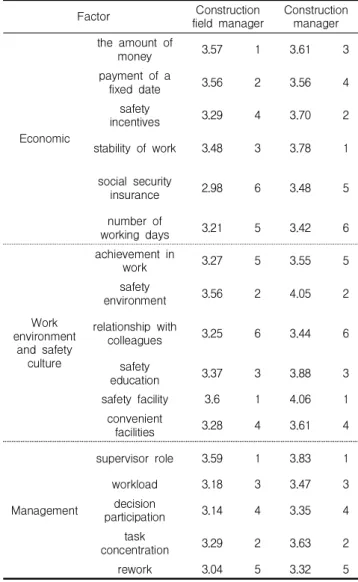
경제요인의 세부요인 설문조사 결과 Table 5에서 제시 된 것과 같이 시공관리자는 임금수준이 근로자들의 동기에 가장 큰 영향을 미치는 것으로 응답하였고, 건설사업관리
다. 경제요인의 세부요인에 대한 중요도 순위는 시공관리자 경우 임금의 수준, 정해진 날짜에 입금 그리고 일의 안정성 순이고, 건설사업관리자 경우 일의 안정성, 안전 인센티브 그리고 임금의 수준의 순으로 시공관리자와는 차이가 있다.
작업환경과 안전문화요인의 중요도 순위는 안전시설물, 안 전한 작업환경 그리고 안전교육의 순으로 시공관리자와 건 설사업관리자의 중요도 순위는 동일하다. 또한 관리요인의 중요도 순위는 현장 감독자의 능력, 작업집중과 공정간의 간섭 그리고 비현실적인 인정과 성과의 순으로 시공관리자 와 건설사업관리자의 중요도 순위는 동일하다.
Factor Construction
field manager
Construction manager
Economic
the amount of
money 3.57 1 3.61 3
payment of a
fixed date 3.56 2 3.56 4
safety
incentives 3.29 4 3.70 2
stability of work 3.48 3 3.78 1
social security
insurance 2.98 6 3.48 5
number of
working days 3.21 5 3.42 6
Work environment
and safety culture
achievement in
work 3.27 5 3.55 5
safety
environment 3.56 2 4.05 2
relationship with
colleagues 3.25 6 3.44 6
safety
education 3.37 3 3.88 3
safety facility 3.6 1 4.06 1
convenient
facilities 3.28 4 3.61 4
Management
supervisor role 3.59 1 3.83 1
workload 3.18 3 3.47 3
decision
participation 3.14 4 3.35 4
task
concentration 3.29 2 3.63 2
rework 3.04 5 3.32 5
Table 5. Results of a survey on detailed motivations factors
4.2 시공관리자와 건설사업관리자간 T검정
시공관리자와 건설사업관리자 간의 중요도 평균차이 유
A Comparison of the Ranking for Safety Motivations Factors between Construction Engineers and Construction Managers
무를 알아보기 위해 T검정을 하였다. T검정의 신뢰도는 95%를 설정하였으며 p-value 값이 0.05 이하일 경우 두 집단의 평균에 차이가 있다는 것을 얻을 수 있다. Table 6은 T검정 분석결과이다.
T검정 결과 상위요인 3개의 요인과 세부요인 17개를 합 한 총 20개의 동기요인 중 시공관리자와 건설사업관리자 간의 평균 차이가 있는 요인은 9개의 요인이었으며 평균 차이가 없는 요인은 11개의 요인이었다. Table 7은 두 집 단의 평균차이의 유무에 따른 요인별 분류이다.
Factor
Average
t p
Construction field manager
Construction manager
Economic 3.56 3.51 0.480 .632
Work environment
and safety culture 3.30 3.87 -5.569 .000
Management 3.46 3.77 -3.261 .001
the amount of
money 3.57 3.61 1.332 .184
payment of a
fixed date 3.56 3.56 -0.018 .985
safety incentives 3.29 3.70 -1.812 .071
stability of work 3.48 3.78 -3.281 .001
social security
insurance 2.98 3.48 -4.719 .000
number of
working days 3.21 3.42 -1.993 .067
achievement in
work 3.27 3.55 -2.984 .003
safety
environment 3.56 4.05 -1.517 .131
relationship with
colleagues 3.25 3.44 -1.924 .055
safety education 3.37 3.88 -1.979 .052
safety facility 3.60 4.06 -1.859 .064
convenient
facilities 3.28 3.61 -4.614 .000
supervisor role 3.59 3.83 -1.067 .287
workload 3.18 3.47 -3.616 .000
decision
participation 3.14 3.35 -2.372 .051
task concentration 3.29 3.88 -3.423 .001
rework 3.04 3.32 -3.691 .000
Table 6. Results of T-test for motivation factors
factors with differences factors without differences
work environment and safety culture, management, stability
of work, social security insurance, achievement in work, convenient facilities, workload, task concentration,
rework
economic, the amount of money, payment of a fixed
date, safety incentives, number of working days,
safety environment, relationship with colleagues,
safety education, safety facility, supervisor role, decision participation Table 7. Motivation factors with differences and without
differences by T-test
4.3 설문결과 분석
근로자의 안전활동 동기요인 중 상위요인인 경제요인, 작업환경과 안전문화요인, 그리고 관리요인에 대한 설문결 과 경제요인의 세부요인에서 세부요인의 중요도 순위는 시 공관리자와 건설사업관리자 간의 의견차이를 보였다. 시공 관리자는 건설 근로자의 안전활동 동기요인을 충족을 위해 임금같이 돈과 관련된 부분을 가장 중요하다고 여기고 있지 만 건설사업관리자의 경우 일의 안정성과 안전 인센티브를 가장 중요하다고 여기고 있다. 이러한 경제요인의 중요도 순위에서 시공관리자와 건설사업관리자의 차이는 근로자 를 직접적으로 관리감독하는 시공관리자와 그렇지 않는 건 설사업관리자의 차이로 사료된다.
작업환경과 안전문화 요인 그리고 관리요인의 세부요인에 대한 설문결과 시공관리자와 건설사업자 두 집단의 중요도 순위는 동일하였다. 작업환경과 안전문화의 요인의 경우 안 전시설물, 안전한 작업환경 등 안전에 관한 현장의 기본적인 안전요소가 중요도에서 높은 순위를 차지하였으며 관리요인 의 경우 관리감독자의 능력이 가장 높은 순위로 나타났다.
이에 따라 현장의 안전한 작업조건과 현장 감독자의 안전관 리 능력 등 건설근로자의 안전활동에 직접적인 관련에 있는 요인들에 대한 개선과 노력이 필요하다고 할 수 있다.
T 검정 결과 동기요인 중 평균의 차이가 있는 상위 동기 요인은 작업환경과 안전문화요인 그리고 관리요인이었다.
해당 요인들의 중요도 순위는 시공관리자 경우 경제요인보 다 낮은 중요도 순위였지만 건설사업관리자 경우 경제요인 보다 높은 중요도 순위였다. 즉 시공관리자는 근로자의 자 발적 안전활동 참여에 대해 경제적 부분을 우선적으로 충족 시켜야 한다는 의견이지만 건설사업관리자는 경제요인 보 다 안전에 관한 작업환경과 현장감독자의 관리 부분의 동기 충족이 먼저 이루어져야 한다는 의견이었다.
본 연구는 건설현장 시공관리자와 건설사업관리자를 대 상으로 설문조사를 실시하여 건설 근로자의 안전활동 동기 요인 중요도 순위에 대한 두 집단 간의 인식을 비교하였다.
그 결과 시공관리자는 경제요인을 가장 중요하게 여겼으며 사업관리자는 경제요인을 가장 후 순위로 여기고 있었다.
또한 경제요인의 세부요인 설문결과 시공관리자는 근로자 의 임금과 관련된 부분을 1순위로 생각하고 있지만 건설사 업관리자는 일의 안정성을 가장 중요한 요인으로 생각하고 있어 경제요인이 둘 간의 가장 큰 차이점을 보인 요인이었 다. 따라서 근로자의 임금과 같은 경제요인을 통한 근로자 의 자발적 안전활동 참여 유도방법은 시공관리자와 건설사 업관리자 간의 의견 조율이 이루어진 후 실행해야 효과적인 안전관리가 가능할 것이다.
그러나 본 연구는 근로자에 관한 의견이 수립되지 않았 다. 따라서 건설 근로자들을 대상으로 추가적인 연구가 필 요하며 근로자의 동기요인을 만족시킬 수 있는 구체적인 방안에 대한 연구가 필요할 것으로 사료된다.
요 약
우리나라의 건설재해 사망자 수는 증가하고 있으며 건설 재해 발생 원인의 대부분 인적요인이었다. 건설근로자의 안전활동에 대한 자발적 참여는 이러한 인적요인 개선과 건설재해예방을 효과를 높일 수 있다. 그러므로 건설근로 자의 자발적 참여를 위해 근로자의 동기요인 충족에 대한 연구의 필요성이 있다. 이에 본 연구에서는 국내 건설현장 근로자의 안전활동 동기요인별로 현장 시공관리자와 건설 사업관리자는 근로자의 어떤 안전 동기요인을 중요하게 다 루고 있는지를 비교하고자 한다. 본 연구는 20개의 근로자 의 안전 동기요인에 대한 설문결과를 분석하였으며 요인에 대한 T검정을 실시하였다. 분석 결과 근로자의 임금과 같 은 경제요인 부분에서 시공관리자와 건설사업관리자 간의 가장 큰 의견 차이를 보였다. 그러므로 근로자의 경제적 동기에 따른 안전관리는 두 집단 간의 의견조율이 필요하다 고 할 수 있다.
키워드 : 동기요인, 안전활동, 관리감독자
This work was supported by Kyonggi University's Graduate Research Assistantship 2019.