Support Vector Machine Model to Select Exterior Materials 1)
Kim, Sangyong
*School of Construction Management and Engineering, University of Reading, Reading, RG6 6AW, UK
Abstract
Choosing the best-performance materials is a crucial task for the successful completion of a project in the construction field. In general, the process of material selection is performed through the use of information by a highly experienced expert and the purchasing agent, without the assistance of logical decision-making techniques. For this reason, the construction field has considered various artificial intelligence (AI) techniques to support decision systems as their own selection method. This study proposes the application of a systematic and efficient support vector machine (SVM) model to select optimal exterior materials. The dataset of the study is 120 completed construction projects in South Korea. A total of 8 input determinants were identified and verified from the literature review and interviews with experts. Using data classification and normalization, these 120 sets were divided into 3 groups, and then 5 binary classification models were constructed in a one-against-all (OAA) multi classification method. The SVM model, based on the kernel radical basis function, yielded a prediction accuracy rate of 87.5%. This study indicates that the SVM model appears to be feasible as a decision support system for selecting an optimal construction method.
Keywords : exterior material, one-against-all, support vector machine
1. Introduction
Materials account for a very large percentage of building costs. More than 50~60% of total cost of project has spent on the work relevant to materials [1]. In the past, the material process is a simple task in which limited conventional materials, such as stone and brick, of selecting materials, are considered. However, the rapid developments of construction method and raw materials have transmuted the skin of buildings sharply. According to Farag[2], about 4,000 metallic alloys and over
Received : February 6, 2011 Revision received : May 25, 2011 Accepted : May 30, 2011
* Corresponding author: Kim, Sangyong
[Tel: 44-118-378-7182, E-mail: [email protected]]
ⓒ2011 The Korea Institute of Building Construction, All rights reserved.
5,000 numbers of plastic, ceramics, glasses have been used in the material market in construction field. For this reason, designers and engineers often face the problems of selecting materials from vast alternatives with consideration of building constraints [3].
In general, the material work at early stage is concerned with core information of project, such as duration, structure type, design and cost, to determine the quality of overall building [4,5].
Additionally, material selection has affected the
environment, lead to greenhouse emissions via their
careless exploitation and transportation [6]. As such,
this process is a crucial topic in construction work
scope. In spite of the gravity of selecting materials,
the process of selecting materials is often neglected
in work process and considered by the purchasing
agent when assessing total cost of project [7]. The
Support Vector Machine Model to Select Exterior Materials
reason is that selection of the best-performance materials is a complex task due to the vast range of considerations: environmental impact, design suitability and changing of total cost [3]. For this reason, the selection of a material method is nearly based on opinion from highly experienced practitioner, who has scope to deal with the extensive material expertise relevant to project.
However, such illogical decision-making or passive process could have negative effect on the entire project. The inappropriate selection of materials prior to construction can contribute to decrease quality and completion degree of project. Therefore, considering that construction field needs supporting systems with their own material selection methods.
In order to escape such a rule of thumbs of the construction method, Artificial intelligence (AI) techniques are widely used as a support application to assist engineers’ decision making by conducting a great deal of study in construction industry over the past few decades [8]. For instance, at early stage of project, the construction cost estimates, which is influenced by a wide range of factors, has been assessed by various AI techniques. Especially, artificial neural network (ANN), adaptive boosting algorithms (AdaBoost) and case-based reasoning (CBR) have been regarded as a representative technique of AI in construction process [9].
Although such applications of AI techniques are popular in the construction field as support programs, they still have limitations like the lack of self-learning and time consumption mechanism [10].
ANN is one of the AI techniques to predict [10], classify [11] and select approximate data [12] in construction field. However, ANN requires higher trial and error processing time in order to structure network due to the fact that ANN basically depends on liner regression so that it is not appreciate when applying non-liner relationships [13]. In terms of Adaboost, recently, it is a notable classifier because
of its effective feature selection, generalization performance and low computational costs [14]. Still, it has demerit that every feature leads to one decision so that dependencies between features cannot be utilized well even though it provides a successful learning algorithm and has strong boundary of generalization [15]. CBR is an alternative to an expert system, which relies on rule-based reasoning. CBR has limitation to reflect suitable current criteria to index and match due to depending on previous experience without validating it in the new situation [16]. This is an apparent problem in changing property of object that past cases may not reflect current object trends.
Among recent AI techniques, SVM has received attention due to its excellent capacity for self-learning and generalization performance in comparison to other AI techniques [17]. In particular, the function of SVM generalization and classification is sharply better than previous techniques by simultaneously determining the problems of two classes [18]. Existing AI techniques need various factors to calculate for optimal function through trial and error with a higher process time.
Such complicated algorithm process is not suitable to deal with the wide range of data in spelling over the varieties inside given classes. However, SVM is able to detect the optimal function through via the nonlinear mapping of input vectors into a higher dimension feature space (kernels), without any knowledge of the mapping [19]. Thus, SVM has been shown higher performance to solve large sample size problems in comparison to conventional AI techniques with minimizing running time [20]. For this reason, it can be applied to practice fields such as human face detection [17], nonlinear time series predictions [21] and dynamic reconstruction of a chaotic system [22].
This study proposes the application of a systematic
and efficient model to support process of selecting
of SVM is briefly reviewed. The potential of SVM model is presented and demonstrated by applying a real data set from South Korea construction market in next chapter, and then the results of proposed SVM model are evaluated with output data obtained from ANN and CBR in “Result”. Finally, conclusions and suggestions for further study are presented.
2. Support Vector Machine
2.1 SVM Approach
The SVM has been developed principally by Vanpik and his collaboration at Bell Laboratories in 1992 [23]. The principle of SVM is based on statistical learning theory and the structural risk minimization, which has shown to deliver higher performance than traditional empirical risk minimization used by many of the learning machines [17]. The SVM is originally designed for binary classification in order to construct an optimal hyper-plane so that the margin of separation between two classes, negative and positive, could be maximized [24]. If the data are linearly separated, SVM can trains liner machines to estimate optimal hyper-plane for separating the data without error into the maximum distance between the hyper-plane and the nearest target points. In terms of non-linear case, SVM provides classification boundary via specific nonlinear mapping the input vectors into high dimensional space. In this sense, the SVM has advantages including strong inference capacity, greater generalization ability and less learning time compared to the other learning techniques [22].
2.2 Theory of SVM
Consider the problem of separating the set of training set {( x
i, y
i)}
li=1, where x
i∈R
dis the i th input
with y
i=1 for class 1 (positive value), and y
i=-1 (negative value) for class 2. According to Vapnik[23]
the separate hyper-plane, which separates the training datum linearly, can be formulated as
y
i( x
i· w +b) ≥ 1 i =1,2,…, l (1)
Where a specific pair ( w, b) is inner product of two vectors; w =weight vector to the hyper-plane that separates the positive value from the negative cases;
and b =scalar. For the case a two-dimensional input space as shown Fig. 1(a), there are many possible liner classifiers that can separate the data. However, there is only one maximum “margin” that is the distance between the separating hyper-plane and the training datum, the nearest to the hyper-plane. This linear classifier is termed the optimal hyper-plane.
The SVM training aims to find the linear separating hyper-plane that gives the maximum margin between two hyper-planes ( x
i· w +b-1=0 and x
i· w +b+1=0) in order to maximize generalization performance. The margin of separation between two classes can be shown to be one that minimizes the functional according to Cristianini and Shawe-Tayler [25]:
Minimize
2
( ) 2 w w
Φ = (2)
where the cost function Φ( w ) is a convex function of w and the constraints are linear in w . This optimization problem can be switched to a Lagrangian formulation [26] as follow:
Maximize
11 [ ( ) 1]
2
i
p i i i
i
L w w α y w x b
=
= ⋅ − ∑ ⋅ − −
Subject to
10
i i i i
α y
=
∑ = and α
i≥ 0, i = 1,2…, l (3)
The objective function L
pand aiding non-negative
variables α are the Lagrange Multiplier, and then
the w could be stated
Support Vector Machine Model to Select Exterior Materials
1
i i i i i
w α y x
=
= ∑ (4)
In addition, the optimal hyper-plane can be formulated by Kűhn-Tucker theorem as follow:
i=1, k, l (5) If points x
iare not located on hyper-plane,
i
0
α = must be satisfied. Those points x
iare called the “support vector”. Therefore, Eq(5) can be re-defined
i i i support vector
w
= ∑ α
y x(6) In this sense, the optimal hyper-plane is located on a linear combination of the support vectors.
Figure 1. Optional separating hyper-plane [19]
In terms of non-separable data, SVM is applied by introducing a new positive slack variables ζ
i( i =1,.., N ) in order to be sufficiently tolerant of classification errors, as shown in Fig. 2(b). It can be rearranged to Eq. (1) as follow:
( ) 1 ξ
i i i
y x w b ⋅ + ≥ − , i=1, k, l (7) To obtain the optimal separating hyper-plane, it can be expressed as follow:
Minimize
1( ,ξ) 1 ξ
2
i i i
L w w w C
=
⎛ ⎞
= ⋅ − ⎜ ⎟
⎝ ∑ ⎠ (8) where C =user-specified parameter that controls trade-off between the complexity model and the minimization of the classification error.
In the case where the decision function is not a linear function of the data, the SVM can map the input vectors X ∈ R
dinto a high dimensional space,
where is called as the feature space (Fig. 2), Z via nonlinear mapping Φ: R
d→ R
d( D ≫ d ). Thus, this quadratic optimization problem can be solved by maximizing the quadratic form
1 , 1
1 ( )
2
l l
D i i j i j i j
i i j
L α α α y y K x x
= =
= ∑ − ∑ ⋅ (9)
where K ( x
i· x
j) is kernel function. It is dispensable to deal with the feature space, reduce the amount of consumption and straightforwardly extend feature space. A kernel function should follow this condition known as the function satisfying Mercer’s thermo (Mercer, 1909).
Figure 2. Desired accuracy ɛ and slack variable ξ [23]
In order to solve equation determinants of Lagrange multipliers and implement the optimal separating hyper-plane in the feature space is given by
0
0 1
( ) sgn ( )
l
i i
i
f x y
α
K x x b=
⎛ ⎞
= ⎜ ⎝ ∑ ⋅ + ⎟ ⎠ (10)
Figure 3. Mapping input data into the feature space [28]
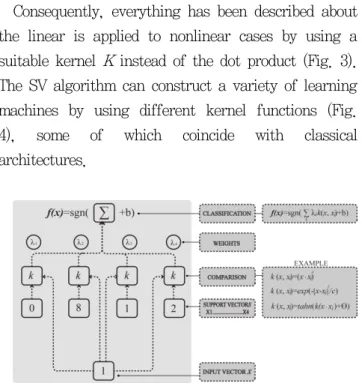
the linear is applied to nonlinear cases by using a suitable kernel K instead of the dot product (Fig. 3).
The SV algorithm can construct a variety of learning machines by using different kernel functions (Fig.
4), some of which coincide with classical architectures.
Figure 4. Architecture of SVM
Generally, three kinds of function have been used among other providing acceptable kernels. Respective kernel functions are described as follows:
· Polynominal kernel: K ( x
i· x
j)=( x
i· x
j+1)
n(11)
where the degree of the polynominal n is user-defended value.
· Radical basis function: K ( x
i· x
j)=exp(- γ ∥( x
i· x
j)∥
2) (12)
Where γ is user-defined value.
· Two-layer neural networks (Sigmodi):
K ( x
i· x
j)= than ( kx
i· x
j- δ )
n(13) where k and δ are user-defined value.
3. Datasets Construct
3.1 Determinants for selection of finishing materials Basically, the variables to use for selecting exterior materials were determined in two steps in this study. The variables candidates to influence the selecting material were initially made by reviewing
selected factors were verified and evaluated via interviewing seventeen experts who have been highly experienced practitioners in the construction field in South Korea. Consequently, eight factors for selecting an exterior material were determined. Table 1 shows an outcome of determinants for Selection of Materials. In terms of total cost is converted based on Building Cost Index (BCI) in 2005.
Table 1. Determinants of materials (input variables)
Factor Type of factor Remarks
Max. Min.
Location Nominal Seoul, Daejun, Busan
Site area(㎡) Numerical 151,134 2,912
No. of story(EA) Numerical 45 9
Structure system Nominal RC, SRC
Gross area(1,000㎡) Numerical 497,677 3,078
Duration(months) Numerical 75 12
Total cost(1,000won) Numerical 497,041,815 851,300 Material cost(won/㎡) Numerical 350,000 165,000
The outcomes of input variables were normalized for controlling the number of group size and applying SVM model. The outcome of input variables was re-coded in the range of “0” to “1” due to the fact that the range of gross area outcome is comprehensive in comparison with the story of building or the duration of construction [31]. In terms of text variable, such as structure system, sorted by the number of type in the same scope (e.g, RC:1, SRC:0).
3.2 Data construction
The 120 completed construction projects in urban
areas of South Korea were collected from
well-known companies. The boundary of dataset was
limited to exterior materials within apartment during
the period from 2000 to 2008. In order to carry out
SVM model, collected data is split into three sets in
Support Vector Machine Model to Select Exterior Materials
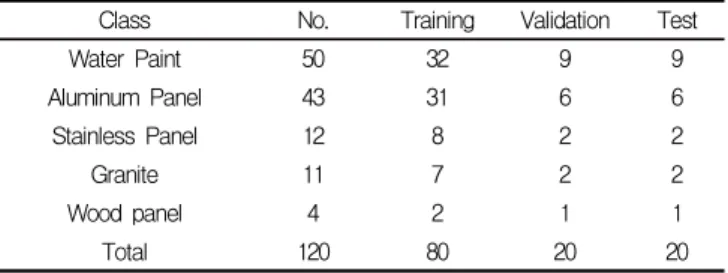
the ratio 66% (Training set), 17% (Validation set) and 17% (Test set) via random selection. “Training set” is consisted of water paint (32EA), aluminum panel (31EA), stainless panel (8EA), granite (7EA) and wood panel (2EA) according to the number of selected material in data. The results of selecting materials were classified into 5 classes: Water paint, Al panel, Stainless panel, Granite, Wood panel, which are representative used material on construction site, as shown in Table 2.
Table 2. Composition of dataset
Class No. Training Validation Test
Water Paint 50 32 9 9
Aluminum Panel 43 31 6 6
Stainless Panel 12 8 2 2
Granite 11 7 2 2
Wood panel 4 2 1 1
Total 120 80 20 20
3.3 SVM for selecting material
3.3.1 One-Against-All (OAA)
In this study, the SVM model was created by SVMdark [32] which is based on SVMlight version [33]. SVM model was applied to real data sets for selecting exterior material in “Test set”.
Originally, SVM was designed for binary classification (2 classes) but cannot naturally extend to more than two classes. However, given data (selected material in cases) was divided into 5 classes. To escape this problem, the SVM model needs to be extended for multiple classifications.
“One-Against-All (OAA)” and “Pairwise” have been used as conventional ways to extend the SVM model for multiple scenarios [24]. In both ways, the OAA classific ation method is the earliest and one of most widely used implementations [34]. For this reason, this study constructs the SVM model on the OAA method. The OAA principle is as follow:
In the SVM, suppose the i
thdecision function,
with the maximum margin, that classifies class i and the remaining classes be formulated
D
i( x )= w
itx + b
i(14) where w
iis the m -dimensional vector and b
iis a scalar.
The hyperplane D
i( x )=0 forms the optimal separating hyperplane and, if the training data are linearly separable, D
i( x )=1 and those belonging to the remaining classes satisfy D
i( x )=-1. For the conventional SVM, if for the input vector x
D
i( x ) > 0 (15)
3.3.2 Proposed classification model
In order to classify 5 classes, the SVM model could be extended according to the OAA classification method as mentioned above. This study has proposed four Binary Classifications (BC) to apply the SVM model. At the Class 1 BC, Class 1 and rest class (Class 2 to Class 5) were grouped, Class 1 belongs to the positive set (target value: +1) and four classes belong negative set (target value:
-1). Along the same way, the rest Classes were grouped in series. The proposed classification model was designed to preferentially select material which is often used in the given cases. Thus, each classification (Class 1 to Class 5) can group into water paint, aluminum panel, stainless panel, granite and wood panel in order.
4. Result
In order to structure SVM model, optimal kernel function and related hyper-parameters need to be determined respectively in the regression part of the SVMdark. 5 BC are tested in four kernel functions:
linear, polynominal, radical basis and sigmoid. The
result of preliminary tests showed that a polynominal
function was chosen as the optimal kernel function,
discrete BC. Then the hyper-parameters that contribute to the best performance in SVM model are determined. Table 3 shows the best kernel functions and hyper-parameters in respective BC by the regression process with 50 runs in SVMdark.
Table 3. Output of optimal parameters for respective binary classifiers
Model Kernel D S C
Water Paint-BC Polynominal 2 3 2
Aluminum panel-BC Polynominal 3 1 4
Stainless panel-BC Polynominal 2 1 2
Granite-BC Polynominal 5 1 5
Wood panel-BC Polynominal 4 1 3
■ Note. D: Number of degree; S: Sines; C: Cosines
Table 4. Comparison of result with actual dataset (Fold 1) Objective WP-
BC AP-
BC SP-
BC Gr-B
C WDP
-BC Result
Water
Paint 1.08 -1.14 -2.81 -0.85 -5.71 Water Paint Water
Paint 1.14 -1.12 -5.10 -0.98 -4.99 Water Paint Water
Paint 0.98 -1.11 -3.38 -1.09 -5.49 Water Paint Water
Paint 1.03 -0.18 -2.99 -1.41 -5.78 Water Paint Water
Paint 1.25 -1.09 -2.87 -1.68 -5.83 Water Paint Water
Paint 1.28 -1.18 -2.87 -1.78 -5.79 Water Paint Water
Paint 1.02 -1.00 -2.91 -0.84 -5.92 Water Paint Water
Paint 0.99 -0.97 -3.49 -1.00 -5.96 Water Paint Water
Paint 1.11 -0.88 -3.40 -0.83 -6.00 Water Paint Aluminum
Pnl -1.15 1.52 -0.98 -0.05 -5.30 Aluminum Pnl Aluminum
Pnl -1.02 0.96 -3.67 -0.62 -3.89 Aluminum Pnl Aluminum
Pnl -1.02 1.07 -2.91 -0.53 -3.92 Aluminum Pnl Aluminum
Pnl -1.17 1.21 -3.30 -0.82 -5.03 Aluminum Pnl Aluminum
Pnl -1.84 -2.99 -1.00 3.22 -5.05 Granite
Aluminum
Pnl -1.39 1.56 -1.22 -1.42 -5.14 Aluminum Pnl Stainless
Pnl -3.44 -1.32 0.37 -2.13 -4.00 Stainless Pnl Stainless
Pnl -4.14 -1.83 -0.87 -0.92 1.34 Wood Pnl Granite -5.97 -7.3 -2.42 0.07 -2.60 Granite Granite -5.99 -7.4 -2.34 -0.32 3.04 Wood Pnl Wood Pnl -9.12 -20.3
6 -2.36 -1.39 1.49 Wood Pnl
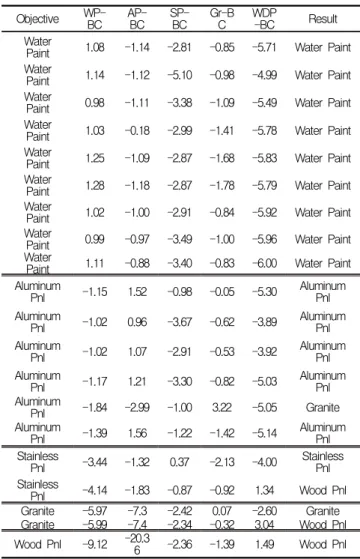
■ Note. Grey hatch : no matched result
Figure 5. Accuracy of respective binary classifiers (Fold 1)
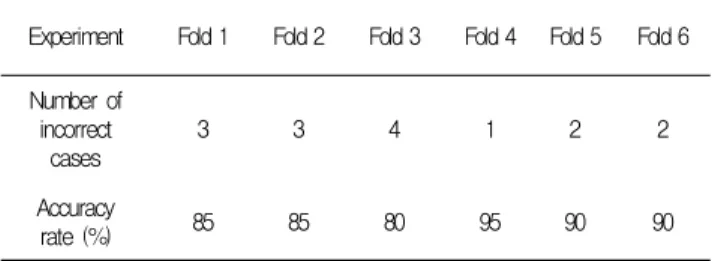
In classification part of SVMdark, determined kernel functions and hyper-parameters are used to select exterior material in dataset. For example, the results of fold 1 reported in Table 4. The accuracy was measured by the percentage of matching correctly classified in 5 BC. The overall accuracy of the SVM model was 85% in training data (fold 1). In terms of respective BC, the prediction performance of 5 classifications was slightly different. Water Paint (WP)-BC ranked first with 100% in total classifications. The lowest rank was occupied by Wood Panel (WDP)-BC, rest classifications (Aluminum Panel, Stainless Panel and Granite classification) were 95% as same position. The result showed that WP-BC superiorly performs compared to other BC in dataset, are given in Fig. 5.
Consequently, WP-BC and AP-BC, which relatively
have a great deal of cases, have shown the higher
accuracy than WDP-BC formed small case in the
given data. The number of case can influence on the
accuracy of respective BC in the decision making
process. Thus, it can be expected that the overall
accuracy percentage of BC will be improved with
increasing the number of input data in respective
class.
Support Vector Machine Model to Select Exterior Materials
![Figure 3. Mapping input data into the feature space [28]](https://thumb-ap.123doks.com/thumbv2/123dokinfo/5127675.579907/4.892.483.826.431.602/figure-mapping-input-data-feature-space.webp)