and textbooks [1,2]. CBE was developed to present teaching content using information and communication technologies.
It can range from simply presenting lecture slides to integrat- ing content into virtual learning experiences using comput- ers and other electronic devices. One of the merits of CBE is that it can be delivered at any time and from any location.
CBE can also reduce variability in educational outcomes by providing standardized education with no variability in edu- cational providers. On the contrary, one of the disadvantages of traditional teaching methods is that a student must attend a lecture at a particular time and place. Another disadvan- tage is that it does not allow self-paced learning.
Nursing educators have utilized non-traditional teaching methods, such as audio-visual devices or computer-based edu cation (CBE) for more than two decades. Owing to the development of personal computers in the 1980s, many nursing educators adopted CBE or the e-learning methods, and their use in nursing is growing exponentially [1,2].
Along with increasing demand for CBE in nursing educa- tion, many studies have been conducted to compare the effectiveness of CBE compared to traditional teaching meth- ods. Those studies can be categorized by the type of learner,
A Meta-Analysis on the Effectiveness of Computer- Based Education in Nursing
Kook Hee Roh, RN, PhD1, Hyeoun-Ae Park, RN, PhD2
1Previous Assistant Professor, Kunsan College of Nursing, Gunsan; 2College of Nursing/Research Institute of Nursing Science, Seoul National University, Seoul, Korea
Objectives: The purpose of this study was to conduct a comparative analysis of education effectiveness between computer- based education and traditional education methods in nursing. Methods: Medical and nursing literature databases were searched to identify studies regarding the effectiveness of computer-based education in nursing. Overall effect sizes for three outcome variables (knowledge, attitude, and practice level) were calculated. The effects of study characteristics on the out- come variables were analyzed. Results: Twenty-seven studies published from 1990 to February 2009, which that met the in- clusion criteria, were included in the analysis. The meta-analysis showed that computer-based education generally had posi- tive effects on knowledge, attitude, and practice, with overall effect sizes of 0.43, 0.35, and 0.34, respectively. This study also showed that the type of learner and the total education period had different effects on knowledge. Conclusions: This meta- analysis found that computer-based education in nursing had positive effects on knowledge, attitude, and practice.
Keywords: Meta-analysis, Computer-based, Education, Nursing
Healthc Inform Res. 2010 September;16(3):149-157.
doi: 10.4258/hir.2010.16.3.149 pISSN 2093-3681 • eISSN 2093-369X
Received for review: July 17, 2010 Accepted for publication: August 24, 2010 Corresponding Author
Hyeoun-Ae Park, RN, PhD
College of Nursing/Research Institute of Nursing Science, Seoul National University, 28 Yeongeon-dong, Jongno-gu, Seoul 110- 799, Korea. Tel: +82-2-740-8827 , Fax: +82-2-765-4103, E-mail:
This is an Open Access article distributed under the terms of the Creative Com- mons Attribution Non-Commercial License (http://creativecommons.org/licenses/by- nc/3.0/) which permits unrestricted non-commercial use, distribution, and reproduc- tion in any medium, provided the original work is properly cited.
ⓒ 2010 The Korean Society of Medical Informatics
I. Introduction
As the availability of computers and the accessibility of the internet have improved, computer-based educations (CBE) have gained new ground as legitimate instructional methods replacing traditional educational methods such as lectures
who may be a nursing student, nurse, patient, or other nurs- ing clients. Various course contents were delivered to nurs- ing students using CBE and its effectiveness was explored in many studies, such as in teaching clinical calculation [3], re- lieving student anxiety in psychiatric practicum [4], teaching intramuscular injection [5], and teaching maternity nursing practicum [6]. These studies concluded that CBE is an effec- tive teaching method for outcomes such as knowledge, skill, learning attitude, and self-efficacy. Several studies have been conducted to investigate the effectiveness of CBE in teaching clinical nurses. The study of Harrington and Walker [7] used it for fire safety education, Kim and Jang [8] for ventilator training, and Choi [9] for infection control skills. These stud- ies have also found that CBE is an effective teaching method to increase the level of knowledge and to produce a better job performance.
However, despite these research findings, it is difficult to conclude that the effectiveness of CBE differs significantly from or is even better than that of traditional teaching meth- ods, because most studies were conducted on a relatively small scale. To address this concern, a meta-analysis -- the statistical analysis of a collection of results from individual studies for the purpose of integrating findings -- was applied.
Meta-analysis has been widely used for evidence-based prac- tice, which combines the results of multiple experiments or quasi-experiments to obtain a composite estimate of the size of the effect.
Several meta-analyses on the effect of CBE in health sci- ences concluded that CBE has at least similar [10] or even better outcomes [11] when compared to traditional teaching methods. However, Cohen’s study is the only meta-analysis which explored the effect of CBE in nursing [11]. Cohen’s study concluded that CBE made a moderate contribution to the effectiveness of teaching, yet the results showed that ef- fect sizes were varied by the characteristics of the studies and called for more studies to be conducted on different educa- tional outcomes [11,12]. Also, considering the fact that the study was published more than 15 years ago, it is worthwhile to conduct another meta-analysis, as information technology advances very rapidly.
The purpose of this study was to investigate the effective- ness of CBE compared to that of traditional teaching meth- ods in nursing. This study focuses on three questions. First, how effective is CBE for three different outcomes of edu- cation such as knowledge, learning attitude, and practice performance? Second, is CBE especially effective for certain outcomes of education? Third, under which conditions does CBE appear to be most effective? It is intended that by ad- dressing these questions from a meta-analytic framework,
more precise conclusions concerning the effect of CBE can be reached.
CBE in this study is limited to the type of education in which a student learns by executing special learning pro- grams on a standalone computer or on the internet. Tradi- tional education (TE) is defined as education delivered using face-to-face lectures, textbooks, booklets, brochures, or ver- bal interactions.
II. Methods
This study used meta-analysis, which required locating studies, coding study features, and quantifying outcomes.
The methods were similar to those used in previous meta- analyses of instructional technologies in higher education by Kulik et al. [13].
1. Locating Studies
The first step in the meta-analysis was to collect a number of studies that compared the effects of CBE vs. TE. For this study, CBE was limited to computer-assisted education and computer-managed instruction using a standalone computer or an internet service. TE was defined as education delivered using face-to-face lectures, textbooks, booklets, brochures, or verbal interactions.
The initial search was performed among articles published during 1990-2009 in three international electronic literature databases such as OVID, PubMed, and Proquest, and three Korean electronic literature databases such as RISS by Ko- rea Education and Research Information Service, Research Information Center for Health (RiCH), and Korean Stud- ies Information Service System (KISS), using the keywords
‘computer’, ‘nursing education’, ‘computer education in nursing’, ‘knowledge’, ‘learning attitude’, and ‘practice per- formance’. Because we were interested in the effectiveness of computer-based education in nursing, we restricted our data search further with the following inclusion criteria. First, the article had to describe a study that was conducted with nurs- ing students, nurses, patients, or other nursing clients using a quasi-experimental or experimental design. Second, the study had to compare outcomes of education such as knowl- edge, learning attitude, and practice performance in two groups of education, CBE and TE. Third, a nurse had to be involved in the research as a primary author or a co-author.
Fourth, descriptive and inferential statistics had to be avail- able.
After examining citation information and the abstracts of searched articles, a total of 49 articles were identified and we then retrieved the full texts of these articles for further
screening. A total of 11 articles were excluded primarily be- cause they did not have a quasi- or true experimental design.
Seven articles were eliminated because they either used dif- ferent learning outcomes measures, or did not include nurses
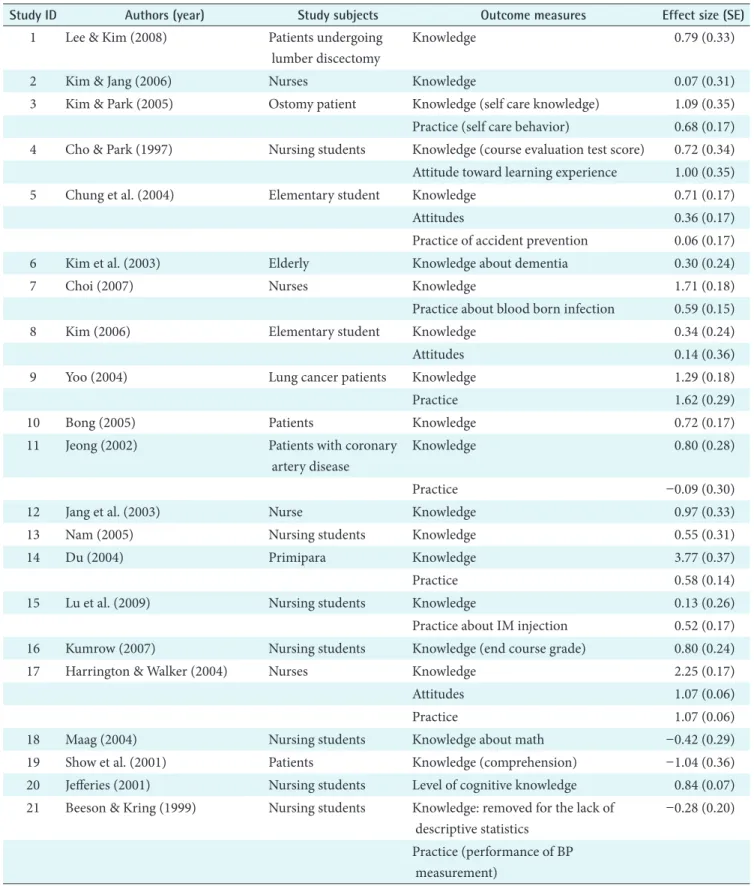
Table 1. A list of articles used in the meta-analysis
Study ID Authors (year) Study subjects Outcome measures Effect size (SE)
1 Lee & Kim (2008) Patients undergoing lumber discectomy
Knowledge 0.79 (0.33)
2 Kim & Jang (2006) Nurses Knowledge 0.07 (0.31)
3 Kim & Park (2005) Ostomy patient Knowledge (self care knowledge) 1.09 (0.35) Practice (self care behavior) 0.68 (0.17) 4 Cho & Park (1997) Nursing students Knowledge (course evaluation test score) 0.72 (0.34)
Attitude toward learning experience 1.00 (0.35)
5 Chung et al. (2004) Elementary student Knowledge 0.71 (0.17)
Attitudes 0.36 (0.17)
Practice of accident prevention 0.06 (0.17)
6 Kim et al. (2003) Elderly Knowledge about dementia 0.30 (0.24)
7 Choi (2007) Nurses Knowledge 1.71 (0.18)
Practice about blood born infection 0.59 (0.15)
8 Kim (2006) Elementary student Knowledge 0.34 (0.24)
Attitudes 0.14 (0.36)
9 Yoo (2004) Lung cancer patients Knowledge 1.29 (0.18)
Practice 1.62 (0.29)
10 Bong (2005) Patients Knowledge 0.72 (0.17)
11 Jeong (2002) Patients with coronary
artery disease
Knowledge 0.80 (0.28)
Practice -0.09 (0.30)
12 Jang et al. (2003) Nurse Knowledge 0.97 (0.33)
13 Nam (2005) Nursing students Knowledge 0.55 (0.31)
14 Du (2004) Primipara Knowledge 3.77 (0.37)
Practice 0.58 (0.14)
15 Lu et al. (2009) Nursing students Knowledge 0.13 (0.26)
Practice about IM injection 0.52 (0.17)
16 Kumrow (2007) Nursing students Knowledge (end course grade) 0.80 (0.24)
17 Harrington & Walker (2004) Nurses Knowledge 2.25 (0.17)
Attitudes 1.07 (0.06)
Practice 1.07 (0.06)
18 Maag (2004) Nursing students Knowledge about math -0.42 (0.29)
19 Show et al. (2001) Patients Knowledge (comprehension) -1.04 (0.36)
20 Jefferies (2001) Nursing students Level of cognitive knowledge 0.84 (0.07)
21 Beeson & Kring (1999) Nursing students Knowledge: removed for the lack of descriptive statistics
-0.28 (0.20)
Practice (performance of BP measurement)
as a primary author or a co-author. Four articles were then removed due to unavailability of descriptive and inferential statistics for meta-analysis. The remaining 27 articles were retained for final analysis. The 27 articles reported separate comparisons of CBE vs. TE. The 27 studies are listed in Table 1.
2. Description of Studies
The 27 studies located for this analysis had different learners and measured various outcomes. The next step in the meta- analysis was to describe the relevant study characteristics and outcomes of the studies identified.
1) Study characteristics
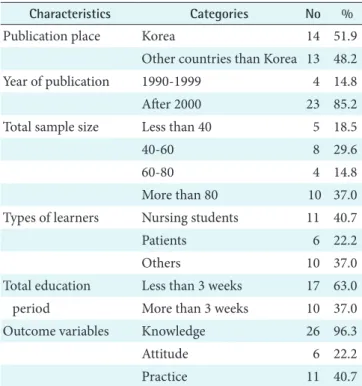
To characterize the studies more precisely, five variables were identified. They were coded following the coding schemes of several published studies [11,14,15]. The coded general char- acteristics of articles included publication features such as publication place and year; types of learners such as nursing students, patients, and learners other than nursing students or patients; and study features, such as sample size and edu- cation period. The coding categories of these variables and the number of comparisons in each category are listed in Table 2.
2) Study outcomes
The next step in the meta-analysis was to express the out-
comes of each comparison in quantitative terms. Outcomes used in the studies were knowledge, attitude, and practice performance.
Table 1. Continued
Study ID Authors (year) Study subjects Outcome measures Effect size (SE)
22 Rouse (2000) Nursing students Knowledge (test score about congenital heart disease)
-0.69 (0.29)
23 Leasure et al. (2000) Nursing students Knowledge (course grade in nursing research course)
0.27 (0.23)
24 Harrington & Walker (2002) Nurses Knowledge (written exam score) 0.41 (0.32) Attitudes (attitude exam score) 0.56 (0.31)
Practice 0.21 (0.31)
25 Wiksten et al. (1998) Other nursing clients Knowledge (cognitive learning) Attitudes
-1.44 (0.28) -0.69 (0.32)
Practice -0.51 (0.31)
26 Frith & Kee (2003) Nursing students Knowledge (cognitive learning) 0.11 (0.31)
27 Gilbert (1993) Nursing students Knowledge 0.13 (0.81)
Out of 26 articles on knowledge, 19 articles were analyzed after articles #7, #9, #14, #17, #18, #19, and #25 were removed based on the homogeneity test. Out of 6 articles on attitude, 4 articles were analyzed after articles #17 and #25 were removed based on the ho- mogeneity test. Out of 11 articles on achievement, 8 articles were analyzed after articles #9, #17, and #25 were removed based on the homogeneity test.
Table 2. Characteristics of 27 studies analyzed in this study
Characteristics Categories No %
Publication place Korea 14 51.9
Other countries than Korea 13 48.2
Year of publication 1990-1999 4 14.8
After 2000 23 85.2
Total sample size Less than 40 5 18.5
40-60 8 29.6
60-80 4 14.8
More than 80 10 37.0
Types of learners Nursing students 11 40.7
Patients 6 22.2
Others 10 37.0
Total education Less than 3 weeks 17 63.0
period More than 3 weeks 10 37.0
Outcome variables Knowledge 26 96.3
Attitude 6 22.2
Practice 11 40.7
3. Data Analysis
Cohen’s [16] measure of effect size d was calculated as the basic index of effect for three outcome variables. For studies which reported more than one outcome variable, we calcu- lated the effect size for each outcome variable. When a study included both a conventionally taught control group and a no-treatment control group, results from the comparison with the conventionally taught group were coded for analy- sis. This procedure controlled for the possibly confounding effects of differential time-on-task. For studies that reported the means and standard deviations for both experimental and control groups, we calculated d from the means and the pooled standard deviation. For the studies without any in- formation on means or standard deviations, we calculated d from statistics such as t and F, using procedures described by Song [17], and Lipsey and Wilson [18]. To make our study more similar to traditional reviews, we also examined the direction of the differences in outcomes of computer-based and traditional teaching: + for differences that favored com- puter-based instruction; and - for differences that favored traditional instruction.
Statistical analyses were performed with Comprehensive Meta-Analysis, ver. 2.0 [19]. All statistical tests were carried out using a two-tailed test with a significance level of .05.
Heterogeneity among studies was explored before combin- ing the effect sizes of all studies by applying the Q test as defined by Cochran [20]. A random or fixed effects model was used based on the heterogeneity test. Before combining all articles, each effect size was weighed to avoid the undue influence of studies with small sample sizes [21]. The 95%
confidence interval of standardized effect size, Cohen’s d, was provided. The binomial effect size display (BESD) (r), representing the difference in outcome measure between experimental and control groups, was computed. To identify the presence of potential publication bias, we computed the Fail-safe N suggested by Rosenthal and Rosnow [22]. Statis- tical analyses were carried out separately for each outcome variable. One study feature – the type of CBE – was dropped from the statistical analysis because of the lack of studies with computer-managed instruction (CMI).
III. Results
This section reports the results of two different analyses. The first analysis examined the overall size and significance of the effects of computer-based education on knowledge, at- titude, and practice performance. The second analysis was conducted to determine whether the reported effects of computer-based education on knowledge, attitude, and prac-
tice performance were different for different types of learners and the total education period.
1. General Characteristics of Studies
The general characteristics of 27 studies analyzed in this study are presented in Table 2. Fourteen studies (51.9%) were published in Korea, and 13 studies (48.2%) were published in countries other than Korea. Four studies (14.8%) were published in the 1990s, and 23 (85.2%) were published after 2000. Ten studies had a sample size greater than 80. Eleven studies had nursing students as learners, six studies had pa- tients as learners, and 10 studies had other types of learners.
Twenty-six studies used computer-assisted instruction (CAI) and only one study used CMI. Seventeen studies had a total education period of less than 3 weeks and 10 studies had more than 3 weeks.
The 27 studies located for this meta-analysis looked at three different outcomes: knowledge in 26 (96.3%) studies, at- titude in 6 (22.2%) studies, and practice performance in 11 (40.7%) studies. The effect size on knowledge, attitude, and practice performance for the 27 studies varied from study to study. Thus, before we combined the effect size of CBE on knowledge, attitude, and practice, the homogeneity of these outcome measures was tested. Based on the homogeneity test of the outcome measures, seven studies on knowledge, two studies on attitude, and three studies on practice perfor- mance were removed.
2. Overall Effects
1) Effect size for major outcome measures
In the first set of analyses, simple descriptive statistics were used to compare the results of computer-based education to those of traditional education. Results were compiled on three outcomes: (1) knowledge; (2) learning attitude; and (3) practice performance. Table 3 presents the weighted mean effect sizes, 95% confidence interval, BESD (r), homogeneity statistics Q (p), total effect size, and fail-safe number.
The weighted mean effect size on knowledge for the 19 studies was 0.42. This indicated a modest effectiveness of CBE on knowledge. Also the BESD (r) representing the difference in knowledge between experiment and control groups was .21. This indicates that knowledge in the CBE group had improved by 21% more than in the traditional instructor-led group.
The weighted mean effect size on attitude for the four stud- ies was 0.35. This indicated a small effectiveness of CBE on attitude. The BESD (r) was .17, indicating that attitude in the CBE group had improved by 17% more compared to the tra-
ditional instructor-led instruction group.
The weighted mean effect size on practice performance for the eight studies was 0.34, representing a small effectiveness of CBE on practice performance. The BESD (r) was .17, rep- resenting that practice performance in the CBE group has improved by 17% more compared to the traditional educa- tion group.
2) Effect size of major outcome measures by study character- istics
Although the effect of computer-based education was mod- erate in the typical study, the size of the effect varied from study to study. The effect size of computer-based education ranged from a high of 0.47 with knowledge [14] to a low of 0.23 with attitude [10].
It seemed possible that this variation in study outcomes might be systematic, and we therefore carried out further analyses to determine whether different types of learners and total education period were producing different results.
The effect sizes for knowledge, attitude, and practice perfor- mance by study characteristics are presented in Table 4.
The weighted mean effect size of CBE on knowledge for nine studies with nursing students was 0.30, four studies with patients 0.77, and six studies with other subjects 0.50.
The effect size of CBE on attitude for one study with nursing
students was 1.01, and the weighted mean effect size of CBE on attitude for three studies with other subjects was 0.29. The weighted mean effect size on practice for two studies with nursing students was 0.18, two studies with patients was 0.25, and four studies with other subjects was 0.42.
For knowledge outcome measures, studies with patients showed the largest effect size, followed by studies with other subjects and studies with nursing students. For attitude out- come measures, it is hard to compare because there was only one study on attitude with nursing students. However, a study with nursing students showed a much larger effect size compared to studies with other subjects. For practice out- come measures, studies with other subjects showed the larg- est effect size, followed by studies with patients and nursing students. However, it is hard to compare because there were only two studies on practice outcome measures with nursing students and patients.
The weighted mean effect size of CBE on knowledge for 11 studies with a total intervention period of below 3 weeks was 0.50, and for eight studies with a total intervention period of over 3 weeks was 0.32. The weighted mean effect size of CBE on attitude for three studies with a total intervention period of below 3 weeks was 0.49, and the effect size of CBE on at- titude for one study with a total intervention period of over 3 weeks was 0.14. The weighted mean effect size of CBE on Table 3. Effect size for major outcome measures
Outcomes No. d+(SE)a 95% CIb BESD (r)c Q (p)d Z (p)e Nfsf
Knowledge 19 0.42 (.06) 0.31 0.53 0.21 28.53 (.05) 7.56 (.00) 1,288
Attitude 4 0.35 (.11) 0.14 0.56 0.17 5.52 (.14) 3.33 (.00) 54
Practice 8 0.34 (.07) 0.20 0.47 0.17 22.71 (.01) 4.95 (.00) 142
ad+(SE): mean effect size weighted by the inverse of their random-effects variance (standard error), b95% CI: 95% confidence inter- val, cBESD (r): binomial effect size display, dQ (p): homogeneity statistics, eZ (p): total effect size, fNfs: fail-safe number.
Table 4. Effect size on major outcome measures by study characteristics
Contents Categories Knowledge Attitude Practice
d+a 95% CIb Q (p)c d+ 95% CI Q (p) d+ 95% CI Q (p) Types of learners Nursing students 0.30 0.15 0.45 12.63 (.13) 0.18 -0.07 0.43 9.59 (.01)
Patients 0.77 0.41 1.14 0.03 (.98) 0.25 -0.19 0.69 2.96 (.09) Others 0.50 0.28 0.64 6.64 (.25) 0.29 0.07 0.50 1.77 (.41) 0.42 0.25 0.58 7.62 (.06) Total education period Below 3 weeks 0.50 0.35 0.64 16.90 (.08) 0.49 0.23 0.76 2.73 (.26) 0.27 0.13 0.42 19.37 (.01)
Over 3 weeks 0.32 0.16 0.48 9.18 (.24) Effect size from only one article was removed.
ad+: mean effect size weighted by the inverse of their random-effects variance, b95% CI: 95% confidence interval, cQ (p): homogene- ity statistics.
practice performance for seven studies with a total interven- tion period of below 3 weeks was 0.27, and the effect size of CBE on practice performance for one study with a total in- tervention period of over 3 weeks was 0.59. Education below 3 weeks had a bigger effect on knowledge than education over 3 weeks. It was hard to compare the effect size of CBE on attitude and practice performance between education pe- riods of over 3 weeks and below 3 weeks, because there was only one study on attitude and practice with an education period of over 3 weeks.
IV. Discussion
As computer and telecommunication technology advances, the use of computer-based education is growing at a rapid rate. The general benefits of computer-based education are that it is usually self-paced and highly interactive. Web- based education, especially, is regarded as one of the greatest innovations in education compared to traditional instructor- led education, due to the fact that access is available anytime and anywhere around the globe [23]. Due to these benefits, computer-based education is regarded an assistive and alter- native educational method to traditional education. Nurse educators are facing many challenges in preparing them- selves to cope with these changes in educational methods.
This meta-analysis examined the results of 27 studies that compared computer-based education with traditional educa- tion in nursing. We compared the effect sizes of knowledge, attitudes, and practice performance from computer-based education and traditional instructor-led education. We also compared the effect sizes of knowledge, attitudes, and prac- tice performance by types of learners and total education period.
This meta-analysis showed that for the most part, comput- er-based education has made a small but significant positive contribution to knowledge, attitudes, and practice perfor- mance, with respective effect sizes of 0.42, 0.35, and 0.34.
These were similar to the findings of Cohen’s study [11] in which the overall achievement effect size was 0.45. The effect size of knowledge was a little higher than those of attitudes and practice performance in this meta-analysis. This could be due to the fact that changes in knowledge precede chang- es in attitudes, and changes in attitudes precede changes in practice performance [15,24-26]. Characteristics of CBE or the content provided could contribute to the higher effect size of knowledge than those of attitudes and practice per- formance.
The effect sizes of knowledge, attitudes, and practice per- formance in this study were smaller than those of studies
comparing an experimental group with computer-based education to a control group with no education [20,26].
These results are expected, since in this study, CBE was compared with traditional instructor-led education rather than with no education. According to BESD (r) statistics, the computer-based education group improved knowledge by 21% compared to the traditional education group. The com- puter-based education group improved attitude and practice performance by 17% each, compared to the traditional edu- cation group.
The second set of analyses reported on the relationship between study characteristics and study outcomes. First, we divided the studies in this meta-analysis into three groups based on the type of learner (patient, nursing student, and other subjects), and compared the effect size of outcome variables by the type of learner. However, we were able to compare only the effect size of knowledge by the type of learner, due to the limited number of studies on attitude and practice performance. The patient group showed the largest effect size of knowledge, followed by the other subjects group and nursing student group. This could be due to the fact that patients have a higher motivation, demand, and readiness for learning compared to nursing students and other subjects [27]. Further study is needed to compare the effectiveness of CBE on outcome variables by the different types of learners.
Secondly, the studies in this meta-analysis were divided into two groups based on total education period (a group with an instructional duration of less than 3 weeks and an- other group with an instructional duration of greater than 3 weeks), and we compared the effect sizes of outcome vari- ables by total instructional period. Again, we were not able to compare the effect sizes of attitude and practice performance by total instructional duration due to the limited number of studies. The average effect size of knowledge in the group with an instructional duration of less than 3 weeks (d = 0.50) appeared to be larger than the average effect size in the group with an instructional duration of longer than 3 weeks (d = 0.32). Kulik et al [14]. compared the average effect size of knowledge with three different instructional durations. In the Kulik et al.'s study, the average effect sizes by duration of instruction were 0.47 for the one semester or less category, 0.49 for the one semester - one year category, and 0.25 for the more than one year category. Since most of the studies included in our meta-analysis tend to have shorter instruc- tional durations compared to Kulik et al. [14], with only 3 studies with an instruction duration between 8 to 16 weeks, it is very difficult to compare the findings of this study with that of Kulik et al.’s study. Thus, further study is needed to investigate the effect of instruction duration as study results
with various instructional durations accumulate.
Of the 27 studies used in this meta-analysis, 26 reported results from CAI programs. Only one study reported results from CMI [28]. Thus, it is impossible to compare the effects of CAI with those of CMI. In this meta-analysis, only knowl- edge, attitude, and practice performance were included as outcome variables. We would like to recommend further meta-analysis with various physiological outcome variables such as plasma glucose levels, as Kim [29] did in her study [29], and various psychological variables such as depression and self esteem of Hill et al. [30] did in their study [30].
This meta-analysis study showed that CBE by nurses has greater positive effects than traditional instructor-led edu- cation, even though the effect size was small. This study showed that the effect of CBE on knowledge was a little higher compared to the effect of CBE on attitudes and prac- tice performance. This study also showed that the type of learner and the total education period had different effects on the level of knowledge. This meta-analysis has proven that CBE, which can be delivered at any time from any loca- tion, is indeed very effective and a legitimate instructional method to replace traditional educational methods such as lectures and textbooks, as the availability of computers and the accessibility of the internet have improved.
Conflict of Interest
No potential conflict of interest relevant to this article was reported.
References
1. Dickerson S, Reinhart AM, Feeley TH, Bidani R, Rich E, Garg VK, Hershey CO. Patient Internet use for health information at three urban primary care clinics. J Am Med Inform Assoc 2004; 11: 499-504.
2. Jeong SH, Kim JE, Kim TY, Park SY, Shin YJ, Lee SY.
Survey on the consumer preference for the internet health information of the patients’ online community members. J Korean Soc Med Inform 2007; 13: 207-220.
3. Gilbert DA, Kolacz NG. Effectiveness of computer as- sisted instruction and small-group review in teaching clinical calculation. Comput Nurs 1993; 11: 72-77.
4. Gega L, Norman IJ, Marks IM. Computer-aided vs.
tutor-delivered teaching of exposure therapy for phobia/
panic: randomized controlled trial with pre-registration nursing students. Int J Nurs Stud 2007; 44: 397-405.
5. Lu DF, Lin ZU, Li YJ. Effects of a web-based course on nursing skills and knowledge learning. J Nurs Educ
2009; 48: 70-77.
6. Cho IS, Park HA. Development effect analysis of web- based CIA program for nursing: application to materni- ty nursing. J Korean Soc Med Inform 1997; 3: 153-160.
7. Harrington SS, Walker BL. The effects of computer- based training on immediate and residual learning of nursing facility staff. J Contin Educ Nurs 2004; 35: 154- 163.
8. Kim NY, Jang KS. Effects of web-based program for evidence-based nursing education on knowledge and learning motivation in nurses. J Korean Soc Med Inform 2006; 12: 9-19.
9. Choi JS. Web, blood-borne infection control, perceived threat of disease, knowledge, behavior, needle stick and sharps injury [dissertation]. Seoul: Seoul National Uni- versity; 2007.
10. Portnoy DB, Scott-Sheldon LA, Johnson BT, Carey MP.
Computer-delivered interventions for health promotion and behavioral risk reduction: a meta-analysis of 75 ran- domized controlled trials, 1988–2007. Prev Med 2008;
47: 3-16.
11. Cohen PA, Dacanay LS. A meta-analysis of computer- based instruction in nursing education. Comput Nurs 1994;12: 89-97.
12. Cohen PA, Dacanay LS. Computer-based instruction and health professions education: a meta-analysis of outcomes. Eval Health Prof 1992; 15: 259-281.
13. Kulik JA, Cohen PA, Ebeling BJ. Effectiveness of pro- grammed instruction in higher education: a meta-ana- ly sis of findings. Educ Eval Policy Anal 1980; 2: 51-64.
14. Kulik JA, Kulika CC, Bangert-Drownsa RL. Effective- ness of computer-based education in elementary schools.
Com put Human Behav 1985; 1: 59-74.
15. Park EO. A meta-analysis of the effects of smoking pre- vention programs in Korea. J Korean Acad Nurs 2004;
34: 1004-1013.
16. Cohen J. Statistical power analysis for the behavioral sciences. Hillsdale, NJ: Lawrenece Erlbaum Associates Inc.; 1988. p531-552.
17. Song HH. Meta-analysis of the study. Seoul: Chun- gmoongak; 2002. p89-160.
18. Lipsey MW, Wilson DB. Practical meta-analysis. Thou- sand Oaks (CA): Sage; 2001. p169-240.
19. Borenstein M, Hedges L, Higgins J, Rothstein H. Com- prehensive meta analysis. ver. 2. Englewood, NJ: Biostat;
2005.
20. Cochran WG. The combination of estimates from dif- ferent experiments. Biometrics 1954; 10: 101-129.
21. Hedges LV, Olkins I. Stastistical methods for meta-ana-
lysis. New York: Academy press; 1985.
22. Rosenthal R, Rosnow RL. Essentials of behavioral re- search: methods and data analysis. New York: McGraw Hill; 1991.
23. Fonteyn M. Print and online versions of evidence-based nursing: innovative teaching tools for nurse educators.
Evid Based Nurs 2002; 5: 6-7.
24. Kim Y, Park I, Park JS. Meta-analysis of effects on ado- lescent smoking cessation programs in Korea. J Korean Acad Nurs 2008; 38: 204-216.
25. Bangert-Drowns RL. The effect of school based sub- stance abuse education - a meta analysis. J Drug Educ 1988; 18: 243-264.
26. Kulik JA, Bangert RL, Williams GW. Effects of comput-
er-based teaching on secondary school students. J Educ Psychol 1983; 75: 19-26.
27. Suh MJ, Park YI, Yoo JS, Kim IJ. Health promotion and health education. Seoul: Soomoonsa; 2000. p80-163.
28. Frith KH, Kee CC. The effect of commucation on nurs- ing student outcomes in web-based course. J Nurs Educ 2003; 42: 350-358.
29. Kim HS. Effects of web-based diabetic education in obese diabetic patients. J Korean Acad Nurs 2005; 35:
924-930.
30. Hill W, Weinert C, Cudney S. Influence of a computer intervention on the psychological status of chronically ill rural women: preliminary results. Nurs Res 2006; 55:
34-42.