Patients’ knowledge and awareness of dental implants in a Turkish subpopulation
Ceyda Özçakır Tomruk1, Zeynep Özkurt-Kayahan2*, Kemal Şençift1
1Department of Oral Surgery and Medicine, Faculty of Dentistry, University of Yeditepe, Istanbul, Turkey
2Department of Prosthodontics, Faculty of Dentistry, University of Yeditepe, Istanbul, Turkey
PURPOSE. The purpose of this study was to evaluate the patients’ knowledge on dental implants in a Turkish subpopulation. MATERIALS AND METHODS. Five hundred twenty seven Turkish adults referred to Yeditepe University Faculty of Dentistry, Istanbul, Turkey, were presented with a questionnaire including 20 questions regarding the level of information and awareness about the dental implants. The data were collected and statistical analyses were performed with Chi square test to compare the descriptive data. RESULTS. Among 527 subjects, 54% were female and 46% were male with a mean age of 42.2 years. The rate of patients’ implant awareness was 27.7%. When the patients were questioned about the treatment options for rehabilitation of tooth missing, 60.9% of patients were informed about fixed partial denture, followed by conventional complete denture (32.5%) and removable partial denture (24.9%). Six percent reported that they were very well informed about the dental implants whereas 48.2% were poorly informed. The information sources of the implants were from the dentist (44.5%), printed media (31.6%) and friends and acquaintances (17.3%), respectively. Sixteen percent of the population believed that their implants would last forever. CONCLUSION. The dentists should give more detailed information to the patients about dental implants and tooth-supported fixed partial dentures in the future. [J Adv Prosthodont 2014;6:133-7]
KEY WORDS: Dental implants; Public awareness; Information sources
INTRODUCTION
Replacement of missing teeth using implant-supported prostheses for esthetic and functional rehabilitation has become an accepted and widely used treatment approach in dentistry.1-5 The perspectives of the public about dental implants are less known. Several studies have been conduct- ed to show the patients’ awareness about oral implants in different countries.6-13 A survey by Zimmer et al.7 demon- strated a high awareness rate as well as general positive atti- tude toward oral implant therapy.A study by Salonen9 from
Finland has shown that the level of awareness of implant treatment among selected groups was 29%, and Best10 from Australia has shown that the awareness rate was 64%. Other surveys from Saudi Arabia and Austria reported that the patients’ awareness rates were 64.4% and 79% respectively.1,12
With the improvement in dental technology, there are variety options to treat patients with different indications.
Due to this improvement, patient demands also increase, however most are often inappropriate. With patients’
increasing demand for implant supported superstructures, dentists dealing with implantology are faced with patients’
high expectations concerning optimal esthetic and function.
Moreover, media reports such as ‘implant forever’ or
‘implants last lifelong’ cause higher, unrealistic patients’
expectations.
To the best of authors’ knowledge there are no existing dental literature regarding the patients’ awareness, expecta- tions and level of knowledge about dental implants in Turkey. Therefore, the aim of this study was to evaluate the dental patients’ awareness, expectations and level of knowl- edge of dental implants as a treatment option for replace- ment of missing teeth among a selected sample of dental patients in Istanbul, Turkey.
Corresponding author:
Zeynep Özkurt-Kayahan
Yeditepe University, Faculty of Dentistry, Bağdat cad. No:238 Goztepe, 34728, Istanbul, Turkey
Tel. 00902163636044-6412: e-mail, [email protected] Received May 30, 2013 / Last Revision July 16, 2013 / Accepted January 17, 2014
© 2014 The Korean Academy of Prosthodontics
This is an Open Access article distributed under the terms of the Creative Commons Attribution Non-Commercial License (http://creativecommons.
org/licenses/by-nc/3.0) which permits unrestricted non-commercial use, distribution, and reproduction in any medium, provided the original work is properly cited.
MATERIALS AND METHODS
The ethics committee of the Yeditepe University approved the study protocol (protocol number BASH.P.06-F.05, 107).
A standardized questionnaire with 20 questions was devel- oped to assess the dental patients’ awareness, expectations and level of knowledge of dental implants. Questionnaire also includes demographic data such as age, sex, monthly income and education level. The questionnaire was adapted from a previous study conducted by Pommer et al.12 A con- sent was taken from the authors with the e-mail for using their questionnaire in this study. A pilot test was conducted to examine the efficiency of the questionnaire on 20 patients. The survey was conducted between February 1 and April 11, 2011 on the patients at the student clinic of Yeditepe University, Faculty of Dentistry. The question- naires were handed to the patients and their relatives during their regular dental visits by students. Patients who have refused to answer the questions were excluded from the study. The definition of dental implants as ‘an artificial tooth that is anchored in jaw bone to replace a missing tooth’ was given to patients who had not heard of dental implants as a treatment option. The data were analyzed by using Number Cruncher Statistical System (NCSS) 2007 (LLC, UT, USA) and Power Analyses and Sample Size Statistical Software (PASS) 2008 (LLC, UT, USA). Chi square test was performed to compare the descriptive data such as frequencies and qualitative data. P values smaller than .05 were considered significant.
RESULTS
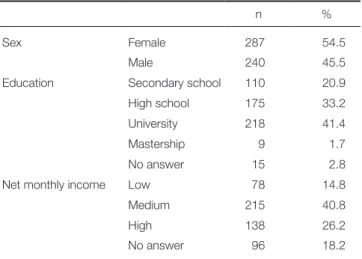
Five hundred twenty seven patients were questioned during the study period. Table 1 summarizes the demographic data of the interviewed people. Among 527 subjects, 54% were female and 46% were male with the mean age of 42.2 years.
Three groups were generated according to monthly average family income: monthly income below 400 Euros, up to
600 Euros and more than 600 Euros.
Out of 31.3% of the interviewed people had prosthesis and only 6.3% had implant therapy. When asked whether they would be satisfied with removable partial dentures, 13.7% answered ‘yes’ and 75.5% answered ‘no’ (Table 2).
Satisfaction with a removable partial denture was higher in the low income categories and in the low level of education (P<.05). There was no statistical difference between males and females regarding acceptance of removable partial den- tures (P>.05). The patients’ implant awareness rate was 43.5% whereas 34.9% was aware about removable partial dentures, 48.4% was aware about conventional complete dentures and 34.9% was aware about fixed partial dentures (Table 3).
To assess the information level of dental implants, 5.7%
reported that they were very well informed subjectively about dental implants whereas 48.2% were poorly informed (Table 3).
Regarding the advantages of the non-removable vs.
removable denture, 45.2% reported ‘less annoying in the mouth’, 33.6% defined ‘more esthetic’, 48.6% reported ‘feel like natural teeth’ and 32.6% ‘did not feel like foreign bod- ies’. When the disadvantages of the non-removable vs.
removable dentures were compared, 60.3% of the study sample stated that high costs were the major complaint, fol- lowed by the need for surgery (34.7%) and and prolonged treatment time (32.1%) (Table 4).
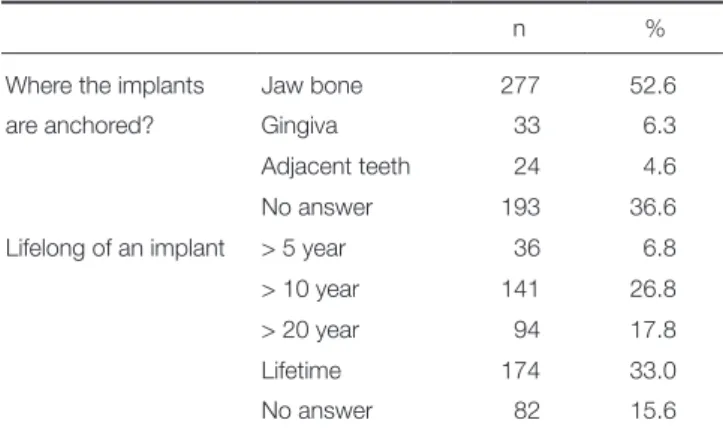
To assess the level of general information of dental implants, the interviewees were asked how long they expect the implant would last. 33% of the interviewees cited ‘life- long’, 6.8% reported ‘up to 5 years’, 26.8% reported ‘up to 10 years’ and 17.8% reported ‘up to 20 years’. There was a significant correlation between education level and lifespan of an implant (Table 5).
When the patients were asked where the implants were anchored, 52.6% said ‘the jaw bone’, 6.3% reported ‘the gums’, 4.6% thought ‘the adjacent teeth’ and 36.6% did not know. As the education level increases, the answer ‘jaw
Table 1. Demographic profile of the interviewed population
n %
Sex Female 287 54.5
Male 240 45.5
Education Secondary school 110 20.9
High school 175 33.2
University 218 41.4
Mastership 9 1.7
No answer 15 2.8
Net monthly income Low 78 14.8
Medium 215 40.8
High 138 26.2
No answer 96 18.2
Table 2. Questions on dental situations
n %
Had implant therapy before? Yes 33 6.3
No 472 89.6
No answer 22 4.2
Carrying dental prostheses Yes 165 31.3
No 354 67.2
No answer 8 1.5
Would you be content with Yes 72 13.7
a removable denture? No 398 75.5
No answer 57 10.8
bone’ increases. Fifty percent of the patients blamed the dentist in case of implant loss, while only 16.5 % blamed the patient (Table 5).
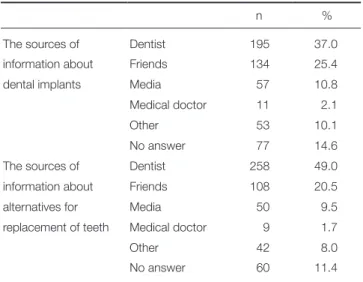
The information sources of the implants were from the dentist (37%), printed media (10.8%) and friends and acquaintances (25.4%), respectively (Table 6).
Table 3. Questions on alternatives for replacing teeth
n %
Alternatives for replacing teeth Implant-supported reconstructions 229 43.5
Removable partial dentures 184 34.9
Removable complete dentures 255 48.4
Fixed partial dentures 184 34.9
How well informed do you feel subjectively about implants? Very well 30 5.7
Well 92 17.5
Moderately well 135 25.6
Poorly 254 48.2
No answer 16 3.0
How well informed do you feel subjectively about alternatives Very well 33 6.3
for replacing teeth? Well 112 21.3
Moderately well 187 35.5
Poorly 182 34.5
No answer 13 2.5
Table 4. Questions on advantages and disadvantages of different dentures
n %
What are the advantages of non-removable vs. removable Less annoying in the mouth 238 45.2
dentures? Esthetics (look nicer) 177 33.6
Are as good as one’s own teeth in function 256 48.6
Like a foreign body 172 32.6
What do you think are the disadvantages of implant-supported High costs 318 60.3
dentures/bridges? Need of surgery 183 34.7
Long treatment time 169 32.1
Table 5. Questions on anchorage and lifelong of implants
n %
Where the implants Jaw bone 277 52.6
are anchored? Gingiva 33 6.3
Adjacent teeth 24 4.6
No answer 193 36.6
Lifelong of an implant > 5 year 36 6.8
> 10 year 141 26.8
> 20 year 94 17.8
Lifetime 174 33.0
No answer 82 15.6
68.3% of the interviewees wished to get more informa- tion about dental implants and of those 76.9% wished it to get from the dentist, 4.6% from friends and acquaintances, and 1.6% from printed media (Table 7). The interviewees with higher educational level preferred the friends as infor- mation source with a significant difference compared to lower educational level (P<.05), while there was no signifi- cant difference between males and females and between income level (P>.05).
Women considered that implants need more special care than natural teeth, whereas men thought implants need less care than natural teeth (P<.05). The higher the education level, the higher it was to be aware of the necessity of the implant care. There was no significant difference between income levels (P<.05).
More than half of the interviewees did not answer whether their regular dentists treating patients with implants, state-of the-art techniques. Almost half of the patients wished their dentist to practice implant dentistry whereas 40% would not.
may be due to sample differences, because the present study mainly includes low socio-economic population (patients attend to student clinic who take the health care with lower cost). In addition, oral implant technology has been recently developed in Turkey however in other coun- tries this technology started earlier.
Significantly less interviewee would be satisfied with a removable denture (75.5% vs. 13.7%). Compared with the results of Pommers’ study,12 acceptance of removable den- tures was statistically lower in the present study group, and there was no significant difference between males and females regarding acceptance of removable dentures. Fifty five percent of those questioned reported that non-remov- able dentures were less disturbing in the mouth, 33%
defined more esthetic, 48.6% feel like natural teeth and 32.6% did not feel like foreign bodies. American patients tought that implant retained restorations were more esthet- ic than removable partial dentures. Similarly, Turkish patients considered that implant-supported fixed partial dentures were like natural teeth. High costs (60.3%), need for surgery (34.7%) and long treatment period (32.1%) were the main disadvantages of the implant treatment according to patients. These results were consistent with the other American and Japanese studies which reported the similar results.7,14 In a Belgian study, the prolonged healing period between implant insertion and restorative procedures was the major concern for not choosing implant therapy.15
In the present survey, expectations of Turkish patients were high for an implant retained restorations in terms of permanence and functionality. Thirty three percent of the interviewees believed that their implants would last for a lifetime. Turkish patients’ expectations were higher than Japanese (28%), German (7%) and Austrian population (24%).12,14,16 Influence of the media such as TV programs may increase the demands and expectations in the near future. Therefore, patients should be informed properly about the implant therapy. Unrealistic estimates and expect- ed implant survival time should be cleared up properly before the treatment to prevent misunderstandings and misinformation.
Dentists were found to be the major information source (37%) followed by friends and printed media. The present distribution of information sources resembles those report- ed by Pommer et al.12 However, Berge10 reported news media, and Al-Johany17 reported friends and their relatives as the main source of information. About 68% of the interviewed population wished to have more information about dental implants and the 77% of them preferred to get this information from their dentist in this study.
Therefore, dental education must include adequate implan- tology courses to provide sufficient and realistic implant information. Postgraduate education or further implant courses should be also taken to give proper implant therapy.
Economic parameters are also decisive factors in the preference of a particular type of treatment. Of those questioned, 60% told that high costs are the main reason not to choose implant therapy. Similarly, in the other stud- Table 6. Questions on the sources of information about
alternatives for replacement of teeth
n %
The sources of Dentist 195 37.0
information about Friends 134 25.4
dental implants Media 57 10.8
Medical doctor 11 2.1
Other 53 10.1
No answer 77 14.6
The sources of Dentist 258 49.0
information about Friends 108 20.5
alternatives for Media 50 9.5
replacement of teeth Medical doctor 9 1.7
Other 42 8.0
No answer 60 11.4
Table 7. Questions on expectations about the source of information
n %
From where would you Dentist 405 76.9
like to get information Friends 24 4.6
about implants? Media 9 1.6
Medical Doctor 21 4.0
Other 24 4.6
No answer 44 8.3
DISCUSSION
This is the first survey study regarding the patients’ aware- ness, expectations and level of knowledge about dental implants in Istanbul, Turkey. This group was selected because of easy access and to increase the response rate as they are regular dental patients at the student clinic.
Implant treatment is an increasingly popular treatment option with a high success rate. Recently, it is becoming the focus of the patients’ interest, especially with the help of media health programs. In the present study, among the dif- ferent options to rehabilitate tooth missing, 43.5% knew about dental implants as a treatment option. Significant dif- ferences were observed between high income and low income level group, and between high education and low education level. This would suggest that low income earn- ers and low education level group should be informed about dental implants in the future to gain them awareness.
The results of the present study were significantly different from the results reported by Zimmer et al.7, Berge10 and Tepper et al.11 which reported high level of awareness as 77%, 70.1% and 72%, respectively. The differences between these countries (America, Norway and Austria) and Turkey
ies the strongest argument against implant therapy was the high costs.7,11,13,14 It is important to underline the patients that quality of life outweighs high cost of implants. The advantages and disadvantages of different types of treat- ment modalities should be properly explained so they can make an informed decision.
As dental implant-retained restorations become more popular, the prevalence of implant complications will also increase. The maintenance of healthy tissue around the dental implants is one of the key factors to obtain long term success. Dental hygiene and care including soft tooth brushes, interproximal brushes, specially designed cleaning instruments made in hard plastics and mouth rinses help to prevent peri-implant disease. Pommer et al.12 reported that 39% of the population thought that implants require more care and half of them would clean their implants similar to natural teeth. In the current study, almost half of the patients, especially women, considered that implants need more care than natural teeth. Almost 34% of them would clean their teeth similar to natural dentition. These findings were in consistent with the results of Al-Johany.17 Dentists should explain their patients the importance of dental hygiene and care before implant therapy, educate and moti- vate them to provide sufficient dental care for the mainte- nance of implants.
CONCLUSION
The present study showed that a subpopulation in Istanbul have limited awareness about dental implants. Many patients do not have the education or background knowl- edge to make an informed decision between implant sup- ported dentures and removable dentures. Future and cur- rent dentists should be sufficiently educated about implan- tology, at least to provide proper implant information.
Regardless of whether dentists are dealing with implants or not, it is crucial to know whether today’s patients are aware of dental implants as a treatment option and whether the information that they have is realistic. Awareness amongst patients regarding the dental implants can help in eliminat- ing any negative image of the procedure that may have been caused due to lack of adequate information. As this survey was conducted in a limited group of people, further studies are needed to be conducted amongst a larger group of people.
REFERENCES
1. Adell R, Lekholm U, Rockler B, Brånemark PI. A 15-year study of osseointegrated implants in the treatment of the edentulous jaw. Int J Oral Surg 1981;10:387-416.
2. Zarb GA, Schmitt A. The longitudinal clinical effectiveness of osseointegrated dental implants: the Toronto study. Part I:
Surgical results. J Prosthet Dent 1990;63:451-7.
3. Ekelund JA, Lindquist LW, Carlsson GE, Jemt T. Implant treatment in the edentulous mandible: a prospective study on Brånemark system implants over more than 20 years. Int J
Prosthodont 2003;16:602-8.
4. Mericske-Stern R, Grütter L, Rösch R, Mericske E. Clinical evaluation and prosthetic complications of single tooth re- placements by non-submerged implants. Clin Oral Implants Res 2001;12:309-18.
5. Özkurt Z, Kazazoğlu E. Treatment modalities for single missing teeth in a Turkish subpopulation: an implant, fixed partial denture, or no restoration. J Dent Sci 2010;5:183-8.
6. Palmqvist S, Soderfeldt B, Arnbjerg D. Subjective need for implant dentistry in a Swedish population aged 45-69 years.
Clin Oral Implants Res 1991;2:99-102.
7. Zimmer CM, Zimmer WM, Williams J, Liesener J. Public awareness and acceptance of dental implants. Int J Oral Maxillofac Implants 1992;7:228-32.
8. Best HA. Awareness and needs of dental implants by pa- tients in New South Wales. Aust Prosthodont J 1993;7:9-12.
9. Salonen MA. Assessment of states of dentures and interest in implant-retained prosthetic treatment in 55-year-old eden- tulous Finns. Community Dent Oral Epidemiol 1994;22:130- 5.
10. Berge TI. Public awareness, information sources and evalua- tion of oral implant treatment in Norway. Clin Oral Implants Res 2000;11:401-8.
11. Tepper G, Haas R, Mailath G, Teller C, Zechner W, Watzak G, Watzek G. Representative marketing-oriented study on implants in the Austrian population. I. Level of information, sources of information and need for patient information.
Clin Oral Implants Res 2003;14:621-33.
12. Pommer B, Zechner W, Watzak G, Ulm C, Watzek G, Tepper G. Progress and trends in patients' mindset on dental im- plants. I: level of information, sources of information and need for patient information. Clin Oral Implants Res 2011;
22:223-9.
13. Chowdhary R, Mankani N, Chandraker NK. Awareness of dental implants as a treatment choice in urban Indian popula- tions. Int J Oral Maxillofac Implants 2010;25:305-8.
14. Akagawa Y, Okane H, Kondo N, Tsuga K, Tsuru H.
Comparative evaluation of chewing function with removable partial dentures and fixed prostheses supported by the single- crystal sapphire implant in the Kennedy Class II partially edentulous mandible. Int J Oral Maxillofac Implants 1989;4:
205-10.
15. Vermylen K, Collaert B, Lindén U, Björn AL, De Bruyn H.
Patient satisfaction and quality of single-tooth restorations.
Clin Oral Implants Res 2003;14:119-24.
16. Rustemeyer J, Bremerich A. Patients' knowledge and expecta- tions regarding dental implants: assessment by questionnaire.
Int J Oral Maxillofac Surg 2007;36:814-7.
17. Al-Johany S, Al Zoman HA, Al Juhaini M, Al Refeai M.
Dental patients' awareness and knowledge in using dental im- plants as an option in replacing missing teeth: A survey in Riyadh, Saudi Arabia. Saudi Dent J 2010;22:183-8.