Endovascular Treatment for Acute Ischemic Stroke Patients over 80 Years of Age
Kihwan Hwang1, Gyojun Hwang1, O-Ki Kwon1, Chang Hyeun Kim1, Seung Pil Ban1, Moon-Ku Han2, Hee-Joon Bae2, Beom Joon Kim2, Jae Seung Bang1, Chang Wan Oh1, Boram Lee1, Eun-A Jeong1
Departments of 1Neurosurgery and 2Neurology, Regional Caridocerebrovascular Center, Seoul National University Bundang Hospital, Seongnam, Korea
Objective : We evaluated the effect of endovascular treatment (EVT) for acute ischemic stroke in patients over 80 years of age.
Materials and Methods : The records of 156 acute stroke patients aged over 80 years who were considered as candidates for EVT were analyzed. Fifty-six patients (35.9%, EVT group) underwent EVT and 100 patients (64.1%, non-EVT group) did not. Outcomes, in terms of func- tional outcomes and rates of symptomatic hemorrhage, in-hospital morbid- ity and mortality, were compared between groups. Each comparison was adjusted for age, time from onset, initial National Institute of Health Stroke Scale, and pre-stroke modified Rankin Scale (mRS).
Results : More patients in the EVT group achieved good outcomes (mRS score of 0-2) at 3 months (35.7% vs. 11.0%, adjusted odds ratio [OR] 4.779 [95% confidence interval 1.972-11.579], p = 0.001) and 12 months (35.7%
vs. 14.0%, adjusted OR 3.705 [1.574-8.722], p = 0.003) after stroke. During admission, rates of hospital-acquired infection including pneumonia (12.5%
vs. 29.0%, adjusted OR 0.262 [0.098-0.703], p = 0.008) and urinary tract infection (16.0% vs. 34.0%, adjusted OR 0.256 [0.099-0.657], p = 0.005) were significantly lower in the EVT group. More symptomatic hemorrhages (10.7% vs. 2.0%, adjusted OR 6.859 [1.139-41.317], p = 0.036) occurred in the EVT group, but no significant difference was observed in in-hospital mortality rate (12.5% vs. 8.0%, adjusted OR 1.380 [0.408-4.664], p = 0.604).
Conclusion : EVT improved functional outcome and reduced the risk of hospital-acquired infections in acute stroke patients over 80 years of age without increasing the risk of in-hospital mortality, although symptomatic hemorrhage occurred more frequently after EVT.
J Cerebrovasc Endovasc Neurosurg.
2015 September;17(3):173-179 Received : 15 May 2015
Revised : 20 July 2015 Accepted : 13 August 2015 Correspondence to Gyojun Hwang Department of Neurosurgery, Regional Car -diocerebrovascular Center, Seoul National University Bundang Hospital, 82 Gumi-ro 173beon-gil, Bungdang-gu, Seongnam 13620, Korea
Tel : 82-31-787-7171 Fax : 82-31-787-4059 E-mail : [email protected]
ORCID : http://orcid.org/0000-0002-7405-0487
This is an Open Access article distributed under the terms of the Creative Commons Attribution Non- Commercial License (http://creativecommons.org/li- censes/by-nc/3.0) which permits unrestricted non- commercial use, distribution, and reproduction in any medium, provided the original work is properly cited.
Keywords Stroke, Aged, Thrombolytic therapy
INTRODUCTION
Age is an important risk factor for stroke occurrence.
Approximately 30% of acute strokes occur in those older than 80 years of age.6)9)24) However, elderly pa- tients tend to have high rates of poor outcomes and
in-hospital mortality.1)4)8)13)14)16)17)23)25)26)30) Furthermore, family members of elderly patients are often reluctant to accept aggressive treatment. Recently, prospective trials have shown the benefit of endovascular treatment (EVT) for acute ischemic stroke.5)12)20)22)32) However, some trials included only patients aged 80 or less,20)32)
and although trial inclusion criteria had no age limi- tation, a small proportion of elderly patients over 80 years were included.5)12)22) Therefore, the evidence supporting that endovascular treatment can be ac- tively recommended for elderly patients as for young- er patients is not sufficient.
To determine whether EVT for acute ischemic stroke is also beneficial in acute ischemic stroke patients over 80 years of age who are candidates for EVT, out- comes were compared between patients who under- went EVT and those who did not, in terms of func- tional outcomes and rates of symptomatic hemorrhage, in-hospital morbidities, and mortality.
MATERIALS AND METHODS
Patient Selection
This retrospective study was approved by our Institutional Review Board. From a stroke registry (January 2009-March 2014) at our institution, data was collected on patients matching the EVT criteria for acute ischemic stroke of our institution: (1) time from onset < 8 hours, (2) major artery occlusion (internal carotid artery, middle cerebral artery [M1 and M2], basilar artery, or vertebral artery), (3) diffusion-perfusion mismatch on MRI (> 120% difference between dif- fusion weighted imaging and time to peak map), (4) an initial National Institute of Health Stroke Scale [NIHSS] score of ≥ 5, and (5) within time from onset of 4.5 hours, no clinical response to intravenous tPA, as described in previous studies.21)28) Patients who had intracranial hemorrhage, large infarctions (infarction size on diffusion MRI ≥ 1/3 on middle cerebral artery territory), bleeding diathesis, or serious illnesses affecting life expectancy including malignancy were excluded.
For 478 patients matching the EVT criteria retrieved from the registry, additional criteria were applied: age
> 80 years and a prestroke modified Rankin Scale (mRS) score of ≤ 2. A total of 156 patients were se- lected as study subjects. To ensure agreement with the above mentioned criteria, the clinical and radio- logic data of the patients were re-reviewed by two in-
vestigators (K.H. and C.H.K.). The stroke MRI proto- col and the method of measuring diffusion-perfusion mismatch used have been previously described.18) Patient management
At our institution, intravenous (IV) administration of tissue plasminogen activator (tPA) is considered, re- gardless of patient age, when indicated. Accordingly, of the 156 study subjects, tPA was administered in 95 patients matching IV tPA indication, but none of them showed a clinical response. In the remaining 61 patients, IV tPA was not used, from passing its time window in 58 patients or from a previous history of intracranial hemorrhage in 3 patients.
Unlike IV tPA administration, EVT for patients over 80 years of age was not actively recommended during the study period. Information on risks and benefits of EVT was provided to first-degree family members (spouse, sons, and daughters) and EVT was per- formed when they agreed. Because none of the pa- tients were clearly conscious, they were unable to par- ticipate in this decision. Of the 156 study subjects, family members of 100 (64.1%, non-EVT group) pa- tients refused EVT, thus they received standard medi- cal treatment in the stroke unit in accordance with stroke guidelines.19) The remaining 56 (35.9%, EVT group) patients underwent EVT according to agree- ment of family members. In line with our EVT proto- col, we primarily used clot retrieval using a Penumbra reperfusion catheter (Penumbra, Alameda, California) or a Solitaire FR stent (ev3, Plymouth, Minnesota).
Intra-arterial infusion of fibrinolytics was reserved for cases with a remaining small amount of thrombi or distal migrating emboli. Technical details have been previously described.3)21)28) After EVT, they were also managed according to the standard treatment guide- lines in the stroke unit.
Data collection
Basic demographic and clinical data (past history, occlusion site, Trial of Org 10172 Acute Stroke Treatment [TOAST] classification, time from onset, in- itial NIHSS score, IV tPA use, hemorrhage, in-hospital
EVT (n = 56, 35.9%) Non-EVT (n = 100, 64.1%) p value Female
Age (SD), years Past history
Smoking Stroke Hypertension Diabetes mellitus Hyperlipidemia Atrial fibrillation Coronary heart disease Prestroke mRS score
01 Occlusion site2
Internal carotid Middle cerebral Basilar Vertebral TOAST classification
Large artery atherosclerosis Cardioembolism
Small artery occlusion Other cause Undetermined cause Time from onset
< 3 hours 3-8 hours
Initial NIHSS score (SD) Intravenous tPA use
32 (57.1%) 84.1 (3.38) 10 (17.9%) 16 (28.6%) 35 (62.5%) 13 (23.2%) 3 (5.4%) 23 (41.1%) 10 (17.9%) 45 (80.4%) 5 (8.9%) 6 (10.7%) 10 (17.8%) 37 (66.1%) 7 (12.5%) 2 (3.6%) 12 (21.4%) 38 (67.9%)
- 0 (0%) 6 (10.7%) 37 (66.1%) 19 (33.9%) 14.2 (7.57) 35 (62.5%)
64 (64.0%) 85.0 (4.50) 23 (23.0%) 32 (32.0%) 63 (63.0%) 18 (18.0%) 8 (8.0%) 26 (26.0%)
8 (8.0%) 72 (72.0%) 16 (16.0%) 12 (12.0%) 24 (24.0%) 67 (67.0%) 6 (6.0%) 3 (3.0%) 34 (34.0%) 50 (50%)
- 2 (2.0%) 14 (14.0%) 61 (61.0%) 39 (39.0%) 14.6 (7.84) 60 (60.0%)
0.493 0.159 0.542 0.720 1.000 0.531 0.747 0.072 0.073 0.423
0.478
0.146
0.606
0.763 0.864
EVT = endovascular treatment; mRS = modified Rankin scale; NIHSS = National Institute of Health Stroke Scale; SD = standard deviation;
TOAST = Trial of Org 10172 Acute Stroke Treatment; tPA = tissue plasminogen activator Table 1. Basic demographic and clinical data for the EVT and non-EVT groups
mortality, and mRS score [prestroke, and at 3 and 12 months after stroke]) were retrieved from the stroke registry. According to the criteria proposed by the European Cooperative Acute Stroke Study (ECASS) group,15) hemorrhage was classified as: hemorrhagic infarction type 1 (HI-1), hemorrhagic infarction type 2 (HI-2), parenchymal hematoma type 1 (PH-1), or pa- renchymal hematoma type 2 (PH-2). Symptomatic hemorrhage was defined as one associated with a ≥ 4-point increase in NIHSS score or a 1-point deterio- ration in level of consciousness.11) The stroke registry was controlled by two stroke neurologists (H.J.B. and M.K.H.). Discrepancies were resolved by consensus during weekly registry meetings.
In-hospital morbidities, including the need for endo- tracheal intubation, gastrointestinal bleeding, pneumo- nia, and urinary tract infection (UTI), were obtained by review of medical records (S.P.B. and B.L.).
Gastrointestinal bleeding included hematemesis and melena. Patients were considered to have a hospi-
tal-acquired infection, when they had clinical, radio- logical, and laboratory findings compatible with in- fection and the organism was confirmed by culture.
The angiographic outcomes of patients who under- went EVT were reviewed and graded by two neuro- interventionists (G.H. and O.K.K) using Thrombolysis in Cerebral Ischemia (TICI) grades. Successful recanal- ization was defined as a TICI grade of ≥ 2b. All com- plications that occurred during EVT were documented.
Measurement of the Effects of EVT
The effects of EVT were determined using: (1) good functional outcome (defined as a mRS score of 0-2) rates at 3 and 12 months after stroke, (2) symptomatic hem- orrhage rates, (3) in-hospital morbidity rates (endotracheal intubation, gastrointestinal bleeding, pneumonia, and UTI), and (4) in-hospital mortality rates.
Statistical analyses
Statistical analysis was performed using STATA (version 13, STATA Corp LP, College Station, TX).
A
B
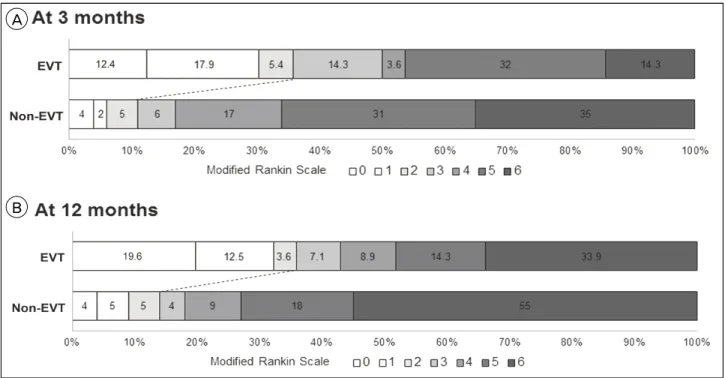
Fig. 1. Distributions of modified Rankin scale score at 3 (A) and 12 months (B) after stroke Note. EVT = endovascular treatment.
The Mann-Whitney U test was used for bivariate analysis of continuous variables and the χ2 or Fisher's exact test for bivariate analysis of nominal factors.
The effects of EVT were compared using binary logistic regression analysis, adjusted for confounders significantly associated with outcome after ischemic stroke: age (< 85 or ≥ 85 years), time from onset (< 4.5 or 4.5-8 hours), initial NIHSS score (moderate, 5-14 or severe, ≥ 15), and prestroke mRS score (0 or 1-2). "tPA use" was ex- cluded from the logistic regression models, because of a lack of clinical response after tPA use in all cases and correlation with time from onset causing a multi- collinearity problem. Two-sided probability values of
< 0.05 were considered to indicate statistical significance.
RESULTS
Basic demographic and clinical data were not sig- nificantly different in the EVT and non-EVT groups (Table 1). In the EVT group, successful recanalization (TICI grade ≥ 2b) was achieved in 46 patients (82.1%).
Of these, 25 patients did not achieve good outcomes
and thus, futile recanalization, defined as mRS ≥ 3 de- spite successful recanalization, was 54.3%. Complications occurred in 3 (5.4%) patients during EVT: vessel rup- ture in 2 patients and intracranial artery dissection in 1 patient. Of these, good outcomes were achieved in 2 patients at 3 and 12 months after stroke. Recanalization failed in 1 patient with vessel rupture, whose out- come was poor (mRS 5 at 3 and 12 months), although bleeding was stopped by temporary balloon occlusion.
At 3 months after stroke, good functional outcomes were achieved in a greater portion of patients in the EVT group than in the non-EVT group (20 [35.7%] vs.
11 [11.0%], adjusted odds ratio [OR] 4.779, 95% con- fidence interval [CI] 1.972-11.579, p = 0.001; Table 2 and Fig. 1A). At 12 months follow-up, this trend con- tinued and the good functional outcome rate was sig- nificantly higher in the EVT group than in the non-EVT groups (20 [35.7%] versus 14 [14.0%], ad- justed OR 3.705, 95% CI 1.574-8.722, p = 0.003; Fig.
1B). In the non-EVT group, proportions of patients who were severely disabled or dead (mRS score of 4-6) were over 80% and significantly higher than in
(n = 56)EVT Non-EVT
(n = 100) Unadjusted odds ratio
(95% confidence interval) Adjusted† odds ratio
(95% confidence interval) p value Good functional outcome (mRS 0-2)
3 months
12 months 20 (35.7%)
20 (35.7%) 11 (11.0%)
14 (14.0%) 4.495 (1.957-10.322)
3.413 (1.555-7.490) 4.779 (1.972-11.579)
3.705 (1.574-8.722) 0.001 0.003 In-hospital morbidities
Endotracheal intubation Gastrointestinal bleeding Pneumonia
Urinary tract infection
10 (17.9%) 1 (1.8%) 7 (12.5%) 9 (16.1%)
17 (17.0%) 8 (8.0%) 29 (29.0%) 34 (34.0%)
1.061 (0.449-2.509) 0.209 (0.025-1.717) 0.350 (0.142-0.862) 0.372 (0.163-0.848)
1.062 (0.415-2.714) 0.185 (0.022-1.585) 0.262 (0.098-0.703) 0.256 (0.099-0.657)
0.901 0.124 0.008 0.005 Symptomatic hemorrhage* 6 (10.7%) 2 (2.0%) 5.880 (1.145-30.196) 6.859 (1.139-41.317) 0.036 In-hospital mortality 7 (12.5%) 8 (8.0%) 1.643 (0.562-4.799) 1.380 (0.408-4.664) 0.604 EVT = endovascular treatment; mRS = modified Rankin Scale.
*Symptomatic hemorrhage was defined as a hemorrhage associated with a ≥ 4-point increase in the NIHSS score or a 1-point deterioration in level of consciousness.
†Each comparison of the two study groups was adjusted for age, time from onset, initial NIHSS score, and prestroke mRS score
Table 2. Functional outcomes, in-hospital morbidities, symptomatic hemorrhages, and in-hospital mortalities in the EVT and non-EVT groups
the EVT group at 3 months (83 [83.0%] vs. 28 [50.0%], adjusted OR 6.950, 95% CI 2.844-16.985, p < 0.001) and 12 months (82 [82%] vs. 32 [57.1%], adjusted OR 4.180, 95% CI 1.837-9.510, p = 0.001) after stroke (Fig. 1A, B).
Of in-hospital morbidities, pneumonia (7 [12.5%]
versus 29 [29.0%], adjusted OR 0.262, 95% CI 0.098-0.703, p = 0.008) and UTI (9 [16.1%] versus 34 [34.0%], adjusted OR 0.256, 95% CI 0.099-0.657, p = 0.005) were significantly less frequent in the EVT group during admission (Table 2).
Hemorrhage occurred in 40 (25.6%) patients, includ- ing 8 (5.1%) with symptomatic hemorrhage during admission. Although hemorrhage types (HI, 6 [10.7%]
vs. 11 [11.0%]; PH, 9 [16.1%] vs. 14 [14.0%], p = 0.941) were similar in the two groups, symptomatic hemor- rhage rates were significantly higher in the EVT group (6 [10.7%] vs. 2 [2.0%], adjusted OR 6.859, 95%
CI 1.139-41.317, p = 0.036).
In-hospital mortality rate did not differ significantly between the EVT and non-EVT groups (7 [12.5%] vs.
8 [8.0%], adjusted OR 1.380, 95% CI 0.408-4.664, p = 0.604).
DISCUSSION
The present study shows that EVT for acute ische- mic stroke was associated with good functional out- comes at 3 and 12 months after stroke in patients over
80 years of age who were candidates for EVT. It also reduced rates of in-hospital morbidities, such as hos- pital-acquired infections. Although symptomatic hem- orrhage occurred more frequently after EVT, overall functional outcome of elderly patients treated by EVT was still better and in-hospital mortality rate was not higher than that of patients not treated with EVT.
Our results indicate that the benefit of EVT for acute ischemic stroke is maintained even in patients over 80 years of age. Therefore, elderly patients should not be simply excluded from EVT candidates because of their age. This is consistent with subgroup analysis of recent prospective trials reporting that no significant interaction was detected between the benefit of EVT and age.5)12)
In addition to functional outcomes, in-hospital mor- bidities were also evaluated as a primary outcome of EVT, because these often lead to unfavorable or fatal outcome in elderly patients.8)13) We found that pneu- monia and UTI developed more frequently in the non-EVT group. Poor clinical condition in patients with acute ischemic stroke is associated with these in-hospital morbidities and, in turn, their develop- ments are predictors for unfavorable outcome and mortality.2)7)10)27)29)31)33-36) Therefore, these findings sug- gest that a better clinical condition achieved by EVT would reduce in-hospital morbidities, contributing to a more favorable outcome in EVT groups.
Symptomatic hemorrhage is an important complica- tion associated with thrombolysis for acute ischemic stroke. Especially in elderly patients with acute ische- mic stroke, symptomatic hemorrhage is frequent and associated with high rates of in-hospital mortality and poor outcome.1)4)8)13)14)16)17)23)25)26)30) In the current study, however, in-hospital mortality rates were not different between the two study groups. In addition, more than 80% of patients not treated by EVT were severely dis- abled or dead (mRS score of 4-6) due to acute stroke or its sequelae at 3 and 12 months after stroke, thus this proportion was found to be much higher than that of the EVT group. Therefore, these results in- dicate that the benefit of EVT overweighs the risk of symptomatic hemorrhage after EVT.
In practice, we frequently encounter elderly patients with acute ischemic stroke, but no consensus has been reached on this issue. Although our results do not provide definite evidence obtained from a well-de- signed randomized study, we believe that they could provide some useful information for physicians and patients, until sufficient data become available.
Several limitations of the current study should be addressed. These include its retrospective nature, sin- gle center experience, and its relatively small cohort.
In addition, selection bias is likely to have been in- troduced by involving family members in the treat- ment decision-making process, and the general man- agement afforded to both EVT and non-EVT groups may have been less than aggressive due to consid- erations of patient age. Nevertheless, the general man- agement guidelines followed were identical for the EVT and non-EVT groups and all patients were man- aged without abandoning treatment, because only pa- tients whose family-members agree on treatment for stroke are permitted to be referred to our tertiary re- ferral hospital.
CONCLUSION
The present study demonstrated that EVT improved functional outcomes at 3 and 12 months after stroke
in patients over 80 years of age with acute ischemic stroke who were candidates for EVT. It also reduced rates of hospital-acquired infections. These results in- dicate that the benefit of EVT for acute ischemic stroke is maintained in elderly patients. In these pa- tients, symptomatic hemorrhage occurred more fre- quently after EVT, but the benefit of EVT overweighs the risk of symptomatic hemorrhage, considering the high rate of poor outcomes in patients who did not undergo EVT. Accordingly, our findings suggest that EVT can be considered in elderly patients, if indicated.
Disclosure
The authors report no conflict of interest concerning the materials or methods used in this study or the findings specified in this paper.
REFERENCES
1. Alshekhlee A, Mohammadi A, Mehta S, Edgell RC, Vora N, Feen E, et al. Is thrombolysis safe in the eld- erly?: analysis of a national database. Stroke. 2010 Oct;41(10):2259-64.
2. Aslanyan S, Weir CJ, Diener HC, Kaste M, Lees KR;
GAIN International Steering Committee and Investigators.
Pneumonia and urinary tract infection after acute ischae- mic stroke: a tertiary analysis of the GAIN International trial. Eur J Neurol. 2004 Jan;11(1):49-53.
3. Bang JS, Oh CW, Jung C, Park SQ, Hwang KJ, Kang HS, et al. Intracranial stent placement for recanalization of acute cerebrovascular occlusion in 32 patients. AJNR Am J Neuroradiol. 2010 Aug;31(7):1222-5.
4. Bateman BT, Schumacher HC, Boden-Albala B, Berman MF, Mohr JP, Sacco RL, et al. Factors associated with in-hospital mortality after administration of thrombolysis in acute ischemic stroke patients: an analysis of the na- tionwide inpatient sample 1999 to 2002. Stroke. 2006 Feb;37(2):440-6.
5. Berkhemer OA, Fransen PS, Beumer D, van den Berg LA, Lingsma HF, Yoo AJ, et al. A randomized trial of intraarterial treatment for acute ischemic stroke. N Engl J Med. 2015 Jan 1;372(1):11-20.
6. Bonita R, Anderson CS, Broad JB, Jamrozik KD, Stewart- Wynne EG, Anderson NE. Stroke incidence and case fa- tality in Australasia. A comparison of the Auckland and Perth population-based stroke registers. Stroke. 1994 Mar;25(3):552-7.
7. Davenport RJ, Dennis MS, Warlow CP. Gastrointestinal hemorrhage after acute stroke. Stroke. 1996 Mar;27(3):421-4.
8. Derex L, Nighoghossian N. Thrombolysis, stroke-unit ad- mission and early rehabilitation in elderly patients. Nat Rev Neurol. 2009 Sep;5(9):506-11.
9. Di Carlo A, Baldereschi M, Gandolfo C, Candelise L, Ghetti A, Maggi S, et al. Stroke in an elderly population:
incidence and impact on survival and daily function.
The Italian Longitudinal Study on Aging. Cerebrovasc Dis. 2003 Feb;16(2):141-50.
10. Finlayson O, Kapral M, Hall R, Asllani E, Selchen D, Saposnik G. Risk factors, inpatient care, and outcomes of pneumonia after ischemic stroke. Neurology. 2011 Oct 4;77(14):1338-45.
11. Furlan A, Higashida R, Wechsler L, Gent M, Rowley H, Kase C, et al. Intra-arterial prourokinase for acute ischemic stroke. The PROACT II study: a randomized controlled trial. Prolyse in Acute Cerebral Thromboembolism. JAMA.
1999 Dec;282(21):2003-11.
12. Goyal M, Demchuk AM, Menon BK, Eesa M, Rempel JL, Thornton J, et al. Randomized assessment of rapid endovascular treatment of ischemic stroke. N Engl J Med. 2015 Mar;372(11):1019-30.
13. Group TNt-PSS. Generalized efficacy of t-PA for acute stroke. Subgroup analysis of the NINDS t-PA Stroke Trial. Stroke. 1997 Nov;28(11):2119-25.
14. Hacke W, Donnan G, Fieschi C, Kaste M, von Kummer R, Broderick JP, et al. Association of outcome with early stroke treatment: pooled analysis of ATLANTIS, ECASS, and NINDS rt-PA stroke trials. Lancet. 2004 Mar;363(9411):
768-74.
15. Hacke W, Kaste M, Fieschi C, Toni D, Lesaffre E, von Kummer R, et al. Intravenous thrombolysis with re- combinant tissue plasminogen activator for acute hemi- spheric stroke. The European Cooperative Acute Stroke Study (ECASS). JAMA. 1995 Oct;274(13):1017-25.
16. Heuschmann PU, Kolominsky-Rabas PL, Roether J, Misselwitz B, Lowitzsch K, Heidrich J, et al. Predictors of in-hospital mortality in patients with acute ischemic stroke treated with thrombolytic therapy. JAMA. 2004 Oct;292(15):1831-8.
17. Hussein HM, Georgiadis AL, Vazquez G, Miley JT, Memon MZ, Mohammad YM, et al. Occurrence and predictors of futile recanalization following endovascular treatment among patients with acute ischemic stroke: a multicenter study. AJNR Am J Neuroradiol. 2010 Mar;31(3):454-8.
18. Hwang G, Oh CW, Bang JS, Jung CK, Kwon OK, Kim JE, et al. Superficial temporal artery to middle cerebral artery bypass in acute ischemic stroke and stroke in progress.
Neurosurgery. 2011 Mar;68(3):723-9; discussion 729-30.
19. Jauch EC, Saver JL, Adams HP Jr, Bruno A, Connors JJ, Demaerschalk BM, et al. Guidelines for the early man- agement of patients with acute ischemic stroke: a guide- line for healthcare professionals from the American Heart Association/American Stroke Association. Stroke.
2013 Mar;44(3):870-947.
20. Jovin TG, Chamorro A, Cobo E, de Miquel MA, Molina CA, Rovira A, et al. Thrombectomy within 8 hours after symptom onset in ischemic stroke. N Engl J Med. 2015 Jun;372(24):2296-306.
21. Kang DH, Hwang YH, Kim YS, Park J, Kwon O, Jung C. Direct thrombus retrieval using the reperfusion cathe- ter of the penumbra system: forced-suction thrombec- tomy in acute ischemic stroke. AJNR Am J Neuroradiol.
2011 Feb;32(2):283-7.
22. Kass-Hout T, Amuluru K, Al-Derazi Y, Singh P, Prestigiacomo CJ, Gandhi CD. Endovascular therapy for acute ischemic stroke: time to enter a new era in stroke management. World Neurosurg. 2015 Jun;83(6);951-3.
23. Kim D, Ford GA, Kidwell CS, Starkman S, Vinuela F, Duckwiler GR, et al. Intra-arterial thrombolysis for acute stroke in patients 80 and older: a comparison of results in patients younger than 80 years. AJNR Am J Neuroradiol.
2007 Jan;28(1):159-63.
24. Marini C, Baldassarre M, Russo T, De Santis F, Sacco S, Ciancarelli I, et al. Burden of first-ever ischemic stroke in the oldest old: evidence from a population-based study. Neurology. 2004 Jan;62(1):77-81.
25. Mazighi M, Labreuche J, Meseguer E, Serfaty JM, Laissy JP, Lavallee PC, et al. Impact of a combined intra- venous/intra-arterial approach in octogenarians. Cerebrovasc Dis. 2011 Jun;31(6):559-65.
26. Mono ML, Romagna L, Jung S, Arnold M, Galimanis A, Fischer U, et al. Intra-arterial thrombolysis for acute is- chemic stroke in octogenarians. Cerebrovasc Dis. 2012 Feb;33(2):116-22.
27. O'Donnell MJ, Kapral MK, Fang J, Saposnik G, Eikelboom JW, Oczkowski W, et al. Gastrointestinal bleeding after acute ischemic stroke. Neurology. 2008 Aug;71(9):650-5.
28. Park H, Hwang GJ, Jin SC, Jung CK, Bang JS, Han MK, et al. A retrieval thrombectomy technique with the Solitaire stent in a large cerebral artery occlusion. Acta Neurochir (Wien). 2011 Aug;153(8):1625-31.
29. Poisson SN, Johnston SC, Josephson SA. Urinary tract infections complicating stroke: mechanisms, consequences, and possible solutions. Stroke. 2010 Apr;41(4):e180-4.
30. Qureshi AI, Suri MF, Georgiadis AL, Vazquez G, Janjua NA. Intra-arterial recanalization techniques for patients 80 years or older with acute ischemic stroke: pooled analysis from 4 prospective studies. AJNR Am J Neuroradiol.
2009 Jun;30(6):1184-9.
31. Rocco A, Pasquini M, Cecconi E, Sirimarco G, Ricciardi MC, Vicenzini E, et al. Monitoring after the acute stage of stroke: a prospective study. Stroke. 2007 Apr;38(4):1225-8.
32. Saver JL, Goyal M, Bonafe A, Diener HC, Levy EI, Pereira VM, et al. Stent-Retriever Thrombectomy after Intravenous t-PA vs. t-PA Alone in Stroke. N Engl J Med. 2015 Jun;372(24):2285-95.
33. Stott DJ, Falconer A, Miller H, Tilston JC, Langhorne P.
Urinary tract infection after stroke. QJM. 2009 Apr;102(4):
243-9.
34. Vargas M, Horcajada JP, Obach V, Revilla M, Cervera A, Torres F, et al. Clinical consequences of infection in patients with acute stroke: is it prime time for further antibiotic trials? Stroke. 2006 Feb;37(2):461-5.
35. Walter U, Knoblich R, Steinhagen V, Donat M, Benecke R, Kloth A. Predictors of pneumonia in acute stroke pa- tients admitted to a neurological intensive care unit. J Neurol. 2007 Oct;254(10):1323-9.
36. Westendorp WF, Nederkoorn PJ, Vermeij JD, Dijkgraaf MG, van de Beek D. Post-stroke infection: a systematic review and meta-analysis. BMC Neurol. 2011 Sep;11(9):110.