INTRODUCTION
In the past, the general population and physicians were less aware of attention-deficit/hyperactivity disorder (ADHD) in adulthood. Pediatric psychiatrists may most often en- counter patients with ADHD as there is a high chance that the parents or other relatives of children treated for ADHD also present with such condition [1]. However, although phy- sicians are experienced, they need adjunctive tools, such as
psychological tests, to make an objective assessment. To diag- nose ADHD in adults, only few psychological tools are avail- able, which include Conners Adult ADHD Rating Scale [2], Brown Attention-Deficit Disorder Scales [3], Wender Utah Rating Scale [4], Barkley’s Adult ADHD Rating Scale-IV [5], and Adult ADHD Self-report Scale (ASRS) [6]. However, such tools are limited by copyright issue and by the effort to standardize procedure from English to Korean language for clinical use in Korea.
To overcome these obstacles, the Korean Academy of Child and Adolescent Psychiatry (KACAP) had organized a task force team to develop the Korean Adult ADHD Rating Scale
This is an Open Access article distributed under the terms of the Creative Commons Attribution Non-Commercial License (https://creativecommons.org/licenses/by-nc/4.0) which permits unrestricted non-commercial use, distribution, and reproduction in any medium, provided the original work is properly cited.
Clinical Utility and Cut-Off Scores of the Korean Adult Attention-Deficit/Hyperactivity Disorder Rating Scale
Minha Hong
1, Young Sik Lee
2, Bongseog Kim
3, Yoo Sook Joung
4, Hanik K Yoo
5, Eui-Jung Kim
6, Soyoung Irene Lee
7, Soo Young Bhang
8, Seung Yup Lee
9, Doughyun Han
2, and Geon Ho Bahn
91
Department of Psychiatry, Myongji Hospital, Hanyang University College of Medicine, Seoul, Korea
2
Department of Psychiatry, Chung-Ang University College of Medicine, Seoul, Korea
3
Department of Psychiatry, Inje University College of Medicine, Seoul, Korea
4
Department of Psychiatry, Sungkyunkwan University College of Medicine, Seoul, Korea
5
Seoul Brain Research Institute, Seoul, Korea
6
Department of Psychiatry, College of Medicine, Ewha Womans University, Seoul, Korea
7
Department of Psychiatry, Soonchunhyang University College of Medicine, Buchun, Korea
8
Department of Psychiatry, Eulji University School of Medicine, Seoul, Korea
9
Department of Psychiatry, Kyung Hee University School of Medicine, Seoul, Korea
Objectives: This study was conducted to re-validate the clinical efficacy of the Korean Adult Attention-Deficit/Hyperactivity Disor- der (ADHD) Rating Scale (K-AARS), which is a self-report scale for ADHD in adults, and to determine the clinical utility and cut-off scores of K-AARS.
Methods: The participants were 135 drug naïve adults with ADHD and 144 healthy controls. To diagnose ADHD based on the diag- nostic criteria of the Diagnostic and Statistical Manual of Mental Disorders, 5th Edition, two board-certified pediatric psychiatrists interviewed the participants and completed the Mini International Neuropsychiatric Interview. K-AARS was applied to all partici- pants. K-AARS comprises six clinical subscales, one impairment subscale, and one driving behavior subscale. The receiver operating characteristic analysis was conducted to calculate the cut-off scores of K-AARS.
Results: All subscale scores, including six clinical subscale, impairment subscale, and driving behavior subscale scores, were found to be significant in distinguishing adults with ADHD from healthy controls. The sensitivity and specificity of the six clinical subscales were 63.0–77.0% and 66.7–79.9%, respectively. The combined total score of the six clinical subscales, had a sensitivity of 80.0% and specificity of 79.9%.
Conclusion: The discriminative power of K-AARS for the diagnosis of ADHD in adults was excellent, and K-AARS and the empiri- cal diagnosis of adults can be useful in diagnosing ADHD in adulthood.
Key Words: Attention deficit hyperactivity disorder; Adult; Dysregulation; Disorganization; Impairment; Driving; Korean adult at- tention-deficit/hyperactivity disorder rating scale.
Received: June 13, 2019 / Revision: June 17, 2019 / Accepted: June 17, 2019
Address for correspondence: Geon Ho Bahn, Department of Psychiatry, Kyung Hee University School of Medicine, 23 Kyungheedae-ro, Dongdaemun- gu, Seoul 02447, Korea
Tel: +82-2-958-8556, Fax: +82-2-957-1997, E-mail: [email protected]
(K-AARS) in 2009, and professor Jae Won Kim was ap- pointed as the principal investigator [1]. Through discussions on whether the new scale will be a self-report form or a physi- cian rate form and whether it can be used as a screening or diagnostic tool, the team members developed a self-report scale to diagnose ADHD in adults. The initial draft of the scale included 86 questions, and the scale was used on 136 adults with ADHD and 408 healthy controls. Via a validity and reliability analysis, the final draft included 73 questions and comprised eight subscales: six clinical subscales, one impairment subscale (IMP), and one subscale for driving behavior (DR) [1]. K-AARS was highly reliable in terms of internal consistency (Cronbach’s alpha: 0.77–0.95) and corre- lation between factors (0.57–0.86). Concurrent validity and discriminant validity were statistically significant [1].
The need for the assessment and diagnostic tools for ADHD in adults was emphasized to prepare for the application of the national health insurance to adults with ADHD since September 2016 in Korea [7]. KACAP had already published the revised version of the Korean practice parameter for ADHD [8]; however, it focused on children and adolescents.
Thus, a practice parameter targeting ADHD in adults must be developed. This study was conducted to determine the cut-off scores for the clinical application of K-AARS as a follow-up to the previous study [1] and as a part of the prep- aration for the publication of the practice parameters.
METHODS
In the previous K-AARS study [1], the participants were aged between 20 and 50 years. In the current study, the tar- get age was expanded from 19 to 65 years. The participants were recruited from March 2017 to February 2019 at eight university hospitals in Seoul and other metropolitan areas.
After two board-certified pediatric psychiatrists conduct- ed clinical interviews in accordance with the Diagnostic and Statistical Manual of Mental Disorders, 5th edition (DSM- 5) [9], patients who visited the psychiatric outpatient clinic and were diagnosed with ADHD were classified under the clinical group with their consent. The diagnosis was made only if there is an agreement between the two psychiatrists.
Otherwise, the participants were not registered in the study.
In case of inconsistency in the presentation of specifiers be- tween psychiatrists, the participant was registered. The Mini International Neuropsychiatry Interview (MINI) Korean version [10] was performed to exclude other mental disor- ders. The healthy controls were recruited from the hospital, and the participants visited the hospital after seeing the re- search advertisement. After the pediatric psychiatrists con- ducted the diagnostic interview that focused on ADHD and
MINI [10], the healthy controls were registered in the study if they did not present with mental disorders. K-AARS was used in all participants in both groups.
K-AARS is a self-report scale and five-point Likert-type scale with the following responses: never, rarely, sometimes, often, and always. The never response is scored 1 (lowest score) for all questions, and the always response is scored 5 (highest score) for all questions. The respondents answered each question about how often they present with a symptom over the past 6 months. K-AARS has 73 questions, which comprised three parts: six clinical subscales with 55 ques- tions, IMP with 6 questions, and a subscale for DR with 12 questions. The six clinical subscales are inattention (IA), hy- peractivity (HYP), impulsivity (IM), antisocial personality/
conduct behavior/oppositional defiant behavior (ACO), emo- tional dysregulation (ED), and disorganization (DO). If the score of the six clinical subscales and IMP subscale were high- er, the symptoms were more severe. When the score of the DR subscale was higher, the driving habit is healthier, and this result is attributed to the reverse scoring of the DR subscale.
The exclusion criteria of the study were as follows:
(1) Mental disorders
(2) Congenital or hereditary genetic disorders
(3) Organic brain disorders, including epilepsy, stroke, and cerebral palsy
(4) Continuous treatment required due to serious physical illness
(5) Drug treatment for ADHD within the last 3 months Statistical analysis
Data were analyzed using descriptive methods, indepen- dent t-test, and χ
2. The SPSS software version 21.0 for Win- dows (IBM Corp., Armonk, NY, USA) was used for analysis.
Moreover, receiver operating characteristic (ROC) analysis was conducted to calculate the cut-off points of K-AARS.
Via the ROC curve analysis, the sensitivity and specificity of all subscales and the total score of the clinical subscales were obtained. The maximum point at which the sum of sensitivity and specificity is determined was considered the cut-off score. If the area under the ROC curve of a test is above 0.70, then the test can be categorized as fair, good, or very good. A p value <0.05 was considered statistically sig- nificant.
Research ethics
The study protocol was approved by the Institutional Re-
view Board of the eight university hospitals, including Kyung
Hee University Hospital (KMC IRB 2017-02-054), of which
the principal investigator was Geon Ho Bahn. Informed con-
sent was obtained from all participants.
RESULTS
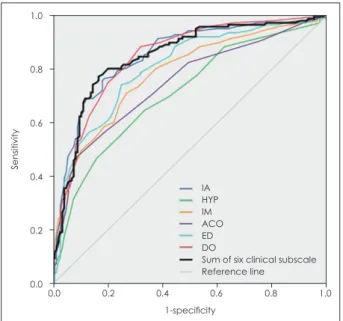
A total of 135 adults with ADHD were included in the clin- ical group and 144 healthy adults in the control group. In the clinical group, 92 (68.1%) were male, with a mean age of 26.7±9.0 years. In the control group, 82 (58.2%) were men with an average age of 27.9±7.0 years. No significant differ- ences were observed in terms of age and sex between the two groups (Table 1). The six clinical subscale and IMP sub- scale scores of the clinical group were significantly higher than those of the control group (Table 2). The DR subscale scores of the clinical group were significantly lower than those of the control group due to reverse scoring. According to the ROC analysis, the sensitivity and specificity of the six clinical subscales (IA, HYP, IM, ACO, ED, and DO) were 63.0–77.0% and 66.7–79.9%, respectively (Table 3, Fig. 1).
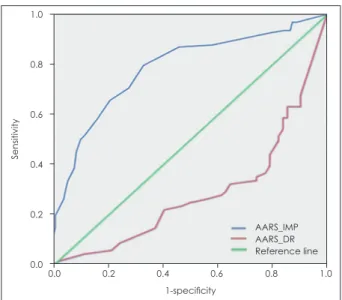
The total score of the six clinical subscales had a sensitivity of 80.0% and a specificity of 79.9% (Fig. 1). The sensitivity and specificity of the IMP subscale were 70.5% and 72.5%, respectively (Fig. 2). As the DR subscales were negatively cor- related, the sensitivity and specificity were 32.4% and 35.5%, respectively (Fig. 2).
DISCUSSION
In Korea, although data about ADHD in adulthood are limited compared to those of ADHD in childhood [11], there is increasing knowledge about the fact that ADHD is a con- dition that affects not only children but also adults, and that such condition continues from childhood to adulthood. More- over, the coverage of the national health insurance for adults with ADHD, which started in September 2016, can help ob- tain more clinical data of adult ADHD cases [7]. However,
Table 1. Demographic characteristics of the subjects Adults with
ADHD (n=135)
Healthy controls
(n=144) χ
2(p) Age (years) 26.7±9.0 27.9±7.0 45.680 (0.107) Sex (male) 92 (68.1) 82 (58.2) 3.726 (0.054) Data are mean±SD or n (%) values. ADHD: attention-deficit/
hyperactivity disorder
Table 2. The comparison of subscale scores of K-AARS between ADHD and control group
Subscales
Adults with ADHD (n=135)
Healthy controls
(n=144) t*
Mean SD Mean SD
IA 52.99 14.55 32.84 12.87 12.269
HYP 12.37 4.63 9.26 3.59 6.238
IM 23.07 8.76 15.06 6.20 8.748
ACO 12.96 5.19 9.15 3.47 7.162
ED 40.79 11.50 28.17 14.68 7.958
DIS 17.58 5.78 10.24 4.69 11.600
Subtotal 159.76 41.97 104.72 36.44 11.714
(n=122) (n=131)
IMP 14.11 7.03 7.70 4.61 8.503
(n=68) (n=62)
DR 29.31 22.91 44.39 17.70 -4.219
*p=0.000. ACO: antisocial personality/conduct behavior/op- positional defiant behavior, ADHD: attention-deficit/hyperac- tivity disorder, DIS: disorganization, DR: driving habits, ED:
emotional dysregulation, HYP: hyperactivity, IA: inattention, IM: impulsivity, IMP: impairment, K-AARS: Korean Adult ADHD Rating Scale
Table 3. AUC analysis for subscales of K-AARS to examine sensi- tivity and specificity
Subscales AUC p Cut-off
value
Sensitivity (%)
Specificity (%)
IA 0.848 0.000 42.50 77.0 77.8
HYP 0.708 0.000 10.50 64.4 66.7
IM 0.781 0.000 18.50 71.1 72.9
ACO 0.745 0.000 10.50 63.0 72.9
ED 0.801 0.000 35.50 74.1 75.0
DO 0.844 0.000 13.50 74.8 79.9
Subtotal of clinical
subscales
0.845 0.000 131.50 80.0 79.9
IMP 0.785 0.000 9.50 70.5 72.5
DR 0.288 0.000 46.50 32.35 35.48
ACO: antisocial personality/conduct behavior/oppositional defiant behavior, AUC: area under the curve, DO: disorgani- zation, DR: driving habits, ED: emotional dysregulation, HYP:
hyperactivity, IA: inattention, IM: impulsivity, IMP: impairment, K-AARS: Korean Adult ADHD Rating Scale
Fig. 1. ROC curve of clinical subscales of K-AARS. ACO: antiso- cial personality/conduct behavior/oppositional defiant behav- ior, DO: disorganization, ED: emotional dysregulation, HYP: hy- peractivity, IA: inattention, IM: impulsivity, K-AARS: Korean Adult ADHD Rating Scale, ROC: receiver operating characteristic.
1.0
0.8
0.6
0.4
0.2
0.0
Sensitivity
0.0 0.2 0.4 0.6 0.8 1.0 1-specificity
IA HYP IM ACO ED DO
Sum of six clinical subscale Reference line
clinicians find it challenging to diagnose ADHD in adults who have different characteristics; thereby, leaving numerous adult patients without proper diagnosis and treatment. As present- ed in this study, each subscale score and the sum of the six clinical subscale scores of K-AARS could be used as a diag- nostic cut-off for adult patients in clinical practice. Based on this study, a total score greater than or equal to 132 for the six clinical subscales will be considered the cut-off score for diagnosing ADHD with the use of K-AARS: the true posi- tive rate (sensitivity) of diagnosis was 80.0%, and the false positive rate (1-specificity) was less than 20.1%. Meanwhile, Kessler et al. [12] have reported that the six-question ASRS had a sensitivity of 68.7% and specificity of 99.5%, and Heo et al. [13] have revealed that the ASRS had a sensitivity of 0.627 and 1-specificity of 0.196 for diagnosing ADHD in the Korean adult population. In Brazilians, the Brown Atten- tion-deficit Disorder Scale presented a fair sensitivity with 72% accuracy and fair specificity with 88% accuracy [14].
Ustun et al. [15] have reported that the revised ASRS had a higher sensitivity at 91.4% and specificity at 96.0%.
Some of the subscales of K-AARS (ACO, ED, and DO) differ from the diagnostic criteria of ADHD in the DSM-5 [9]. From the outset of the development of K-AARS, authors aimed to identify the symptoms and characteristics of ADHD in adults because the diagnostic criteria of DSM-5 were mainly based on childhood symptoms. Since ADHD has been over- lapped with a variety of psychiatric comorbidities, comorbid psychiatric disorders, particularly behavioral or personality disorders, must be identified [16]. Of the patients with clus- ter B personality disorders, 33–65% have a history of ADHD
in childhood [16]. Oppositional defiant disorder and con- duct disorder as well as anxiety disorders are observed in 25–33% of children with ADHD [17]. Although the ACO sub- scale itself cannot distinguish such diagnoses, it could help physicians diagnose and treat ADHD associated with anti- social personality, oppositional defiant disorder, or conduct disorder. In the Utah criteria for adult ADHD [4], temper, af- fective lability, emotional over-reactivity, and disorganiza- tion have been emphasized in addition to attention difficul- ties, hyperactivity/restlessness, and impulsivity. Moreover, Pinzone et al. [18] have emphasized temperament traits, such as lability, irritability, and excessiveness of emotional re- sponses in adult ADHD. The ED and DO subscales can re- flect such symptoms and characteristics in ADHD. As emo- tional regulation deficits are evident in about 34–70% of adults, the specific subgroups of ADHD must be differenti- ated from the initial stage of the diagnosis [19]. The efficacy of using ACO, ED, and DO subscales should be monitored and reevaluated using the K-AARS in clinical practice.
The IMP score could be used to assess the influence of ADHD on daily life as the diagnostic criteria D of the DSM- 5 have stated that “clear evidence that the symptoms inter- fere with, or reduce the quality of social, academic, or occu- pational functioning” [9]. In future studies, authors should assess the possible use of IMP score as an indicator of the current severity of ADHD based on the DSM-5 [9]. Adults with ADHD present with impairments in cognitive, emo- tional, and social functioning, and difficulty in driving is one of these impairments [20]. However, not all individuals with ADHD are affected similarly. Ferro and Leatherdale [21]
have reported the lack of association between ADHD and past-year traffic violations. However, they have found three factors that increase the odds for past-year traffic violations among individuals with ADHD: aged 20–29 years, male sex, and white ethnicity. Therefore, in this study, although the DR subscale score was a significantly sensitive subscale for dis- criminating between the ADHD and healthy control groups, it may not be the answer to whether all individuals with ADHD present with higher level of unsafe driving behaviors [20].
The DR score must also consider differences depending on regions and cultures, such as big and small cities as well as urban and rural areas.
The participants were included in the study based on the assessment of two psychiatrists using the DSM-5 but with- out the use of quantitative psychological measures, and this is considered a limitation of this study. Meanwhile, two psy- chiatrists diagnosed the participants with ADHD only when a consensus is made, and this is considered the strength of the study. Another limitation is that this study was con- ducted at eight university hospitals located in metropolitan
Fig. 2. ROC curve of impairment and driving behavior subscales from K-AARS. AARS: Adult Attention-Deficit/Hyperactivity Disorder Rating Scale, DR: driving, IMP: impairment, K-AARS: Korean Adult ADHD Rating Scale, ROC: receiver operating characteristic.
1.0
0.8
0.6
0.4
0.2
0.0
Sensitivity
0.0 0.2 0.4 0.6 0.8 1.0 1-specificity
AARS_IMP AARS_DR Reference line