© 2013 The Korean Academy of Medical Sciences.
This is an Open Access article distributed under the terms of the Creative Commons Attribution Non-Commercial License (http://creativecommons.org/licenses/by-nc/3.0) which permits unrestricted non-commercial use, distribution, and reproduction in any medium, provided the original work is properly cited.
pISSN 1011-8934 eISSN 1598-6357
Epidemiology of Hemorrhagic Fever with Renal Syndrome in Korea, 2001-2010
This study describes the epidemiology of hemorrhagic fever with renal syndrome (HFRS) in the past 10 yr (2001-2010) in Korea. During this period, a total of 3,953 HFRS patients and an average prevalence rate of 0.81 per 100,000 population were recorded, with a total of 40 fatal cases, corresponding to a case fatality rate of 1.01%. More HFRS cases were found in men than in women (57% vs 43%), and a higher prevalence rate of HFRS was observed in patients older than 40 yr (82.1%). The highest numbers of HFRS cases were found amongst farmers (35.6%). The majority of HFRS cases (71.3%) occurred in the last quarter of the calendar year (October to December). More HFRS cases occurred in the western part than in the eastern part of Korea (68.9% vs 31.1%). The incidence of HFRS was
significantly higher (P < 0.001) in rural areas than in urban areas (80.3% vs 19.7%). HFRS still occurs commonly among men, in autumn, and in western rural area of Korea.
Key Words: Hemorrhagic Fever with Renal Syndrome; Epidemiology; Autumn; Rural Area Soo-Han Lee,1 Byung-Hyun Chung,1
Won-Chang Lee,1 and In-Soo Choi1,2
1Department of Veterinary Medicine and 2Veterinary Science Research Institute, College of Veterinary Medicine, Konkuk University, Seoul, Korea Received: 1 May 2013
Accepted: 1 August 2013 Address for Correspondence:
In-Soo Choi, PhD
Department of Veterinary Medicine, College of Veterinary Medicine, Konkuk University, 263 Achasan-ro, Gwangjin-gu, Seoul 143-701, Korea
Tel: +82.2-2049-6055, Fax: +82.2-3436-5880 E-mail: [email protected]
This paper was supported by Konkuk University in 2013.
http://dx.doi.org/10.3346/jkms.2013.28.10.1552 • J Korean Med Sci 2013; 28: 1552-1554
BRIEF COMMUNICATION
Infectious Diseases, Microbiology & Parasitology
Hantavirus infection induces 2 different diseases, hemorrhagic fever with renal syndrome (HFRS) and hantavirus pulmonary syndrome (HPS), mainly in Korea, far east Russia, and China and in the United States, respectively (1, 2). The viruses are trans- mitted to humans by the inhalation of excreta of rodents infect- ed with hantaviruses (3). HFRS was first recognized during the Korean War in the early 1950s, and although a hantavirus vac- cine has been developed, the disease remains a serious prob- lem in Asia and Europe (1, 4), and especially among soldiers in Korea (5, 6). A 2006 report describes HFRS epidemiology in en- demic regions in Korea during a relatively short period, 1995- 1998 (7); however, an updated epidemiological study is neces- sary to better understand the current status of HFRS in Korea.
This study provides a comprehensive epidemiological overview of HFRS during the past decade in Korea.
Raw data were utilized from the National Notifiable Disease Surveillance System (NNDSS) website of the Korean Center for Disease Control and Prevention (KCDC) (2001-2010) (8), and
“HFRS,” Incidence for Communicable Diseases (Category III), Yearbook of Health and Welfare Statistics by the Ministry of Health and Welfare, Republic of Korea (MHW, ROK), 2001-2010 (9). During the period 2001-2010, there were 3,953 patients and 40 fatal cases of HFRS (Table 1). The prevalence rate (PR) of HFRS per 100,000 population and case fatality rate (CFR) were estimated by the criteria established by the World Health Orga- nization (WHO), and the upper and lower limits of the 95% con- fidence interval (CI) were calculated. Statistically significant
differences between the epidemiological aspects were deter- mined at P < 0.05 and P < 0.01 using the chi-square test or the paired t-test. The data analyses were carried out using the sta- tistical system software included in Microsoft Excel 2007.
As shown in Table 1, the HFRS cases were analyzed accord- ing to the PR, CFR, gender, age, and occupation of the infected individuals. There were a total of 3,953 HFRS patients with an average PR of 0.81 (95% CI, 0.79-0.85) per 100,000 population and a total of 40 fatal cases with a CFR of 1.01% (95% CI, 0.7-1.3).
A significantly higher number (P < 0.001) of men were infected than women (57% vs 43%). The CFR was also significantly high- er (P < 0.05) in men than in women (1.3% vs 0.7%). The distri- bution of HFRS cases by age clearly showed a significantly higher incidence of HFRS in people older than 40 yr (P < 0.001). When the HFRS patients were analyzed by occupation, significantly higher (P < 0.001) number of infections occurred among farm- ers (35.6%) than among those in other job groups (38.7%).
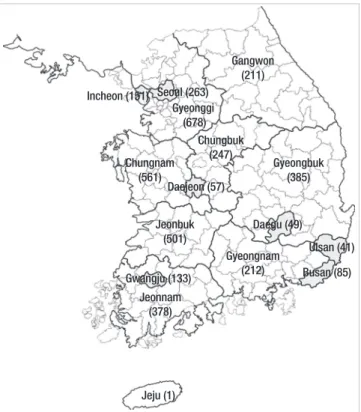
HFRS cases were analyzed by season, geography, and resi- dent area of individuals. The PR of HFRS in spring, summer, au- tumn, and winter was 7.0%, 9.1%, 61.4%, and 22.5%, respective- ly. The PR of HFRS in autumn was significantly higher than that in other seasons (P < 0.001). The HFRS cases predominantly occurred during the last quarter of the calendar year (October, November, and December). A significantly higher number of HFRS cases (P < 0.001) was reported in the western part (prov- inces of Gyeonggi, Chungnam, Jeonbuk, Jeonnam, and Jeju and major cities of Seoul, Incheon, Daejeon, and Gwangju, 68.9%)
Lee S-H, et al. • HFRS in Korea, 2001-2010
http://jkms.org 1553
http://dx.doi.org/10.3346/jkms.2013.28.10.1552
than in the eastern part (provinces of Gangwon, Chungbuk, Gyeongbuk, Gyeongnam and major cities of Daegu, Ulsan, and Busan, 31.1%) of Korea (Fig. 1). Finally, HFRS cases were signif- icantly higher (P < 0.001) in rural areas (80.3%) than in urban areas (19.7%).
This study provides a more updated HFRS prevalence status in the whole population of Korea during the past decade. A pre- vious report addressed annual prevalence and incidence rates of HFRS during the late 1990s only in endemic areas near the demilitarized zone (DMZ) between South and North Korea (7).
The prevalence rate per 100,000 population of HFRS determined in this study was 0.81. In contrast, the annual prevalence of HFRS determined in the previous study was 40-64 per 100,000 mili- tary population in the DMZ areas. Therefore, the prevalence of HFRS could be seriously affected by the regions and populations examined.
This study confirmed that the incidence of HFRS significantly increased in the autumn. In the previous report, an almost iden- tical pattern of HFRS incidence was identified in soldiers in en- demic areas (7). Higher incidence of HFRS in the autumn, ver- sus other seasons, could be attributed to the high numbers of hantavirus-infected rodents in Korea during this time (10, 11).
Seroprevalence of hantaviruses in wild rodents in Korea confi- dently demonstrated that most wild rodent hantavirus infec- tions occur in the autumn. Therefore, increased outdoor activi- ty of people in the autumn, especially in rural areas, would in- crease the probability of hantavirus infection, leading to a high- er incidence of HFRS in the autumn among farmers.
In this study, the HFRS patient numbers and CFR were signi- ficantly higher in men than in women. However, a recent study conducted in China reported that the incidence of HFRS is grea- ter in men, but the CFR is higher in women than in men (12).
The discrepancy of CFRs between Korean and Chinese HFRS patients is an interesting question that requires more thorough epidemiological studies to resolve. In addition, many more HFRS patients were identified in people older than 40 yr and in the western part of Korea. This could be partially explained by a lar- ger population in the western part of Korea and the advanced ages of farmers.
In conclusion, HFRS still occurs commonly among men, in autumn, and in western rural area of Korea. These comprehen- sive epidemiological data would be valuable for developing HFRS control strategies in Korea.
DISCLOSURE
The authors have no conflicts of interest to disclose.
REFERENCES
1. Jonsson CB, Figueiredo LT, Vapalahti O. A global perspective on hanta- virus ecology, epidemiology, and disease. Clin Microbiol Rev 2010; 23:
412-41.
2. Lee HW, Lee PW, Johnson KM. Isolation of the etiologic agent of Korean Hemorrhagic fever. J Infect Dis 1978; 137: 298-308.
Table 1. Prevalence rate, case fatality rate, and other aspects of HFRS
Parameters No. of cases (%) P value* 95% CI
Total No. of patients 3,953
Prevalence rate/100,000 0.81 0.79-0.85
Total No. of death 40
Case-fatality rate in % 1.01 0.7-1.3
Gender of patients Male Female Total
2,252 (57.0) 1,701 (43.0)
3,953
< 0.001 55.5-58.5 41.5-44.5 CFR (%) by sex
Male
Female 29/2,252 (1.3)
11/1,701 (0.7) < 0.05 Age (yr)
< 39
> 40 Total
708 (17.9) 3,245 (82.1)
3,953
< 0.001 16.7-19.1 80.9-83.3 Occupation
Farmers Mistresses White-collar jobs Blue-collar jobs Soldiers Students Other jobs Total
1,407 (35.6) 384 (8.8) 301 (7.6) 222 (5.6) 48 (1.2) 98 (2.5) 1,529 (38.7)
3,953
< 0.001 34.1-37.1 7.9-8.4 6.8-8.4 4.9-6.3 0.9-1.5 2.0-3.0
95% CI, Confidence interval of 95% of the rate; CFR, Case fatality rate.
*Chi-square analysis indicated a significant difference from the total value. Fig. 1. Number of HFRS cases by administrative provinces and special cities of Korea during 2001-2010.
Gangwon (211)
Chungbuk (247) Chungnam
(561)
Jeonbuk (501)
Gyeongbuk (385)
Daegu (49)
Ulsan (41) Gyeongnam
(212) Gwangju (133)
Jeonnam (378)
Jeju (1)
Busan (85) Daejeon (57)
Seoul (263) Gyeonggi
(678) Incheon (151)
Lee S-H, et al. • HFRS in Korea, 2001-2010
1554 http://jkms.org http://dx.doi.org/10.3346/jkms.2013.28.10.1552 3. Lee HW, van der Groen G. Hemorrhagic fever with renal syndrome. Prog
Med Virol 1989; 36: 62-102.
4. Smadel JE. Epidemic hemorrhagic fever. Am J Public Health Nations Health 1953; 43: 1327-30.
5. Park K, Kim CS, Moon KT. Protective effectiveness of hantavirus vaccine.
Emerg Infect Dis 2004; 10: 2218-20.
6. Song JW, Moon SS, Gu SH, Song KJ, Baek LJ, Kim HC, Kijek T, O’Guinn ML, Lee JS, Turell MJ, et al. Hemorrhagic fever with renal syndrome in 4 US soldiers, South Korea, 2005. Emerg Infect Dis 2009; 15: 1833-6.
7. Song JY, Chun BC, Kim SD, Baek LJ, Kim SH, Sohn JW, Cheong HJ, Kim WJ, Park SC, Kim MJ. Epidemiology of hemorrhagic fever with renal syn- drome in endemic area of the Republic of Korea, 1995-1998. J Korean Med Sci 2006; 21: 614-20.
8. Korea Center for Disease Control and Prevention. Hemorrhagic fever with renal syndrome: statistical system of the national notifiable disease
surveillance system (2001-2010). Available at http://www.cdc.go.kr.
9. Ministry of Health and Welfare, Republic of Korea (MHW, ROK). Hem- orrhagic fever with renal syndrome, Incidence for communicable diseas- es (category III). Yearbook of Health and Welfare Statistics (2001-2010).
Seoul: Ministry of Health and Welfare, 2010.
10. Lim MY, Ryou J, Kim SY, Shin EH, Yoo YJ, Yun SM, Noh YT, Han MG, Ju YR. Seroprevalence of hantaviruses in small wild mammals trapped in South Korea from 2005 to 2010. J Vector Ecol 2012; 37: 97-101.
11. Ryou J, Lee HI, Yoo YJ, Noh YT, Yun SM, Kim SY, Shin EH, Han MG, Ju YR. Prevalence of hantavirus infection in wild rodents from five provinc- es in Korea, 2007. J Wildl Dis 2011; 47: 427-32.
12. Klein SL, Marks MA, Li W, Glass GE, Fang LQ, Ma JQ, Cao WC. Sex dif- ferences in the incidence and case fatality rates from hemorrhagic fever with renal syndrome in China, 2004-2008. Clin Infect Dis 2011; 52: 1414- 21.