Analysis of the Shoulder and Elbow Section of the Korean Orthopedic In-training Examination
Joon Yub Kim, Myung Gon Jung, Ki Bum Kwon, Seok Won Chung1
Department of Orthopedic Surgery, Seonam University Myongji Hospital, Goyang, 1Department of Orthopaedic Surgery, Konkuk University School of Medicine, Seoul, Korea
Background: The aim of this study was to analyze the questions in the shoulder and elbow section of the Korean Orthopaedic In-Train- ing Examination (KOITE) and compare them with those of the US Orthopaedic In-Training Examination (US OITE).
Methods: Twenty-nine questions in the shoulder and elbow section of the KOITE from 2010 to 2014 were analyzed and compared with those of the US OITE (80 questions) by literature review. A thorough analysis of the contents was performed after categorizing as topics, diagnostic tools, treatment modalities, taxonomic classification, and references.
Results: The shoulder and elbow section of the KOITE was 5.8% weight which was similar to the US OITE (5.9%). The most commonly appearing topic was anterior labral injury (17.2%) on the KOITE compared to instability and arthritis (21.3%, each) on the US OITE. Mag- netic resonance imaging was most frequently appeared imaging modality on the KOITE (41.0%) compared to the radiograph on the US OITE (43.0%). The Latarjet procedure was the most commonly asked treatment modality (22.2%) on the KOITE, whereas arthroplasty (33.3%) on the US OITE. The KOITE showed an even taxonomic classification distribution compared to the US OITE. Campbell’s opera- tive orthopaedics covered 96.6% questions as a reference on the KOITE compared to the Journal of Bone and Joint Surgery, American Volume on the US OITE, which covered 45.0%.
Conclusions: This specific analysis shows us current trends of the shoulder and elbow section of the KOITE and it might be developed for use in the educational curricula for the trainee.
(Clin Shoulder Elbow 2016;19(2):67-72)
Key Words: Orthopedics; Korean orthopedic in-training examination; Shoulder; Elbow
Copyright © 2016 Korean Shoulder and Elbow Society. All Rights Reserved. pISSN 2383-8337
Clinics in Shoulder and Elbow Vol. 19, No. 2, June, 2016 http://dx.doi.org/10.5397/cise.2016.19.2.67
Received May 31, 2015. Revised December 21, 2015. Accepted January 28, 2016.
Correspondence to: Seok Won Chung
Department of Orthopaedic Surgery, Konkuk University School of Medicine, 120-1 Neungdong-ro, Gwangjin-gu, Seoul 05030, Korea Tel: +82-2-2030-7604, Fax: +82-2-2030-7748, E-mail: [email protected]
Financial support: None. Conflict of interests: None.
Introduction
Residents are required to develop knowledge, technical skills, interpersonal skills, compassion, and an ability to work with oth- ers.1) In-training examination is a well-known tool for assessment of the medical knowledge of residents, and many studies have reviewed and analyzed in-training examinations for various or- thopaedic topics.1-14) The US Orthopaedic In-Training Examina- tion (US OITE) was started in 1963 by the American Academy of Orthopaedic Surgeons and is taken annually.2-8,11-14) The format of the examination has been updated.8,13) Now, the US OITE is computer-based with 275 questions covering 12 different subspecialty sections.2-8,11,13,14) The performance of residents has
been evaluated and compared using the results of this examina- tion and by the extent of their academic development.7-9,13) Resi- dents become aware of their strengths and weaknesses in medi- cal knowledge through the examination,7,8) and the orthopaedic department of each hospital can use the examination results to optimize their curricula because they can be used as a minimal standard during trainee or resident education.1) The Korean Orthopaedic In-Training Examination (KOITE) has been adminis- tered annually since 1980 to second to fourth year orthopaedic residents. However, no analytical or descriptive study has been conducted with respect to the KOITE and only a few have been conducted with regard to the shoulder and elbow section of the US OITE.8,12) Therefore, the purpose of this study was to analyze
the shoulder and elbow section of the KOITE and compare with that of the US OITE by literature review. We hypothesized that the KOITE may not completely cover the shoulder and elbow topics in clinics and that some notable differences could be found compared to US OITE data reported in previous studies.
Methods
This retrospective analysis was performed on the KOITE be- tween 2010 and 2014. A total of 500 questions were examined, and 29 questions in the shoulder and elbow section were identi- fied. First, we reviewed the literature related to the shoulder and elbow section of the US OITE by Osbahr et al.8) as a reference for comparison conducted with data from 2005 to 2009. The contents were analyzed and categorized as topics, diagnostic tools, treatment modalities, taxonomic classification, and refer- ences. The question constructs were categorized according to a single best answer (A type) or an extended matching type ques- tion (R type). The topics were classified based on the diagnosis.
Diagnostic tools were classified according to imaging modalities, physical examinations, and laboratory and neurophysiological tests. The imaging modalities were sub-classified according to X-ray, magnetic resonance imaging (MRI)/magnetic resonance arthrography (MRA), computed tomography/computed tomog- raphy arthrography, clinical pictures, ultrasonography, and mul- timedia. The diagnostic tools were also categorized according to critical or additive based on their roles during problem solving.
If the problem was solved without a diagnostic tool, the ques- tion was categorized as additive and problems that could not be solved without a diagnostic tool were categorized as critical.
Treatment modalities were classified as followings; Latarjet, open reduction with internal fixation, total or reverse shoulder arthroplasty, arthroscopic or open rotator cuff repair, tendon transfer or reconstruction, and rehabilitation. Taxonomy was classified as direct recall or knowledge (class A), diagnosis or evaluation (class B), and decision making or treatment (class C).
The references used in this study were Korean Orthopedic As- sociation (KOA) recommended, including the KOA Textbook of Orthopaedics (7th edition), Campbell’s Operative Orthopaedics (12th edition), Rockwood and Green’s Fractures in Adults and Children (7th edition), the American Academy of Orthopaedic Surgeons Instructional Course Lecture from 2010 to 2014, and the KOA and Clinics in Orthopaedic Surgery (CiOS) journals from 2010 to 2014.
Results
The overall weight of the shoulder and elbow section of the KOITE was 5.8% (29 of 500 questions). The US OITE included 1,351 questions from 2005 to 2009, 2.7 times higher than that on the KOITE. However, the weight of the shoulder and elbow
section on the US OITE (80 questions, 5.9% of weight) was simi- lar to our results.8) Shoulder questions (21 questions, 4.2%) were dominant compared to elbow questions (eight questions, 1.6%) on the KOITE, similar to that on the US OITE (shoulder ques- tions: 69 questions, 5.1%; and elbow questions: 11 questions, 0.8%).
The topics on the KOITE and US OITE are summarized in Table 1. On the KOITE, the top four topics considered during the past 5 years were biceps problems including superior labrum anterior to posterior lesion (17.2%), anterior instability (13.8%), osteoarthritis (10.3%), and pitching elbow (10.3%), whereas the top three topics on the US OITE from 2005 to 2009 were rota- tor cuff pathology (21.3%), arthritis (11.3%), and instability (6.3%).
The US OITE shoulder topics considered more various diseases compared with those on the KOITE, including posterior shoulder dislocation, pectoralis major tendon injuries, adhesive capsuli- tis, acromioclavicular joint dislocation, humeral avulsion of the glenohumeral ligament, inflammatory arthritis, mesoacromiale, scapular dyskinesia, sternoclavicular joint injury, subacromial impingment, subscapularis injury, anesthesia problems, and ba- sic anatomy. The elbow topics tested were somewhat different between the KOITE and the US OITE. Although pitching elbow was the most common topic tested on both in-training examina- tions, the KOITE tested ankylosis, malunion of a distal humerus fracture, pronator teres syndrome, radial nerve palsy, and lateral epicondylitis, and the US OITE tested medial collateral ligament injury, elbow arthroscopy, elbow dislocation, and radial head fracture etc.8)
Among 25 questions regarding diagnostic tools on the KOITE, imaging modalities and physical examination were common, with 10 and 12 times each. Combined presentations of imaging modalities and physical examinations appeared in three ques- tions. Among the 25 questions, 14 questions (56.0%) were criti- cal, and 11 questions (44.0%) were additive.
MRI/MRA was the most commonly used image modality (41%) on the KOITE compared to the radiograph (43%) on the US OITE (Fig. 1). With respect to the physical examination on the KOITE, the Hornblower’s sign and weakness of internal rota- tion and external rotation were asked as rotator cuff injuries, the pop-eye sign appeared in a few questions on biceps rupture, and physical findings related to neurological compromise of the suprascapular, musculocutaneous, median, and radial nerves were also presented. Five of eight elbow-related questions were related to the physical examination and were presented with an additive role rather than a critical role. The KOITE did not include laboratory test-related questions because there were no questions on inflammatory arthritis, sepsis, or infection during the period. Only one question was related to neurophysiological tests, and it was presented with imaging modality and physical examination; therefore, its value was additive.
Twelve of 36 treatment questions (33.3%) on the US OITE
Table 1. Number of Questions on the KOITE and the US OITE Sub-classified according to Shoulder and Elbow Topics by Year
Shoulder-elbow topic KOITE (year) US OITE (year)
2005–2009
2010 2011 2012 2013 2014 Total
Shoulder
Glenohumeral arthritis, arthroplasty 2 1 0 0 0 3 9
Rotator cuff injuries 1 1 1 0 0 3 7
Rotator cuff arthropathy, RTSA 0 0 0 0 0 0 7
Basic science, anatomy 0 1 0 0 0 1 4
Proximal humerus fracture 0 0 0 1 1 2 4
Internal impingement 0 0 0 0 0 0 3
Shoulder dislocation, Latarjet 1 0 0 1 2 4 3
Suprascapular nerve entrapment 0 0 1 0 0 1 3
Multidirectional instability 0 1 0 0 1 2 2
Pectoralis major tendon injuries 0 0 0 0 0 0 2
Biceps tendon rupture and dislocation 0 0 1 1 1 3 0
SLAP 0 0 0 1 1 2 0
Elbow
Radial nerve palsy 1 0 0 0 0 1 0
Pitching 1 0 1 0 1 3 2
Pronator teres syndrome 0 0 0 0 1 1 0
Lateral epicondylitis 0 1 0 0 0 1 0
Medial collateral ligament injuries 0 0 0 0 0 0 4
Distal humerus fracture 0 0 1 0 0 1 0
Ankylosis 0 0 0 0 1 1 0
Nineteen topics on the US OITE were omitted in this table, including acromioclavicular joint dislocation, adhesive capsulitis, anesthesia considerations, biceps tendon injury, clavicular fractures, humeral avulsion of glenohumeral ligament, inflammatory arthritis, mesoacromiale, neuropathic arthropathy, rotator cuff calcific tendinitis, scapular dyskinesis, sternoclavicular subluxation, subacromial impingement, subscapularis injury, elbow arthroscopy, elbow dislocation, lateral epicondylitis, radial head fracture, and triceps rupture.
KOITE: Korean Orthopaedic In-Training Examination, US OITE: United States Orthopaedic In-Training Examination, RTSA: reverse total shoulder arthro- plasty, SLAP: superior labrum anterior to posterior lesion.
2010 2011 2012 2013 2014
5
4
3
2
1
0
KOITE
2005 2006 2007 2008 2009
14
12
10
8
6
4
2
0 Multimedia
Ultrasonography Clinical picture CT/CTA MRI/MRA X-ray
US OITE
MRI and arthroscopic photography Intraoperative photograpy Arthroscopic photography Clinical photography CT
MRI
Radioprapic arthrogram Radiography
Year
Numberofquestions Numberofquestions
Year Fig. 1. Number of questions on the KOITE and the US OITE according to imaging modalities.
KOITE: Korean Orthopaedic In-Training Examination, US OITE: United States Orthopaedic In-Training Examination, CT: computed tomography, CTA: com- puted tomography arthrography, MRI: magmetic resonance imaging, MRA: magnetic resonance arthrography.
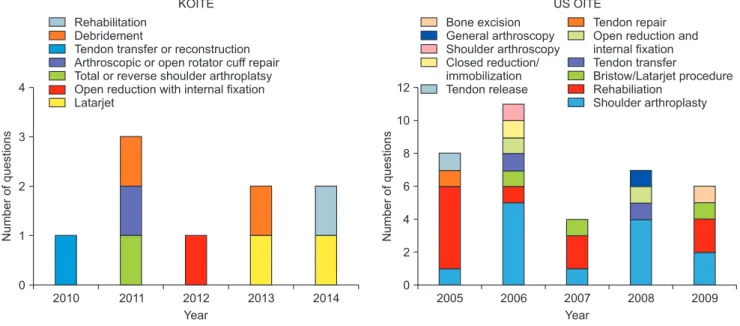
were about arthroplasty and 10 questions (27.8%) were about rehabilitation, whereas one of nine questions (11.1%) on the KOITE were about arthroplasty and one of nine questions (11.1%) were about rehabilitation. Interestingly, the Latarjet procedure was a commonly asked treatment modality and appeared twice on the KOITE (Fig. 2).
The KOITE showed an even taxonomic classification distribu- tion (38% in class A, 31% in class B, and 31% in class C) com- pared to that of the US OITE (50% in class A, 21.3% in class B, and 28.7% in class C).8)
The most commonly cited reference on the KOITE was Campbell’s Operative Orthopaedics (96.6%). The KOA textbook covered 69% of the questions and the KOA and CiOS journals were cited only four times (13.8%) (Table 2). However, the most commonly cited references on the US OITE was the Journal of Bone and Joint Surgery, American Volume, with 36 times (45.0%), and other various orthopaedic journals, the Journal of Shoulder
and Elbow Surgery, American Journal of Sports Medicine, the Journal of the American Academy of Orthopaedic Surgeons, and Arthroscopy: Journal of Arthroscopic and Related Surgery, etc.
were also frequently cited (Table 3)8).
Discussion
Despite its 35-year history, no analytical or descriptive study has been conducted on the KOITE. As faculty members and orthopedic surgeons at training hospitals with the shoulder and elbow surgery subspecialty, the interest in the orthopaedic resi- dents training as well as the interest in the roles for the KOITE led us to start this study.
Only four to eight questions in the shoulder and elbow sec- tion on the KOITE were included each year during the study period (2010 to 2014). Therefore, the range of shoulder and el- bow topics tested by the KOITE was somewhat limited (total 29
2010 2011 2012 2013 2014
4
3
2
1
0
2005 2006 2007 2008 2009
12
10
8
6
4
2
0
US OITE KOITE
Rehabilitation Debridement
Tendon transfer or reconstruction Arthroscopic or open rotator cuff repair Total or reverse shoulder arthroplatsy Open reduction with internal fixation Latarjet
Bone excision General arthroscopy Shoulder arthroscopy Closed reduction/
immobilization Tendon release
Tendon repair Open reduction and internal fixation Tendon transfer
Bristow/Latarjet procedure Rehabiliation
Shoulder arthroplasty
Year
Numberofquestions Numberofquestions
Year Fig. 2. Number of questions on the KOITE and the US OITE according to treatment modalities.
KOITE: Korean Orthopaedic In-Training Examination, US OITE: United States Orthopaedic In-Training Examination.
Table 2. Number of Questions on the KOITE according to Recommended Reference by Year
Reference KOITE (year)
2010 2011 2012 2013 2014 Total
Textbook of Korean Orthopedic Association (7th edition) 4 6 3 3 4 20
Campbell’s operative orthopedics (12th edition) 5 6 5 4 8 28
Rockwood and Green’s fractures in adults and children (7th edition) 3 5 1 3 3 15
ICL of AAOS 2 5 3 3 5 18
The journal of KOA, CiOS 1 0 0 1 2 4
KOITE: Korean Orthopedic In-Training Examination, ICL: instructional course lecture, AAOS: American Academy of Orthopaedic Surgeons, KOA: Korean Orthopedic Association, CiOS: Clinics in Orthopaedic Surgery.
questions during the study period) compared to that of the US OITE (total 80 questions between 2005 and 2009). Even though the weight of the shoulder and elbow section was similar to that of the US OITE (5.8% and 5.9%, respectively), the increase of the weight of the shoulder and elbow section questions on the KOITE or the increase of the absolute numbers of questions on the KOITE leaving the current weight of shoulder and elbow section appears to be required for more accurate and reliable analysis.
According to the data of the Health Insurance Review & As- sessment Service (HIRA) in 2014,15) 1,960,132 patients were treated for shoulder diseases (ICD-10; M 75) including rotator cuff tear or disease, biceps tendinitis, adhesive capsulitis, calcific tendinitis, and bursitis. In detail, adhesive capsulitis (ICD-10; M 750) was the most commonly treated disease with incidence of 734,802 and 446,512 patients were treated for rotator cuff tears or diseases (ICD-10; M 758 and M 759), 35,9539 impingement syndromes (ICD-10; M 754), and 103,886 calcific tendinitis (ICD-10; M 753) were treated in 2014.15) In addition, 156,384 patients were treated for traumatic rotator cuff tears (ICD-10;
S 46); however, only 17,998 patients were treated for shoulder dislocation (ICD-10; S 430) in 2014.15) Despite these statistics on the prevalence of shoulder disease, questions regarding ro- tator cuff pathology including rotator cuff tears, impingement syndromes, and rotator cuff tear arthropathy appeared only 3 times during 5 years of this study period, compared to the 17 questions on the US OITE between 2005 and 2009. The ques- tions in the shoulder section of the KOITE appeared to be rela- tively deviated to the anterior instability with the appearance of 4 questions during the study period; however, only 3 questions regarding rotator cuff pathology appeared in the same period.
Considering the prevalence of shoulder disease in Korea as well as results of study by the US OITE,8,15) we think that the ques- tions in the shoulder section of the KOITE should be developed
to cover more various shoulder disease.
Higher prevalence of questions on glenohumeral joint (GHJ) arthritis (9 of 46 shoulder topics) and arthroplasty (12 of 36 treatment questions in the shoulder section) on the US OITE,8) compared to questions on GHJ arthritis (3 of 21 questions) and arthroplasty (1 of 9 questions) on the KOITE, might be due to higher prevalence of GHJ arthritis in the US rather than Korea (32.8% prevalence in US [>60 years] vs. 16% prevalence [>65 years] in Korea).16-18) According to HIRA,15) there were 39,480 elbow dislocations (S 531) in 2014; however no question on elbow dislocation was asked in on the KOITE during the study period, although there were 3 questions on pitching elbow in the same period. We think that the questions in the elbow sec- tion of the KOITE should also be developed to reflect the clinical circumstances to include elbow fracture and dislocations and lateral epicondylitis rather than pitching elbow, and those efforts will be important to orthopaedic residents who might start a practice.
The reference of the KOITE is mainly focused on textbooks including Campbell’s operative orthopaedics and the KOA text- book. The expansion of references to SCI(E)-level journals could be considered to catch up with recent advances in shoulder and elbow surgery. In addition, the KOA and CiOS journals should be cited more frequently to attract the passion and interest of orthopedic residents to these journals.
We observed a discrepancy between the topics tested on the KOITE and US OITE as well as the topics we frequently encoun- ter in the orthopaedic clinic; therefore, the current KOITE shoul- der and elbow section questions may be inappropriate for re-or- ganizing educational programs in the orthopaedic departments of training hospitals. We think that the Korean orthopaedic board examination committee can use our data in development of more appropriate questions in the future. In addition, our re- sults may be helpful to orthopaedic residents in preparation for Table 3. Number of Questions on the US OITE according to Recommended Reference by Year
Reference US OITE (year)
2005 2006 2007 2008 2009 Total
Journal of Bone and Joint Surgery, American Volume (J) 6 9 4 7 10 36
Journal of Shoulder and Elbow Surgery (J) 9 9 2 4 1 25
American Journal of Sports Medicine (J) 4 2 8 1 3 18
Journal of the American Academy of Orthopaedic Surgeons (RJ) 2 1 3 3 3 12
Arthroscopy: Journal of Arthroscopic and Related Surgery (J) 4 3 4 1 0 12
Journal of Bone and Joint Surgery, British Volume (J) 0 0 2 5 1 8
Orthopedic Clinics of North America (RJ) 4 2 1 0 0 7
Others 4 4 3 8 6 25
US OITE: United States Orthopaedic In-Training Examination, J: journal, RJ: review journal, Others: Journal of Arthroplasty, Orthpaedic Knowledge Update Shoulder and Elbow (Review Book), Orthopaedic Knowledge Update Sports Medicine (Review Book), Master Technique in Orthopaedic Surgery: The Shoulder (Book), Instructional Course Lectures (Review Book), American Journal of Orthopedics, Clinics in Sports Medicine (Review Journal).
their in-training tests as well as for the Korean orthopaedic board examination.
This is the first study to analyze the questions of the shoulder and elbow section of the KOITE. However, several limitations of our study should be considered. First, we did not evaluate orthopaedic resident’s scores; therefore, our knowledge regard- ing whether the structure of the KOITE shoulder and elbow sec- tion is educationally appropriate may be incomplete. Second, we were unaware of the analytical results for the other KOITE sections compared to those on the US OITE, therefore we do not know whether the differences observed were unique to the shoulder and elbow section compared to the other KOITE sections. Finally, the study period was somewhat limited, from 2010 to 2014, and there was a time difference from the study by Osbahr et al.8) for the US OITE analysis (from 2005 to 2009), although the duration was the same, with 5 years.
Conclusion
This specific analysis shows us the current trend of the shoul- der and elbow section on the KOITE. The shoulder and elbow section should be developed in number to cover various diseas- es of shoulder and elbow as the US OITE. Further development of questions on the KOITE based on results from this study might optimally reflect the educational curricula of orthopedic trainees in the future.
References
1. Black KP, Abzug JM, Chinchilli VM. Orthopaedic in-training examination scores: a correlation with USMLE results. J Bone Joint Surg Am. 2006;88(3):671-6.
2. Barr CR, Cheng I, Chou LB, Hunt KJ. Foot and ankle questions on the orthopaedic in-training examination: analysis of con- tent, reference, and performance. Orthopedics. 2012;35(6):
e880-8.
3. Cross MB, Osbahr DC, Nam D, Reinhardt KR, Bostrom MP, Dines JS. An analysis of the hip and knee reconstruction sec- tion of the orthopaedic in-training examination. Orthopedics.
2011;34(9):e550-5.
4. Farjoodi P, Khanna AJ, Marker DR, Frassica FJ. Evaluation of the Orthopaedic In-Training Examination: spine questions. J Surg Educ. 2010;67(3):139-42.
5. Krueger CA, Shakir I, Fuller BC. Prevalence of answers to orthopaedic in-training examination questions in 3 com- monly used orthopedic review sources. Orthopedics.
2012;35(9):e1420-6.
6. Marker DR, Mont MA, McGrath MS, Frassica FJ, LaPorte DM.
Current hand surgery literature as an educational tool for the orthopaedic in-training examination. J Bone Joint Surg Am.
2009;91(1):236-40.
7. Osbahr DC, Cross MB, Bedi A, et al. Orthopaedic in-training examination: an analysis of the sports medicine section. Am J Sports Med. 2011;39(3):532-7.
8. Osbahr DC, Cross MB, Taylor SA, Bedi A, Dines DM, Dines JS. An analysis of the shoulder and elbow section of the ortho- pedic in-training examination. Am J Orthop (Belle Mead NJ).
2012;41(2):63-8.
9. Papp DF, Ting BL, Sargent MC, Frassica FJ. Analysis of the pe- diatric orthopedic surgery questions on the Orthopaedic In- Training Examination, 2002 through 2006. J Pediatr Orthop.
2010;30(5):503-7.
10. Sayeed SA, Marker DR, Mears SC, Delanois RE, Mont MA. Re- constructive knee surgery literature as a tool for the orthopae- dic in-training examination. Bull NYU Hosp Jt Dis. 2011;69(2):
168-72.
11. Sheibani-Rad S, Arnoczky SP, Walter NE. Analysis of the basic science section of the orthopaedic in-training examination.
Orthopedics. 2012;35(8):e1251-5.
12. Srikumaran U, Freehill MT, Spiker AM, McFarland EG, Pe- tersen SA. Evaluation of shoulder and elbow questions on the orthopaedic in-training examination as an instrument for en- hancing examination preparation. J Bone Joint Surg Am. 2011;
93(11):e63.
13. Srinivasan RC, Seybold JD, Kadakia AR. Analysis of the foot and ankle section of the Orthopaedic In-Training Examination (OITE). Foot Ankle Int. 2009;30(11):1060-4.
14. Taylor BC, Fowler TT. Analysis of the trauma section of the or- thopaedic in-training examination. Orthopedics. 2011;34(7):
e261-6.
15. Health Insurance Review & Accessment Service (HIRA) [In- ternet]. Wonju: HIRA; 2014 [cited 2015 May 31]. Available from: http://www.hira.or.kr/rd/dissdic/infoSickList.do?sickType
=1&pgmid=HIRAA020044020100.
16. Kerr R, Resnick D, Pineda C, Haghighi P. Osteoarthritis of the glenohumeral joint: a radiologic-pathologic study. AJR Am J Roentgenol. 1985;144(5):967-72.
17. Oh JH, Chung SW, Oh CH, et al. The prevalence of shoul- der osteoarthritis in the elderly Korean population: associa- tion with risk factors and function. J Shoulder Elbow Surg.
2011;20(5):756-63.
18. Petersson CJ. Degeneration of the gleno-humeral joint. An anatomical study. Acta Orthop Scand. 1983;54(2):277-83.