• 검색 결과가 없습니다.

Internal Drainage of an Esophageal Perforation in a Patient with a High Surgical Risk

N/A
N/A
Protected

Academic year: 2021

Share "Internal Drainage of an Esophageal Perforation in a Patient with a High Surgical Risk"

Copied!
4
0
0

로드 중.... (전체 텍스트 보기)

전체 글

(1)

ISSN: 2233-601X (Print) ISSN: 2093-6516 (Online)

− 395 −

Received: November 3, 2016, Revised: December 5, 2016, Accepted: December 6, 2016, Published online: October 5, 2017

Corresponding author: Jong Ho Cho, Department of Thoracic and Cardiovascular Surgery, Samsung Medical Center, Sungkyunkwan University School of Medicine, 81 Irwon-ro, Gangnam-gu, Seoul 06351, Korea

(Tel) 82-2-3410-0289 (Fax) 82-2-3410-6986 (E-mail) [email protected]

© The Korean Society for Thoracic and Cardiovascular Surgery. 2017. All right reserved.

This is an open access article distributed under the terms of the Creative Commons Attribution Non-Commercial License (http://creativecommons.org/

licenses/by-nc/4.0) which permits unrestricted non-commercial use, distribution, and reproduction in any medium, provided the original work is properly cited.

Internal Drainage of an Esophageal Perforation in a Patient with a High Surgical Risk

Hongsun Kim, M.D. 1 , Younghwan Kim, M.D. 1 , Jong Ho Cho, M.D., Ph.D. 1 , Yang Won Min, M.D., Ph.D. 2

Departments of

1

Thoracic and Cardiovascular Surgery and

2

Medicine, Samsung Medical Center, Sungkyunkwan University School of Medicine

A 71-year-old man presented with a productive cough and fever, and he was diagnosed as having an esoph- ageal perforation and a mediastinal abscess. He had a history of traumatic hemothorax and pleural drainage for empyema in the right chest and was considered unable to tolerate thoracic surgery because of sepsis and progressive aspiration pneumonia. In order to aggressively drain the mediastinal contamination, we per- formed internal drainage by placing a Levin tube into the mediastinum through the perforation site. This procedure, in conjunction with controlling sepsis and providing sufficient postpyloric nutrition, allowed the esophageal injury to completely heal.

Key words: 1. Esophageal perforation 2. Mediastinitis

Case report

A 71-year-old man with symptoms including a pro- ductive cough and fever was transferred to our emergency room. He underwent endoscopic removal of a fish bone and 1 week later was admitted to a local clinic for symptoms suggestive of mediastinitis.

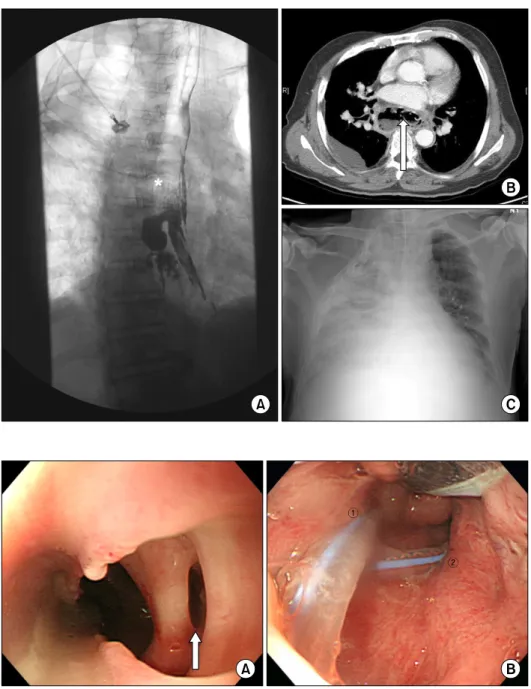
However, no mucosal defect was found during an esophageal endoscopic examination, and he was con- servatively managed with nothing by mouth and antibiotics. After the productive cough and fever pro- gressed, chest computed tomography (CT) was per- formed at the clinic, and the CT scan showed a wide esophageal perforation, mediastinal abscess, and right pleural empyema. Upon arrival at our institution, his blood pressure was steady, but he was tachypneic. A gastrografin esophagogram showed a perforation in the middle thoracic esophagus (Fig. 1).

Urgent intervention was necessary, but the aspira- tion pneumonia progressed while the patient was in the intensive care unit. Moreover, he had a history of traumatic hemothorax and pleural drainage for em- pyema in the right chest, and there were some calci- fied pleural lesions visib le in the CT scan. We thought that a right-side approach in the chest, which is the conventional option, would be time-consuming and present a high risk. Considering the patient’s septic condition and perioperative risk, we decided to avoid intervention with a thoracic incision, and therefore chose to perform neither a conventional thoracotomy nor video-assisted thoracoscopic surgery. Instead, we performed posterior mediastinal drainage with the Barovac PS400L (Sewoon Medical Co. Ltd., Cheonan, Korea) by making an incision on the left side of the neck on the second hospital day. However, the drain- age seemed insufficient. On the following day, an

Korean J Thorac Cardiovasc Surg 2017;50:395-398 □ CASE REPORT □

https://doi.org/10.5090/kjtcs.2017.50.5.395

(2)

Hongsun Kim, et al

− 396 −

Fig. 1. Initial workup images. (A) Gastrografin esophagogram showing a perforation (*) in the middle of the thoracic esophagus. (B) Chest computed tomography scan show- ing a wide esophageal perforation (arrow), mediastinal abscess, and right pleural empyema. (C) Chest radiograph showing increased hazi- ness in the entire right lung due to aspiration pneumonia.

Fig. 2. Initial esophageal esophago- gram. (A) A 4-cm perforation (ar- row) is shown. (B) One Levin tube ( ①) was placed in the stomach, and another ( ②) Levin tube was placed in the mediastinum through the perforation.

esophageal endoscopy was performed, and results showed multiple sites of wall injuries; one perfo- ration site was 26–30 cm from the incisor, another 3-mm perforation was 32 cm from the incisor, and a 2.5-cm-deep laceration was 35 cm from the incisor.

We then inserted 2 Levin tub es via esophageal en- doscopy: one 12-Fr tub e was inserted into the me- diastinum through the larger perforation site for in- ternal mediastinal drainage and another 12-Fr tube was inserted into the stomach for gastric drainage (Fig. 2). After Stenotrophomonas maltophilia was identified during the initial microbiological culture of

the sputum, the antibiotic regimen was adjusted.

We started continuous suction of 60–80 mm Hg

both for the internal mediastinal drainage and for

the gastric drainage. After beginning the aggressive

mediastinal and gastric drainage, the patient’s con-

dition improved. On the ninth hospital day, we per-

formed a jejunostomy to provide sufficient nutritional

support and a gastrostomy for gastric drainage and

to allow one Levin tub e to b e removed. We main-

tained continuous suction for the internal mediastinal

drainage, but we started natural drainage during the

jejunostomy and gastrostomy. The patient was ex-

(3)

Internal Drainage of an Esophageal Perforation

− 397 −

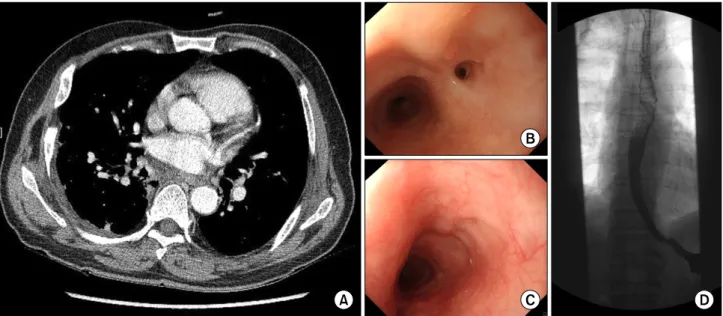
Fig. 3. Follow-up CT scan, endoscopic image, and esophagogram. (A) Chest CT scan showing a notable decrease in the extent of the me- diastinal abscess. (B) Endoscopic image showing that the previous injury sites were nearly healed, with a 0.5-cm defect remaining. (C) Endoscopic image after 6 months after the initial presentation, showing that the esophageal injury has completely healed. (D) Esophagogram showing no evidence of leakage. CT, computed tomography.

tubated on the 11th hospital day, and then he was moved to the general ward on the 18th hospital day.

The next day, we turned off the suction for the me- diastinal drainage and started to drain naturally, be- cause the amount of drainage was sufficiently reduced.

The microbiologic culture obtained on the 13th hos- pital day showed no pathologic microorganism other than normal flora, and the results of multiple consec- utive microbiologic cultures were the same.

The remaining Levin tube for the internal drainage was removed on the 25th hospital day. At the fol- low-up endoscopic examination on the 26th hospital day, the previous injury sites were nearly healed, and there was only a 0.5-cm defect 28 cm from the incisor (Fig. 3). According to the follow-up chest CT scan obtained on the 29th hospital day, there was a notab le decrease in the extent of the mediastinal abscess. The follow-up esophagogram on the 39th hospital day showed no evidence of leakage, so the patient was started on an oral diet. Finally, the pa- tient was discharged on the 46th hospital day. There were no abnormal findings on the last follow-up esophagogram and endoscopic examination 6 months after the initial presentation.

Discussion

Esophageal perforation is rare, but it is a highly le- thal condition characterized by transmural disruption of the esophagus and contamination of the media- stinum by gastric and oral secretions. In 1947, an ag- gressive surgical treatment for spontaneous esoph- ageal perforation was introduced [1], and since then, a number of other treatment options have been tested. However, because esophageal perforation is rare and results from extremely heterogeneous caus- es, there is a lack of convincing data to form a con- sensus for treatment.

The goals of managing an esophageal perforation are to control the source of the sepsis, close the per- foration, and drain the associated contamination. The definitive surgical treatment is to either surgically re- pair the perforation [2] or perform an esoph- agectomy [3]. Nondefinitive treatment options include endoscopy (stent grafting, endoscopic clipping, and endoscopic vacuum-assisted closure [E-VAC]) [4], sur- gical drainage or debridement, T-tube repair, and esophageal exclusion.

Biancari et al. [5] conducted a systematic review

and meta-analysis of 75 previous studies regarding

esophageal perforation in adults. They reported a

(4)

Hongsun Kim, et al

− 398 − mortality rate of 11.9%, with a mean hospital stay of 32.9 days. Many studies and reviews have associated surgical treatment within 24 hours with a successful outcome [6]. However, Biancari et al. [5] found that a treatment delay of >24 hours was associated with a risk ratio of 2.28, but this was not confirmed by a meta-regression analysis. Sudarshan et al. [7] also re- ported that time to treatment was not associated with the management of outcomes.

E-VAC is a novel technique for managing an esoph- ageal perforation. E-VAC was first used with good re- sults in the treatment of rectal anastomotic leakages.

It was later used to close leaks from perforations in the upper gastrointestinal tract. Recent studies have shown the overall success of E-VAC in such cases to be 84%–100% [8]. The main complication associated with E-VAC is post-therapy stenosis. In fact, we tried to perform E-VAC at the perforation site before the internal mediastinal drainage, but we failed due to technical issues.

In our case, the cause of the esophageal perfo- ration was uncertain, as it could have b een the result of a foreign body (a fish bone) or an iatrogenic cause. Considering the time to treatment (>24 hours) and the progression of the aspiration pneu- monia, primary repair of the perforation was not a feasible option for the patient. Additionally, we did not think the patient could tolerate surgery. Therefore, we decided to perform the aggressive mediastinal drainage by less-invasive methods, along with the in- sertion of a posterior mediastinal drainage catheter.

After the trial E-VAC failed, we performed the in- ternal drainage by placing one Levin tube into the mediastinum through the perforation site, and we performed a gastric drainage with another Levin tube. With aggressive drainage of the associated con- tamination, control of the sepsis, and sufficient post- pyloric nutrition, the patient recovered, and the esophageal injury healed.

There is a lack of evidence to support performing internal drainage of a benign esophageal perforation.

The drainage was conducted using continuous suc- tion of 80 mm Hg, based on the E-VAC method, but there is no evidence that specifically supports this step. However, when a patient with an esophageal perforation and a mediastinal abscess has a high per- ioperative risk for thoracic surgery, and especially when E-VAC has failed, internal drainage should be considered in conjunction with other adjuvant pro- cedures.

Conflict of interest

No potential conflicts of interest relevant to this article are reported.

References

1. Barrett NR. Report of a case of spontaneous perforation of the oesophagus successfully treated by operation. Br J Surg 1947;35:216-8.

2. Cho S, Jheon S, Ryu KM, Lee EB. Primary esophageal repair in Boerhaave’s syndrome. Dis Esophagus 2008;21:660-3.

3. Seo YD, Lin J, Chang AC, Orringer MB, Lynch WR, Reddy RM. Emergent esophagectomy for esophageal perfo- rations: a safe option. Ann Thorac Surg 2015;100:905-9.

4. Ooi G, Burton P, Packiyanathan A, et al. Indications and efficacy of endoscopic vacuum-assisted closure therapy for upper gastrointestinal perforations. ANZ J Surg 2016 Nov 15 [Epub]. https://doi.org/10.1111/ans.13837.

5. Biancari F, D’Andrea V, Paone R, et al. Current treatment and outcome of esophageal perforations in adults: system- atic review and meta-analysis of 75 studies. World J Surg 2013;37:1051-9.

6. Brinster CJ, Singhal S, Lee L, Marshall MB, Kaiser LR, Kucharczuk JC. Evolving options in the management of esophageal perforation. Ann Thorac Surg 2004;77:1475-83.

7. Sudarshan M, Elharram M, Spicer J, Mulder D, Ferri LE.

Management of esophageal perforation in the endoscopic era: is operative repair still relevant? Surgery 2016;160:

1104-10.

8. Mennigen R, Senninger N, Laukoetter MG. Novel treatment

options for perforations of the upper gastrointestinal

tract: endoscopic vacuum therapy and over-the-scope

clips. World J Gastroenterol 2014;20:7767-76.

수치

Fig. 1. Initial workup images. (A)  Gastrografin esophagogram showing  a perforation (*) in the middle of  the thoracic esophagus
Fig. 3. Follow-up CT scan, endoscopic image, and esophagogram. (A) Chest CT scan showing a notable decrease in the extent of the me- me-diastinal abscess

참조

관련 문서

A and E, In control group, a small amount of new bone was observed at the margin of bone defect (40×); B and F, In experimental group 1, a large amount of new bone was formed

 In the present study, as a preliminary study, a LACC-based Compton CT was developed to estimate the activity of the spot inside the radioactive waste drum. To

A positive-feedback loop is formed by an amplifier and a frequency-selective network Figure 13.1 The basic structure of a sinusoidal oscillator.. A positive feedback loop is

출처 : IAEA 발표 자료(Comprehensive inspection exercise at bulk handling facilities, “U-235 Enrichment measurements by gamma-ray spectroscopy”) 13.  Uranium

Since every classical or virtual knot is equivalent to the unknot via a sequence of the extended Reidmeister moves together with the forbidden moves, illustrated in Section 2,

▣ 신경계 짂단과 검사.. 1) 컴퓨터 단층 촬영술(Computed Tomography Scan, CT scan) - 조 영젗를 주사하거나 조영젗 투여 없이 뇌의 3차원적읶 영상을 얻는

1 John Owen, Justification by Faith Alone, in The Works of John Owen, ed. John Bolt, trans. Scott Clark, "Do This and Live: Christ's Active Obedience as the

Method We obtained blood samples from 49 patients who underwent surgical treatment for esophageal squamous cell cancer (ESCC) We performed ctDNA analysis with