Printed in the Republic of Korea DOI 10.5012/jkcs.2011.55.2.243
5-(Heteroaryl)isoxazole계 화합물의 합성 및 항균 활성
R. Janaki RamaRao, A. K. S. Bhujanga Rao*, N. Sreenivas, B. Suneel kumar, and Y. L. N. Murthy† Natco Research Centre, Natco Pharma Ltd., Hyderabad, Andhra Pradesh, PIN. 500018, India.
†Department of Organic Chemistry, Andhra University, Visakhapatnam, Andhra Pradesh, PIN. 530003, India (접수 2010. 9. 1; 수정 2010. 10. 12; 게재확정 2010. 12. 22)
Synthesis and Antibacterial Activity of Novel 5-(heteroaryl)isoxazole Derivatives
R. Janaki RamaRao, A. K. S. Bhujanga Rao*, N. Sreenivas, B. Suneel kumar, and Y. L. N. Murthy† Natco Research Centre, Natco Pharma Ltd., Hyderabad, Andhra Pradesh, PIN. 500018, India.
*E-mail: [email protected]
†Department of Organic Chemistry, Andhra University, Visakhapatnam, Andhra Pradesh, PIN. 530003, India (Received September 1, 2010; Revised October 12, 2010; Accepted December 22, 2010)
요 약. Isoxazole계 화합물을 합성하고 항균활성연구를 수행하였다. 3-Di(alkylamino)acryloalkanones을 hydroxylamine hydrochloride 또는 hydroxylamine-O-sulphonic acid와 반응시켜서 target isoxazole계 화합물을 합성하였다.
주제어: Isoxazole계 화합물, 3-di(alkylamino)acryloalkanones, Hydroxylamine hydrochloride, Hydroxylamine-O-sulphonic acid, 항균활성
ABSTRACT. The synthesis, characterization and antibacterial activity of novel isoxazole derivatives were reported. 3-Di (alkylamino)acryloalkanones were prepared and used as synthons to get the target isoxazole derivatives via reaction with hydroxylamine hydrochloride or hydroxylamine-O-sulphonic acid.
Keywords: Isoxazole derivatives, 3-di(alkylamino)acryloalkanones, Hydroxylamine hydrochloride, Hydroxylamine-O-sulphonic acid, Antibacterial activity
INTRODUCTION
Recently the opportunistic infectious diseases have become the most serious problem in chemotherapy. They have been mainly caused by troublesome Gram-negative bacteria, especially Pseudomonas aeruginosa. Further- more, the infectious diseases caused by other glucose non- fermenting Gram-negative rods and anaerobic bacteria, have gradually increased. The situations have stimulated the search for newer antibacterial agents.
The heterocyclic core in the molecules shows some interesting biological profiles such as antimalarials,1 and diuretic2 properties. Compounds containing isoazoline and isoxazole nuclei are known to possess antiinflammatory, antihypertensive, bactericidal, and other types of biolog- ical activity. Sulpha drugs such as sulfisoxazole, sulpha- methoxazole, and some penicillin derivatives (cloxacillin and oxacillin) having isoxazole moiety were knownto exhibit antimicrobial properties.3-6 The chemical structures of these compounds are mentioned in Fig. 1. Some drugs
having isoxazole moiety exhibit antipsychotic and neu- roleptic activity.7,8
The prevalence of isoxazole core in natural and bio- logically active molecules has stimulated the need for developing novel isoxazole derivatives which exhibit a wide array of biological activities. The preparation of biheterocyclic compounds represents an important strategy in organic synthesis and provides interesting substances for subsequent biological evaluation. Hence in the current work, we aimed to synthesize novel 5-(heteroaryl)isox- azole derivatives and to evaluate antibacterial activity of these compounds. The heteroaryl moiety of these 5-(het- eroaryl)isoxazole derivatives has been chosen from 5- and 6-membered heterocyclic compounds, particularly pyri- dine, pyrazine, thiophene, bromothiophene and furan. A total fourteen 5-(heteroaryl)isoxazole derivatives 1(a-n) were synthesized and the evaluation of antibacterial activ- ity of these compounds was also studied. Among the above isoxazole derivatives compounds 1b, 1d, 1f and 1h are known in the literature.9-11
The synthetic process for the preparation of the 5-(het- eroaryl)isoxazole derivatives 1(a-n) of the current work involves the familiar [3+2] route of isoxazoles containing C-C-C and N=O fragments. The C-C-C synthon is reacted with N=O synthon in a suitable solvent to get the required isoxazole derivative. In the synthesis of novel 5-(het- eroaryl)isoxazoles, we employed 3-(dimethylamino)acryloal- kanone (2) as C-C-C synthon and hydroxylamine hydro- chloride or hydroxylamine-O-sulfonic acid as the N=O synthon. 3-(Dimethylamino)acryloalkanone 2(a-n) are reacted with hydroxylamine hydrochloride or hydroxy- lamine-O-sulfonic acid in methanol to afford the required 5-(heteroaryl)isoxazole derivatives. The synthetic path- way and the structural formulae of 5-(heteroaryl)isox- azoles 1(a-n) of current study are depicted in Scheme 1.
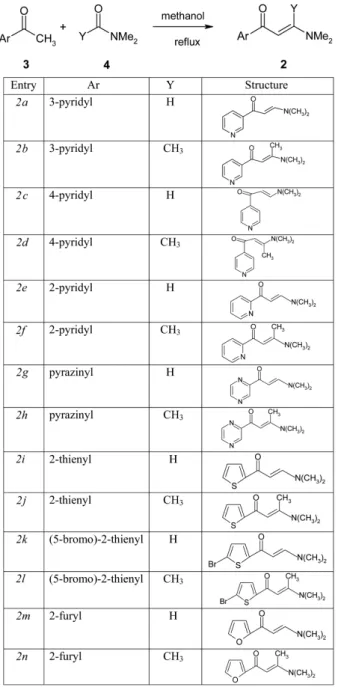
The synthesis of the key intermediates, 3-(dimethy- lamino)acryloalkanone 2(a-n) comprises of, coupling of suitable heteroarylketone (3) with N,N-dimethylformamide dimethyl acetal or with N,N-dimethylacetamide dimethyl acetal (4) in refluxing methanol12. The synthetic pathway and the structural formulae of 3-(dimethylamino)acry- loalkanone 2(a-n) are given in Scheme 2.
Antibacterial activity of the 5-(heteroaryl)isoxazoles 1(a-n) was tested by employing sulfamethoxazole as ref- erence standard.
RESULTS AND DISCUSSION
Novel 5-(heteroaryl)isoxazoles 1(a-n) were prepared by reacting 3-dimethylamino acryloalkanone 2(a-n) (C-C-C synthon, 1.0 mole), with hydroxylamine-O-sulphonic acid or hydroxylamine hydrochloride (N=O synthon, 1.1 mole) in methanol. Reactions required reflux temperatures with hydroxylamine hydrochloride whereas room temperature was sufficient with hydroxylamine-O-sulphonic acid. Reac- tions were monitored by TLC and the products were iso-
lated by conventional techniques such as crystallization and column chromatography. Yields of the products were Fig. 1. Chemical structures of sulfisoxazole, sulphamethoxazole,
cloxacillin, and oxacillin.
Scheme 1. Synthesis of novel 5-(heteroaryl)isoxazole compounds 1(a-n).
found to be moderate to low and purities were greater than 98% (HPLC).
The C-C-C synthon, 3-(dimethylamino)acryloalkanones 2(a-n) were synthesized by reacting the suitable heteroar- ylketone (1 mole) with N,N-dimethylformamide dimethyl acetal or N,N-dimethylacetamide dimethyl acetal (1.3 mole) in methanol at reflux temperature. The products were iso- lated by simple crystallization technique with purity (HPLC) above 99%. The yield of the products ranged from mod- erate to good.
All 5-(heteroaryl)isoxazole compounds (1a-n) were tested
for their antibacterial activity against E. coli (NCIM 2065), Staphylococcus aureus (NCIM 2079), Pseudomonas aerug- inosa (NCIM 2200) by cup plate method. All test strains were maintained on nutrient agar slants and were subcul- tured.These bacteria also served as test pathogens for the assay.
Solutions of isoxazole molecules were made in DMSO at a concentration of 200 mg/mL under aseptic conditions.
The antibacterial activity of these isoxazoles were com- pared with that of sulfamethaxazole as reference antibac- terial agent. Compounds 1j and 1k which contain 2-thienyl and (5-bromo)-2-thienyl moieties in the fifth position of 5-heteroarylisoxazoles displayed good antibacterial activ- ity against E. coli, Pseudomonas aeruginosa, Staphylo- coccus aureus (Table 1).
CONCLUSION
In conclusion, fourteen 5-(heteroaryl)isoxazoles com- pounds 1(a-n) bearing various heteroaryl moieties were synthesized and their antibacterial activity studied against E. coli (NCIM 2065), Staphylococcus aureus (NCIM 2079), Pseudomonas aeruginosa (NCIM 2200) employing sul- famethoxazole as reference standard. The potencies of these molecules varied, depending upon the nature of het- eroaryl moiety substituted in the fifth position of 5-(het- eroaryl)isoxazoles. Significant activity is observed for compounds 1j and 1k which contain 2-thienyl and (5- bromo)-2-thienyl moieties in the fifth position.
EXPERIMENTAL
All reactions were monitored by thin layer chromatog- raphy carried out on 0.2 mm E. Merck silica gel plates (60F-254) using UV light as a visualizing agent. All sol- vents were obtained from commercial sources and freshly distilled before use. The 1H NMR and 13C NMR spectra were recorded on Bruker 400-MHz spectrometer. The chemical shifts are reported in d parts per million (ppm) relative to TMS. The IR spectra were recorded in liquid Scheme 2. Synthesis of 3-(dialkylamino)acryloalkanones 2(a-n).
Table 1. Bacterial activity of isoxazoles at 200 mg/mL-zones of inhibition
Compound E. coli Pseudomonas areginosa
Staphylococ- cus aureus 1j 15±0.2 mm 18±0.2 mm 30±0.2 mm 1k 14±0.2 mm 16±0.2 mm 26±0.2 mm Sulfamethoxazole
(reference) 28±0.2 30±0.2 mm 40±0.2 mm
state in KBr cell and solid state as KBr dispersion using Perkin-Elmer FT-IR spectrometer. The Mass Spectra were recorded on Waters Quattro Micro LC/MS/MS. Analyt- ical HPLC was performed on a Waters system equipped with a UV detector set at 225 nm. Compounds were dis- solved in the mobile phase and injected through a 100 µL loop. The following eluent system was used: 0.01 M H3PO4 solution and acetonitrile (750:250 ratio). HPLC retention times (tR) were obtained, at flow rates of 1.0 ml/min, using Kromasil C18 5 (250 × 4.6 mm) column and isocratically run up to 60 min.
Synthesis of 3-Dimethylaminoacryloalkanones (C- C-C synthons), 2(a-n)
Synthesis of 3-Dimethylamino-1-(3-pyridyl)-2-propen- 1-one (2a): 3-Acetylpyridine (20 g, 0.16 moles), N,N- dimethylformamide dimethyl acetal (25 g, 0.21 moles) and methanol (40 mL) were charged into a 250 mL three- necked round-bottom flask and stirred at reflux temper- ature for 10 h. Methanol was evaporated under reduced pressure to get a brown crystalline residue (33.9 g). The resulting residue was crystallized from a solvent mixture of EtOAc: isopropyl ether (1:3) (100 mL) at 5-10oC to afford a yellow coloured crystalline solid (20 g).
Yield: 60%, mp. 80.2oC; purity (HPLC): 99.89%; IR (KBr): cm-1 3423, 2918, 1640.6, 1578.8, 1514.4. 1H NMR (CDCl3/TMS): δ 2.95 (s, 3H), 3.18 (s, 3H), 5.66 (d,1H, J=12.4 Hz), 7.35 (dd,1H, J=4.8 Hz, 8.0 Hz), 7.85 (d, 1H, J=12.0 Hz), 8.17 (dt, 1H, J=8.0Hz), 8.65 (dd, 1H, J=1.6 Hz, 4.8 Hz), 9.07 (s, 1H). 13C NMR (CDCl3/TMS): δ 37.01, 44.84, 91.38, 122.89, 134.62, 135.25, 148.52, 151.03, 154.33, and 185.84. MS (m/z): 177.4 (M+1) (100%), 132.2 (42%).
Synthesis of 3-Dimethylamino-1-(3-pyridyl)-2-buten- 1-one (2b): Compound (2b) was prepared in the same manner as described above using N,N-dimethylacetamide dimethyl acetal instead of N,N-dimethylformamide dim- ethyl acetal.
Crystallized from EtOAc: n-hexane (1:1), yield: 40%, mp. 51.3-56.5oC; purity (HPLC): 99.56%; IR (KBr): cm-1 3432, 1610.9, 1568.3, 1539.5, 1405.3. 1H NMR (CDCl3/ TMS): δ 2.68 (s, 3H), 3.11 (s, 6H), 5.61 (s, 1H), 7.33 (m, 1H), 8.15 (dd, 1H, J=2.0 Hz, 8.0 Hz), 8.63 (dd, 1H, J=1.6 Hz, 4.8 Hz), 9.05 (s, 1H). 13C NMR (CDCl3/TMS): δ 16.37, 40.00, 91.77, 122.92, 134.61, 137.87, 148.38, 150.51, 164.62, 185.23. MS (m/z): 191.5 (M+1) (100%), 146.3 (55%).
Synthesis of 3-Dimethylamino-1-(4-pyridyl)-2-propen- 1-one (2c): Compound (2c) was prepared in the same manner by employing 4-acetylpyridine and N,N-dimethylforma-
mide dimethyl acetal as substrate and reactant respectively.
Crystallized from EtOAc: isopropyl ether (1:3), yield:
43%, mp. 114oC; purity (HPLC): 99.98%; IR (KBr): cm-1 3424.5, 3027.1, 1640.1, 1564.2, 1525.2. 1H NMR (CDCl3/ TMS): δ 2.96 (s, 3H), 3.19 (s, 3H), 5.64 (d, 1H, J=12.4 Hz), 7.68 (dd, 2H, J=1.2 Hz, 4.8 Hz), 7.86 (d, 1H, J=12.4 Hz), 8.70 (dd, 2H, J=1.2 Hz, 4.4 Hz). 13C NMR (CDCl3/TMS):
δ 37.25, 45.13, 91.50, 121.02, 147.03, 150.06, 155.03, 186.36. MS (m/z): 177.4 (M+1) (100%), 159.4 (24%), 134.3 (5%).
Synthesis of 3-Dimethylamino-1-(4 -pyridyl)-2-buten- 1-one (2d): Compound (2d) was synthesized in the same manner by employing 4-acetylpyridine and N,N-dimeth- ylacetamide dimethyl acetal.
Crystallized from EtOAc: n-hexane (1:1), yield: 38%, mp. 91.6oC; purity (HPLC): 99.89%; IR (KBr): cm-1 3422.9, 3015.1, 1601.6, 1529.8, 1487.4. 1H NMR (CDCl3/ TMS): δ 2.68 (s, 3H), 3.11 (s, 6H), 5.58 (d, 1H), 7.64 (dd, 2H, J=1.6 Hz, 4.4 Hz), 8.66 (dd, 2H, J=1.6 Hz, 4.8 Hz). 13C NMR (CDCl3/TMS): δ 16.47, 40.09, 91.53, 120.91, 149.59, 149.86, 165.25, 185.31. MS (m/z): 191.5 (M+1) (100%), 174.5 (8%), 173.5 (51%), 146.3 (8%).
Synthesis of 3-Dimethylamino-1-(2-pyridyl)-2-propen- 1-one (2e): Compound (2e) was prepared in the same manner by employing 2-acetylpyridine and N,N-dimeth- ylformamide dimethyl acetal.
Crystallized from EtOAc: isopropyl ether (1:3), yield:
70%, mp. 122.6oC; purity (HPLC): 99.85%; IR (KBr):
cm-1 3431, 3015.9, 1638.5, 1565.6, 1534.9. 1H NMR (CDCl3/ TMS): δ 2.99 (s, 3H), 3.18 (s, 3H), 6.46 (d, 1H, J=12.4Hz), 7.35 (m, 1H), 7.80 (m, 1H), 7.90 (d, 1H, J=12.4 Hz), 8.15 (d, 1H, J=8.0 Hz), 8.63 (1H, m). 13C NMR (CDCl3/TMS):
δ 37.27, 44.95, 90.94, 121.81, 125.21, 136.53, 148.07, 154.56, 156.03, 186.65. MS (m/z): 177.5 (M+1) (100%), 159.4 (16%), 134.3 (23%).
Synthesis of 3-Dimethylamino-1-(2-pyridyl)-2-buten-1- one (2f ): Compound (2f ) was prepared in the same man- ner by employing 2-acetylpyridine and N,N-dimethylac- etamide dimethyl acetal.
Crystallized from EtOAc: n-hexane (1:1), yield: 44%, mp. 69oC; purity (HPLC): 98.72%; IR (KBr): cm-1 3432.8, 2913.3, 1604.6, 1541.1, 1465.9. 1H NMR (CDCl3/TMS):
δ 2.71 (s, 3H), 3.14 (s, 6H), 6.55 (s, 1H), 7.31 (m, 1H), 7.78 (m, 1H), 8.14 (dt, 1H, J=8 Hz), 8.59 (ddd, 1H, J=0.8 Hz, 1.6 Hz). 13C NMR (CDCl3/TMS): δ 16.40, 40.06, 90.74, 121.57, 124.64, 136.47, 147.79, 157.88, 164.91, 185.46. MS (m/z): 191.5 (M+1) (100%), 173.4 (33%), 146.3(24%).
Synthesis of 3-Dimethylamino-1-(2-pyrazinyl)-2-propen- 1-one (2g): Compound (2g) was prepared by employing
acetylpyrazine and N,N-dimethylformamide dimethyl acetal.
Crystallized from EtOAc: n-hexane (1:1), yield: 38%, mp. 131.0oC; purity (HPLC): 99.74%; IR (KBr): cm-1 3433.2, 2946.9, 1637.3, 1582.1, 1544.4. 1H NMR (CDCl3/ TMS): δ 3.01 (s, 3H), 3.21 (s, 3H), 6.34 (d, 1H, J=12.4 Hz), 7.93 (d, 1H, J=12.8 Hz), 8.56 (dd, 1H, J=1.6 Hz, 2.8 Hz), 8.65 (d,1H, J=2.4 Hz), 9.34 (d, 1H, J=1.6 Hz). 13C NMR (CDCl3/TMS): δ 37.50, 45.25, 90.92, 142.76, 144.29, 146.02, 150.45, 154.99, 185.35. MS (m/z): 178.5 (M+1) (100%), 160.4 (16%).
Synthesis of 3-Dimethylamino-1-(2-pyrazinyl)-2-buten- 1-one (2h): The above compound (2h) was prepared using acetylpyrazine and N,N-dimethylacetamide dime- thyl acetal.
Crystallized from EtOAc: n-hexane (1:1), yield: 53%, mp. 131.8oC; purity (HPLC): 99.14%; IR (KBr) cm-1: 13422.9, 2922.4, 1617.3, 1537.1, 1444. 1H NMR (CDCl3/ TMS): δ 2.73 (s, 3H), 3.15 (s, 6H), 6.44 (s, 1H), 8.52 (dd, 1H, J=1.2 Hz, 2.4 Hz), 8.60 (d, 1H, J=2.8 Hz), 9.32 (d, 1H, J=1.6 Hz). 13C NMR (CDCl3/TMS): δ 16.48, 40.08, 90.37, 142.28, 143.99, 145.19, 152.06, 165.55, 183.57. MS (m/
z): 192.5 (M+1) (100%), 174.4 (24%).
Synthesis of 3-Dimethylamino-1-(2-thienyl)-2-propen- 1-one (2i): The above compound (2i) was synthesized using 2-acetylthiophene and N,N-dimethylformamide dim- ethyl acetal.
Crystallized from EtOAc: isopropyl ether (1:3), yield:
59%, mp. 110.9°C; purity (HPLC): 99.85%; IR (KBr): cm-1 3422.8, 3070.9, 1636.0, 1544.1, 1513.0. 1H NMR (CDCl3/ TMS): δ 2.92 (s, 3H), 3.14 (s, 3H), 5.61 (d, 1H, J=12.0 Hz), 7.07 (dd, 1H, J=3.6 Hz, 4.8 Hz), 7.47 (dd, 1H, J=1.2 Hz, 5.2 Hz), 7.63 (dd, 1H, J=0.8 Hz, 3.6 Hz), 7.79 (d, 1H, J=12.4 Hz). 13C NMR (CDCl3/TMS): δ 37.10, 44.86, 91.22, 127.94, 143.74, 147.18, 150.17, 154.60, 184.80. MS (m/z):
182.4 (M+1) (100%), 111.1 (60%).
Synthesis of 3-Dimethylamino-1-(2-thienyl)-2-buten- 1-one (2j): Compound (2j) was synthesized by employ- ing 2-acetylthiophene and N,N-dimethylacetamide dime- thyl acetal.
Crystallized from EtOAc: n-hexane (1:1), yield: 70%, mp. 94.5oC; purity (HPLC): 99.93%; IR (KBr): cm-1 3417.7, 2952.5, 1588.9, 1544.0, 1515.0. 1H NMR (CDCl3/ TMS): δ 2.64 (s, 3H), 3.07 (s, 6H), 5.64 (s, 1H), 7.04 (dd, 1H, J=3.6 Hz, 4.8 Hz), 7.41 (dd, 1H, J=1.2 Hz, 4.8 Hz), 7.55 (dd, 1H, J=1.2 Hz, 4.0 Hz). 13C NMR (CDCl3/TMS):
δ 16.13, 39.73, 91.23, 126.86, 127.18, 129.12, 149.85, 163.44, 179.72. MS (m/z): 196.5 (M+1) (100%), 112.2 (21%), 111.1 (76%).
Synthesis of 3-Dimethylamino-1-(5-bromo-2-thienyl-)- 2-propen-1-one (2k): Preparation of compound (2k) was prepared from 5-bromo-2-acetylthiophene and N,N-dim- ethylformamide dimethyl acetal.
Crystallized from EtOAc: isopropyl ether (1:3), yield:
70%, mp. 114.1oC; purity (HPLC): 100%; IR (KBr): cm-1 3415.4, 2900.9, 1631.6, 1548.3, 1521.8. 1H NMR (CDCl3/ TMS): δ 2.91 (s, 3H), 3.15 (s, 3H), 5.5 (d, 1H, J=12.4 Hz), 7.03 (d, 1H, J=4.0 Hz), 7.34 (d, 1H, J=4.0 Hz), 7.78 (d, 1H, J=12.0 Hz). 13C NMR (CDCl3/TMS): δ 37.21, 45.01, 90.57, 118.12, 128.09, 130.57, 148.96, 153.73, 179.39.
MS (m/z): 262.4 (M+2) (97%), 260.4 (M+) (100%), 189.3 (18%).
Synthesis of 3-Dimethylamino-1-(5-bromo-2-thienyl)- 2-buten-1-one (2l): Compound (2l) was prepared by react- ing 5-bromo-2-acetylthiophene with N,N-dimethylaceta- mide dimethyl acetal.
Crystallized from EtOAc: n-hexane (1:1), yield: 79%, mp.
126.7oC; purity (HPLC): 99.89%; IR (KBr): cm-1 2915.9, 1580.7, 1540.2, 1491.3 1HNMR (CDCl3/TMS): δ 2.61 (s, 3H), 3.07 (s, 6H), 5.49 (s, 1H), 7.00 (d, 1H, J=4.0 Hz), 7.28 (d, 1H, J=4.0 Hz). 13CNMR (CDCl3/TMS): d 16.32, 39.94, 90.34, 116.91, 126.76, 130.36, 151.53, 164.01, 178.44.
MS (m/z): 276.4 (M+2) (98%), 274.4 (M+) (100%), 191.3 (29%).
Synthesis of 3-Dimethylamino-1-(2-furyl)-2-propen- 1-one (2m): Compound (2m) was synthesized by using 2- acetylfuran and N,N-dimethylformamide dimethyl acetal.
Crystallized from EtOAc: isopropyl ether (1:3), yield:
68%, mp. 82.1oC; purity (HPLC): 99.94%; IR (KBr): cm-1 3421.4, 2918.6, 1641.8, 1576.9, 1541.1. 1H NMR (CDCl3/ TMS): δ 2.92 (s, 3H), 3.14 (s, 3H), 5.66 (d, 1H, J=12.4 Hz), 6.48 (dd, 1H, J=1.6 Hz, 3.6 Hz), 7.06 (dd, 1H, J=0.8 Hz, 3.6 Hz), 7.49 (dd, 1H, J=0.4 Hz, 1.2 Hz), 7.79 (d, 1H, J=
12.4 Hz). 13C NMR (CDCl3/TMS): δ 37.10, 44.82, 91.24, 111.62, 113.12, 143.98, 153.3, 154.63, 177.24. MS (m/z):
166.4 (M+1) (100%), 98.0 (30%), 95.0 (49%).
Synthesis of 3-Dimethylamino-1-(2-furyl)-2-buten- 1-one (2n): The above compound (2n) was synthesized by using 2-acetylfuran and N,N-dimethylacetamide dim- ethyl acetal.
Crystallized from EtOAc: hexane (1:1), yield: 66%, mp.
76.7oC; purity (HPLC): 99.41%; IR (KBr): cm-1 3403.9, 3112.8, 1603.9, 1571.0, 1557.6. 1H NMR (CDCl3/TMS):
δ 2.65 (s, 3H), 3.07 (s, 6H), 5.71 (s, 1H), 6.44 (dd, 1H, J=1.6 Hz, 3.2 Hz), 7.00 (d, 1H, J=3.6 Hz), 7.43 (dd, 1H, J=0.8 Hz, 1.6 Hz). 13C NMR (CDCl3/TMS): δ 16.39, 39.89, 90.95, 111.54, 112.07, 143.16, 156.27, 163.84, 176.58. MS (m/z): 180.5 (M+1) (100%), 112.2 (25%), 95.0 (26%).
Synthesis of novel 5-(Heteroaryl)isoxazoles 1(a-n):
General procedure
Method-A: 3-Dimethylaminoacryloalkanone (2), (1.0 mole equivalents), and methanol were charged into a three necked round bottomed flask and the reaction mass was cooled to 0-5oC. A solution of hydroxylamine-O-sulphonic acid (1.1 mole equivalents) in methanol was added drop wise to the above reaction mass. Then the reaction mass was allowed to warm to room temperature, and stirred for 1-2 h. TLC was checked for completion of reaction.
Methanol was evaporated under reduced pressure to yield a brown coloured residue. The organic residues were quenched into aq. saturated sodium bicarbonate solution and extracted into methylene chloride. The layers were separated, organic layer was dried over sodium sulphate, and solvent was distilled off under vacuum to get brown coloured products. The crude products were purified by column chromatography to get pure 5-heteroarylisoxazoles.
Method-B: 3-Dimethylaminoacryloalkanone (2), (1.0 mole equivalents), methanol, and hydroxyl- amine hydro- chloride (1.1 mole equivalents) were charged into a three necked round bottomed flask at room temperature. Then the reaction mass was stirred at 65-70°C for 3-4h for com- pletion reaction by TLC. The products were isolated as per the process mentioned above.
Synthesis of 5-(3-pyridyl)isoxazole (1a): (Method A) 3-Dimethylamino-1-(3-pyridyl)-2-propen-1-one (2a) was used as substrate. Product was isolated by column chro- matography using ethyl acetate as eluent. Yield: 30%, mp.
76-77.8oC; purity (HPLC): 98.75%; IR (KBr): cm-1 3432.4, 3063.3, 1620.5, 1603.4, 1583.3, 1459.1, 1423.0
1H NMR (DMSO-D6/TMS): δ 7.22 (d, 1H, J=1.6 Hz), 7.59 (dd, 1H, J=4.8 Hz, 7.6 Hz), 8.3 (dt, 1H, J=8.0 Hz), 8.70 (dd, 1H, J=1.6 Hz, 4.8 Hz), 8.75 (d, 1H, J=1.6 Hz), 9.13 (d, 1H, J=2 Hz). 13C NMR (DMSO-D6/TMS): δ 101.60, 123.57, 124.96, 133.78, 146.81, 151.35, 152.34, 166.30, MS (m/z): 147.3 (M+1) (100%), 129.2 (10%), 119.2 (29%).
Synthesis of 3-Methyl-5-(3-pyridyl)isoxazole (1b):
(Method B)
3-Dimethylamino-1-(3-pyridyl)-2-buten-1-one (2b) was used as substrate. Product was isolated by column chro- matography using ethyl acetate as eluent. Yield: 30%, mp.
70.4-70.9oC; purity (HPLC): 99.85%; IR (KBr): cm-1 3415.4, 3035.4, 1615.5, 1562.5, 1485.7, 1406.3 1H NMR (DMSO-D6/TMS): δ 2.31(s, 3H), 7.05 (s, 1H), 7.55-7.59 (dd, 1H, J=4.8 Hz, 7.6 Hz), 8.21-8.24 (dt, 1H, J=1.6 Hz, 2.0 Hz), 8.68 (dd, 1H, J=1.2 Hz, 4.8 Hz), 9.06 (d, 1H, J=1.6 Hz). 13C NMR (DMSO-D6/TMS): δ 11.29, 102.60, 123.55, 124.64, 133.29, 146.61, 151.10, 160.99, 166.43,
MS (m/z): 161.4 (M+1) (100%), 134.3 (21%), 133.3 (13%).
Synthesis of 5-(4-pyridyl)isoxazole (1c): (Method A) 3-Dimethylamino-1-(4-pyridyl)-2-propen-1-one (2c) was used as substrate. Product was isolated by column chro- matography using ethyl acetate as eluent. Yield: 27%, mp.
93.5-97.6oC; purity (HPLC): 98.77%; IR (KBr): cm-1 3446.1, 2964.1, 1637.5, 1597, 1412.3, 1262.2 1H NMR (DMSO-D6/TMS): δ 7.35 (d, 1H, J=1.6 Hz), 7.87 (dd, 2H, J=1.6 Hz, 4.4 Hz), 8.78 (m, 3H). 13C NMR (DMSO- D6/TMS): δ 103.31, 120.00, 133.81, 151.04, 152.44, 166.29, MS (m/z): 147.0 (M+1) (100%), 120.0 (13%), 119.0 (38%).
Synthesis of 3-Methyl-5 -(4-pyridyl)isoxazole (1d):
(Method A)
3-Dimethylamino-1-(4-pyridyl)-2-buten-1-one (2d) was used as substrate. Product was isolated by column chro- matography using ethyl acetate as eluent. Yield: 31%, mp.
58-65.3oC; purity (HPLC): 99.25%; IR (KBr): cm-1 3447.7, 3125.6, 1587.1, 1550.6, 1414.5 1H NMR (DMSO-D6/
TMS): δ 2.33 (s, 3H), 7.18 (s, 1H), 7.79-7.81 (dd, 2H, J=1.6 Hz, 4.4 Hz), 8.75 (dd, 2H, J=1.6 Hz, 4.4 Hz). 13C NMR (DMSO-D6): δ 11.21, 104.26, 119.58, 133.76, 150.88, 161.05, 166.30, MS (m/z): 161.0 (M+1) (100%), 146.0 (8%), 134.0 (8%), 133.0 (13%), 120.0 (12%).
Synthesis of 5-(2-pyridyl)isoxazole (1e): (Method B) 3-Dimethylamino-1-(2-pyridyl)-2-propen-1-one (2e) was used as substrate. Product was isolated by column chro- matography using ethyl acetate as eluent. Yield: 21%, oily liquid; purity (HPLC): 89.51%; IR (KBr) cm-1: cm-13424.0, 3060.1, 1576.6, 1562.0, 1456.7, 1427.0 1H NMR (DMSO- D6/TMS): δ 7.11 (d, 1H, J=2 Hz), 7.51 (m, 1H), 7.98 (m, 2H), 8.73 (m, 2H). 13C NMR (DMSO-D6/TMS): δ 102.30, 121.22, 125.20, 137.92, 145.74, 150.32, 152.01, 168.14, MS (m/z): 147.3 (M+1) (100%), 138.3 (24%), 120.2 (28%).
Synthesis of 3-Methyl-5 -(2-pyridyl)isoxazole (1f ):
(Method A)
3-Dimethyl amino-1-(2-pyridyl)-2-buten-1-one (2f) was used as substrate. Product was isolated by column chro- matography using ethyl acetate as eluent. Yield: 20%, crude;
purity (HPLC): 99.85%; IR (KBr): cm-1 3424.8, 1580.0, 1564.1, 1422.4 1H NMR (DMSO-D6/TMS) δ 2.33 (s, 3H), 6.98 (s, 1H), 7.49-7.52 (m, 1H), 7.92-7.99 (m, 2H), 8.72 (dd, 1H, J=1.6 Hz, 4.8 Hz). 13C NMR (DMSO-D6/
TMS): δ 11.28, 103.63, 121.12, 125.19, 137.97, 146.04, 150.37, 160.99, 168.56, MS (m/z): 161.4 (M+1) (100%), 138.3 (36%), 120.2 (40%).
Synthesis of 5-(2-pyrazinyl)isoxazole (1g): (Method A) 3-Dimethylamino-1-(2-pyrazinyl)-2-propen-1-one (2g) was used as substrate. Product was isolated by column chromatography using ethyl acetate: n-hexane (1:1) as
eluent. Yield: 21%, mp. 120-130.4oC; purity (HPLC): 100%;
IR (KBr): cm-1 3423.8, 3144.9, 1608.4, 1562.2, 1400.7.
1H NMR (DMSO-D6/TMS): δ 7.30 (d, 1H, J=1.6 Hz), 8.76-8.81 (m, 3H), 9.24 (d, 1H, J=1.2 Hz). 13C NMR (DMSO-D6/TMS): δ 104.26, 141.94, 142.53, 145.53, 146.23, 152.44, 166.00, MS (m/z): 148.3 (M+1) (100%), 138.3 (11%).
Synthesis of 3-Methyl-5-(2-pyrazinyl)isoxazole (1h):
(Method A)
3-Dimethylamino-1-(2-pyrazinyl)-2-buten-1-one (2h) was used as substrate. Product was isolated by column chromatography using ethyl acetate as eluent. Yield: 22%, mp. 113.2-114.9oC; purity (HPLC): 99.20%; IR (KBr):
cm-1 3431.2, 3145.8, 1616.0, 1562.8, 1443.2, 1411.6. 1H NMR (DMSO-D6/TMS): δ 2.34 (s, 3H), 7.16 (s, 1H), 8.76 (d, 1H, J=2.4 Hz), 8.79 (m, 1H), 9.19 (d, 1H, J=1.2 Hz).
13C NMR (DMSO-D6/TMS): δ 11.44, 105.48, 142.09, 142.37, 145.51, 146.10, 161.48, 166.28, MS (m/z): 162.4 (M+1) (100%), 139.3 (14%), 121.2 (32%).
Synthesis of 5-(2-thienyl)isoxazole (1i): (Method B) 3-Dimethylamino-1-(2-thiophenyl)-2-propen-1-one (2i) was used as substrate. Yield: 93%, oily crude; purity (HPLC): 98.37%; IR (KBr): cm-1 3137.0, 3108.1, 1611.5, 1591.9, 1467.1. 1H NMR (DMSO-D6/TMS): δ 6.89 (d, 1H, J=2.0 Hz), 7.26 (dd, 1H, J=3.6 Hz, 4.8 Hz), 7.74 (dd, 1H, J=1.2 Hz, 3.6 Hz), 7.84 (dd, 1H, J=0.8 Hz, 4.8 Hz), 8.67 (d, 1H, J=2.0 Hz). 13C NMR (DMSO-D6/TMS): δ 98.21, 126.82, 127.84, 128.76, 150.53, 164.08. MS (m/z):
152.3 (M+1) (100%), 124.2 (19%).
Synthesis of 3-Methyl-5-(2-thienyl)isoxazole (1j):
(Method B)
3-Dimethylamino-1-(2-thiophenyl)-2-buten-1-one (2j) was used as substrate. Yield: 89.09%, oily crude; purity (HPLC): 99.77%; IR (KBr): cm-1 3109.4, 2930.8, 1614.4, 1603.4, 1477.3, 1419.3. 1H NMR (DMSO-D6/TMS): δ 2.27 (s, 3H), 6.71 (s, 1H), 7.24 (dd, 1H, J=4.0 Hz, 5.2 Hz), 7.66 (d, 1H, J=4.0Hz), 7.80 (dd, 1H, J=0.8 Hz, 4.8 Hz). 13C NMR (DMSO-D6/TMS): δ 11.26, 100.79, 127.82, 128.96, 129.28, 161.05, 164.41. MS (m/z): 166.3 (M+1) (100%), 165.4 (24%), 138.3(16%), 126.3 (12%).
Synthesis of 5-(5-bromo-2-thienyl)isoxazole (1k):
(Method B)
3-Dimethylamino-1-(2-thophenyl-5-bromo)-2-propen- 1-one (2k) was used as substrate. Product was isolated by crystallization from n-hexane. Yield: 72%, mp. 64.6-65.8oC;
purity (HPLC): 98.67%; IR (KBr): cm-1 3425.4, 3132.0, 1603.8, 1463.2, 1416.5. 1H NMR (DMSO-D6/TMS): δ 6.92 (d, 1H, J=1.6 Hz), 7.40 (d, 1H, J=3.6 Hz), 7.56 (d, 1H, J=3.6 Hz), 8.67 (d, 1H, J=1.6 Hz). 13C NMR (DMSO-D6):
δ 99.97, 115.23, 128.68, 130.05, 132.21, 152.08, 162.56.
MS (m/z): 232.4 (M+2) (95%), 230.4 (M+) (100%), 177.3 (36%).
Synthesis of 3-Methyl-5-(5-bromo-2-thienyl)isoxazole (1l): (Method B)
3-Dimethylamino-1-(2-thophenyl-5-bromo)-2-buten- 1-one (2l) was used as substrate. Product was isolated by crystallization from n-hexane. Yield: 72%, mp. 79.8-80.2oC;
purity (HPLC): 99.43%; IR (KBr): cm-1 3416.0, 3095.1, 2976.0, 1611.8, 1476.0, 1443.0, 1413.8. 1H NMR (DMSO- D6/TMS): δ 2.26 (s, 3H), 6.76 (s, 1H), 7.38 (d, 1H, J=3.6 Hz), 7.51 (d, 1H, J=3.6 Hz). 13C NMR (DMSO-D6/TMS):
δ 11.45, 101.54, 115.37, 128.77, 130.53, 132.53, 161.50, 163.17. MS (m/z): 246.4 (M+2) (94%), 244.4 (M+) (100%), 185.4 (6%), 184.6 (17.5%), 165.4 (24%).
Synthesis of 5-(2-furyl)isoxazole (1m): (Method B) 3-Dimethylamino-1-(2-furanyl)-2-propen-1-one (2m) was used as substrate. Product was isolated by column chro- matography using ethyl acetate: n-hexane (1:10) as elu- ent. Yield: 57%, oily crude; purity (HPLC): 99.37%; IR (KBr): cm-1 3133.2, 1641.1, 1622.1, 1492.5, 1447.5. 1H NMR (DMSO-D6/TMS): δ 6.74 (dd, 1H, J=1.6 Hz, 3.2 Hz), 6.81 (d, 1H, J=1.6 Hz), 7.16 (d, 1H, J=3.2 Hz), 7.97 (d, 1H, J=1.6 Hz), 8.70 (d, 1H, J=2.0 Hz ). 13C NMR (DMSO- D6/TMS): δ 99.34, 111.33, 112.65, 142.78, 145.40, 151.59, 160.52. MS (m/z): 136.3 (M+1) (100%), 102.1 (20%).
Synthesis of 3-Methyl-5-(2-furyl)isoxazole (1n):
(Method B)
3-Dimethyl amino-1-(2-furanyl)-2-buten-1-one (2n) was used as substrate. Product was isolated by column chro- matography using ethyl acetate: n-hexane (1:1) as eluent.
Yield: 72%, oily crude; purity (HPLC): 99.20%; IR (KBr):
cm-1 3135.7, 2933.6, 1644.2, 1626.3, 1546.5, 1503.1, 1455.4, 1416.9. 1H NMR (DMSO-D6/TMS): δ 2.28 (s, 3H), 6.64- 6.72 (m, 2H), 7.09 (dd, 1H, J=1.2Hz, 2.8 Hz), 7.93 (d, 1H, J=1.6 Hz). 13C NMR (DMSO-D6/TMS): δ 11.02, 100.55, 111.00, 112.55, 142.80, 145.28, 160.54, 160.76. MS (m/z):
150.3 (M+1) (100%), 149.3 (8%), 123.2 (7%), 122.2 (40%).
Antibacterial activity studies-Cup Plate method Media
All experiments with E. Coli, Pseudomonas aerugi- nosa, Staphylococcus aureus, were carried out in media as follows: Bactopeptone (6.0 g), pancreatic digest of casein (4.0 g) yeast extract (3.0 g), beef extract (1.5 g), dextrose anhydrous (1.0 g), agar (15 g) are dissolved in 1000 mL of distilled water and pH adjusted to 6.613.
Evaluation of antibacterial activity
A solution of the experimental isoxazole was prepared
in DMSO at a concentration of 200 mg/mL under aseptic conditions. All the solutions were sterilized by membrane filtration. Solid agar media were used for all the test organ- isms. Antimicrobial activity of the isoxazoles against dif- ferent strains of bacteria was determined by cup plate method and the activity was expressed in terms of zone of inhibition in mms. Inoculum was prepared by washing a medium slant of test organisms with 5 ml of fresh aq.
NaCl and further diluting 1 mL to 10 mL to make inocu- lum containing 106 CFU/mL. This suspension was added to 25 ml melted medium at temp 45-50oC and plates were prepared. Holes of diameter 6 mm were made into the agar plates with sterile borer and filled with the drug. The plates were incubated at 35oC for 24 hrs. The results were compared by using sulfamethoxazole as reference stan- dard.
Acknowledgements. The authors thank to the manage- ment of Natco Pharma Ltd. for supporting this work. The technical support from the analytical division and micro- biology division of Natco Research Centre is gratefully acknowledged.
REFERENCES
1. Abdel Rehman, M. M.; Mangouma, S. A.; EL-Bitar, H. L.
Bull. Pharm. Sci. 1990, 13, 137.
2. He, F.; Snider, B. B. J. Org. Chem. 1999, 64, 1397.
3. Whest, H. M.; Hoffer, M. US 2430094, 1947.
4. Wornser, G. P.; Keusch, G. T.; Hell, R. C. Drugs 1982, 24, 459.
5. Doyle, F. P.; Long, A. A. W.; Nayler, J. H. C.; Stove, E.
R. J. Chem. Soc. 1963, 5838.
6. Doyle, F. P.; Long, A. A. W.; Nayler, J. H. C.; Stove, E.
R. Nature 1961, 192, 1183.
7. Gelders, Y. G.; Heylen, S. L. E.; Bussche, G. V.; Reyn- tjens, A. J. M.; Janssen, P. A. J. Pharmacopsychiatry 1990, 23, 206.
8. Strupczehki, J. T.; Allen, R. C.; Gardner, B. A.; Schmid, B. L.; Stache, U.; Glamkowski, E. J.; Jones, M. C.; Ellis, D. B.; Huger, F. P.; Dunn, R. W. J. Med. Chem. 1985, 761.
9. Elena, B.; Ricardo, B.; Francesco, D. S.; Stefano, M.; Rob- erto, P. Heterocycles 1983, 20, 501.
10. Takao, S.; Yoshinori, K.; Daishi, U.; Hiroshi, Y. Tetrahe- dron 1991, 47, 5111.
11. Nilda, M. S.; Jorge, L. M T.; Ana, L. P. M.; Eliezer, J. B.;
Carlos, A. M. F. Eur. J. Med. Chem. 2002, 37, 163.
12. Georgy, B. B.; Robert, B. M.; Lee, J. A.; James, B. R. Jr.
J. Med. Chem. 1978, 21, 623.
13. Takeoueda, Kiyoshi, T.; Shigeshi, T.; Seizaburo, K. The Pharmaceutical Society of Japan. 1952, 1, 16.