Received: January 4, 2018 Revised: April 1, 2018 Accepted: May 9, 2018
Address for Correspondence: Tawiwan Pantasri, Department of Obstetrics and Gynecology, Faculty of Medicine, Chiang Mai University, Chiang Mai 50200, Thailand
Tel: +66-053935552, Fax: +66-053936112, E-mail: [email protected]
Original Article
pISSN: 2288-6478, eISSN: 2288-6761 https://doi.org/10.6118/jmm.2018.24.2.100 Journal of Menopausal Medicine 2018;24:100-107
J MM
Introduction
Anovulation is a common gynecologic problem in women, usually presenting with either secondary amenorrhea or oligomenorrhea.1 The incidence of oligomenorrhea among the general population is around 13.5%.2 Nearly one half of women who reported oligomenorrhea have polycystic ovaries and higher serum luteinizing hormone and testosterone lev- els than women with a regular menstrual cycle.2~4 The most common cause of anovulation is polycystic ovary syndrome
(PCOS).1,5,6 PCOS is associated with many health problems, including metabolic syndrome and cardiovascular disease.7,8 Other causes of anovulation, such as thyroid disease, hy- perprolactinemia, and congenital adrenal hyperplasia, also associated with cardiovascular disease in both young and old patients.9~15 No study has followed these group of anovula- tory patients from their reproductive stage until they pass through menopause. So, how anovulation/PCOS affects menopause is still unknown. Despite limited research, PCOS patients likely experience less severe symptoms as they get-
The Association between Oligomenorrhea, Onset of Menopause and Metabolic Syndrome in Thai Postmenopausal Women
Siripen Ongsupharn1,2, Tawiwan Pantasri1, Worashorn Lattiwongsakorn1, Nuntana Morakote1
1Division of Reproductive Medicine, Department of Obstetrics and Gynecology, Faculty of Medicine, Chiang Mai University, Chiang Mai, Thailand, 2Division of Reproductive Medicine, Department of Obstetrics and Gynaecology, Faculty of Medicine, Srinakharinwirot University, Nakhon Nayok, Thailand
Objectives: This study explored the association between a history of oligomenorrhea and onset of menopause and metabolic parameters.
Methods: The study population was 605 postmenopausal women who were patients at the Menopause Clinic, Maharaj Nakorn Chiang Mai Hospital, Chiang Mai, Thailand between February 2015 and December 2015. A questionnaire was used to ask all women about their history of oligomenorrhea. The study also collected medical data, including weight, height, waist circumference, blood pressure, and blood glucose and lipid profile.
Results: Of the 231 postmenopausal women with a complete data record, 31 had a history of oligomenorrhea and 200 did not.
The age of onset of menopause was around 48 years in both groups. Prevalence of metabolic syndrome was 12.1%. More women with a waist circumference larger than 80 cm had a history of oligomenorrhea at the interview than women who had not, but a history of oligomenorrhea did not relate to other metabolic parameters. The adjusted odds ratio of a history of oligomenorrhea to waist circumference was 3.69 (95% confidence interval, 1.17-11.64).
Conclusions: A history of oligomenorrhea did not affect the age at menopause, but was associated with waist circumference during menopause. (J Menopausal Med 2018;24:100-107)
Key Words: Anovulation · Menopause · Metabolic syndrome · Oligomenorrhea · Polycystic ovary syndrome
Siripen Ongsupharn, et al. Oligomenorrhea and Menopause
ting older,16,17 and they tend to start menopause later than normoovulatory women.18~20 In addition, postmenopausal women with either a prior history of menstrual cycle ir- regularity or PCOS might be at greater risk of metabolic syndrome.17,21
Menopause is an important period in a woman’s life; as the population ages, better health services for menopausal women are needed. Metabolic syndrome is important as as- sociated with cardiovascular disease;22 physicians should recognize metabolic syndrome and also metabolic parame- ters, so they can provide appropriate disease management to this high risk group, thereby reducing cardiovascular events.
This study aimed to shed light on the effect of oligomenor- rhea on menopause by analyzing its correlation with age of onset of menopause and incidence of metabolic syndrome.
Materials and Methods
This study was conducted at the Menopausal Clinic, Ma- haraj Nakorn Chiang Mai Hospital, Thailand from February to December 2015. The Ethics Committee of the Faculty of Medicine, Chiang Mai University approved this study (OBG- 2557-027880). All Thai women visiting our clinic during the study period who met the following criteria - aged 40 to 80 years and diagnosed as being in natural or surgical meno- pause after age 39 were asked to participate in an interview on a voluntary basis.
The interviews were designed to gather any underlying disease status, surgical history, hormone usage, and men- strual history without the use of any affecting medication from age 20 to 40 years. We also collected their medical data, including weight, height, waist circumference, blood pressure, and laboratory results of fasting blood glucose and lipid profile at the first diagnosis of menopause and the current visit.
The age of onset of menopause was defined as the age at which a woman experienced amenorrhea for one year.
Women with a history of oligomenorrhea were defined as those having irregular menstruation with intervals lasting more than 35 days, but not longer than 6 months during the majority (80%) of their reproductive stage (20-40 years of age). Metabolic syndrome was diagnosed if a woman met
3 of the 5 criteria identified in “Harmonizing the Metabolic Syndrome: a Joint Interim Statement of the International Diabetes Federation Task Force on Epidemiology and Pre- vention; National Heart, Lung, and Blood Institute; Ameri- can Heart Association; World Heart Federation; International Atherosclerosis Society; and International Association for the Study of Obesity”.23 These are: 1) waist circumference
≥80 cm in women (cut-off point in Asians);24,25 2) serum triglyceride level ≥150 mg/dL or on drug treatment for elevated triglycerides; 3) serum high-density lipoprotein cholesterol (HDL-C) < 50 mg/dL or on drug treatment for reduced HDL-C; 4) systolic blood pressure ≥130 mmHg, diastolic blood pressure ≥85 mmHg or on antihypertensive drug treatment with a history of hypertension; and 5) fast- ing glucose ≥100 mmHg or on drug treatment for elevated glucose.
Patients with any of the following were excluded from this study: 1) missing or incomplete medical data; 2) no history of menstruation; 3) an endocrine disorder or other chronic disease that affected malnutrition; 4) a history of chemo- therapy or radiation; or 5) had ever used any medications or substances that affected menstruation, such as herbs, con- traceptive medication, or hormonal treatment that was not menopausal hormonal therapy without a drug-free period.
In the absence of any previous study on the history of oligomenorrhea in menopausal women, we first conducted a pilot study using a questionnaire, interviews, and medi- cal record review. It revealed that of 7 menopausal women with a history of oligomenorrhea, around 80% had a waist circumference greater than 80 cm, and of 120 without oli- gomenorrhea, only 40%. The sample size was calculated by stipulating the alpha error at 0.05 (95% confidence or 5%
significance level) and a beta error equal to 0.1 (power 1-β
= 90%) for the 2 independent groups. From the pilot study, this generated a needed sample size of 30 in the group of menopausal women with a history of oligomenorrhea to be able to compare differences in waist circumference with the group of women with a history of normal menstruation.
All statistical analyses were carried out using SPSS ver- sion 22.0 for Windows (SPSS Inc., Chicago, IL, USA), a combination of 3 packages (data preparation, advanced statistics, and statistics based), IBM Singapore Pte Ltd.
(Changi, Singapore). A normality test was performed to
Journal of Menopausal Medicine 2018;24:100-107
J MM
confirm which variables were normally distributed. Discrete data were analyzed as frequency and percentages. Continu- ous variables were compared using an independent t-test or non-parametric Mann-Whitney U test. Categorical vari- ables were compared using a χ2 test. A multivariate logistic regression was performed to assess individual risks. Results were reported as mean value ± standard deviation and categorical values were expressed in relative frequency. A P value of less than 0.05 was considered significant.
Results
Six hundred and five postmenopausal women participated in this study. There were thirty-one women were excluded for incomplete data and 3 due to a history of hyperpro- lactinemia or the continuation of hormonal contraception without a free period of abstinence. Thirty-one women had a history of oligomenorrhea. The control group consisted of 200 postmenopausal women selected randomly by an inter- net randomizer program from 540 women with a history of normal menstruation. The mean age and body mass index (BMI) of the 540 women with a history of normal men- struation and the 200 who were selected randomly were not statistically different.
Baseline characteristics are shown in Table 1. Women with a history of oligomenorrhea had a higher BMI and a higher proportion of surgical menopause compared to those with a history of normal menstruation. The waist circumference from the start of menopause was neither measured nor re- corded.
There was no significant difference in the number of pa- tients with abnormal metabolic parameters in either group at the first visit to the menopause clinic. The prevalence of metabolic syndrome was 12.1%. More women had a waist circumference of more than 80 cm in the oligomenorrhea group at the time of interview, as shown in Table 2.
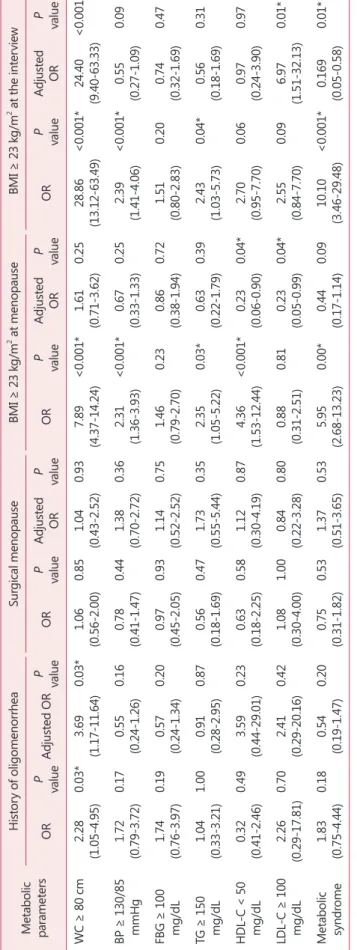
The factors that might affect metabolic parameters are BMI and surgical menopause. Multivariate analysis was ap- plied to assess their relationship and the results are shown in Table 3. BMI was the major factor affecting metabolic syndrome in postmenopausal women.
Discussion
The prevalence of oligomenorrhea among the general population is 13.5%.2 The most common cause of anovu- lation is PCOS,1 which occurs in 7% to 10% of reproduc- tive women.5,6 The prevalence of 5.43% of postmenopausal women with a history of oligomenorrhea in this study was Table 1. Comparison of characteristics between postmenopausal women with a history of normal menstruation and those with a history of oligomenorrhea
History of normal men-
struation (n = 200)
History of oli- gomenorrhea
(n = 31) P value
Age at the interview 0.98
Mean ± SD (years) 58.9 ± 5.7 59.0 ± 7.2
Min-max 47-75 43-77
Menarche 0.30
Mean ± SD (years) 14.4 ± 1.9 14.8 ± 2.3
Min-max 11-21 10-19
Age at menopause 0.38
Mean ± SD (years) 48.9 ± 3.7 48.3 ± 3.6
Min-max 40-57 41-55
Type of menopause 0.001*
Natural menopause 165 (82.5%) 17 (54.8%) Surgical menopause 35 (17.5%) 14 (45.2%)
Hormonal usage 0.15
Used and stopped >
1 year 79 (39.5%) 18 (58.1%)
Currently using or
stopped < 1 year 42 (21.0%) 4 (12.9%)
Never used 79 (39.5%) 9 (29.0%)
Waist circumference
(cm) 0.12
Mean ± SD 78.3 ± 7.7 80.7 ± 8.3
Min-max 59-101 64-101
BMI (kg/m2) 0.04*
Mean ± SD 23.7 ± 3.3 25.1 ± 4.6
Min-max 14.9-34.2 18.1-34.9
The data is presented as mean ± standard deviation or n (%) SD: standard deviation, BMI: body mass index
Journal of Menopausal Medicine 2018;24:100-107 Siripen Ongsupharn, et al. Oligomenorrhea and Menopause
lower than expected. This low prevalence might have been affected by recall bias, as the mean age of participants in this study was 59 years old. However, women with a history of oligomenorrhea might have a more obvious menstruation problem than those with a history of normal menstruation.
This study found that the BMI at menopause was no dif- ferent between women with a history of normal menstrua- tion and those with oligomenorrhea, at around 23 to 25 kg/
m2, which corresponded with a previous study.26 For the women in this study, BMI increased after menopause, and
those with a history of oligomenorrhea had a higher BMI and bigger waist circumference than those with a history of normal menstruation. As the basal metabolic rate decreases with aging,27,28 the BMI typically increases after 10 years of menopause. However, women with oligomenorrhea might have had problems related to hormone disturbance and glu- cose metabolism since they were young,3,15 contributing to their larger weight gain. BMI significantly affects metabolic parameters and health problems.29~31 The adjusted odds ratio in this study revealed that a history of oligomenorrhea re- Table 2. Comparison of the number of women with abnormal metabolic parameters between the group with a history of oligomenorrhea and those with a history of normal menstruation at their first menopause visit and at the time of interview
Metabolic parameters
At the time of menopause At the interview
History of normal menstruation
(n = 200)
History of oligo- menorrhea
(n = 31) P value History of normal menstruation
(n = 200)
History of oligo- menorrhea
(n = 31) P value
Waist circumference (cm) 0.049*
≥80 Not available 82 (41.0) 19 (61.3)
<80 Not available 118 (59.0) 12 (38.7)
BMI (kg/m2) 0.44 0.67
≥23 85 (42.5) 16 (51.6) 108 (54.0) 18 (58.1)
<23 115 (57.5) 15 (48.4) 92 (46.0) 13 (41.9)
BP (mmHg) 0.91 0.25
SBP ≥ 130, DBP ≥ 85 73 (36.5) 11 (35.5) 40 (20.0) 9 (29.0)
SBP < 130, DBP < 85 127 (63.5) 20 (64.5) 160 (80.0) 22 (71.0)
FBS (mmol/L) 0.63 0.25
≥5.56 50 (25.0) 9 (29.0) 43 (21.5) 10 (32.3)
<5.56 150 (75.0) 22 (71.0) 157 (78.5) 21 (67.7)
Triglyceride (mmol/L) 0.36 1.00
≥1.69 32 (16.0) 7 (22.6) 25 (12.5) 4 (12.9)
<1.69 168 (84.0) 24 (77.4) 175 (87.5) 27 (87.1)
HDL-C (mmol/L) 0.49
<1.30 39 (19.5) 8 (25.8) 19 (9.5) 1 (3.2)
≥1.30 161 (80.5) 23 (74.2) 0.42 181 (90.5) 30 (96.8)
Metabolic syndrome 0.23
Yes (12.1%) Not available 22 (11.0) 6 (19.4)
No (87.9%) Not available 178 (89.0) 25 (80.6)
BMI: body mass index, BP: blood pressure, SPB: systolic blood pressure, DBP: diastolic blood pressure, FBS: fasting blood sugar, HDL-C:
high-density lipoprotein cholesterol
Journal of Menopausal Medicine 2018;24:100-107
J MM
Table 3. Crude and adjusted odds ratio of possible factors affecting metabolic syndrome parameters at the time of interview
Metabolic paramet
ers
History of oligomenorrheaSurgical menopauseBMI ≥ 23 kg/m2 at menopauseBMI ≥ 23 kg/m2 at the interview ORP valueAdjusted ORP valueORP valueAdjusted ORP valueORP valueAdjusted ORP valueORP valueAdjusted ORP value WC ≥ 80 cm2.28 (1.05-4.95)0.03*3.69 (1.17-11.64)0.03*1.06 (0.56-2.00)0.851.04 (0.43-2.52)0.937.89 (4.37-14.24)<0.001*1.61 (0.71-3.62)0.2528.86 (13.12-63.49)<0.001*24.40 (9.40-63.33)<0.001* BP ≥ 130/85 mmHg1.72 (0.79-3.72)0.170.55 (0.24-1.26)0.160.78 (0.41-1.47)0.441.38 (0.70-2.72)0.362.31 (1.36-3.93)<0.001*0.67 (0.33-1.33)0.252.39 (1.41-4.06)<0.001*0.55 (0.27-1.09)0.09 FBG ≥ 100 mg/dL1.74 (0.76-3.97)0.190.57 (0.24-1.34)0.200.97 (0.45-2.05)0.931.14 (0.52-2.52)0.751.46 (0.79-2.70)0.230.86 (0.38-1.94)0.721.51 (0.80-2.83)0.200.74 (0.32-1.69)0.47 TG ≥ 150 mg/dL1.04 (0.33-3.21)1.000.91 (0.28-2.95)0.870.56 (0.18-1.69)0.471.73 (0.55-5.44)0.352.35 (1.05-5.22)0.03*0.63 (0.22-1.79)0.392.43 (1.03-5.73)0.04*0.56 (0.18-1.69)0.31 HDL-C < 50 mg/dL0.32 (0.41-2.46)0.493.59 (0.44-29.01)0.230.63 (0.18-2.25)0.581.12 (0.30-4.19)0.874.36 (1.53-12.44)<0.001*0.23 (0.06-0.90)0.04*2.70 (0.95-7.70)0.060.97 (0.24-3.90)0.97 LDL-C ≥ 100 mg/dL2.26 (0.29-17.81)0.702.41 (0.29-20.16)0.421.08 (0.30-4.00)1.000.84 (0.22-3.28)0.800.88 (0.31-2.51)0.810.23 (0.05-0.99)0.04*2.55 (0.84-7.70)0.096.97 (1.51-32.13)0.01* Metabolic syndrome1.83 (0.75-4.44)0.180.54 (0.19-1.47)0.200.75 (0.31-1.82)0.531.37 (0.51-3.65)0.535.95 (2.68-13.23)0.00*0.44 (0.17-1.14)0.0910.10 (3.46-29.48)<0.001*0.169 (0.05-0.58)0.01* *Significant of difference with P < 0.05 WC: waist circumference, BP: blood pressure, FBG: fasting blood glucose, TG: triglyceride, HDL-C: high-density lipoprotein cholesterol, LDL-C: low-density lipoprotein cholesterol, OR: odds ratio, BMI: body mass index
Journal of Menopausal Medicine 2018;24:100-107 Siripen Ongsupharn, et al. Oligomenorrhea and Menopause
lated to the chance of having a waist circumference of more than 80 cm; while this is a discrete variable, it could also have been associated with high BMI. As waist circumference is a factor in diagnosing metabolic syndrome, which is linked to cardiovascular disease,23 awareness needs to be raised of the increased risk of metabolic syndrome in reproductive women with anovulation and menopausal women with prior oligomenorrhea.
The majority of women participating in this study were healthy at their first menopause visit, and the prevalence of hypertension, impaired glucose tolerance, hypertriglyc- eridemia, and low HDL-C was similar to those published in a previous study of women aged between 40 and 49 years old.32 In general, the prevalence of hypertension, impaired glucose tolerance, hypertriglyceridemia, and low HDL-C in- creases with age.32,33 In this study, however, the prevalence of these metabolic problems did not change much over 10 years. This study found a prevalence of metabolic syndrome of 12.1% among the women interviewed, very low compared to some previous studies that reported 34% to 45% in women aged 50 to 59 years old,32,34 but similar to Indhavivadhana et al.35, who found a prevalence of 15.9% (13.6-18.2%) in Thai perimenopausal and postmenopausal women. These dif- ferences across ethnicities might reflect different lifestyles.
The women participating in this study and Indhavivadhana et al.35 attended the Menopause Clinic, where they received appropriate health education and health surveillance, per- haps benefitting from better health care than the general population.
The median age of menopause among Thai females is 49.5 ± 3.6 years,36 which is a little younger than other ethnicities;
i.e., 51.4 for African-American and Caucasian, 51.8 for Japanese, 51.5 for Chinese, and 51.0 for Hispanics.37 Earlier natural menopause is independently associated with several factors: current smoking, lower educational level, unmarried, unemployed, ethnicity, and a history of heart disease. The mean age at menopause of the northern Thais in this study was around 48 years old, in both those with oligomenorrhea and regular menstruation.
In this study, surgical menopause was more common among women with a history of oligomenorrhea. The an- ovulation relates to abnormal uterine bleeding, endometrial hyperplasia, and endometrial cancer;38 while these may be
reasons for hysterectomy, clear records were not available in this study.
The strength of this study was that the data were collect- ed from a large homogenous population with a long follow- up period attending the same menopause clinic. However, there could be some recall bias and missing data. A pro- spective study with a specific group of patients and larger sample size would provide a clearer conclusion.
Conclusion
In conclusion, oligomenorrhea did not affect the age of onset of menopause of Thai women, but women with oli- gomenorrhea seemed to have a larger waist circumference during menopause than women with history of regular menstruation. BMI affected metabolic parameters during menopause.
Acknowledgement
The authors would like to acknowledge the nurses, resi- dent trainees and staff at the Menopause Clinic, Chiang Mai University for their invaluable help in recruiting the patients.
We would also like to thank all participating patients.
Conflict of Interest
No potential conflict of interest relevant to this article was reported.
References
1. Chandeying P, Pantasri T. Prevalence of conditions causing chronic anovulation and the proposed algorithm for anovu- lation evaluation. J Obstet Gynaecol Res 2015; 41: 1074-9.
2. Taponen S, Martikainen H, Järvelin MR, Laitinen J, Pouta A, Hartikainen AL, et al. Hormonal profile of women with self-reported symptoms of oligomenorrhea and/or hirsut- ism: Northern Finland birth cohort 1966 study. J Clin En- docrinol Metab 2003; 88: 141-7.
Journal of Menopausal Medicine 2018;24:100-107
J MM
3. Rickenlund A, Eriksson MJ, Schenck-Gustafsson K, Hirschberg AL. Amenorrhea in female athletes is associated with endothelial dysfunction and unfavorable lipid profile. J Clin Endocrinol Metab 2005; 90: 1354-9.
4. Taponen S, Ahonkallio S, Martikainen H, Koivunen R, Ruokonen A, Sovio U, et al. Prevalence of polycystic ovaries in women with self-reported symptoms of oligomenorrhoea and/or hirsutism: Northern Finland Birth Cohort 1966 Study. Hum Reprod 2004; 19: 1083-8.
5. March WA, Moore VM, Willson KJ, Phillips DI, Norman RJ, Davies MJ. The prevalence of polycystic ovary syndrome in a community sample assessed under contrasting diagnostic criteria. Hum Reprod 2010; 25: 544-51.
6. Baptiste CG, Battista MC, Trottier A, Baillargeon JP. Insu- lin and hyperandrogenism in women with polycystic ovary syndrome. J Steroid Biochem Mol Biol 2010; 122: 42-52.
7. Norman RJ, Dewailly D, Legro RS, Hickey TE. Polycystic ovary syndrome. Lancet 2007; 370: 685-97.
8. Pantasri T, Vutyavanich T, Sreshthaputra O, Srisupundit K, Piromlertamorn W. Metabolic syndrome and insulin re- sistance in Thai women with polycystic ovary syndrome. J Med Assoc Thai 2010; 93: 406-12.
9. Biondi B, Klein I. Hypothyroidism as a risk factor for car- diovascular disease. Endocrine 2004; 24: 1-13.
10. Charmandari E, Chrousos GP. Metabolic syndrome mani- festations in classic congenital adrenal hyperplasia: do they predispose to atherosclerotic cardiovascular disease and secondary polycystic ovary syndrome? Ann N Y Acad Sci 2006; 1083: 37-53.
11. Georgiopoulos GA, Stamatelopoulos KS, Lambrinoudaki I, Lykka M, Kyrkou K, Rizos D, et al. Prolactin and preclini- cal atherosclerosis in menopausal women with cardiovascu- lar risk factors. Hypertension 2009; 54: 98-105.
12. Jiang XB, Li CL, He DS, Mao ZG, Liu DH, Fan X, et al.
Increased carotid intima media thickness is associated with prolactin levels in subjects with untreated prolactinoma: a pilot study. Pituitary 2014; 17: 232-9.
13. Kim MS, Merke DP. Cardiovascular disease risk in adult women with congenital adrenal hyperplasia due to 21-hy- droxylase deficiency. Semin Reprod Med 2009; 27: 316-21.
14. Souza LL, Guedes EP, Teixeira PF, Moreira RO, Godoy- Matos AF, Vaisman M. Serum TSH levels are associated with cardiovascular risk factors in overweight and obese adolescents. J Pediatr (Rio J) 2016; 92: 532-8.
15. Taponen S, Martikainen H, Jarvelin MR, Sovio U, Laitinen J, Pouta A, et al. Metabolic cardiovascular disease risk factors in women with self-reported symptoms of oligomenor- rhea and/or hirsutism: Northern Finland Birth Cohort 1966 Study. J Clin Endocrinol Metab 2004; 89: 2114-8.
16. Hsu MI. Changes in the PCOS phenotype with age. Ste- roids 2013; 78: 761-6.
17. Shah D, Bansal S. Polycystic ovaries - beyond menopause.
Climacteric 2014; 17: 109-15.
18. Li J, Eriksson M, Czene K, Hall P, Rodriguez-Wallberg KA. Common diseases as determinants of menopausal age.
Hum Reprod 2016; 31: 2856-64.
19. Saxena R, Bjonnes AC, Georgopoulos NA, Koika V, Panidis D, Welt CK. Gene variants associated with age at meno- pause are also associated with polycystic ovary syndrome, gonadotrophins and ovarian volume. Hum Reprod 2015; 30:
1697-703.
20. Tehrani FR, Solaymani-Dodaran M, Hedayati M, Azizi F.
Is polycystic ovary syndrome an exception for reproductive aging? Hum Reprod 2010; 25: 1775-81.
21. Solomon CG, Hu FB, Dunaif A, Rich-Edwards JE, Stamp- fer MJ, Willett WC, et al. Menstrual cycle irregularity and risk for future cardiovascular disease. J Clin Endocrinol Metab 2002; 87: 2013-7.
22. Mottillo S, Filion KB, Genest J, Joseph L, Pilote L, Poirier P, et al. The metabolic syndrome and cardiovascular risk a systematic review and meta-analysis. J Am Coll Cardiol 2010; 56: 1113-32.
23. Alberti KG, Eckel RH, Grundy SM, Zimmet PZ, Cleeman JI, Donato KA, et al. Harmonizing the metabolic syndrome: a joint interim statement of the International Diabetes Feder- ation Task Force on Epidemiology and Prevention; National Heart, Lung, and Blood Institute; American Heart Associa- tion; World Heart Federation; International Atherosclerosis Society; and International Association for the Study of Obesity. Circulation 2009; 120: 1640-5.
24. Grundy SM, Cleeman JI, Daniels SR, Donato KA, Eckel RH, Franklin BA, et al. Diagnosis and management of the metabolic syndrome: an American Heart Association/
National Heart, Lung, and Blood Institute Scientific State- ment. Circulation 2005; 112: 2735-52.
25. Hara K, Matsushita Y, Horikoshi M, Yoshiike N, Yokoyama T, Tanaka H, et al. A proposal for the cutoff point of waist circumference for the diagnosis of metabolic syndrome in the Japanese population. Diabetes Care 2006; 29: 1123-4.
26. Aekplakorn W, Mo-Suwan L. Prevalence of obesity in Thailand. Obes Rev 2009; 10: 589-92.
27. Poehlman ET. Menopause, energy expenditure, and body composition. Acta Obstet Gynecol Scand 2002; 81: 603-11.
28. Davis SR, Castelo-Branco C, Chedraui P, Lumsden MA, Nappi RE, Shah D, et al. Understanding weight gain at menopause. Climacteric 2012; 15: 419-29.
29. Han TS, Lean ME. A clinical perspective of obesity, meta- bolic syndrome and cardiovascular disease. JRSM Cardio-
Journal of Menopausal Medicine 2018;24:100-107 Siripen Ongsupharn, et al. Oligomenorrhea and Menopause
vasc Dis 2016; 5: 2048004016633371.
30. Kyrou I, Randeva HS, Tsigos C, Kaltsas G, Weickert MO.
Clinical problems caused by obesity. In: De Groot LJ, Chrousos G, Dungan K, Feingold KR, Grossman A, Hersh- man JM et al., editors. Endotext. South Dartmouth, MA:
MDText.com, Inc.; 2000.
31. Rutter MK, Sullivan LM, Fox CS, Wilson PW, Nathan DM, Vasan RS, et al. Baseline levels, and changes over time in body mass index and fasting insulin, and their relationship to change in metabolic trait clustering. Metab Syndr Relat Disord 2014; 12: 372-80.
32. Aekplakorn W, Kessomboon P, Sangthong R, Chariyalert- sak S, Putwatana P, Inthawong R, et al. Urban and rural variation in clustering of metabolic syndrome components in the Thai population: results from the fourth National Health Examination Survey 2009. BMC Public Health 2011;
11: 854.
33. Aekplakorn W, Chariyalertsak S, Kessomboon P, Sangth- ong R, Inthawong R, Putwatana P, et al. Prevalence and management of diabetes and metabolic risk factors in Thai
adults: the Thai National Health Examination Survey IV, 2009. Diabetes Care 2011; 34: 1980-5.
34. Ford ES, Giles WH, Dietz WH. Prevalence of the meta- bolic syndrome among US adults: findings from the third National Health and Nutrition Examination Survey. JAMA 2002; 287: 356-9.
35. Indhavivadhana S, Rattanachaiyanont M, Wongvananurak T, Kanboon M, Techatraisak K, Leerasiri P, et al. Predictors for metabolic syndrome in perimenopausal and postmeno- pausal Thai women. Climacteric 2011; 14: 58-65.
36. Chompootweep S, Tankeyoon M, Yamarat K, Poomsuwan P, Dusitsin N. The menopausal age and climacteric complaints in Thai women in Bangkok. Maturitas 1993; 17: 63-71.
37. Gold EB, Bromberger J, Crawford S, Samuels S, Greendale GA, Harlow SD, et al. Factors associated with age at natu- ral menopause in a multiethnic sample of midlife women.
Am J Epidemiol 2001; 153: 865-74.
38. Dumesic DA, Lobo RA. Cancer risk and PCOS. Steroids 2013; 78: 782-5.