Journal of the Korean Chemical Society
2007, Vol. 51, No. 3
Printed in the Republic of Korea
-287-
단 신
InCl
3를 함유한 중수소 치환된 아세토나이트릴 용액의 라만 스펙트럼에서 관찰된 InCl
4−
이온
조준성†·조한국*
인천대학교화학과
†제물포고등학교
(2007. 4. 13 접수)
InCl
4-Observed in the Raman Spectra of Deuterated Acetonitrile Containing InCl
3Jun-Sung Cho
†and Han-Gook Cho
*Department of Chemistry, University of Incheon, 177 Dohwa-dong, Nam-ku, Incheon, 402-749, Korea
†Jemulpo High School, 26 Jun-dong, Joong-ku, Incheon, 400-190, Korea (Received 13 April, 2007)
주제어: 아세토나이트릴, InCl4−,라만, 용매화, 밀도함수이론 Keywords: acetonitrile, InCl4−, Raman, solvation, DFT
Indium(III) halide complexes have shown a remark- ably varied crystal chemistry; structures containing indium in 4-8 coordination are known, whereas only coordination numbers of 4 and 6 have been reported for the complexes in solution.1 Insertion of water molecule into the coordination sheath readily occurs, resulting in six coordinate complexes. Various mixed halogeno/aqua complexes InXn(H2O)6-n3-n(X
=F, Cl, Br, I) are observed in aqueous solution.2 More complicate InFnXm(H2O)6-n-m3-n-m (X=Cl, Br) spe- cies have also been identified in a recent 19F NMR study of indium fluoride complexes.3
Six coordinate InXnL6-n3-n species can also be formed in nonaquous media for L = dimethylforma- mide, dimethylsulfoxide, or tributyl phosphate and X = Cl or Br,4 whereas only four coordinate tetrahe- dral InI4− anion is observed in the indium iodide aqueous solution with additional HI, mainly due to the large size of the iodine atom.2 It is also reported in 115In NMR studies that four coordinate indium halide anions (InX4−) are obtained in extraction with solvents such as acetone, methyl isobutyl ketone,
ethyl ether, isopropyl ether, n-butyl acetate, cyclo- hexanone, and ethyl acetoacetate from HCl, HBr, and HI solutions.2,5,6 Tuck et al. substantiated in an
115In NMR study formation of In2Cl62− in various organic solvent.7 Dissolution of RInX4 (R = organic cations) salts in dichloromethane, acetone, acetoni- trile, tetrahydrofuran, chloroform does not lead to indium-solvent bonding or dissociation of the anion.7
It is therefore intriguing to determine reliably the coordination number in a typical organic solvent containing indium halide. InX3 in fact provides a test case; GaX3 forms four coordinate anions (GaX4−) in solutions regardless of the solvent,8 whereas TlX3
normally gives six coordinate anions (e.g. TlX63−).9 We report here a Raman study for CD3CN solution of InCl3. CD3CN is used instead of CH3CN for this study, to avoid the interference originating from the strong Fermi resonance between the ν2 and the ν3 + ν4
combination modes observed from CH3CN,10 whose magnitude varies dramatically upon coordination.
CD3CN (99.95%, Aldrich) in ampule was used without further treatment. Anhydrous InCl3, pack-
Journal of the Korean Chemical Society
288 조준성·조한국
aged under argon in ampule, was also used as pur- chased from Aldrich. The concentration (molality) of InCl3 in CD3CN in this study ranges from 0 to 4.5 m, close to the saturation point. Spectra were collected using a Raman module incorporated into an FT-IR spectrometer (Bio-Rad FTS 175C) with a resolution of 4.0 cm−1, which was accompanied with a YAG laser, a Ge detector, and a holographic notch transmission filter as the light source, detec- tor, and Rayleigh filter, respectively. Bulb-type Raman cell (Bio-Rad 925-0101) with reflective coat- ing on one side was used for higher signal intensity.
Complementary density functional theory (DFT) calculations were carried out using the Gaussian 03 package,11 B3LYP density functional,12 6-311++G (3df, 3pd) basis sets for Cl and SDD pseudopoten- tial and basis set13 for In (46 electron core) to pro- vide a consistent set of vibrational frequencies for the anticipated species in solution. Zero point ener- gies were included in the calculation of product energies. The solvent effects are not counted in cal- culations.
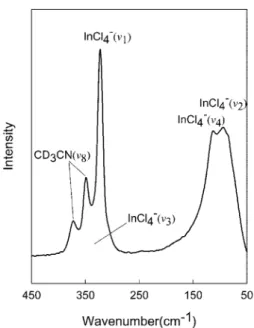
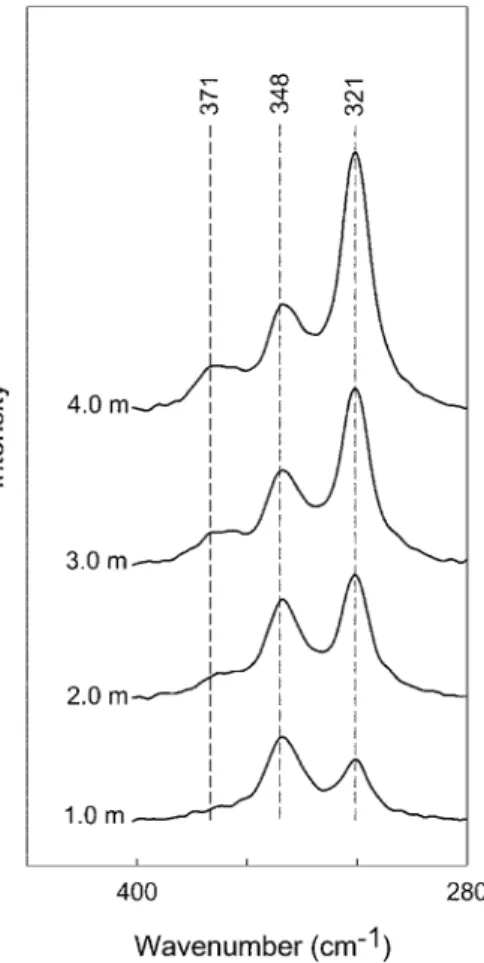
Shown in Fig. 1 is the Raman spectrum of CD3CN solution containing InCl3 (4.0 m) in the 100-600 cm–1 region. Beside the ν8 CCN deformation band of free CD3CN at 348 cm–1, four more strong absorptions are observed at 371, 321, 112, and 89 cm−1. Fig. 2 shows the variation of the ν8 CCN deformation band region with concentration. Evidently the two absorptions at 371 and 321 cm-1 increase propor- tionally with InCl3 concentration while the inten- sity of the ν8 band of free CD3CN at 348 cm−1 stays essentially the same. The band at 371 cm−1 is attrib- uted to the ν8 CCN deformation mode of CD3CN coordinated to the cationic species (In(CD3CN)x3+).14
The frequencies of other three bands (321, 112, and 89 cm−1) are consistent with the previous val- ues reported for InCl4− by Woodward and Taylor in Raman studies for InCl3 extracts from aqueous solutions of indium chloride containing hydrochlo- ric acid.5 They are, therefore, attributed to A1 sym- metric stretching, F2 antisymmetric deformation, and
E symmetric deformation bands of InCl4−, respec- tively. Much weaker F2 antisymmetric stretching band at 337 cm−1 is covered by the stronger ν8 band
of free CD3CN and the A1 symmetric stretching band of InCl4− at 348 and 321 cm−1, respectively, as shown in Fig. 1.
InCl4− with Td symmetry has four vibrational modes,
A1 symmetric stretch (ν1), E symmetric deforma- tion (ν2), F2 asymmetric stretch (ν3), and F2 asym- metric deformation (ν4). Among them, only the latter two are IR active, whereas all of them are Raman active. The A1 symmetric stretch, E sym- metric deformation, and F2 asymmetric deforma- tion bands are expected to be reasonably strong and sharp, whereas, the F2 asymmetric deformation band weak and diffused.5 The observed frequencies are compared with the predicted frequencies in
Table 1, where they match within 5%.
No other considerable bands are observed in the
Fig. 1. Raman spectrum in the range of 450-50 cm-1 of InCl3
solution in CD3CN at 4.0 m. The CCN deformation bands of CD3CN free and coordinated are observed at 347 and 371 cm-1, respectively. The A1 symmetric stretching (ν1), E symmetric deformation (ν2), and F2 antisymmetric deformation (ν4) bands of InCl4−are located at 321, 94, and 113 cm-1, respectively.
The F2 antisymmetric stretching band (ν3), expected at about 337 cm-1, is apparently overlapped by the ν7 CCN deformation band of free CD3CN and the ν1A1 symmetric stretching band of InCl4−. No other considerable bands are observed in the spectrum, suggesting that InCl4− is the primary anion present in the solution.
InCl3를 함유한 중수소 치환된 아세토나이트릴 용액의 라만 스펙트럼에서 관찰된 InCl4−이온 289
2007, Vol. 51, No. 3
low frequency region even at high concentration as shown in Fig. 1, indicating that InCl4− is the domi- nating anionic species in the acetonitrile solution of InCl3. The present result, therefore, reconfirms that the four coordinate species is indeed the primary anion in typical organic solvents, and higher num- ber of coordination is normally achieved by addi- tion of water or in organic media with strong ligating group, such as carbonyl group.15
InCl4− is formed via disproportionation reaction of InCl3 as shown in reaction (1).
4InCl3 + xCD3CN (CD3CN)xIn3+ + 3InCl4−(1) The stability of InCl4− in solution originates from the low energy, which is 285.8 kcal/mol lower than the reactants (In(2P1/2)+2Cl2) at the level of B3LYP/
6-311++G(3df, 3pd) while InCl3 is 64.2 kcal/mol more stable than the reactants. InCl5− and InCl6− are 238.6 and 219.4 kcal/mol lower than the reactants, respectively. The predicted In-Cl bond length is also the shortest (2.360 Å) for InCl4−, compared with those of 2.543 Å for InCl3, 2.375 and 2.714 Å for InCl5−, and 2.464 and 2.494 Å for InCl6−.
It is also notable that the measured frequencies are essentially the same as the previous values, indi- cating that the vibrational characteristics of InCl4−
remain virtually unchanged regardless of the media.
The effect of concentration is also negligible as shown in Fig. 2 while the chances to form counter-
Fig. 2. The emerging bands on the both side of the ν8 CCN deformation band of free CD3CN with increasing InCl3
concentration. The emerging band at 371 cm−1 is believed to arise from the coordinated CD3CN to In3+ (In(CD3CD)x3+).
The strong A1 symmetric stretching band of InCl4−at 321 cm−1 grows proportionally with InCl3 concentration.
Table 1. Observed frequencies in the low frequency region of CD3CN solution containing InCl3a
Obsb Calcc Obs/Calc Intd Descriptione
346.9 (-0.6)e CD3CN ν8 CCN deform
370.7 (23.2)d,e CD3CN coordinated to In3+ν8
321 306 1.05 25 InCl4−A1 sym. str.
89 85 1.05 2 InCl4−E sym. deform
337f 328 1.03 10 InCl4−F2 antisym. str.
112 115 0.97 3 InCl4−F2 antisym. deform
aAll frequencies are in cm-1.
bNumbers in parantheses are the frequency shifts relative to the frequencies of free CD3CN in the pure CD3CN.
cPredicted frequencies with B3LYP/6-311++G(3df, 3pd)/SDD
dPredicted Raman scattering activity in Å4/amu.
eBrief description of the vibrational mode.
fValue taken from Ref.[5]. Frequencies could not be determined in this study because of severe overlap by the CCN deforma- tion bands of free CD3CN and those coordinated to the solute.
Journal of the Korean Chemical Society
290 조준성·조한국
ion pairs rise with concentration; at 4.0 m, the molecu- lar ratio between the solvent and solute is about 4.5:1. The invariance of the vibrational characteris- tics of the tetrachloroindate anion is compared to the dramatic variation in vibrational characteristics of acetonitrile upon coordination to the cation (In3+).14,16
In conclusion, relatively strong bands are observed in the low frequency region of the Raman spectrum of acetonitrile containing InCl3. The frequencies match with the previously observed tetrachloroindate anion (InCl4−) in extracts from indium chloride solution containing hydrochloric acid.5 No other considerable bands are observed in the region, indi- cating that InCl4− is the primary anion, which is formed in disproportionation reaction of indium chloride. Stability of the four coordinate anionic species is also reproduced by DFT calculations. The present results reconfirm that InX4− is normally the major species in organic solvents, whereas the higher coordination number (e.g. 6) requires strong ligands, such as water and organic solvents with strong ligating group.2-4,15
Acknowledgment.
This work was supported by University of Incheon Research Grant in 2006.REFERENCES
1. Malyarick, M. A.; Petrosyants, S. P. Inorg. Chem. 1993, 32, 2263.
2. (a) Wilkinson, G.; Gillard, R. D.; McCleverty, J. A., Eds. Comprehensive Coordination Chemistry; Perga- mon: Oxford, England, 1987; Vol. 3, pp 157-182. (b) Haraguchi, H.; Fuwa, K.; Fujiwara, S. J. Phys. Chem.
1973, 77, 1497.
3. Petrosyants, S. P.; Malyarick, M. A.; Buslaev, Yu. A.
Koord. Khim. 1989, 11, 1493.
4. (a) Sheka, I. A.; Sheka, Z. A. Indium Halides and Their Coordination Compounds; Nauk Dumka: Kiev, 1981.
(b) Skorobogat’ko, E. P.; Mikitchenko, V. F. Vestin.
Kiev Univ. Khim. 1986, 27, 16.
5. (a) Woodward, L. A.; Taylor, M. J. J. Chem. Soc. 1960, 4473. (b) Woodward, L. A.; Singer, G. H. J. Chem. Soc.
1958, 716.
6. (a) Woodward, L. A.; Nord, A. A. J. Chem. Soc. 1956, 3721. (b) Woodward, L. A.; Bill, P. T. J. Chem. Soc.
1955, 1699.
7. McGarvey B. R.; Trudell, C. O.; Tuck, D. G.; Victori- ano, L. Inorg. Chem. 1980, 19, 3432.
8. Colton, R.; Dakternieks D.; Hauenstein, J. Aust. J. Chem.
1981, 34, 949.
9. (a) Davies, J. E. D.; Long, D. A. J. Chem. Soc. A1968, 2050. (b) Lincoln, S. F.; Sandercock, A. C.; Stranks, D.
R. Aust. J. Chem. 1975, 28, 1901.
10. Fawcett, W. R.; Liu, G. J. Phys. Chem. 1992, 96 4231.
11. Kudin, K. N., et al. Gaussian 03, Revision B.04, Gaus- sian, Inc.: Pittsburgh, PA, 2003.
12. (a) Becke, A. D. J. Chem. Phys.1993, 98, 5648. (b) Lee, C.; Yang, Y.; Parr, R. G. Phys. Rev. B1988, 37, 785.
13. Andrae, D.; Haeussermann, U.; Dolg, M.; Stoll, H.; Preuss, H. Theor. Chim. Acta1990, 77, 123.
14. (a) Cha, J.-N.; Cheong, B.-S.; Cho, H.-G. J. Phys. Chem.
A2001, 105, 1789. (b) Seo, J.-S.; Cheong, B.-S.; Cho, H.-G. Spectrochim. Acta A2002, 58, 1747. (c) Seo, J.- S.; Kim, K.-W.; Cho, H.-G. Spectrochim. Acta A2003, 59, 477. (d) Cho, H.-G. Spectrochim. Acta A2003, 59, 1517.
15. Hanson, M. P.; Plane R. A. Inorg. Chem. 1969, 6, 746.
16. (a) Jamrós, D.; Wójcik, M.; Lindgren, J.; Stangret, J. J.
Phys. Chem. B1997, 101, 6758. (b) Jamrós, D.; Wójcik, M.; Lindgren, J. Spectrochim. Acta A2000, 56, 1939.
(c) Nyquist, R. A. Appl. Spectrosc. 1990, 44, 1405.