ISSN 2234-3806 • eISSN 2234-3814
https://doi.org/10.3343/alm.2018.38.3.220
Evaluation of a New Multiplex Real-Time PCR Assay for Detecting Gastroenteritis-Causing Viruses in Stool Samples
Jungwon Hyun, M.D., Dae-Hyun Ko, M.D., Su-Kyung Lee, M.S., Han-Sung Kim, M.D., Jae-Seok Kim, M.D., Wonkeun Song, M.D., and Hyun Soo Kim, M.D.
Department of Laboratory Medicine, Hallym University College of Medicine, Hwaseong, Korea
Background: Diarrhea has been the second leading cause of death among children under the age of five, and the rapid and accurate pathogen diagnosis in patients with diarrhea is crucial for reducing morbidity and mortality. A newly developed one-step multiplex real- time PCR assay, the Allplex GI-Virus Assay, was evaluated for its ability to detect six diar- rhea-causing viruses (rotavirus, norovirus genogroup I (GI) and genogroup II (GII), enteric adenovirus, astrovirus, and sapovirus) in stool samples.
Methods: The performance of the Allplex assay was compared with those of another mul- tiplex PCR assay (Seeplex Diarrhea-V Ace Detection) and genotyping by sequencing, us- ing 446 stool samples from patients with acute gastroenteritis.
Results: The overall agreement rates between the results of the Allplex and Seeplex as- says were 98.7% for rotavirus, 99.1% for norovirus GI, 93.3% for norovirus GII, 98.0% for adenovirus, and 99.6% for astrovirus. The overall agreement rates between the Allplex as- say and genotyping were 99.1% for rotavirus, 99.1% for norovirus GI, 98.7% for norovirus GII, 89.7% for adenovirus, 98.2% for astrovirus, and 99.8% for sapovirus. In addition, eight rotavirus genotypes, three norovirus GI genotypes, four norovirus GII genotypes, eight ade- novirus genotypes, two astrovirus genotypes, and two sapovirus genotypes were detected.
Conclusions: The Allplex assay showed high agreement with Seeplex and genotyping re- sults, and was able to additionally detect sapoviruses. The Allplex assay could be useful in identifying viral gastrointestinal infections in patients with acute gastroenteritis symptoms.
Key Words: Gastroenteritis, Allplex assay, Rotavirus, Norovirus, Adenovirus, Astrovirus, Sapovirus
Received: April 25, 2017 Revision received: August 9, 2017 Accepted: January 9, 2018 Corresponding author: Hyun Soo Kim Department of Laboratory Medicine, Hallym University Dongtan Sacred Heart Hospital, Hallym University College of Medicine, 7 Keunjaebong-gil, Hwaseong 18450, Korea
Tel: +82-31-8086-2775 Fax: +82-31-8086-2789 E-mail: [email protected]
© Korean Society for Laboratory Medicine This is an Open Access article distributed under the terms of the Creative Commons Attribution Non-Commercial License (http://creativecom- mons.org/licenses/by-nc/4.0) which permits unrestricted non-commercial use, distribution, and reproduction in any medium, provided the original work is properly cited.
INTRODUCTION
Diarrhea is the second leading cause of death among children under the age of five, accounting for one in nine child deaths worldwide [1]. Thus, the rapid and accurate diagnosis of the underlying pathogen in patients with diarrhea is important for establishing good clinical practices aimed at reducing morbidity and mortality. Multiplex polymerase chain reaction (PCR)-based
methods have been used clinically; these methods have the ad- vantages of shorter duration of process and improved sensitivity [2-5].
The Allplex GI-Virus Assay (Seegene, Seoul, Korea) is a recent one-step multiplex real-time reverse transcription PCR (qRT-PCR) assay that uses a multiple detection temperature technique (MuDT) [6] for simultaneously detecting rotavirus, norovirus genogroup I (GI) and genogroup II (GII), adenovirus type 40/41,
2017-03-16 https://crossmark-cdn.crossref.org/widget/v2.0/logos/CROSSMARK_Color_square.svg
astrovirus, and sapovirus. Compared with the previous multiplex RT-PCR assay, the Allplex assay can additionally detect sapovi- ruses and quantify six viral targets in a single fluorescence chan- nel without a melting curve analysis.
This study aimed to evaluate, for the first time, the clinical per- formance of the Allplex assay for detecting these six diarrhea- causing viruses and to compare the results with those of another multiplex PCR assay and viral genotyping.
METHODS 1. Clinical samples
This study was approved by the Institutional Review Board of the Hallym University Dongtan Sacred Heart Hospital (IRB num- ber 2015-475), Korea. This study utilized stool samples collected and stored in Dongtan Sacred Heart Hospital from December 2013 to September 2016. The sample collection period was dif- ferent for each virus because the positive rates for norovirus GI, adenovirus, astrovirus, and sapovirus were very low; thus, the collection period was extended to obtain an adequate number of positive samples. The number of samples and collection peri- ods were as follows: 1) 301 leftover samples after testing for ro- tavirus, norovirus, adenovirus, and astrovirus from November 2015 to December 2015; 2) 56 rotavirus-positive samples from December 2015 to March 2016; 3) 43 adenovirus-positive sam- ples from August 2015 to June 2016; and 4) 46 astrovirus-posi- tive samples from December 2013 to March 2016. Samples with inadequate volume for subsequent testing were excluded.
During the above mentioned periods, the leftover samples after testing were collected and stored at –70°C until further analysis.
2. Allplex and Seeplex assays
Nucleic acids were extracted from the samples, using the QIAamp Viral RNA Mini Kit (Qiagen, Hilden, Germany) and a QIAcube platform (Qiagen) after the stored samples were thawed.
For the Allplex assay, 5 μL of RNA extract was mixed with 20 μL of master mix and qRT-PCR was performed using a CFX96 system (Bio-Rad, Hercules, CA, USA) under the following condi- tions: reverse transcription at 50°C for 20 minutes, denaturation at 95°C for 15 minutes, and 45 cycles of PCR (10 seconds at 95°C, 1 minute at 60°C, and 30 seconds at 72°C). All procedures were performed according to the manufacturer’s instructions.
The Seeplex Diarrhea-V ACE Detection assay (Seegene) is a multiplex PCR system for detecting astrovirus, rotavirus, enteric adenovirus, and norovirus GI and GII. For this assay, following cDNA synthesis, 3 μL of cDNA was mixed with 17 μL of master
mix and PCR was performed using SimpliAmp Thermal Cycler (Thermo Fisher Scientific, Waltham, MA, USA) under the follow- ing conditions: 15 minutes at 94°C; followed by 40 cycles of 94°C for 30 seconds, 60°C for 90 seconds, and 72°C for 90 seconds; and a final single incubation at 72°C for 10 minutes.
All procedures were performed according to the manufacturer’s instructions.
3. Genotyping for rotavirus, norovirus, adenovirus, astrovirus, and sapovirus
Genotyping targeting the capsid genes was conducted by previ- ously described PCR and sequencing methods [7, 8]. Briefly, rotavirus G (VP7) and P (VP4) genotyping was performed ac- cording to the WHO manual, using specific primer sets [9], with some modifications. Norovirus capsid genotyping was performed using specific primer sets [8], and adenovirus capsid hexon ge- notyping was performed by PCR and sequencing using a speci- fied primer set (ADHEX1F/AD2) or a different primer set (AD1/
AD2) [10]. Additionally, astrovirus and sapovirus genotyping was performed by PCR and sequencing techniques using specific capsid primer sets [11, 12]. The PCR products were visualized by electrophoresis on an agarose gel and analyzed by DNA se- quencing. The nucleotide sequences were analyzed using ABI Prism BigDye Terminator version 3.1 (Applied Biosystems, Fos- ter City, CA, USA), and the genotypes were confirmed using the NCBI BLAST server of the GenBank database.
4. Analytical sensitivity and specificity of the Allplex assay
To determine the analytical sensitivity (the lower limit of detec- tion) for norovirus GI and GII and adenovirus, commercialized virus culture fluids were purchased (Catalog #0810086CF, nor- ovirus GI [recombinant]; #0810087CF, norovirus GII [recombi- nant]; and #0810085CF, adenovirus type 41; ZeptoMetrix Cor- poration, Buffalo, NY, USA). Viral nucleic acids were extracted using the QIAamp DSP DNA Mini Kit (Qiagen). To determine the lower limit of detection for rotavirus astrovirus, and sapovi- rus, in vitro transcribed RNAs were prepared using the MEGA- script T7 Kit (Life Technologies, Carlsbad, CA, USA). The pre- pared nucleic acids were serially diluted, and the Allplex assay was carried out using a CFX96 system (Bio-Rad). The lower limit of detection was defined as the lowest concentration that was detected in ≥95% of the replicates [13].The analytical specificity (cross-reactivity) of the Allplex assay was assessed using 169 different pathogens (43 viruses and 126 bacteria), including 24 target viruses (see Supplemental Data Table S1). Each pathogen was tested thrice, using the same
procedures for sample processing.
5. Statistical analyses
Inter-rater agreement statistics (Cohen’s kappa) were used to compare the results of the Allplex assay, Seeplex assay, and ge- notyping. The kappa value was interpreted as follows: <0.20, poor agreement; 0.21–0.40, fair agreement; 0.41–0.60, moder- ate agreement; 0.61–0.80, good agreement; and 0.81–1.00, very good agreement [14]. MedCalc version 15 (MedCalc Soft- ware, Mariakerke, Belgium) was used for all statistical analyses.
RESULTS
1. Comparison between the Allplex assay, Seeplex assay, and genotyping results for clinical samples
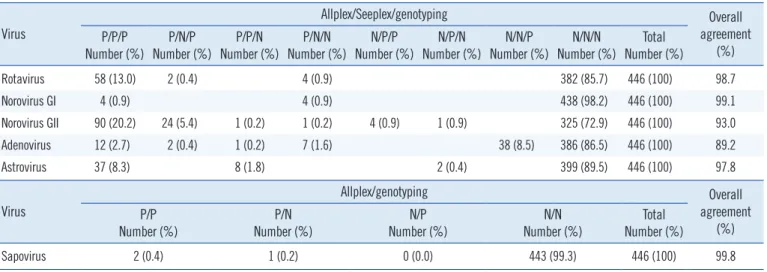
A total of 446 stool samples were tested, and the results of the three assays are summarized in Table 1. The overall agreement rates between the three assays for rotavirus, norovirus GI, noro- virus GII, adenovirus, and astrovirus were 98.7%, 99.1%, 93.0%, 89.2%, and 97.8%, respectively. The overall agreement rates between the Allplex and Seeplex assays were 98.7% for rotavi- rus, 99.1% for norovirus GI, 93.3% for norovirus GII, 98.0% for adenovirus, and 99.6% for astrovirus. Furthermore, the overall agreement rates between the Allplex assay and genotyping were 99.1% for rotavirus, 99.1% for norovirus GI, 98.7% for norovi- rus GII, 89.7% for adenovirus, 98.2% for astrovirus, and 99.8%
for sapovirus.
As shown in Table 2, the positive agreement rate of the Allplex assay with the Seeplex assay ranged from 94.8% to 100%, while
the negative agreement rate ranged from 92.9% to 100%. The kappa correlation ranged from 0.663 to 0.976 and showed good to very good agreement. The positive agreement rate between the Allplex assay and genotyping was 100% for rotavirus, noro- virus GI, astrovirus, and sapovirus; 96.6% for norovirus GII; and 26.9% for adenovirus. Moreover, the negative agreement rate ranged from 98.0% to 99.8%. The kappa correlation ranged from 0.663 to 0.965 and showed good to very good agreement, except for adenovirus (with a kappa correlation of 0.332, indi- cating fair agreement).Detailed results for the three methods for each virus are shown in see Supplemental Data Tables S2-S8.
2. Discrepant results between the Allplex assay, Seeplex assay, and genotyping for clinical samples
For rotavirus, two cases (0.4%) were negative only in the See- plex assay, and four cases (0.9%) were positive only in the All- plex assay (see Supplemental Data Tables S2, S8). All cases had high threshold cycle (CT) values of >30 in the Allplex assay.
They were interpreted as discrepancies near the cutoff with low rotavirus concentration.
For norovirus GI, four cases (0.9%) were detected by the All- plex assay only. These cases had very high CT values (>35) and were thus interpreted as discrepancies near the cutoff with very low norovirus concentration (see Supplemental Data Tables S3, S8).
For norovirus GII, 24 cases (5.4%) were negative only in the Seeplex assay, one case (0.2%) was negative only in genotyp- ing, one case (0.2%) was positive only in the Allplex assay, four cases (0.9%) were negative only in the Allplex assay, and one
Table 1. Comparison of the Allplex assay, Seeplex assay, and genotyping for detecting rotavirus, norovirus, adenovirus, and astrovirus, and comparison of the Allplex assay and genotyping for detecting sapovirus in 446 clinical stool samples
Virus
Allplex/Seeplex/genotyping Overall
agreement P/P/P (%)
Number (%) P/N/P
Number (%) P/P/N
Number (%) P/N/N
Number (%) N/P/P
Number (%) N/P/N
Number (%) N/N/P
Number (%) N/N/N
Number (%) Total Number (%)
Rotavirus 58 (13.0) 2 (0.4) 4 (0.9) 382 (85.7) 446 (100) 98.7
Norovirus GI 4 (0.9) 4 (0.9) 438 (98.2) 446 (100) 99.1
Norovirus GII 90 (20.2) 24 (5.4) 1 (0.2) 1 (0.2) 4 (0.9) 1 (0.9) 325 (72.9) 446 (100) 93.0
Adenovirus 12 (2.7) 2 (0.4) 1 (0.2) 7 (1.6) 38 (8.5) 386 (86.5) 446 (100) 89.2
Astrovirus 37 (8.3) 8 (1.8) 2 (0.4) 399 (89.5) 446 (100) 97.8
Virus
Allplex/genotyping Overall
agreement P/P (%)
Number (%) P/N
Number (%) N/P
Number (%) N/N
Number (%) Total Number (%)
Sapovirus 2 (0.4) 1 (0.2) 0 (0.0) 443 (99.3) 446 (100) 99.8
Abbreviations: P, positive; N, negative.
case (0.2%) was positive only in the Seeplex assay (see Supple- mental Data Tables S4, S8). Among the 24 cases that were neg- ative only in the Seeplex assay, 22 had CT values >30 and were considered to have a low norovirus concentration. However, the CT values of the remaining two cases were 23.79 and 25.09, and they were identified as type GII.3. The one case that was negative only in genotyping had a CT value of 31.09 in the All- plex assay and showed weak positivity in the Seeplex assay; this case was considered to have a low norovirus concentration. The one case that was positive only in the Allplex assay had a high CT value of 35.35. The four cases that were negative only in the Allplex assay were all identified as type GII.4 by genotyping; it was estimated that the Allplex assay could not detect these cases.
Moreover, the one case that was positive only in the Seeplex as- say was negative by ELISA antigen test and was thus suspected to be a false positive result.
For adenovirus, two cases (0.4%) were negative only in the Seeplex assay, one case (0.2%) was negative only in genotyping, seven cases (1.6%) were positive only in the Allplex assay, and 38 cases (8.5%) were positive only in genotyping (see Supple- mental Data Tables S5, S8). The two cases that were negative only in the Seeplex assay had very high CT values of 36.47 and 36.58, and the one case that was negative only in genotyping had a very high CT value of 38.97. The seven cases that were positive only in the Allplex assay had very high CT values of >35.
These 10 discrepant cases were considered as low-concentra- tion samples.
For astrovirus, eight cases (1.8%) were negative only in geno- typing, and two cases (0.4%) were positive only in the Seeplex assay (see Supplemental Data Tables S6, S8). The eight cases that were negative only in genotyping consisted of genotypes that could not be detected by the genotyping method performed in our laboratory. The two cases that were positive only in the Seeplex assay showed weak bands and were interpreted as a discrepancy near the cutoff with low concentration.
For sapovirus, one discrepant case was positive in the Allplex assay, but was negative in genotyping (see Supplemental Data Tables S7, S8).
3. Detected genotypes of rotavirus, norovirus, adenovirus, astrovirus, and sapovirus
Eight rotavirus genotypes (G1P[8], G2P[4], G3P[8], G4P[6], G8P[8], G9P[4], G9P[8], and G8P[4]), three norovirus GI geno- types (GI.1, GI.5, and GI.6), four norovirus genotypes GII (GII.3, GII.4, GII.6, and GII.17), eight adenovirus genotypes (C1, C2, B3, C5, C6, A12, A31, and F41), two astrovirus genotypes (types Table 2. Comparison of the Allplex assay with the Seeplex assay and genotyping Virus
Comparison with the Seeplex assayComparison with genotyping Positive agreementNegative agreement Kappa value (95% CI)Positive agreementNegative agreement Kappa value (95% CI) %95% CI%95% CI%95% CI%95% CI Rotavirus100.0 (58/58)93.8–100.098.5 (382/388) 96.7–99.40.943 (0.898–0.988)100.0 (60/60)94.0–100.099.0 (382/386)97.4–99.70.963 (0.926–0.999) Norovirus GI100.0 (4/4)39.8–100.099.1 (438/442)97.7–99.80.663 (0.353–0.972)100.0 (4/4)39.8–100.099.1 (438/442)97.7–99.80.663 (0.353–0.972) Norovirus GII94.8 (91/96)88.3–98.392.9 (325/350)89.6–95.30.815 (0.752–0.878)96.6 (114/118)91.6–99.199.4 (326/328)97.8–99.90.965 (0.938–0.993) Adenovirus100.0 (13/13)75.3–100.097.9 (424/433)96.1–99.10.733 (0.566–0.899)26.9 (14/52)15.6–41.098.0 (386/394)96.0–99.10.332 (0.189–0.475) Astrovirus95.7 (45/47)85.5–99.5100.0 (399/399)99.1–100.00.976 (0.942–1.000)100.0 (37/37)90.5–100.098.0 (401/409)96.2–99.20.893 (0.819–0.966) Sapovirus100.0 (2/2)15.8–100.099.8 (443/444)98.8–100.00.799 (0.413–1.000) Abbreviation: CI, confidence interval.
1 and 5), and two sapovirus genotypes (GII and GIV) were de- tected (see Supplemental Data Tables S2-S8).
4. Analytical sensitivity and specificity of the Allplex assay
The lower limits of detection for norovirus GI (recombinant), nor- ovirus GII (recombinant), and adenovirus using commercialized virus culture fluids were 75, 5, and 0.5 TCID50 (50% tissue cul- ture infective dose)/mL, respectively. The lower limits of detec- tion for rotavirus, astrovirus, and sapovirus using in vitro tran- scribed RNA were 5×101, 5×10², and 5×10³ copies/reaction, respectively. The analytical specificity showed 100% negative signals for the 145 non-target pathogens and positive signals for the 24 target pathogens (see Supplemental Data Table S1).DISCUSSION
Multiplex qRT-PCR assays have recently been applied for the detection of enteric viruses associated with gastroenteritis. These tests have enabled rapid, accurate, and simultaneous detection of enteric viruses with enhanced sensitivity and specificity [15- 17]. We evaluated the ability of a new multiplex qRT-PCR assay, the Allplex assay, to detect six common diarrhea-causing viruses and compared the results with those of the Seeplex assay and genotyping. The agreement rates among the three assays were very high. The overall agreement rates between the Allplex and Seeplex assays were ≥98.0%, except for norovirus GII (93.3%), and those between the Allplex assay and genotyping were ≥98.0%, except for adenovirus (89.7%). The low agreement rate for ade- novirus was probably because the Allplex assay was designed to detect only types 40 and 41, whereas genotyping is able to de- tect all types of adenovirus. Therefore, 38 cases were adenovi- rus-positive only by genotyping, and they were all genotypes other than those of adenovirus F40 and F41.
The Allplex assay showed higher positive rates than the See- plex assay (see Supplemental Data Tables S2-S7). The majority of the discrepant results were most likely due to low virus con- centrations near the cutoff because most of them showed high CT values in the Allplex assay. Moreover, most of the discrepant results with low concentrations were negative only in the Seeplex assay, but positive in the Allplex assay and genotyping. There- fore, the most discrepant cases with low concentrations were considered as true pathogens in gastroenteritis patients.
The Seeplex assay norovirus GII-negative cases were thought to contain viral concentrations too low to be detected using the Seeplex assay, while the Allplex assay norovirus GII-negative cases were most likely caused by issues with primer and reac-
tion conditions.
In addition, we performed genotyping by PCR and sequencing for all samples that were positive in the Allplex or Seeplex assays.
To the best of our knowledge, this is the first report to evaluate the ability to detect viral genotypes by a multiplex qRT-PCR as- say for the six most common diarrhea-causing viruses. Further- more, the assays revealed common viral genotypes in the stool samples. The 38 cases not detected by the Allplex assay included genotypes 1 (5 cases), 2 (9 cases), 3 (17 cases), 5 (3 cases), 6 (2 cases), 12 (1 case), and 31 (1 case) (see Supplemental Data Table S5). While most previous studies have focused only on en- teric genotypes 40 and 41 in gastroenteritis, a recent study [10]
reported that other genotypes (1, 2, 3, 5, 6, 12, 31, and 55) could also be associated with enteric symptoms. That study also found that genotypes 1 and 31 were significantly associated with intussusception. Therefore, although adenovirus genotype 41 is the most common genotype isolated in the Korean patients with acute gastroenteritis, an assay for detecting other genotypes may be needed.
The Allplex assay can detect sapovirus, which cannot be de- tected by the Seeplex assay. Sapovirus is considered a common cause of gastroenteritis in young children less than five years of age. Of the five sapovirus genogroups, GI, GII, and GIV are thou- ght to cause disease in humans [3]. Using the Allplex assay, we were able to detect three cases of sapovirus (see Supplemental Data Table S7) in newborn, 2-year-old, and 7-year-old patients.
The one case that was positive in the Allplex assay, but negative in genotyping, had a very high CT value (36.99) and was consid- ered as a low viral concentration sample. Therefore, the Allplex assay could detect the causative virus in pediatric gastroenteritis patients.
The Allplex assay can detect multiple targets and quantify each target in a single fluorescence channel without a melting curve analysis. Moreover, in contrast to the Seeplex assay and other previously developed assays, the Allplex assay can also detect sapoviruses.
The Allplex assay could detect six enteric viruses simultane- ously in a single reaction tube and showed high agreement with the Seeplex and genotyping results. This assay enabled detec- tion of the frequent genotypes of six enteric viruses in 2015–2016 in Korea. Therefore, the Allplex assay may constitute a good al- ternative method for diagnosing gastrointestinal virus infections in clinical laboratories. However, owing to genotype changes over time, continuous monitoring will be required.
Authors’ Disclosures of Potential Conflicts of Interest
No potential conflicts of interest relevant to this study are re- ported.
Acknowledgements
We wish to thank Seegene Corporation for providing the Allplex and Seeplex assay kits and additional financial support. The funders had no role in the study design, data collection and in- terpretation, writing of the report, or the decision to submit the work for publication.
REFERENCES
1. Liu L, Johnson HL, Cousens S, Perin J, Scott S, Lawn JE, et al. Global, regional, and national causes of child mortality: an updated systematic analysis for 2010 with time trends since 2000. Lancet 2012;379:2151- 61.
2. Liu J, Kibiki G, Maro V, Maro A, Kumburu H, Swai N, et al. Multiplex re- verse transcription PCR Luminex assay for detection and quantitation of viral agents of gastroenteritis. J Clin Virol 2011;50:308-13.
3. Bennett S and Gunson RN. The development of a multiplex real-time RT-PCR for the detection of adenovirus, astrovirus, rotavirus and sapo- virus from stool samples. J Virol Methods 2016;242:30-4.
4. Feng W, Gu X, Sui W, Zhang M, Lu B, Wang M, et al. The application and epidemiological research of xTAG GPP multiplex PCR in the diag- nosis of infectious diarrhea. Zhonghua Yi Xue Za Zhi 2015;95:435-9.
5. Higgins RR, Beniprashad M, Cardona M, Masney S, Low DE, Gubbay JB. Evaluation and verification of the Seeplex Diarrhea-V ACE assay for simultaneous detection of adenovirus, rotavirus, and norovirus geno-
groups I and II in clinical stool specimens. J Clin Microbiol 2011;49:3154- 62.
6. Lee YJ, Kim D, Lee K, Chun JY. Single-channel multiplexing without melting curve analysis in real-time PCR. Sci Rep 2014;4:7439.
7. Kim JS, Kim HS, Hyun J, Kim HS, Song W, Lee KM, et al. Analysis of rotavirus genotypes in Korea during 2013: an increase in the G2P[4]
genotype after the introduction of rotavirus vaccines. Vaccine 2014;32:
6396-402.
8. Kim JS, Kim HS, Hyun J, Kim HS, Song W. Molecular Epidemiology of Human Norovirus in Korea in 2013. Biomed Res Int 2015;2015:468304.
9. WHO. Manual of rotavirus detection and characterization methods. Ge- neva, Switzerland: World Health Organization, 2009.
10. Kim JS, Lee SK, Ko DH, Hyun J, Kim HS, Song W, et al. Associations of Adenovirus Genotypes in Korean Acute Gastroenteritis Patients with Re- spiratory Symptoms and Intussusception. Biomed Res Int 2017;2017:
1602054.
11. Zhou N, Lin X, Wang S, Wang H, Li W, Tao Z, et al. Environmental sur- veillance for human astrovirus in Shandong Province, China in 2013.
Sci Rep 2014;4:7539.
12. Kapusinszky B, Minor P, Delwart E. Nearly constant shedding of diverse enteric viruses by two healthy infants. J Clin Microbiol 2012;50:3427- 34.
13. Kim J, Kim H, Lee S, Oh S, Woo K, Kim S, et al. Guidelines for the Per- formance Evaluation of In-Vitro Diagnostic Test for the Detection of Nor- ovirus Infection in Korea. Lab Med Online 2017;7:1-6.
14. Altman D. Practical statistics for medical research. London: Chapman and Hall, 1991.
15. Zhang C, Niu P, Hong Y, Wang J, Zhang J, Ma X. A probe-free four-tube real-time PCR assay for simultaneous detection of twelve enteric viruses and bacteria. J Microbiol Methods 2015;118:93-8.
16. Siah SP, Merif J, Kaur K, Nair J, Huntington PG, Karagiannis T, et al.
Improved detection of gastrointestinal pathogens using generalised sam- ple processing and amplification panels. Pathology 2014;46:53-9.
17. McAuliffe GN, Anderson TP, Stevens M, Adams J, Coleman R, Mahaga- masekera P, et al. Systematic application of multiplex PCR enhances the detection of bacteria, parasites, and viruses in stool samples. J In- fect 2013;67:122-9.
Supplemental Data Table S1. List of viruses and bacteria tested for specificity
Viruses tested Results Bacteria tested Results
Adenovirus 40 (ATCC VR931) P Atopobium vaginae (ATCC BAA-55) N
Adenovirus 41 (ATCC VR930) P Aeromonas caviae (ATCC 15468) N
Astrovirus (QCMD GastroV13-03) P Aeromonas hydrophila (KCTC 2358) N
Norovirus-GI (ATCC VR-3199SD) P Aeromonas salmonicida subsp. masoucida (KCCM 40239) N
Norovirus-GI.3 (QCMD NV13-06) P Aeromonas veronii bv sobria (ATCC 9071) N
Norovirus-GI.7 (QCMD NV13-09) P Aeromonas veronii bv veronii (ATCC 35623) N
Norovirus-GI.8 (QCMD NV13-12) P Alcaligenes faecalis (KCTC 2678) N
Norovirus-GII (ATCC VR-3200SD) P Bacillus cereus (KCTC 1012) N
Norovirus-GII.b (QCMD NV13-08) P Bacteroides fragilis (ZMC 306850) N
Norovirus-GII.4 (QCMD NV13-10) P Bacteroides fragilis (KCTC 3688) N
Rotavirus (QCMD GastroV13-06), P Bacteroides uniformis (KCTC 5204) N
Rotavirus G1P4 (WAVA Rotavirus G1P4) P Bifidobacterium adolescentis (KCCM 11206) N
Rotavirus G1P6 (WAVA Rotavirus G1P6) P Bifidobacterium longum (KCCM 11953) N
Rotavirus G1P8 (WAVA Rotavirus G1P8) P Blastocystis hominis (ATCC 50608D) N
Rotavirus G2P4 (WAVA Rotavirus G2P4) P Clostridium difficile NAP1 B1 (ATCC BAA-1870D-5) N
Rotavirus G3P6 (WAVA Rotavirus G3P6) P Campylobacter coli (KCTC 15212) N
Rotavirus G3P8 (WAVA Rotavirus G3P8) P Campylobacter curvus (KCTC 15196) N
Rotavirus G3P9 (WAVA Rotavirus G3P9) P Campylobacter hyointestinalis subsp. hyointestinalis (KCTC 15207) N
Rotavirus G4P6 (WAVA Rotavirus G4P6) P Campylobacter jejuni subsp. jejuni (KCTC 5327) N
Rotavirus G9P6 (WAVA Rotavirus G9P6) P Campylobacter rectus (KCTC 5636) N
Rotavirus G9P8 (WAVA Rotavirus G9P8) P Campylobacter sputorum biovar sputorum (KCTC 15215) N
Sapovirus G1 (Korean isolate) P Campylobacter upsaliensis (KCTC 15213) N
Sapovirus G2 (Korean isolate) P Chlamydia trachomatis (D-UW3) (ZMC 308821) N
Sapovirus G4 (Korean isolate) P Chlamydia trachomatis (serotype E) (ZMC 309273) N
Adenovirus type 1 (QCMD ADV13-03) N Chlamydia trachomatis (serotype F) (ZMC 309275) N
Adenovirus type 5 (QCMD ADV13-08) N Chlamydia trachomatis (serotype G) (ZMC 309272) N
Adenovirus type 4 (QCMD ADV13-09) N Chlamydia trachomatis (serotype H) (ZMC 309274) N
Adenovirus type 14 (QCMD ADV13-04) N Chlamydia trachomatis (serotype I) (ZMC 309277) N
Cytomegalovirus (AD169) (NIBSC 09/162) N Chlamydia trachomatis (serotype J) (ZMC 309216) N
Enterovirus (Type 71) (ZMC 308539) N Chlamydia trachomatis (serotype K) (ZMC 309276) N
Epstein-Barr virus (B95-8 strain) (ZMC 309068) N Clostridium acetobutylicum (KCTC 1037) N
Hepatitis B virus-a (HBV genotype a) (BBI PHD350-05) N Clostridium baratii (KCTC 5131) N
Hepatitis B virus-b (HBV genotype b) (BBI PHD350-14) N Clostridium beijerinckii (KCTC 2203) N
Hepatitis B virus-c (HBV genotype c) (BBI PHD350-04) N Clostridium bifermentans (KCTC 5393) N
Hepatitis C virus (HCV) (BBI A306-6515) N Clostridium chauvoei (KCTC 5571) N
HSV-1(Macintyre; VR-539) (ZMC 308202) N Clostridium difficile (non-toxigenic) (ATCC 43593) N
HSV-2(MS; VR-540) (ZMC 308203) N Clostridium difficile (ATCC 43598) N
Human Herpes 6B virus (Z29 strain) (ZMC 309266) N Clostridium ghonii (KCTC 5329) N
Human Herpes 7 virus (SB strain) (ZMC 306938) N Clostridium innocuum (KCTC 5183) N
Human Papilloma virus-16 (Caski) (QCMD HPV12-07) N Clostridium nexile (KCTC 5578) N
(Continued to the next page)
Viruses tested Results Bacteria tested Results
Human Papilloma virus-18 (Hela) (QCMD HPV12-08) N Clostridium paraputrificum (KCTC 5331) N
Rubella virus (ZMC 306675) N Clostridium septicum (KCTC 5695) N
Varicella Zoster virus (ZMC 810168) N Clostridium sphenoides (KCTC 5653) N
Enterococcus avium (KCTC 5190) N
Enterococcus casseliflavus (KCCM 40712) N
Enterococcus durans (KCCM 40711) N
Enterococcus faecalis (ATCC 51299) N
Enterococcus faecium (ATCC 51559) N
Enterococcus hirae (KCCM 12216) N
Escherichia coli O157:H7:VT1 (Korean isolate) N
Escherichia coli O157:H7:VT2 (Korean isolate) N
Escherichia coli (Enteroaggregative E. coli, EAEC) (NCCP 14039) N Escherichia coli (Enteroinvasive E. coli, EIEC) (NCCP 15663) N Escherichia coli (Enteropathogenic E. coli, EPEC) (NCCP 15662) N Escherichia coli (Enteropathogenic E. coli, EPEC) (NCCP 15661) N
Escherichia coli (KCCM 11591) N
Escherichia coli O:H48 (KCCM 41957) N
Escherichia coli O1:K1:H7 (KCCM 12451) N
Escherichia coli O157 (NCCP 11142) N
Escherichia coli O55:K59(B5):H- (KCCM 41290) N
Escherichia coli O6:H1 (KCCM 11234) N
Escherichia coli O78:K80:H12 (KCCM 40405) N
Escherichia hermannii (KCTC 22526) N
Escherichia coli (Enterotoxigenic E. coli, ETEC) (NCCP 14037) N Escherichia coli (Enterotoxigenic E. coli, ETEC) (NCCP 15731) N
Gardnerella vaginalis (ATCC 49145D) N
Helicobacter pylori (KCTC 12083) N
Klebsiella pneumoniae (KCTC 2952) N
Klebsiella pneumoniae Z026 (ZMC 306544) N
Lactobacillus acidophilus (KCCM 32820) N
Lactobacillus acidophilus (ZMC 309549) N
Lactobacillus casei (KCCM 12452) N
Lactobacillus crispatus (ATCC 33820) N
Lactobacillus gasseri (ATCC 33323) N
Lactobacillus jensenii (ATCC 25258) N
Lactobacillus reuteri (KCCM 40717) N
Mobiluncus curtisii (ATCC 35241) N
Moraxella catarrhalis Ne 11 (ZMC 306374) N
Mycoplasma genitalium (ATCC 33530D) N
Mycoplasma hominis (ZMC 307435) N
(Continued to the next page) Supplemental Data Table S1. Continued
Viruses tested Results Bacteria tested Results
Neisseria gonorrhoeae (ZMC 305345) N
Neisseria gonorrhoeae (ATCC 700825D) N
Neisseria meningitides (ATCC 700532D) N
Parabacteroides distasonis (KCTC 5751) N
Pentatrichomonas hominis (ATCC 30000) N
Peptostreptococcus anaerobius (KCTC 5182) N
Salmonella bongori (KCCM 41758) N
Salmonella choleraesuis subsp. arizonae (KCCM 41575) N Salmonella choleraesuis subsp. arizonae (KCCM 41035) N Salmonella choleraesuis subsp. choleraesuis (KCCM 11863) N Salmonella choleraesuis subsp. diarizonae (KCCM 41761) N Salmonella enterica subsp. enterica serovar Paratyphi C (KCCM 41577) N
Salmonella enteritidis (IFO 3313) (KCCM 12021) N
Salmonella houtenae (KCTC 12399) N
Salmonella typhimurium (KCCM 11806) N
Serratia marcescens (KCCM 40105) N
Shigella boydii (KCCM 41649) N
Shigella dysenteriae (NCCP 14746) N
Shigella flexneri (KCCM 11937) N
Shigella sonnei (KCCM 11903) N
Staphylococcus haemolyticus (KCTC 3341) N
Staphylococcus hominis subsp. hominis (KCTC 3343) N
Staphylococcus saprophyticus (KCTC 3345) N
Streptococcus mitis (ZMC 306837) N
Streptococcus mutans Z072 (ZMC 307290) N
Streptococcus oralis (KCTC 13048) N
Streptococcus pneumoniae 19F (ZMC 307676) N
Streptococcus pyogenes Rosenbach (KCTC 40411) N
Ureaplasma parvum (ATCC 27815) N
Ureaplasma urealyticum (ZMC 307121) N
Ureaplasma urealyticum (ATCC 33695) N
Vibrio albensis (KCTC 12321) N
Vibrio alginolyticus (KCCM 40513) N
Vibrio cholerae Z132 (ZMC 801901) N
Vibrio cincinnatiensis (KCTC 2733) N
Vibrio fluvialis (KCCM 40827) N
Vibrio furnissii (KCCM 41679) N
Vibrio hollisae (KCCM 41680) N
Vibrio mediterranei (KCTC 2735) N
Vibrio mimicus (KCCM 40826) N
(Continued to the next page) Supplemental Data Table S1. Continued
Viruses tested Results Bacteria tested Results
Vibrio nereis (KCTC 2722) N
Vibrio parahaemolyticus (KCCM 11965) N
Vibrio parahaemolyticus (KCTC 2471) N
Vibrio splendidus (KCTC 12679) N
Vibrio vulnificus (KCCM 41665) N
Yersinia enterocolitica (KCCM 41657) N
Abbreviations: ATCC, American Type Culture Collection; KCTC, Korean Collection for Type Culture; KCCM, Korean Culture Center of Microorganisms; ZMC, ZeptoMetrix Corporation; QCMD, Quality Control for Molecular Diagnostics; WAVA, Waterborne Virus Bank; NCCP, National Culture Collection for Pathogens;
BBI, BBI Diagnostics; BEI, BEI Resources; NIBSC, National Institute for Biological Standards and Control; P, positive; N, negative.
Supplemental Data Table S1. Continued
Supplemental Data Table S2. Comparison of the Allplex assay, Seeplex assay, and genotyping for detecting rotavirus in clinical stool speci- mens
Allplex Seeplex Genotyping Genotype (Number) Number of specimens (%)
P P P G1P[8] (10), G2P[4] (20), G3P[8] (3), G4P[6] (9), G8P[8] (1), G9P[4] (2), G9P[8] (2), G4 (7)
54
P WP P G2P[4] (2), G3P[8] (1), G8P[4] (1) 4
P N P G1P[8] (1), G4 (1) 2
P N N 4
N N N 382
Total 446 (100)
Positive rate of the Allplex assay: 14.3% (64/446); Positive rate of the Seeplex assay: 13.0% (58/446); Positive rate of genotyping: 13.5% (60/446); Overall percent agreement between the three methods: 98.7% (440/446); Overall percent agreement between the Allplex assay and genotyping: 99.1% (442/446);
Percent positive agreement between the Allplex assay and genotyping: 100.0% (60/60); Percent negative agreement between the Allplex assay and geno- typing: 99.0% (382/386); Overall percent agreement between the Allplex assay and the Seeplex assay: 98.7% (440/446); Percent positive agreement be- tween the Allplex assay and the Seeplex assay: 100.0% (58/58); Percent negative agreement between the Allplex assay and the Seeplex assay: 98.5%
(382/388); Overall percent agreement between the Seeplex assay and genotyping: 99.6% (444/446); Percent positive agreement between the Seeplex assay and genotyping: 96.7% (58/60); Percent negative agreement between the Seeplex assay and genotyping: 100.0% (386/386).
Abbreviations: P, positive; WP, weakly positive; N, negative.
Supplemental Data Table S3. Comparison of the Allplex assay, Seeplex assay, and genotyping for detecting norovirus GI in clinical stool specimens
Allplex Seeplex Genotyping Genotype (Number) Number of specimens (%)
P P P GI.6 (2), GI.1 (1) 3
P WP P GI.5 (1) 1
P N N 4
N N N 438
Total 446 (100)
Positive rate of the Allplex assay: 1.8% (8/446); Positive rate of the Seeplex assay: 0.9% (4/446); Positive rate of genotyping: 0.9% (4/446); Overall percent agreement between the three methods: 99.1% (442/446); Overall percent agreement between the Allplex assay and genotyping: 99.1% (442/446); Percent positive agreement between the Allplex assay and genotyping: 100.0% (4/4); Percent negative agreement between the Allplex assay and genotyping: 99.1%
(438/442); Overall percent agreement between the Allplex assay and the Seeplex assay: 99.1% (442/446); Percent positive agreement between the Allplex assay and the Seeplex assay: 100.0% (4/4); Percent negative agreement between the Allplex assay and the Seeplex assay: 99.1% (438/442); Overall per- cent agreement between the Seeplex assay and genotyping: 100.0% (446/446); Percent positive agreement between the Seeplex assay and genotyping:
100.0% (4/4); Percent negative agreement between the Seeplex assay and genotyping: 100.0% (442/442).
Abbreviations: P, positive; WP, weakly positive; N, negative.
Supplemental Data Table S4. Comparison of results for the Allplex assay, Seeplex assay, and genotyping for detecting norovirus GII in clin- ical stool specimens
Allplex Seeplex Genotyping Genotype (Number) Number of specimens (%)
P P P GII.4 (56), GII.3 (26), GII.17 (6), GII.6 (1) 89
P WP P GII.4 (1) 1
P N P GII.3 (13), GII.4 (10), GII (1) 24
P WP N 1
P N N 1
N WP P GII.4 (4) 4
N P N 1
N N N 325
Total 446 (100)
Positive rate of the Allplex assay: 26.0% (116/446); Positive rate of the Seeplex assay: 21.5% (96/446); Positive rate of genotyping: 26.5% (118/446); Over- all percent agreement between the three methods: 93.0% (415/446); Overall percent agreement between the Allplex assay and genotyping: 98.7%
(440/446); Percent positive agreement between the Allplex assay and genotyping: 96.6% (114/118); Percent negative agreement between the Allplex assay and genotyping: 99.4% (326/328); Overall percent agreement between the Allplex assay and the Seeplex assay: 93.3% (416/446); Percent positive agree- ment between the Allplex assay and the Seeplex assay: 94.8% (91/96); Percent negative agreement between the Allplex assay and the Seeplex assay:
92.9% (325/350); Overall percent agreement between the Seeplex assay and genotyping: 93.3% (416/446); Percent positive agreement between the See- plex assay and genotyping: 79.7% (94/118); Percent negative agreement between the Seeplex assay and genotyping: 99.4% (326/328).
Abbreviations: P, positive; WP, weakly positive; N, negative.
Supplemental Data Table S5. Comparison of the Allplex assay, Seeplex assay, and genotyping for detecting adenovirus in clinical stool specimens
Allplex Seeplex Genotyping Genotype (Number) Number of specimens (%)
P P P F41 (12) 12
P WP N 1
P N P C2 (1), B3 (1) 2
P N N 7
N N P C1 (5), C2 (9), B3 (17), C5 (3), C6 (2), A12 (1), A31 (1) 38
N N N 386
Total 446 (100)
Positive rate of the Allplex assay: 4.9% (22/446); Positive rate of the Seeplex assay: 2.9% (13/446); Positive rate of genotyping: 11.7% (52/446); Overall per- cent agreement between the three methods: 89.2% (398/446); Overall percent agreement between the Allplex assay and genotyping: 89.7% (400/446);
Percent positive agreement between the Allplex assay and genotyping: 26.9% (14/52); Percent negative agreement between the Allplex assay and genotyp- ing: 98.0% (386/394); Overall percent agreement between the Allplex assay and the Seeplex assay: 98.0% (437/446); Percent positive agreement between the Allplex assay and the Seeplex assay: 100.0% (13/13); Percent negative agreement between the Allplex assay and the Seeplex assay: 97.9% (424/433);
Overall percent agreement between the Seeplex assay and genotyping: 91.3% (407/446); Percent positive agreement between the Seeplex assay and geno- typing: 23.1% (12/52); Percent negative agreement between the Seeplex assay and genotyping: 99.7% (393/394).
Abbreviations: P, positive; WP, weakly positive; N, negative.
Supplemental Data Table S6. Comparison of the Allplex assay, Seeplex assay, and genotyping for detecting astrovirus in clinical stool specimens
Allplex Seeplex Genotyping Genotype (Number) Number of specimens (%)
P P P Astrovirus 1 (35), Astrovirus 5 (2) 37
P P N 7
P WP N 1
N P N 1
N WP N 1
N N N 399
Total 446 (100)
Positive rate of the Allplex assay: 10.1% (45/446); Positive rate of the Seeplex assay: 10.5% (47/446); Positive rate of genotyping: 8.3% (37/446); Overall percent agreement between the three methods: 97.8% (436/446); Overall percent agreement between the Allplex assay and genotyping: 98.2% (438/446);
Percent positive agreement between the Allplex assay and genotyping: 100.0% (37/37); Percent negative agreement between the Allplex assay and geno- typing: 98.0% (401/409); Overall percent agreement between the Allplex assay and the Seeplex assay: 99.6% (444/446); Percent positive agreement be- tween the Allplex assay and the Seeplex assay: 95.7% (45/47); Percent negative agreement between the Allplex assay and the Seeplex assay: 100.0%
(399/399); Overall percent agreement between the Seeplex assay and genotyping: 97.8% (436/446); Percent positive agreement between the Seeplex assay and genotyping: 100.0% (37/37); Percent negative agreement between the Seeplex assay and genotyping: 97.6% (399/409).
Abbreviations: P, positive; WP, weakly positive; N, negative.
Supplemental Data Table S7. Comparison of the Allplex assay and genotyping for detecting sapovirus in clinical stool specimens
Allplex Genotyping Genotype (Number) Number of specimens (%)
P P GII (1), GIV (1) 2
P N 1
N N 443
Total 446 (100)
Positive rate of the Allplex assay: 0.7% (3/446); Positive rate of genotyping: 0.4% (2/446); Overall percent agreement between the Allplex assay and geno- typing: 99.8% (445/446); Percent positive agreement between the Allplex assay and genotyping: 100.0% (2/2); Percent negative agreement between the Allplex assay and genotyping: 99.8% (443/444).
Abbreviations: P, positive; N, negative.
Supplemental Data Table S8. Analysis of discrepant results between the Allplex assay, Seeplex assay, and genotyping
Allplex Seeplex Genotyping Genotype CT value of Allplex Number of specimens Rotavirus
1 P N P G1P[8] 33.65 1
2 P N P G4 33.85 1
3 P N N 31.46 1
4 P N N 38.49 1
5 P N N 38.44 1
6 P N N 36.39 1
Norovirus GI
1 P N N 35.29 1
2 P N N 39.60 1
3 P N N 39.05 1
4 P N N 39.85 1
Norovirus GII
1 P N P GII.3 39.88 1
2 P N P GII.3 38.85 1
3 P N P GII.3 38.21 1
4 P N P GII.3 39.43 1
5 P N P GII.3 38.59 1
6 P N P GII.3 35.66 1
7 P N P GII.3 33.74 1
8 P N P GII.3 34.45 1
9 P N P GII.3 33.28 1
10 P N P GII.3 25.09 1
11 P N P GII.3 23.79 1
12 P N P GII.3 33.23 1
13 P N P GII.3 34.34 1
14 P N P GII.4 38.81 1
15 P N P GII.4 38.78 1
16 P N P GII.4 35.10 1
17 P N P GII.4 37.20 1
18 P N P GII.4 37.80 1
19 P N P GII.4 38.66 1
20 P N P GII.4 36.27 1
21 P N P GII.4 39.94 1
22 P N P GII.4 30.48 1
23 P N P GII.4 34.98 1
24 P N P GII 33.37 1
25 P WP N 31.09 1
26 P N N 35.35 1
27–30 N WP P GII.4 4
31 N P N 1
(Continued to the next page)
Allplex Seeplex Genotyping Genotype CT value of Allplex Number of specimens Adenovirus
1 P WP N 38.97 1
2 P N P C2 36.47 1
3 P N P B3 36.58 1
4 P N N 36.39 1
5 P N N 38.97 1
6 P N N 39.44 1
7 P N N 37.43 1
8 P N N 39.20 1
9 P N N 37.34 1
10 P N N 38.08 1
11–48 N N P C1, C2, B3, C5, C6, A12, A31 38
Astrovirus
1 P P N 24.49 1
2 P P N 30.88 1
3 P P N 24.41 1
4 P P N 15.10 1
5 P P N 15.48 1
6 P P N 14.89 1
7 P P N 27.20 1
8 P WP N 31.94 1
9 N P N 1
10 N WP N 1
Sapovirus
1 P N 36.99 1
Abbreviations: P, positive; WP, weakly positive; N, negative.
Supplemental Data Table S8. Continued