Tuberc Respir Dis 2012;73:219-223
CopyrightⒸ2012. The Korean Academy of Tuberculosis and Respiratory Diseases. All rights reserved.
Prevalence of Latent Tuberculosis Infection among Medical Students in South Korea
Da Ho Jung*, Kyung-Wook Jo, M.D.*, Tae Sun Shim, M.D.
Division of Pulmonary and Critical Care Medicine, Asan Medical Center, University of Ulsan College of Medicine, Seoul, Korea
Background: We investigated the prevalence of latent tuberculosis infection (LTBI) among medical students in South Korea.
Methods: Students from one medical school, who were in second- or third-year classes before clerkship course, were enrolled for three consecutive years in the study. A standard questionnaire was given to each participant, and tuberculin skin test (TST), QuantiFERON-TB GOLD In-Tube (QFT-GIT) assay, and chest radiography were performed.
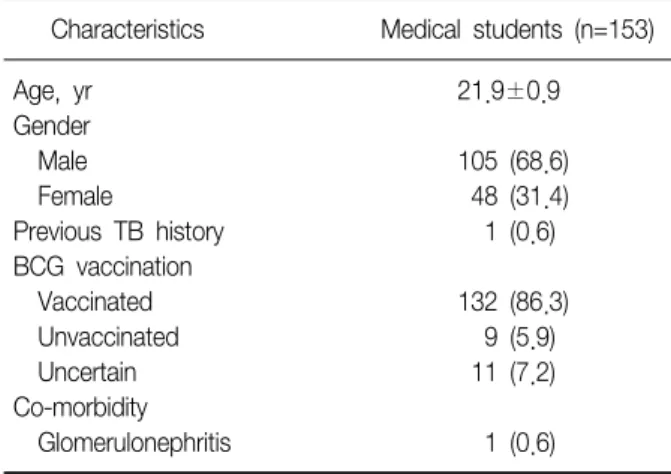
Results: A total of 153 participants were enrolled in the study. The mean age of the subjects was 21.9±0.9 years, 105 (68.6%) were male, and 132 (86.3%) had been vaccinated with Bacille Calmette-Guérin (BCG). Four students (2.6%) had a history of contact with tuberculosis (TB) patients during medical practice. No abnormal chest radiograph findings were found for any of the subjects. Of the 153 subjects, 23 (15.0%) tested positive for the TST, and 8 (5.2%) tested positive for the QFT-GIT. The agreement between the two tests was determined to be 0.34 using kappa coefficients. Of the four students who had a history of contact with TB patients, only one subject tested positive for both tests, and the other three students tested negative for both tests.
Conclusion: A low prevalence of LTBI was found among medical students before clerkship course in South Korea.
Key Words: Latent Tuberculosis; Tuberculin Test; Interferon-gamma Release Tests, Schools, Medical; Students
Address for correspondence: Tae Sun Shim, M.D.
Division of Pulmonary and Critical Care Medicine, Asan Medical Center, University of Ulsan College of Medicine, 388-1, Pungnap-dong, Songpa-gu, Seoul 138-736, Korea Phone: 82-2-3010-3892, Fax: 82-2-3010-6968
E-mail: [email protected]
*Da Ho Jung and Kyung-Wook Jo contributed equally to this work.
Received: Aug. 17, 2012 Revised: Sep. 8, 2012 Accepted: Sep. 27, 2012
CCIt is identical to the Creative Commons Attribution Non-Commercial License (http://creativecommons.org/licenses/by-nc/3.0/).
Introduction
Tuberculosis (TB) still remains a serious health threat in South Korea, an intermediated TB-burden country. In 2011, 39,557 cases (80.7 cases per 100,000 populations) were officially reported by the Korean Tuberculosis Surveillance system
1, which is the highest incidence among Organization for Economic Cooperation and Development (OECD) countries.
In order to reduce TB burden in South Korea, various measures such as private-public-mix cooperation for TB care and control have been introduced recently
2. One of the cornerstones of such measures involves targeted screening of subjects who are at high risk of developing TB, followed by treatment of the latent TB infection (LTBI). In addition to the tuberculin skin test (TST), which has been used for more than 100 years for the diagnosis of LTBI, whole blood interferon-gamma re- leasing assays (IGRAs) based on the Mycobacterium tu- berculosis-specific antigens have been introduced re- cently to diagnose the LTBI
3,4.
Contemporary TST and IGRA survey are valuable for
epidemiological and clinical assessment as well as in the
planning of preventive measure. However, the LTBI
prevalence of the general population assessed by the
TST and IGRA are not well-known in South Korea, es-
pecially in healthy young adults whose age is in
twenties. Especially, the prevalence of LTBI has never
Table 1. Clinical characteristics of 153 medical students*
Characteristics Medical students (n=153)
Age, yr 21.9±0.9
Gender
Male 105 (68.6)
Female 48 (31.4)
Previous TB history 1 (0.6) BCG vaccination
Vaccinated 132 (86.3)
Unvaccinated 9 (5.9)
Uncertain 11 (7.2)
Co-morbidity
Glomerulonephritis 1 (0.6)
*Values are presented as means±standard deviations (SD) or number (%) of subjects.
TB: tuberculosis; BCG: Bacillus Calmette-Guérin.
been reported in medical students only in South Korea.
Therefore, we investigated the LTBI prevalence among medical students in a medical school in South Korea.
Materials and Methods 1. Subjects
A study to assess the positive rates of the TST and IGRA among medical students was conducted in a med- ical school, located in Seoul, from March 2010 to March 2012. Students only in second- or third-year class before clerkship course were enrolled. Because this LTBI test was a part of routine health examination in this medical school, written informed consent was waived. A stand- ardized questionnaire included age, gender, past history of any underlying disease including TB, history of con- tact to patient with TB, and history of Bacillus Calmette- Guérin (BCG) vaccination.
After the completed questionnaire had been obtained, TST and QuantiFERON-TB Gold In-Tube (QFT-GIT;
Cellestis Ltd., Carnegie, VIC, Australia) assay were per- formed at the same time and chest radiograph was taken. This study was approved by the Institutional Review Board of the institution.
2. Tuberculin skin test
Each TST was performed by intradermal injection of 2 tuberculin units of purified protein derivative (PPD) RT23 (Statens Serum Institute, Copenhagen, Denmark) into the forearm using the Mantoux technique
5. Reac- tions were evaluated 48 to 72 hours after injection, with a positive result defined as an induration of ≥10 mm in the transverse diameter by well-trained personnel.
3. QuantiFERON-TB Gold In-Tube (QFT-GIT) The QFT-GIT assay was performed in 2 stages, ac- cording to the manufacturer's instructions. One-milliliter aliquots of blood were drawn directly into three evac- uated blood collection tubes, one containing heparin alone (negative control), one containing T cell mitogen (positive control), and one containing M. tuberculosis - specific antigens, including early secreted antigenic tar-
get 6 (ESAT-6), culture filtrate protein 10 (CFP-10), and TB7.7 (TB-antigen tube). Following overnight incuba- tion, 200μL of plasma was removed from each well and the concentration of interferon-gamma (IFN-γ) was determined by enzyme-linked immunosorbent as- say, with a positive response defined as an antigen-nil IFN-γ concentration ≥0.35 IU/mL
6.
4. Statistical analysis
Concordance between results of the TST and QFT-GIT were assessed using kappa (κ) coefficients, with κ>0.75 defined as excellent agreement, κ<0.4 as poor agreement, and κ between 0.4 and 0.75 as fair to good agreement
7. All statistical analyses were performed using SPSS version 12.0 (SPSS Inc., Chicago, IL, USA).
Results 1. Characteristics of subjects
The study participants consisted of 153 medical stu-
dents. The mean age of students was 21.9±0.9 years,
105 (68.6%) were male and 132 (86.3%) had been vac-
cinated with BCG. One student had a history of pulmo-
nary TB. Four students (2.6%) had a history of contact
to patient with TB during medical practice while they
Figure 1. Scatter plot of individual responses of the TST and QFT-GIT in medical students. The dashed line repre- sents the cutoff of 0.35 IU/mL for interferon-gamma. All points below zero for QTF-GIT results in this figure have been assigned a value of zero. TST: tuberculin skin test;
QFT-GIT: QuantiFERON-TB Gold In-Tube.
Table 2. TST and QFT-GIT results among 153 medical stu- dents
QFT-GIT
Positive (n=8) Negative (n=145) TST
Positive (n=23) 6 17
Negative (n=130) 2 128
TST: tuberculin skin test; QFT-GIT: QuantiFERON-TB Gold In-Tube.