Studies of the Life Cycle and Rearing Methods of Whitebacked Planthopper (Sogatella furcifera Horváth)
Kyung-Min Kim
1and Young-hie Park
2*
1
Division of Plant Biosciences, School of Applied Biosciences, College of Agriculture & Life Science, Kyungpook National University, Daegu 41566, Korea
2
Korea National Open University, 86 Daehak-ro, Jongro-gu, Seoul 03087, Korea
Received February 23, 2018 /Revised February 28, 2018 /Accepted March 8, 2018
This study developed a method to minimize rice damages and enhance timely control by accurately classifying Whitebacked Planthopper (WBPH). The body size of the 1st–3rd instar was 1.5-2 mm, and the body size of the 4-5 instar was 2.5-3.5 mm. In the third instar, the ratio of the front wing bud and the back wing-bud was 1:1. The fourth instar occupied 3/4 of the front wing-bud, and the 5th instar showed that the front wing-bud covers the back wing-bud. It was confirmed that the 1st instar does not have a sensory plate, the 2nd instar has 2-3, the 3rd instar has 4-5, the 4th instar has 6-9, the 5th instar has 10-15, and the adult instar has 15-20 sensory plates. The female spawning organs were reddish when the spawning horn was inserted. WBPH showed that the larvae of 2-3 larvae most actively feed on rice, and the damaged area was the stem of rice near the ground. In addition, a parti- al black wound was observed after the feeding. WBPH-susceptible 'Chucheong' was yellowish, and early growth was slower than that of 'Cheongcheong', which was resistant; moreover, a difference be- tween susceptibility and resistance was observed. The identification of the number of such wounds in the bioassay will be a better basis for understanding the difference in susceptibility between WBPH strains and cultivars. These results will be used as basic data for cultivating the WBPH-resistant vari- eties of rice.
Key words : Life cycle, rearing, spawning organs, whitebacked planthopper
*Corresponding author
*Tel : +82-2-3668-4630, Fax : +82-2-3673-2381
*E-mail : [email protected]
This is an Open-Access article distributed under the terms of the Creative Commons Attribution Non-Commercial License (http://creativecommons.org/licenses/by-nc/3.0) which permits unrestricted non-commercial use, distribution, and reproduction in any medium, provided the original work is properly cited.
ISSN (Print) 1225-9918 ISSN (Online) 2287-3406 Journal of Life Science 2018 Vol. 28. No. 3. 357~360 DOI : https://doi.org/10.5352/JLS.2018.28.3.357
서 론
흰등멸구(Sogatella furcifera Horvath)는 벼멸구(Nilaparvata
lugens Stal.)와 함께 우리나라에서 월동할 수 없는 해충으로매년 6월 하순에서 7월에 걸쳐 중국 남부지방에서 저기압 이 동에 따라 남서풍을 타고 우리나라로 비래하여 벼에 막대한 피해를 주는 해충 중의 하나이다. 분류학상으로 매미목 멸구 과에 속하는 흰등멸구는 한국을 포함한 벼를 재배하는 지역인 중국, 일본, 베트남, 인도, 네팔, 파키스탄, 필리핀, 인도네시아, 이집트 등지에서 발생하여 많은 피해를 주는 것으로 보고되고 있다[7]. 일반적으로 흰등멸구는 벼멸구에 비하여 비래량이 약 10배 이상 많고, 초기밀도도 높다. 우리나라의 경우 최대 발생 기는 7월 하순에서 8월 상순이며 피해상은 8월 하순 이후에 나타나고 있다. 흰등멸구는 25℃의 조건에서 1세대 기간이 약 28일이며, 6월부터 8월 사이의 기온에서는 20~30일 만에 1세
대를 경과한다. 흰등멸구의 성충과 약충이 집단적으로 벼를 흡즙할 경우에는 위조, 고사, 황변, 도복 등의 현상이 일어난다 [3, 6]. 벼가 고사되어 도복이 일어날 정도의 상태에서는 100%
의 감수를 보이고, 황변하는 상태에서는 60%, 그리고 벼의 생 육이 건전하게 보일 정도의 낮은 밀도에서는 20%의 감수를 초래한다고 한다. 흰등멸구의 피해는 조기발견이 어려울 뿐만 아니라 피해정도가 뚜렷이 나타난 상태에서의 약제 살포는 실기(失機)가 되기 때문에 약제방제만으로는 흰등멸구 방제에 어려움이 있어 흰등멸구 저항성 품종의 육성이 요구되고 있다 [1, 2, 4, 5]. 또한 이런 흰등멸구는 벼멸구에 비해 논문이나 학술적 연구결과가 턱없이 부족하여 흰등멸구 저항성 검정을 위한 생물검정에도 많은 제약이 있어 흰등멸구 저항성 계통선 발에 많은 걸림돌이 되고 있다. 따라서 본 연구에서는 흰등멸 구의 생태를 관찰․조사하여 흰등멸구 사육과 증식에 효과적 으로 적용할 수 있는 방법을 연구하고, 흰등멸구에 저항성을 가지는 ‘청청’의 생물검정을 통하여 저항성 품종 육성을 위한 기초자료로 활용하고자 한다.
재료 및 방법
흰등멸구 사육
본 연구에서는 농촌진흥청 국립식량과학원 작물환경과에
358 생명과학회지 2018, Vol. 28. No. 3
Fig. 1. Dietary material preparation steps. A : Chucheong seed- ed appearance, B : seeds of 5g in a container of 50×14×5 cm, C : a state of 1 week of greenery, D : a plan to eat and nurture trees from 4 to 5 leaves.
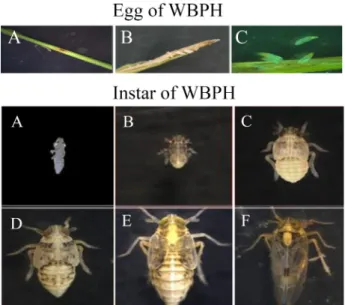
Fig. 2. Life cycle of whitebacked planthopper (WBPH). Egg of WBPH, A: A photograph of a wound after spawning, B : A photograph of a stem of a rice pod after spawning, C : A photograph of an egg of WBPH. Instar of WBPH, A : photograph of the first instar, B : photograph of the second instar, C : photograph of the third instar, D : photograph of the fourth instar, E : photograph of the fifth instar, F: photograph of the adult.
서 흰등멸구의 유충을 50×50×40 cm의 사육상에 분양받아 공 시재료로 이용하였다. 이를 온실에서 온도 28℃, 광도 2,000 lux 그리고 16시간 주기의 조건으로 식이재료인 ‘추청’의 유묘 를 공급하며 세대진전을 시켰다. 흰등멸구를 사육시키기 위한 사육상은 직접 제작하였는데, 벽면은 아크릴 소재를 사용하였 고 환기와 수분 공급을 위해 100 mesh망으로 3면을 만들었다.
식물재료
식물 재료로는 흰등멸구의 식이재료로써 흰등멸구의 선호 도가 높은 ‘추청’을 사용하였다. 종자를 침종하여 20×14×5 cm 의 용기에 4-5 g씩 파종하고 수분을 충분히 공급하여 28℃의 암조건에서 2~3일 최아시킨 후, 온실에서 1~2주 정도 녹화시 킨 4~5엽기의 유묘를 식이재료로 사용하였다(Fig. 1).
흰등멸구 생활환의 관찰
흰등멸구를 Mouth-Operated Aspirator를 이용해 포집하 고, 광학현미경(Stemi 2000-C)과 카메라(Olympus-U-PMTVC) 를 연결하여 흰등멸구를 자세하게 촬영하고 관찰하였다.
생물 검정
생물 검정을 위한 식물재료로는 흰등멸구 저항성인 ‘청청’
과 감수성인 ‘추청’을 공시품종으로 사용하였다. 상토를 채운 육묘상자(58.5×20 cm)에 4×0.5 cm간격으로 저항성 품종인 ‘청 청’과 감수성 품종인 ‘추청’을 한 열당 20립씩 3열을 파종하였 다. 파종 후, 모가 4~5엽기에 이르렀을 때 26~28℃의 온도조건 을 갖춘 온실에서 2~3령충의 흰등멸구를 접종하였다. 그리고 접종한 시점으로부터 흰등멸구가 완전히 안착하고 흡즙을 시 작하여 감수성 품종인 ‘추청’이 고사하는 때를 기점으로 저항 성과 감수성 계통간의 차이를 관찰하였다.
결과 및 고찰
흰등멸구는 엽초부위에 알을 산란하고 산란한 장소의 조직 은 붉게 변화됨을 관찰할 수 있었다(Fig. 2).
흰등멸구의 알은 바나나모양의 흰색이고, 알의 분화과정에 서 눈을 관찰 할 수 있었다. 어린약충의 경우 몸 색깔이 흰색 이며 겹눈색깔이 엷은 검은색이고, 중령~노령의 경우 회백색 의 반분이 있는 것을 확인하였다. 흰등멸구의 한 세대는 28 일이며, 난기간은 6~7일, 약충 기간은 11~12일, 성충 기간은 18~19일인 것을 관찰하였고, 령충별로 구분하여 생활환을 구 성해보았다(Fig. 2).
흰등멸구의 약충은 령충별로 구분할수 있는데, 구분하는 방 법에는 세 가지가 있다. 첫째, 흰등멸구의 전체적인 크기로 구분하였을 때, 제 1~3 령충은 1.5~2.0 mm이고, 제 4~5 령충은 2.5~3.5 mm로써 발육단계에 따라 차이가 있음을 확인하였다.
둘째, 흰등멸구의 날개의 흔적인 시아로 구분할 수 있다. 제
1 령충과 제 2 령충은 시아의 흔적만 남아있어 구분이 힘들었
지만, 제 3 령충은 앞날개시아와 뒷날개시아의 비율이 1:1인
것을 확인하였다. 또한 제 4 령충은 앞날개시아가 전체의 3/4
을 차지하고, 제 5 령충은 앞날개시아가 뒷날개시아를 모두
덮는 것을 관찰할 수 있었다. 령충 구분의 세 번째 방법은 촉각
제 3 절에 있는 감각판의 수로 구분이 가능하다. 제 1 령충은
감각판이 없으며, 제 2 령충은 2~3 개, 제 3 령충은 4~5 개,
제 4 령충은 6~9 개, 제 5령충은 10~15 개, 성충은 15~20 개가
Journal of Life Science 2018, Vol. 28. No. 3 359
Table 1. Classification criteria for whitebacked planthopper
Instar age Size (mm) Wing-bud No. of sensory plate
1
2 1.5~2.0 There are only traces that make it difficult to distinguish. none 2-3
3 The front wing-bud and the back wing-bud are in a 1:1 ratio. 4-5
4 2.5~3.0 The front wing-bud occupies 3/4 of the whole. 6-9
5 The front wing-bud covers the back wing-bud. 10-15
Table 2. The distinction criterion of female and male for whitebacked planthopper
Item Female Male
Size Ventral
Reproductive organs Back
Large
Mostly brown or dark brown The ovipositor is stretched long
Both sides of bovine plate
Small Mostly black Round shape are dark brown or black
Fig. 3. The main distinction of whitebacked planthopper (WBPH).
Comparison photographs of sensory plates of WBPH, A:
fourth instar with six to seven sensory plates, B: third instar with four to five sensory plates. Classification of male and female white of WBPH, A: Female back and belly, B: Male back and belly. The berry of WBPH, A:
juice extractor, B: spawning organ.
Fig. 4. Comparison of varieties after inoculating plants with WBPH. 'Chucheong' indicates susceptibility and 'Cheong- cheong' indicates resistance. S : susceptibility, R : resist- ance.
있는 것을 관찰하고 분류하였다(Table 1, Fig. 3).
흰등멸구의 암수 공통적인 특징은 등의 소순판 양쪽이 암갈
색 혹은 검은색을 띠고 있으나, 흰등멸구의 암수의 구별은 몇 가지로 나눌 수 있다. 먼저 암컷의 경우, 흰등멸구의 암컷은 크기가 크며, 복부가 대부분 갈색을 띠고, 산란관이 길게 뻗어 있는 것을 관찰했다. 흰등멸구의 수컷은 크기가 작으며, 복부 는 대부분 검은색을 띠고, 생식기가 둥근 모양인 것을 관찰하 였다(Table 2, Fig. 3).
흰등멸구의 입부분에 길게 뻗어있는 흡즙기관인 구침을 관
찰할 수 있었고, 구침을 이용해 식물의 즙액을 빨아먹는 것을
확인하였다. 흰등멸구의 산란기관은 암컷이 침상태로 된 산란
관을 지니고 있으며 식물의 엽초와 엽신하부, 잎윗면등 조직
속에 종으로 낳는다. 암컷의 산란기관은 수컷에 비해 길게 뻗
어있는 것을 관찰하였다(Fig. 3). 흰등멸구는 제 3~4 령충이
벼에 부착하여 흡즙 할 경우 벼가 고사하여 그 피해가 큰 것으
로 알려져 있는데[7], 본 실험결과에서는 제 2~3 령충이 가장
360 생명과학회지 2018, Vol. 28. No. 3
초록:흰등멸구의 생활환 및 사육방법 연구
김경민
1․박영희
2*
(
1경북대학교 응용생명과학부,
2한국방송통신대학교)
본 연구는 흰등멸구를 정확히 구분하여 벼 피해를 최소화하고 적기에 방제할 수 있는 방법을 개발하기 위하여 실시하였다. 제 1~3 령충의 몸의 크기는 1.5~2 mm이였고, 제 4~5 령충은 2.5~3.5 mm 정도로 확인하였다. 제 3령 충은 앞날개시아와 뒷날개시아의 비율이 1:1이였으며, 제 4 령충은 앞날개시아가 전체의 3/4을 차지하고, 제 5 령충은 앞날개시아가 뒷날개시아를 모두 덮는 것을 관찰하였다. 제 1 령충은 감각판이 없으며, 제 2 령충은 2~3 개, 제 3 령충은 4~5 개, 제 4 령충은 6~9 개, 제 5 령충은 10~15 개, 그리고 성충은 15~20 개를 가지는 것으로 확인하였다. 암컷의 산란기관과 산란 시에 산란관을 삽입한 부위가 붉게 변화됨을 관찰하였다. 흰등멸구는 주로 2~3 령충이 가장 활발하게 벼를 흡즙하였고, 그 피해부위는 지면과 가까운 볏대인 것으로 확인하였다. 또한 흡즙 후에는 부분적으로 검은 상처가 난 것을 관찰하였다. 흰등멸구의 감수성을 가지는 ‘추청’은 저항성인 ‘청청’에 비 해 조기에 황변되고 초기 생육이 부진하여 감수성과 저항성간의 차이를 관찰할 수 있었다. 또한 생물 검정에 있어 이러한 상처의 수를 파악하는 것은 흰등멸구의 계통․품종 간 감수성의 차이를 보다 쉽게 파악 할 수 있는 기준이 될 것으로 사료된다. 이상의 결과는 벼의 흰등멸구 저항성 품종 육성의 기초자료로 이용 될 것이다.
활발하게 흡즙하는 것으로 관찰되었다.
감수성이 가장 높은 4~5 엽기의 유묘에 흰등멸구 제 2~3 령충의 유충을 접종한 결과, 흰등멸구의 감수성을 가지는 ‘추 청’은 저항성인 ‘청청’에 비해 조기에 황변되고 초기 생육이 부진한 것을 관찰할 수 있었다(Fig. 4). Shin and Shim [6]은 인디카형의 품종은 흰등멸구에 저항성을 나타내며, 자포니카 형의 품종들은 대체적으로 흰등멸구에 대하여 감수성으로 나 타난다고 보고 하고 있다. 본연구에서도 인디카형인 ‘청청’은 흰등멸구에서 저항성으로, ‘추청’은 감수성으로 나타나 shin and Shim [6]의 실험결과와 일치하였다. 따라서 본 연구결과 는 흰등멸구의 생활환과 사육방법 뿐 아니라 흰등멸구의 저항 성 품종에 대한 연구에 많은 도움을 줄 것으로 사료된다.
감사의 글
본 논문은 농촌진흥청 차세대바이오그린 21사업 생명공학 사업단 (PJ013647032018)의 지원에 의해 이루어진 것임.
References