• 검색 결과가 없습니다.

Impact of Dual-Hemisphere Transcranial Direct Current Stimulation Combined with Modified Constraint-Induced Movement Therapy on Upper Limb Function in Chronic Stroke: A Single Blinded Randomized Controlled Trial

N/A
N/A
Protected

Academic year: 2021

Share "Impact of Dual-Hemisphere Transcranial Direct Current Stimulation Combined with Modified Constraint-Induced Movement Therapy on Upper Limb Function in Chronic Stroke: A Single Blinded Randomized Controlled Trial"

Copied!
10
0
0

로드 중.... (전체 텍스트 보기)

전체 글

(1)

수정된 강제 유도 운동치료와 결합된 이중 반구 경두개 직류 자극이 만성 뇌졸중의 팔 기능에 미치는 영향 : 단일 맹검 무작위 통제 시험

김 선 호

영광 재활병원 작업치료실 작업치료사

Impact of Dual-Hemisphere Transcranial Direct Current Stimulation Combined with Modified Constraint-Induced Movement Therapy on Upper Limb Function in Chronic Stroke:

A Single Blinded Randomized Controlled Trial

Kim Sunho, OT, Ph.D

Dept. of Occupational Therapy, Young Kwang Rehabilitation Hospital, Occupational Therapist

Abstract

Purpose : The purpose of this study was to research the effects of dual-hemisphere transcranial direct current stimulation (dual tDCS) and modified constraint-induced movement therapy (mCIMT) to improve upper extremity motor function after stroke.

Methods : The study period was from August 2019 to November 2019, and included 24 patients who met the selection criteria.

Participants were divided into 2 groups: dual tDCS and mCIMT, and sham dual tDCS and mCIMT group. Dual tDCS and mCIMT group performed mCIMT immediately after applying dual tDCS for 20 minutes, and sham dual tDCS and mCIMT group performed mCIMT immediately after applying sham tDCS for 20 minutes without turning on the power source. Total interventions were conducted 5 times per week for 4 weeks, and mCIMT was conducted for 30 minutes per session for both experimental and control groups. Fugl–Meyer assessment (FMA) and Motor Activity Log scale (MAL) were analyzed before and after 4 weeks of intervention.

Results : Both experimental and control groups showed significant changes in FMA, Amount of Use (AOU), and Quality of Movement (QOM) of MAL. When the differences between groups was compared using ANCOVA, the experimental group showed a greater improvement in FMA and AOU of MAL than the control group.

Conclusion : In order to enhance the effect of improving upper limb function of stroke patients, dual tDCS could be applied to provide more effective treatment in the clinical setting. Further studies will be needed in larger groups of stroke patients, including long-term follow-up, and multi-group comparisons through the establishment of anodal tDCS and mCIMT, cathodal tDCS, and mCIMT groups to clarify the effects of dual tDCS. In addition, research is needed to establish a protocol for tDCS, and this evidence-based intervention protocol is expected to be used in the clinical setting as an interventional method for various purposes.

Key Words : chronic stroke, dual-hemisphere transcranial direct current stimulation, modified constraint-induced movement therapy group, upper extremity

1)

교신저자 : 김선호, [email protected]

논문접수일 : 2020년 2월 26일 | 수정일 : 2020년 3월 16일 | 게재승인일 : 2020년 4월 3일

(2)

Ⅰ . 서 론

1. 연구의 배경 및 필요성

팔 기능 장애는 뇌졸중 이후 발생하는 운동 결함으로 뇌졸중 환자의 30~60 %가 편마비로 인하여 일상생활활 동을 수행하는데 있어 어려움을 겪고 있다. 뇌졸중 환자 들은 이러한 신경학적, 기능적 결함을 지닌 채로 장기간 생존하게 되는데, 팔 기능 손상 환자의 약 33 %에서 66

%는 발병 이후 6개월 이내에 약간의 회복을 나타내기도 한다고 보고되고 있다(Mercier 등, 2001).

뇌졸중 환자들은 일상생활활동을 수행하는데 있어 비 손상측 팔의 과도한 사용은 손상측 팔의 비사용을 촉진 시키며 운동량 감소를 이끌어 낸다(Smania 등, 2012). 이 러한 손상측 팔의 비사용을 방지하기 위한 치료로서 비 손상측의 사용을 억제시키면서 손상측 팔의 기능적 과 제를 집중적으로 훈련하도록 하는 접근법인 강제유도운 동치료(constraint-induced movement therapy; CIMT)가 있 다(Taub 등, 2006). CIMT는 깨어있는 시간의 90 % 동안 비손상측의 움직임을 제한시키며, 하루 6시간의 반복적 이고 강도높은 훈련을 실시하게 되는데, 이전의 많은 연 구에서 만성 뇌졸중 환자의 팔 기능을 향상시키는 CIMT 의 효과를 보고하고 있다(Taub 등, 2006; Wolf 등, 2006).

하지만 강도높은 훈련과 비손상측 억제로 야기되는 환 자의 부담감, 낙상위험 증가, 일시적으로 독립적인 생활 이 어려워진다는 점 등과 같은 임상 적용에 대한 문제점 이 제기되었으며, 이러한 문제를 최소화하기 위하여 비 손상측 팔의 억제 시간과 손상측 팔의 훈련시간을 줄인 수정된 강제유도 운동치료(modified constraint-induced movement therapy; mCIMT)가 개발되었다(Levine & Page, 2004; Page 등, 2008). 이전의 많은 연구를 통해 강도를 줄인 mCIMT 역시 뇌졸중 환자의 기능 회복에 긍정적인 효과를 보인다는 결과를 보고하고 있으며(Brogårdh 등, 2009; Dettmers 등, 2005; Fuzaro 등, 2012; Lin 등, 2009), 뇌졸중 병변의 반대측(contralateral)과 동측(ipsilateral) 반 구 모두에서 대뇌 겉질의 성질 변화를 촉진한다고 밝히 고 있다(Liepert 등, 2000; Nudo 등, 1996; Pascual-Leone 등, 2005). 이러한 일차운동겉질의 가소성은 팔 운동 기

능의 개선에 특히 중요하다.

뇌졸중 환자들의 운동장애는 손상 반구의 감소된 출 력과 비손상측 반구와 손상측 반구 사이의 대뇌반구 간 경쟁 모델(model of interhemispheric rivalry)에 따라 비손 상측 반구로 부터의 무조건적인 억제로 인해 발생하게 된다 (Nowak 등, 2009). 경두개 직류 전류자극(transcranial direct current stimulation; tDCS)은 비침습적 뇌 자극으로 손상측 반구에 흥분성을 증가시키는 양극(anodal) 자극 과 비손상측 반구에 흥분성을 억제시키는 음극(cathodal) 자극으로 구성되어 있으며(Nowak 등, 2009), 두피에 약 한 연속전류를 전달함으로써 신경세포를 탈분극 (cathodal) 시키거나 과분극(anodal) 자극시켜 대뇌 겉질 의 흥분성을 변화시켜 기능 개선을 이끌어 낸다(Fregni

& Pascual-Leone, 2007; Lindenberg 등, 2010).

tDCS의 양극 자극의 효과에 대한 연구는 많이 이루어 져 왔으나 음극 자극에서의 효과에 대한 연구는 아직 부 족하다(Giacobbe 등, 2013). 일반적으로 음극 자극은 양 극 자극의 반대쪽 뇌 반구의 눈확 위(supraorbital area)에 부착되어 기준 전극(reference electrode)으로 이용되는 경 우가 대부분이었지만, 최근에는 음극 자극의 부착 부위 에 따른 효과를 확인하는 연구들이 많아지고 있으며 뇌 신경 세포의 흥분을 증가시키는 양극 자극을 손상측 뇌 반구의 일차운동영역(primary motor area, M1)에 부착하 고 부가적으로 흥분을 억제하는 음극 자극을 비손상측 뇌 반구의 일차운동영역에 부착 시 손상측 뇌 반구의 활 성이 더 가중되는 결과를 보고하고 있다(Plow 등, 2013).

이러한 결과는 한쪽 뇌가 지나치게 우세해 지면 다른쪽 뇌의 활성을 억제한다는 뇌 반구 간 억제 가설 (interhemispheric inhibition theory)을 뒷받침하는 증거라 고 할 수 있다(O'Shea 등, 2014).

이를 근거로 두 개의 전극을 모두 사용하는 양 반구

경두개 직류전류 자극(dual-hemisphere transcranial direct

current stimulation; dual tDCS)을 사용한 연구들이 이뤄지

고 있으며, Sehm 등(2013)은 dual tDCS가 일차운동겉질

자극 (primary motor cortex stimuli)의 대뇌겉질 또는 대뇌

반구 간 처리를 조절하는데 효과를 보이며 비손상측 반

구에서 대뇌반구 간 억제를 더 낮출 수 있는 것으로 보

고하고 있다. 또한, Takebayashi 등(2017)은 dual tDCS가

운동 및 행동훈련과 결합되어 대뇌겉질 흥분성을 자극

(3)

촉진하기 위해 사용될 수 있으며, 물리치료와 작업치료 같은 재활치료와 결합할 때 가소성 변화를 촉진시키는 것으로 보고하고 있다.

하지만 이전 연구들은 단지 양극(anodal) 자극만을 사 용하거나 음극(cathodal) 자극만을 사용하는 단일 (unilateral) 전극 tDCS 연구가 대부분이며, dual tDCS에 대한 연구 또한 tDCS의 단일 효과만을 검증하거나 (Lindenberg 등, 2010; Nowak 등, 2009), dual tDCS와 함께 사용되는 중재로써 mCIMT 비교하여 환자들의 수행에 대한 부담감이나 안정성 및 비용적 측면에서 임상 적용 에 제한점이 있는 CIMT(Bolognini 등, 2011; Takebayashi 등, 2017)를 사용하거나 비용적, 공간적 제한을 가진 로 봇 치료(Mazzoleni 등, 2019) 등과의 결합 중재 효과를 알 아보는 연구가 대부분이다. 또한, 국내외적으로 mCIMT 와 tDCS와의 결합 중재에 관련된 연구는 거의 없기 때 문에 이에 대한 검증이 필요하다고 판단된다.

2. 연구의 목적

이에 본 연구의 목적은 만성 뇌졸중 환자의 팔 기능 회복에 대한 dual tDCS와 mCIMT의 결합 중재 효과를 알아보고 분석하는 것이다.

Ⅱ. 연구방법

1. 연구 대상

본 연구는 2019년 08년 11일부터 11월 05일 까지 W시 Y 병원에서 시행되었으며, 연구의 대상자는 Y 병원에 입원하여 재활치료를 받고 있는 24명의 만성 뇌졸중으 로 인한 편마비 환자를 대상으로 하였다. 본 연구의 대 상자 선정기준은 연구 참여에 동의한 자, 20세에서 90세 성인인 자, 만성 뇌졸중(>180 days from stroke onset)인 자이며, 양측 반구 또는 뇌줄기 부위의 경색 또는 출혈 인 자, 손허리손가락관절(metacarpophalangeal joints)과 손 가락뼈사이관절(interphalangeal joints)의 자발적 폄 동작 이 각각 10˚ 이하, 20˚ 이하인 자, 균형유지 또는 걷기

에서 심각한 손상이 있는 자, 인지 손상이 의심되는 자 (MMSE-K 24점 이하), 실행증이 있는 자, 뇌졸중 이외에 다른 통제되지 않는 건강상태 또는 심각한 말기 질환이 존재하는 자, 어깨, 팔꿈치, 손목 또는 손가락 부위의 심 각한 강직이 있는 자는 본 연구에서 제외하였다. 모든 연구참여자는 본 연구에 대한 내용을 완전하게 이해한 대상자에 한해 자발적으로 이루어졌다. 또한, 모든 참여 자는 실험 및 결과의 사용에 대해 통보 받았으며, 연구 에 포함시키는데 공식적으로 동의한 서면 진술서에 서 명하도록 요청받았다.

2. 연구 설계

본 연구는 단일 맹검 무작위 위약 대조군, 전·후 비교 설계 (single blinded, randomized, sham controlled, pre-post design)이다. 선정된 연구 대상자들은 dual tDCS와 mCIMT 그룹과 sham mCIMT 그룹으로 무작위 배정되었 다. 무작위 추출은 중재가 시작되기 전 순차적으로 번호 가 매겨진 봉인된 불투명한 봉투를 선택하게 함으로 진 행되었다. 중재와 평가의 진행은 연구자와 5년 이상의 임상경력을 가진 4명의 작업치료사 총 5명이 참여하였 다. 이중 연구자를 포함한 2명은 연구대상자들이 중재를 수행하는데 참여하였고, 3명은 중재 전·후로 두 그룹의 환자들을 평가하였다. 연구에 참여한 모든 환자들은 dual tDCS 프로토콜에 대해 알 수 없도록 맹검을 실시하 였다 . 평가는 병원 작업치료실 내에서 진행되었으며, 대 상자 선정 조건에 해당하는 환자를 대상으로 중재 전·

후, 48시간 이내, 사전 사후 평가를 실시하였다.

3. 중재

실험군은 dual tDCS를 20분간 적용한 직후 mCIMT를 실시하였으며, 대조군은 전류 전원을 켜지 않은 상태로 20분간 sham tDCS를 적용한 직후 mCIMT를 실시하였다.

총 중재 기간은 4주간 주 5회 실시하였으며, mCIMT는

실험군과 대조군 모두 회기 당 30분씩 진행되었다. 연구

가 진행되는 4주간 모든 연구대상자는 하루 2회, 운동치

료, 작업치료, 언어치료(해당자에 한해)와 같은 일반 전

통적인 재활치료를 병행하였다.

(4)

1) dual tDCS

tDCS 세션은 환자들이 목 지지대와 팔걸이가 있는 편 안한 의자에 앉아 있는 상태에서 진행되었다. dual tDCS 를 위한 사용된 장비는 The Brain Driver v2.1 tDCS(The Brain Driver v2.1, The Brain Driver, USA)로서 휴대가 간 편한 장점을 가지고 있다. 전극 부착 부위는 양전극은 손상측 일차운동겉질(point C3 or C4 according to the 10–

20 system), 음전극은 비손상측 일차운동겉질(point C4 or C3 according to the 10–20 system)에 각각 부착되었으며, 자극 프로토콜은 20분 동안 1 ㎃ 세기의 정전류(constant current)를 적용하였다(Giacobbe 등, 2013; Nitsche &

Paulus, 2000).

2) mCIMT

본 연구에 참여한 모든 참여자는 mCIMT를 실시하는 총 4주, 주 5일간 깨어있는 동안 일상생활에서 씻고 식 사하는 시간과 물리치료 및 작업치료를 받는 시간을 제 외하고 하루 5시간 동안 장갑(mitt)을 사용하여 비손상측 팔의 손목과 손의 움직임을 제한하였다. 손상측 팔에 대 한 반복적 집중훈련 프로그램은 이전의 연구를 참고하 여 선정하였으며(Kim 등, 2016), 고무공 바구니에 담기, 플라스틱 병 옮기기, 페그 보드 담기, 카드 뒤집기, 콩 줍 기, stacking cone 쌓기, 책장 넘기기, 동전 넣기 등 8가지 과제로 구성하였다. 손상측 팔 훈련 프로그램은 등받이 가 있는 의자에서 앉아 실시하였으며, 엉덩관절과 무릎 관절, 발목관절을 약 90 °로 굽힘시킨 편안한 상태에서 실시하며, 양발이 바닥에 닿지 않을 경우 발판 위에 양 발을 올리게 하여 실시하였다.

4. 실험 도구

1) 간이 정신 상태 검사-한국판(mini mental status exam-korean; MMSE-K)

본 연구에서는 연구대상자들의 인지 손상 여부를 판 단하기 위해 MMSE-K를 사용하였다. MMSE는 Folstein 등(1975)에 의해 개발되었으며, 1989년 한글판으로 번안 되어 표준화되었다. MMSE-K는 뇌졸중을 포함한 뇌 손 상 환자들의 인지 수준을 평가하기 위한 도구로 사용되

고 있으며, 검사자 간 신뢰도는 0.99로 높다(Park &

Kwon, 1989). 30점 만점 중 24점 미만은 인지 손상으로 판정할 수 있으며, 본 연구에서는 24점 이상을 대상자로 선정하였다.

2) Fugle-Meyer Assessment(FMA)

본 연구에서는 팔의 운동기능 회복 수준을 평가하기 위해 FMA를 사용하였다. Bruunstrom 회복의 6단계를 근 거로 개발되었으며, 점수 척도는 수행하지 못할 경우 0 점, 부분적으로 수행할 경우 1점, 완전하게 수행할 경우 2점으로, 0~2점의 3점 척도로 이루어져 있다. 하부 항목 으로는 팔 기능, 다리 기능, 균형, 감각, 관절운동범위, 통증의 총 113문항으로 구성되어 있으며, 본 연구에서는 팔 기능 영역 33문항(총점 66점)만을 사용하였다 (Fugl-Meyer 등, 1975; Gladstone 등, 2002). 팔 운동 기능 항목의 검사자간 신뢰도는 r=.97~.99이고, 검사-재검사 신뢰도는 r=.94~,99, 급간상관계수(intraclass correlation coefficient; ICC)는 r=.97로 높게 나타났다(Page 등, 2012).

3) Motor Activity Log(MAL)

본 연구에서는 일상생활활동 시 손상측 팔의 사용빈 도와 질의 회복 수준을 평가하기 위해 CIMT의 효과를 측정하기 위하여 개발된 도구로 실제 일상생활에서 손 상측 팔을 얼마나 사용 하는지를 양적, 질적으로 평가하 는 도구이다(Taub 등, 1993). 구성 항목은 팔을 사용하는 30가지의 다양한 일상생활활동으로 이루어져 있으며, 환 자나 보호자와의 인터뷰를 통해 평가하는 방식이다. 결 과 측정은 얼마나 양적으로 많이 사용하는지를 나타내 는 팔의 사용량(amount of use; AOU)과 질적 평가를 나 타내는 움직임의 질(quality of movement; QOM)로 나뉜 다. 점수는 항목 당 0~5점의 6점 척도로 되어 있으며, 내 적일치도는 Cronbach‘s α= .81~.87 이며, 검사-재검사 신 뢰도는 r=.91로 높게 나타났다(Uswatte 등, 2005).

4. 분석 방법

모든 데이터는 SPSS 21.0 프로그램(IBM Corp.,

Armonk, NY, USA)를 사용하여 분석되었다. 범주형 척도

(5)

는 Fisher’s exact test, 서열 척도는 unpaired t test를 사용 하여 기초선에 대한 그룹 간 차이를 평가하였다. 치료군 과 대조군 간의 치료 효과는 FMA 점수와 MAL의 AOU 와 QOM의 사전점수를 공변량으로 한 공분산분석 (analysis of covariance; ANCOVA)으로 평가되었으며, paired t-test를 사용하여 각 군 내 차이를 분석하였다. 실 험군에 대한 효과 크기 지수 η2로 계산되었다. 데이터 는 평균과 표준편차로 나타냈으며, 통계적 유의수준 α

=.05로 정의하였다.

Ⅲ. 연구결과

1. 대상자들의 일반적 특성

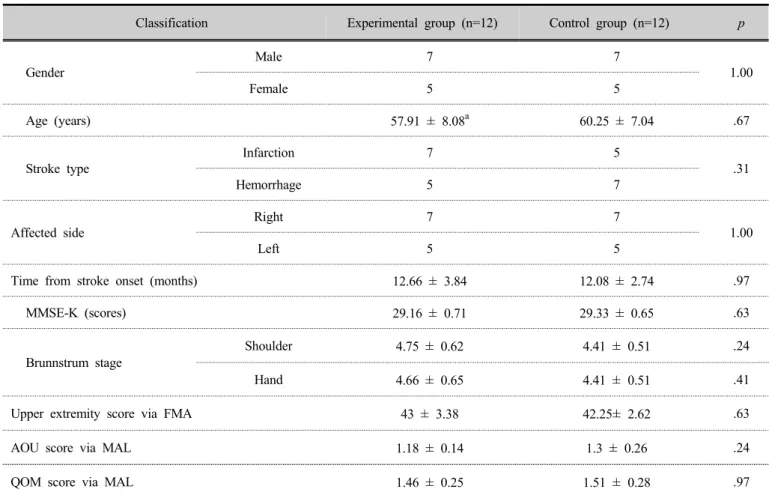
연구대상자들의 일반적 특성과 중재 전 FMA와 MAL 의 AOU, QOM의 기초선 값에 대한 두 그룹 간 유의한 차이는 나타나지 않았다(Table 1).

2. 그룹 내간 FMA, MAL 점수 변화

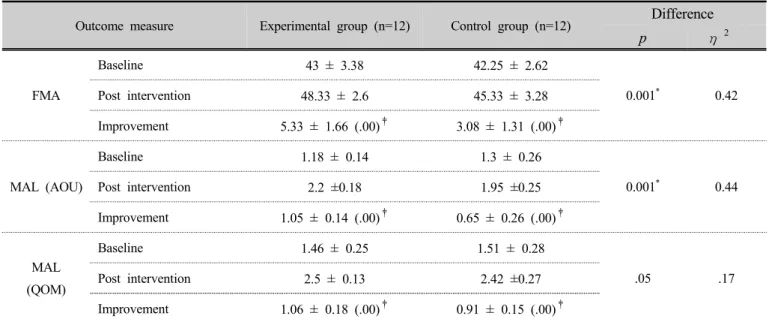
실험군과 대조군 모두 FMA와 MAL의 AOU, QOM에 서 유의한 변화를 나타냈다(Table 2). ANCOVA를 통해 그룹 간 차이를 비교한 결과, 실험군은 대조군 보다 FMA(p<.001, η

2

=.42), MAL의 AOU(p<.001, η

2

=.44)에서 더 큰 개선을 나타냈다(Table 2).

Classification Experimental group (n=12) Control group (n=12) p

Gender

Male 7 7

1.00

Female 5 5

Age (years) 57.91 ± 8.08

a

60.25 ± 7.04 .67

Stroke type

Infarction 7 5

.31

Hemorrhage 5 7

Affected side

Right 7 7

1.00

Left 5 5

Time from stroke onset (months) 12.66 ± 3.84 12.08 ± 2.74 .97

MMSE-K (scores) 29.16 ± 0.71 29.33 ± 0.65 .63

Brunnstrum stage

Shoulder 4.75 ± 0.62 4.41 ± 0.51 .24

Hand 4.66 ± 0.65 4.41 ± 0.51 .41

Upper extremity score via FMA 43 ± 3.38 42.25 ± 2.62 .63

AOU score via MAL 1.18 ± 0.14 1.3 ± 0.26 .24

QOM score via MAL 1.46 ± 0.25 1.51 ± 0.28 .97

a
mean±SD, AOU; amount of use, FMA; fugl-meyer assessment, MAL; motor activity log, QOM; quality of movement

Table 1. Patient distribution according to demographic and clinical characteristics in experimental group

and control group

(6)

Outcome measure Experimental group (n=12) Control group (n=12) Difference

p η

2

FMA

Baseline 43 ± 3.38 42.25 ± 2.62

0.001

*

0.42 Post intervention 48.33 ± 2.6 45.33 ± 3.28

Improvement 5.33 ± 1.66 (.00)

3.08 ± 1.31 (.00)

MAL (AOU)

Baseline 1.18 ± 0.14 1.3 ± 0.26

0.001

*

0.44

Post intervention 2.2 ± 0.18 1.95 ± 0.25

Improvement 1.05 ± 0.14 (.00)

0.65 ± 0.26 (.00)

MAL (QOM)

Baseline 1.46 ± 0.25 1.51 ± 0.28

.05 .17

Post intervention 2.5 ± 0.13 2.42 ± 0.27

Improvement 1.06 ± 0.18 (.00)

0.91 ± 0.15 (.00)

AOU; amount of use, FMA; Fugl-Meyer Assessment, MAL; Motor Activity Log, QOM; quality of movement,

*

Between-group comparison on the change in score from pre to post intervention,

p<0.01 and

p<0.001 for within groups change from baseline to post-treatment

Table 2. Comparison of changes in FMA, MAL within group and between group

Ⅳ . 고 찰

본 연구는 만성 뇌졸중 환자를 대상으로 mCIMT 이전 치료로 dual tDCS를 적용한 그룹과 mCIMT 만 수행한 그룹과의 비교를 통해 손상측 팔의 운동기능 회복에 대 한 효과 차이가 있는지 알아보고자 하였다. FMA와 MAL에 의해 평가된 결과, mCIMT의 이전 치료로 사용 된 dual tDCS는 mCIMT에 의해 발생된 운동기능의 개선 효과를 증가시켰다.

tDCS는 대뇌 운동겉질의 활성화 유발하는 비침습적 자극으로 임상 사용의 효율성 측면에서 장점을 가지고 있는 뇌 자극 방법이다(Nitsche 등, 2003). tDCS를 통한 전기 자극이 신경학적 분극 작용을 직접적으로 유발하 지는 않지만, NMDA 수용체(NMDA receptor)활성화, 장 기 강화(long term potentiation; LTP)와 장기 저하(long term depression; LTD)의 변화를 유발하여 손상 또는 비 손상측 대뇌반구의 활성화를 조절하게 된다(Nitsche 등, 2003; Paulus, 2003).

tDCS는 양극(anodal) 자극과 음극(cathodal) 자극으로

나뉘게 되는데 양극 자극은 손상 측 대뇌반구의 국소 뇌 혈류량의 증가와 흥분성을 증가시켜 손상된 운동겉질 활동의 상향 조절을 강화시키게 되며, 음극 자극은 비손 상측 대뇌반구의 국소 뇌 혈류량의 감소와 흥분성 감소 를 통해 운동겉질 활동의 하향 조절을 강화시키게 된다 (Schlaug & Renga, 2008). 뇌졸중 환자의 편측 뇌 손상으 로 인해 뇌들보경유 억제(transcallosal inhibition) 균형이 깨어지면서 비손상측 운동 겉질의 과흥분성을 야기하게 되는데(Liepert 등. 2000), 이러한 tDCS의 조절 기전을 바 탕으로 한 운동겉질의 적절한 분극 균형은 비정상적인 반구 간 경쟁(abnormal interhemispheric competition)을 억 제하여 운동기능 개선을 이끌어낸다(Bolognini 등, 2011).

본 연구에서 dual tDCS와 함께 사용된 mCIMT는 회복

을 위한 뇌의 신경가소성 변화를 유도하는 재활훈련으

로, 그 효과 발현에 대한 신경기전은 비손상측 팔의 제

한과 손상측 팔의 집중적인 과제훈련을 통해 비손상측

대뇌반구의 겉질 활성도를 감소시키고, 손상측 대뇌반구

의 겉질 활성도를 증가시키는 tDCS의 회복기전과 비슷

하여 (Bolognini 등, 2011; Liepert, 2000), 두 중재를 결합

하여 사용하는 것은 운동 신경망(neural network)에 대한

(7)

각 중재 효과를 강화하여 임상적 효과크기를 증가시킬 수 있다(Bolognini 등, 2011). Ateia 등(2017)은 40명의 뇌 졸중 환자를 대상으로 각 20명 씩, dual tDCS와 CIMT 그 룹과 CIMT 그룹으로 나누어 비교한 결과, dual tDCS와 CIMT를 실시한 그룹이 CIMT만 단독으로 실시한 그룹 보다 팔 기능과 손상측 반구의 운동겉질의 활성화 개선 에 보다 효과적임을 보고하였고, Bolognini 등(2011)의 연 구에서는 dual tDCS와 CIMT를 같이 실시한 그룹이 CIMT만 실시한 그룹보다 더 큰 손 기능과 근력 개선을 보였으며, 더불어 전반적인 팔 기능의 향상과 운동겉질 의 활성화를 이끌어 내었다고 보고하고 있다. 본 연구에 서도 dual tDCS와 mCIMT를 실시한 실험군과 mCIMT만 실시한 대조군 모두 집단 내 유의한 개선을 보였고, 실 험군은 대조군보다 유의한 변화를 보였다. 이는 앞서 언 급한 이전 연구들의 결과와 유사하며, dual tDCS가 mCIMT의 효과를 강화시킨 것으로 유추할 수 있다.

뉴런은 전기신호로 정보를 전달하게 되는데 두 뉴런 사이에 신호 전달이 빠를수록 연관이 높은 뉴런이라고 판단해 시냅스의 연결을 강화시키게 되는데(Nitsche와 Paulus, 2000), 본 연구 결과와 같이 mCIMT에 관여하는 운동겉질 영역에 대한 dual tDCS의 동시적용에 의해 가 소성을 향상시킬 수 있었던 것은 시냅스 전(presynaptic) 및 시냅스 후(postsynaptic) 요소가 동시에 활성화될 때 시냅스 효능(synaptic efficacy)의 강화가 발생한다 (Stollberg, 1995)는 Hebbian principle과도 일치한다고 할 수 있다.

본 연구의 결과, FMA와 MAL의 AOU에서는 그룹 간 유의미한 차이를 보였지만, MAL의 QOM에서는 그룹 간 차이를 보이지 않았다. 하지만, QOM에서 그룹 간 차이 의 효과크기(η

2

)는 0.17로 큰 효과(large effect)를 나타냈 다. Cohen에 따르면, η

2

로 평가된 효과크기는 η

2

<0.01 에 대해 작은 효과(small effect), 0.01<η

2

<0.06에 대한 중 간 효과(medium effect) 및 η

2

>0.14에 대한 큰 효과(large effect)로 보고되고 있다(Cohen, 2005). MAL의 QOM 점 수의 p값이 0.05로 그룹 간에 유의한 차이를 나타내지는 않았지만, η

2

값은 이 차이가 dual tDCS와 mCIMT의 결 합 중재의 실질적인 효과를 나타내는 것으로 설명할 수 가 있다. 또한, 이러한 불일치는 통계 오류(type II error) 로 설명될 수가 있으며, 표본크기가 작기 때문에 통계분

석에서의 불충분한 검정력과 관련이 있는 것으로 판단 할 수 있을 것이다. Lang 등(2008)은 뇌졸중 환자의 MAL의 QOM 점수의 최소 임상적 중요도 차이(minimum clinically important difference; MCID)를 1.00~1.10점으로 보고하고 있는데, 본 연구에서 MAL의 QOM 점수의 MCID는 실험군에서 1.06, 대조군에서 0.91로 대조군에 서는 해당되지 않았으며, 이는 QOM에서 그룹 간 차이 가 통계적으로 유의하지 않았음에도 불구하고 실험군에 서 지속적으로 더 높은 개선이 있었다는 결론을 뒷받침 할 수 있다.

본 연구는 임상에서의 중재 효과 촉진을 위한 효율성 과 유용성 측면에서 의미가 있다고 할 수 있다. 본 연구 에서 사용한 mCIMT 프로토콜은 기존의 CIMT의 강도높 은 훈련 스케줄을 수정하여 국내 임상 환경에서 시행되 고 있는 30분을 기준으로 했기 때문에 임상적용이 용이 하며, tDCS 또한 휴대성이 높아 이동이 간편하고 통증이 나 불편감이 거의 없는 장점을 가지고 있어 임상에서 재 활훈련 수행 전에 쉽게 사용이 가능하다. 본 연구의 결 과를 바탕으로 뇌졸중 환자들의 팔 기능 개선에 효과를 높이기 위해 dual tDCS와 더불어 mCIMT를 시행할 수 있을 것으로 사료된다.

본 연구의 제한점은 첫 번째로 연구대상자의 수가 적 어 일반화하기 어렵다는 것이다. 추후연구를 통해 많은 뇌졸중 환자를 대상으로 하여 장기 추적을 포함한 연구 를 시행할 필요가 있을 것이다. 두 번째로 본 연구에서 는 대조군으로 mCIMT 그룹만 설정하였다는 것이다.

dual tDCS의 효과의 명확한 입증을 위해서 양극 자극과

mCIMT, 음극 자극과 mCIMT 그룹의 설정을 통한 다중

그룹 비교가 필요하다고 생각된다. 마지막 세 번째로 뇌

의 활성을 직접적으로 증진시키거나 억제시킬 수 있는

dual tDCS는 mCIMT뿐만 아니라 다른 재활훈련과 동반

하여 사용될 수 있고 기능 개선에 효과적인 방법이지만

아직은 적용 부위와 명확한 기전이 확립되지 않았고 특

히 음극의 사용에 따른 효과가 불명확한 현실이다. 추후

연구에서는 dual tDCS의 명확한 프로토콜 확립을 위한

연구가 필요할 것이며, 이러한 근거 기반의 중재 프로토

콜을 통해 임상에서 다양한 목적으로 사용될 수 있는 중

재법으로 사용될 것이라 생각된다.

(8)

Ⅴ . 결 론

본 연구는 dual tDCS와 mCIMT의 결합 중재가 뇌졸중 환자들의 팔 기능에 어떠한 영향이 있는지 알아보는 것 이다. 2019년 08년 11일부터 11월 05일 까지 W시 Y 병 원에서 시행되었으며, 연구의 대상자는 강원도 Y 재활 병원에 입원하여 재활치료를 받고 있는 편마비가 있는 뇌졸중 환자 24명을 대상으로 하였다. 대상자는 실험군 과 대조군으로 나누어 진행되었으며, 실험군은 dual tDCS를 20분간 적용한 직후 mCIMT를 실시하였으며, 대 조군은 전류 전원을 켜지 않은 상태로 20분간 sham tDCS를 적용한 직후 mCIMT를 실시하였다. 총 중재 기 간은 4주간 주 5회 실시하였으며, mCIMT는 실험군과 대 조군 모두 회기 당 30분씩 진행되었다. 중재 효과에 대 한 결과측정은 FMA와 MAL을 사용하여 분석하였다. 연 구 결과 중재 후 dual tDCS와 mCIMT를 결합하여 진행 한 실험군은 FMA와 MAL의 AOU, QOM에서 sham dual tDCS와 mCIMT를 실시한 대조군보다 유의한 개선을 보 였다.

본 연구의 결과를 바탕으로 뇌졸중 환자들의 팔 기능 개선에 효과를 강화시키기 위해 dual tDCS를 적용한 작 업 중재를 통해 효과적인 치료를 할 수 있을 것이다. 추 후 연구에서는 dual tDCS의 효과에 대한 일반화를 위해 많은 뇌졸중 환자를 대상으로 다중그룹 비교 연구가 필 요하며, 특히, 음극 자극의 확실한 효과 검증을 통해 dual tDCS의 명확한 프로토콜 확립을 위한 연구가 이루 어져야 할 것이다.

참고문헌

Ateia A, Talat W, Nawito A, et al(2017). Effect of transcranial direct current stimulation on upper extremity functional recovery in stroke patients. J Adv Pharm Educ Res, 7(4), 486-490.

Bolognini N, Vallar G, Casati C, et al(2011).

Neurophysiological and behavioral effects of tDCS combined With constraint-induced movement therapy in

poststroke patients. Neurorehabil Neural Repair, 25(9), 819-829. https://doi.org/10.1177/1545968311411056.

Brogårdh C, Vestling M, Sjålund BH(2009). Shortened constraint-induced movement therapy in subacute stroke - no effect of using a restraint: a randomized controlled study with independent observers. J Rehabil Med, 41(4), 231-236. https://doi.org/10.2340/16501977-0312.

Cohen J(2005). Statistical power analysis for the behavioral science. 2nd ed, New York, Routledge Academic, pp.51-55.

Dettmers C, Teske U, Hamzei F, et al(2005). Distributed form of constraint-induced movement therapy improves functional outcome and quality of life after stroke. Arch Phys Med Rehabil, 86(2), 204-209. https://doi.org/

10.1016/j.apmr.2004.05.007.

Folstein MF, Folstein SE, McHugh PR(1975). Mini-mental state: a practice method for grading the cognitive state of patients for the clinician. J Psychiatr Res, 12(3), 189-198. https://doi.org/10.1016/0022-3956(75)90026-6.

Fregni F, Pascual-Leone A(2007). Technology insight:

noninvasive brain stimulation in neurology-perspectives on the therapeutic potential of rTMS and tDCS. Nat Clin Pract Neurol, 3(7), 383–393. https://doi.org/

10.1038/ncpneuro0530.

Fugl-Meyer AR, Jääskö L, Leyman I, et al(1975). The post-stroke hemiplegic patient. 1. a method for evaluation of physical performance. Scand J Rehabil Med, 7(1), 13–31.

Fuzaro AC, Guerreiro CT, Galetti FC, et al(2012). Modified constraint-induced movement therapy and modified forced-use therapy for stroke patients are both effective to promote balance and gait improvements. Rev Bras Fisioter, 16(2), 157-165. https://doi.org/10.1590/

s1413-35552012005000010.

Giacobbe V, Krebs HI, Volpe BT, et al(2013). Transcranial direct current stimulation (tDCS) and robotic practice in chronic stroke: the dimension of timing.

NeuroRehabilitation, 33(1), 49-56. https://doi.org/

10.3233/NRE-130927.

(9)

Gladstone DJ, Danells CJ, Black SE(2002). The Fugl–

Meyer assessment of motor recovery after stroke: a critical review of its measurement properties.

Neurorehabil Neural Repair, 16(3), 232–240. https://

doi.org/10.1177/154596802401105171.

Kim SH, Park JH, Jung MY, et al(2016). Effects of task-oriented training as an added treatment to electromyogram-triggered neuromuscular stimulation on upper extremity function in chronic stroke patients.

Occup Ther Int, 23(2), 165-174. https://doi.org/10.1002/

oti.1421.

Mercier L, Audet T, Hébert R, et al(2001). Impact of motor, cognitive, and perceptual disorders on ability to perform activities of daily living after stroke. Stroke, 32(11), 2602–2608. https://doi.org/10.1161/hs1101.

098154.

Lang CE, Edwards DF, Birkenmeier RL, et al(2008).

Estimating minimal clinically important differences of upper-extremity measures early after stroke. Arch Phys Med Rehabil, 89(9), 1693–1700. https://doi.org/10.1016/

j.apmr.2008.02.022.

Levine P, Page SJ(2004). Modified constraint- induced therapy: A promising restorative outpatient therapy. Top Stroke Rehabil, 11(4), 1-10. https://doi.org/10.1310/

R4HN-51MW-JFYK-2JAN.

Liepert J, Bauder H, Wolfgang HR, et al(2000).

Treatment-induced cortical reorganization after stroke in humans. Stroke, 31(6), 1210–1216. https://doi.org/

10.1161/01.str.31.6.1210.

Lin KC, Wu CY, Liu JS, et al(2009). Constraint-induced therapy versus dose-matched control intervention to improve motor ability, basic/extended daily functions, and quality of life in stroke. Neurorehabil Neural Repair, 23(2), 160-165. https://doi.org/10.1177/

1545968308320642.

Lindenberg R, Renga V, Zhu LL, et al(2010). Bihemispheric brain stimulation facilitates motor recovery in chronic stroke patients. Neurology, 75(24), 2176–2184.

https://doi.org/10.1212/WNL.0b013e318202013a.

Mazzoleni S, Tran VD, Dario P, et al(2019). Effects of transcranial direct current stimulation (tDCS) combined with wrist robot-assisted rehabilitation on motor recovery in subacute stroke patients: a randomized controlled trial.

IEEE Trans Neural Syst Rehabil Eng, 27(7), 1458-1466.

https://doi.org/10.1109/TNSRE.2019.2920576.

Nitsche MA, Liebetanz D, Antal A, et al(2003). Modulation of cortical excitability by weak direct current stimulation--technical, safety and functional aspects.

Suppl Clin Neurophysiol, 56, 255-276. https://doi.org/

10.1016/s1567-424x(09)70230-2.

Nitsche MA, Paulus W(2000). Excitability changes induced in the human motor cortex by weak transcranial direct current stimulation. J Physiol, 527(3), 633-639.

https://doi.org/10.1111/j.1469-7793.2000.t01-1-00633.x.

Nowak DA, Grefkes C, Ameli M, et al(2009).

Interhemispheric competition after stroke: brain stimulation to enhance recovery of function of the affected hand. Neurorehabil Neural Repair, 23(7), 641–

656. https://doi.org/10.1177/1545968309336661.

Nudo RJ, Wise BM, SiFuentes F, et al(1996). Neural substrates for the effects of rehabilitative training on motor recovery after ischemic infarct. Science, 272(5269), 1791–

1794. https://doi.org/10.1126/science.272.5269.1791.

O'Shea J, Boudrias MH, Stagg CJ, et al(2014). Predicting behavioural response to TDCS in chronic motor stroke.

Neuroimage, 85(3), 924-933. https://doi.org/ 10.1016/

j.neuroimage.2013.05.096.

Page SJ, Fulk GD, Boyne P(2012). Clinically important differences for the upper-extremity Fugl–Meyer Scale in people with minimal to moderate impairment due to chronic stroke. Phys Ther, 92(6), 791–798. https://

doi.org/10.2522/ptj.20110009.

Page SJ, Levine P, Leonard A, et al(2008). Modified constraint induced movement therapy in chronic stroke:

results of a single blinded randomized controlled trial.

Phys Ther, 88(3), 333-340. https://doi.org/10.2522/

ptj.20060029.

Park JH, Kwon YD(1989). Korean version of mini-mental

(10)

state examination (MMSE-K) part 1: development of the test for the elderly. J Korean Neuropsychiatr Assoc, 28(1), 125-135.

Pascual-Leone A, Amedi A, Fregni F, et al(2005). The plastic human brain cortex. Annu Rev Neurosci, 28(1), 377–401.

https://doi.org/10.1146/annurev.neuro.27.070203.144216.

Paulus W(2003). Transcranial direct current stimulation (tDCS). Suppl Clin Neurophysiol, 56, 249-254.

https://doi.org/10.1016/S1567-424X(09)70229-6.

Plow EB, Cunningham DA, Beall E, et al(2013).

Effectiveness and neural mechanisms associated with tDCS delivered to premotor cortex in stroke rehabilitation: study protocol for a randomized controlled trial. Trials, 14(1), 331-340. https://doi.org/

10.1186/1745-6215-14-331.

Schlaug G, Renga V, Nair D(2008). Transcranial direct current stimulation in stroke recovery. Arch Neurol, 65(12), 1571-1576. https://doi.org/10.1001/archneur.65.12.1571.

Sehm B, Kipping J, Schäfer A, et al(2013). A comparison between uni- and bilateral tDCS effects on functional connectivity of the human motor cortex. Front Hum Neurosci, 7(183), 1-7. https://doi.org/10.3389/fnhum.2013.00183.

Smania N, Gandolfi M, Paolucci S, et al(2012).

Reduced-intensity modified constraint-induced movement therapy versus conventional therapy for upper extremity rehabilitation after stroke: a multicenter trial. Neurorehabil Neural Repair, 26(9), 1035–1045.

https://doi.org/10.1177/1545968312446003.

Stollberg J(1995). Synapse elimination, the size principle, and Hebbian synapses. J Neurobiol, 26(2), 273-282.

https://doi.org/10.1002/neu.480260211.

Takebayashi T, Takahashi K, Moriwaki M, et al(2017).

Improvement of upper extremity deficit after constraint-induced movement therapy combined with and without preconditioning stimulation using dual-hemisphere transcranial direct current stimulation and peripheral neuromuscular stimulation in chronic stroke patients: a pilot randomized controlled trial. Front Neurol, 8(568), 1-8. https://doi.org/ 10.3389/fneur.2017.00568.

Taub E, Miller NE, Novack TA, et al(1993). Technique to improve chronic motor deficit after stroke. Arch Phys Med Rehabil, 74(4), 347–354.

Taub E, Uswatte G, King DK, et al(2006). A placebo-controlled trial of constraint-induced movement therapy for upper extremity after stroke. Stroke, 37(4), 1045–1049.

https://doi.org/10.1161/01.STR.0000206463.66461.97.

Uswatte G, Taub E, Morris D, et al(2005). Reliability and validity of the upper-extremity Motor Activity Log-14 for measuring real-world arm use. Stroke, 36(11), 2493–2496.

https://doi.org/10.1161/01.STR.0000185928.90848.2e.

Wolf SL, Winstein CJ, Miller JP, et al(2006). Effect of

constraint-induced movement therapy on upper

extremity function 3 to 9 months after stroke: the

EXCITE randomized clinical trial. JAMA, 296(17),

2095–2104. https://doi.org/ 10.1001/jama.296.17.2095.

수치

Table 1. Patient distribution according to demographic and clinical characteristics in experimental group  and control group
Table 2. Comparison of changes in FMA, MAL within group and between group

참조

관련 문서

1 John Owen, Justification by Faith Alone, in The Works of John Owen, ed. John Bolt, trans. Scott Clark, &#34;Do This and Live: Christ's Active Obedience as the

Stimulation of cell surface-expressed ENO1 induced faster repopulation of FLS in the scratch test assay, and increased PDGF-induced transwell migration.. Cytoplasmic

The purpose of this study is to investigate the effect of online shopping mall characteristics on direct purchasing satisfaction of foreign consumers and purchase

The purpose of this study was to investigate the effects of a disability awareness program on improving the attitudes of regular elementary school

The purpose of this study was to investigate the impact of social capital and positive psychology capital on the will of start-up according to experience

The purpose of this research is to the development and effect of the anthroposophy group art therapy program for improvement of creativity and reduction

The purpose of this study was to examine the parents' perceptions on the current status, effects and satisfaction of personal assistant service for students

The purpose of this study was to provide primary material in discussing methods to activate the treatment effects of diabetes and reduce the rate of