Research in Plant Disease pISSN 1598-2262, eISSN 2233-9191 www.online-rpd.org
The Korean Society of Plant Pathology
This is an open access article distributed under the terms of the Creative Commons Attribution Non-Commercial License (http://creativecommons.org/licenses/
by-nc/4.0/), which permits unrestricted non-commercial use, distribution, and reproduction in any medium, provided the original work is properly cited.
https://doi.org/10.5423/RPD.2019.25.1.38 Note Open Access
국내 지황에 발생하는 바이러스병 발생 현황
The Incidence of Virus Diseases in Rehmannia glutinosa in Korea
권선정* · 윤주연 · 조인숙 · 최국선
농촌진흥청 국립원예특작과학원 원예특작환경과
Sun-Jung Kwon*, Ju-Yeon Yoon, In-Sook Cho, and Gug-Seoun Choi
Horticultural and Herbal Crop Environment Division, National Institute of Horticultural and Herbal Science, RDA, Wanju 55365, Korea
While rehmannia (Rehmannia glutinosa Libosch) was identified as a host of at least five viruses, including Rehmannia mosaic virus (ReMV), Youcai mosaic virus (YoMV), Broad bean wilt virus 2 (BBWV2), Plantago asiatica mosaic virus (PlAMV), and Rehmannia virus 1 (ReV1), viral incidence surveys have not been per- formed yet in rehmannia fields in Korea. In this study, we performed field surveys during 2017-2018 to investigate the incidence of 5 major viruses in rehmannia. A total of 145 symptomatic samples were col- lected from the rehmannia fields in major cultivation areas of Korea. Molecular diagnosis assays showed that all the collected leaf samples were infected with more than two viruses. Particularly, two species of Tobamovirus, ReMV and YoMV, were detected in all the samples. In addition, our analysis showed that the root stocks of 4 rehmannia cultivars were infected with at least two viruses. Since rehmannia is prop- agated by vegetative propagation, it is highly important to produce virus-free root stocks of rehmannia to control virus diseases in rehmannia.
Keywords: Field survey, Incidence, Rehmannia glutinosa, Viruses
지황은 현삼과의 다년생 초본으로 한국을 비롯한 중국, 일 본 등에 분포하며 주로 영양번식에 의해 재배되는 약용작물이 다. 주요 이용 부위는 뿌리로 가공방법에 따라 생지황, 건지황, 숙지황으로 구분되는데 각 종류에 따라 약재 성질이 다르다고 알려져 있다. 생지황과 건지황은 주로 해열, 지혈 및 이뇨작용 에 효능이 좋으며 숙지황은 자양강장 및 당뇨병 치료와 혈압강 하, 면역강화에 효능이 있다고 알려져 있다(Cho, 2012; Jang 등, 2011; Lee와 Seo, 2004; Li 등, 2012; Oh 등, 2011). 최근 고소득 작물로 인식되어 약용작물 중 국내 재배면적이 꾸준히 증가하 고 있는 추세이다.
2016년에 음성의 지황 재배포장에서 잎에 황화, 노란 반점, 모 틀 증상 및 변색, 괴저 등과 같은 바이러스 증상과 함께 포장 전 반에 생육이 저조해지는 증상을 확인하고 바이러스 감염 의심 시료들을 채집하여 감염 바이러스를 동정한 바 있다. 그 결과, Rehmannia mosaic virus (ReMV), Youcai mosaic virus (YoMV), Broad bean wilt virus 2 (BBWV2), Plantago asiatica mosic virus (PlAMV), Rehmannia virus 1 (ReV1)의 총 5종의 바이러스 감염 이 확인되었다(Kwak 등, 2018; Kwon 등, 2018a, 2018c; Lim 등, 2016). ReMV와 YoMV는 길이가 약 350 nm인 Tobamovirus 속 에 속하는 막대형 입자형태의 바이러스로 즙액이나 접촉에 의 해 전염되는 바이러스이다(Kubota 등, 2012; Kwon 등, 2018a;
Lim 등, 2016; Zhang 등, 2008). BBWV2는 직경이 약 25 nm인 구형 바이러스로 Fabavirus 속에 속하며 기주범위가 매우 넓은 바이러스이며 즙액 및 진딧물에 의해 매개된다(Ying 등, 2010).
*Corresponding author Tel: +82-63-238-6323 Fax: +82-63-238-6305 E-mail: [email protected]
Received February 27, 2019 Revised March 15, 2019 Accepted March 16, 2019
PlAMV는 길이가 약 450 nm인 Potexvirus 속에 속하는 사상형 바이러스로 주로 즙액 전염한다고 알려져 있다(Kwak 등, 2018).
ReV1는 길이가 약 1500 nm인 사상형 바이러스로 Closterovirus 속에 속하며 즙액에 의해서는 전염되지 않고 진딧물에 의해 전 염되는 바이러스로 구명되었다(Kwon 등, 2018c).
본 연구에서는 지황에서 보고된 5종의 바이러스를 대상으로 국내 지황 재배포장의 바이러스 발생현황을 조사하였다. 2017- 2018년에 지황의 국내 주요 재배지역인 충북 음성과 제천, 충남 금산, 전북 정읍, 전남 나주 및 경북 영주 등에서 바이러스 감염 잎 시료를 채집하여 조사하고 국내 품종 별 종근에서도 바이러 스 감염 현황을 조사하였다. 바이러스 감염확인은 주로 전자현 미경과 유전자 진단법을 이용하여 수행하였다.
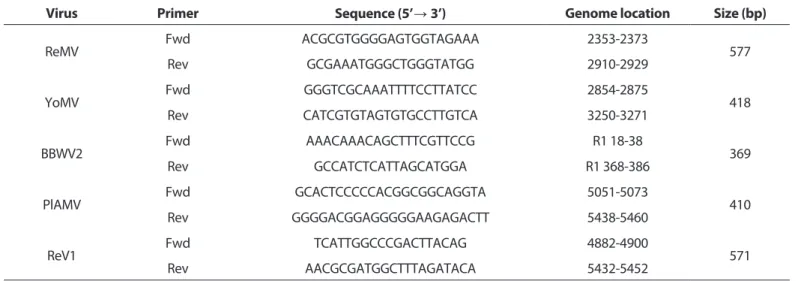
지황의 국내 주요 생산지역 6곳의 농가 및 시험포장에서 총 145개의 잎 시료를 채집하였다. 채집시기는 정식 후 생육 초 기인 5월 하순부터 7월 초순과 수확 전 생육 후기인 9월 하 순부터 10월 중순까지 나누어 실시하였다. 지황 포장에서 발 견되는 주요 바이러스 증상은 잎의 모자이크 및 모틀 증상 과 노란반점, 엽맥괴사 등이었으며, 특히 신초에 심한 모자 이크와 함께 잎이 말리며 요철되는 증상을 관찰할 수 있었 다(Fig. 1). 포장의 육안조사 결과 대부분의 지황에서 바이러 스 증상이 관찰되었다. 유전자 진단에 앞서 채집한 잎 시료 는 dip method에 의한 direct negative staining법으로, 투 과전자현미경(TEM)으로 검경하였을 때 높은 농도로 바이러 스 감염여부를 확인할 수 있었고 막대형과 2종의 사상형 바 이러스가 함께 관찰되었다(Fig. 2A). 전자현미경의 해상도가 낮아 구형 바이러스는 관찰되지 않았다. 감염 바이러스의 정 확한 진단을 위해 total RNA를 추출하고 5종 바이러스의 특 이 프라이머(Table 1)를 이용하여 기존 방법에 의해 유전자 진단하였다(Kwon 등, 2018b). 진단 결과, 모든 시료에서 바이 러스가 검출되었고, 특히 ReMV와 YoMV는 전 채집시료에서 진단되었다. 지역에 따라 금산과 정읍 시료는 ReMV, YoMV와 함께 BBWV2 3종이 전 시료에서 모두 검출되었고 음성 시료 는 ReMV, YoMV, PlAMV 3종이 모든 시료에서 복합감염 된 것 으로 조사되었다. 바이러스 종류별 발병률은 ReMV와 YoMV (100%), BBWV2 (81%), ReV1 (49%), PlAMV (34%) 순으로 많 이 발병됨을 확인하였다(Table 2).
지황 감염 시료 진단 결과, 2종 이상의 바이러스가 함께 검 출되는 것으로 나타나 복합감염 양상을 분석하였다. ReMV 와 YoMV 2종 복합감염은 5.5%인 반면, 3종 복합감염과 4종 복합감염은 43.4%와 33.2%로 매우 높게 나타났다. 이들 중 가장 높게 나타나는 조합은 ReMV+YoMV+BBWV2 (31.7%) 와 ReMV+YoMV+BBWV2+ReV1 (22.8%)였다. 5종 바이러스
가 모두 감염되어 있는 조합도 17.9%로 매우 높게 나타났다 (Table 3).
지황의 높은 바이러스 발병률의 원인을 조사하기 위해 국 내 지황 품종의 종근에서 바이러스 진단을 수행하였다. 지황 은 농가에서 수확한 지황 뿌리를 보관한 후 이듬해 종근으로 사용하고 있어 종근의 바이러스 감염여부는 이후 재배 시 바 이러스 발생의 주요 요인이 될 수 있다. 국내 재배 지황 4품종 (고강, 토강, 다강, 원강)에 대하여 품종 별로 5개씩 종근을 채 집하고 각 종근에서 바이러스 감염 양상을 조사하였다. 유전 자 진단 결과 품종에 관계없이 서로 유사한 감염양상을 보였 으며, 5종 바이러스가 모두 감염된 종근은 20개 중 7개였고 4 종 바이러스 감염은 6개, 3종 바이러스 감염은 4개, 2종 바이 러스 감염은 3개로 나타났다(Table 2). 잎 시료 분석 결과와 동일하게 종근에서도 ReMV와 YoMV는 100% 검출되었다. 한 편, 종근에서 바로 dip method를 통한 전자현미경 검경이 가 능한지 알아보기 위해 5종 바이러스가 모두 검출된 종근을 대상으로 TEM을 관찰하였다. 잎 시료에서와 마찬가지로 구 Fig. 2. Detection of virus particles from leaves (A) and roots (B) of Rehmannia glutinosa samples by transmission electron microsco- py. Three types of virus particles (tobamovirus-like, potexvirus-like, and closterovirus-like particles as indicated with open arrows, tri- angle arrows and diamond arrows, respectively) were observed.
Scale bar, 200 nm.
Fig. 1. Various virus symptoms on Rehmannia glutinosa (A) Yellow mosaic symptoms induced in plants co-infected with ReMV, YoMV, BBWV2, and ReV1. (B) Mosaic and leaf curl symptoms induced in plants co-infected with ReMV, YoMV, and BBWV2. (C) Vein necrosis and yellowing symptoms induced in plants co-infected with ReMV, YoMV, BBWV2, PlAMV, and ReV1.
형 바이러스를 제외하고는 상당히 높은 밀도의 막대형과 2종 의 사상형 바이러스 입자를 관찰할 수 있었다(Fig. 2B). 지황 종근의 바이러스 감염 결과는 포장에서 조사된 높은 바이러 스 발생률의 원인이 바이러스 감염 종근일 가능성이 높음을 시사한다. 바이러스에 감염된 지황 식물체는 뿌리에 바이러스 가 축적되어 있다가 종근으로 정식된 이듬해 포장에서 바이 러스가 감염된 채 생육되었고, 재배 중 작업 시 접촉이나 또는 진딧물 등 바이러스 종류별 전염 방식에 의해 다시 주변 식물 체로 전반 되어 지황 포장에 바이러스병이 만연하게 된 것으 로 예측된다.
지황에 감염하는 5종의 바이러스들이 지황 생육 및 생산량, 생산 품질에 어떻게 영향을 주는지는 아직 구명되지 않았다. 바 이러스에 감염되지 않은 건전묘의 확보가 필요한 시점이다. 지 황의 번식이 주로 영양체에 의해 이루어지고 있지만 종자 확보 후 실생묘를 활용할 경우 바이러스 축적이 제한되어 예방에 도 움이 될 것으로 예상된다. 바이러스에 감염되지 않은 지황 건전 묘 확보를 통해 바이러스병의 전염 특성 및 피해 양상을 분석할 예정이며 예방기술과 관리방안을 확립하여 고품질의 지황 생 산에 도움이 되기를 기대한다.
Table 1. List of primers used to detect viruses in rehmannia
Virus Primer Sequence (5’ ↓ 3’) Genome location Size (bp)
ReMV Fwd ACGCGTGGGGAGTGGTAGAAA 2353-2373
Rev GCGAAATGGGCTGGGTATGG 2910-2929 577
YoMV Fwd GGGTCGCAAATTTTCCTTATCC 2854-2875
Rev CATCGTGTAGTGTGCCTTGTCA 3250-3271 418
BBWV2 Fwd AAACAAACAGCTTTCGTTCCG R1 18-38
Rev GCCATCTCATTAGCATGGA R1 368-386 369
PlAMV Fwd GCACTCCCCCACGGCGGCAGGTA 5051-5073
Rev GGGGACGGAGGGGGAAGAGACTT 5438-5460 410
ReV1 Fwd TCATTGGCCCGACTTACAG 4882-4900
Rev AACGCGATGGCTTTAGATACA 5432-5452 571
Table 2. Viral incidence in six rehmannia fields in Korea during 2017~2018
Region Virus
Total
ReMV YoMV BBWV2 PlAMV ReV1
Chungcheongbuk-do
Eumseong 30 30 25 30 21 30
Jecheon 20 20 9 5 7 20
Chungcheongnam-do
Geumsan 31 31 31 5 10 31
Jeollabuk-do
Jeongeup 46 46 46 6 21 46
Jeollanam-do
Naju 10 10 2 2 4 10
Gyeongsangbuk-do
Yeongju 8 8 4 1 8 8
Total 145 145 117 49 71 145
요 약
최근 국내 지황에서는 Rehmannia mosaic virus (ReMV), You- cai mosaic virus (YoMV), Broad bean wilt virus 2 (BBWV2), Plan- tago asiatica mosaic virus (PlAMV), Rehamnnia virus 1 (ReV1) 등 5종의 바이러스 감염이 확인되었다. 국내 주요 지황 재배지 역의 포장에서 지황 바이러스의 발병률을 조사하기 위해 2017 년부터 2018년까지 여섯 지역의 포장에서 바이러스병 조사를 실시하였다. 지황에 나타나는 주요 바이러스 증상은 잎에 모 자이크와 노란 반점 및 변색이었으며 생육이 저조해지는 증상 이 관찰되었다. 총 145개의 시료를 채집하여 5종 바이러스에 대 한 유전자 진단을 실시한 결과, 전 시료에서 2종 이상의 바이러 스가 복합 감염되어 있음을 확인하였다. 지황은 뿌리로 영양번 식하는 재배 특성 상 품종별 종근에서도 바이러스 감염여부를 조사하였으며, 종근에서도 5종의 바이러스가 검정됨에 따라 지황에서의 바이러스병 관리를 위해서는 무병 종근의 생산 및 보급이 매우 중요할 것으로 판단된다.
Acknowledgement
This work was supported by a grant from the Basic Re- search Program (PJ01260902) of National Institute of Horti- cultural and Herbal Science, Rural Development Administra- tion, Republic of Korea.
References
Cho, Y.-J. 2012. Characterization of biological activities of Rehman- nia glutinosa extracts. J. Life Sci. 22: 943-949. (In Korean)
Jang, J. P., Kil, K. J., Lee, G. H., Ji, Y. S., Kim, B. R., Kang, K. H. et al. 2011.
Change of inorganic component, reducing sugar, catapol and benzo[α]pyrene contents of Rehmannia glutinosa Libosch. var.
purpurea Makino by drying methods. Korean J. Medicinal Crop Sci. 19: 501-507. (In Korean)
Kubota, K., Usugi, T., Tomitaka, Y., Matsushita, Y., Higashiyama, M., Kosaka, Y. et al. 2012. Characterization of Rehmannia mosaic virus isolated from chili pepper (Capsicum annuum) in Japan. J.
Gen. Plant Pathol. 78: 43-48.
Kwak, H.-R., Kim, M., Kim, J., Choi, H.-S., Seo, J.-K., Ko, S.-J. et al. 2018.
First report of Plantago asiatica mosaic virus in Rehmannia gluti- nosa in Korea. Plant Dis. 102: 1046.
Kwon, S.-J., Kim, Y.-B., Back, C.-K. and Chung, B.-N. 2018a. First report of a mixed infection of Youcai mosaic virus and Rehmannia mo- saic virus in Rehmannia glutinosa in Korea. Plant Dis. 102: 462.
Kwon, S.-J., Cho, I.-S., Yoon, J.-Y. and Chung, B.-N. 2018b. Incidence and occurrence pattern of viruses on peppers growing in fields Table 3. Types of Mixed infection of 5 viruses in rehmannia in
Korea
Type of mixed infection Incidence (%)
ReMV+YoMV 5.5
ReMV+YoMV+BBWV2 31.7
ReMV+YoMV+PlAMV 5.5
ReMV+YoMV+ReV1 6.2
ReMV+YoMV+BBWV2+PlAMV 8.3
ReMV+YoMV+BBWV2+ReV1 22.8
ReMV+YoMV+PlAMV+ReV1 2.1
ReMV+YoMV+BBWV2+PlAMV+ReV1 17.9
Total 100.0
Table 4. Incidence of virus infection in tuberous root stocks of rehmannia
Cultivar Sample No.
Virus detection
ReMV YoMV BBWV2 PlAMV ReV1
Gogang
1 + + + + +
2 + + - + -
3 + + + - +
4 + + + + +
5 + + - + -
Togang
1 + + + - +
2 + + + + -
3 + + + - -
4 + + + + +
5 + + + + -
Dagang
1 + + + + +
2 + + + - +
3 + + - + +
4 + + + + +
5 + + - - -
Wongang
1 + + - - -
2 + + - + -
3 + + - - -
4 + + + + +
5 + + + + +
+, detected; -, not detected
in Korea. Res. Plant Dis. 24: 66-74. (In Korean)
Kwon, S.-J., Jin, M., Cho, I.-S., Yoon, J.-Y. and Choi, G.-S. 2018c. Iden- tification of rehmannia virus 1, a novel putative member of the genus Closterovirus, from Rehmannia glutinosa. Arch. Virol. 163:
3383-3388.
Lee, C.-K. and Seo, J.-M. 2004. Changes of the constituents in the Rehmanniae Radix preparata during processing. J. Korean Soc.
Food Sci. Nutr. 33: 1748-1752. (In Korean)
Li, Z.-F., Yang, Y.-Q., Xie, D.-F., Zhu, L.-F., Zhang, Z.-G. and Lin, W.-X.
2012. Identification of autotoxic compounds in fibrous roots of Rehmannia (Rehmannia glutinosa Libosch.). PLoS One 7: e28806.
Lim, S., Zhao, F., Yoo, R. H., Igori, D., Jeong, J. C., Lee, H. S. et al. 2016.
Complete genome sequence of Rehmannia mosaic virus infect-
ing Rehmannia glutinosa in South Korea. Genome Announc. 4:
e01595-15.
Oh, H. L., You, B. R., Kim, H. J., Lee, J. Y., Kim, N. Y., Song, J. E. et al.
2011. Quality characteristics and antioxidant activities of Rehm- anniae radix Paste. J. Korean Soc. Food Sci. Nutr. 40: 1518-1524. (In Korean)
Ying, Z., Rui, Z., Song, G. Xiao, H., Feng, F. Z. and Tao. Z. 2010. Mo- lecular identification of viral pathogens inducing Rehmannia glutinosa mosaic disease in Beijing. Acta Phytophyl. Sinica 37:
447-452.
Zhang, Z. C., Lei, C. Y., Zhang, L. F., Yang, X. X., Chen, R. and Zhang, D.
S. 2008. The complete nucleotide sequence of a novel Tobamo- virus, Rehmannia mosaic virus. Arch. Virol. 153: 595-599.