www.kafm.or.kr
235
서 론흡연은 암, 심혈관 질환, 폐질환과 관련성이 있으며 한국인에서 전 체 사망률 및 암과 관련된 사망률을 증가시키는 것으로 알려져 있 다.1,2) 경제협력개발기구(Organisation for Economic Cooperation and Development, OECD) health data 2014에 따르면 우리나라 전체 흡연 율은 21.6%로 가입국 중 여섯 번째로 높은 국가이며, 특히 남성 흡연 율은 37.6%로 OECD 회원국 중 그리스에 이어 두 번째로 높다.3) 흡연 을 중단하지 못하는 주된 이유는 니코틴의 강력한 의존성 때문인
데, 니코틴은 담배성분 중 유일한 정신활성 물질로서 기억, 주의력, 수행 능력에 관여하며 스트레스 반응을 조절하고 기분을 안정시킨 다.4)
흡연은 신체적인 문제와 정신적인 문제 특히 우울과도 관련이 있 는 것으로 보인다. 2016년 정신질환 실태 역학조사에 따르면 정신질 환에 대한 우리나라 성인의 평생 유병률은 25.4%로 4명 중 1명이 경 험하며, 정신질환 가운데 주요우울장애 5.0%, 니코틴 금단증과 의존 증을 포함하는 니코틴 사용장애는 6.0%, 자살생각 및 시도는 15.4%
등으로 조사되었다.5) 이 중 우울증은 흔한 정신과적 질환으로 우리
Received August 28, 2017 Revised October 17, 2017 Accepted October 17, 2017
Corresponding author Ga Eun Nam Tel: +82-2-920-5104, Fax: +82-2-928-8083 E-mail: [email protected]
ORCID: http://orcid.org/0000-0002-6739-9904
Copyright © 2019 The Korean Academy of Family Medicine
This is an open-access article distributed under the terms of the Creative Commons At- tribution Non-Commercial License (http://creativecommons.org/licenses/by-nc/4.0) which permits unrestricted noncommercial use, distribution, and reproduction in any medium, provided the original work is properly cited.
Brief
Communication
https://doi.org/10.21215/kjfp.2019.9.2.235 eISSN 2233-9116
Korean J Fam Pract. 2019;9(2):235-238
Korean Journal of Family Practice
KJFP
금연 진료 환자에서 니코틴 의존도와 우울감 간의 관련성
김창수
1, 남가은
1,2,*, 정경만
1, 한병덕
1, 조성중
1, 김정훈
1, 엄도현
1, 김태륜
1, 이상우
11삼육서울병원 가정의학과, 2고려대학교 의과대학 가정의학교실
Association between Nicotine Dependence and Depressive Mood among Patients of Smoking Cessation Clinic
Chang Soo Kim1, Ga Eun Nam1,2,*, Kyoung Man Jung1, Byoungduck Han1, Sung Jung Cho1, Jung Hun Kim1, Do Hyun Eum1, Tae Ryoon Kim1, Sang Woo Lee1
1Department of Family Medicine, Sahmyook Medical Center; 2Department of Family Medicine, Korea University College of Medicine, Seoul, Korea
Background: This study evaluated the association between nicotine dependence and depressive mood in patients who visited a secondary hospital for smoking cessation treatment.
Methods: From March 2016 to February 2017, a total of 48 patients who visited the smoking cessation clinic of a secondary hospital in Seoul were surveyed through questionnaires. Nicotine dependence was assessed by the Fagerström Test for Nicotine Dependence. The Beck Depression Inventory (BDI) was used to assess depressive mood.
Results: The mean BDI score was positively associated with nicotine dependence (P=0.01). In multivariable logistic regression analysis, increasing BDI was associated with higher odds (1.21, 95% confidence interval; 1.02–1.44) of high nicotine dependence after adjusting for all confounding variables.
Conclusion: Depressive mood was positively associated with nicotine dependence among patients who visited a smoking cessation clinic.
Consideration of depressive mood in smoking cessation treatment may be helpful for smoking cessation among patients with a willingness to quit smoking.
Keywords: Smoking Cessation; Nicotine Dependence; Depressive Mood
Chang Soo Kim, et al. Depressive Mood and Nicotine Dependence
www.kafm.or.kr
236
Korean J Fam Pract. 2019;9(2):235-238Korean Journal of Family Practice
KJFP
나라도 마찬가지로 남녀 모두에서 유병률이 점차 증가하고 있다.6) 외국의 연구에서 성인 흡연자의 경우 비흡연자에 비해 더 많은 우울 증상7)과 우울 삽화8)와 자살 사고8,9)를 발현하고 더 높은 자살률10,11) 을 보인다는 보고가 있다.
본 연구는 금연 진료를 위해 내원한 환자를 대상으로 우울감과 니코틴 의존도 간의 관련성에 대해 살펴보았다.
방 법
1. 연구 대상
2016년 3월부터 2017년 2월까지 금연 진료를 위해 서울시 소재 일 개 2차 병원 금연 클리닉에 처음 내원한 환자 중 설문 문항에 대해 무응답을 하였거나 중복응답을 한 2명을 제외하고 총 48명(남자 40 명, 여자 8명)을 연구 대상자로 하였다.
2. 조사 변수
니코틴 의존도는 6개 문항으로 구성된 한국판 니코틴 의존도 설 문 도구(Fagerstrom test for nicotine dependence)12)로 평가하였다. 0–3 점은 낮은 의존(low dependence), 4–6점은 중간 의존(moderate depen- dence), 7–10점은 높은 의존(high dependence)의 세 그룹으로 나누었 다. 우울감은 Beck Depression Inventory (BDI)13)로 평가하였다. 스트레 스 정도에 대한 평가로는 9개 문항으로 구성된 국민건강영양조사 (Korea National Health and Nutrition Examination Survey, KNHANES) 스트레스 설문: short form14)과 21개 문항으로 구성된 Cognitive Stress
Response Scale15) 두 가지 도구를 이용하였다. 그리고, 연구 대상자가 자가보고 설문지에 응답한 내용을 토대로 주당 음주 횟수, 동거인 여 부, 흡연자와 동거 여부, 흡연 시작 연령, 총 흡연기간, 지난 1년간 금 연시도 여부, 최장 금연기간에 대해 조사하였다. 연구대상자의 키 (cm)와 체중(kg)을 측정하였으며, 체질량지수(kg/m2)를 계산하였다.
3. 통계 분석
통계 분석은 STATA ver. 13.0 (Stata Co., College Station, TX, USA)을 사용하였으며, P-value <0.05인 경우에 통계적으로 유의한 것으로 판 정하였다. 니코틴 의존도에 따라 세 그룹(mild dependence, moderate dependence, high dependence)으로 나누었으며, 연속형 변수에 대해 서는 analysis of variance (ANOVA) test를 이용하고 범주형 변수에 대 해서는 chi-square test를 이용하여 대상자의 특성을 비교하였다. 피 어슨 상관 분석(Pearson’s correlation analysis)을 이용하여 니코틴 의 존도와 조사 변수들 간의 상관관계를 조사하였다. 다변량 로지스틱 회귀 분석(multivariable logistic regression analysis)을 이용하여 BDI에 따른 높은 니코틴 의존도(high nicotine dependence)의 오즈비와 95%
신뢰구간을 산출하였다.
결 과
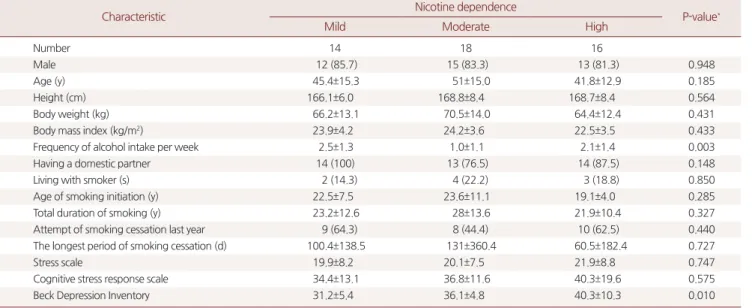
Table 1은 니코틴 의존 점수에 따른 연구 대상자들의 특성을 보여 주고 있다. 주당 음주횟수와 니코틴 의존도 세 그룹 간의 비교에서는 중간 의존도에서 1.0±1.1회로 제일 적었고 낮은 의존도에서 2.5±1.3회
Table 1. Characteristics of study subjects according to nicotine dependence scale
Characteristic Nicotine dependence
P-value*
Mild Moderate High
Number 14 18 16
Male 12 (85.7) 15 (83.3) 13 (81.3) 0.948
Age (y) 45.4±15.3 51±15.0 41.8±12.9 0.185
Height (cm) 166.1±6.0 168.8±8.4 168.7±8.4 0.564
Body weight (kg) 66.2±13.1 70.5±14.0 64.4±12.4 0.431
Body mass index (kg/m2) 23.9±4.2 24.2±3.6 22.5±3.5 0.433
Frequency of alcohol intake per week 2.5±1.3 1.0±1.1 2.1±1.4 0.003
Having a domestic partner 14 (100) 13 (76.5) 14 (87.5) 0.148
Living with smoker (s) 2 (14.3) 4 (22.2) 3 (18.8) 0.850
Age of smoking initiation (y) 22.5±7.5 23.6±11.1 19.1±4.0 0.285
Total duration of smoking (y) 23.2±12.6 28±13.6 21.9±10.4 0.327
Attempt of smoking cessation last year 9 (64.3) 8 (44.4) 10 (62.5) 0.440
The longest period of smoking cessation (d) 100.4±138.5 131±360.4 60.5±182.4 0.727
Stress scale 19.9±8.2 20.1±7.5 21.9±8.8 0.747
Cognitive stress response scale 34.4±13.1 36.8±11.6 40.3±19.6 0.575
Beck Depression Inventory 31.2±5.4 36.1±4.8 40.3±10.3 0.010
Values are presented as number only, number (%), or mean±standard deviation.
*P-values were obtained by using ANOVA test for continuous variables or chi-square test for categorical variables.
www.kafm.or.kr 김창수 외. 금연 진료 환자에서 니코틴 의존도와 우울감 간의 관련성
Korean J Fam Pract. 2019;9(2):235-238
237
Korean Journal of Family Practice
KJFP
로 제일 높아 세 그룹 간 유의한 차이를 보였다(P=0.003). 스트레스 평가 항목 두 가지(KNHANES stress scale, Cognitive Stress Response Scale) 모두 니코틴 의존도가 증가할수록 스트레스 지수의 증가도 보 이나, P값이 각각 0.747, 0.575으로 통계적으로 유의하지 않았다. BDI 는 니코틴 의존도가 높은 그룹일수록 높았으며 통계적으로 유의하 였다(P=0.01).
Table 2에서는 다변량 로지스틱 회귀 분석(multivariable logistic re- gression analysis)을 이용하여 BDI에 따른 높은 니코틴 의존도의 오 즈비(95% 신뢰구간)를 산출하였다. 단변량 분석(model 1)에서는 BDI 증가에 따른 높은 니코틴 의존도의 오즈비(95% 신뢰구간)가 1.14 (1.01–1.28)이었다. 나이와 성별에 대한 보정 후(model 2)에는 BDI 증가 에 따른 높은 니코틴 의존도의 오즈비(95% 신뢰구간)가 1.13 (1.01–
1.26)이었다. 나이, 성별, 체질량지수, 음주 여부에 대한 보정 후(model 3)에는 BDI 증가에 따른 높은 니코틴 의존도의 오즈비(95% 신뢰구 간)가 1.17 (1.01–1.35)이었다. 총 흡연기간, 흡연시작 연령에 대한 추가 보정 후(model 4)에는 BDI 증가에 따른 높은 니코틴 의존도의 오즈 비(95% 신뢰구간)가 1.21 (1.02–1.44)이었다.
고 찰
본 연구는 금연 진료를 위해 내원한 환자를 대상으로 우울감 및 니코틴 의존도와의 관련성에 대해 살펴보았다. 본 연구 결과, BDI는 니코틴 의존도가 증가함에 따라 증가하였으며, 다양한 변수를 보정 한 다변량 로지스틱 회귀 분석에서도 동일한 결과를 보였다.
과거 연구들16,17)을 살펴보면 비흡연자에 비해 흡연자에서 우울과
스트레스 정도가 높으며, 또한 니코틴 의존도가 높을수록 우울 정 도도 높은 것으로 보고하였다. 또한 우울감이 니코틴 의존도에 가장 크게 영향을 미치며, 니코틴 의존도가 높을수록 BDI가 높으며, 우울 증이 있는 흡연군의 평균 니코틴 의존도가 높다고 하였다.17) 일반 인 구를 대상으로 한 연구18)에서 남녀 모두 비흡연자에 비해 흡연자에 서 우울증상이 많고 과거흡연자에 비해 현재 흡연자가 우울증상이 많은 것으로 나타나 다른 메타 연구19)와 비슷한 결과를 보였다. 여성
흡연자에서도 우울의 정도가 높을수록 흡연을 많이 하고 니코틴 의 존도가 높다는 보고20)가 있으며, 스트레스와 흡연은 비례관계가 있 고 또한 스트레스는 흡연량과 니코틴 의존도와도 비례관계를 보인 다는 보고21)도 있다. BDI 대신 간이 정신진단 검사(Symptom Check- List-90-Revised, SCL-90-R)를 이용한 최근의 한 연구22)에서 니코틴 의 존도와 우울, 하루 흡연량과 우울이 양의 상관관계가 있다고 보고하 였으며, 니코틴 의존도와 우울의 관계는 본 연구의 결과와 일치한다.
본 연구에는 몇 가지 제한점이 있다. 첫째, 연구 대상자가 48명으 로 적어 통계적으로 제외되었던 변수가 실제로 유의할 가능성이 있 다. 둘째, BDI는 지난 1주일 간의 상태를 반영하기에 긴 흡연 기간과 의 상관관계가 잘 반영되지 않을 가능성이 있다. 셋째, 단면 분석으 로 니코틴 의존도와 우울감 간의 인과 관계를 설명할 수 없다.
결론적으로 금연 진료 환자를 대상으로 한 본 연구에서, 우울감 과 니코틴 의존도는 양의 상관관계가 있음을 확인하였다. 금연 진료 를 함에 있어 니코틴 의존도와 함께 우울감에 대한 평가도 같이 시 행한다면 금연 성공률 향상에 도움이 될 수 있을 것으로 보인다.
CONFLICT OF INTEREST
No potential conflict of interest relevant to this article was reported.
요 약
연구배경:
금연 치료를 받기 위해 내원한 환자를 대상으로 니코틴 의존도와 우울감 간의 관련성을 평가하였다.방법:
2016년 3월에서 2017년 2월까지, 서울시 소재 일개 2차 병원 금 연 클리닉에 내원한 48명을 대상으로 하였다. 니코틴 의존도는 한국 판 니코틴 의존도 설문 도구(Fagerstrom test for nicotine dependence) 로 평가하였다. 우울감 평가는 한국판 벡우울척도(Beck Depression Inventory, BDI)를 이용하였다.결과:
니코틴 의존도가 높을수록 우울 정도도 높았다(P=0.01). 나이, 성별, 체질량지수, 음주 여부, 총 흡연기간, 흡연시작 연령을 보정한 Table 2. ORs of high nicotine dependence according to BDIBDI ORs (95% CI)
Model 1 Model 2 Model 3 Model 4
Per 1 point increasing BDI
1.14 (1.01–1.28) 1.13 (1.01–1.26) 1.17 (1.01–1.35) 1.21 (1.02–1.44)
Model 1 was unadjusted. Model 2 was adjusted for age and sex. Model 3 was adjusted for age, sex, body mass index, and alcohol intake. Model 4 was adjusted for age, sex, body mass index, alcohol intake, total duration of smoking, and age of smoking initiation.
OR, odds ratio; BDI, Beck Depression Inventory; CI, confidential intervals.
ORs (95% CI) were obtained by using multivariable logistic regression analysis.
Chang Soo Kim, et al. Depressive Mood and Nicotine Dependence
www.kafm.or.kr
238
Korean J Fam Pract. 2019;9(2):235-238Korean Journal of Family Practice
KJFP
다변량 로지스틱 회귀 분석 결과 BDI의 증가는 니코틴 의존도 오즈 비의 증가와 관련되었다.
결론:
금연 진료를 위해 내원한 환자에서 니코틴 의존도와 우울감 간에 양의 상관관계를 보였다.중심단어:
금연; 니코틴 의존; 우울감 ORCID남가은, http://orcid.org/0000-0002-6739-9904
REFERENCES
1. Kim DH, Suh YS. Smoking as a disease. Korean J Fam Med 2009; 30: 494- 502.
2. Lee EH, Park SK, Ko KP, Cho IS, Chang SH, Shin HR, et al. Cigarette smok- ing and mortality in the Korean Multi-center Cancer Cohort (KMCC) study. J Prev Med Public Health 2010; 43: 151-8.
3. OECD. OECD health data 2014 [Internet]. Paris: OECD; 2014 [cited 2017 Apr 1]. Available from: http://www.oecd.org/health/health-systems/health- data.htm.
4. Han JH. Assessment and treatment of nicotine dependence. J Korean Soc Biol Ther Psychiatry 2002; 8: 13-26.
5. Ministry of Health and Welfare. The survey of mental disorders in Korea [Internet]. Sejong: Ministry of Health and Welfare; 2016 [cited 2017 Apr 1].
Available from: http://www.jbmhc.or.kr/sub.php?id=b2_1&mode=view&
menukey=40&idx=21&page=1.
6. Park SM, Han MA, Park J, Ryu SY, Choi SW, Shin HH, et al. Associations be- tween smoking, drinking and depression among Korean adults: the 5th Ko- rea National Health and Nutrition Examination Survey. Korean J Health Promot 2016; 16: 111-8.
7. Anda RF, Williamson DF, Escobedo LG, Mast EE, Giovino GA, Remington PL. Depression and the dynamics of smoking. A national perspective.
JAMA 1990; 264: 1541-5.
8. Glassman AH. Cigarette smoking: implications for psychiatric illness. Am J Psychiatry 1993; 150: 546-53.
9. Tanskanen A, Viinamäki H, Hintikka J, Koivumaa-Honkanen HT, Lehtonen J. Smoking and suicidality among psychiatric patients. Am J Psychiatry 1998; 155: 129-30.
10. Angst J, Clayton PJ. Personality, smoking and suicide: a prospective study. J Affect Disord 1998; 51: 55-62.
11. Malone KM, Waternaux C, Haas GL, Cooper TB, Li S, Mann JJ. Cigarette smoking, suicidal behavior, and serotonin function in major psychiatric dis- orders. Am J Psychiatry 2003; 160: 773-9.
12. Fagerstrom KO, Schneider NG. Measuring nicotine dependence: a review of the Fagerstrom Tolerance Questionnaire. J Behav Med 1989; 12: 159-82.
13. Shin HC, Kim CH, Park YW, Cho BL, Song SW, Yun YH, et al. Validity of beck depression inventory(BDI): detection of depressio in primary care. J Korean Acad Fam Med 2000; 21: 1451-65.
14. Shin HC. Measuring stress with questionnaires. J Korean Med Assoc 2013;
56: 485-95.
15. Koh KB, Park JK. Development of the cognitive stress response scale. J Ko- rean Neuropsychiatr Assoc 2004; 43: 320-8.
16. Sim YS, Choi GY, Lee SY, Kim SC, Kim YG, Park SH, editors. Depression, anxiety and stress assessment by nicotine dependence in smokers. Tubercu- losis and Respiratory Diseases; 2010 Nov 18-19; Seoul, Korea. Seoul: The Korean Academy of Tuberculosis and Respiratory Diseases; 2010.
17. Oh SY, Kim SI, Youn BB. The relationship between nicotine dependency and depession in smokers. J Korean Acad Fam Med 1993; 14: 79-87.
18. Sung HN, Kim JS. The relationship between smoking and depressive symp- toms among Korean adults. Korean J Health Educ Promot 2016; 33: 57-66.
19. Taylor G, McNeill A, Girling A, Farley A, Lindson-Hawley N, Aveyard P.
Change in mental health after smoking cessation: systematic review and meta-analysis. BMJ 2014; 348: g1151.
20. Kim OS. Cigarette smoking, alcohol drinking, and depression in women smokers. Health Nurs 2002; 15: 17-22.
21. Kim YS, Jo HS. Smoking behavior and related factors of female smokers from public health center in Incheon. Korean J Health Educ Promot 2008;
25: 125-38.
22. Kang HC. A study on the relationship with nicotine dependence and men- tal health. J Oriental Neuropsychiatry 2014; 25: 55-62.