Introduction
Consistent with the global trend and based on inflation, South Korea has gradually increased its cigarette tax by 10%–
30% in an attempt to reduce the smoking rate
1. However, even with these increases, the price of cigarettes in South Korea was still low, and the prevalence of smoking was high compared to other Organisation for Economic Co-operation and Devel- opment countries
2. Moreover, the price of cigarettes in South Korea had not increased in 10 years from 2004 to 2014
3. From 2008 to 2011, the smoking rate among male South Koreans did not vary very much, reduce from 47.7% to 47.3%, slightly decreased to 43.7% in 2012, and to 42.1% in 2013
4. In January 2015, the government abruptly increased the cigarette tax, and the retail price of cigarettes increased by 80% compared to the previous year (Figure 1A). In addition, smoke-free areas
Positive Effects of the National Cigarette Price Increase Policy on Smoking Cessation in South Korea
Do Sun Kwon, M.D. 1 , Tae Hee Kim, M.D. 1 , Min Kwang Byun, M.D., Ph.D. 1 , Hyung Jung Kim, M.D., Ph.D. 1 , Hye Sun Lee, Ph.D. 2 , Hye Jung Park, M.D., Ph.D. 1 and Korean Smoking Cessation Study Group
1
Department of Internal Medicine, Gangnam Severance Hospital, Seoul,
2Biostatistics Collaboration Unit, Yonsei University College of Medicine, Seoul, Korea
Background: In January 2015, South Korea’s government raised the cigarette tax, and the retail price of cigarettes abruptly increased by 80% compared to the previous year. This research aimed to determine the effect of this increase on smoking cessation among South Korean smokers.
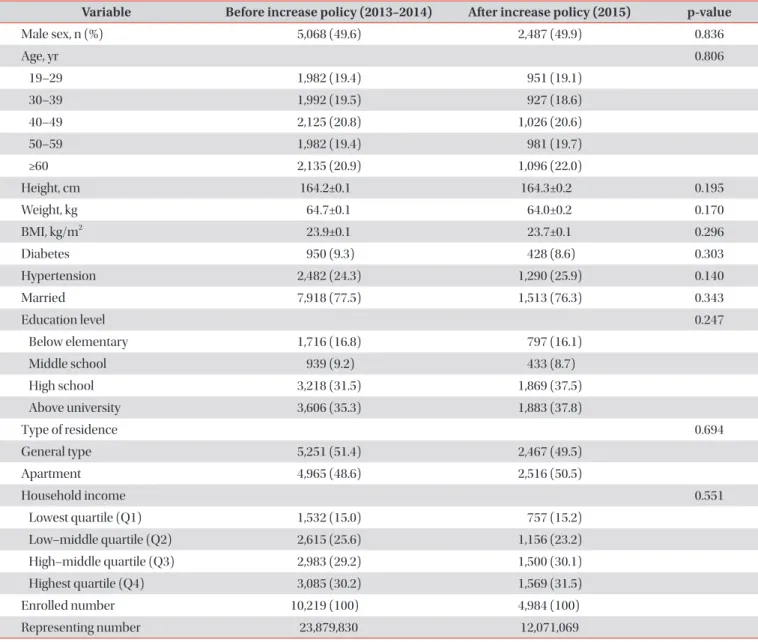
Methods: We analyzed data collected by the 2013–2015 South Korea National Health and Nutrition Examination Survey of 15,203 South Koreans over 19 years old using regression analysis. We examined the recent non-smoking period of nonsmoking people, prepared according to the survey, and analyzed the recent smoking cessation ratio.
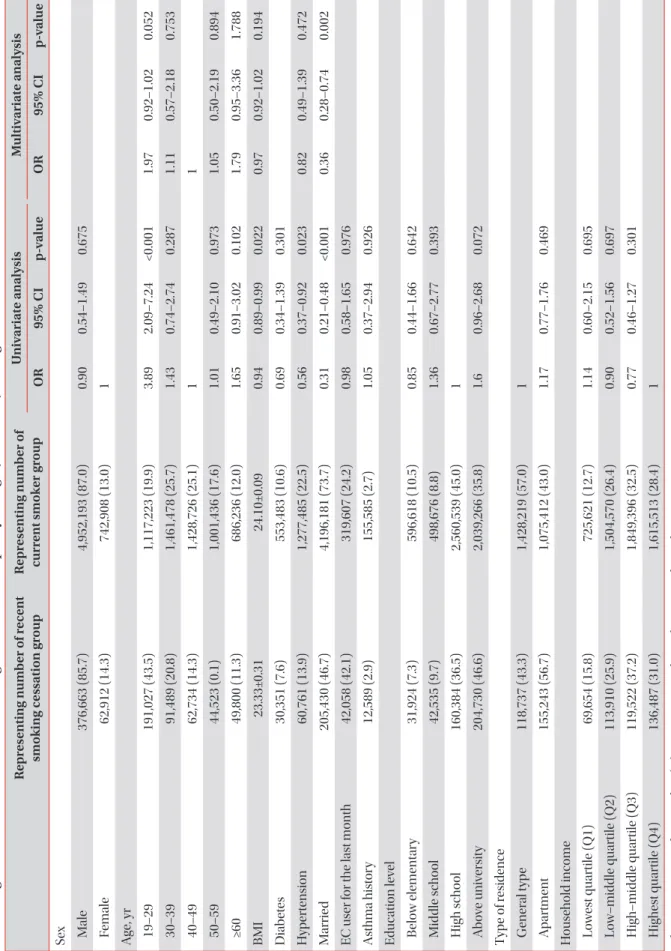
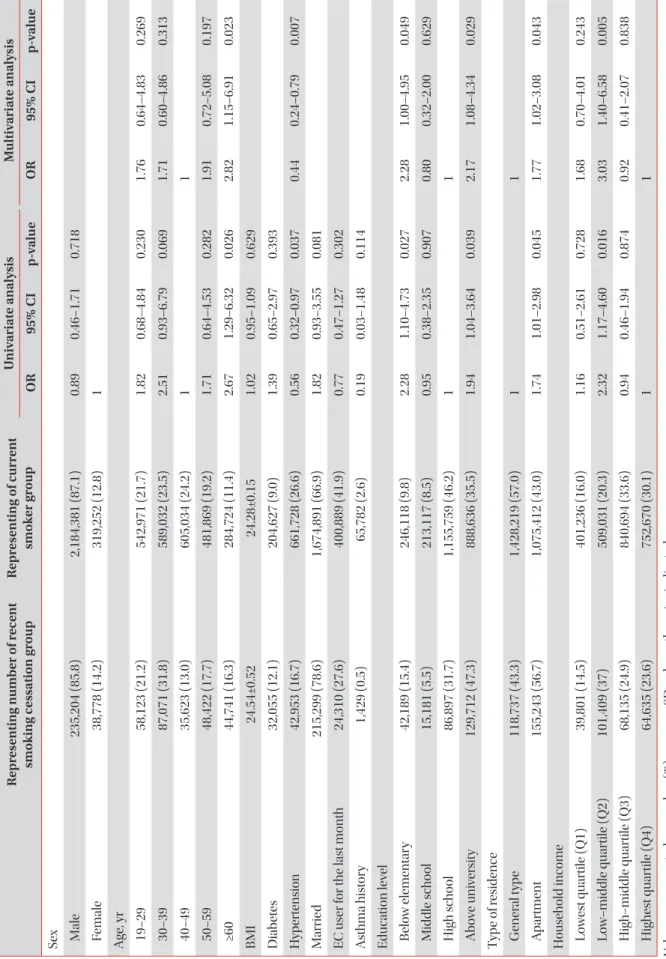
Results: Among smokers, from 2013 to 2014, the smoking cessation rate was 7.2%, and it increased to 9.9% in 2015 after the increase in the cigarette tax. In 2015, the recent smoking cessation rate was higher among people over the age of 60 (odds ratio [OR], 2.67) compared to those between the ages of 40 and 49. The recent smoking cessation rate was higher among people with below elementary education (OR, 2.28) and above university education (OR, 1.94) compared to high school, higher for those with apartments (OR, 1.74) compared to general type residences, and higher among those with a household income in the low-middle quartile (Q2) (OR, 2.32) compared to the highest quartile (Q4).
Conclusion: This innovative policy including increase in cigarette prices affected smoking cessation, and its impact varied by sub-group of smokers in South Korea.
Keywords: Cigarette Price; South Korea; Smoking; Policy
Address for correspondence: Hye Jung Park, M.D., Ph.D.
Department of Internal Medicine, Gangnam Severance Hospital, Yonsei University College of Medicine, 211 Eonju-ro, Gangnam-gu, Seoul 06273, Korea
Phone: 82-2-2019-3302, Fax: 82-2-3463-3882 E-mail: [email protected]
Received: Feb. 11, 2019 Revised: Jun. 10, 2019 Accepted: Aug. 30, 2019 Published online: Nov. 7, 2019
cc