− 1 − DOI:10.5720/kjcn.2012.17.1.1
대학생의 채소 섭취 행동변화단계에 따른 채소 섭취 관련 인식, 자아효능감 및 식행동
안 윤·김 경 원†
서울여자대학교 자연과학대학 식품영양학과
Beliefs Regarding Vegetable Consumption, Self-Efficacy and Eating Behaviors according to the Stages of Change in Vegetable Consumption among College Students
Yun Ahn, Kyung Won Kim
†Department of Food & Nutrition, Seoul Women's University, Seoul, Korea
Abstract
The purpose of this study was to examine beliefs, self-efficacy and eating behaviors by the stages of change in vegetable consumption among college students (n = 297). A survey was conducted to examine study variables, and subjects were categorized into three groups based on the stages of change: precontemplation/contemplation stage (PC/
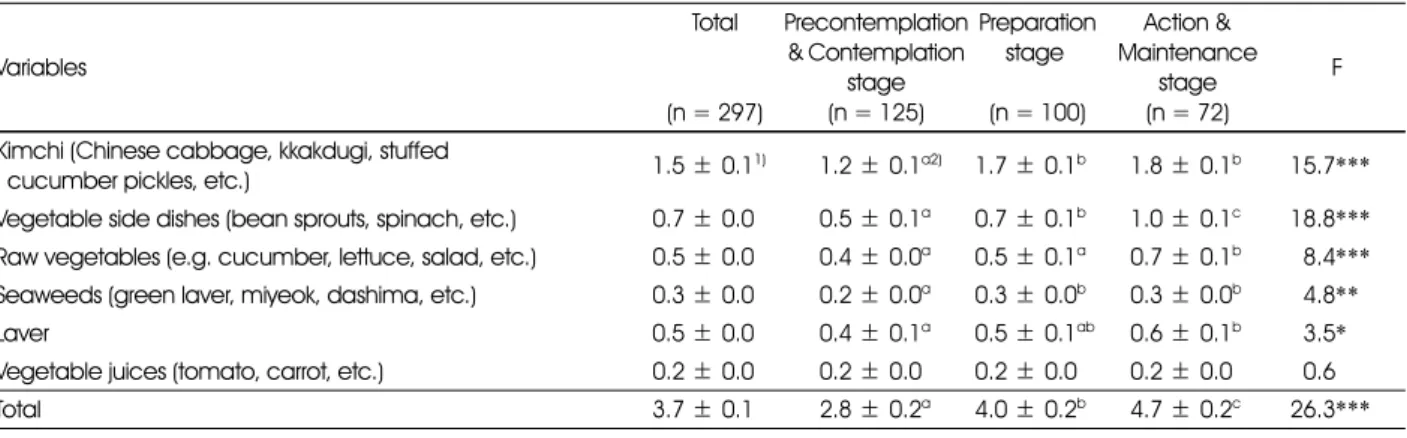
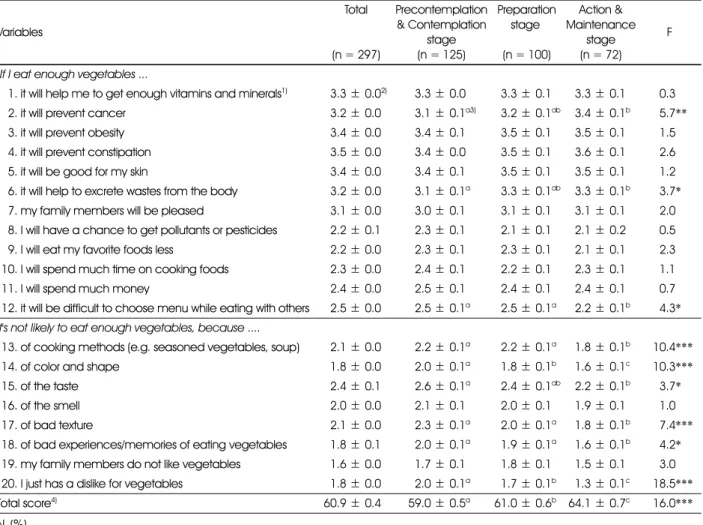
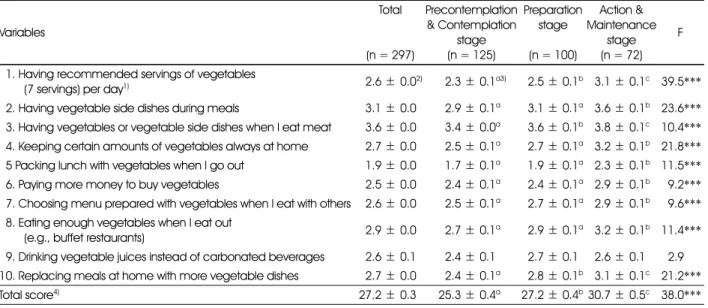
C), preparation stage (P), action/maintenance stage (A/M). Subjects had 3.7 servings of vegetables a day, and vegetable consumption was significantly different by stages of change (p < 0.001). The A/M group showed higher score on beliefs regarding vegetable consumption (p < 0.001) than the other groups, and perceived benefits of vegetable consumption (e.g. cancer prevention) more strongly (p < 0.05). The PC/C group felt more barriers than the A/M group, such as disliking cooking methods, texture of vegetables (p < 0.001), bad taste and bad experience of eating vegetables (p < 0.05). Self-efficacy score was 27.2, with decreasing self-efficacy from A/M to P, PC/C (p < 0.001). The A/M group showed more confidence in nine behaviors such as “eating vegetables during meals” and
“replacing menu at home with more vegetable dishes” (p < 0.001) than the other groups. The A/M group had more desirable eating behaviors (e.g, having a variety of foods, eating regularly, consumption of food groups). This study suggests that target population for education and educational strategies be different based on the stages of change. For those in the PC/C stage, education might focus on reducing barriers and increasing self-efficacy. For those in the A/
M stage, it is necessary to use strategies to maintain and reinforce behaviors for enough vegetable consumption.
(Korean J Community Nutr 17(1) : 1~13, 2012)
KEY WORDS : vegetables·stages of change·beliefs·self-efficacy·college students
—————————————————————————
서 론
—————————————————————————
대학생은 청소년에서 성인으로 접어드는 시기이며 성인기 의 균형된 영양과 건강 유지를 위해 이 시기에 올바른 식습
관을 형성함이 중요하다. 그러나 대학생이 되면서 청소년기 와는 다른 생활패턴을 갖게 되고, 학업 이외의 여러 활동에 참여하면서 불규칙한 생활을 하게 된다. 대학생 대상의 여러 연구를 보면 불규칙한 식사, 결식, 과식, 가공식품이나 패스 트푸드의 잦은 섭취, 부절적한 간식, 채소나 과일, 유제품의 섭취 부족 등 식습관 문제가 다양하게 나타났다(Kim 등 2004; Hwang & Lee 2007; Ko 2007; Jang 등 2011). 2009년 국민건강영양조사 결과에 의하면 19~29 세 연령층의 경우 에너지, 칼슘, 칼륨, 리보플라빈 등의 섭취 가 권장 수준에 비해 낮았고 나트륨, 단백질, 인 등은 권장 수 준을 훨씬 상회하였다(Ministry of Health & Welfare 2010). 특히 이 연령층에서 비타민 C, 칼슘, 리보플라빈 등 영양소를 평균필요량 미만으로 적게 섭취한 대상자가 50%
접수일: 2012년 1월 4일 접수 수정일: 2012년 2월 5일 수정 채택일: 2012년 2월 5일 채택
*
This work was supported by a special research grant from Seoul Women's University (2011).
†Corresponding author: Kyung Won Kim, Department of Food &
Nutrition, College of Natural Sciences, Seoul Women's University, 621 Hwarangro, Nowon-gu, Seoul 139-774, Korea
Tel: (02) 970-5647, Fax: (02) 976-4049 E-mail: [email protected]