http://dx.doi.org/10.7236/JIWIT.2012.12.5.17
JIWIT 2012-5-3
레일레이 페이딩 채널에서 CSI 지연을 갖는 증가 최적 릴레이 선택 시스템
Incremental Best Relay Selection System with Outdated CSI in Rayleigh Fading Channels
김남수* Nam-Soo Kim
요 약 최근에 스펙트럼 효율과 전력절약을 위해서 협동 다이버시티 구조의 증가 최선 릴레이 선택법이 제안되었다. 그러나 최선 릴레이를 선택하는 과정에서 실제 데이터 전송 시와 채널 예측 시에 시간적인 지연이 발생하게 된다. 결 국 이 지연으로 말미암아 지연된 채널 정보를 갖게 된다. 이 논문에서는 지연된 채널 정보가 증가 최선 릴레이 선택 다이버시티 구조에 미치는 영향을 해석적으로 유도하였다. 시스템 성능은 상관계수가 감소할수록 급격히 나빠짐을 알 수 있었다. 시스템 성능은 상관계수가 1에서 0.9로 감소할 때 성능 저하가 가장 컸으며, 상관계수가 점차 작아질수록 성능 저하는 다소 완만하였다.
Abstract Recently, for spectral efficiency and power saving, an incremental best relay selection of a cooperative diversity scheme is proposed. However during the best relay selection process, there may exist a delay between channel estimation and actual data transmission. Consequently, this delay causes outdated channel state information (CSI). We analytically derive the effect of the outdated CSI to an incremental best relay selection diversity scheme. It is noted that the system performance deteriorates with decreasing the value of the correlation coefficient sensitively. When the correlation coefficient reduces from 1 to 0.9, the most performance degradation is denoted. However, the performance degradation is diminished with decreasing the correlation coefficient.
Key Words : Cooperative diversity, Relay, Best relay selection, CSI, Performance.
*정회원 : 청주대학교 전자공학과
접수일자 2012년 8월 10일, 수정완료 2012년 9월 17일 게재확정일자 2012년 10월 12일
Received: 10 August, 2012 / Revised: 17 September, 2012 / Accepted: 12 October, 2012
*Corresponding Author: [email protected]
Dept. of Electronics Engineering, Cheongju University, Korea
Ⅰ. Introduction
MIMO system has attractive features such as spectral efficiency and performance improvement for mobile environments[1],[2]. However it has the hardware complexity and requires the space to install several
antennas at transmitter and/or receiver for spatial diversity in wireless fading channel. Especially, a small mobile station has size limit for multiple antennas.
Recently, cooperative diversity has been highly focused for diversity
gain and less power consumption by adapting
spatially independent relays which have usually single antenna instead of multiple antennas[3],[4]. Especially in a parallel relay cooperation, the relays (usually the multiple relays) which satisfy the transmit condition forward the information to a destination for spectral efficiency. It is well known that the multiple active relays improve the diversity gain, however, decrease the spectral efficiency[5]-[7].
Very recently, to overcome this inefficiency an incremental best relay selection[4],[8]-[10]
which selects only one indirect (source-relay-destination) path is proposed. In [9], the lower bound of the end-to-end outage probability is considered under the assumption that the selected best relay is not in outage. More accurate closed form of the end-to-end outage probability expression is investigated in [10].
However, the incremental best relay selection for proactive scheme has to know all the exact instantaneous channels (i.e., between a source and a destination (S-D), a source and relays (S-R), and relays and a destination (R-D) channels) to select the best relay. And after the best relay selection process, the selected relay transmits the received information to a destination. Unfortunately, there may exist a delay between channel estimation and actual data transmission at the selected best relay. In other words, the instantaneous channel state information (CSI) used in relay selection can substantially differ from that of the current CSI at the data transmission, hence it causes the outdated CSI problems. It is well known the outdated CSI deteriorates the system performance[11],[12]. The effect of outdated CSI on a relay selection between R-D paths has been studied in [12], [13].
However, those opportunistic relay schemes, which select the best relay between R-D paths, only include the effect of outdated CSI to the R-D paths. To the best of our knowledge, the effect of the delayed CSI to the whole S-R-D paths of an incremental best relay selection scheme has not been considered in the literature.
Therefore, in this paper we derive the closed-form
expression of the end-to-end outage probability of an incremental best relay selection scheme with outdated CSI in fading channel. Also we derive the probability density function (pdf) of each hop with outdated CSI which can be applied to the other diversity combining schemes. We assumed each channel has an independent and identically distributed Rayleigh fading channel and each relay has decode-and-forward (DF) protocol.
The remainder of this paper is organized as follows.
In section II we introduce the system model of an incremental cooperative diversity scheme. The outage probability of the scheme with outdated CSI is derived analytically in section III. Finally, the numerical examples are depicted in section IV, and concluding remarks are given in section V.
Ⅱ. System model
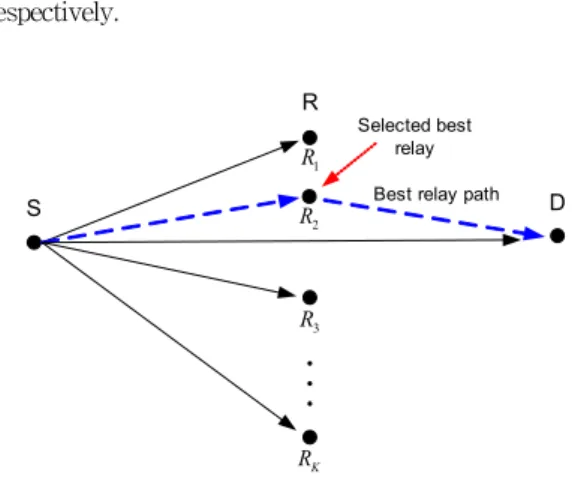
Fig.1 shows an incremental best relay selection cooperative diversity system with a source (S), a destination(D) and relays. ( ) denotes the relay. And the slotted line denotes the selected best relay path. We assume independent and identically distributed Rayleigh fading across all links. , and denote the channel gain between S and , S and D, and and D, respectively.
S
R
D R1
R2
R3
RK
Best relay path Selected best
relay
Fig 1. System model 그림 1. 시스템 모델
Hence, , and
denote the instantaneous SNR between S and , S and D, and and D, respectively. Where represents the transmit energy per symbol and is the noise power spectral density.
Therefore, the average received SNR is given by
, , and ,
where ∙ denotes the expectation operator.
During the first hop, S broadcasts its information to D as well as relays. If the received SNR exceeds a predetermined threshold at D, the transmission is completed. Otherwise, D sends a binary feedback to the source and the best relay selection process is started.
The selection process of the best relay is based on the SNRs across the two hops of each relay. In the second hop, the best relay retransmits the received information to the destination. The best relay selection is performed jointly as follows [9];
(a) Firstly, for each relay link, select minimum SNR link,
1 2
min{ , } , ,...,
k γ γSk kD for k K
Λ = = (1)
(b) Secondly, select the best relay across the relays,
* 1 2 , ,...,
max { k}
k k K
γ = = Λ
(2)
The received information both from the source and the selected best relay are combined using Maximal-ratio-combining (MRC) receiver at D.
Ⅲ. Performance Analysis
According to the Jake’s scattering model, the channel gain between the source and the relay
and its estimated(delayed) value follow a joint
complex Gaussian distribution with correlation coefficient , where ∙ denotes the zero-order Bessel function of the first kind, is the Doppler frequency, stands for the time delay of the relay. The received SNR of the relay
conditioned on its delayed SNR follows a non-central chi-square distribution which is given by [11].
2 2
1 2
2 1
2 2 1 2
2
1 1
( ˆ)
( )
ˆ
ˆ ˆ
( )
( ) ˆ ( )
k k
k k k
K K
k k k
k k K
k k k
K K
f e I
γ ρ γ
γ ρ
γ γ
ρ γ γ γ γ γ
γ ρ ρ γ γ ρ
− +
− −
−
⎛ ⎞
⎛ ⎞ ⎜ ⎟
= − ⎜⎝ ⎟⎠ ⎜⎝ − ⎟⎠ (3)
where we assume each relay has same correlation coefficient and where denotes the
order modified Bessel-function of the first kind,
( ) 2
0
2 0
1 ( / )
! ( ),
k k
I x x x
k k
α
α α
∞ +
=
= ≥
Γ + +
∑ (4)
Therefore the probability density function (pdf) of the SNR between the best relay and the destination (R-D path) can be written by
0 0
* * * *
* * * * *
* ˆ ˆ ˆ max( )
ˆ ˆ
( ) ( ) ( )
( ) ˆ
r d r d r d r d r d i
i
z z i
r d z r d r d r d
z r d
f f f z z
f z d dz
γ γ γ γ γ γ γ γ γ
γ
∞ ∞
= = =
= =
×
∫ ∫
(5)
where the inner integral is the pdf of the delayed SNR , which is given by [10]
( )
0
1
1
1 1
1
1
* *
* *
* *
*
ˆ ˆ max( )
ˆ ˆ /
ˆ /
ˆ ˆ
( ) ( ) ( )
( )
( )
i i
r d r d
r d r d
r d
i z
r d z z z r d
K i i
i sr rd
K i i
i rd
f f z z f z dz
K i
e e
i
K ie
i
γ γ
γ γ γ
γ γ
γ γ
γ γ γ γ
γ
∞
= =
− − −
=
− −
=
= =
⎛ ⎞ −
= ⎜ ⎟⎝ ⎠ − −
⎛ ⎞ −
+ ⎜ ⎟
⎝ ⎠
∫
∑
∑ (6)
By replacing Eq. (6) into Eq. (5), and by using the
identities of Eq. 6.614.3, Eq. 9.220.2 and Eq. 9.215.1 in [14], the pdf can be obtained by
2 2
2 2
1
1
2 2
1
1
1
2 2
1
1
1
1
1
* *
*
*
*
/ ( )
( )
( )
( )
( )
( )
( )
r d
r d
r d rd rd
r d rd r d
i i
K i
i sr rd rd
i i
K i
i rd rd
f
K i
e e
i i i
K i
i i e
γ
γ
γ γ γ ρ γρ
γ
γ ρ γρ
γ
γ γ
γ γ γ γ ρ γρ
γ γ γ ρ γρ
− − − − +
=
− −
− +
=
⎛ ⎞
⎛ ⎞ − ⎜ ⎟
= ⎜ ⎟⎝ ⎠ − ⎜⎝ − − + ⎟⎠
⎛ ⎞ −
+ ⎜ ⎟⎝ ⎠ − +
∑
∑
(7)
where . As a special case of , the delayed SNR equals (i.e.,
), hence Eq. (7) corresponds to Eq. (6). The pdf of the SNR between the source and the best relay(S-R path),
, can be easily obtained by replacing and with and , respectively.
Cumulative density function(CDF) of can be easily derived from Eq. (7), which is written by
( ) 2 2
2 2
1
1 1
1
1 1
1 1 1
1 1
* *
*
*
*
/ ( )
( )
( ) ( )
( )
r d
r d
r d rd rd
r d rd r d
i i K
i rd
i sr rd
i i
K i
i rd
F
K i
e e
i i i
K e
i
γ
γ
γ γ γ ρ γρ
γ
γ ρ γρ
γ
γ γ γ
γ γ γ γ γ
− − − − +
=
− −
− +
=
⎡ ⎛ ⎞⎤
⎛ ⎞ − ⎢ ⎜ ⎟⎥
= ⎜ ⎟⎝ ⎠ − ⎢⎢⎣ − − ⎜⎝ − ⎟⎠⎥⎥⎦
⎛ ⎞
⎛ ⎞ − ⎜ ⎟
+ ⎜ ⎟⎝ ⎠ ⎜⎝ − ⎟⎠
∑
∑
(8)
Similarly the CDF of can be obtained from Eq.
(8) by replacing and with and , respectively.
Assume, each channel has equal average channel gain where and . With this assumption, the CDF
∙ is identical to
∙,
∙
∙ ∙, and is written by
( ) 2 2
2 2
2
2 1
1 1
1 2
2 1
1
1 1 1 1
2 1 2
1 1 2
/ ( )
( )
( ) ( )
( )
e e e
e e
K ix
x i
i EG
i
i ix
K i
i
K i
F x e e
i i i
K e
i
γ γ ρ γ ρ
γ ρ γ ρ
− − − +
−
=
− −
− +
=
⎡ ⎛ ⎞⎤
⎛ ⎞ ⎢ ⎜ ⎟⎥
= ⎜ ⎟⎝ ⎠− − ⎢⎣ − − ⎜⎝ − ⎟⎠⎥⎦
⎛ ⎞
⎛ ⎞ − ⎜ ⎟
+ ⎜ ⎟⎝ ⎠ ⎜⎝ − ⎟⎠
∑
∑
(9)
The outage probability of the incremental relay system can be written by
( ) ( )
( )
1
1
*
* *
Pr Pr
Pr , ,
out sd sr
sd sd
sr r d
P γ γ
γ γ γ γ
= < Γ < Γ
+ > Γ < Γ + < Γ (10)
where , , and is the transmission rate in bit per second per Hz(bps/Hz).
And where
( 1) 1 1 1/
Pr γsd< Γ =Fγsd( )Γ = −e−Γ γsd (11) and
( * ) * ( )
Pr ( )
sr EG
sr Fγ F
γ < Γ = Γ = Γ
(12)
In Eq. (10), the probability term of
for ≤ can be approximated by [15]
( * * ) 1 * *
Pr , ( ) ( )
sr r d
sr r d x Fγ Fγ x
γ > Γ γ < Γ − ≈ −⎡⎣ Γ⎤⎦ Γ − (13)
With this approximation, the outage probability of Eq. (10) can be derived by
( )
( )
[ ]
1
1 1
0
0
1
1 1
* *
* *
*
/
/
Pr , ,
Pr ,
( ) ( )
e
e r d
sd sd
sr r d
x
sr r d
e
x EG
e
x e dx
F F x e dx
γ
γ γ
γ γ γ γ
γ γ
γ
γ
Γ −
Γ −
> Γ < Γ + < Γ
= > Γ < Γ −
≈ − Γ Γ −
∫
∫ (14)
Replacing Eq. (8) into Eq. (14), and rearranging, we can obtain
( )
[ ] ( )
( )
1
2 1
2 2 2 2
1 1
1 1
1
1 2
2 2 2
2 1 2 1
2
1 [ 1 1
2 1
1 1 2 1 1 }
2 1 2
* *
/ /
/ ( ) ( )
Pr , ,
( ) { -
( )
( )
e e
e e e e e
sd sd
sr r d
K i
EG
i e
i i
i i
K i
F e e
i i
e i e e
i i
K i
γ γ
ρ
γ γ ρ γ ρ γ ρ γ ρ
γ γ γ γ
γ
ρ ρ
ρ
− −Γ −Γ
=
− Γ
− Γ −
−Γ − + − +
> Γ < Γ + < Γ
⎛ ⎞ Γ
≈ − Γ ⎜ ⎟⎝ ⎠− − −
⎧ − + ⎛ ⎞⎫
⎪ ⎜ ⎟⎪
− ⎨⎪⎩− − − ⎜⎝− ⎟⎠⎬⎪⎭
+ ⎜ ⎟⎛ ⎞
⎝ ⎠
∑
( )1 1 2 2 2 122 2 2 1 21 2212 2
1
1 2 1
1 1
2 1 2
( )
/ ( ) ( ) ( )
- ]
( )
e e e e e
i
i i
K i i
i
e i e e
i
ρ
γ ρ ρ γ ρ γ ρ γ ρ γ ρ
ρ
− Γ
− − Γ −
−Γ − + − +
=
⎡ ⎛ ⎞⎤
− ⎢ − − + ⎜− ⎟⎥
⎢ − ⎜⎝ ⎟⎠⎥
⎣ ⎦
∑
(15)
By substituting Eq. (11), Eq. (12), and Eq. (15) into Eq. (10), we can have a closed-form expression for the end-to-end outage probability of the incremental- best-relay DF cooperative diversity with outdated CSI over Rayleigh fading channels. As a special case of correlation coefficient that means there is no CSI delay, Eq. (15) is identical to Eq. (13) of [10] which does not include the effect of the CSI delay.
Ⅳ. Numerical examples
0 5 10 15 20 25 30 35 40
10-8 10-7 10-6 10-5 10-4 10-3 10-2 10-1 100
SNR(dB) Pout
0 6. ρ =
0 8. ρ=
0 9. ρ=
1 0. ρ=
Fig 2. Outage probability for different values of correlation coefficient ( , ) 그림 2. 상관계수에 따른 오수신율 ( , )
Fig.2 shows the outage probability for different values of correlation coefficient ( , ). It is noticed that the less correlation between thereal channel and the delayed channel increases the outage probability. When the correlation coefficient becomes 1, 0.9, 0.8 and 0.6, the required average SNR to satisfy the
outage probability of × is 22.0 dB, 28.6 dB, 31.5 dB, and 33.5 dB, respectively. As the correlation coefficient decreases from 1 to 0.9, the required SNR increases 6.6 dB for the outage probability of × in Fig.2. However the required SNR decreases as the correlation coefficient decreases.
With this observation, we can conclude that the delay of CSI affects to the performance sensitively. To improve the performance of an incremental relay system, it is necessary that the delay time has to be minimized for high correlation between the real and the delayed channels.
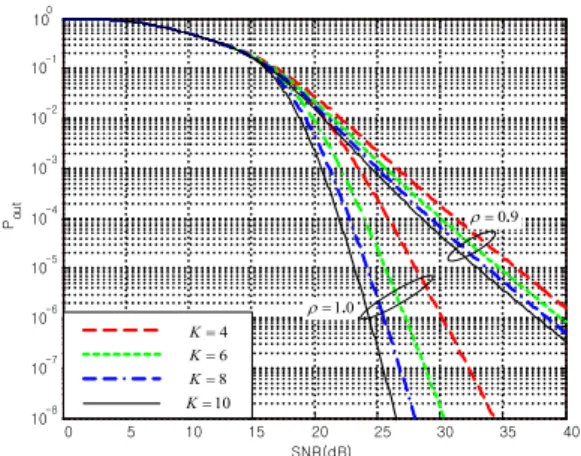
Fig.3 shows the outage probability for different number of relays with . As we expected, the performance improves with the number of relays.
On the other hand, when the number of relays is 4, 6, 8 and 10, the required average SNR to satisfy the outage probability of × is 31.2 dB, 30.1 dB, 29.2 dB, and 28.6 dB, respectively, with correlation coefficient of 0.9. However with the correlation coefficient , the required SNR is 25.9 dB, 24.0 dB, 22.8 dB, and 22.0 dB. This tendency shows that the performance improvement with increasing number of relays accentuates as the correlation coefficient grows.
0 5 10 15 20 25 30 35 40
10-8 10-7 10-6 10-5 10-4 10-3 10-2 10-1 100
SNR(dB) Pout
4 K=
0 9. ρ =
1 0. ρ = 6
K= 8 K=
10 K=
Fig 3. Outage probability for different number of
( )
그림 3. 값에 따른 오수신율 ( )
Ⅴ. Conclusions
Cooperative diversity system which is applied to the relaying system has diversity gain in fading channel, hence it is highly focused for power saving and network reliability in ad-hoc networks.
However, performance of an incremental best relay selection cooperative diversity system is sensitive for a delay which is mainly caused by the selection process.
We analytically derive the closed-form expression for the end-to-end outage probability of an incremental- best-relay DF cooperative diversity with outdated CSI over Rayleigh fading channels.
We noticed that the system performance deteriorates with decreasing the value of the correlation coefficient.
When the correlation coefficient reduces from 1 to 0.9, the most performance degradation is denoted. However, the performance degradation is less sensitive with decreasing the correlation coefficient. Also as we expected, performance improves with the number of relays.
From the results of this paper, we can conclude the delayed CSI causes performance degradation sensitively. Therefore it is recommended that the time delay must be reduced to improve the performance of an incremental-best-relay DF cooperative diversity system.
References
[1] D. Gesbert, M. Shafi, D-S Shiu, P. Smith, A.
Naguib, "From theory to practice: An overview of MIMO space-time coded wireless systems," IEEE Journal on Selected Areas in Communi., vol.21, no.3, pp. 281-302, April 2003.
[2] A. Goldsmith, S.A. Jafar, N. Jindal, S. Vishwanath,
"Capacity limits of MIMO channels," IEEE Journal on Selected Areas in Communi- cations, vol.21, no.5, pp. 684-702, June 2003.
[3] J. N. Laneman, D.N.C. Tse, and G.W. Wornell,
“Cooperative diversity in wireless networks;
efficient protocols and outage behavior,” IEEE Trans. on Inf. Theory, vol.50, no.12, pp.3062-3080, Dec. 2004.
[4] A. Bletsas, H. Shin, M. Z. Win, and A. Lippman, “A simple cooperative diversity method based on network path selection,” IEEE Journal on Sel. Areas in Communications, vol.24, no.3, pp.659-972, Mar.
2006.
[5] N.C. Beaulieu and J. Hu, “A closed-form expression for the outage probability of decode-and-forward relaying in dissimilar Rayleigh fading channels,”
IEEE Communications Letters, vol.10, no.12, pp.
813-815, Dec. 2006.
[6] Y. Zhao, R. Adve, and T. J. Lim, “Outage probability at arbitrary SNR with cooperative diversity,” IEEE Communications Letters, vol.9, no.8, pp. 700-702, Aug. 2005.
[7] Nam-Soo Kim, Ye Hoon Lee, “Decision of transmit relays and transmit power of double opportunistic transmit cooperative relaying system in Rayleigh fading channels,” LNCS6869, Springer, pp.487-495, Aug. 2011.
[8] S. S. Ikki and M. H. Ahmed, “Performance analysis of incremental-relaying cooperative-diversity networks over Rayleigh fading channels,” IET Communi., vol.5, no.3, pp.337-349, Feb. 2011.
[9] A. Adinoyi, Y. Fan, H. Yanikomeroglu, and H. V.
Poor, “Performance of selection relaying and cooperative diversity,” IEEE Trans. on Wireless Communi., vol.8, no.12, pp. 5790-5795,Dec.2009.
[10] K. Tourki, H.-C. Yang, M.-S. Alouini, “Accurate outage analysis of incremental decode-and-forward opportunistic relaying,” IEEE Trans. on Wireless Communi., vol.10, no.4, pp. 1021-1025, April 2011.
[11] J. Vicario and C. Anton-Haro, “Analytical assessment of multi-user vs. spatial diversity trade-offs with delayed channel state information,”
IEEE Communication Letters, vol.10, no.8, pp.
588-590, Aug. 2006.
[12] Yubo Li, Q. Yin, and H.-M. Wang, “On the design
※ This work was supported by the project of development of local industry technology which was conducted by the Ministry of Knowledge Economy of the Korean Government (project no.
A001100214).
of relay selection strategies in regenerative cooperative networks with outdated CSI,” IEEE Trans. on Wireless Communi. vol.10, no.9, pp.
3086-3097, Sep. 2011.
[13] J. Vicario, A. Bel, and J. A. Lopez-Salcedo,
“Opportunistic relay selection with outdated CSI:
outage probability and diversity analysis,” IEEE Trans. on Wireless Communi., vol.8, no.6, pp.
2872-2876, June 2009.
[14] Alan Jeffrey and Dan Zwillinger, Table of integrals, series, and products, Academic Press, 2000.
[15] Qing F. Zhou, Francis C. Lau, and S. F. Hau,
“Asymptotic analysis of opportunistic relaying protocols,” IEEE Trans. on Wireless Communi., vol.8, no.8, pp. 3915-3920, Aug. 2009.
저자 소개 김 남 수(정회원)
∙1986년 ~ 1994년 : ETRI(전자통신 연 구소) 이동통신 연구단 무선기술 연구 실장 역임
∙1991년 : 연세대학교 대학원 전자공학 과 공학박사
∙1991년 ~ 1991년: BNR(Bell Northern Research) 방문연구원
∙2002년 ~ 2003년 : NJIT(New Jersey Institute of Technology) 교환교수
∙1994년 ~ 현재 : 청주대학교 전자공학과 교수
∙2006년 ~ 2007년 : 청주대학교 학술정보처장
∙2010년 ~ 2010년 : 청주대학교 입학처장
<주관심분야 : Wireless mobile ad-hoc network, RF system design, Digital modulation, 무선 이동통신 채널, 이동통신 시스템 설계>