33
“Calculation of Energy Dependent Neutron Correction Coefficient Ratios of Natural Rhodium in Energy Region from 0.003 to 100 eV”
Calculation of Energy Dependent Neutron Correction Coefficient Ratios of Natural Rhodium in Energy Region from 0.003 to 100 eV
Samyol Lee
Department of Radiology, Nambu University
Abstract
In the neutron capture experiment and calculation, the neutron absorption and scattering are very important. Especially these effects are conspicuous in the resonance energy region and below the thermal energy region. In the present study, we obtained energy dependent neutron absorption ratios of natural rhodium in energy region from 0.003 to 100 eV by MCNP-4B Code. The coefficients for neutron absorption was calculated for several types of thickness. In the lower energy region, neutron absorption is larger than higher region, because of large capture cross section (1/v). Furthermore it seems very different neutron absorption in the large resonance energy region. These results are very useful to decide the thickness of sample and shielding materials.
Ⅰ Introduction .
The neutron absorption and scattering are very important to calculate the thickness of shield and experimental sample. In the present study, the absorption ratios of natural Rhodium (
103Rh) were calculated by MCNP(A General Monte Carlo N-Particle Transport Code)-4B Code. Furthermore the accurate neutron capture cross-sections of fission products (FPs) is very important for designing the high burn-up core of a nuclear reactor, because the products, for which they are called a fission product poisons, decrease the neutron flux of a reactor.
Rhodium (
103Rh) is a fission product with high fission yield (several percent in the fast reactor
[1]) and a strong neutron absorbing nuclide. The accurate measurement of capture cross-section is of great
importance for the characteristic calculation in a reactor. However the effects of neutron absorption and scattering in the sample were not to be ignored.
[2]Since the capture cross-section is large in the lower energy region (thermal neutron capture cross-section:
1452 barn)
[3].
Ⅱ Method and calculation .
In the neutron capture cross-section measurement
and the study of the neutron shielding effects, the
effect of single and multiple neutron scatterings in the
capture sample are quite important in determining a
thickness of material. This effect, which increases with
the effective sample thickness relative to the
geometrical thickness in the direction of incident
neutrons, must be considered in the capture
34
한국방사선학회 논문지 Vol.2, No.3,통권 제 호6 , 2008년 월9
cross-section measurement in which the total number of capture events in a sample is measured. In the present study, we have made Monte Carlo calculations using the MCNP-4B code
[4]to simulate the neutron capture and multiple scattering events in the sample and carry out the corrections of the effect of single and multiple neutron scatterings in the capture sample. The scheme of simulation shown in Fig. 1.
There are several type of neutron and photon reaction in the sample(material). We can assume that there are one and two reactions in the case of thin sample. However, there are several type of reactions in the case of thick sample. (18mm x 18mm and Thickness: 1, 2, 4, 10mm). The sampling(neutron generation number) is 10,000,000 times.
Figure 1. Incident neutrons have several type of reaction as follows (1). Neutron elastic scattering
(2). Neutron inelastic scattering and photon production (3). Photon absorption(capture)
(4). Neutron leakage (5). Neutron capture (6). Photon scattering (7). Photon leakage
Ⅲ Result .
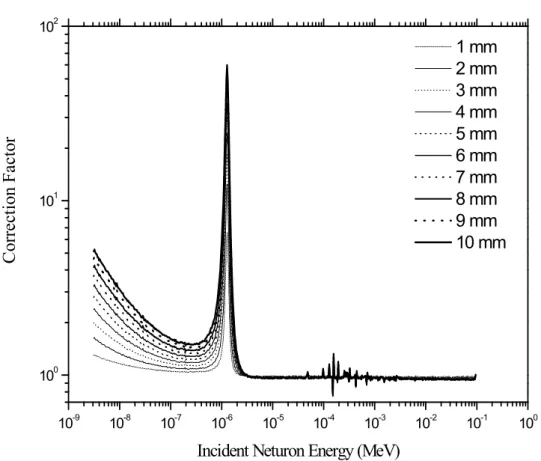
The correction factor of the Rhodium sample is shown in Fig. 2. In the thermal energy region, the correction factors were remarkably depend on the incident neutron energy. Furthermore it seems very different correction factor in the large neutron capture resonance and below the resonance. It correspond to
the result from Breit-Wigner formular and 1/v
thermal neutron capture cross section. However in
small and sharp resonances above several neutron
energy, the difference is small. It seems constant
factor above 1 keV neutron energy because of low
neutron capture cross section. From these results we
have to consider the neutron capture effects in the
thermal energy region and large neutron capture
region.
35
“Calculation of Energy Dependent Neutron Correction Coefficient Ratios of Natural Rhodium in Energy Region from 0.003 to 100 eV”
10
-910
-810
-710
-610
-510
-410
-310
-210
-110
010
010
110
2C o rr ec ti o n F ac to r
Incident Neturon Energy (MeV)
1 mm 2 mm 3 mm 4 mm 5 mm 6 mm 7 mm 8 mm 9 mm 10 mm
Figure 2. The correction factor of Rhodium sample for several thickness(1 10mm)∼
Acknowledgments
The authors would like to express their thanks to the linac staff of the Research Reactor Institute, Kyoto University(KURRI) for making it possible to eoperate the accelerator steadily. This work was supported by the Korea Research Foundation Grant funded by the Korean Government (MOEHRD, Basic Research Promotion Fund) (KRF-2007-521-C00071).
Reference
[1] R. L. MACKLIN, and J. HALPERIN, Nucl. Sci. Eng., 73, 174 (1980).
[2] Nakazawa, M., Kobayashi, K., Iwasaki, S., Iguchi, T., Sakurai, K., Ikeda, Y., Nakagawa, T., 1992. JAERI 1325.
[3] Mughabghab, S. F., Divadeenam, M., Holden, N. E., 1981, Neutron Cross Sections, Vol. 1, Neutron Resonance Parameters and Thermal Cross Sections, Part A, Academic Press.
[4] Briesmeister J. F. (Ed.), 1997. MCNP-A General Monte Carlo Code for Neutron and Photon Transport, Version 4B, LA-12625-M, Los Alamos National Laboratory.