Original Article KME Review
Korean Medical Education Review 2015; 17(1): 33-38 pISSN 2092-5603 eISSN 2093-6370 http://dx.doi.org/10.17496/kmer.2015.17.1.33
기본의학교육과정의 학습성과와 의사 국가시험 평가목표의 일치도 분석
김나진1ㆍ박인애1ㆍ김은주1ㆍ백승애1ㆍ권난이1ㆍ이혜인1ㆍ김수영1,2
가톨릭대학교 의과대학 1마스터의학교육지원센터, 2병리학교실
Evaluation of Concordance between Learning Outcomes of Basic Medical Education Courses and Assessment Items of the Medical Licensing Examination
Na Jin Kim
1ㆍIn Ae Park1ㆍEun Ju Kim1ㆍSeung Ae Baek1ㆍNani Kwon1ㆍHye In Lee1ㆍSu Young Kim1,21MASTER Center for Medical Education Support and 2Department of Pathology, The Catholic University of Korea College of Medicine, Seoul, Korea
During the education reform in 2009, the Catholic University of Korea College of Medicine (CUMC) adopted body systems as the basis for structuring basic medical education. After running the new program for 5 years, we need to evaluate the program by comparing it with nationwide standards. This study was designed to evaluate the coverage of our basic medical education program by comparing it with the assessment items of the medical licensing examination for physicians in the Republic of Korea. We built a relational database populated with 3,017 learning outcomes from all the courses on basic medical education. We tagged each learning outcome according to 2 criteria: 206 physician encounters and 9 outcome domains.
A majority of the learning outcomes were in the domains of ‘knowledge’ and ‘critical thinking.’ In addition, we repeated the categorization process with 584 assessment items of the medical licensing examination in the Republic of Korea and compared them with the categorization results of the learning outcomes.
Among the 206 physician encounters, we found that outcomes on family violence and sexual violence were missing in the learning outcomes of CUMC. Eighty-two physician encounters were associated with more than one outcome domain, and 96 physician encounters were covered in more than one course.
Twenty-one physician encounters were repeated in 5 or more courses and 34 physician encounters had outcomes categorized into 3 or more domains. Thus, we showed that the 2-way categorization could be applied to the comparison and evaluation of two different education formats.
Keywords: Competency-based education, Curriculum, Professional education, Medical schools
Corresponding author Su Young Kim
Department of Pathology, The Catholic University of Korea College of Medicine, 222 Banpo-daero, Seocho-gu, Seoul 137-701, Korea Tel: +82-2-2258-7315
Fax: +82-2-537-6586
E-mail: [email protected] http://orcid.org/0000-0003-3066-3246 Received: December 23, 2014 Revised: Janurary 19, 2015 Accepted: Janurary 19, 2015
INTRODUCTION
The Catholic University of Korea College of Medicine (CUMC) was founded in 1954. CUMC had maintained discipline-oriented basic medical courses for 55 years. In 1973, instructional objectives for basic medical education (BME) were formulated according to each discipline. Although the learning objectives were rigorously reviewed and revised to accommodate changes in society and the education environment thereafter, the discipline-oriented structure of BME courses was maintained.
The BME courses consisted of 3 semesters of basic medical sciences, 2 semesters of clinical sciences, and 3 semesters of clinical clerkship.
During the medical education reform in 2009, the
discipline-oriented BME structure was abandoned and body
systems were chosen as the main structure of BME courses. During
the reform, learning objectives were shuffled and converted to
competency-based learning outcomes. Since then, we have run
the new BME courses for 5 years and an evaluation of the new
courses has been recommended. BME courses can be evaluated
Periods Foundation period (1 semesters) Integration period (3 semesters) Application period (4 semesters) Courses Structure of the body
Molecular medicine Cellular function Basis of diseases Epidemiology
Basis of pharmacological therapeutics Medical language
Basis of imaging medicine Evidence-based medicine
Omnibus (2 medical humanities courses)
Infection & immunology Blood & tumors Nervous system Psychiatry Sensory system Digestive system Heart & vessels Respiratory system Musculoskeletal system Nutrition & endocrine system Urinary system
Reproduction & women Emergency & intensive care Surgical therapy
Omnibus (5 medical humanities courses)
Clerkship courses in 15 clinical departments Clinical pathologic conference
Personalized medicine Legal medicine Health care
Symptom-based practice Integrative medicine
Omnibus (7 medical humanities courses)
Total 11 courses 19 courses 28 courses
Table 1. Basic medical education courses in the Catholic University of Korea College of Medicine
in many different ways. Among them, we decided to analyze
the courses in terms of learning outcomes. We wanted to know whether the coverage, repetition, and omission of the learning outcomes were appropriate for national and global standards.
In addition, we wanted to check whether the medical students who successfully finished our BME courses met the assessment items of the medical licensing examination by evaluating the learning outcomes.
The current 4-year BME courses in CUMC consist of 3 sequential periods: the foundation, the integration, and the application. The foundation period mainly consists of basic medical sciences, such as anatomy, physiology, and biochemistry.
In the integration period, students take multidisciplinary courses structured by body systems. For example, in the infection and immunology course, the education contents related to the topic were delivered to the students through lectures on several related disciplines, such as microbiology, immunology, internal medicine, and pediatrics. The application period is mainly composed of a 2-year clerkship in the affiliated hospitals (Table 1).
Recently, the National Health Personnel Licensing Exami- nation Board (NHPLEB) in the Republic of Korea published a set of assessment items based on 105 physician encounters (PEs) for the medical licensing examination. NHPLEB’s assessment items are competencies required of medical graduates to achieve physician licensure. Because NHPLEB’s assessment items are structured by PEs, which are different from the structure of the learning outcomes in CUMC, we need a systemic method to cross-reference the two different systems. Because the collection
of learning outcomes from all BME courses is complex and huge, standardization is required for a comparison to different systems.
With the standardization, it may be possible to compare and benchmark any kind of BME outcome, such as the outcomes from other countries (Elizondo-Montemayor et al., 2007) and global standards (Schwarz and Wojtczak, 2002).
In this study, we cross-referenced our learning outcomes with NHPLEB’s assessment items by building a relational database.
We evaluated the coverage and consistency of our learning outcomes. Further, we found drawbacks and the need for revision of our learning outcomes to meet the nationwide requirements.
METHODS
We chose 2 criteria to classify learning outcomes and assessment items of any kind. The first one is the PE. The PE is a commonly used item in a number of systems of learning outcomes (Prasad, 2010). Clinical presentations (CPs) (Mandin et al., 1995), which are another frequent type of learning outcome, can be covered by PEs. To formulate the final list of PEs, we reviewed 105 PEs of the NHPLEB and 179 CPs of the Medical Council of Canada (MCC) (Baumber et al., 1992). Eighty-six items were found in both the lists. After combining the items of NHPLEB and MCC, we added 16 PEs of our own to meet all learning outcomes of CUMC. The final list had 214 PEs.
For the fine mapping of learning outcomes, we chose outcome
domains as the second criterion to tag learning outcomes. We
reviewed the articles on learning outcome domains (Elizondo-
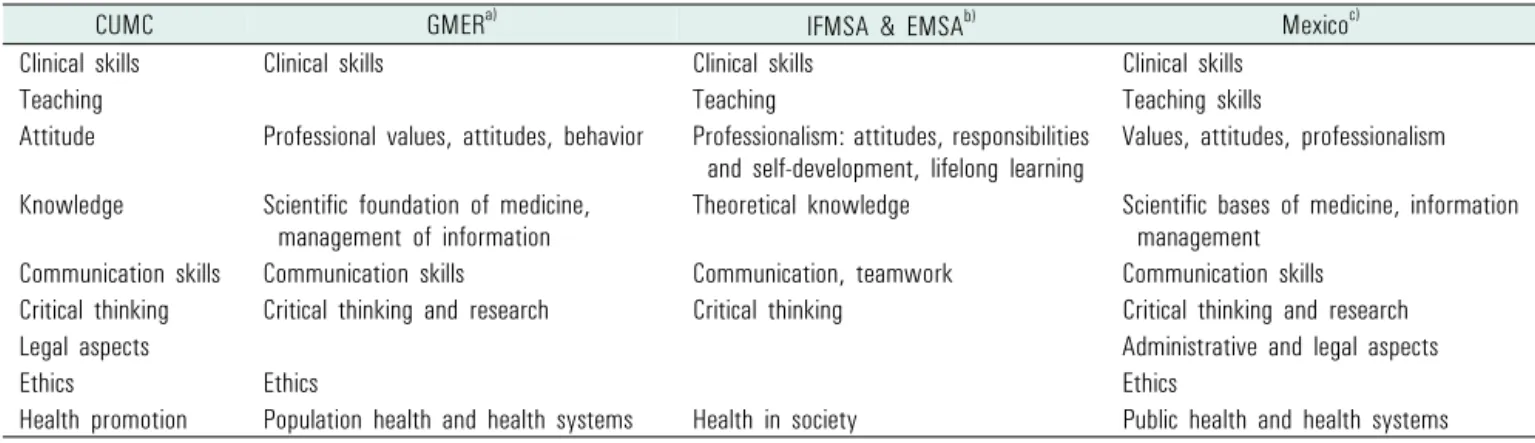
CUMC GMER
a)IFMSA & EMSA
b)Mexico
c)Clinical skills Clinical skills Clinical skills Clinical skills
Teaching Teaching Teaching skills
Attitude Professional values, attitudes, behavior Professionalism: attitudes, responsibilities
and self-development, lifelong learning Values, attitudes, professionalism Knowledge Scientific foundation of medicine,
management of information Theoretical knowledge Scientific bases of medicine, information management
Communication skills Communication skills Communication, teamwork Communication skills Critical thinking Critical thinking and research Critical thinking Critical thinking and research
Legal aspects Administrative and legal aspects
Ethics Ethics Ethics
Health promotion Population health and health systems Health in society Public health and health systems CUMC, The Catholic University of Korea College of Medicine.
a)
Global minimum essential requirements (Schwarz and Wojtczak, 2002).
b)The International Federation of Medical Students’ Associations (IFMSA) and the European Medical Students’ Association (EMSA) (International Federation of Medical Students’ Associations et al., 2007).
c)Outcome-based national profile of Mexico’s medical graduates (Elizondo-Montemayor et al., 2007).
Table 2. Cross-reference of learning outcome domains found in articles and CUMC
Figure 1. Schematic representation of the 2-way categorization of the learning outcomes from CUMC and the assessment items of NHPLEB. CUMC, The
Catholic University of Korea College of Medicine; NHPLEB, National Health Personnel Licensing Examination Board; PE, physician encounter.
Outcome domains Learning outcomes of CUMC Assessment items of NHPLEB
Clinical skills Demonstrate basic life support skills on patients showing cardiac arrest Missing
Teaching Missing Answer the questions on treatment plans for dying patients and their
families
Attitude Show sympathy on suffering of dying patient and his/her family Understand and manage psychological process of dying patients Show sympathy on the death of patients
Knowledge Explain difference between oxygen therapy and mechanical ventilation
executed in respiratory failure patient Plan palliative care for dying patients, including pain control, protection of patients’ dignity, and roles of family and community Communication
skills Watch and learn how to explain treatment plans and obtain informed consent from patients and their families Missing
Critical thinking Missing Missing
Legal aspects Explain needs of advance directives and therapeutic obstinacy Write a death certificate after recognition of a patient’s death Help dying patients and their family making decisions on legal issues Ethics Explain ethical issues related to dying patients, hospice, and palliative
care Help dying patients and their family making decisions on ethical issues
Health promotion Missing Missing
CUMC, The Catholic University of Korea College of Medicine; NHPLEB, National Health Personnel Licensing Examination Board.
Table 3. An example (physician encounter: dying patient & bereavement) of mapping learning outcomes of CUMC and assessment items of NHPLEB
Figure 2. Frequencies of the learning outcomes of CUMC and the assessment items of NHPLEB according to outcome domains. None of the NHPLEB’s assessment
items were found in the communication domain. CUMC, The Catholic University of Korea College of Medicine; NHPLEB, National Health Personnel Licensing Examination Board.
Montemayor et al., 2007; International Federation of Medical Students’ Associations et al., 2007; Schwarz and Wojtczak, 2002).
The outcome domains introduced by previous articles were similar to each other. We compared the domains and finalized 9 domains that were mentioned in several articles (Table 2).
We collected 3,017 learning outcomes from all BME courses in CUMC and manually tagged each learning outcome with the 2-way categories mentioned above (Figure 1). The same tagging procedures were carried out with 608 assessment items by the NHPLEB. After the categorization of all outcomes, cross- referencing was performed in terms of the PE category and the outcome domain category (Table 3). Manual review and curation of the huge collection of learning outcomes and assessment items was a labor-intensive task. For a systematic approach, maintenance of data integrity, and further evaluation, we built a relational database populated with the learning outcomes, the assessment items, and their relationship using FileMaker Pro 13 (Santa Clara, CA, USA).
RESULTS
1. Comparison of outcome domains
The assessment items of the NHPLEB and the learning outcomes of CUMC were categorized by outcome domains, and the number of lists in each domain was compared (Figure 2).
Compared with the assessment items of the NHPLEB, the learning outcomes of CUMC were found to have considerably more emphasis on the knowledge domain. About half of the learning outcomes (1,594 outcomes) were categorized into the knowledge domain. We found 2 reasons for the propensity of CUMC’s outcomes to fall in the knowledge domain. Most of the learning outcomes (1,096 outcomes) of basic medical sciences were associated with the knowledge domain. Because the NHPLEB does not have an examination for basic medical sciences, the paucity of outcomes in the knowledge domain may be justified.
In addition, a significant number of the outcomes in the knowledge domain did not state student competencies. We assumed that some of the outcomes were neglected in the process of conversion from instructional objectives to learning outcomes during the period of medical education reform.
Scarcity of the NHPLEB’s outcomes in the clinical skill and communication domains may be explained by the fact that the NHPLEB’s assessment items were intended for written examinations. The NHPLEB has a separate examination for evaluating clinical skills.
2. Comparison of physician encounters
Among 214 PEs, we found that 2 PEs (sexual violence and family
violence/abuse), which were recently introduced in the assessment
items, were not covered by the learning outcomes of CUMC.
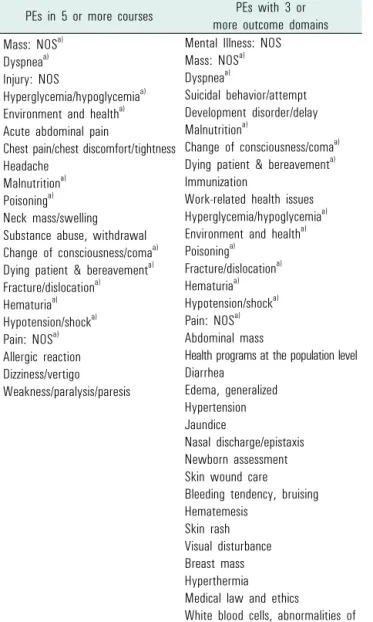
PEs in 5 or more courses PEs with 3 or more outcome domains Mass: NOS
a)Dyspnea
a)Injury: NOS
Hyperglycemia/hypoglycemia
a)Environment and health
a)Acute abdominal pain
Chest pain/chest discomfort/tightness Headache
Malnutrition
a)Poisoning
a)Neck mass/swelling Substance abuse, withdrawal Change of consciousness/coma
a)Dying patient & bereavement
a)Fracture/dislocation
a)Hematuria
a)Hypotension/shock
a)Pain: NOS
a)Allergic reaction Dizziness/vertigo Weakness/paralysis/paresis
Mental Illness: NOS Mass: NOS
a)Dyspnea
a)Suicidal behavior/attempt Development disorder/delay Malnutrition
a)Change of consciousness/coma
a)Dying patient & bereavement
a)Immunization
Work-related health issues Hyperglycemia/hypoglycemia
a)Environment and health
a)Poisoning
a)Fracture/dislocation
a)Hematuria
a)Hypotension/shock
a)Pain: NOS
a)Abdominal mass
Health programs at the population level Diarrhea
Edema, generalized Hypertension Jaundice
Nasal discharge/epistaxis Newborn assessment Skin wound care Bleeding tendency, bruising Hematemesis
Skin rash Visual disturbance Breast mass Hyperthermia Medical law and ethics
White blood cells, abnormalities of PE, physician encounter; NOS, not otherwise specified.
a)
PEs found in the both columns.
Table 4. The lists of frequently covered PEs in basic medical education courses
of the Catholic University of Korea College of Medicine (in order of frequency) 3. Revisiting physician encounters with different levels of
learning outcomes
According to Miller’s pyramid, a clinical assessment has 4 levels (Miller, 1990). Although knowledge is required to show clinical competence, it is not enough to show clinical competence by itself. To build clinical competence on each PE, we need to revisit the same PEs with different outcome levels. To evaluate the revisiting schemes in CUMC’s learning outcomes, we counted the numbers of associated domains and BME courses for each PE across all BME courses. Among the 214 PEs, 82 PEs were associated with more than one outcome domain and 96 PEs were
covered in more than one BME course. 21 PEs were repeated in 5 or more courses and 34 PEs had outcomes categorized into 3 or more domains (Table 4).
DISCUSSION
We showed that allocating a PE and an outcome domain to each learning outcome and assessment item, respectively, facilitated the evaluation of BME courses in CUMC. Through the 2-way categorization of the outcomes, we could easily measure the concordance between the learning outcomes and the assessment items. Moreover, identification of the learning outcomes that were replicated in several courses was possible through the categorization process.
Each course in BME needs to be monitored and audited. The courses receive feedback from the faculty and the students, and we vigorously evaluate the feedback and actively adopt the feedback that has reasonable justification. Because the courses keep changing each education year, the balance of the whole education system can easily become unbalanced without any monitoring and auditing. Some faculty and medical students are concerned that the education of the basic medical sciences is not sufficient at CUMC. By analyzing learning outcomes, we were able to list contents on basic medical sciences in the BME program and further adjust the appropriate amount of basic medical science education in the body-system-oriented courses.
The abovementioned mapping practice can be extended to the area of student examinations. Besides the evaluation of courses, the 2-way categorization may facilitate the evaluation of the examinations that the medical students take during the courses.
As we did with learning outcomes, each test item can be tagged with a PE and an outcome domain. Medical students’
competencies on associated learning outcomes can be evaluated by analyzing the difficulty level of the test items. By collecting test results and the associated learning outcomes on each student, we may provide the students’ individual portfolios on competence.
With information on the level of a student’s achievement, we can provide individualized self-directed learning modules to students who have a low profile in a certain group of learning outcomes.
Only 4 assessment items of the NHPLEB were included in
the domain of clinical skills. Because the current cross-referencing
of learning outcomes and assessment items was confined to a
written examination, most clinical skills were not covered in this study. Currently, we are planning an extension of the outcome analysis system to accommodate OSCE/CPX (objective structured clinical examination/clinical performance examination) and the clinical skill examination of the NHPLEB.
This will complete the evaluation process of concordance between the learning outcomes and the assessment items.
By evaluating the courses and outcome domains associated with the same PEs, we could see the repetition and deepening of the learning outcomes. As the students advanced to the next level of courses, the same PEs were introduced again along with learning outcomes with different categories of outcome domains.
With this repetition and widening of the associated outcome domain, students may consolidate the competencies related to each PE.
In summary, cross-referencing 2 different structures of learning outcomes and assessment items can be achieved by building universal criteria. We showed that a 2-way categorization (PEs and outcome domains) could be applied to body-system-oriented learning outcomes and PE-structured assessment items. Through the mapping process, we were able to evaluate the coverage and the repetition of the learning outcomes of the BME courses in CUMC. The mapping results will be used as valuable evidence
to guide the management of BME courses.
CONFLICT OF INTEREST
No potential conflict of interest relevant to this article was reported.
REFERENCES
Baumber, J. S., Challis, E. B., & Medical Council of Canada. (1992). Objectives
for the qualifying examination. Ottawa: Medical Council of Canada.Elizondo-Montemayor, L., Cid-Garcia, A., Perez-Rodriguez, B. A., Alarcon- Fuentes, G., Perez-Garcia, I., & David, S. (2007). Outcome-based national profile of Mexico’s medical graduates. Med Teach, 29(7), 691-698.
International Federation of Medical Students’ Associations, European Medical Students’ Association, Hilgers, J., & De Roos, P. (2007). European core curriculum: The students’ perspective, Bristol, UK, 10 July 2006.
Med Teach, 29(2-3), 270-275.
Mandin, H., Harasym, P., Eagle, C., & Watanabe, M. (1995). Developing a “clinical presentation” curriculum at the University of Calgary. Acad
Med, 70(3), 186-193.Miller, G. E. (1990). The assessment of clinical skills/competence/per- formance. Acad Med, 65(9 Suppl), S63-S67.
Prasad, V. (2010). Perspective: Beyond storytelling in medicine: An encounter- based curriculum. Acad Med, 85(5), 794-798.
Schwarz, M. R., & Wojtczak, A. (2002). Global minimum essential requirements: A road towards competence-oriented medical education.
Med Teach, 24(2), 125-129.