INTRODUCTION
Under the pandemic of coronavirus disease 2019 (COVID-19), caused by severe acute respiratory syn- drome coronavirus 2 (SARS-CoV-2), rapid and reliable diagnostic assays are essential for the timely isolation and treatment of infected patients and the prevention of further spread of the virus among individuals. Several real-time reverse transcription polymerase chain reac- tion (RT-qPCR) assays have been utilized in most diag- nostic laboratories as the first-line standard diagnostic method for SARS-CoV-2 (Carter et al., 2020; Corman et al., 2020; Lu et al., 2020; van Kasteren et al., 2020). Fur- thermore, several reverse transcription loop-mediated
isothermal amplification (RT-LAMP) assays have been developed to detect SARS-CoV-2 (Baek et al., 2020;
Kitagawa et al., 2020; Lau et al., 2020; Rodel et al., 2020;
Thomson et al., 2020; Yan et al., 2020). RT-LAMP assays that can amplify a target gene under a single reaction temperature using Bst DNA polymerase and four or six primers have comparable sensitivity and specificity to RT-qPCR assays for SARS-CoV-2 detection. In addi- tion, RT-LAMP assays are less time consuming and can be easily adapted for use in relatively under-equipped laboratories. Therefore, RT-LAMP assays have been rec- ognized as suitable alternatives to the RT-qPCR assay for detection of SARS-CoV-2. The Isopollo® COVID-2 assay (M-monitor, Daegu, Korea), hereafter referred to
KJVS
Korean Journal of Veterinary Service SHORT COMMUNICATION
Comparison of clinical diagnostic performance between
commercial RRT-LAMP and RT-qPCR assays for SARS-CoV-2 detection
Hye-Ryung Kim1, Jonghyun Park1, Hyung-Soo Han2, Yu-Kyung Kim3, Hyo-Sung Jeon4, Seung-Chun Park1, Choi-Kyu Park1*
1College of Veterinary Medicine & Animal Disease Intervention Center, Kyungpook National University, Daegu 41566, Korea
2Department of Physiology, School of Medicine, Kyungpook National University, Daegu 41944, Korea
3Department of Clinical Pathology, School of Medicine, Kyungpook National University, Daegu 41944, Korea
4M Monitor Incorporation, Daegu 42713, Korea
Received September 14, 2021 Revised September 29, 2021 Accepted September 29, 2021
Corresponding author:
Choi-Kyu Park
E-mail: [email protected] https://orcid.org/0000-0002-0784-9061
The rapid and reliable detection of severe acute respiratory syndrome coronavirus 2 (SARS-CoV-2) plays a key role in isolating infected patients and preventing further viral transmission. In this study, we evaluated the clinical diagnostic performances of a commercial real-time reverse transcription loop-mediated isothermal amplification (RRT-LAMP) assay (Isopollo® COVID-2 assay, M-monitor, Daegu, Korea) using eighty COVID-19 suspected clinical samples and compared these with the results of a commercial real-time reverse transcription polymerase chain reaction (RT-qPCR) assay (AllplexTM 2019-nCoV rRT-QPCR Assay, SeeGene, Seoul, Korea). The results of the RRT-LAMP assay targeting the N or RdRp gene of SARS-CoV-2 showed perfect agreement with the RT-qPCR assay results in terms of detection. Furthermore, the RRT-LAMP assay was completed in just within a 20-min reaction time, which is significantly faster than about the 2 h currently required for the RT- qPCR assay, thus enabling prompt decision making regarding the isolation of infected patients. The RRT-LAMP assay will be a valuable tool for rapid, sensitive, and specific detection of SARS-CoV-2 in human or unexpected animal clinical cases.
Key Words: SARS-CoV-2, Real-time RT-LAMP, Diagnostic performance
Copyright ⓒ The Korean Society of Veterinary Service.
This is an Open Access article distributed under the terms of the Creative Commons Attribution Non-Commercial License (http://creativecommons.org/licenses/
by-nc/4.0). which permits unrestricted non-commercial use, distribution, and reproduction in any medium, provided the original work is properly cited.
https://doi.org/10.7853/kjvs.2021.44.3.163 pISSN: 1225-6552 eISSN: 2287-7630 Korean J Vet Serv 2021;44(3):163-168
as mRRT-LAMP assay, is a newly introduced commercial real-time RT-LAMP (RRT-LAMP) assay for the detection of SARS-CoV-2 that has been authorized for exporta- tion in Korea. However, the diagnostic performance of the mRRT-LAMP assay has not yet been reported.
Therefore, in this study, we comparatively evaluated the clinical diagnostic performances of the RRT-LAMP assay and a commercial RT-qPCR assay (AllplexTM 2019-nCoV rRT-QPCR Assay, SeeGene, Seoul, Korea), thereafter referred to as sgRT-qPCR, which has been certified and broadly used for SARS-CoV-2 detection in Korea, EU, and other countries (Carter et al., 2020; van Kasteren et al., 2020). Recently, SARS-CoV-2 infection has been re- ported in cats, dogs, tigers, lions, and minks suggesting animal-to-human and animal-to-animal transmission of the virus (Maddy et al., 2020). Therefore, it is essen- tial to know the possibility of infection for other animal species and it is needed to have a diagnostic tool for unexpected animal clinical cases.
MATERIALS AND METHODS
Clinical samples and RNA extraction
Eighty nasopharyngeal swab specimens were used for clinical evaluation. These specimens were collected from patients with suspected COVID-19 hospitalized at Kyungpook National University Hospital (KNUH, Daegu, Korea) and placed in Virocult® viral transport media (Sigma). RNAs were extracted from the samples using a commercial RNA extraction kit (Real-Prep Viral DNA/
RNA Kit, BioSewoom, Seoul, Korea) as per manufac- turer’s instruction. Extracted RNAs were stored at −80℃
until use. Sampling for this study was approved by the KNUH ethics committee (KNUH 2020-02-003-002).
sgRT-qPCR assay
The sgRT-qPCR assay (SeeGene) was performed ac- cording to the manufacturer’s instructions. Briefly, RNA template (8 μL) was added to the master mix, and the
sgRT-qPCR was performed with the flollowing reaction conditions: reverse transcription at 50℃ for 20 min, initial denaturation at 95℃ for 15 min, 45 cycles of de- naturation at 94℃ for 15 s, and annealing and extension at 58℃ for 30 s using a real-time PCR system (CFX96TM Dx System, Bio-Rad, CA, USA). Ct values from Cal Red 610 (RdRp gene), Quasar 670 (N gene), and HEX (inter- nal control) were acquired from each sample. Samples were considered positive when a signal was detected at Ct<40 for any gene, negative if the internal control was amplified but not the viral genes, and invalid when the internal control was not amplified.
mRRT-LAMP assay
The mRRT-LAMP assay (M-monitor) was performed according to the manufacturer’s instructions. Briefly, RNA template (5 μL) was added to the master mix, and the mRRT-LAMP assay was performed for 40 cycles at intervals of 30 s at 58℃ isothermal condition using a re- al-time PCR system (CFX96TM Dx System, Bio-Rad). The time to positive (Tp) values from SYTO 9 intercalating fluorescent dye (N gene, RdRp gene, or internal control) were acquired from each sample. Samples were consid- ered positive when a signal was detected at Ct<40 for any gene, negative if the internal control was amplified but not the viral genes, and invalid when the internal control was not amplified.
Comparison of clinical diagnostic performance using clinical samples
To comparatively evaluate the performance of the mRRT-LAMP and sgRT-qPCR assays for SARS-CoV-2 detection, each assay was performed with RNA tem- plates extracted from 80 nasopharyngeal swabs de- scribed above. The concordance rate between both as- says was calculated using the following formula: (number of consistent results by both methods/total numbers)×
100%. The Tp value of mRRT-LAMP or Ct value of sgRT- qPCR was converted to time elapsed to compare the re- Hye-Ryung KimㆍJonghyun ParkㆍHyung-Soo HanㆍYu-Kyung KimㆍHyo-Sung JeonㆍSeung-Chun ParkㆍChoi-Kyu Park
KJVS
action times. As the fluorescence signal of mRRT-LAMP was monitored every 30 s interval under isothermal conditions, the reaction time was calculated in minutes by dividing the Tp value by 2. In the case of sgRT-qPCR, as the reaction temperature changes per cycle, the re- action time required per cycle was calculated consid- ering the ramping time (3.3℃/sec) determined for the real-time PCR system (Bio-Rad). Considering these pa- rameters, the reaction time per cycle was calculated to be 67 s. In addition, the sgRT-qPCR assay also includes reverse transcription (20 min) and initial denaturation (15 min) prior to cycling. Accordingly, the total reaction time (time elapsed) for sgRT-qPCR was calculated by multiplying the Ct value of each sample by 67 sec and adding 35 min.
RESULTS AND DISCUSSION
The ongoing COVID-19 pandemic requires an accu- rate and efficient diagnostic method for the detection of SARS-CoV-2 in suspected patients and asymptom- atic individuals. Most diagnostic assays for SARS-CoV-2 RNA detection rely on the RT-qPCR assays (Carter et al.,
2020; Corman et al., 2020; Lu et al., 2020; van Kasteren et al., 2020), but RT-LAMP assays are promising alterna- tives (Baek et al., 2020; Kitagawa et al., 2020; Lau et al., 2020; Rodel et al., 2020; Thomson et al., 2020; Yan et al., 2020). In the present study, we evaluated the clinical diagnostic performance of a commercial mRRT-LAMP assay (M-monitor) and compared the results with those of a commercial sgRT-qPCR assay (SeeGen) for SARS- CoV-2 detection. We selected the sgRT-qPCR assay as the reference for comparative evaluation because it has been certified for Emergency Use Authorization by the United States Food and Drug Administration and other drug regulatory authorities (Carter et al., 2020) and has been proven to have comparable diagnostic perfor- mance as other commercial kits in a previous study (van Kasteren et al., 2020).
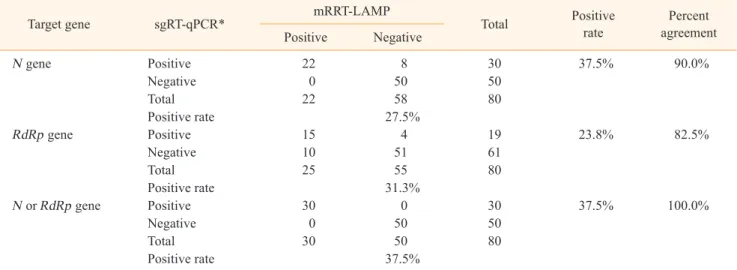
The results of the comparative clinical evaluation of the mRRT-LAMP and sgRT-qPCR assays are given in Table 1, 2. Internal control genes were successfully amplified by both mRRT-LAMP and sgRT-qPCR assays from all 80 clinical samples, indicating that the results of two assays could be interpreted as valid. In detect- ing N gene of SARS-CoV-2 from clinical samples, the
Table 1. Comparison of clinical performance between mRRT-LAMP and sgRT-qPCR for the detection of SARS-CoV-2
Target gene sgRT-qPCR* mRRT-LAMP
Total Positive
rate Percent agreement Positive Negative
N gene Positive 22 8 30 37.5% 90.0%
Negative 0 50 50
Total 22 58 80
Positive rate 27.5%
RdRp gene Positive 15 4 19 23.8% 82.5%
Negative 10 51 61
Total 25 55 80
Positive rate 31.3%
N or RdRp gene Positive 30 0 30 37.5% 100.0%
Negative 0 50 50
Total 30 50 80
Positive rate 37.5%
mRRT-LAMP, real-time reverse transcription loop-mediated isothermal amplification assay using Isopollo® COVID-2 assay (M-monitor, Daegu, Korea); sgRT-qPCR, real-time reverse transcription polymerase chain reaction assay using AllplexTM 2019-nCoV rRT-QPCR Assay (SeeGene, Seoul, Korea); SARS-CoV-2, severe acute respiratory syndrome coronavirus 2.
*The samples that are positive by the sgRT-qPCR were determined to be true positive in the hospital, because the assay has been certified and broadly used as standard diagnostic method for SARS-CoV-2 detection in Korea.
Comparison of clinical diagnositc performance between commercial RRT-LAMP and RT-qPCR assay for SARS-CoV-2 detection KJVS
positive ratio of mRRT-LAMP or sgRT-qPCR assay was 27.5% (22/80) or 37.5% (30/80), and the percentage of positive, negative, or overall agreement between the re- sults of the mRRT-LAMP and the sgRT-qPCR assay was determined as 73.3% (22/30), 100.0% (50/50), or 90.0%
(72/80), respectively. In detecting the RdRp gene of SARS-CoV-2 from clinical samples, the positive ratio of mRRT-LAMP or sgRT-qPCR assay was 31.3% (25/80) or 23.8% (19/80), and the percentage of positive, negative, or overall agreement between the results of the mRRT- LAMP and the sgRT-qPCR assay was determined as 78.9% (15/19), 83.6% (51/61), or 82.5% (66/80), respec- tively. For the detection of either the N or RdRp gene from each clinical sample, the positive ratio of mRRT- LAMP and sgRT-qPCR assay was the same as 37.5%
(30/80), showing 100% of positive, negative, and overall agreement between both assays.
However, some discrepancies between the assay re- sults were observed for individual N or RdRp gene de- tection. The reason for these discrepancies remains un- clear but may be attributed to differences in sensitivity between the two assays, unknown inhibitors specific for each assay, or the degradation of individual target genes in clinical samples. However, when interpreting the as- say results of either N or RdRp gene detection for each sample, both assays showed the same positive ratio of 37.5% and 100% percent agreement between the two as- say results (Table 1). Several researchers have reported that false-negative or false-positive reactions can occur for various reasons, even with the best diagnostic meth-
od, causing serious problems for control and quarantine COVID-19 (Carter et al., 2020; Thomson et al., 2020).
And also, considering the continuous genetic muta- tion of SARS-CoV-2 and the characteristics of the RT- LAMP method that requires the use of multiple primers, it cannot exclude the possibility that mutations in the gene sequence of the primer-binding site will occur, which will lower the diagnostic efficacy of the RT-LAMP assay. Therefore, it is necessary to update and improve the primers used in the RT-LAMP assay by continuously monitoring the virus for mutations to ensure accurate and sensitive diagnosis of SARS-CoV-2.
Inconsistencies of the results between different diag- nostic methods or between target genes amplified with the same diagnostic method have been reported by re- searchers, which are similarly found in this study (Carter et al., 2020; Kitagawa et al., 2020; Rodel et al., 2020;
Thomson et al., 2020; van Kasteren et al., 2020). Such inconsistencies of test results may inevitably occur in any diagnostic method, but a strategy to minimize such discrepancies is needed in order to minimize misdiag- nosis caused by false-positive or false-negative reac- tions, Therefore, it is recommended to use a diagnostic method that can detect two or more targets simultane- ously and it is more recommended to use another diag- nostic method with a different operating mechanism as an alternative diagnostic method.
A comparison of reaction times between the mRRT- LAMP and sgRT-qPCR assays is presented in Table 2.
The mean reaction time for N or RdRp gene-positive Table 2. Comparison of reaction times between mRRT-LAMP and sgRT-qPCR for the detection of SARS-CoV-2 genes from clinical samples
Methods Target gene Number of positive samples
Reaction time of each method (min)
Range Mean SD
sgRT-qPCR N 30 58.3~78.8 73 4.4
RdRp 19 64.5~75.1 71.9 2.9
mRRT-LAMP N 22 7.5~16.3 11.6 2.3
RdRp 25 8.0~15.8 11.7 2.2
mRRT-LAMP, real-time reverse transcription loop-mediated isothermal amplification assay using Isopollo® COVID-2 assay (M-monitor, Daegu, Korea); sgRT-qPCR, real-time reverse transcription polymerase chain reaction assay using AllplexTM 2019-nCoV rRT-QPCR Assay (SeeGene, Seoul, Korea); Range, the shortest detection time – the longest detection time; SD, standard deviation; SARS-CoV-2, severe acute respiratory syndrome coronavirus 2.
Hye-Ryung KimㆍJonghyun ParkㆍHyung-Soo HanㆍYu-Kyung KimㆍHyo-Sung JeonㆍSeung-Chun ParkㆍChoi-Kyu Park
KJVS
samples in the RT-qPCR assay was 73.0 (±4.4) min or 71.9 (±2.9) min, respectively. In contrast, the mean re- action time for N or RdRp gene-positive samples in the RRT-LAMP was 11.6 (±2.3) min or 11.7 (±2.2) min, re- spectively (Table 2). Therefore, the mean reaction times of the mRRT-LAMP assay was 61.4 min for N gene or 60.2 min for RdRp gene, which are shorter than those of the sgRT-qPCR assay, indicating that the developed mRRT-LAMP assay can be utilized as a faster diagnos- tic method than sgRT-qPCR for the detection of SARS- CoV-2 from clinical samples. The reason for the faster reaction speed of mRRT-LAMP is that it does not re- quire RT and the initial denaturation steps, and because the reaction is performed under isothermal conditions, there is no time delay due to reaction temperature change.
In summary, the mRRT-LAMP assay allows rapid, sen- sitive, and specific detection of SARS-CoV-2 by target- ing both N and RdRp genes of the virus and the assay will be a valuable diagnostic assay alternative to RT- qPCR for the detection of SARS-CoV-2 in human or un- expected animal clinical cases.
ACKNOWLEDGEMENTS
This work was supported by the Commercializations Promotion Agency for R&D Outcomes (COMPA) grant funded by the Korean Government (Ministry of Science and ICT) (2021, R&D project No. 1711139487).
CONFLICT OF INTEREST
No potential conflict of interest relevant to this article was reported.
ORCID
Hye-Ryung Kim, https://orcid.org/0000-0002-9616-5365 Jonghyun Park, https://orcid.org/0000-0002-9432-0026 Hyung-Soo Han, https://orcid.org/0000-0001-7200-0921 Yu-Kyung Kim, https://orcid.org/0000-0002-4699-8502
Hyo-Sung Jeon, https://orcid.org/0000-0002-1223-626X Seung-Chun Park, https://orcid.org/0000-0001-8539-1087 Choi-Kyu Park, https://orcid.org/0000-0002-0784-9061
REFERENCES
Baek YH, Um J, Antigua KJC, Park JH, Kim Y, Oh S, Kim YI, Choi WS, Kim SG, Jeonga JH, Chin BS, Nico- las HDG, Ahn JY, Shin KS, Choi YK, Park JS, Song MS. 2020. Development of a reverse transcription- loop-mediated isothermal amplification as a rapid early-detection method for novel SARS-CoV-2.
Emerg Microb Infec 9(1): 998-1007.
Carter LJ, Garner LV, Smoot JW, Li Y, Zhou Q, Saveson CJ, Sasso JM, Gregg AC, Soares DJ, Beskid TR, Jer- vey SR, Liu C. 2020. Assay techniques and test de- velopment for COVID-19 diagnosis. ACS Cent Sci 6:
591-605.
Corman VM, Landt O, Kaiser M, Molenkamp R, Meijer A, Chu DKW, Bleicker T, Brünink S, Schneider J, Schmidt ML, Mulders DGJC, Haagmans BL, van der Veer B, van den Brink S, Wijsman L, Goderski G, .Romette JL, Ellis J, Zambon M, Peiris M, Goossens H, Reusken C, Koopmans MPG, Drosten C. 2020.
Detection of 2019 novel coronavirus (2019-nCoV) by real-time RT-PCR. Euro Surveill 25(3): 2000045.
Kitagawa Y, Orihara Y, Kawamura R, Imai K, Sakai J, Tarumoto N, Matsuoka M, Takeuchi S, Maesaki S, Maeda T. 2020. Evaluation of rapid diagnosis of novel coronavirus disease (COVID-19) using loop- mediated isothermal amplification. J Clin Virol 129: 104446.
Lau YL, Ismail I, Mustapa NI, Lai MY, Soh TST, Hassan A, Peariasamy KM, Lee YL, Chong YM, Sam IC, Goh PP. 2020. Real-time reverse transcription loop-me- diated isothermal amplification for rapid detection of SARS-CoV-2. Peer J 8: e9278.
Lu X, Wang L, Sakthivel SK, Whitaker B, Murray J, Ka- mili S, Lynch B, Malapati L, Burke SA, Harcourt J, Tamin A, Thornburg NJ, Villanueva JM, Lindstrom S.
2020. US CDC real-time reverse transcription PCR Comparison of clinical diagnositc performance between commercial RRT-LAMP and RT-qPCR assay for SARS-CoV-2 detection KJVS
panel for detection of severe acute respiratory syn- drome coronavirus 2. Emerg Infect Dis 26(8): 1654- 1665.
Mahdy MAA, Younis W, Ewaida Z. 2020. An overview of SARS-CoV-2 and animal infection. Front Vet Sci 7:
596391.
Rodel J, Egerer R, Suleyman A, Sommer-Schmid B, Baier M, Henke A, Edel B, L¨offler B. 2020. Use of the variplexTM SARS-CoV-2 RT-LAMP as a rapid molecular assay to complement RT-PCR for CO- VID-19 diagnosis. J Clin Virol 132: 104616.
Thomson D, Lei Y. 2020. Mini review: Recent progress in RT-LAMP enabled COVID-19 detection. Sens Act
Rep 2(1): 100017.
van Kasteren PB, van der Veer B, van den Brink S, Wijs- man L, de Jonge J, van den Brandt A, Molenkamp R, Reusken CBEM, Meijera A. 2020. Comparison of seven commercial RT-PCR diagnostic kits for CO- VID-19. J Clin Virol 128: 104412.
Yan C, Cui J, Huang L, Du B, Chen L, Xue G, Li S, Zhang W, Zhao L, Sun Y, Yao H, Li N, Zhao H, Feng Y, Liu S, Zhang Q, Liu D, Yuan J. 2020. Rapid and visual detection of 2019 novel coronavirus (SARS-CoV-2) by a reverse transcription loop-mediated isother- mal amplification assay. Clin Microbiol Infec 26(6):
773-779.
Hye-Ryung KimㆍJonghyun ParkㆍHyung-Soo HanㆍYu-Kyung KimㆍHyo-Sung JeonㆍSeung-Chun ParkㆍChoi-Kyu Park
KJVS