43(4) : 316∼ 322 (2012)
316
희렴 추출물의 Heme Oxygenase-1 발현을 통한 생쥐 해마 유래 HT22 세포 보호효과
임남경1#·이동성2#·여선정3·김윤철4·정길생1,3*
1계명대학교 신약개발연구소, 2원광대학교 한방체액조절연구센터,
3계명대학교 약학대학, 4원광대학교 약학대학
Involvement of Heme Oxygenase-1 Induction in the Neuroprotective Activitiy of Extract of Siegesbeckia Herba in Murine Hippocampal HT22 Cells
Nam Kyung Im1#, Dong Sung Lee2#, Sun Jung Yeo3, Youn-Chul Kim2, and Gil-Saeng Jeong1,3
*
1New Drug Development Institute, Keimyung University, Dae-gu 704-701, Korea
2Hanbang Body-Fluid Research Center, Wonkwang University, Iksan 570-749, Korea
3College of Pharmacy, Keimyung University, Dae-gu 704-701, Korea
4College of Pharmacy, Wonkwang University, Iksan 570-749, Korea
Abstract − Siegesbeckia Herba is known to have anti-oxidant, anti-inflammatory, anti-allergic and anti-tumor. The objective of this study is to explore the neuroprotective effect of Siegesbeckia Herba against glutamate-induced oxidative stress in mouse hippocampal HT22 cells. Siegesbeckia Herba 70% ethanol extract and solvent fractions have the potent neroprotective effects on glutamate-induced nerotoxicity by induced the expression of heme oxygenase (HO)-1 in the mouse hippocampal HT22 cells.
Especially, ethyl acetate fraction showed higher protective effect. In HT22 cell, Siegesbeckia Herba ethyl acetate fraction makes the nuclear accumulation of Nrf2. Further, we found that treatment with c-JUN N-terminal kinase (JNK) inhibitor (SP600125) reduced Siegesbeckia Herba ethyl acetate fraction induced HO-1 expression and Siegesbeckia Herba ethyl acetate fraction also increased JNK phosphorylation. In conclusion, the ethyl acetate fraction of 70% ethanol extract of Siegesbeckia Herba sig- nificantly protect glutamate-induced oxidative damage by induction of HO-1 via Nrf2 and JNK pathway in mouse hippocampal HT22. Taken together these finding suggest that Siegesbeckia Herba ethyl acetate fraction good source for taking active com- pounds and may be a potential therapeutic for brain disorder by targeting the oxidative stress of neuronal cell.
Key words − Siegesbeckia Herba, ROS, Heme oxygenase-1, HT22, Glutamate, Neroprotective effect
희렴(Siegesbeckia Herba)은 국화과(Compositae)에 속하며, 진득찰(Siegesbeckia glabrescens Makino) 또는 털진득찰 (Siegesbeckia pubescens Makino) 1년생의 전초를 약용으로 사용한다. 높이는 40~100 cm로 자라며 야산이나 들에서 흔 히 볼 수 있으며, 전체에 짧은 털이 빽빽하게 나며, 끝이 뾰 족하고 가장자리에 톱니가 있는 잎이 줄기에 마주난다. 꽃 은 8~9월에 가지나 줄기 끝에 노란 꽃이 산방 꽃차례로 달 리며, 열매를 둘러싸는 5개의 주걱모양의 총포조각의 겉에 나 있는 털에는 끈적거리는 액체가 묻어있어 다른 물체에 잘 달라붙는다. 예로부터 민간에서 제풍습(除風濕), 리근골
(利筋骨), 강혈압(降血壓)의 효능이 있어 요슬산연(腰膝酸軟), 사지마비(四肢麻痺), 고혈압(高血壓), 류마티스 등의 치료에 널리 사용되어 왔다.1,2) 희렴에서 분리된 주요성분으로는 sesquiterpene 계열 성분과 diterpene 계열 성분 등이 보고되 어 있으며,3-5) 생리활성으로는 항알러지작용, 면역억제작용, 항고혈압작용, 항암작용, 항산화작용등이 알려져 있다.6-8)
산소에 의하여 유래되는 superoxide, hydroxy peroxyl, alkoxyl, hydroperoxyl radical, nitric oxide등과 같은 활성산 소종(reactive oxygen spesies, ROS)은 호흡 과정이나 세포 대사과정에서 자연스럽게 생성되며 여러 가지 세포 반응을 조절하는 역할을 한다.9-10) 하지만, 과도한 스트레스, 흡연, 음주 등 여러 가지 원인으로 인하여 과도하게 생성된 활성 산소들은 노화를 유발하고 알츠하이머, 파킨슨 증후군, 헌
#
These authors contributed equally to this work
*교신저자(E-mail):[email protected]
(Tel): +82-53-580-6649
팅턴 증후군과 같은 중추신경계 퇴행성 뇌질환을 일으키는 원인중 하나로 알려져 있다.11-13) 글루타메이트의 과다 분비 는 수용체들의 과도한 자극으로 뇌 신경세포에 산화적 스 트레스를 유발하고 세포사멸을 유도하여 뇌손상을 일으킨
다.14-16)본 실험에 사용한 생쥐의 해마유래 세포주인 HT22
세포는 글루타메이트 수용체가 없는 세포주로서 글루타메 이트와 함께 처리할 때 신경흥분독성이 아닌 산화적 스트 레스로 인하여 세포가 손상을 받으며, 산화적 스트레스로 인한 뇌 세포 보호 물질을 찾는 실험모델로 유용하게 이용 되고 있다.17)
Heme oxygenase (HO)는 세포의 항산화 시스템에서 중요 한 구성요소로서 HO 유도체중 하나인 HO-1은 세포내의 heme을 분해하여 일산화탄소, 철, billiverdin을 만든다.18) 분 해된 생성물인 일산화탄소, 철, billiverdin과 HO-1 그 자체 는 세포손상 및 사멸의 억제, 항염증 및 항산화 작용을 하 는 것으로 알려져 있으며, 다양한 질병의 타겟으로 주목을 받고 있다. 특히 최근에는 HO-1과 그 부산물들이 항산화 작 용을 통하여 산화적 스트레스에 의한 뇌 세포 손상을 억제 한다는 많은 연구가 보고 된다.19) 따라서, 본 연구에서는 희 렴 에탄올 추출물과 그 분획물의 HT22 생쥐유래 해마세포 에서 글루타메이트로 유발한 산화적 손상에 대한 뇌세포 보 호 효과를 살펴보았으며, 그 작용 기전을 탐색하였다.
재료 및 방법
실험 재료 − 본 실험에 사용된 희렴(Siegesbeckia Herba) 은 2011년 9월 대구광역시 약령 시장에서 건조된 것을 구 입하여 사용하였다. 형태학적 평가를 통하여 동정하였고 표 본시료(KMP-2012-02)는 계명대학교 약학대학에 보관하였다.
시약 및 기기 − DMEM 배지와 trypsin-ethylenediaminet- etraacetic acid (EDTA)는 Gibco Laboratories사에서 구입하 였으며, fetal bovine serum (FBS)는 Hyclone Laboratories사 에서 구입하였다. L-glutamate, Trolox와 3'-(4,5-dimethylthiazol -2-yl)-2,5-diphenyltetrazolium bromide (MTT)는 Sigma사에 서 구입하였다. 96-Well tissue culture plates와 기타 tissue culture dishes는 Nunc사 제품을 이용하였다. 흡광도는 BioRad사의 Microplate Reader를 이용하여 측정하였다.
추출 및 분획 − 건조된 희렴 2 kg을 10배(W/V)의 70%
에탄올을 넣어 3회 추출, 여과하고 rotary vacuum evaporator 로 농축한 후 에탄올 추출물(183.7 g)로 사용하였다. 이 추 출물을 증류수로 현탁 시킨 후 n-hexane, CHCl3, EtOAc로 순차적으로 3회 반복 추출한 후 각 분획들을 감압 농축하여 용매를 휘발 시킨 뒤 hexane (16.8 g), CHCl3 (1.9 g), EtOAc (3.8 g),분획과 남은 H2O 분획층 (55.2 g)을 얻었다. 각 시료 들은 -70oC에서 보관하며 사용하였다.
세포배양 − 마우스 해마유래의 HT22 세포주는 묵인희 교
수(서울대학교)로부터 분양받아 사용하였으며, D-MEM 배 지에 10% FBS와 1% antibiotics를 첨가하여 37oC의 5%
CO2 incubator에서 1-2일 마다 계대배양하면서 실험에 사용 하였다.
글루타메이트 유도 뇌세포 보호효과 측정 − 글루타메이 트로 유도한 뇌세포 독성에 대한 보호 효과는 정등의 방법20) 에 따라 실시하였다. HT22세포를 96 well microplate에 2×10⁵ cells/well이 되게 분주한 후, 37oC의 5% CO2 incubator 에 서 24시간 배양한 다음, 5 mM의 글루타메이트와 각 추 출물과 분획물(50, 100, 200 µg/ml)을 농도별로 처리하였다.
시료 처리 12시간 후 세포 생존률을 MTT 방법으로 측정하 였으며, Trolox 50 µM을 양성대조군으로 하여 비교하였다.
모든 실험은 대조군에 대한 세포 보효율을 mean±S.D.로 표 시하였으며, 각각 3회 반복 실험치를 이용하여 계산하였다.
ROS (reactive oxygen species) 측정 − 세포내에서 활성 산소가 발생되면 2',7'-dichlorofluorescein diacetate (DCFDA) 가 esterase또는 산화적 가수분해에 DCFH로 탈아세틸화 되 고 비형광성인 DCFH는 활성 산소에 의해 산화되어 2',7'- dichloro-fluorescein (DCF)로 전환되고 이는 강한형광물질 을 가진다. 이러한 원리를 이용하여 ROS생성정도를 측정 하였다. 배양된 세포를 PBS로 세척한 후, 10 µM 2',7'- dichlofluorescein diacetate (DCFDA, 35845)를 포함하는 Hank' balanced salt 용액에서 30분 동안 암실에서 반응시킨 후 세포의 형광광도 (excitation wave length: 490 nm; emission wave length:525 nm)를 microplate reader (SpectramaxGemini XS, Molecular Devices, Sunnyvale, CA, U.S.A.)를 측정하 였다.
Western Blot Analysis − HT22세포를 60 mm dish에 seeding 3×10⁵ cells/well이 되도록 배양한 후 시료를 농도별 시간별로 처리한 한 후 상등액을 제거하고 PBS로 세척하였 다. RIPA buffer를 첨가하여 세포를 용해시키고 원심 분리 하여 얻은 단백질은 Bradford assay로 정량하여 12% SDS- PAGE를 이용하여 전기 영동한 후 PVDF membrane에 옮 긴 다음 5% skim milk로 30 분간 blocking한 후 1차 항체 (HO-1)를 1:1000으로 희석하여 넣고 1시간 동안 반응한 다 음, 다시 2차 항체를 반응시키고, ECL 용액을 1:1로 잘 섞 어서 membrane 위에 가하여 발광시키고 암실에서 X선 필 름에 감광한 후 현상하였다. 같은 방법으로 actin antibody 를 이용하여 actin을 측정하였다.
핵과 세포질 분획 − HT22 세포에 protease inhibitor cocktail I과 1 mM phenylmethylsulfonyl fluoride (PMSF) 를 첨가한 PER-mammalian protein extraction buffer를 첨가 하여 균질화하고 4oC에서 15,000×g로 원심분리 하였다. 10 분간 원심분리 후 상등액을 세포질 분획으로 사용하기 위 하여 -80oC에서 저장하였다. 나머지 침전물은 PBS로 세척 한 후 RIPA buffer [150 mM NaCl, 1% NP-40, 0.5%
sodium deoxycholate, 0.1% SDS, 50 mM Tris-HCl (pH 7.4), 50 mM glycerophosphate, 20 mM NaF, 20 mM ethylene glycol tetraacetic acid (EGTA), 1 mM dithiothreitol (DTT), 1 mM Na3VO4, protease inhibitors]를 첨가하고 4oC에서 15 분간 혼합한 후 4oC, 16,000×g에서 15분간 원심분리 하였 다. 이후의 과정은 앞에서 설명한 western blotting 방법을 이용하였다.
통계처리 − 본 실험의 통계처리는 GraphPad Prism, version 3.03 (GraphPad Software Inc., San Diego, CA, USA)을 사용하였다. 각 실험군의 결과는 평균치와 표준오 차로 나타내었으며, 각 실험군 간의 결과는 ANOVA test를 사용하여 분석하고 유의적인 차이가 있는 항목에 대해서만 검정하였다. 실험군 간의 차이는 95% 수준 (p<0.05)에서 유 의성 있는 것으로 하였다.
결과 및 고찰
ROS (reactive oxygen species)는 반응성이 높아 세포 구 성성분인 단백질, 지질, 당 DNA등을 비가역적, 비 선택적 으로 공격하여 파괴하고, 이는 노화는 물론 암을 비롯하여 여러 가지 질병을 야기하며, ROS에 의한 뇌세포의 손상은 알츠하이머, 파킨슨증후군, 헌팅턴 증후군 같은 퇴행성 뇌 질환의 주요 원인으로 알려져 있다.21,22)글루타민 분해물인 글루타메이트는 신경전달 물질로 알려져 있으며, 퇴행성 뇌 질환을 일으키는 원인으로 보고 되고 있다. 본 연구에서는 글루타메이트로 산화적 손상을 유발한 생쥐해마 유래 HT22 세포주에서 희렴 70% 에탄올 추출물과 분획물의 항산화 효 과와 뇌세포 효과와 기전을 연구 하였다. HT22세포를 배양 한 후 5 mM의 글루타메이트를 12시간 처리하였을 때 아무
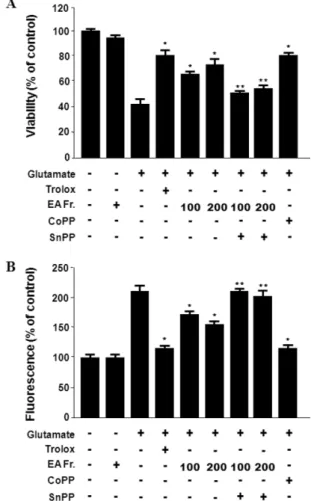
Fig. 1. Effects of Siegesbeckia Herba 70% ethanol extracts and its fractions on glutamate-induced oxidative neurotoxicity and inhibition of reactive oxygen species generation. (A) Cells were treated with samples and then incubated for 12 h with glutamate (5 mM). (B) Exposure of HT22 cells to 5 mM glutamate for 12 h increased reactive oxygen species production. Each bar represents the mean±S.D. of three independent experiments, *p<0.05. Trolox (50µM) was used as the positive control.
것도 처리하지 않은 군에 비해 세포 생존률이 37.2±1.21%
로 감소하는 세포 손상을 유도하였으며, 이에 희렴 추출물 과 분획물을 농도별로 처리한 결과, 그 중 희렴 에탄올 추 출 200 µg/ml에서 45±3.21%로 세포 생존률이 조금 증가하 였다. 그러나 희렴 에틸아세테이트 분획물에서는 50, 100, 200µg/ml에서 각각 44±1.33%, 61±2.3%, 72±3.2%로 증가 하는 세포 생존률을 보였다. 물 분획물에서는 100, 200 µg/
ml에서 각각 44±3.1%, 50±1.1%로 조금 증가하는 세포 생 존률을 보였다. 여러 다양한 분획 가운데 희렴 ethyl acetate 분획물이 가장 우수한 보호활성을 나타내었다(Fig. 1A). ROS 소거 효과도 세포 보호 효과와 같이 에틸아세테이트 분획 물 50, 100, 200 µg/ml에서 각각 180±2.3%, 152±1.23%, 132±2.2%의 우수한 ROS 감소 효과를 나타내었으며, H2O 분획에서는 200 µg/ml에서 180±2.1%로 ROS 감소 효과를 나타내었다(Fig. 1B). 글루타메이트 유도 세포 손상에 대한 보호효과와 ROS소거 활성정도는 잘 알려진 항산화 물질인 trolox 50µM과 비교하여 측정하였다. 또한 뇌세포의 보호 기전에 관여하는 중요한 단백질인 heme oxygenase (HO)-1 의 발현 정도를 알아보기 위하여 HT22세포에 에틸아세테 이트 분획과 물 분획물을 12 시간 처리한 결과, 희렴 물 분 획층에서는 HO-1발현이 나타나지 않았다(Fig 2A). 그러나, 에틸아세테이트 층 에서는 HO-1발현은 처리 농도 의존적 으로 증가하였다(Fig. 2B). HO-1 발현의 양성 대조군으로 HO-1 유도 약물로 알려진 cobalt protoporphyrin (CoPP) 20µM을 사용하였다. 또한, HO-1의 발현과 뇌 세포 보호 효과 및 ROS 생성 억제에 미치는 영향을 살펴보기 위하여, HO-1 inhibitor로 알려진 Tin protoporphyrin (SnPP)를 처리 하여 실험을 진행하였다. 실험 결과 Snpp를 전 처리 한 후
희렴 에틸아세테이트를 처리 하였을 때 100, 200 g/ml에서 각각 65±1.2%, 75±2.3%증가하던 세포 생존율이 48±2.3%, 53±1.2%으로 감소 하였으며(Fig. 3A), ROS생성억제능에서 희렴 에틸아세테이트를 처리 하였을 때 100, 200 µg/ml에서 각각 172±1.3%, 161±3.3%감소하던 ROS 생성이, 100, 200µg/ml에서 211±1.3%, 203±1.2%으로 증가하였다(Fig 3B). 이로써 희렴 에틸아세테이트에 의한 HO-1 단백질 발 현 증가가 뇌 세포 보호효과 및 ROS생성 억제에 영향을 미 친다는 것을 확인하였다.
HO-1은 항산화시스템에 주요한 역할을 하고, HO-1발현 에 관여하는 경로중 Nrf2의 핵 내로의 이동은 매우 중요한
Fig. 2. Effects of Siegesbeckia Herba ethyl acetate fraction and H2O fraction on HO-1 expression in HT22 cells. Cells were incubated for 12 h with ethyl acetate fraction (A) and H2O fraction (B). Expression of HO-1 was determined by western blot analysis, and representative blots of three independent experiments are shown. CoPP (20 µM)
Fig. 3. Effects of Siegesbeckia Herba ethyl acetate fraction- induced HO-1 on glutamate induced oxidative neurotoxicity and reactive oxygen species generation. (A) Cells were treated with 100 and 200µg/ml of Siegesbeckia Herba ethyl acetate fraction in the presence or absence of 50 µM SnPP, 20 µM CoPP and then exposed to glutamate (5 mM) for 12 h. (B) Exposure of HT22 cells to 5 mM glutamate for 12 h increased reactive oxygen species production. Siegesbeckia Herba ethyl acetate fraction induced HO-1 effectively inhibited reactive oxygen species production. Each bar represents the mean±S.D.
of three independent experiments, *p<0.05 vs. control. **p<0.05 vs. group treated with S. glabrescens ethyl acetate fraction.
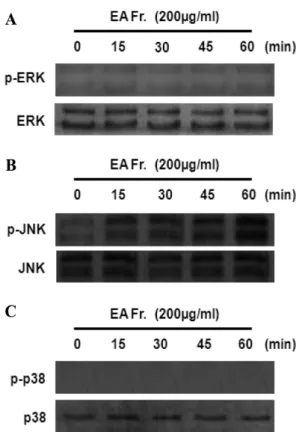
인자로 알려져 있다. Nrf2는 전사인자로 알려져 있으며 단 백질 유전자에 존재하는 ARE에 결합하여 HO-1과 같은 항 산화 단백질 발현을 촉진시켜 외부 침입이나 산화적 스트 레스 방어기전의 주요한 역할을 담당하고 있다.23,24) 앞에서 확인한 HO-1발현을 증가 시킨 희렴 에틸아세테이트 분획 물의 Nrf2 핵 내 이동에 미치는 영향을 확인하기 위해, 희 렴 에틸아세테이트 분획물을 시간별로 처리하고 Nrf2 핵 내 전사 정도를 확인해 본 결과, 0.5, 1, 1.5 시간이 증가함에 따라 세포질의 Nrf2가 감소하였으며, 대조적으로 핵 내의 전사정도가 증가하였다(Fig. 4). Mitogen activated protein kinase (MAPK) 경로 역시 HO-1의 발현에 주요한 역할을 하는 것으로 알려져 있다.25-28) MAPKs는 extracellular signal-regulated kinase (ERK), p38, c-Jun N-terminal kinase (JNK) 의 세 가지 계열의 family로 세포 외부의 자극을 전 달하여 세포내 반응을 일으키는데 역할을 한다. 이에 따라 희렴 에틸아세테이트 분획물의 HO-1발현에 MAPK가 미치 는 영향을 알아보기 위해 200 µg/ml의 희렴 에틸아세테이 트분획물을 처리 하였을 때, 시간이 지남에 따라 ERK와 p38 인산화에는 영향을 주지 못하였으나(Fig. 5A와 5C), JNK 인산화는 증가 시켰다(Fig. 5B). 이러한 결과를 바탕으 로 희렴 ethyl acetate 분획물의 HO-1발현이 JNK 인산화를 통하여 나타나는지 살펴 보기 위하여, ERK, p38, JNK 각 각의 억제제를 전 처리한 후 희렴 에틸아세테이트 분획물 을 처리하여 HO-1발현과 세포 생존률을 확인하였다. 그 결 과, ERK의 억제제인 PD98059와 p38의 억제제인 SB203580 를 전 처리했을 시에는 HO-1의 발현과 세포보호 효과에 큰 영향을 미치지 못했지만, JNK의 억제제인 SP600125 처리 했을 시에는 증가하던 HO-1의 발현이 줄어들고, 세포 보호
효과 역시 희렴 에틸아세테이트를 처리 하였을 때 82±1.1%
으로 증가하던 세포 생존율이 57±2.1%으로 감소하는 것을 확인하였다(Fig. 6). 이러한 결과를 통해 희렴 에틸아세테이 트분획물의 HO-1 발현은 MAPK기전 중 JNK 인산화를 통 해 나타나며, 이를 통해 세포보호 효과 효과가 나타남을 확 인 할 수 있었다.
따라서, 본 연구에서 희렴 추출물의 에틸아세테이트 분획 물은 생쥐유래 해마 세포HT22에서 글루타메이트로 유발한 세포독성에 강한 보호 효과를 나타내었으며, MAPKs중 JNK pathway 인산화와 Nrf2 핵내로 전사를 통하여 항산화 및 HO-1 단백질 발현을 증가시키며, HO-1 단백질 발현은 글 루타메이트에 의한 산화적 스트레스로부터 보호활성을 나 타내는데 중요한 역할을 함을 확인 하였다. 추후 연구를 통 하여 희렴 에틸아세테이트분획물의 추가적인 뇌세포 보호 기전 연구와 활성 물질 분리에 관한 연구가 필요할 것으로 생각된다.
Fig. 4. Effects of Siegesbeckia Herba ethyl acetate fraction on Nrf-2 nuclear translocation in HT22 cells. Cells were treated with 200µg/ml of Siegesbeckia Herba ethyl acetate fraction for 0.5, 1, and 1.5 h. The nuclei were fractionated from the cytosol using PER-Mammalian Protein Extraction buffer as described in materials and methods. Nrf-2 protein was detected by western blot analysis, and representative blots of three independent experiments are shown.
Fig. 5. Effects of Siegesbeckia Herba ethyl acetate fraction- induced MAPK activation in HT22 cells. (A) Cells were treated with 200µg/ml of Siegesbeckia Herba ethyl acetate fraction for the indicated times. Cell extracts were analyzed by western blot with antibodies specific for phosphorylated ERK1/2 (p-ERK)(A), phosphorylated JNK (p-JNK)(B), or phosphorylated p38 (p-p38)(C). Membranes were stripped and re-probed for total form of each MAPK antibody as a control, and the representative blots of three independent experiments are shown.
결 론
본 연구는 희렴 70% 에탄올 추출물과 각각의 분획물의 뇌세포 보고 효과와 그 메커니즘에 관하여 연구하였으며, 그 결과 희렴 에틸아세테이트 분획층에서 글루타메이트로 유도한 HT22세포의 독성에 대하여 우수한 보호 효과를 나 타내었다. 이는 JNK인산화와 Nrf2의 핵 내 전사 유도를 통 하여 HO-1 단백질 발현이 주요하게 작용하는 것으로 생각 된다.
사 사
이 연구는 계명대학교 신약개발연구소 약학대학 특성화 연구기금으로 이루어졌음.
인용문헌
1.생약학교재편찬위원회 (2007) 생약학, 218-220. 동명사, 서 울.
2.한국 약용식물학 연구회 (2001) 종합약용식물학, 219. 학 창사, 서울.
3. Baruan, R. N., Sharma, R. P., Madhusudanan, K. P., Thy- agarajan, G., Herz, W. and Govindan, S. V. (1980) New melampolides and darutigenol from Siegesbeckia orientalis.
Phytochemistry 19: 323-325.
4. Zdero, C., Bohlmann, F., King, R. M. and Robinson, H.
(1991) Sesquiterpene lactones and other constituents from Siegesbeckia orientalis and Guizotia scabra. Phytochemistry 30: 1579-1584.
5. Han, K. D., Kim, J. H. and Oh, S. J. (1975) Chemistry and pharmacology of diterpenoids of Siegesbeckia pubscens.
Yakhak Hoeji 19: 129-165.
6. Kim, J. Y., Lim, H. J. and Ryu, J. H. (2008) In vitro anti- inflammatory activity of 3-O-methyl-flavones isolated from Siegesbeckia glabrescens. Bioorg. Med. Chem. Lett. 18:
1511-1514.
7. Sun, H. X. and Wang, H. (2006) Immunosuppressive Activity of the Ethanol Extract of Siegesbeckia orientalis on the Immune Responses to Ovalbumin in Mice. Chemi. Biodivers.
3: 754-761.
8. Huh, J. E., Baek, Y. H., Lee, J. D., Choi, D. Y. and Park, D.
S. (2008) Therapeutic effect of Siegesbeckia pubescens on cartilage protection in a rabbit collagenase-induced model of osteoarthritis Yakhak Hoeji 107: 317-328.
9. Packer, L. (1994) In methods in enzymology: Oxygen rad- icals in biological systems. Part C, Academic press, San Diego. 233: 15-35.
10. Kandaswami, C. and Middleton, E. (1994) Free radical scav- enging and antioxidant activity of plant flavonoids. In free radicals in diagnostic medicine. Armstrong D, de. 351-376.
Plenum press, New York and London.
11. Satoh, T., Enokido, Y., Kubo, K., Yamada, M. and Hatanaka, H. (1999) Oxygen toxicity induces apoptosis in neuronalcells.
Cell Mol. Neurobiol. 18: 649-666.
12. Satoh, T., Okamoto, S., Cui, J.,Watanabe, Y., Furuta, K., Suzuki, M., Tohyama, K. and Lipton, S. A. (2006) Acti- vationof the Keap1/Nrf2 pathway for neuroprotection by electrophilic [correction of electrophillic] phase II inducers.
Proc. Natl. Acad. Sci. U. S. A. 103: 768-773.
13. Satoh, T. and Lipton, S. A. (2007) Redox regulation of neu- ronal survival mediated by electrophilic compounds. Trends Fig. 6. Effects of Siegesbeckia Herba ethyl acetate fraction-induced JNK pathway activation on HO-1 expression and glutamate- induced neurotoxicity. (A) Cells were incubated with 200µg/ml of Siegesbeckia Herba ethyl acetate fraction for 12 h in the presence or absence of PD98059 (40µM), SB203580 (20 µM) and SP600125 (25 µM). Western blotting was then performed with HO-1 antibody. (B) Cells untreated or treated with Siegesbeckia Herba ethyl acetate fraction (200µg/ml) in the presence or absence of each specific inhibitor for 12 h were exposed to 5 mM glutamate for 8 h. Trolox (50µM) was used as positive control. Each bar represents the mean±S.D. of three experiments. *p<0.05 vs. glutamate (5 mM), **p<0.05 vs. same treatment plus SnPP.
Neurosci. 30: 37-45.
14. Alibright, T. D., Jessel, T. M., Kandel, E. R. and Poster, M.
I.(2000) Neural science: a century of progress and the mys- teriesthat remain. Cell 18: 209-216.
15. Siesjo, B. K. (1981) Cell damage in the brain: a specula- tivesynthesis. J. Cereb. Blood Flow Metab. 1: 155-185.
16. Greenamyre, J. T., Penney, J. B., Young, A. B., D'Amato, C.
J. and Hicks, S. P. (1985) Alterations in L-glutamate bind- ingin Alzheimer's and Huntington's disease. Science 4693:
1496-1499.
17. Rossler, O. G., Bauer, I., Chung, H. Y. and Thiel, G. (2004) Glutamate-induced cell death of immortalized murine hip- pocampalneurons: neuroprotective activity of heme oxyge- nase-1, heat shock protein 70, and sodium selenite. Neurosci.
Lett. 362: 253-257.
18. Jeong, G. S., Li, B., Lee, D. S., Choi, H. G. and Kim, Y. C.
(2010) Neuroprotective effects of the extract of Zingiberis Rhizoma. Kor. J. Pharmacogn. 41: 190-195.
19. Choi, H. G., Lee, D. S., Li, B., Jun, K. Y., Jeong, G. S. and Kim, Y. C. (2011) Neroprotective effect of the water-insol- uble fraction of root barks of Dictamnus dasycarpus 70%
ethanol extract on glutamate-induced oxidative damage in mouse hippocampal HT22 cells. Kor. J. Pharmacogn. 42:
175-181.
20. Jeong, G. S., Li, B., Lee, D. S., Byun, E., Kang, D. K., Lee, H. S. and Kim, Y. C. (2007) Cytoprotective constituents of Alipinia katsumadai seeds against glutamate-induced oxi- dative injury in HT22 cells Nat. Prod. Sci. 13: 268-272.
21. Tan, S., Schubert, D. and Maher, P. (2001) Oxytosis: a novel form of programmed cell death. Curr. Top. Med. Chem. 1:
497-506.
22. Rossler, O. G., Bauer, I., Chung, H. Y. and Thiel, G. (2004) Glutamate-induced cell death of immortalized murine hip-
pocampal neurons: neuroprotective activity of heme oxy- genase-1, heat shock protein 70, and sodium selenite.
Neurosci. Lett. 362: 253-257.
23. Balogun, E., Hoque, M., Gong, P., Killeen, E., Green, C. J., Foresti, R., Alam, J. and Motterlini, R. (2003) Curcumin acti- vates the heme oxygenase-1 gene via regulation of Nrf2 and the antioxidant-responsive element. Biochem. J. 371: 887- 895.
24. Itoh, K., Chiba, T., Takahashi, S., Ishii, T., Igarashi, K., Katoh, Y., Oyake, T., Hayashi, N., Satoh, K., Hatayama, I., Yama- moto, M. and Nabeshima, Y. (1997) An Nrf2/small Maf het- erodimer mediates the induction of phase II detoxifyse enzyme genes through antioxidant response elements. Bio- chem. Biophys. Res. Commun. 236: 313-322.
25. Choi, B. H., Hur, E. M., Lee, J. H., Jun, D. J. and Kim, K. T.
(2005) Protein kinase C delta-mediated proteasomal degra- dation of MAP kinase phosphatase-1 contributes to glutama- teinduced neuronal cell death. J. Cell Sci. 119: 1329-1340.
26. Oh, H. L., Seok, J. Y., Kwon, C. H., Kang, S. K. and Kim, Y.
K. (2006) Role of MAPK in ceramide-induced cell death in primary cultured astrocytes from mouse embryonic brain.
Neurotoxicology 27: 31-38.
27. Elbirt, K. K., Whitmarsh, A. J., Davis, R. J. and Bonkovsky, H. L. (1998) Mechanism of sodium arsenite-mediated induc- tion of heme oxygenase-1 in hepatoma cells. Role of mito- gen-activated protein kinases. J. Biol. Chem. 273: 8922-8931.
28. Kietzmann, T., Samoylenko, A. and Immenschuh, S. (2003) Transcriptional regulation of heme oxygenase-1 gene expres- sion by MAP kinases of the JNK and p38 pathways in pri- mary cultures of rat hepatocytes. J. Biol. Chem. 278: 17927- 17936.
(2012. 12. 10 접수; 2012. 12. 14 심사; 2012. 12. 20 게재확정)