Introduction
The fishes of Sardinella which is belonging to the family Clupeidae is distributed in the tropi- cal and subtropical waters of the world (Wongratana, 1980). The genus comprises of ap- proximately 21 species which inhabit both Atlantic and Indo-West Pacific (Whitehead, 1985). They live along the coastal areas with high productivity and mainly feed zooplankton.
Although many taxonomic works have been done, most species of Sardinella have many difficulties in identification each other (Chan, 1965). Regan (1917) distinguished Sardinella from Harengula and Fowler (1941) investigated the herrings from the Philippin archipelago.
Chan (1965) revised the systematic works for Sardinella from the Indo-Pacific and Wongratana (1983) reported 24 new clupeoid species from the Indo-Pacific. Whitehead (1985) revised all the clupeoid species from the world.
In Korea, only one species, Harengula zunasi has been reported by Chyung (1977), thereafter, Youn (1996) studied the systematics and morpho- logy of the families Engraulidae and Clupeidae from Korea, in which two Sardinella species were regarded as valid species in Korea.
In the present study, we provided illustrations and some osteological features of S. lemuru collected from Korea for the first time.
Materials and Methods
Two specimens of Sardinella lemuru caught in the adjacent waters of Cheju Island were obtain- ed at the fish market in Cha-gal-chi, Pusan.
Measurements, counts and hierarchy followed Chan (1965) and Nelson (1994). The bone struc- ture was investigated under microscope after removing the flesh and stainning by Alizarin Red S. The specimen was deposited in the Ichthyo- logy Laboratory, Pukyong National University (PKNU).
Results
Sardinella lemuru Bleeker, 1853 (Fig. 1) (New Korean name : Bali-paen-daeng-i)
Sardinella lemuru Bleeker, 1853 : 500 (type lo- cality : Batavia, Indonesia)
Sardinella lemuru : Wongratana, 1980 : 111, Whitehead, 1985 : 103, Paxton et al., 1989 : 157.
─
─ 190 ──
A New Record of the Herring, Sardinella lemuru (Pisces: Clupeidae) from Korea
Jin Koo Kim, Chung-Bae Kang*, Kyeong-Ho Han** and Yong Uk Kim*
Mokpo Laboratory, National Fisheries Research and Development Institute, Mokpo, Korea
*Department of Marine Biology, Pukyong National Univeristy, Pusan, Korea
**Division of Aqua Life Science, Yosu National University, Yosu, Korea
Two specimens of Sardinella lemuru Bleeker, 1853 were collected for the first time from the adjacent waters of Cheju Island, Korea, in March 1997. S. lemuru is very similar to S. zunasi (Bleeker, 1854) in external features but differs in the number of anal fin rays. While S. lemuru is difficult to differentiate by color from Clupea pallasii valenciennes, 1847 the two are easily differentiated by their gill raker counts. We propose “Bali-paen-dang-i” as a new Korean name for S. lemuru.
Key words : Sardinella lemuru, herring, new record, Korea
Sardinella lemuru
1. Description
Dorsal fin rays 17; Pectoral fin rays 16~17;
Pelvic fin rays 9; Anal fin rays 16~17; Scutes 19
±15 = 34; Lower gill rakers 157~160; Vertebrae 23±25 = 48.
Snout length 3.71~3.91 mm (mean 3.81 mm, n
= 2), upper jaw length 2.50~2.53 mm (mean 2.52 mm, n = 2), orbital length 4.83~4.98 mm (mean 4.90 mm, n = 2), postorbital length 2.11~2.20 mm (mean 2.15mm, n = 2) in head length (Table 1).
Body elongate and subcylindrical, its depth 25.35~25.45% of standard length, but greatly compressed anteriorly and posteriorly; dorsal and ventral profiles very gently curved in similar form, however the former is slightly more curv- ed; belly rounded, fairly sharply keeled; body de- pth greatest at the dorsal f in origin, its depth less than 30% of standard length.
Head rather short, as long as the body depth;
snout bluntly pointed, the length somewhat long- er than the orbital length; eye moderate size, heavily covered by adipose tissue with a vertical slit at the pupil.
Mouth terminal; upper jaw bordered by pre- maxillary, maxillary and supramaxillaries; ma- xillary extending below anterior margin of pupil, expanded portion of the second supramaxillary a symmetrical paddle shaped; lower jaw slightly projecting beyond the upper; dentary deep, the tip bluntly pointed; no teeth on jaws (Fig. 2).
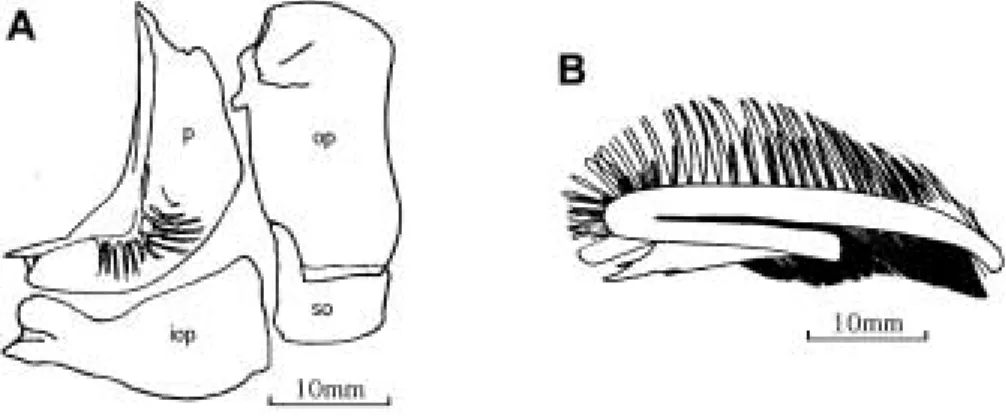
Preopercle smooth, crescent-shaped, bears a little ridges on its surface; opercle smooth, rec- tangular, without radiating grooves; subopercle small, with a dorso-anterior process (Fig. 3A).
Gill rakers well developed, very fine, numerous
and closely set from one another (Fig. 3B).
Dorsal f in single, the origin is nearer to the tip of snout than to base of caudal f in; dorsal fin base short, the length 3.09~3.3 mm (mean 3.20 mm, n = 2) in predorsal length. Pelvic f in small, the origin under the 8th ray of dorsal f in, the length 5.41~5.87 mm (mean 5.64 mm, n = 2) in prepelvic length. Anal f in base rather short, the length 5.77~6.20 mm (mean 5.99 mm, n = 2), last two rays somewhat longer and more extensively branched than preceding rays (Fig. 4). Caudal fin well forked with pointed upper and lower lobes.
Body covered by thin, somewhat adherent cycloid scales, which has only one continuous transverse groove distally, and 4 pairs of inter- rupted one anteriorly (Fig. 5). Predorsal median ridge covered by the adjacent side of tow longitu- dinal rows of scales.
Fig. 1. Sardinella lemuru Bleeker, PKNU970310, 211.80 mm in standard length.
Fig. 2. Jaw bones of Sardinella lemuru Bleeker. an : angular, ar : articular, d : dentary, m : maxillary, pm : premaxillary, spm1 : first supramaxillary, spm2 : second supramaxillary.
2. Color in fresh
Body dark blue dorsally, but silvery white ven- trally. Head yellowish silver with a black spot superiorly in the gill-opening. Dorsal, pectoral and anal fins yellowish white, otherwise pelvic whitish, caudal grayish with a black tip.
3. Distribution
Southern Korea, southern Japan, Taiwan Island, Hong Kong, Philippines, southern coasts of East Java and Bali, Western Australia, Phuket, Thailand.
4. Remark
The genus Sardinella was firstly established by Valenciennes (1847) and then has been defin- ed by Regan (1917). Because morphological dif-
ferences between most Sardinella species are subtle, so many errors have been caused for identif ication of the Sardinella species by many workers. Chyung (1977) reported Harengula zunasi, thereafter, Kim et al. (1994) placed zuna- si to the genus Herklotsichthys. However, many authors like Regan (1917), Chan (1965), Wongra- tana (1980), Gloerfelt-Tarp and Kailola (1984), Whitehead (1985), Kim and Kang (1993) and Youn (1996) transferred zunasi to the genus Sar- dinella.
Regan (1917) primarily distinguished Sardinella from the genus Harengula by the differences in the size of the last two anal fin rays, not enlarged in Harengula. Chan (1965) involved a new charac- ter for differentiating them, that is the shape of the expanded portion of the second supramaxil- lary bone. Herklotsichthys differs from the genus Sardinella to have less fronto-parietal striae on
Fig. 3. Opercular bones (A) and gill rakers (B) of Sardinella lemuru Bleeker. opercular bones, iop : interopercle, op : opercle, p : preopercle, so : subopercle.
Fig. 4. Anal f in rays of Sardinella lemuru Bleeker showing the last two rays elongated.
Fig. 5. Scale in the upper region off pectoral f in of Sar- dinella lemuru Bleeker.
top of head presented by Gloerfelt-Tarp and Kailola (1984).
Therefore, zunasi should be transferred to the genus Sardinella rather than Harengula and Herklotsichthys.
After original description of Sardinella lemuru by Bleeker (1853), Chan (1965) treated the species as a synonym of S. aurita. Actually, most mea- surements of the present specimens conform well to the those of S. aurita (Table 1). However, many authors like Wongratana (1980), Gloerfelt-Tarp and Kailola (1984) and Nakabo (1993) recognized S. lemuru as a valid species.
The recent comprehensive work is that of Wongratana (1980), in which S. lemuru is well distinguished from S. aurita based on the differ- ences of the distribution and the number of gill rakers. That is, S. lemuru has lower gill rakers 77~188 and lives from China to Australia. Al- though the range of the number of lower gill rakers is overlapped between two species, our specimens have lower gill rakers 157~160, the- refore we consider ours as S. lemuru.
However, Eschmeyer (1998) stated that S.
lemuru can not be distinguished as yet on mor- phological grounds from S. aurita which occurs in the Atlantic Ocean, it means they should be investigated in osteological as well as genetical aspects.
S. lemuru is very similar to S. zunasi, but they are easily distinguished by the number of anal f in rays (9 cf. 8 in zunasi) and lower gill rakers (77~188 cf. 48~57 in zunasi).
In recent, Youn (1996) carried out the taxono-
mic study of the family Engraulidae and Clupei- dae from Korea, in which 10 genera 11 species of the family Clupeidae, 4 genera 7 species of the family Engraulidae were in detail revised in comparative anatomy. According to Youn (1996), Sardinops immaculata, Harengula zunasi were revealed as a synonym of Sardinella jussieu and Sardinella zunasi respectively. Therefore, the genus Sardinella comprises of 3 species includ- ing the present species lemuru in Korea.
We propose the new Korean name “Bali-pane- daeng-i” for S. lemuru Bleeker.
References
Bleeker, P. 1853. Derde bijdrage tot de kennis der ichthyologische fauna van ceram. Nat. Tijdschr.
Ned. Ind., vol. v, pp. 233~248.
Chan, W.L. 1965. A systematic revision of the Indo -Pacific clupeid fishes of the genus Sardinella (Family Clupeidae). Japan. J. Ichthyol, 12(3/6) : 104~118.
Chyung, M.K. 1977. The Fishes of Korea. IL-JI Sa Pub. Co. Seoul, pp. 727. (in Korean)
Eshmeyer, W.N. 1998. Catalog of fishes. vol. 1~3, California Academy of Sciences, San Francisco, pp. 2905.
Fowler, H.W. 1941. Contributions to the biology of the Philippine archipelago and adjacent regions.
Smithsonian Institutuion Univ. Stat. Nat. Mus., 100(13), pp. 879.
Gloerfelt-Tarp, T. and P.J. Kailola. 1984. Trawled fishes of southern Indonesia and northwestern Australia. Tien Wah Press, Singapore, pp. 406.
Kim, I.S. and E.J. Kang. 1993. Coloured fishes of Korea. Acad. Pub. Co. Seoul. pp. 477. (in Korean) Kim, Y.U., Y.M. Kim and Y.S. Kim. 1994. Commer-
cial fishes of the coastal and offshore waters in Korea. National Fisheries Research and Deve- lopment Agency. pp. 299. (in Korean)
Nakabo, T. 1993. Fishes of Japan with Pictorial keys to the species. Tokai Univ. Press, Tokyo, pp. 1474.
(in Japanese)
Nelson, J.S. 1994. Fishes of the world. 3rd ed., John Wiley and Sons, INC, New York, pp. 600.
Paxton, J.R., D.F. Hoese, G.R. Allen and J.E.
Hanley. 1989. Zoological catalogue of Australia.
vol. 7. Pisces. Petromyzontidae to Carangidae.
Australian Government Publishing Service, Canberra, i-xii±1~665.
Regan, C.T. 1917. A revision of the clupeid fishes of the genera Sardinella, Harengula, etc. Ann. Mag.
Nat. Hist., ser. 8, vol. xixxx, pp. 377~395.
Valenciennes, M.A. 1847. Clupeidae. In : Cuvier M.B. and M.A. Valenciennes (eds.). Histoire Naturelle Des Poissons, 20 : 189~200. (in French) Whitehead, P.J.P. 1985. FAO species catalogue. vol.
Table 1. Comparison of the measurments between Sardi- nella aurita and Sardinella lemuru
Sardinella Sardinella
Characters aurita lemuru
(Chan, 1965) (Present study)
Number of specimens 28 2
Standard length (mm) 65.0~165.5 211.8~220.4 In standard length
Head length 3.66~3.84 3.96~3.99
Body depth 3.65~4.78 3.93~3.95
Predorsal length 2.18~2.31 2.20~2.28 Prepectoral length 3.82~4.10 4.25~4.67 Prepelvic length 1.81~1.97 1.97~1.98 Preanal length 1.22~1.35 1.25~1.26 In head length
Snout length 3.09~3.75 3.71~3.91 Upper jaw length 2.41~2.49 2.50~2.53 Orbital length 3.53~4.33 4.83~4.98 Postorbital length 2.36~2.58 2.11~2.20
7. Clupeoid fishes of the world. An annotated and illustrated catalogue of the herrings, sardines, pilchards, sprats, anchovies and wolfherrings.
Part 1-Chirocentridae, Clupeidae and Pristigas- teridae. FAO Fish. Synop, (125) vol. 7, pt. 1 : 303pp.
Wongratana, T. 1980. Systematic of clupeoid fishes of the Indo-Pacific region. Ph.D. thesis, Univer- sity of London, pp. 432.
Wongratana, T. 1983. Diagnoses of 24 new species and proposal of a new name for a species of Indo -Pacific clupeoid fishes. Japan. J. Ichthyol, 29 : 385~407.
Youn, C.H. 1996. A study on the systematics and morphology on the families Engraulidae and Clupeidae (Pisces: Clupeiformes) from Korea.
Ph.D. thesis, University of Chunbuk, pp. 180. (in Korean)
한국산 청어과 어류
1
미기록종 김진구∙강충배*∙한경호**∙김용억*국립수산진흥원 남해수산연구소 목포분소, *부경대학교 해양생물학과,
**여수대학교 수산생명과학부
청어과 Clupeidae, 밴댕이속 Sardinella에 속하는 Sardinella lemuru Bleeker, 1853 2개체가 1997년 3월에 우리나라 제주도 연안에서 처음으로 채집되었기에 이를 보고한다. S. lemuru는 동 일속의 밴댕이 S. zunasi와 외부형태학적으로 매우 유사하나 뒷지느러미 연조수에서 잘 구별되 며, 청어 Clupea pallasii와는 체색에서 매우 비슷하여 식별이 어려우나, 새파수에서 잘 구별된다. Sardinella lemuru의 국명을“바리밴댕이”로 명명한다.
Received : July 1, 2001 Accepted : August 29, 2001