무선 이종 네트워크에서
향상된 핸드오버 및 QoS 보장을 위한 연구
Inter-working Architecture for Seamless Handover and QoS in Heterogeneous Wireless Networks
김 문*, 문태욱*, 조성준*
Moon Kim*, Tae-Wook Moon* and Sung-Joon Cho* 요 약
최근 WLAN과 차세대 이동통신의 결합 서비스와 관련하여 이종 네트워크의 연동에 대한 요구가 증대되고 있다. 또한 무선 네트워크에서 원활한 밀티미디어 서비스와 QoS 보장의 중요성이 대두되고 있다. 따라서 무선 이종 네트워크에서 원활한 멀티미디어 서비스와 QoS 보장에 관련된 연구가 활발히 진행되고 있다. 본 논문에서 는 WLAN과 WiBro 이종 네트워크에서 멀티미디어 서비스 및 QoS의 연속성을 제공하기 위해서 새로운 연동 방 안을 제안한다. 그리고 제안한 연동 방안을 바탕으로 inter-network vertical handover 알고리즘과 QoS-aware MAC 알고리즘을 제공한다. 또한 NS-2 시뮬레이션을 사용하여 성능을 비교, 분석 한다.
Abstract
The integration of WLAN and beyond 3G mobile networks offers the possibility of achieving anytime and anywhere Internet access. Moreover the requests for seamless multimedia services and the Quality of Service (QoS) support have been one of key issues in wireless networks. Therefore the researches relative to seamless multimedia service and QoS over heterogeneous wireless networks have been progressing rapidly. In this paper, we propose inter-working architecture for supporting seamless multimedia service and QoS over WLAN and WiBro networks. Based on the proposed inter-working architecture, we also provide both the seamless handover architecture such an inter-network vertical handover and the QoS-aware wireless Medium Access Control (MAC) scheme. In addition, we evaluate and compare the performance by Network Simulator-2 (NS-2) simulations.
Key words : WLAN, WiBro, QoS, Interworking, Handover
* 한국항공대학교 대학원 정보통신공학과 (Dept. of Inform. & Telecom. Eng., Graduate School of Hankuk Aviation University) ‧ 제1저자 (First Author) : 김문
‧ 접수일자 : 2007년 1월 15일
I. Introduction
In these days wireless services such as WLAN, Bluetooth, WiBro and home network are getting popular all around the world. Because of its already well organized network architecture, IEEE 802.11 WLAN
services are most successful and becoming important.
Furthermore the integration of WLAN and mobile
networks, such as Global System for Mobile
Communications/General Packet Radio Service
(GSM/GPRS), Universal Mobile Telecommunications
System (UMTS), Code Division Multiple Access 2000
(CDMA 2000), and WiBro offers the possibility of achieving anytime and anywhere Internet access. Given the complementary characteristics of WLAN with faster short-distance access and mobile networks with slower long-distance access, it is compelling to combine them to bring a cost-effective system capable of providing ubiquitous data services and high data rate services [1], [2].
In this motivation, we study how to guarantee seamless handover service and QoS over WLAN-WiBro heterogeneous networks. Especially, Multimedia Messaging Service (MMS) provides the means for delivering multimedia messages among mobile users in store-and-forward fashion. Furthermore, MMS also provides mobile users with the possibility to exchange multimedia messages with the Internet users and has been seen as the key application in its entry into mobile network services. The WLAN-WiBro heterogeneous networks will particularly make MMS more ubiquitous, bringing benefits to both service providers and mobile users. In addition, the mandatory part of the current WLAN MAC scheme is called Distributed Coordination Function (DCF) which uses Carrier Sense Multiple Access with Collision Avoidance (CSMA/CA). DCF is supposed to provide a channel access with equal probabilities to all traffic flows contending for the channel access in a distributed manner, hence it does not guarantee QoS [3]. In order to support QoS, a number of QoS-aware MAC schemes have been introduced to extend DCF which has not guaranteed any service differentiation. However, none of those schemes fulfill both QoS features and channel efficiency although these support the service differentiation based on priority [4], [5]. Therefore, we propose both the inter-working architecture for ensuring seamless multimedia service and the wireless MAC scheme for ensuring QoS in WLAN-WiBro heterogeneous networks.
The remaining of this paper is organized as follows.
In the next section, we propose seamless inter-working architecture with inter-network vertical handover by
reusing the existing standards and network elements at the same time. In section 3, we describe QoS-aware wireless MAC scheme in detail. Then, we evaluate and compare the performance of seamless handover and QoS in terms of throughput achievement through simulations by using NS-2. Finally, section 5 concludes this paper via summarizing results and outlining future works.
Ⅱ. Seamless Inter-working Architecture
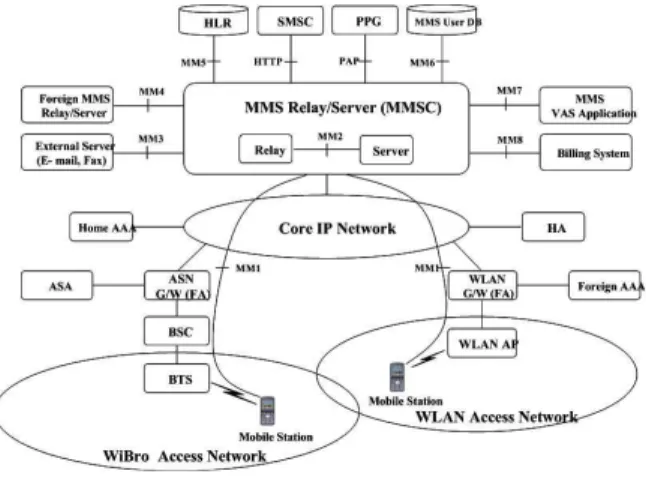
We employ loosely-coupled inter-working with Mobile IP (MIP) to propose new platform architecture for supporting seamless MMS service in integrated WLAN and WiBro networks. It interfaces the MMSRS (MMSC) with many
Fig. 1. Seamless inter-working architecture for supporting seamless multimedia service over
WLAN-WiBro heterogeneous networks.
existing network elements such as SMSC, Push Proxy Gateway (PPG), HLR, Home Agent (HA), Authentication Authorization Accounting (AAA), Authentication Service Authorization Server (ASA), Access Service Network (ASN), WLAN Gateway (FA), WLAN Access Point (AP), and so on. It has two new functional entities specifically added to support Mobile IP which are the HA and the FA. The ASN Gateway has been modified to act as an FA for the mobile network in addition to its original intended functionality.
WLAN has been setup and connected through a local
sub-network to the core network with its own gateway
and FA. the AAA server and the ASA server are used for authentication and authorization of WLAN users as well as the WiBro users. Unless it is firstly authenticated by the AAA server or ASA server, no users can access the core network through WiBro or WLAN access networks. The Mobile Station (MS) has been provided with MIP client that support both 802.11 and WiBro access technologies.
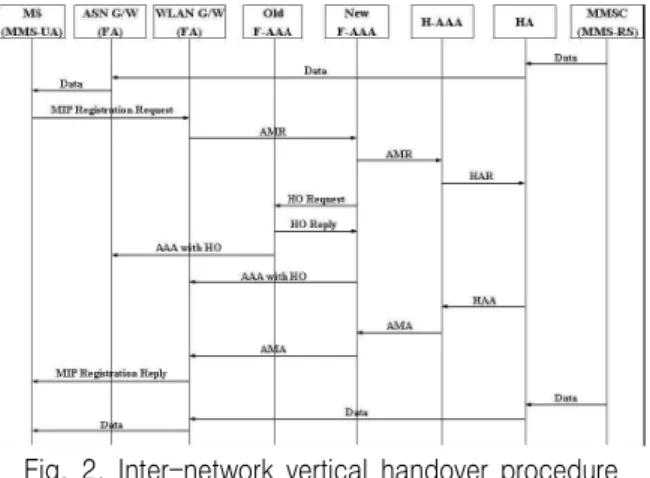
When the MS moves fromWiBro to WLAN while downloading the newMMS message from the MMSC, we consider an inter-network vertical handover in the different administrative networks. As illustrated in Fig.
2, the inter-network vertical handover between WLAN and WiBro access networks can be decomposed in the following steps [6].
Step 1. When the MS moves into WLAN from WiBro, it sends an MIP Registration Request message to the WLAN Gateway (FA).
Step 2. The WLAN Gateway (FA) modifies the MIP Registration Request message into an AMR message and sends it to the new F-AAA.
Step 3. The new F-AAA possibly adds or modifies some optional Attribute Value Pair (AVP) and forwards the AMR message to the H-AAA.
Fig. 2. Inter-network vertical handover procedure when the MS moves from WiBro to WLAN.
Step 4. The H-AAA generates a Home Agent Request (HAR) message and sends it to the HA.
Step 5. The HA processes the HAR message and then responds with a Home Agent Answer (HAA)
message to the H-AAA..
Step 6. After receiving the HAA message, the HAAA generates an AMA message and sends it to the new F-AAA.
Step 7. The new F-AAA possibly modifies the AMA message and forwards it to the WLAN Gateway (FA).
The Binding Update and Binding Acknowledgment messages should be authenticated since these messages are performed in the different administrative networks.
After the MS is authenticated, the WLAN Gateway (FA) starts signaling for the Binding Update.
Step 8. The WLAN Gateway (FA) sends the Binding Update message to the new F-AAA in order to inform the ASN Gateway (FA) of the new CoA of the MS. The new F-AAA sends the Binding Update message to the old F-AAA. Then, the old F-AAA relays the Binding Update message to the ASN Gateway (FA).When the MS moves into WLAN from WiBro, it sends an MIP Registration Request message to the WLAN Gateway (FA).
Step 9. The ASN Gateway (FA) replies with the Binding Acknowledgment message to the old F-AAA in order to confirm the update of binding cache entry on the MS. The old F-AAA sends the Binding Acknowledgment message to the new F-AAA. Then, the new F-AAA relays the Binding Acknowledgment message to the WLAN Gateway (FA). The ASN Gateway (FA) starts buffering the packets and retransmits them to the WLAN Gateway (FA).
Step 10. The WLAN Gateway (FA) sends the MIP Registration Reply message to the MS. Then, the MS can still keep downloading the new MMS message from the MMSC via the HA and the WLAN Gateway (FA).
Ⅲ. QoS-aware Wireless MAC Scheme
The proposal MAC scheme in this paper called
Enhanced DCF with Network Adaptation (EDCF-NA)
adopts two main methods, i.e. one is backoff procedure
and the other is Inter Frame Space (IFS) control, of
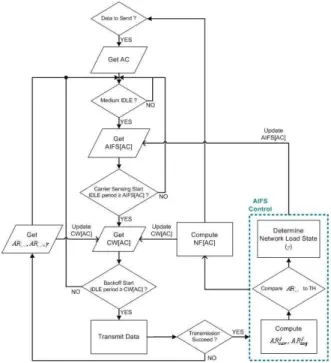
which purpose is to provide QoS efficiently. Both methods employ dynamic process to adapt MAC parameters, such Contention Window (CW) and Arbitrary IFS (AIFS), based on network condition determined by acknowledge (ACK) rate and Network Load Threshold (TH) as shown in Fig. 3. Further operation of EDCF-NA is presented below [7].
Network Determination: After the MAC layer of a station transmits packet, it computes the ACK rate affected with whole transmission fail due to collision, drop, and so on. The number of ACK received and the total number of packets sent are adopted to estimate the current ACK rate.
AIFS Control: EDCF-NA adjusts the size of AIFS taking into account the amount of network load. In heavily loaded network, e.q. the network load state is BUSY, the network obstacles including collision and drop occur frequently. In other words, the medium access to transmit a packet in overloaded network causes additional collisions or drops; hence it is required for MAC algorithm to throttle the medium access.
Fig. 3. Flow chart describing enhanced wireless MAC algorithm.
Backoff Algorithm: When a packet transmission is
achieved, each AC computes a novel factor denoted by Network Factor (NF). It is derived from not only the AC's priority level and but also the network conditions in order to offer both priority and network based QoS.
Ⅳ. Performance Evaluation
In Fig. 2, the round-trip MIP Registration Request/Reply messages between the MN and the WLAN Gateway (FA) will take 2tMN_FA. The round-trip AMR/AMA messages between the WLAN Gateway (FA) and the new F-AAA will take 2tFA_FAAA. The Binding Update/Acknowledgment messages between the WLAN Gateway (FA) and the new F-AAA will
take 2tFA_FAAA. The Binding Update/Acknowledg ment messages between the old F-AAA and the new FAAA will take 2tOFAAA_NFAAA. The Binding Update/Acknowledgm- ent messages between the old F-AAA and the ASN Gateway (FA) will take 2tFA_FAAA. The round-trip AMR/AMA messages between the new F-AAA and the H-AAA will take 2tFAAA_HAAA. The round-trip HAR/HAA messages between the H-AAA and the HA will take 2tHAAA_HA. Therefore, during the inter-network vertical handover, the total time is given by
TInter-network_HO=2tMN_FA+6tFA_FAAA+2tOFA AA_NFAAA+2tFAAA_HAAA+2tHAAA_HA (1)
With this Equation (1), we simulate the intranetwork horizontal handover and the inter-network vertical handover using enhanced wireless MAC scheme. We assume that the processing time in each entity can be negligible since it normally takes less than 1ms [8].
Also, the MAC parameters for three ACs used in simulations are addressed at Table 1.
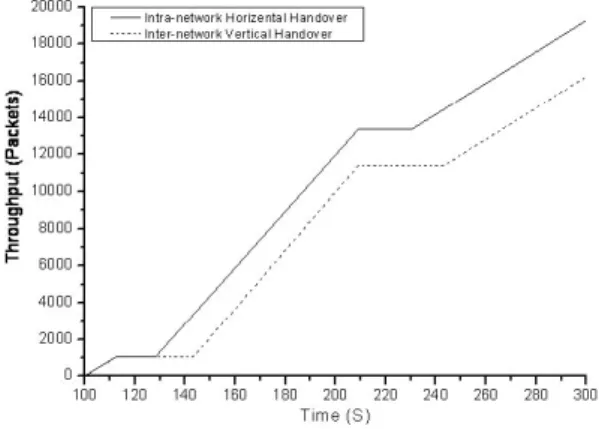
According to the simulation results in Fig. 4, the
intra-network horizontal handover procedures happen for
about 21.44 s (from time 208.98 s to time 230.42 s), but
the inter-network vertical handover procedures happen for about 34.91 s (from time 208.98 s to time 243.89 s) due to the additional smooth handover and AAA procedures. Especially, the internetwork vertical handover needs more extra time than the intra-network horizontal handover when the MN is far from its home network. The throughput of the inter-network vertical handover is lower by the average 7.02% and the maximum 10.12% than that of the intra-network horizontal handover.
Table 1. MAC parameters used for three different ACs.
Parameters High Medium Low
AIFSN 2 3 4
AIFS (us) 34 43 52
CWmin 7 15 31
CWmax 31 63 1023
Packet Size (bytes) 160 1280 200
The comparison of throughput performance under differential priority is shown at Fig. 5. We have employed EDCF-NA for supporting QoS in internetwork vertical handover. As described at Fig. 5, both handover schemes without EDCF-NA do not guarantee any service differentiation although these represent better throughput performance on low priority traffics.
Moreover, when using EDCF-NA, inter-network vertical handoff scheme provides significant improvement of throughput performance in High priority traffics.
Fig. 4. Comparison of throughput performance between intra-network and inter-network handoff.
Fig. 5. Comparison of throughput performance between intra-network and inter-network handoff with
and w/o EDCF-NA.
Ⅴ. Conclusions
In this paper, we proposed inter-working architecture
or supporting seamless handover and QoS over
heterogeneous wireless networks. We employed a
loosely-coupled approach and Mobile IP approach with
AAA while reusing the existing standards and network
elements at the same time. Based on the proposed
inter-working architecture, we also provided seamless
handover architecture such as the inter-network vertical
handover that couldn’t be possible within the current
networks. Additionally we adopted enhanced wireless
MAC scheme using dynamic procedures to suit both the
CW and the IFS depending on the ACK rate and the
current network load state. Then, we evaluated them
with simulation results. In result, we figured out that the
throughput performance of inter-network vertical
handover was worse than that of intra-network horizontal
handover. The main reason was that there were
additional retransmissions during inter-network vertical
handover compared to intra-network horizontal
handover. Furthermore, it was obviously seen that the
use of enhanced wireless MAC scheme guaranteed QoS
properly. This paper will make a contribution for service
providers to offer their customers with seamless
PS-based multimedia service and QoS in heterogeneous
wireless networks. For seamless CS-based real-time
service, we need to make an investigation into reducing the disruption time during the inter-network vertical handover.
Acknowledgments
This research was supported by the Internet Information Retrieval Research Center (IRC) in Korea Aerospace University. IRC is a Regional Research Center of Gyeonggi Province, designated by ITEP and Ministry of Commerce, Industry and Energy.
References
[1] M. M. Buddhikot, G. Chandranmenon, S. Han, Y. W.
Lee, S. Miller, and L. Salgarelli, "Design and impleme ntation of a WLAN/CDMA2000 interworking architec ture," IEEE Communications Magazine, vol. 44, pp.
90-100, Nov. 2003.
[2] M. Cappiello, A Floris, and L. Veltri, "Mobility among st heterogeneous networks with AAA support," ICC 2002, pp.2064-2069, May 2002.
[3] IEEE Std. 802.11-1999, Information technology-Telec ommunications and information exchange between sys tems-Local and metropolitan area networks-Specific Requirements-Part 11: Wireless LAN Medium Access Control (MAC) and Physical Layer (PHY) Specificati ons, IEEE, 1999.
[4] IEEE Std. 802.11e/D8.0-2004, Draft Supplement to Standard for Telecommunications and Information Ex change Between Systems-LAN/MAN Specific Requir ements-Part 11: Wireless Medium Access Control (M AC) and Physical Layer (PHY) Specifications: Mediu m Access Control (MAC) Enhancements for Quality of Service (QoS), IEEE, 2004.
[5] L. Romdhani, Ni Qiang, T. Turletti, "Adaptive EDCF:
enhanced service differentiation for IEEE 802.11 wirel ess ad-hoc networks," IEEE Wireless Communications and Networking Conf. (WCNC 2003), vol. 2, pp. 1373- 1378, Mar. 2003.
[6] S. Y. Kim, Y. B. Cho, and S. J. Cho, "Platform architec ture for seamless MMS service over WLAN and CDM
A2000 networks," PCM 2004, pp. 720-727, Dec. 200 4.
[7] M. Kim, H. J. Ye, S. J. Cho, "QoS-aware Wireless MAC Protocol Using Network Load Adaptation," The Sixth IEEE International Conference on Computer an d Information Technology (CIT) 2006 - CD Proc., Se p. 2006.
[8] C. E. Perkins and K. Y. Wang, "Optimized smooth handoffs in mobile IP," Proceedings of IEEE Internati onal Symposium on Computers and Communication, pp. 340-346, Jul. 1999.
김 문 (金 文)
2004년 2월 : 한국항공대학교 정보통 신공학과 (공학사)
2006년 2월 : 한국항공대학교 정보통 신공학과 (공학석사)
2006년 9월 ~ 현재 : 한국항공대학교 정보통신공학과 박사과정
관심분야 : 차세대 무선인터넷, QoS, MMR, Hybrid 네트워크
문태욱 (文太郁)
1992년 2월 : 한국항공대학교 항공통 신정보공학과 (공학사)
1994년 8월 : 한국항공대학교 항공통 신정보공학과 (공학석사)
1994년 8월 ~ 1997년 2월 : 스탠더드 텔레콤 연구원
1997년 2월 ~ 2000년 2월 : 삼성전자 무선기술팀 전문기술그룹 전임연구원
2000년 2월 ~ 현재 : 하나로텔레콤
2006년 3월 ~ 현재 : 한국항공대학교 정보통신공학과 박사과 정
관심분야 : 무선통신, WiBro, 네트워크, Hybrid 네트워크
조 성 준 (趙成俊)
1969년 2월 : 한국항공대학교 항공통 신공학과 (공학사)
1975년 2월 : 한양대학교 대학원(공학 석사)
1981년 3월 : 오사카대학 대학원(공학 박사)
1972년 8월 ~ 현재 : 한국항공대학교 항공전자 및 정보통신공학부 교수
관심분야 : 이동통신, 무선통신, 환경전자공학, 이동무선 인터넷