Published online 29 June 2009 in Wiley InterScience (www.interscience.wiley.com). DOI: 10.1002/dac.1038
Performance enhancement of mSCTP for vertical handover across
heterogeneous wireless networks
Dong Phil Kim and Seok Joo Koh
∗,†Department of Computer Science, Kyungpook National University, Daegu, South Korea
SUMMARY
In the mobile Stream Control Transmission Protocol (mSCTP) for vertical handover, a mobile user may suffer from performance degradation due to the problems of packet reordering and retransmission timeout and due to the packet loss during handover. To solve these problems, we propose a new scheme of handover retransmission for mSCTP handover, in which the correspondent node retransmits the outstanding data packets to the mobile node over the new primary path. From simulation results, it is shown that the proposed scheme can avoid the packet reordering and retransmission timeout problems during handover. Moreover, we can see that the proposed scheme can significantly improve throughput of mSCTP handover, compared with the existing schemes. Copyrightq 2009 John Wiley & Sons, Ltd.
Received 21 July 2008; Revised 12 February 2009; Accepted 21 May 2009
KEY WORDS: mSCTP; vertical handover; packet reordering; retransmission timeout; handover retransmission
1. INTRODUCTION
As the next-generation wireless networks have been evolved toward IP-based heterogeneous network architecture, the issues on seamless IP handover across heterogeneous wireless networks have been highlighted [1, 2]. Until now, several approaches for IP mobility have been made. Among them, it is noted that the Stream Control Transmission Protocol (SCTP)[3] can be used to support IP handover in the transport layer with the help of its multi-homing and dynamic address reconfiguration features, which is called mobile SCTP (mSCTP)[4, 5].
The mSCTP handover allows the mobile node (MN) to dynamically add a new IP address or delete an IP address to or from the current SCTP association, as MN moves across different IP
∗Correspondence to: Seok Joo Koh, Department of Computer Science, Kyungpook National University, Daegu, South Korea.
†E-mail: [email protected]
Contract/grant sponsor: MKE (The Ministry of Knowledge Economy), Korea; contract/grant number: IITA-2008-C1090-0804-0004
networks. During mSCTP handover, MN is required to switch the primary path from the old IP address to a new IP address.
In this paper, we consider mSCTP for vertical handover in which MN moves around heteroge-neous wireless networks with access links of different characteristics. In particular, we will focus on the following two types of wireless access networks: Wireless Local Area Network (WLAN) with a high data rate (e.g. 11 Mbps) to users and low mobility, and 3G wireless network with a low to medium data rate (e.g. 384 kbps) and high mobility[6, 7]. When the mSCTP handover is used for vertical handover across WLAN and 3G wireless, the handover performance may be dramatically degraded. This performance degradation comes from the disparity of network band-width and/or transmission delay for the two concerned access networks. In such a heterogeneous network environment, MN may experience the out-of-order reception of the data packets owing to the asymmetric link characteristics, which is referred to the ‘packet reordering’ problem[8, 9]. Moreover, when the MN switches its primary path into a new IP address, the data packets sent to the old IP address may be lost due to the weak signal strength of the old wireless link. This induces the expiration of the corresponding retransmission timer, and thus the lost data packets will be retransmitted over a new path. These packet reordering and retransmission timeout problems tend to incur the performance degradation of mSCTP handover in the heterogeneous wireless networks.
In the literatures, many works[10–13] have dealt with the packet reordering issue. Most of them focus on the packet reordering occurring in the normal high-speed Internets, but not the vertical handover situations. These works also insist that it is tricky to predict the packet reordering and also to prevent the spurious fast retransmissions or timeout retransmissions prior to its occurrence. Instead, these works propose the solutions including the duplicate selective acknowledgement (DSACK) options[10, 12] and Eiffel algorithms [11, 13], in which it is verified if the disordered packets, which has just been occurred over the Internet, are spurious. If so, these works prevent the fast retransmissions and retransmission timeouts with the Eiffel Algorithm or DSACK options. On the other hand, this paper only deals with the packet reordering and retransmission timeout issues that would have occurred due to the asymmetric link characteristics while an mSCTP vertical handover is used for vertical handover across the heterogeneous wireless networks such as 3G wireless and WLAN. Particularly, in a vertical handover situation, it is noted that the packet reordering is more likely to be induced by the asymmetric-link characteristics than the pathological reasons such as the routing protocol or sudden congestion, etc.
Moreover, several works have been made to address the packet reordering and retransmission timeout problems in case of TCP over Mobile IP [14–16]. The authors in [14, 15] proposed some schemes to solve the spurious fast retransmissions incurred by packet reordering during the handover. In particular, the work in [16] proposed the round-trip time (RTT) equalization and inflation, in which RTT equalization scheme is used to prevent spurious fast retransmission by equalizing the RTT delays experienced by packets during handover, and RTT inflation scheme is used to suppress the timeout for burst data packets by inflating the retransmission timers. However, those existing works did not consider the mSCTP vertical handover across heterogeneous access networks.
In the meantime, some works [17, 18] have been made to study the mSCTP handover in the heterogeneous wireless networks. The authors in[17] proposed a bicasting scheme (sending dupli-cated data to both old and new IP addresses) for mSCTP handover to achieve better performance when MN remains in the overlapping region between two access networks. However, this scheme cannot solve the packet reordering problem. The authors in [18] proposed an improvement to mSCTP handover for heterogeneous wireless networks called SMART-FRX. With the proposed
SMART-FRX, the mSCTP handover entity begins the multicasting of data packets to both the old and new paths, as soon as MN goes into the vertical handover region. This scheme may be beneficial to mSCTP handover when MN experiences temporal failover during handover, but it does not deal with the packet reordering and retransmission timeout problems.
On the other hand, the work in[9] addressed the packet reordering problem for mSCTP handover. The authors in their work proposed a scheme to avoid the unnecessary fast retransmissions due to the packet reordering, in which the CN will be enforced to ignore the corresponding retransmission requests (via missing reports of SCTP Selective ACKs). In particular, they considered an mSCTP handover with concurrent ‘multi-path’ transmissions, in which CN transmits data packets using the new and old paths at the same time in the handover region. In the work, the authors deal with the packet reordering problem as well as the retransmission policy of data lost during handover. However, those works have only focused on how to avoid the packet reordering in the mSCTP handover. That is, they did not investigate the effect of performance degradation of mSCTP handover due to the packet reordering. Furthermore, they did not deal with the retransmissions timeout problem of mSCTP vertical handover.
In this paper, we propose a simple and novel ‘handover retransmission’ scheme for mSCTP vertical handover that is used to avoid the packet reordering problem and the retransmission timeout problem due to the packet loss during handover. In particular, we will focus on the performance enhancement of mSCTP by normally increasing the congestion window of SCTP during the handover. For performance evaluation, we perform extensive ns-2 simulations and compare the proposed scheme with the existing schemes for a variety of test environments.
The remainder of this paper is organized as follows. Section 2 briefly overviews the mSCTP handover and describes the packet reordering and the retransmission timeout problems during handover. The proposed scheme of handover retransmission for mSCTP vertical handover is described in Section 3. Section 4 presents the simulation results. Finally, we conclude the paper in Section 5.
2. PROBLEM DESCRIPTIONS
In this section, we give an overview of mSCTP handover and then present the two problems that are subject to the mSCTP vertical handover across the heterogeneous wireless networks.
2.1. mSCTP handover
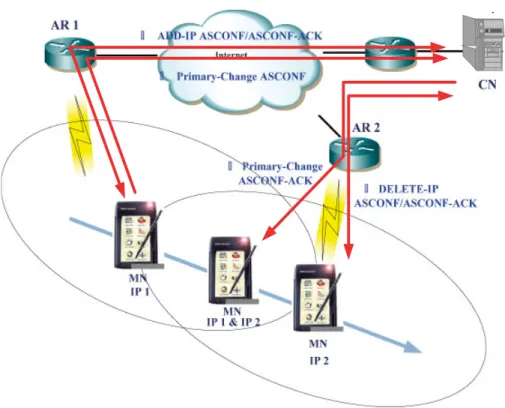
In mSCTP, each SCTP endpoint is able to add or delete an IP address to or from the existing association, and also to change the primary IP address for SCTP association[4]. Figure 1 illustrates the protocol operation of mSCTP handover in the different IP networks.
In Figure 1, we assume that an MN initiates an SCTP association with the CN, and moves from AR1 region to AR 2 region. For the SCTP association, MN initially uses ‘IP address 1’ in the AR1 region. Then, the overall mSCTP handover procedures could be performed as follows.
When the MN moves into the AR2 region, it detects the movement to a new subnet and obtains a new address ‘IP address 2’ by using the IP address configuration scheme or Dynamic Host Configuration Protocol (DHCP). After then, the newly obtained IP address 2 will be informed to the CN in the transport layer. This is performed by sending an SCTP Address Configuration (ASCONF) chunk to CN. The MN receives the responding ASCONF-ACK chunk from the CN.
Figure 1. mSCTP handover operations.
This is called by the ‘Add-IP’ operation, the old IP address 1 is still used as the primary address, until the new IP address 2 is set to be the ‘Primary Address’ by the MN. Before the primary address is newly set, IP address 2 is still used as a backup path. As the MN further continues to move toward AR 2region, it needs to change the new IP address as its primary IP address. For this purpose, the MN sends the ASCONF chunk using the IP 1 address and receives the responding ASCONF-ACK chunk from the CN over the IP address 2. Once the primary address is changed, the CN sends the outgoing data packets over the new primary IP address of MN (IP address 2). This is called the ‘Primary Path Switching’ operation. As the MN continues to move toward B, it will delete the old IP address 1 from the association. This is called the ‘Delete-IP’ operation. These procedural steps will be repeated each time the MN moves to a new subnet region.
2.2. Packet reordering problem
When the MN moves across between heterogeneous wireless networks, it should switch its primary path to a newly configured IP address. In this period, unexpected packet reordering may occur due to the disparity of link bandwidths between the two concerned networks, as shown in the vertical handover from 3G to WLAN. This packet reordering may occur since the data packets sent to the new path with high bandwidth may arrive at the MN earlier than those sent to the old path with low bandwidth.
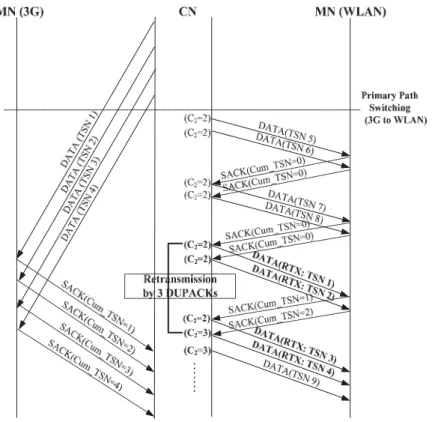
Figure 2 shows an example of packet reordering problem caused by mSCTP handover from 3G to WLAN.
Figure 2. Packet reordering problem in mSCTP vertical handover.
In the figure, the four data packets (TSN 1–4) are transmitted by CN to MN in the 3G network, and then the primary path of MN is switched to WLAN. After the primary path switching, CN sends the newly generated data packets (TSN 5–8) to the new primary address of WLAN. It is noted that WLAN has a larger link bandwidth than 3G, Therefore, the new data packets (TSN 5–8) may possibly arrive an MN earlier than the old data packets (TSN 1–4). When MN receives the new data packets in WLAN, it experiences the packet reordering, and then reports the gaps of Transmission Sequence Numbers (TSNs) for missing data chunks to CN via subsequent SACK chunks. Accordingly, CN may receive the three duplicated SACK chunks from MN, as shown in the figure. As per the IETF RFC 4960 [3], CN will perform the SCTP fast retransmissions for the missing data packets, as indicated by ‘DATA (RTX)’ in the figure. In the meantime, the congestion window(C2) of CN cannot increase, which induces performance degradation of mSCTP
handover. In this example, we assume that the initial C2 begins with 2•MTU at the slow start
phase.
2.3. Retransmission timeout due to packet loss
In the mSCTP vertical handover, we need to consider another problem, in which the data packets transmitted to the old primary path may be lost since the status of the old path may be unstable during the handover operations. It is noted that the MN is at the edge (boundary) of the network in
Figure 3. Retransmission timeout problem by packet loss in the mSCTP vertical handover.
the middle of handover and this may make the old link (path) more unstable. The event of packet loss at MN can be realized by CN only when the retransmission timer is expired, and this may incur the degradation of handover performance.
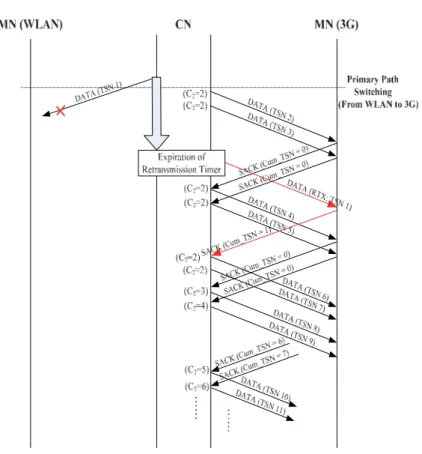
Figure 3 illustrates the example of such a retransmission timeout problem due to packet loss. In the figure, we assume that the MN moves from WLAN to 3G network. In this scenario, MN detects the weak signal strength of the WLAN access point (AP), and switches the primary path to the 3G wireless link. In the figure, we assume that CN sends one data packet (TSN 1) to MN through the old path (WLAN) just before the primary path switching, and unfortunately the data packet is lost since the old path becomes unstable at the edge of the network by handover.
After the primary path is switched to a new IP address obtained from 3G network, the CN sends the new data packets (TSN 2 and 3) to MN via 3G path. In the meantime, CN will realize the packet loss event by the expiration of the retransmission timer and then it will retransmit the corresponding data packet via the new path (3G link) since the primary path is switched to the 3G path. By this, the congestion window(C2) of CN for the new path cannot increase until the retransmitted
data have been acknowledged. Hence, this retransmission timeout may lead to degradation of the mSCTP handover performance.
3. HANDOVER RETRANSMISSION OF mSCTP
In this section, we propose a simple and novel ‘handover retransmission scheme for the mSCTP vertical handover’ so as to improve the handover performance by avoiding the problems of packet reordering and retransmission timeout due to the packet loss during handover. In the proposed scheme, we will focus on the data transmission from CN to MN, and also take into account the following assumptions:
(a) The MN has the two different wireless network interfaces, but does not support the ‘concur-rent’ multi-path transmission, which SCTP endpoints can transmit data packets through multiple network interfaces at the same time[9].
(b) The MN has a large receiver buffer size.
(c) The initial congestion window begins with 2-MTU at the slow start phase.
(d) The MN can be informed about the transmission link capacity of its wireless network inter-faces. This can be achieved by MN to explore the link-layer information for the concerned wireless network interfaces.
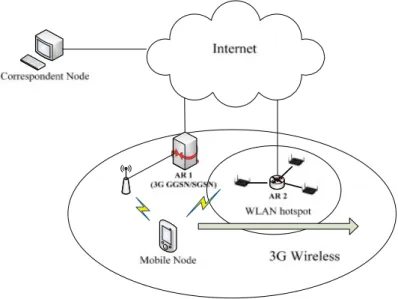
In this paper, we will consider the movement of MN from 3G to WLAN and then back to the 3G wireless, as depicted in Figure 4.
In Figure 4, the MN is assumed to be equipped with a 3G wireless and WLAN interfaces, and AR 1 and AR 2 belong to the different IP subnets. In the AR 1 region, MN communicates with CN using 3G wireless. When the MN moves to the WLAN hotspot, it can automatically configure its IP address using DHCP. After a new IP address is configured, the MN adds the new address to the ongoing SCTP association by performing the mSCTP ‘Add-IP’ operation. After then, the MN performs the primary path switching to receive the data transmission over WLAN link. When the MN leaves the WLAN hotspot and moves back to 3G wireless, it changes its primary path to 3G
wireless link. Then, it deletes the old IP address from the association by performing the mSCTP Delete-IP operation.
It is noted that the packet reordering tends to occur since the new data packets sent from CN to the new primary path will arrive at the MN earlier than the data packets sent over the old primary path. In addition, the retransmission timeout problem due to packet loss may occur during handover since CN may send the data packets over the old path that is unstable when MN is at the edge of the old network.
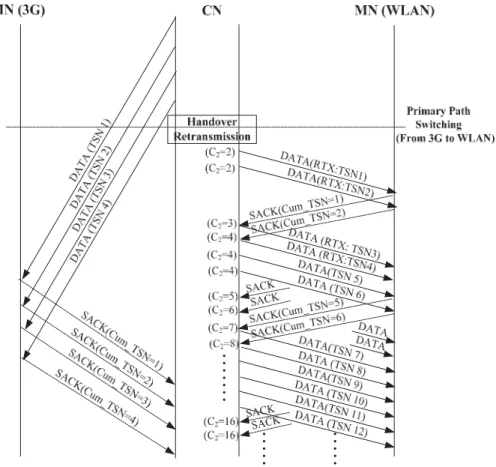
To solve both problems, we propose a simple handover retransmission scheme of mSCTP handover. In the proposed ‘handover retransmission scheme,’ the CN will first retransmit the outstanding data packets, which have been transmitted to the old address but not been acknowledged yet, to the new primary destination address. That is, CN will not send the newly generated data packets until it retransmits the outstanding data packets to the new primary path. While the outstanding data packets, which have been retransmitted over the new primary path after the primary path switching or have been transmitted over the old primary path before the primary path switching, arrive at the MN and their acknowledgements are received to CN, the congestion window will be continuously increased. Therefore, we can avoid the spurious fast retransmission due to packet reordering and also the retransmission timeout due to packet loss. Also, the proposed scheme ensures that the congestion window of the new primary destination address will continue to increase.
The proposed handover retransmission scheme for mSCTP vertical handover (HR-mSCTP) can be summarized below.
HR-mSCTP: Handover Retransmission for mSCTP Vertical Handover CN performs the following operations just when the primary path is switched: Step 1. Pause the data transmissions to the old primary address
Step 2. Check if there are the outstanding data chunks that have not been acknowledged. If yes, go to Step 3. Otherwise, go to Step 4
Step 3. Retransmit all the outstanding data chunks to the new primary address Step 4. Send the newly generated data chunks to the new primary address
As described in the algorithm above, when the MN switches the primary path into the new primary address, CN stops the data transmissions to the existing primary address and investigates whether there are the outstanding data packets. As soon as completing the retransmission, if any, CN begins transmission of the new data packets to the new primary path.
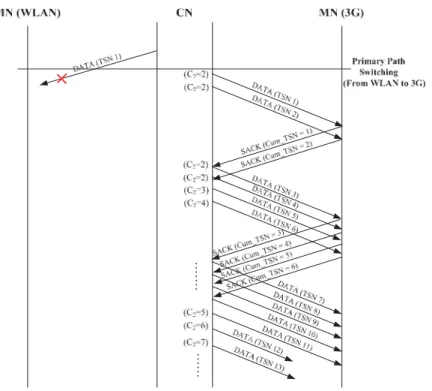
Figures 5 and 6 illustrate the examples of the proposed HR-mSCTP to solve the packet reordering problem and the retransmission timeout problem.
In Figure 5, when the primary path is switched from 3G to WLAN, the CN first retransmits the outstanding data packets (TSN 1–4) over WLAN. The retransmission of the outstanding data packets are performed according to the slow start mode. Thus, the two outstanding data packets, TSN 1 and TSN 2, are first retransmitted. When the acknowledgements for TSN 1 and TSN 2 arrive at the CN, the CN retransmits the TSN 3 and TSN 4 and sends the new data packets TSN 5 and TSN 6. Therefore, the congestion window will continue to increase due to the slow start mode of the congestion control.
In Figure 6, when the primary path is switched from WLAN to 3G wireless, CN sends the outstanding data packet (TSN 1), which was lost in the old path, as soon as the primary path
Figure 5. HR-mSCTP for solving the packet reordering problem.
is switched back to 3G link, together with the newly generated data (TSN 2) with the initial congestion window C2of 2-MTU. When the corresponding SACKs are successfully received by
CN, the next data packets are sequentially transmitted and C2 of 3G link is normally increased.
4. NUMERICAL RESULTS AND DISCUSSION
To analyze the performance of the proposed HR-mSCTP scheme, we configure a test network that consists of 3G wireless and WLAN links using the ns-2 network simulator[19], as shown in Figure 7.
In simulation, an MN initially receives the data packets of File Transfer Protocol application from 3G network. Then, MN moves into WLAN and switches the primary path to the new IP address. As MN moves further, it will leave the WLAN coverage and go back to 3G wireless region. In simulation, it is assumed that there is no shared bottleneck link along the paths from CN to MN.
Figure 6. HR-mSCTP for solving the retransmission timeout problem.
Figure 7. Simulation scenario.
The parameters used for simulation are set as follows. The wired links between CN and the two access routers (AR1 and AR2) are all set to 100 Mbps of bandwidth and 15 ms of transmission delay. 3G wireless link of MN is set to 384 kbps and 100 ms, whereas WLAN link of MN is set to 11 Mbps and 15 ms [9]. The data chunk size is 1468 bytes and the Maximum Transfer Unit (MTU) size is set to 1500 bytes. Moreover, if not stated otherwise, the packet loss rates in the
Figure 8. Experimental results for movement from 3G wireless to WLAN: (a) normal mSCTP scheme and (b) proposed scheme.
3G and WLAN networks are set to zero. Also, the primary path is switched from 3G wireless to WLAN links and from WLAN to 3G wireless links at the time of 25 and 50 s after the simulation begins. The non-real-time FTP data transmission from CN to MN will be performed for 70s. All the simulation results are averaged for 10 test instances.
For performance evaluation, we will mainly investigate the transmission throughput during the vertical handover. On the other hand, in the mSCTP vertical handover, the handover latency could be significantly reduced because the MN can utilize the two paths (old and new) at the same time in the overlapping region. The studies on the handoff delay for the mSCTP vertical handover were given in the existing works[7, 20, 21].
4.1. Vertical handover from 3G wireless to WLAN
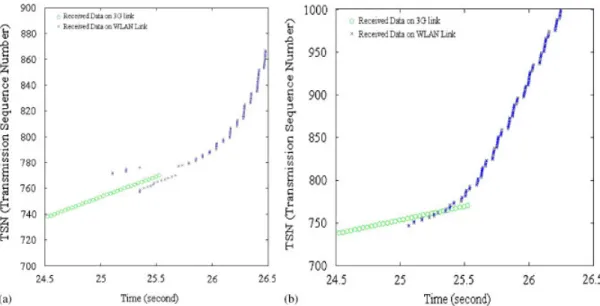
Before going further to the performance evaluation of the proposed scheme, to examine the impact of the packet reordering problem in the mSCTP handover, we will first experiment the ns-2 simulations for the normal mSCTP handover and proposed HR-mSCTP schemes, as shown in Figure 8. In the figure, the TSN values of the data packets received by MN are plotted for movement from 3G wireless to WLAN.
In the figure, CN initially sends the data packets to 3G link as the primary path. When MN enters the WLAN coverage, CN switches the primary path into the WLAN link at the time of 25 s, as shown in Figure 8(a). At this moment, we can see that the packet reordering occurs at around the time of 25.1 s and subsequently the spurious fast retransmissions are performed at the time of 25.3–25.8 s. After that the congestion window for the new primary path begins in the slow start phase.
On the other hand, from Figure 8(b), we can see that the packet reordering does not occur in the HR-mSCTP, and the TSN values increase much faster than those in Figure 8(a). These results
Figure 9. Comparison of performance for the existing and proposed schemes: (a) congestion window size and (b) transmission throughput.
show that the proposed HR-mSCTP scheme can solve the packet reordering problem and continue to increase the congestion window for the new primary path.
Now, we will compare the performance of the proposed HR-mSCTP scheme with the two existing schemes: the normal SCTP[3, 4] and multi-path transmission for mSCTP [9]. Throughout the experimental results, we denote the proposed scheme by ‘HR-mSCTP’, the normal mSCTP scheme by ‘mSCTP’ and the multi-path transmission for mSCTP by ‘MT-mSCTP’.
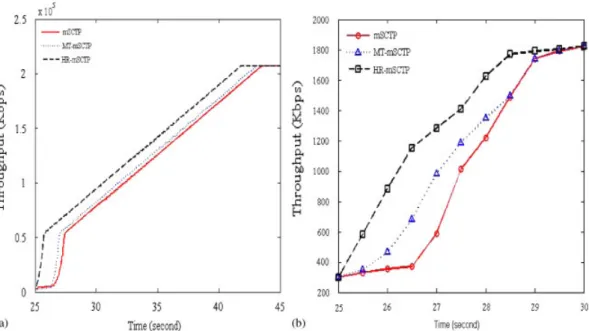
Figure 9 compares the performance the existing schemes with HR-mSCTP in terms of the congestion window and transmission throughput. In Figure 9(a), we can see that the proposed HR-mSCTP scheme increases the congestion window faster than the two existing schemes, after the primary path is switched at a time of 25 s. The corresponding throughput performances are depicted in Figure 9(b). Such a performance gain comes because the proposed scheme can avoid the spurious fast retransmissions and further normally increase the congestion window for the new path immediately after the primary path is switched. On the other hand, it is noted that MT-mSCTP does not outperform the proposed scheme, since the congestion window for the new path cannot normally increase until the outstanding data packets are all acknowledged, even though it solves the spurious fast retransmission problem due to packet reordering.
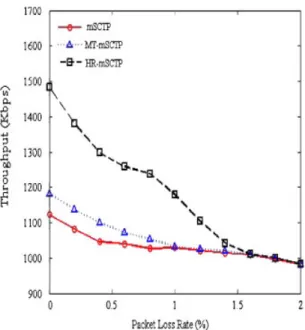
Figure 10 compares the transmission throughputs of mSCTP handover schemes for different loss rates in the 3G network. In the experiments, WLAN has no packet loss rate, whereas the 3G wireless has the packet loss rate ranged from 0.2 to 2%. The throughputs plotted in the figure indicate the results obtained for 4 s after the primary path switching from 3G wireless to WLAN link.
From the figure, it is clear that the proposed HR-mSCTP outperforms the existing schemes in the case with a low packet loss rate. However, as the packet loss rate increases, the performance
Figure 10. Throughput comparison for different packet loss rates in 3G network.
Figure 11. Congestion window by HR-mSCTP for different packet loss rates in 3G network.
of the proposed scheme degrades significantly and eventually becomes similar to the results by the existing schemes. This is because the gain of the larger congestion window in the proposed scheme disappears in the severely congested networks.
Figure 11 shows the size of congestion window for 3G wireless path by HR-mSCTP just before the primary path is switched to the WLAN link. As shown in the figure, when the packet loss rate is increased, the congestion window is decreased and thus the throughput performance of HR-mSCTP is degraded, as also shown in Figure 10.
Figure 12. Throughput comparison for different packet loss rates in WLAN.
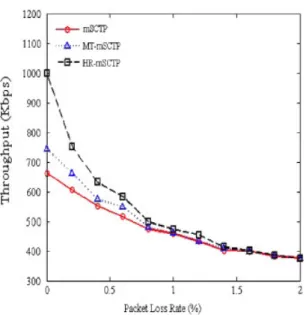
On the other hand, Figure 12 compares the transmission throughputs for different loss rates in WLAN network. In the experiment, the packet loss rates of WLAN are ranged from 0.2 to 2%, whereas 3G network has no packet loss rate.
From the figure, it is shown that the proposed HR-mSCTP can achieve better throughput than the existing schemes for the test networks with the packet loss rate ranged from 0 to 1.4%. However, in the highly congested networks, the HR-mSCTP cannot give significant performance gain compared with the existing schemes. These results are along the same line with those in Figures 10 and 11.
4.2. Vertical handover from WLAN to 3G wireless
Figure 13 shows the handover performances of the normal mSCTP and proposed HR-mSCTP schemes for movement of MN from WLAN to 3G. In this type of movement, the MT-mCSTP is not considered since it provides the same results with the normal mSCTP in that both of the schemes do not deal with the retransmission timeout problem. In the experiments, so as to simulate the packet loss events of MN at the edge of the WLAN network, we set the packet loss rates for WLAN to 3% during the time between 48 and 50 s in the simulation period.
In Figure 13(a), it is shown that when an MN moves back from WLAN to 3G wireless, the packet reordering does not occur. This is because WLAN has a higher network bandwidth than 3G, and thus the packets sent to WLAN will arrive at MN earlier than those sent to 3G. However, from the figure, it is observed that some retransmissions of data packets are done at the time of 50.5–51.6 s after the primary path switching. These retransmissions are caused by the retransmission timeout problem. After all the retransmissions, the congestion window for the 3G wireless link starts in the slow start phase.
On the other hand, from Figure 13(b), we can see that there is no retransmission due to the timeout of retransmission timer. In the figure, CN performs the handover retransmissions just after the primary switching at the time of 50s and thus all the data packets are acknowledged within a
Figure 13. Experimental results for the normal mSCTP and HR-mSCTP schemes: (a) normal mSCTP scheme and (b) HR-mSCTP scheme.
short time interval. After that, the TSN values of HR-mSCTP tend to increase faster than those of Figure 13(a).
Figure 14 compares the performance of the normal mSCTP handover scheme and the proposed scheme in terms of the congestion window and transmission throughput. In Figure 14(a), we can see that the proposed HR-mSCTP scheme increases the congestion window faster than the normal mSCTP handover scheme after the primary path switching from WLAN to 3G wireless link at the time of 50 s. In the viewpoint of the throughput, the proposed HR-mSCTP outperforms the normal mSCTP scheme during handover, as shown in Figure 14(b).
On the other hand, Figure 15 compares the transmission throughputs of the normal mSCTP and proposed HR-mSCTP schemes for different packet loss rates in WLAN.
From the figure, it is shown that the proposed scheme can achieve better performance than the normal mSCTP handover scheme for all test scenarios. In addition, the gap of the performance between the existing and proposed schemes gets increased as the packet loss rate becomes larger. This is because the retransmission timeout problem for the existing mSCTP scheme becomes more severe in the network environment with a higher loss rate.
4.3. Vertical handover across between 3G wireless and WLAN
In this subsection, we examine the handover performance of the normal mSCTP and proposed HR-mSCTP schemes in the scenario where the MN moves forth and back between the boundaries of the 3G and WLAN with short intervals. In these experiments, the packet loss rate for WLAN is set to 1% for 1 s whenever the MN moves into the WLAN and moves out from the WLAN. Moreover, the MN switches the primary path between 3G wireless and WLAN at 5, 7, 11, 16, 20, 28 s.
Figure 14. Performance comparisons for the normal mSCTP and HR-mSCTP schemes: (a) congestion window size and (b) transmission throughput.
Figure 16. Experimental results for the movement around between 3G wireless and WLAN: (a) TSN and (b) congestion window size.
Figure 16 shows the TSNs and congestion window of the normal mSCTP scheme and the proposed scheme in the movement around between 3G wireless and WLAN.
As shown in Figure 16(a), the proposed HR-mSCTP increases the TSNs faster than the normal mSCTP scheme. In addition, the performance improvement between two schemes gets increased as the simulation time goes on. It is because the proposed scheme increases the congestion window faster than the normal mSCTP scheme as shown in Figure 16(b), and also such a gain is continuously accumulated whenever the primary path is switched between two concerned networks.
5. CONCLUSIONS
Until now, we have addressed the packet reordering problem and the retransmission timeout problem of mSCTP handover across heterogeneous wireless access networks. Those problems tend to occur due to the discrepancy of link bandwidth and transmissions delay for the concerned heterogeneous access networks.
To solve the packet reordering and retransmission timeout problems, we have proposed a simple and novel ‘handover retransmission’ scheme in which CN will retransmit all the outstanding data packets over the new primary path, if any, after the primary path is switched. By ns-2 simulations, we have compared the proposed scheme with the existing schemes for mSCTP vertical handover between 3G wireless and WLAN.
From the simulation results, it is shown that the proposed scheme can avoid the packet reordering problem in the scenario when an MN moves from 3G wireless to WLAN and thus significantly
improve the transmission performance during handover compared with the existing schemes. Moreover, in the movement scenario from WLAN back to 3G wireless, the proposed scheme can also achieve more performance gain than the existing scheme by avoiding the expirations of retransmission timers for data lost during handover.
For further study, we need to analyze the performance of HR-mSCTP for a wide variety of network environments and the primary path switching rules. We also need to investigate the theoretical analysis for the performance of the proposed scheme with the consideration of the SCTP congestion control mechanisms.
ACKNOWLEDGEMENTS
This research was supported by MKE (The Ministry of Knowledge Economy), Korea, under the ITRC support program supervised by the IITA (IITA-2008-C1090-0804-0004).
REFERENCES
1. Lin Y et al. Wireless and Mobile Network Architecture. Wiley: New York, 2001.
2. Evans B et al. Visions of 4G. Electronics and Communication Engineering Journal 2000; 12(6):293–303. 3. Stewart R et al. Stream control transmission protocol. IETF RFC 4960, 2007.
4. Koh S et al. mSCTP for soft handover in transport layer. IEEE Communications Letters 2004; 8(3):189–191. 5. Stewart R et al. Stream control transmission protocol (SCTP) dynamic address reconfiguration. IETF RFC 5061,
2007.
6. Salkintzis AK. Interworking techniques and architectures for WLAN/3G integration toward 4G mobile data networks. IEEE Wireless Communications 2004; 11(3):50–61.
7. Ma L et al. A new method to support UMTS/WLAN vertical handover using SCTP. IEEE Wireless
Communications 2004; 11(4):44–51.
8. Iyengar J et al. Making SCTP more robust to changeover. Technical Report TR2003-01, Computer Information Sciences Department, University of Delaware, 2002.
9. Huang CM et al. The handover control mechanism for multi-path transmission using stream control transmission protocol. Computer Communications 2007; 30(17):3239–3256.
10. Zhang M et al. RR-TCP: a reordering-robust TCP with DSACK. Proceeding of IEEE ICNP, Atlanta, GA, U.S.A., November 2003; 95–106.
11. Ludwig R et al. The Eifel algorthm: making TCP robust against spurious retransmissions. ACM SIGCOMM
Computer Communication Review 2000; 30(1):217–225.
12. Gharai L et al. Packet reordering, high speed networks and transport protocol performance. Proceeding of IEEE
ICCCN, Chicago, IL, U.S.A., 2004; 73–78.
13. Ladha S et al. On making SCTP robust to spurious retransmissions. ACM SIGCOMM Computer Communication
Review 2000; 30(1):30–36.
14. Hansmann W et al. On things to happen during a TCP handover. Proceeding of IEEE LCN, Koigswinter, Germany, October 2003; 109–118.
15. Daniel L et al. TCP behavior with changes in access link bandwidth and delay during vertical handoffs. Proceeding
of NGMAST, Cardiff, Wales, U.K., September 2007; 346–353.
16. Rutagemwa H et al. Robust cross-layer design of wireless profiled TCP mobile receiver for vertical handover.
IEEE Transactions on Vehicular Technology 2007; 56(6):3899–3911.
17. Aydin I et al. Cellular SCTP: a transport-layer approach to internet mobility. Proceeding of ICCCN, Double Tree Lincoln Centre, Dallas, TX, U.S.A., 2003; 285–290.
18. Ma L et al. Performance improvements of mobile SCTP in integrated heterogeneous wireless networks. IEEE
Transactions on Wireless Communications 2007; 6(10):3567–3577.
20. Kim D et al. Analysis of SCTP Handover by Movement Patterns. Lecture Notes in Computer Science, vol. 3645, 2005; 521:529. Available from: http://www.springerlink.com/content/105633/.
21. Antonios A et al. A soft-handover transport protocol for media flows in heterogeneous mobile networks. Computer
Networks 2006; 50(11):1860–1871.
AUTHORS’ BIOGRAPHIES
Dong-Phil Kim He received the BS degree from the department of Computer Science
in the Inje University, Korea in 2003. He received the MS degree and the PhD degree from the department of Information Security in the Kyungpook National University, respectively. He is now with the LG Electronics Inc. His current research interests include Internet Mobility, mobile SCTP, and next-generation mobile/wireless networks.
Seok-Joo Koh He received the BS and MS degrees in Management Science from KAIST
in 1992 and 1994, respectively. He also received PhD degree in Industrial Engineering from KAIST in 1998. From August 1998 to February 2004, he worked for Protocol Engineering Center in ETRI. He is now an Associate Professor at the department of Computer Science in the Kyungpook National University since March 2004. His current research interests include mobility management in the next-generation networks, IP mobility, multicasting and SCTP. He has so far participated in the international standardization as an editor in ITU-T SG13 and ISO/IEC JTC1/SC6.