Multi-Homing RTP (mhRTP) for QoS-guaranteed Vertical Handover in Heterogeneous Wireless
Access Networks
Igor Kim, Young-Tak Kim*
Abstract : In this paper, we propose an application layer-based vertical handover management protocol, called multihoming RTP (mhRTP), for real-time applications with seamless mobility across heterogeneous wireless access networks. The proposed multi-homing RTP provides a soft handover by utilizing multiple available wireless access network interfaces simultaneously. The newly available path is dynamically added to the ongoing session by the mhRTP session manager. Also the decision making of QoS-improving or QoS-guaranteed handover is possible based on the estimation of available bandwidth in each candidate network. The performances of the proposed mhRTP have been analyzed through a series of simulations on OPNET network simulator. From the performance analysis, we confirmed that the proposed mhRTP can provide QoS-guaranteed vertical handover with efficient session managements.
Keywords : Real-Time transport protocol (RTP), Quality-of-service (QoS), IEEE 802.11, IEEE 802.16e, Voice over IP (VoIP)
* Corresponding Author
Manuscript received : 2010. 09. 03.,
Revised : 2010. 09. 20., Accepted : 2010. 10.
12.
Igor Kim, Young-Tak Kim: Dept. of Info. and Comm. Eng., Graduate School, Yeungnam University
※ This research work was supported by HiMang Project (No 100035594) funded by MKE, Korea.
1. Introduction
Seamless secure mobile multimedia service provisioning is expected to be one of the most important feature in future Internet, and mobile Internet terminals (e.g., smart phone and FMC (fixed mobile convergence)) with multihoming network interfaces are widely available [1, 2].
Especially, the vertical handover among different wireless access networks should be able to seamlessly provide QoS-guaranteed service.
For seamless mobility support in network protocol layer, IETF has been developing Mobile IPv4 (MIPv4) protocol, while the enhanced mobility management protocols, such as FMIPv6, HMIPv6 and PMIPv6, have been proposed to be based on Mobile IPv6 (MIPv6) protocol. MIPv4 and MIPv6 assume additional functionalities of home agent, foreign agent, and optional regional mobility manager.
MIPv4/MIPv6-based mobility support requires software module update in the kernel part of each mobile terminal. Unfortunately, however, most of the currently available mobile nodes are using IPv4, and it is not expected to get any solution of unified mobility management available in Internet backbone network soon.
For mobility support in transport protocol layer, the SCTP with attractive features of multi-homing and multi-streaming can be used, where multiple network interfaces or multiple streams can be used in an SCTP session.
However, it may be difficult to use the SCTP directly for multimedia applications, due to the
lack of functions required for real-time services, including framing, timing, and QoS reporting. Also, the transport protocol layer modules, such as TCP and UDP, are implemented in the kernel which are not easy to update.
The mobility support in application protocol layer allows the most flexible scenario in practical implementation, since most popular realtime multimedia applications are provided in server-client model where the application programs (that includes the RTP module) can be easily downloaded from the server.
Multiflow real-time transport protocol (MRTP) had been proposed to provide multi-path transport of real-time multimedia data with traffic partitioning in sender and flow reassembling at receiver [3]. The MRTP, however, does not provide necessary functions for QoS-guaranteed vertical handover in heterogeneous multi-homing network interfaces.
In this paper, we proposed a QoS-guaranteed vertical handover management protocol at application layer, called multi-homing RTP (mhRTP), for realtime applications with seamless mobility across heterogeneous wireless access networks. The proposed multi-homing RTP provides a soft handover by utilizing multiple available wireless access network interfaces simultaneously. The newly available path is dynamically added to the ongoing session, by the mhRTP session manager. Also the decision making of QoS-improving or QoS-guaranteed handover is possible based on the newly available network resource status, such as available bandwidth.
The proposed QoS-guaranteed vertical handover scheme with mhRTP provides following advantages: i) easy deployments in client-server service provisioning of VoIP, IPTV or video teleconference, without any necessary modification in kernel level for mobile IP; ii) support of multi-homing that enables the usage of multiple wireless network interfaces simultaneously for minimized packet
losses at vertical handover; iii) support of decision making for QoS-improving or QoS-guaranteed handover based on the newly available network resource status; and iv) support of session re-negotiation for improved end-to-end QoS/QoE (Quality of Experience) in the changed network environment at vertical handover.
The rest of this paper is organized as follows. In section II, we propose the multi-homing RTP (mhRTP) for QoS-guaranteed vertical handover in heterogeneous Internet networking environment. In section III, we evaluate the performance of the proposed mhRTP, based on OPNET simulations of vertical handover between WiFi and WiMax wireless access networks. Finally, we conclude this paper in Section IV.
Ⅱ. mhRTP: A Vertical Handover Management Protocol for Real-Time
Applications
Fig. 1 depicts the proposed mhRTP protocol architecture. On the top of the model there is a multimedia application, which can be any application that uses RTP, such as voice over IP (VoIP) or real-time multimedia conference.
For each multimedia application, multimedia session is created and managed by the functional modules of multimedia session setup and control, and multimedia data representation that handles encoding and decoding.
The core module in the proposed protocol is mhRTP session manager. Only one session manager is running in each mhRTP node. One manager handles a number of mhRTP sessions which are related to different application data streams. It is responsible for: i)creation, deletion, control and maintenance of mhRTP sessions; ii)direction of application data to appropriate mhRTP session; iii)in-order
delivery of application data from mhRTP sessions to the appropriate application;
iv)transmission and reception of mhRTCP control packets; and v)duplication of data traffic during handover. mhRTP session is a single multihoming RTP session, which is managed by the mhRTP session manager. Each mhRTP session is an independent process, which simply provides connectivity between mhRTP and transport layer, and is used to deliver packets to the transport protocol. mhRTP session is created when the application starts and exists during the whole communication time between the MN and CN. mhRTP handover manager collects the necessary information from the layer management module to make a handover decision. The handover manager also interacts with session manager whenever it is required to create a new mhRTP session or delete an old session.
Handover manager collects the link layer information, such as received signal strength, bit error rate, candidate networks information and delivers this information to the mhRTP handover decision maker.
Fig. 1. Functional architecture of mhRTP
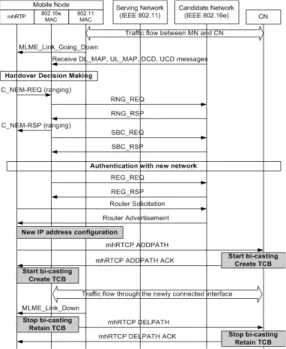
Fig. 2 depicts the mhRTP vertical handover sequence. In this paper, we consider two wireless access network technologies: IEEE 802.11 Wi-Fi [4] and IEEE 802.16e WiMAX [5]. Any other wireless link layer technology (e.g., 3GPP/UMTS), however, may be used in
the same way. Mobile Node (MN) is initially attached to the WiFi network and exchanges multimedia data with the Correspondent Node (CN). While moving from the WiFi basic service set (BSS), the MN's 802.11 MAC layer management entity (MLME) may send Link_Going_Down indication to the layer management module (Fig. 1), as the signal strength decreases below the pre-defined threshold. mhRTP handover manager is directly informed about the link status change information.
The handover manager sends the command to start channel scanning to the WiMax MAC through the layer management module which is a broker between mhRTP modules and other protocol layers, that provides a cross layer cooperations.
Fig. 2. mhRTP handover sequence diagram
When the new address assignment is completed, the mhRTP session manager creates a new mhRTP stream with socket interface and adds it to the ongoing mhRTP session. A new transmission control block (TCB) at the UDP is created. Each mhRTP
stream is associated with independent TCB. A newly created mhRTCP ADDPATH message is transmitted through the new mhRTP session and newly initialized wireless interface to the CN.
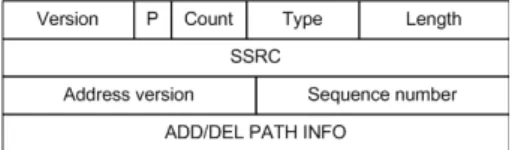
The formats of mhRTP messages are shown in Fig. 3 - Fig. 5. The first six fields (Version, Padding, Count, Type, Length, and SSRC) are same as in the RTCP packet [6]. The address version field identifies which IP version is used. The sequence number field is used for ADDPATH retransmission. When the sender of ADDPATH message doesn't receive ADDPATH ACK within a retransmission timeout (RTO) period, it may retransmit ADDPATH message with incremented sequence number field. The RTO value is calculated based on the round-trip time (RTT) value as it is defined in [7]. The RTT value can be obtained from the periodical sender (SR) or receiver (RR) reports.
The format of ADDPATH ACK message is depicted in Fig. 4. The status field indicates the successful or unsuccessful path addition. If the path addition is unsuccessful the reason code is specified in the reason field.
Fig. 3. mhRTCP ADDPATH/DELPATH
Fig. 4. mhRTCP ACK
Fig 5. mhRTCP REFRESH
When a path addition is successfully completed, the MN may start data transmission
through the newly available interface. The duplicated data delivery (i.e., bi-casting) is started on the different mhRTP paths for reliable delivery. The MN makes a decision to stop the bi-casting, possibly when Link_Down event is delivered to the mhRTP session manager through the layer management module or based on some other decision. The MN transmits DELPATH message to the CN, and the CN replies with DELPATH ACK message, and stops bi-casting. The TCB on the previous path is retained for certain period after the path becomes inactive. This TCB retaining can significantly reduce the handover processing delay, especially when the MN moves back and forth between two networks frequently.
In many situations we may need to perform session re-negotiation by adjusting some of the application parameters to keep the communication quality at the desired level. For example, this can be useful during the MN's handover, especially, if the available bandwidths in the previous and new access networks are quite different. When a MN performs a handover from an access network with highly available bandwidth to a reduced available bandwidth network (i.e., from Wi-Fi to UMTS), it has to perform session re-negotiation adjusting the application settings, otherwise, the quality of the service may be significantly reduced due to the packet buffer overflow at the bottleneck wireless access link and increased number of retransmission attempts. Such multimedia application settings can be, for example, video coding rate for videoconference applications.
Since mhRTP is closely related to the multimedia application, it can be easily adapted to perform session re-negotiation. mhRTP capable terminal simply sends a newly defined RTCP REFRESH message (Fig. 5), which contains the media information for the session re-negotiation. Based on this information two end nodes adjust their applications.
The selection of the target AP is one of the major step during the mhRTP handover. A proper selection of the candidate wireless access network may significantly affect the QoS experienced by the user after the handover. We assume that the wireless LAN (WLAN) with broad bandwidth has higher preference over the wireless WAN (WWAN) networks, since in many cases the achievable throughput in WLAN is much higher and, in addition, the user may prefer to attach to the WLAN network considering the cost of service.
When the Link_Going_Down event is delivered to the handover manager, it requests the information of the candidate APs, such as candidate AP MAC addresses, their operating channel numbers, number of stations associated with each AP, and their traffic specifications (TSPEC). This information can be obtained through the external information server or even the serving AP and is used to estimate the available bandwidth in each candidate WLAN. The details of the bandwidth estimation in WLAN are described in our previous work at [8].
In WWAN, such as WiMAX, 3GPP/UMTS, GPRS, the allocation of resources is strictly controlled by the BS and signalling for connection establishment. Thus, there is no guarantee that MN will get as much bandwidth as required, and will obtain the information of the residual bandwidth beforehand. After a two-phase negotiation with the candidate BS, the MN will get the fixed bandwidth depending on the coding rate. We assume that the MN may acquire sufficient bandwidth within the maximum rate of the WWAN via some time slot allocation mechanisms in the BS.
Algorithm 1 shows the available bandwidth based vertical handover decision algorithm for mhRTP. When a MN is initially connected with the WLAN and receives beacons, it compares the received signal strength (RSS) with RSSTh
which is a predefined threshold when MN crosses the cell boundary. If the RSS is less than RSSTh, then the number of received beacons less than RSSTh (Nrss) is incremented. Handover decision maker collects the information of available bandwidth in each candidate network and serving network. If currently available bandwidth (ABcur) in the serving network is less than the required bandwidth (RB) or Nrss is larger than the predefined threshold (NTh) than the MN performs handover to the WWAN network which can provide sufficient bandwidth for on-going mhRTP session.
When the MN is currently connected to WWAN, the handover decision making is similar to the case, when the MN is initially in WLAN, described above. In addition, since we give a preference to a WLAN network, the MN periodically activates WLAN interface to capture possible beacons transmitted by the candidate APs. When MN detects available WLANs, it estimates the available bandwidth and selects a proper WLAN which can provide enough resources for mhRTP session. If none
of the WLANs can provide the required bandwidth (RB), then the MN stays attached to the currently serving WWAN. The periodic beacon listening must not be performed too frequently, since the power consumption of WLAN interface is high.
Ⅲ. Performance Evaluation and Analysis
We implemented the proposed mhRTP protocol in the network simulator OPNET [9].
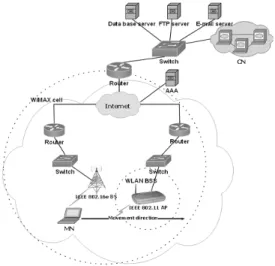
Fig. 6 depicts the simulation scenario for the evaluation of the proposed scheme. The MN is initially attached to the WiMAX BS and moves towards Wi-Fi BSS with pedestrian movement velocity of 5 km/h. The MN performs vertical handover twice, i.e., from WiMAX to Wi-Fi when the MN enters the Wi-Fi BSS, and back from Wi-Fi to WiMAX when the MN leaves the Wi-Fi BSS. IEEE 802.11b with direct sequence spread spectrum (DSSS) was configured in wireless LAN. The Wi-Fi BSS radius was configured to be 100 meters. The frame loss based rate
Fig. 6. Simulation topology
adaptation technique for wireless LANs, called Auto Rate Fallback (ARF), was implemented to make the simulations more
realistic. WiMAX network was configured with the OFDMA physical layer of 20 MHz bandwidth, and the frame duration was set to 20ms. The time division duplex (TDD) was configured as a duplexing technique.
Two scenarios were considered in the performance evaluation. In the first scenario, the bi-directional VoIP application was configured at the mhRTP-capable MN and CN.
The G.711 encoded voice frames were transmitted at 64 kbit/s data rate. In the second scenario, bi-directional videoconference application was configured at the MN and CN.
The quarter video graphics array (QVGA) with 15 frames/second and 512 kbit/s coding rate was selected for video representation.
Finally, in order to simulate the background load, we configured several MNs in Wi-Fi and WiMAX networks to run FTP, E-mail, and data base access applications.
In the first scenario, the MN runs VoIP application and performs a vertical handover twice, as shown in Fig. 6. Fig. 7 shows the achieved mouth-to-ear delay for VoIP application. The mouth-to-ear delay consists of the network delay and processing delay caused by voice frames compression, decompression, and packetization. The path through the WiMAX access network has longer delay of near 60 ms, which is mostly due to the WiMAX framing.
Fig. 7. Mouth-to-ear delay (sec)
Nearly at 110 seconds of simulation time, the MN performs Wi-Fi network attachment and starts duplicated data transmission through both interfaces. Since the signal strength from the Wi-Fi AP is not strong enough to utilize the maximum physical transmission rate of 11 Mbps, the MN performs rate adaptation. The frequent rate adaptation causes slight fluctuations of delay, because the transmission time of wireless frames is different. Fig. 8 shows the jitter performance during handover.
The negative jitter indicates that the time difference between the consecutive packets at the destination node was reduced because of the change of route. The negative sharp peak of jitter is shown at the network path switch time, when the first packet is received through the newly available path with lower mouth-to-ear delay.
Fig. 8. Jitter (sec)
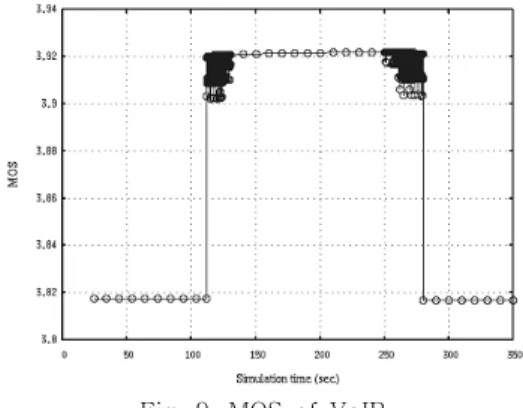
Fig. 9 shows the mean opinion score (MOS) value for the speech quality evaluation. The MOS value was computed based on the E-model [10]. The MOS value is higher when the MN connects to the Wi-Fi AP. This is because the mouth-to-ear delay through the Wi-Fi network path is lower than through the WiMAX network path. Even though the signal strength from AP is not high enough to utilize the maximum physical transmission rate, the MN switches to Wi-Fi network because the monitored mouth-to-ear delay is less than the delay at WiMAX network and there is no
packet loss. In addition, the rate of VoIP application is only 64 kbit/s, which can be provided by the minimum physical transmission rate at 1 Mbps in 802.11b.
Fig. 9. MOS of VoIP
The wireless handover from Wi-Fi to WiMAX access network is similar to the handover procedure from WiMAX to Wi-Fi, as explained above. However, the handover in this case is imminent, because MN loses its connectivity with Wi-Fi AP. When the signal strength from AP becomes weak due to the path loss and the number of retransmissions increases, the MN executes the rate adaptation which causes the fluctuations of mouth-to-ear delay, jitter, and MOS. The positive sharp peak of jitter indicates the network path switch time, when the first packet is received through the newly available path with lower moth-to-ear delay.
In the second scenario, we configured a bi-directional videoconference application
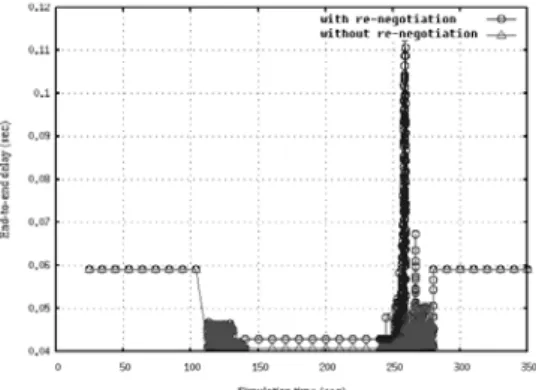
between MN and CN. We compared the mhRTP with re-negotiation and without re-negotiation. When the MN completes the vertical handover from WiMAX to Wi-Fi access network, and the signal quality from the AP is good enough and the bit error rate is low, it starts re-negotiation.
Fig. 10. End-to-end delay
Since the available bandwidth is higher in Wi-Fi network, the MN may request to increase the video coding rate in order to improve the video quality. Nearly at 140 seconds of simulation time, the MN initiates a session re-negotiation with the CN. The video coding rate was increased to 2048 kbit/s.
Based on the media information provided in RTCP REFRESH message, the MN and CN adjust the video frame rate.
Fig. 10 shows that the end-to-end delay for mhRTP after re-negotiation was slightly increased. This is because the wireless frame size increased due to the higher video data rate, which results in longer transmission delay. We also compute the MOS value for videoconference application based on the opinion model provided in [11].
Fig. 11. Jitter (sec)
Fig. 12 shows that the MOS value was
significantly increased compared to the case of without re-negotiation. When the signal quality from AP becomes weak and MN executes rate adaptation, the layer 2 queue size at the MN increases, because the lower physical transmission rate cannot handle high speed video application. This results in increase of end-to-end delay and jitter (Fig. 11). The MN initiates session re-negotiation with the CN and adjusts the coding rate to 512 kbit/s and adjusts the video frame rate. In the case of mhRTP, even though the end-to-end delay and jitter may increase due to the wireless link adaptation during handover, it still provides much better MOS value compared to the case of without re-negotiation.
Fig. 12. MOS of video session
IV. Conclusion
In this paper, we proposed a QoS-guaranteed vertical handover management protocol at application layer, called multi-homing RTP (mhRTP) for realtime applications with seamless mobility across heterogeneous wireless access networks.
The proposed QoS-guaranteed vertical handover scheme with mhRTP provides following advantages: i) easy deployments in client-server service provisioning of VoIP, IPTV or video teleconference, without any necessary modification in kernel level or network infrastructure of Mobile IP protocols;
ii) support of multi-homing that enables the usage of multiple available wireless network interfaces simultaneously for minimized packet losses at vertical handover; iii) support of decision making for QoS-improving or QoS-guaranteed handover based on the newly available network resource status; and iv) support of session re-negotiation for improved end-to-end QoS/QoE (Quality of Experience) at the changed network environment at vertical handover. Throughout a series of performance analysis on OPNET network somulator, it was confirmed, that the proposed mhRTP with re-negotiation can provide QoS-guaranteed/
enhancing multimedia services.
References
저 자 소 개
Igor KimReceived B.S. degree in computer science and information technology from Tashkent Univ. of Info. Tech. (TUIT) in 2005. In 2007 he has received M.S. degree from Yeungnam Univ. From 2007 he is pursuing his Ph. D.
degree in the Dept. of Inform. and Com. Eng.
of Yeungnam University.
Research interests : Mobility management, QoS provisioning in wireless networks, seamless handover, large-scale network simulation.
Email : [email protected]
Young-Tak Kim
Received Ph.D. degree from KAIST in 1990.
He joined Korea Telecom (KT) in 1990, where he had researched and developed ATM-MSS. Currently he is a professor of the Dept. of Info. and Comm. Eng. of Yeungnam Univ. In 2001 and 2008, he had been working as a visiting scholar at NIST, USA, where he joined in the design and implementation of NIST GMPLS simulator (GLASS) and Next Generation Routing Architecture (NGRA) project.
Research interests : QoS-guaranteed traffic engineering, QoS-aware seamless secure mobility and related network operations and management.
Email : [email protected]