논문 2015-52-6-12
무선메쉬네트워크에서 실시간 이동 멀티미디어 응용을 위한 고성능 QoS 멀티캐스트 라우팅 기법
( High Performance QoS Multicast Routing Scheme for Real-Time Mobile Multimedia Applications in Wireless Mesh Networks )
강 문 식**
( Moonsik Kang
ⓒ)
요 약
본 논문에서는 무선 메쉬네트워크(WMN)를 위한 동적 이동성 트래픽 환경에 적응하는 향상된 QoS 멀티캐스트 라우팅 스 케줄링 기법을 제안한다. 이는 멀티미디어 응용에 대한 지연의 제약 조건을 제어함으로써 네트워크 QoS 문제를 처리하도록 한다. 멀티캐스트 그룹의 크기는 현재 네트워크 상태 및 QoS 요구사항 등에 따라 결정되며, 멀티캐스트 트리의 동적 재구성은 부분적 멀티캐스트 라우팅 방식 및 트래픽 예측 기법을 사용하는 전처리과정을 통해 이루어진다. 제안된 방법의 성능 평가는 적합한 지연시간 제한과 관련된 최적의 값을 선택함으로써, 임의로 생성된 가상 무선메쉬 네트워크 그래프에서 수행된다. 시뮬 레이션 결과로 부터 제안된 QoS 멀티캐스트 라우팅 기법의 성능이 향상됨을 확인하였다.
Abstract
In this paper, an enhanced QoS multicast routing scheduling scheme is proposed to adapt to a dynamic mobile traffic condition for wireless mesh networks (WMNs). It handles the network QoS by controlling the delay constraints for multimedia applications. The group size will be controlled according to both the current network state and QoS requirements. The dynamic reconstruction of QoS multicast tree can be obtained from preprocessing with both the partial multicast routing scheme and the traffic estimation. Performance evaluation of the proposed scheme is carried out on randomly generated graph derived from the wireless mesh network, by choosing the optimal value related to the appropriate delay bounds. Simulation results show that the proposed scheme can improve the performance of QoS multicast routing for WMNs.
Keywords: QoS Multicast Routing, Delay Constraints, Traffic Estimation, Multimedia Application, Wireless Mesh Network
* 정회원, 강릉원주대학교 전자공학과
(Department of Electronic Engineering, GangneungWonju National University)
ⓒ Corresponding Author(E-mail: [email protected])
※ This work was supported by the GangneungWonju National University Professor Research Grant in 2014.
Received ; April 5, 2015 Revised ; May 18, 2015 Accepted ; May 24, 2015
Ⅰ. Introduction
Recently, the increasing needs for wireless multimedia applications such as medical imaging, environmental remote sensing, mobile internet services and remote collaboration demand the massive network capability to store and manage a
very large amount of data. Furthermore global information systems based on the high-speed wireless and wired networks including the large scale multimedia management systems are prevalent with the advances in network technology. These huge data needs to be processed in real time and distributed to end users who are widely separated in the geographical locations. In addition, applications on WMN is a wide of development, as a form of wireless ad hoc network, which is a communications network made up of radio nodes organized in a mesh topology. WMNs often consist of mesh clients, mesh routers and gateways. A mesh network is reliable and offers redundancy, which can be implemented with various wireless technology including 802.11, 802.15, 802.16, cellular technologies or combinations of more than one type[2∼4]. In order to cope with this increasing traffic requirements, several research topics have aimed at providing users for the required Quality of service (QoS) at different network layers[1,2,6,9]. Further it may be often necessary for these systems to transmit the same data simultaneously from one source to two or more destinations. Multicast is an efficient way to transmit data from a sender to a group of receivers. With the rapid growth of group oriented applications in wireless environment, it becomes crucial to support multicast in WMNs[2, 5].
However, in this paper, we are mainly interested in the mesh backbone formed by 802.11 mesh routers.
Also QoS can be considered as the ability to provide different priority to different applications, users, or data flows or to guarantee a certain level of performance to a data flow. Moreover, multicasting technology would be one of the key requirements for data networks supporting multimedia applications, especially in wireless mesh networks[2∼3, 8]. The most popular solution to multicast routing uses the tree construction since the data can be transmitted in parallel to many different destinations along the paths of the tree, and a minimum number of copies of the
data need to be transmitted, with duplication of data being necessary only at branches in the tree.
In the past, optimization techniques for multicast routing and many algorithms for constructing multicast trees have been proposed. Most studies of the multicast routing for wired networks focused on developing heuristic algorithms that can find a near-optimal tree according to current network state.
For example, there have been a number of solutions, such as a heuristic argument for multicast tree construction that depends on bounded end-to-end delay along the paths from source to each destination. One of these algorithms is to find efficient multicast trees in the presence of constraints on the copying ability of the individual switch nodes in the network, and other distributed algorithms for finding multicast trees in point-to-point data networks are based on the centralized Steiner heuristics, considering the shortest path and the Kruskal-based shortest path heuristics. These algorithms, however, can hardly achieve the optimal performance in WMN environment[2, 7]. In order to handle this problem efficiently, we have studied on the traffic engineering enhancement for QoS multicast routing to make the best use of network resources across WMNs.
As mentioned earlier, the purpose of multicasting is to reduce the communication cost for applications that send the same data to multiple recipients. The situation may be more complicated when networks will have the dynamic wireless conditions[3]. In this paper, an enhanced QoS multicast routing scheduling scheme for wireless link is proposed, which satisfies the network condition with the delay constraints, and designed to adapt to a dynamic node condition such as the participating and leaving from the multicast group. Here, we construct a new QoS multicast tree from the partial multicast routing scheme according to traffic estimation. The performance of the proposed scheme was evaluated on randomly generated wireless mesh network.
The rest of the paper is organized as the follows:
Section Ⅱ investigates the network model for the enhanced QoS multicasting. In Section Ⅲ we will present the proposed QoS multicast routing scheme based on traffic estimation. In section Ⅳ, we will evaluate the performance of the proposed EQMST operation and analyze the simulation results. Finally, section Ⅴ gives some concluding remarks of this paper.
Ⅱ. Network Model for Enhanced QoS Multicasting
1. Network Model
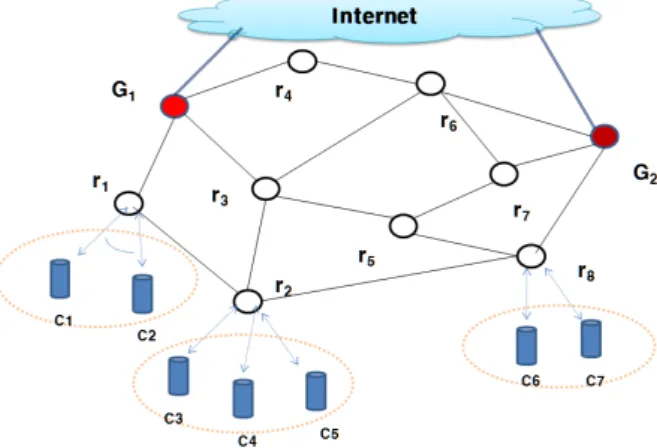
A wireless mesh network as shown in fig. 1 can be modeled as a weighted graph G = (V,E) with node set V and edge set E for simplicity, and two functions C(e) and D(e) on edge e, where C(e) is a positive real cost function and D(e) is a positive integer delay function on e. In figure 1, the colored node(Gi) stands for mesh routers with gateways, while the white node(ri) and ci stand for mesh router and wireless mesh client respectively. Also, we define a source node S and a set of multicast destinations,
⊆ , called the multicast group, and we assume that this graph is undirected for simplicity. We then define a connection request ri to be a pair (DM, Δ) where D is delay tolerance. Also, we define a route
그림 1. 무선메쉬네트워크의 전형적인 예
Fig. 1. Typical example of wireless mesh network.
for a connection request(ri) to be a connected subgraph of G such that ⊆ and the delay constraint satisfies the condition given by the equation (1).
∀∈ ≤
(1)
The negotiation may be necessary if there may not be any route satisfying the equation (1) for a given connection request, considering the static multicast problem stating that Given a network N and a connection request , find a route R(ri) such that has a minimum value among the all possible routes for ri. For the enhanced QOS multicast problem, let’s consider a network N with a sequence of requests R
=[r1,r2,r3, ... rn] where each is a pair (ri,v,dy),
∈ ∈ =event{join, leave}, where CI is a set of connection identifiers. We are interested in constructing of enhanced QoS Minimum Steiner Tree for WMNs, and the optimization problem described as follows:
Given a weighted graph G=(V,E) representing a WMN with two weighted functions C(e) and D(e) on edge e, a source S, a set of destinations D, and considering the dynamic event with a sequence of connection requests, then construct a new enhanced QoS Minimum Steiner Tree(EQMST) such that cost function C(e) is minimized according to traffic estimation while delay bonded condition for QoS is satisfied.
All systems that are able to adjust their functioning according to changes in their environment are based on feedback information. In this respect, they use a control loop, feedback loop, and context based adaptation loop. Also several architectures for cognitive networks have been proposed in the literature so far. The QoS scheme is aiming at providing the prioritized services by considering the bandwidth, the controlled jitter and latency, and the improved loss characteristics[1∼2, 13]. Also, it is important to make sure that providing priority for one or more flows does not make the other flows
fail. Referring to congestion management we try to raise the priority of a flow by traffic estimation in different ways. The queue management method for congestion avoidance adapts priority by dropping lower-priority flows. Fig. 1 shows a typical example of wireless mesh network. As shown in Fig. 1, a WMN consists of two types of nodes: mesh routers and mesh clients. The mesh routers form an infrastructure of mesh backbone for mesh clients. In particular, G1 and G2 nodes in this figure stand for mesh routers with gateway.
2. QoS Strategy
The policing process is used to delay some or all of the packets in a traffic stream to bring the stream into compliance with a traffic profile. This normally has a finite-size buffer, and packets may be discarded if there is insufficient buffer space to hold the delayed packets. Policing and shaping provide priority to a flow by limiting the throughput of other flows. In a single service class network, there is no classification of the traffic based on the characteristics of applications. To account for multiple traffic flows through the network and for avoiding congestion caused by uneven network operation utilizations, the BE model uses the over-provisioning technique in which the network simply provides enough bandwidth to always match the committed network service guarantees. This method involves dropping additional incoming bandwidth on any network link at the time of congestion. The idea behind it is that if the network load is kept low, then packets will not be dropped, nor will they experience high delays caused by waiting in long queues. No matter how much capacity is provided by the network, new applications always seem to appear to consume it. For interactive applications, the end-to-end delay also becomes a significant factor.
Instead of maintaining state information, DS (differentiated service) applies different PHBs (per hop behaviors) to packets. This achieves scalability
by aggregating the traffic classification state for the IP-layer packets in DS network[10∼12,14,15]
.
A TCA (traffic conditioning agreement) represents a filter to which the specific SLA (service level agreement) is bound. This filter is a classifier for separating the traffic stream for processing. In the DS region, SLA is mapped to a conceptual network model, which is then applicable to the configuration of the individual elements within the network. In addition, as a part of SLA, the TCA is translated to a DS specific TCS (traffic conditioning specification).
The TCS is defined as a set of parameters specifying the traffic profile. The TCF (traffic conditioning framework) consists of two parts, such as the traffic classifier and traffic conditioner. The main components of the traffic conditioner are the meter, marker and shaper/dropper. The meter is used to measure the temporal properties of traffic flowing and its comparison against those specified in a TCA.
Ⅲ. The proposed enhanced QoS Multicast Routing based on Traffic Estimation
Here we describe an enhanced QoS multicast routing scheme in WMNs assuming that only one connection request with the identities of the destination nodes is given to the routing algorithm at one time. Also our algorithm is based on the optimal minimum Steiner tree algorithm by satisfying delay constraint from QoS requirements.
1. Dynamic Delay-bounded Multicast Routing Algorithm
In order to find an optimal solution of the multicast problem, we have developed a good solution to construct an enhanced QoS multicast Steiner tree (EQMST) based on both Steiner tree approximation and traffic estimation scheme. Here, it is assumed that the source node has a sufficient information about network links to construct a delay bounded multicast tree. The feasible search optimization and
the partial multicast paradigm are fundamental to our algorithm. The details of proposed EQMST algorithm are as follows.
a. After a WMN is deployed the mesh backbone can be represented by a network infrastructure graph G =(V,E). Nodes and edges in the graph stand for communication endpoints and communication links, respectively.
b. In the resource control plane, the information for traffic monitoring is exchanged. This is essential between the RCA and the database. In the admission control layer the signaling procedure is under operation between the end user application and the bandwidth broker. Alternatively, The procedure can be operated between the end user and an Admission Control Agent (ACA). The ACA would more likely be resident on the mesh routers (wireless mesh routers with gateway in our terminology) to the core network.
c. Next step is to construct a delay constrained minimum spanning tree from the constrained closure graph representing a WMN. At this time, the maximum and the minimum group sizes are determined due to network link states from the traffic estimation, which may be negotiable according to both the network conditions and user requirements.
d. The fourth step is to examine whether there is a delay constrained minimum spanning tree which satisfies the initial conditions or not. If not, it may be tried to reconstruct a new constrained minimum spanning tree by the negotiation for solving the violations.
e. The fifth step is to find an optimal QoS Steiner tree) to minimize the cost in case of the consequent dynamic events such as ‘join’ or ‘leave’. When a node wants to participate at the multicast group, it
precedes to examine that the current group size may exceed the maximum size. If so, it should wait for joining in the priority queue until it will be permitted.
Otherwise, try to find the shortest direct node from this node to any nodes in the group without violating the delay bound. If there are no direct nodes, find the shortest path from the source node, and then connect the node which the path intersects with the group node while delay constraint is satisfied. If not, return second step.
f. The last step is to update the routing table from the new node information and to manage the priority queue for the control of group size, in order to obtain the efficient performance, from the QoS requirements and network traffic conditions.
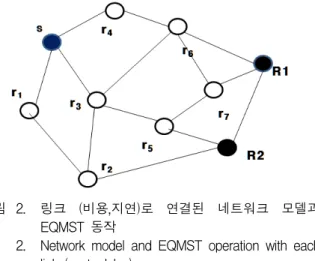
Fig. 2 shows an example graph with a sequence of two events handled by the dynamic algorithm described above. The dynamic event 1 is assumed as the case which node R1 joins in the group, and the event 2 as the one which node R2 leaves. The initial graph with multicast group set shown in Fig. 2, assuming that a delay bound is 5.5 units. As shown in Fig. 1, a WMN consists of mesh routers and mesh clients. In general, mesh routers have minimal mobility and operate just like a network of fixed routers, except being connected by wireless links through wireless technologies such as IEEE 802.11[2].
그림 2. 링크 (비용,지연)로 연결된 네트워크 모델과 EQMST 동작
Fig. 2. Network model and EQMST operation with each link (cost, delay).
From the fig. 1, we can see that some mesh routers have the gateway functionality because they are connected to the Internet with physical wires.
Moreover, every mesh router is equipped with a traffic aggregation device (similar to an 802.11 access point) that interacts with individual mesh clients. The mesh router relays aggregated data traffic of mesh clients to and from the Internet. In this paper, we are mainly interested in the mesh backbone formed by 802.11 mesh routers.
2. Management of group size and priority queue
Multicasting, as we mentioned, is the simultaneous transmission of data to multiple destinations. The group membership size has influence on the performance of multicasting, as it will be shown in Fig. 6. Thus we tried to control the size for obtaining the best performance according to various circumstances. We define the maximum group size as, the minimum group size as , and the current group size as. The value of can be determined at the beginning or at the time of reconstruction of the tree.
The current group size may be variable whenever dynamic events occur. The value of , however, will be restricted to after is equal to . To solve this situation, priority queue can be used to keep the priority order for joining the multicast group as shown in Fig. 3. The priority queue size(Sg) can be set to , where Sn is the network size. The minimum spanning tree is maintained even if a node leaves a group. The node turns into an intermediate node unless it is not the end node in the tree. If it is the
그림 3. 그룹 관리를 위한 유한 우선순위 큐 모델 Fig. 3. Finite priority queue model for group
management.
end node, it will be removed off from the tree. When the group size decreases to, the tree will be reconstructed.
3. Resource control scheme
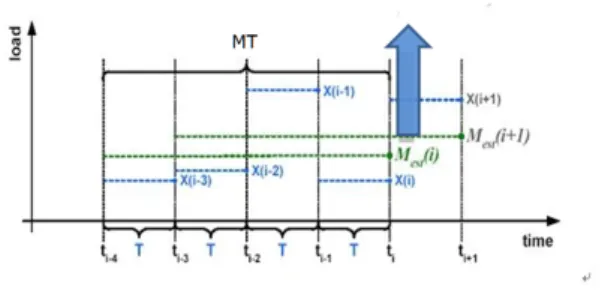
The traffic matrix is specified based on traffic estimation according to traffic measurement method as shown in Figure 4. This figure shows the estimation method of Mean rate using the moving average. Here, T represents sampling interval, X(i) means the measured mean rate in i, and N means window size (number of sampling intervals). The values within such a pattern matrix will be typical or normal values, of which normal values are within a predefined threshold. In the normal, we can safely provision the network according to our pre-specified matrix by allocating the optimal bandwidth.
Continuous monitoring of the incoming traffic enables us to recognize whether at any given time the incoming traffic is within the bounds of the expected traffic.
Figure 5 shows the resource control strategy according to traffic condition. Here, m in represents the status of available resources is reduced to a minimum. In a while, m ax represents a state in which the available resources to keep the maximum value. In the presence of sudden changes, the network enters an abnormal state. In this case, the network reacts by further changing the weight in discordance with the matrix above. As soon as the network returns to a normal state, parameters are brought back to the recommended values. Since when the network condition is monitored continuously and estimated to the moving average of rate, it gives us the opportunity to in fact record variations in traffic pattern over longer periods of time. As a result, the weights within the matrix can be defined and re-defined over time as a continuously varying function.
그림 4. 이동 평균기법을 이용한 트래픽 예측
Fig. 4. Traffic estimation using moving average method.
그림 5. 트래픽 조건에 따른 자원제어 방법
Fig. 5. Resource control strategy according to traffic condition.
Ⅳ. Performance Evaluation
1.
Network Model for simulation
We evaluate the performance of the proposed EQMST algorithm by running simulation with randomly generated test networks. For this, a number of random graphs are generated, which have some of the characteristics of real networks. The n nodes of a graph are randomly distributed on a Cartesian coordinate plane, and the (x, y) coordinates of each node was chosen between (0,0) and (W,W), creating a forest of n nodes spread across the plane. In order to determine if an event was to be added to or deleted from a node from the connection, we consider the probability model obtained by the same method proposed in [1], with the probability function given by the equation (2).
where Pen is the probability that an event is the addition of a node, n is the number of nodes in the group of the current connection, N is the network size, and σ is a parameter in (0,1).
2. Simulation Results
Here, we present the simulation results of the proposed EQMST algorithm. Our algorithm has run on 25-, 50-, 75-, 100-, 125-, and 150-node network models. For each simulation, EQMST ran a sequence of 500 events using the fixed value for σ= n/N, for which Pen(n)=0.5, assuming that the multicast trees are reconstructed in other algorithms, because they are not able to adapt these situations. For the comparison of the algorithms, we use the mean values of the final results. Table 1 shows the parameters used in these experiments in detail.
Comparing the performance of our solutions for the Minimum Spanning Tree and the Minimum delay solution, the delay bound of dynamic multicast solution was set to those of the corresponding solutions. In these figures, the MST means the cost of Minimum Spanning Tree, which is the optimum cost solution, even though with the unconstrained delay, while the MDS means Minimum Delay Solution using shortest path algorithm, which is the optimum delay solution, regardless of the network costs. EQMST means the cost of dynamic solution with bound equal to maximum delay in the minimum delay solution.
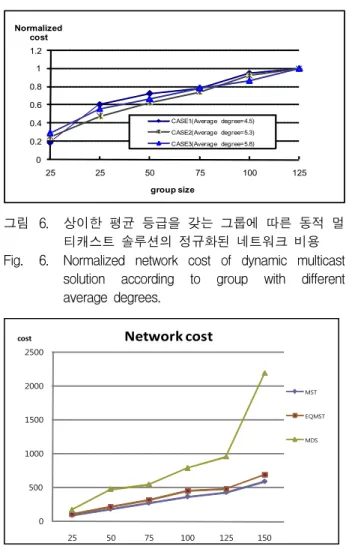
Fig. 6 shows the characteristics of the network
items values
no. of
nodes 25 50 75 100 125 150
average
degree 4.85 5.16 5.23 4.96 5.01 5.25 표 1. 시뮬레이션을 위한 매개변수 (EQMST) Table 1. Parameters for simulations (EQMST)
0 0.2 0.4 0.6 0.8 1 1.2
25 25 50 75 100 125
Normalized cost
group size
CASE1(Average degree=4.5) CASE2(Average degree=5.3) CASE3(Average degree=5.8)
그림 6. 상이한 평균 등급을 갖는 그룹에 따른 동적 멀 티캐스트 솔루션의 정규화된 네트워크 비용 Fig. 6. Normalized network cost of dynamic multicast
solution according to group with different average degrees.
0 500 1000 1500 2000 2500
25 50 75 100 125 150
cost Network cost
MST EQMST MDS
그림 7. EQMST에서의 노드 수에 따른 네트워크 비용 Fig. 7. Network cost vs number of nodes in EQMST.
cost of dynamic multicast solution as a function of group size. Here, we set the number of nodes is 75, and average degrees as 4.5 (CASE1), 5.5 (CASE2), and 6.2 (CASE3) respectively. It may be observed that as the group size increases, as expected, network cost increases. From these results, we may say that the group size should be restricted to obtain efficient network performance. For example, in order to get the performance with the cost below than 50%
(CASE2), group size should not exceed 35% of the network size.
Figure 7 indicates the characteristics of network cost versus the number of nodes, for the group size equal to 20% of the total network size. The cost of the EQMST solution with the delay bound set to the optimal value from the traffic estimation is nearly
identical to that of the MST solution with priority scheme, which is the optimal cost solution. It means that our algorithm converges to optimal solution. By selecting the optimal values for the delay bound, the optimal QoS solution can be obtained between the optimal cost solution and the minimum delay solution in wireless mesh networks, which is very adequate to mobile multimedia applications.
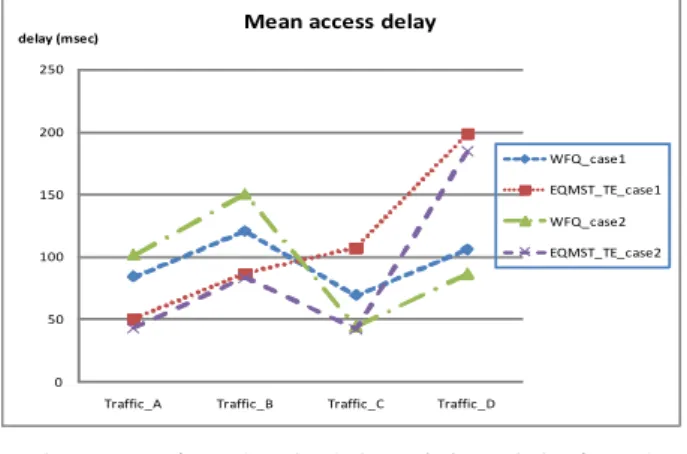
In the simulation, the proposed scheme based on traffic estimation (EQMST_TE), traffic estimation for overload traffic condition (EQMST_TE_OL) and weighted fair queuing (WFQ) functions were implemented between wireless mesh routers in WMN, respectively. Figure 8 shows a comparison of the mean access delay according to each traffic class for two cases. Here, the x- and y-axis represents the traffic class and mean access delay time in msec, respectively. Also case 1 means that the traffic amount of each class occurs at the same rate, whereas case 2 means that the traffic occurrence rates for traffic_A, traffic_B, traffic_C and traffic_D are 36%, 24%, 15% and 25%, respectively. These results show that the delay performance of traffic_A (the traffic with relative high priority) of EQMST_TE was improved considerably compared to other lower priority traffic, and Traffic_A showed much better performance in case 2. The non-linear performance characteristics for EQMST_TE scheme can be analyzed to be due to the nonlinear characteristic of the traffic distribution.
Fig. 9 shows the mean delay performance for the over traffic case in the presence of Traffic_A traffic over 50% compared with the others in the network (50%, 12%, 16%, and 22%, respectively). Here, the x- and y-axis represents the traffic types (class) and mean delay time in msec, respectively. The results show that the delay performance for Traffic_A traffic of EQMST_TE (or EQMST_TE_OL) is much improved when compared to those of Traffic_B, Traffic_C and Traffic_D. This is due to the proper operation of the proposed scheme for the high
0 50 100 150 200 250
Traffic_A Traffic_B Traffic_C Traffic_D
delay (msec) Mean access delay
WFQ_case1 EQMST_TE_case1 WFQ_case2 EQMST_TE_case2
그림 8. 두 가지 경우에 대한 트래픽 유형에 따른 평균 액세스 지연
Fig. 8. Mean access delay according to the traffic types for two cases.
0 50 100 150 200 250 300
TC_A TC_B TC_C TC_D
delay (msec)
Traffic Types
Mean delay for overload
WFQ_normal EQMST_TE EQMST_TE_OL
그림 9. 과부하 트래픽 조건에서의 평균 트래픽 지연 Fig. 9. Average traffic delay for the overload traffic
condition.
priority class. In particular, when the TE scheme is applied to Traffic_B (for video traffic) and the traffic density is heightened, the proposed EQMST_TE(or EQMST_TE_OL) performance is much greater for that traffic than for the other schemes.
Ⅴ. Conclusion
The QoS multicast routing problem for wireless is one of the essential problems to support real-time multimedia services, which are becoming very important in wireless mesh networks including wireless ad hoc network. In this paper, an enhanced QoS multicast routing scheme is proposed to adapt to a dynamic mobile traffic condition for wireless mesh
networks. This scheme is based on the modifications of algorithms for the constrained Steiner tree, which satisfies the network conditions with the delay constraints. The dynamic QoS multicast tree is constructed using partial multicast routing scheme and traffic estimation. This scheme can guarantee the end-to-end delay bound from source to each of destination nodes, and also adapt to a dynamic wireless link conditions. Possible future projects include a high performance adaptive QoS routing schemes to support a wide range of QoS requirements for various dynamic events in global wireless networks.
REFERENCES
[1] A.F. Bayan and Tat-Chee Wan, “A Scalable QoS Scheduling Architecture for WiMAX Multi-Hop Relay Networks”, 2010 ICETC, 2010.
[2] Bo Rong and Yi Qian et al, “Enhanced QoS Multicast Routing in Wireless Mesh Networks”, IEEE Trans. on Wireless Communications, Vol.7, No. 6, Jun. 2008.
[3] P. I. Basarkod and Sunilkumar S. Manvi,
“On-demand QoS and Stability Based Multicast Routing in Mobile Ad Hoc Networks”, Journal of Communications and Information Technology, Mar. 2014.
[4] Liming Xie and X. Jia, “QoS Multicast Routing and Transmission Scheduling in Multi-hop Cognitive Radio Networks”, IEEE2010 Workshop on Pervasive Comm. Globecom, 2010.
[5] A.F. Bayan and Tat-Chee Wan, “A Scalabe QoS Scheduling Architecture for WiMAX Multi-Hop Relay Networks”, 2010 ICETC, 2010.
[6] Xavi Masip-Bruin, Marcelo Yannuzzi, et al.,
“The EuQoS System: A Solution for QoS Routing in Heterogeneous Networks”, IEEE Communications Magazine, Feb. 2007.
[7] Lajos HanzoII and R. Tafazolli, “A Survey of QoS Routing Solutions for Mobile AD-HOC Networks”, IEEE Communications, Vol. 9, No. 2, 2007.
[8] M. Kang, High Performance QoS Traffic Transmission Scheme for Real-Time Multimedia Services in Wireless Networks, IEEK Transactions on Smart Processing and
저 자 소 개 강 문 식(정회원)
1985년 연세대학교 전자공학과 학사 졸업.
1988년 연세대학교 전자공학과 석사 졸업.
1993년 연세대학교 전자공학과 박사 졸업.
1996년 펜실바니아대학교 전기및전자공학과 Post-Doc
<주관심분야 :
차세대융합초고속네트워크구조및 최적화기법, 무선모바일네트워크의 QoS 트래 픽제어 및 보안, 이동멀티미디어 트래픽모델링 및 응용
>
Computing, vol. 1, no.3, Dec. 2012
[9] A.F. Bayan and Tat-Chee Wan, “A Scalable QoS Scheduling Architecture for WiMAX Multi-Hop Relay Networks”, 2010 ICETC, 2010.
[10] Fei Zhang and James Macnicol, “Efficient Streaming Packet Video Over Differentiated Service Networks”, IEEE Trans. on Multimedia, Vol. 8, No. 5, Oct. 2006.
[11] Xavi Masip-Bruin, Marcelo Yannuzzi, et al.,
“The EuQoS System: A Solution for QoS Routing in Heterogeneous Networks”, IEEE Communications Magazine, Feb. 2007.
[12] M. Kang, “An Efficient High-Speed Traffic Control Scheme for Real-Time Multimedia Applications in Wireless Networks”, LNEE Vol.215 (ICITCS2012), Dec. 2012.
[13] Xavi Masip-Bruin, Marcelo Yannuzzi, et al.,
“The EuQoS System: A Solution for QoS Routing in Heterogeneous Networks”, IEEE Communications Magazine, Feb. 2007.
[14] Albert Banchs et al, “Providing Throughput Guarantees in IEEE 802.11e Wireless LANs”, Proceedings of WCNC 2002, Mar. 2002.
[15] Panos Trimintzios et al, “Quality of Service Provisioning for Supporting Premium Services in IP Networks”, Proceedings of the IEEE Global Telecommunications Conference, Nov. 2002.
[16] Sorniotti et al, “Design Guidelines for an Internet Scaled QoS Framework”, Proceedings of ECUMN’07, 2007.