JKSCI
Tongue Segmentation Using the Receptive Field Diversification of U-net
1)
Yu-Jie Li*, Sung-Tae Jung**
*Lecturer, School of Intelligent Manufacturing, Weifang University of Science and Technology, Shandong, China Student, Dept. of Computer and Software Engineering, Wonkwang University, Jeonbuk, Korea
**Professor, Dept. of Computer and Software Engineering, Wonkwang University, Jeonbuk, Korea
[Abstract]
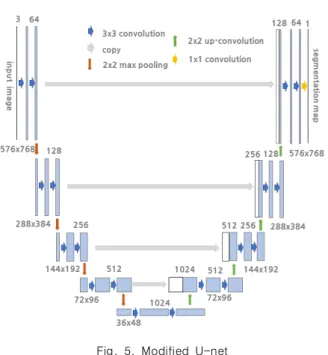
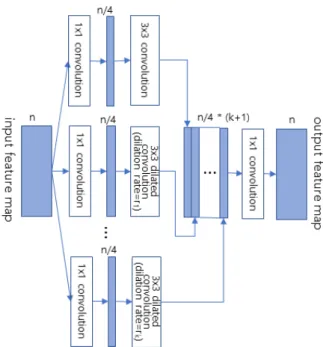
In this paper, we propose a new deep learning model for tongue segmentation with improved accuracy compared to the existing model by diversifying the receptive field in the U-net. Methods such as parallel convolution, dilated convolution, and constant channel increase were used to diversify the receptive field.
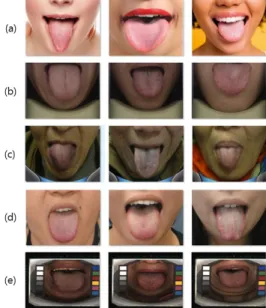
For the proposed deep learning model, a tongue region segmentation experiment was performed on two test datasets. The training image and the test image are similar in TestSet1 and they are not in TestSet2.
Experimental results show that segmentation performance improved as the receptive field was diversified.
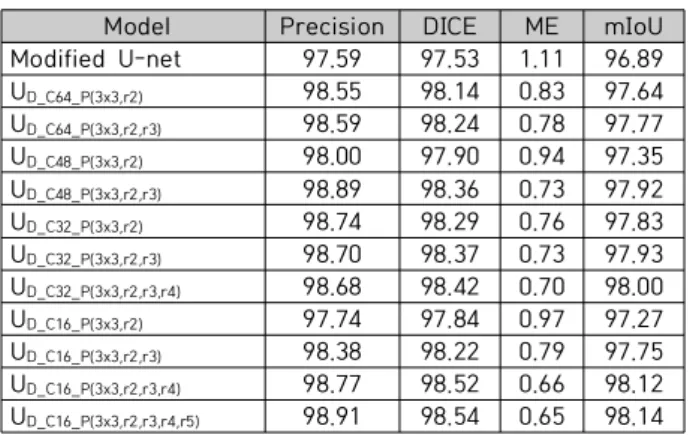
The mIoU value of the proposed method was 98.14% for TestSet1 and 91.90% for TestSet2 which was higher than the result of existing models such as U-net, DeepTongue, and TongueNet.
▸Key words: Tongue, Segmentation, Deep Learning, U-net, Receptive Field
[요 약]
본 논문에서는 U-네트에서 수용 영역을 다양화하여 기존의 모델보다 정확도가 개선된 새로운 혀 영역 분할을 위한 딥러닝 모델을 제안한다 . 수용 영역 다양화를 위하여 병렬 컨볼루션, 팽창된 컨볼루션 , 상수 채널 증가 등의 방법을 사용하였다. 제안된 딥러닝 모델에 대하여, 학습 영상과 테스트 영상이 유사한 TestSet1과 그렇지 않은 TestSet2의 두 가지 테스트 데이터에 대해 혀 영역 검출 실험을 진행하였다 . 수용 영역이 다양화됨에 따라 혀 영역 분할 성능이 향상되는 것을 실험 결과에서 확인할 수 있었다 . 제안한 방법의 mIoU 값은 TestSet1의 경우 98.14%, TestSet2의 경우 91.90%로 U-net, DeepTongue, TongueNet 등 기존 모델의 결과보다 높았다.
▸주제어: 혀, 분할, 딥러닝, U-네트, 수용 영역
∙First Author: Yu-Jie Li, Corresponding Author: Sung-Tae Jung
*Yu-Jie Li ([email protected]), School of Intelligent Manufacturing, Weifang University of Science and Technology;
Dept. of Computer and Software Engineering, Wonkwang University
**Sung-Tae Jung ([email protected]), Dept. of Computer and Software Engineering, Wonkwang University
∙Received: 2021. 08. 24, Revised: 2021. 09. 23, Accepted: 2021. 09. 24.
Copyright ⓒ 2021 The Korea Society of Computer and Information http://www.ksci.re.kr pISSN:1598-849X | eISSN:2383-9945
![Fig. 4. ENet Bottlenect Module[14]](https://thumb-ap.123doks.com/thumbv2/123dokinfo/5309349.382208/4.892.164.362.404.646/fig-enet-bottlenect-module.webp)