Print ISSN: 2288-4637 / Online ISSN 2288-4645 doi:10.13106/jafeb.2021.vol8.no7.0225
Critical Factors Affecting Student Satisfaction and Loyalty: An Empirical Study in Cambodia
Rotana KIENG
1, Kitti PHOTHIKITTI
2, Rawin VONGURAI
3Received: March 20, 2021 Revised: May 22, 2021 Accepted: June 01, 2021
Abstract
This research aimed to investigate the key factors affecting student satisfaction and loyalty in selected private universities in Cambodia.
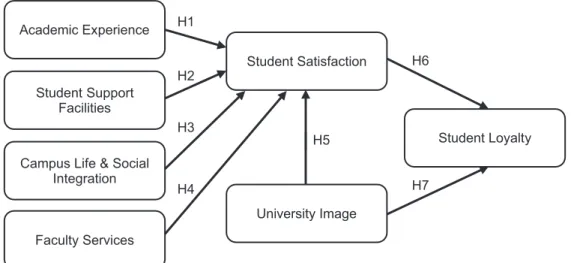
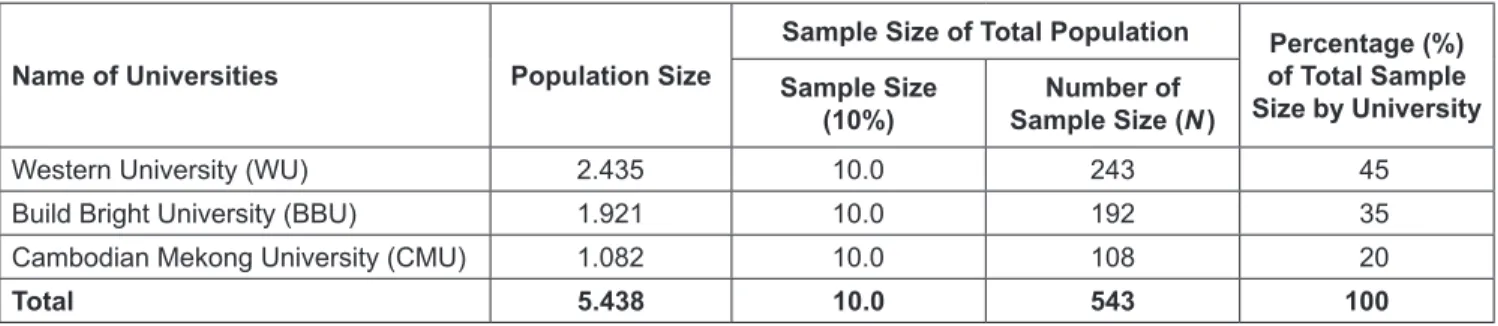
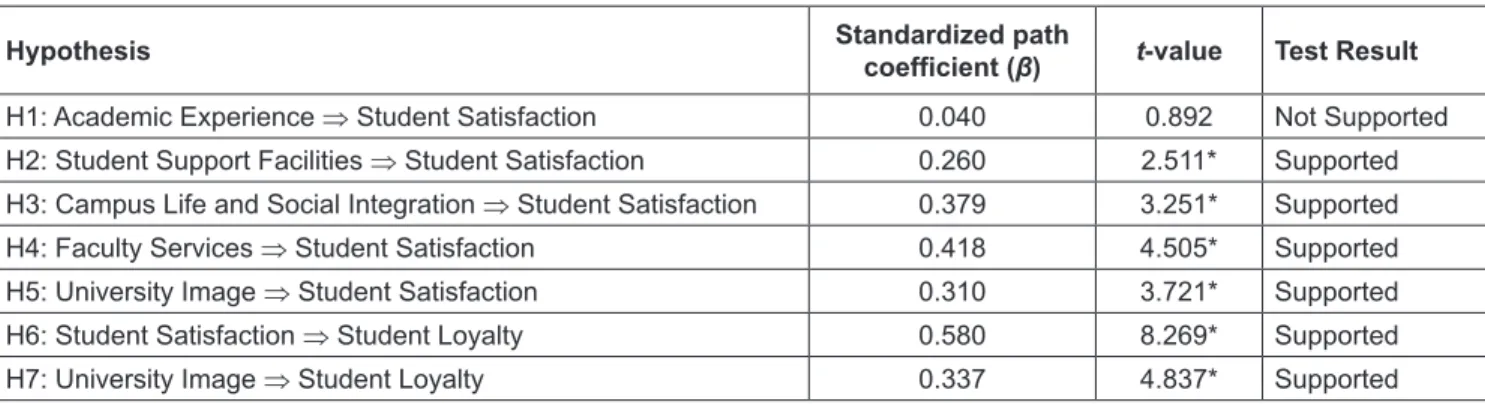
The study implemented a quantitative survey designed and guided by seven hypotheses to test the causal relationships among variables, such as academic experience, faculty services, campus life, social integration, student support facilities, student satisfaction, university image, and student loyalty. The research applied a multi-stage sampling technique of probability procedures to guarantee the presence of the research population. Confirmatory Factor Analysis (CFA) and Structural Equation Modeling (SEM) were applied for data analysis to test the hypotheses model. The collected survey totaled 543 from three universities. The purposive sampling methods were used to select the three target universities, based on their reputation, the number of students, year of establishment, and the recognition from the Ministry of Education, Youth, and Sport. The stratified random sampling method was employed to select target respondents for data collection by dividing the population into subgroups to ensure a random sample. The results showed that student support facilities, campus life, and social integration, faculty services, and university image play very important roles in the satisfaction and loyalty of the students in three universities.
Keywords: Higher Education, University Image, Student Satisfaction, Student Loyalty JEL Classification Code: I20, I23, M10
stable post-secondary education, is a precondition for invention and development. Knowledgeable citizens are extra employable, make a higher income, and withstand monetary tremors better than the rest (World Bank, 2021).
The privatization of HE was a complete need in Cambodia.
It was an extra means of meeting the inevitable claim of the population for a worldwide development, which indicated that HE was no more reserved for the elites (Lee
& Healy, 2006). The necessity to privatize higher education institutions was also owed to the growing number of learners seeking HE and the inability of the state to finance them (Altbach, 2007).
In its rapid growth over the last 20 years, Cambodia enjoyed a fantastic rise in the number of higher learning institutions and universities, both public and private, particularly since the beginning of the New Millennium.
The remarkable increase in number brings along widespread concern to found ethics to ensure the worth of HE, equity in educational access, and services for university students.
The efforts of progress and transformation have faced many structural challenges. Just as academic literature refers to the
“complexity” of higher education in general, Cambodian university leaders, policymakers, and educational researchers
1
First Author and Corresponding Author. Ph.D. Candidate, Organization Development, Graduate School of Business and Advanced Technology Management, Assumption University, Thailand [Postal Address: 592/3 Soi Ramkhamhaeng 24, Khwaeng Hua Mak, Khet Bang Kapi, Bangkok, 10240, Thailand]
Email: [email protected]
2
Dean, Graduate School of Business and Advanced Technology Management, Assumption University, Thailand.
Email: [email protected]
3
Program Director, Innovative Technology Management, Graduate School of Business and Advanced Technology Management, Assumption University, Thailand. Email: [email protected]
© Copyright: The Author(s)
This is an Open Access article distributed under the terms of the Creative Commons Attribution Non-Commercial License (https://creativecommons.org/licenses/by-nc/4.0/) which permits unrestricted non-commercial use, distribution, and reproduction in any medium, provided the original work is properly cited.