≫ 硏究論文 ≪
鹽酸溶液에서 Tri 2-Ethylhexyl Amine(TEHA)에 의한 백금과 로듐의 分離
孫盼盼 · 李晩承
木浦大學校 工科大學 新素材工學科
Separation of Platinum(IV) and Rhodium(III) from Acidic Chloride Solution by Solvent Extraction with Tri 2-Ethylhexyl Amine(TEHA)
Pan-Pan Sun and Man-Seung Lee*
Department of Advanced Materials Science & Engineering, Mokpo National University, Chonnam 534-729, Korea
요 약
TEHA 와TEHA 및TBP와 LIX63과의 혼합용매를 사용하여 염산용액으로부터 백금과 로듐을 분리하기 위한 용맥추출실험을 수행 하였다. 염산농도 1-9 M 범위에서 추출제의 농도에 따른 두 금속의 추출거동과 분리 가능성을 조사하였다. 혼합용액에서 백금과 로 듐의 농도는 각각1 × 10
−3M 과 2 × 10
−4M 로 조절하였다. TEHA와 혼합추출제에 의한 추출시 로듐의 추출율은 추출조건에 의존하 나, 백금은 염산농도와 무관하게 모두 추출되었다. 혼합용액에서 염산농도가 낮을 경우 로듐이 추출되지 않아 백금과 로듐의 분리 가 가능하였다. LIX63을 첨가한 TEHA는 로듐의 추출율을 향상시켰으나, TBP를 첨가한 TEHA는 두 금속의 추출에 거의 영향을 미치지 않았다.
주제어 : 백금, 로듐, HCl, TEHA, 용매추출
Abstract
Solvent extraction experiments were performed to separate platinum and rhodium from mixed chloride solution by using tri 2-ethylhexyl amine (TEHA) and its mixture with TBP and LIX 63. Effects of extraction conditions on the separation of the two metals were investigated as a function of extractant concentration in the HCl concentration range from 1 to 9 M. The con- centration of Pt (IV) and Rh(III) was controlled to 1 × 10
−3M and 2 × 10
-4M, respectively. In the extraction with TEHA and its mixture, Pt was quantitatively extracted irrespective of HCl concentration, while the extraction percentage of Rh depended on the extraction condition. When the concentration of HCl in the mixed solution was low, the extraction of Rh was nil and sep- aration of Pt and Rh was possible. Adding TBP to TEHA had little effect on the extraction of both metals, while adding LIX63 to TEHA favored the extraction of Rh.
Key words : Platinum(IV), Rhodium(III), HCl, TEHA, Solvent extraction
* Received : May 7, 2013 ·Revised : June 12, 2013·Accepted : July 1, 2013 Corresponding Author : Man-Seung Lee (E-mail : [email protected])
Department of Advanced Materials Science & Engineering, Mokpo National University, 61 Dorim-ri, Chungkye-myun, Muan- gun, Chonnam, 534-729, Korea
Tel : +82-62-450-2492 / Fax : +82-62-450-2498
ⓒThe Korean Institute of Resources Recycling. All rights reserved. This is an open-access article distributed under the terms
of the Creative Commons Attribution Non-Commercial License (http://creativecommons.org/licenses/by-nc/3.0/), which permits
unrestricted non-commercial use, distribution and reproduction in any medium, provided the original work is properly cited.
1. Introduction
Platinum group metals (PGMs) are used as catalysts for air-pollution abatement in vehicles, and petroleum refining owing to their unique physical and chemical properties. Pt and Pd are efficient in catalyzing the reaction of C and H to CO2 and H2O, while Rh is efficient in catalyzing the reaction of nitrogen oxides (NOx) to N2.1) Until now, no metal can substitute for rhodium to control NOx emissions.2) The composition of catalysts depends on their type. In automobile catalysts, the typical molar ratio of platinum to rhodium is about 5 : 1.
The depletion of natural PGM resources leads to the development of their recovery from the secondary sources. The spent catalysts produced from the petrochemical and automobile industries are important secondary resources for PGMs. In hydrometallurgical treatment of spent catalysts, PGMs together with other minor elements in the spent catalysts are dissolved by leaching with chloride based solutions3), and then the PGMs are recovered by solvent extraction with different extractants4-10) or by ion exchange with various resins.11-13) In solvent extraction process, commercial amines, such as Alamine304-1(tertiary amine), Alamine308 (tri-isooctyl amine), Alamine336 (mixture of tri-octyl/decyl amine), TOA (trioctyl amine), and Aliquat336 (Aliphatic quaternary ammonium salt) have excellent extraction efficiency for Pt from chloride solutions.1,14)
TEHA, a branched-chain amine, was found to be a considerably weaker extractant for mineral acids than straight chain aliphatic amines, while still stronger than solvating extractants, such as, alcohols and esters. 14) It has been reported that the stripping from loaded TEHA is easy compared with other amines such as Alamine308, Alamine336, and TOA.16)
However there is no report on using TEHA (tri 2- ethylhexyl amine) as an extractant for the separation of PGMs. In this study, the effect of HCl and TEHA concentration on the extraction behavior of Pt and Rh as well as the stripping was investigated. The MaCabe-Thiele plot for the extraction of Pt was constructed. Moreover, a mixture of TEHA with TBP or LIX63 was tested as an extractant to separate the two metals.
2. Experimental
Stock solutions of platinum and rhodium were prepared by dissolving the necessary amount of PtCl4 (Aldrich, 98%) and RhCl3·4H2O (Aldrich, 99.99%) in doubly distilled water. Throughout our experiments, the concentration of Pt (IV) and Rh(III) was controlled to 1 × 10⁻³ M and 2 × 10⁻⁴ M , respectively. The acidity of the mixed solution was adjusted by adding HCl solution (Duksan pure Chem., 35%). NaCl (Tedia company, Inc., 99%), Na2CO3 (Yakuri pure chemicals co., LTD, 99.7%), thiourea (Daejung chemicals & metals co., 96%), HNO3 (Duksan pure Chem., 64%), HClO4 (Daejung chemicals
& metals co., 60%) were used in preparing the stripping agents.
TEHA (BASF corporation), TBP (Tributyl phosphate, Yakuri pure chemicals co., 99%), LIX63 (5,8-Diethyl-7- hydroxydodecane-6-oxime, Cognis, 70%) were used without further purification. The concentration of extractant was adjusted by using toluene as a diluent. 1-Decyl alcohol (Acros Organics) was used as a modifier.
Equal volumes (20 mL) of aqueous and organic phases were mixed in a 100 mL screwed cap bottle and shaken for 30 min with a wrist action shaker. The aqueous phase was separated after the two phases were separated. The organic phase was stripped by certain stripping reagent at equal volume (20 mL). All the extraction and stripping experiments were carried out at ambient temperature. The concentration of metal in the aqueous phase was measured by ICP-OES (Spectro arcos). The concentration of metal in the organic phase was obtained by mass balance. The concentration of HCl was determined by volumetric titration with standard Na2CO3 solution.17)
3. Results and discussion
3.1. Extraction of Pt and Rh from mixed solu- tion by using TEHA
3.1.1 Effect of TEHA and HCl concentration on the extraction of metals
Fig. 1 shows the extraction behavior of Pt and Rh as a function of TEHA concentration in the range from 0.01 to 0.7 M at unit phase ratio. The extraction behavior of both Pt and Rh was affected by the concentration of HCl, especially when the concentration of TEHA was low.
When the concentration of HCl was 1 M, the extraction of
Pt increased with increasing TEHA concentration from 0.01 to 0.7 M and Pt was completely extracted by 0.7 M TEHA. It was noted that solids with orange color were formed during these extraction process. When the concentration of HCl was in the range from 3 to 9 M, most of Pt was extracted irrespective of the concentration of TEHA.
In the case of Rh, when the concentration of TEHA was lower than 0.05 M, the extraction percentage of Rh was nil at 1 M HCl. The extraction percentage of Rh increased to nearly 40% with the further increase of TEHA concentration to 0.7 M when the concentration of HCl was 1 and 3 M. However in the HCl concentration range between 5 and 9 M, the effect of increasing the concentration of TEHA on the extraction of Rh was not remarkable. Quantitative and selective extraction of Pt was achieved with 0.03 and 0.05 M concentration of TEHA at 1 M HCl, where the co- extraction of Rh was nil.
During the extraction process of Pt and Rh by using 0.7 M TEHA, the concentration of HCl before and after extraction was measured. When HCl concentration in the feed was 1, 3 and 5 M, the extraction percentage of HCl was about 70%, 22%, and 14.4%, respectively. The extraction percentage of HCl decreased with the increase of HCl concentration in the feed. The solvent extraction reaction of HCl by TEHA (R3N) can be represented as16, 18)
R3N+ HCl = R3N·HCl (1)
Like other amines, the extraction reaction of Pt could be represent as1,5)
PtCl62− + 2R3NHClorg = PtC16 (R3NH)2, org+ 2Cl− (2)
Based on the above equation, the extraction of platinum decreases at higher concentration of HCl owing to the mass action effect of chloride ions.5) However, the extrac- tion of platinum was not significantly affected by the concentration of HCl in our experimental range.
There are seven kinds of aqua-chloro complexes of Rh in chloride solution. RhCl63- is the predominant species at high concentration of HCl (9 M). 4) Extraction of by TEHA from strong HCl solution could be represented as:
RhCl63− + 3R3NHClorg = RhCl6(R3NH)3,org+ 3Cl− (3)
When HCl concentration was low, Rh exists as a hydrophilic complex, such as RhCl5(H2O)2− owing to extensive aquation reaction. Extraction reaction of this species by TEHA is represented below4,19)
RhCl5(H2O)2−
+ 2R
3NHClorg= (R3NH)2RhCl5(H2O) org +2Cl− (4)
The decrease in the extraction of Rh with the increase of HCl concentration from 1 to 9 M was due to the anion exchange mechanism. Mass action effect of chloride ion suppressed the extraction of Rh by TEHA at high HCl concentration.
3.1.2 Extraction isotherm of platinum
In order to find the number of stages needed to completely extract platinum from the mixed solution at 1 M HCl concentration, the McCabe-Thiele plot for the extraction of Pt was constructed by contacting the mixed solution and 0.03 M TEHA at various phase ratio of O/A ranging from 1 to 9. According to the McCabe- Thiele plot shown in Fig. 2, complete extraction of Pt from the mixed solution is possible in 3 stages at an O/
A ratio of 2.
3.1.3 Stripping of platinum from loaded TEHA Stripping experiments with different agents such as HNO3, HClO4, NaCl, H2O, a mixture of 0.1 M Thiourea and 0.5 M HCl were tested to investigate the possibility of
Fig. 1. Effect of TEHA and HCl concentration on the
extraction of Pt(IV)and Rh(III) (room tempera-
ture, O/A = 1).
stripping of Pt from the loaded TEHA as well as of regeneration of the extractant. The loaded TEHA and stripping solutions were mixed at unit phase ratio. The results are represented in Table 1. Although HNO3 can strip Pt from the loaded TEHA, increase of HNO3 concentration from 4 to 8 M led to slight increase in the stripping percentage of Pt from 27.8 to 45.2%. H2O gave a stripping percentage of 20%. Using 0.1 M Th + 0.5 M HCl, 1 M HClO4 and 2 M NaCO3 as a stripping agent gave similar stripping percentage of Pt. Considering the ease of further refining process of Pt from the stripping solution, HClO4 was selected as a stripping agent for further stripping studies.
The effect of HClO4 concentration on the stripping percentage of Pt from the loaded TEHA was investigated
by varying the concentration of HClO4 from 0.2 to 8 M.
The loaded TEHA was obtained from the extraction process at unit phase ratio (1 L scale). In this process, some precipitates with orange color were formed. After the solid was filtered, the stripping experiments were carried out at unit phase ratio. The results showed that the stripping percentage of Pt was less than 20% in all the concentration range of HClO4 used in this study. These results imply that some of platinum may be present in the precipitate during the extraction step. The tendency to form precipitates during extraction was more remarkable when the experimental scale was increased to 1 L.
3.2. Effect of TBP concentration in a mixture with TEHA on the extraction of metals
In order to investigate the effect of adding TBP to TEHA on the extraction of metals from the mixed solution at 1 M HCl concentration, a mixture of TBP and 0.03 M TEHA was used as an extractant. When the concentration of TBP in the mixture was 0.05 and 0.1 M, precipitates with orange color were formed. When the concentration of TEHA in the mixture was 0.3 M, the formation of the precipitates was negligible in the TBP concentration range adopted in this study and the two phases were separated well. Therefore, further experiments were carried out by varying TBP concentration to 0.3 M in the mixture of 0.3 M TEHA. The concentration of HCl in the feed was varied from 1 to 9 M.
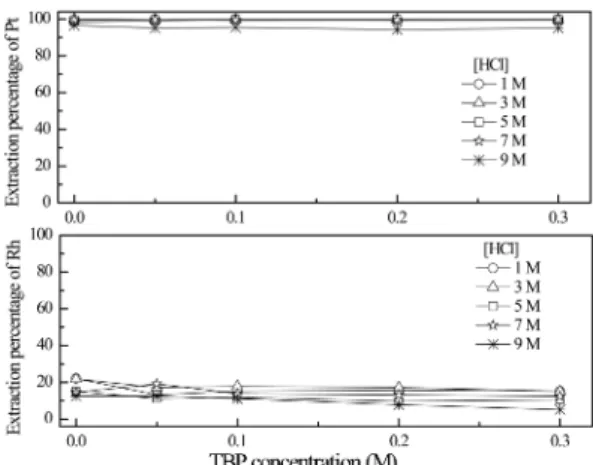
The results (Fig. 3) suggested that when the mixture of
Fig. 2. McCabe-Thiele plot for Pt extraction from mixed
chloride solution with 0.03 M TEHA (room tem- perature, O/A = 1, 2, 3, 5, 7, 9).
Table 1. Selection of stripping agents for stripping of Pt from loaded TEHA.
Stripping agent Stripping %
4M HNO
327.8
8M HNO
345.2
0.2M HClO
41
1M HClO
460
8M HClO
445.8
0.1M Th+0.5M HCl 61.8
2 M NaCO
359.4
1M NaCl 20.6
H
2O 20
Fig. 3. Effect of HCl and TBP concentration in the mixture
with 0.3 M TEHA on the extraction of Pt(IV)and
Rh(III).
TEHA and TBP was employed as an extractant, more than 98% of Pt was extracted while the extraction percentage of Rh was lower than 20% in all the concentration range of HCl. Increase of TBP concentration in the mixture with 0.3 M TEHA had negligible effect on the extraction of both Pt and Rh in our experimental range.
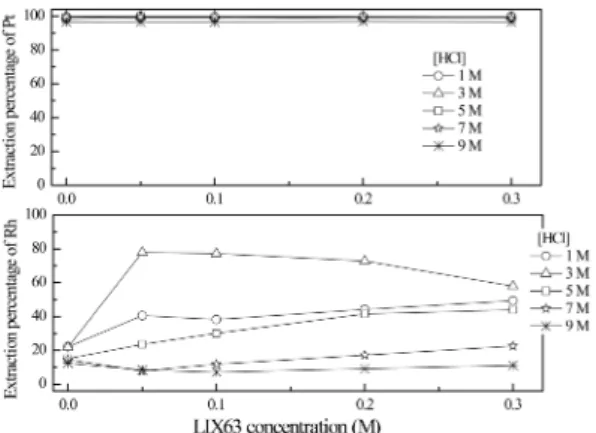
3.3. Effect of LIX63 concentration in a mix- ture with TEHA on the extraction of metals Our results showed that adding TBP to TEHA had little effect on the extraction of Pt and Rh, in our experimental range. LIX63 is a chelating extractant and it has been reported that some mixture of extractant with LIX63 has synergistic effect on the extraction of metals. Therefore, a mixture of LIX63 and TEHA was used to compare the extraction behavior of the metals with TEHA and a mixture of TBP and TEHA. For this purpose, the concentration of LIX 63 in the mixture with TEHA was varied to 0.3 M. The concentration of HCl in the mixed was varied from 1 to 9 M. Unlike the extraction with the mixture of TEHA and TBP, no precipitate was formed during the extraction. The results in Fig. 4 indicate that adding LIX 63 to TEHA had little effect on the extraction of Pt, while the extraction percentage of Rh was increased when the concentration of HCl was low. Increasing the
concentration of LIX 63 in the mixture favored the extraction of Rh at the same concentration of HCl. The extraction percentage of Rh increased with the increase of HCl concentration from 1 to 3 M and then decreased with the further increase of HCl concentration from 5 to 9 M.
As a conclusion, adding LIX 63 to TEHA had negative effect on the separation of Pt and Rh. But these results might be applied for the extraction of Rh since 80%
extraction of Rh could be obtained by using 0.3 M TEHA and 0.05 M LIX 63 as an extractant at unit phase ratio.
According to Fig. 1, 3 and 4, low concentration of TEHA and its mixture with low concentration of TBP/
LIX 63 led to better separation of Pt and Rh. Comparison of the separation factors obtained with different extractants used in this study is represented in Table 2.
Compared with TEHA extractant (0.3 M) alone, the separation factors by the mixture of TEHA and TBP/ LIX 63 were decreased. Therefore, it might be concluded that mixing TBP/LIX63 with TEHA had negative effect on the separation of Pt and Rh and the negative effect was more pronounced with LIX63 than that with TBP. When TEHA alone was used as an extractant, lower con- centration of TEHA favored the separation of the two metals and 0.03 M TEHA led to higher separation of Pt and Rh at 1 M HCl.
4. Conclusions
Solvent extraction separation of Pt and Rh by using TEHA as an extractant was investigated. By adjusting HCl and TEHA concentration, Pt was selectively extracted and thus could be separated from rhodium. It was possible to recover platinum from the loaded TEHA by stripping with 1 M HClO4. However, the formation of precipitate was observed during the extraction process and some platinum might exist in the solid. Adding TBP to TEHA had little effect on the extraction of both metals.
However, use of the mixture of TEHA and LIX63 led to no formation of the precipitates during the extraction.
Adding LIX 63 to TEHA favored the extraction of Rh and has adverse effect on the separation of Pt and Rh. The
Fig. 4. Effect of HCl and LIX63 concentration in mixture
with 0.3 M TEHA on the extraction of Pt(IV)and Rh(III).
Table 2. Comparison of separation factor obtained with different extractants in this study(Separation factor=D
Pt/D
Rh) HCl TEHA 0.03 M TEHA 0.3 M TEHA 0.3 M+ 0.05 M TBP TEHA 0.3 M+ 0.05 M LIX63
1 M 64,956 754 748 173
3 M 75,81 7,158 2,191 176
increase in the extraction percentage of Rh by the mixture of LIX63 and TEHA could be applied to the separation of PGMs from other metals.
감사의 글
본 논문은 환경부 “환경융합신기술개발사업”의 연구 비 지원에 의해 수행되었습니다.
References
1. Jaree, A., khunphakdee, N., 2011: Separation of con- centrated platinum (IV) and rhodium (III) in acidic chloride solution via liquid-liquid extraction using tri- octylamine, J. Ind. Eng. Chem. 17, pp. 243-247.
2. National research council, 2008: Minerals, critical minerals, and the U.S. economy, pp. 137-147, National Academies Press, Washington.
3. Lee, M.S., 2010. Chemical properties and dissolution technology of platinum group metals in solutions. J. of Korean Inst. of Resources Recycling 19 (5), pp. 3-12.
4. Benguerel, E., Demopoulos, G. P., Harris, G. B., 1996:
Speciation and separation of rhodium (III) from chloride solutions: a critical review, Hydrometallurgy 40, pp. 135- 152.
5. Kumar, J.R., Lee, H.I., Lee, J.Y., Kim, J.S., Sohn, J.S., 2008: Comparison of liquid-liquid extraction studies on platinum (IV) from acidic solutions using bis (2, 4, 4- trimethylpentyl) monothiophosphinic acid, Sep. Purif.
Technol. 63, pp. 184-190.
6. Mhaske, A. A., Dhadke, P. M., 2001: Extraction separation studies of Rh, Pt and Pd using Cyanex 921 in toluene-a possible application to recovery from spent catalysts, Hydrometallurgy 61, pp. 143-150.
7. Lee, J. Y., Kumar, J. R., Kim, J.S., Kim, D. J., Yoon, H.S., 2009: Extraction and separation of Pt (IV) /Rh (III) from acidic chloride solution using Aliquat 336, J. Ind. End.
Chem. 15, pp. 359-364.
8. Lee, J.Y., Kumar, J. R., Kim, J. S., Park, H. K., Yoon, H.
S., 2009: Liquid-liquid extraction/separation of platinum (IV) and rhodium (III) from acidic chloride solutions using
tri-iso-octylamine, J. Hazard. Mater. 168, pp. 424-429.
9. Nowottny, C., Halwachs, W., Schugerl, K., 1997: Recovery of platinum, palladium and rhodium from industrial process leaching solutions by reactive extraction, Sep.
Purif. Technol. 12, pp. 135-144.
10. Sun, P. P., Lee, M. H., Lee, M. S., 2010: Separation of Rh (III) from the mixed chloride solutions containing Pt (IV) and Pd (II) by extraction with Alamine 336, Bull. Korean Chem. Soc. 31, pp. 1945-1950.
11. Shen, S., Pan, T., Liu, X., Yuan, L., Wang, J., Zhang, Y., Guo, Z., 2010: Adsorption of Rh (III) complexes from chloride solutions obtained by leaching chlorinated spent automotive catalyst on ion-exchange resin Diaion WA21J, J. Hazard. Mater. 179, pp. 104-112.
12. Sun, P.P., Lee, J. Y., Lee, M.S., 2012: Separation of Pt(IV) and Rh(III) from acidic Chloride Solution by ion exchange with anion resins, Hydrometallurgy 113-114, pp. 200-204.
13. Kononova, O.N., Melnikov, A.M., Borisova, T.V., 2012:
Simultaneous sorption recovery of platinum and rhodium from sulfate-chloride solutions, Hydrometallurgy 117-118, pp. 101-107.
14. Sun, P.P., Lee, J. Y., Lee, M.S., 2011: Separation of Pt(IV) and Rh(III) from Chloride Solution by solvent extraction with amine and neutral extractants, Mater. Trans. 52, pp.
2071-2076.
15. Eyal, A. M., Hazan, B., Bloch, R., 1991. Recovery and concentration of strong mineral acids from dilute solutions through LLX. II. Reversible extraction with branched- chain amines, Solvent Extr. Ion Exch., 9(2), pp. 211-222.
16. Banda, R., Nguyen, T.H., Lee, M. S., 2013: Recovery of HCl from chloride leach solution of spent HDS catalyst by solvent extraction, Chem. Process Eng. 34(1), pp. 153-163.
17. Bassett, J., Denney, R. C., Jeffery, G. H., Mendham, J., 1978: Vogel’s textbook of quantitative inorganic analysis, pp. 36-37. Longman, New York.
18. Haghshenas, D.F., Darvishi, D., Rafieipour, H., Alamdari, E. K., Salardini, A.A., 2009: A comparison between TEHA and Cyanex 923 on the separation and the recovery of sulfuric acid from aqueous solutions, Hydrometallurgy 97, pp. 173-179.
19. Levitin, G., Schmuckler, G., 2003. Solvent extraction of rhodium chloride from aqueous solutions and its separation from palladium and platinum. Reactive & Functional Polymers 54, pp. 149-154.
孫 盼 盼
• 연태대학교(중국) 응용화학 학사
• 목포대학교 신소재공학과 공학석사
• 현재 목포대학교 신소재공학과 박사 과정
李 晩 承