Copyright © 2015 The Korean Society of Plastic and Reconstructive Surgeons
This is an Open Access article distributed under the terms of the Creative Commons Attribution Non-Commercial License (http://creativecommons.org/
licenses/by-nc/3.0/) which permits unrestricted non-commercial use, distribution, and reproduction in any medium, provided the original work is properly cited. www.e-aps.org
Original Article
INTRODUCTION
Facial laceration is the most common type of facial trauma for plastic surgeons in emergency departments, and most cases re- quire primary closure. Repair of facial laceration is necessary not only for wound healing without complications but to minimize
scarring. However, many problems can arise while suturing fa- cial lacerations, such as uncooperative adults, who may be drunk or have sustained head trauma, uncooperative children, and pa- tients with unstable vital signs. In children especially, apart from scarring, parents are often concerned about the use of sedatives, insufficient anesthesia, and stitch removal.
The Usefulness of Leukosan SkinLink for Simple Facial Laceration Repair in the Emergency
Department
Hyunjoo Kim, Junhyung Kim, Jaehoon Choi, Woonhyuk Jung
Department of Plastic and Reconstructive Surgery, Keimyung University Dongsan Medical Center, Keimyung University School of Medicine, Daegu, Korea
Background Repair of facial laceration in the emergency department can pose a number of difficulties. Children can be uncooperative, but adults can also be if they have sustained head trauma or are intoxicated. Leukosan SkinLink consists of topical adhesive and adhesive tape that can be applied easily to long or tense wounds. In this study, the authors compared conven
tional suturing with Leukosan SkinLink for facial laceration patients in the emergency department.
Methods The prospective study was carried out from March 2013 to September 2013 with linear facial laceration patients visiting the emergency department. Exclusion criteria were open fractures, joint injuries, skin defects, hairy skin, and mucosa. The author used Leukosan SkinLink for skin closure in the experimental group and used conventional suturing in the control group. The scar evaluation using the Patient and Observer Scar Assessment Scale (POSAS) along with satisfaction scores, procedure times, and complications were compared.
Results A total of 77 patients (30 in the control group and 47 in the experimental group) participated and underwent followup for 6 months postoperatively. The scar assessment using the POSAS and the satisfaction score in both groups were similar. The average procedure time in the experimental group was shorter. In the control group, there were four cases of wound dehiscence, two of infection, and one of skin necrosis, whereas four cases of wound dehiscence and one allergic reaction occurred in the experimental group.
Conclusions With a simple application technique, Leukosan SkinLink is a new effective method for facial laceration repair especially useful for children and uncooperative adults.
Keywords Laceration / Tissue adhesives / Surgical tape / Visual analog scale
Correspondence: Junhyung Kim Department of Plastic and Reconstructive Surgery, Keimyung University Dongsan Medical Center, Keimyung University School of Medicine, 56 Dalseong-ro, Jung-gu, Daegu 700-712, Korea
Tel: +82-53-250-7635 Fax: +82-53-255-0632 E-mail: [email protected]
This article was presented at 72nd Congress of The Korean Society of Plastic and Reconstructive Surgeons on November 7–9, 2014 in Seoul, Korea.
No potential conflict of interest relevant to this article was reported.
Received: 3 Mar 2015 • Revised: 5 May 2015 • Accepted: 18 May 2015
pISSN: 22346163 • eISSN: 22346171 • http://dx.doi.org/10.5999/aps.2015.42.4.431 • Arch Plast Surg 2015;42:431437
432
With liquefied topical adhesives such as Dermabond (Ethicon, Cincinnati, OH, USA), there is no need for local anesthetics, sedatives, or stitch removal. Hence, the simple procedure is con- venient for both physicians and patients and requires less time for outpatient visits. However, these products cannot be applied to long or tense wounds [1]. The purpose of this study was to evaluate Leukosan SkinLink (BSN Medical GmbH, Hamburg, Germany), which consists of liquefied topical adhesive and ad- hesive tape, and to assess the short- and long-term outcomes of facial laceration repair using this product with regard to cosme- sis and postoperative complications for comparison with con- ventional suturing.
METHODS
Subjects
Following Institutional Review Board approval (DSMC 2013- 12-022-004), patients who visited the emergency department of our institution with facial lacerations between March 2013 and September 2013 were evaluated for study inclusion. Writ- ten informed consent was obtained from all patients included in this study. Exclusion criteria included the following: known al- lergy to cyanoacrylates, formaldehyde, or adhesive strips; known dermatosis; impaired wound healing problems such as keloid or rheumatologic disease; steroid or antimetabolic medication;
open fractures, joints, or skin defects that require high tension for repair; or any hairy skin or mucosa. Patients who were un- conscious or had unstable vital signs owing to multiple traumas were also excluded. Eighty-nine out of 782 patients were includ- ed in this study, and patients were allowed to choose the skin closure material; Thirty-eight patients those treated with Leu- kosan SkinLink were the experimental group and fifty-one pa- tients those who underwent conventional suturing were the con- trol group.
Operation technique
In the control group, after sterilizing the wound and surround- ing skin with 0.05% chlorhexidine solution, 1:100,000 epineph- rine mixed with 1% lidocaine was infiltrated near the wound.
After waiting a few minutes for the hemostatic effect on the wound, simple interrupted skin suture using a non-absorbable suture (6-0 Dafilon, B. Braun, Bethlehem, PA, USA) was performed. If there was muscle injury or the tension needed for repair was high, a simple buried suture on the muscle or subcutaneous tis- sue using an absorbable suture (5-0 Monosyn, B. Braun) was performed before skin suturing. If the wound margin was dirty and uneven, conservative debridement was performed using a No. 15 blade knife.
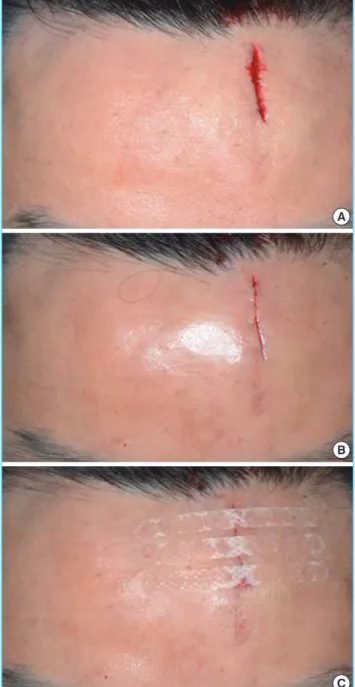
In the experimental group, after sterilizing and drying with gauze, adhesive tape was applied perpendicularly to the wound appro- ximating edge with the fingers assisted by the forceps to produce eversion. Liquefied topical adhesive was then applied on the tape rather than directly to the wound. Similar to the control group, debridement or buried suturing was performed if necessary pri- or to application of Leukosan SkinLink (Fig. 1).
After skin closure in both groups, a semi-occlusive dressing with foam (Mepilex Lite, Molnlycke Health Care, Gothenburg,
(A) Forehead laceration involving frontalis injury. (B) The frontalis muscle was repaired with 5-0 Monosyn. (C) Adhesive tape was ap- plied perpendicularly to the wound. Liquefied topical adhesive was applied on the tape.
Fig. 1. Applying Leukosan SkinLink
A
B
C
Sweden) was applied. The stitches were removed on postopera- tive day five in the control group. In the experimental group, the Leukosan SkinLink was allowed to loosen without assistance and was completely removed on postoperative day ten. Steri- Strip (3M, Maplewood, MN, USA) was applied in both groups for three months for scar management.
All the series of the procedures in both groups were perform ed by one of the co-authors (H.J.K.) to exclude the possibility of inter-operator variability.
Evaluation
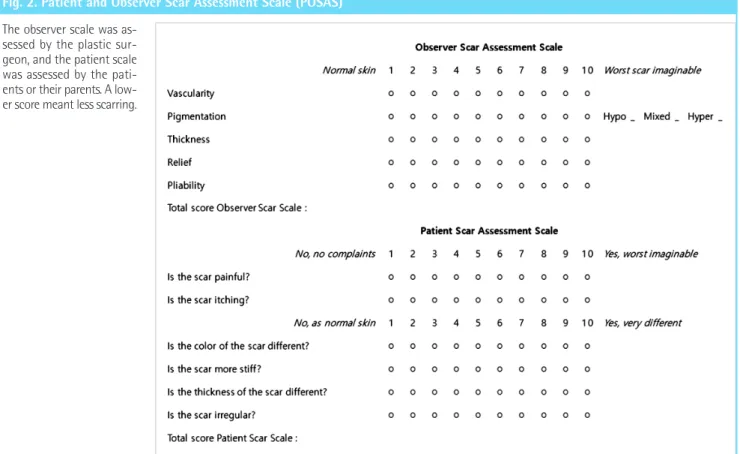
The scar was assessed using the POSAS on the day of suture or Leukosan SkinLink removal, then one and six months postop- eratively (Fig. 2). The Observer Scale included vascularity, pig- mentation, thickness, relief, and pliability, while the Patient Scale included pain, itching, color, stiffness, thickness, and irregularity.
Each item could be rated between 1 and 10, with a score of 10 reflecting the worst imaginable scar or sensation. The observer scale was assessed by two plastic surgeons facing the patient di- rectly, and the patient scale was assessed by the patients or their parents. The total score for the observer scale was obtained by adding the scores of each of five items (range, 5 to 50) and the total score for the patient scale was obtained by adding the scores of each of six items (range, 6 to 60). The lowest scores, 5 in the
observer scale and 6 in the patient scale, were for normal skin [2].
On the day of suture or Leukosan SkinLink removal, patients were asked to assess their overall satisfaction level including com- fort as well as pain on suture or Leukosan SkinLink removal us- ing a scale of 1 to 4 (1 at one end representing dissatisfaction and 4 at the opposite end representing very satisfactory). The length of the wound and the time required for the procedure, beginning with sterilization and ending with dressing, were com- pared. Complications were documented by the physician.
Statistical analysis
Using IBM SPSS Statistics ver. 22.0 (IBM Corp. Armonk, NY, USA) for Windows to analyze identity between the two groups, the chi-squared test was conducted for categorical variables such as gender and location of the wound, and the two-sample t-test and Wilcoxon rank sum test were conducted for the other con- tinuous variables. A P-value of < 0.05 was considered to indicate statistical significance.
RESULTS
Subjects
From a total of 782 patients that visited the emergency depart- ment for facial laceration, 89 (control group 38, experimental
The observer scale was as- sessed by the plastic sur- geon, and the patient scale was assessed by the pati- ents or their parents. A low- er score meant less scarring.
Fig. 2. Patient and Observer Scar Assessment Scale (POSAS)
434
group 51) agreed to participate in this study, among whom 12 patients were lost to follow-up, leaving 77 (control group 30, ex- perimental group 47) who were followed for at least 6 months.
Patient demographics in the two groups were not significantly different (Table 1). Among the wound regions, the forehead (control group 17, experimental group 25) was the most com- mon, followed by the chin (control group 9, experimental group 14), cheek (control group 2, experimental group 5), and other sites (control group 2, experimental group 3).
Outcomes
Scar assessment for the control group by both observers and pa- tients resulted in lower values than for the experimental group.
However, other than at one month after surgery (P= 0.031), there was no significant difference between the two groups (P>
0.05) (Table 2).
The satisfaction score for the procedure was higher in the exper- imental group, but the difference was not significant (P=0.073).
The procedure time per centimeter for the experimental group was 16.95 minutes shorter with sedation and 12.01 minutes short- er without sedation (P< 0.05) (Table 3).
In the control group, four cases of wound dehiscence, two cas- es of skin necrosis, and two cases of stitch abscesses were report- ed. In the experimental group, four cases of wound dehiscence and one case of allergic dermatitis were reported. None of the wound dehiscence cases involved full-thickness dehiscence, and they all healed well after re-approximation with the Steri-Strip.
The two cases of superficial skin necrosis were less than 5 mm across and healed completely within two weeks after dressing with foam (Mepilex Lite). The two cases of stitch abscess were treated with incision and drainage. The patient with allergic der- matitis at the periphery of normal skin responded to a topical steroid.
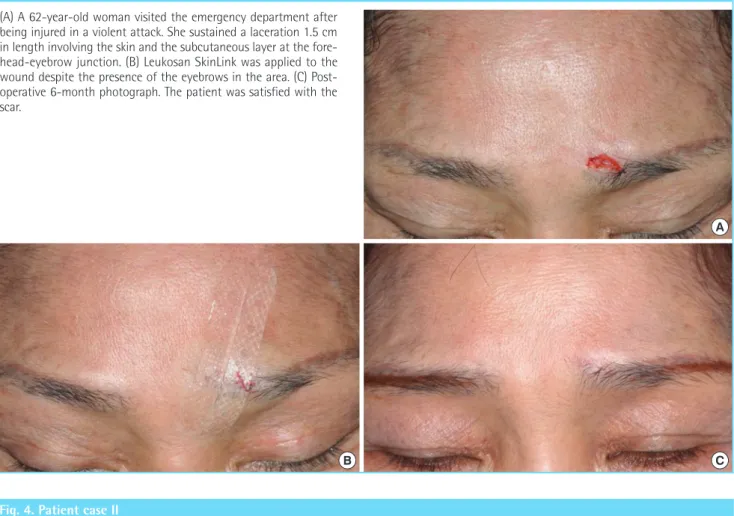
Case 1
A 62-year-old woman visited the emergency department for a 1.5-cm eyebrow laceration caused by violence. Buried suturing was not performed because the depth of the wound was just be- neath the dermis, and the tension to the wound edge was low.
Leukosan SkinLink was applied to the wound with manual ap- proximation of the wound edge. There were no complications during a 6-month follow-up, and the patient was satisfied with the cosmetic outcomes (Fig. 3).
Case 2
A 14-month-old girl visited the emergency department with her parents for a 1-cm forehead laceration sustained during a fall.
Buried suturing was not performed, and the wound was easily closed using Leukosan SkinLink without tension. There was no need for sedation. There were no complications during a 6-month follow-up, and the parents indicated that they were satisfied with the simple procedure without sedation and that the scar was ac- ceptable (Fig. 4).
Characteristic Control
group Experimental group P-value Patient score
Immediately postoperative Postoperative one month Postoperative six months
19.5 (9.7) 18.66 (8.34) 20.43 (8.79)
20.87 (9.6) 21.1 (9.39) 20.78 (8.5)
0.545 0.249 0.860 Observer score
Immediately postoperative Postoperative one month Postoperative six months
19.16 (7.34) 18.8 (7.92) 17.23 (6.2)
21.85 (7.7) 22.8 (7.79) 18.74 (5.81)
0.133 0.031 0.282 Values are presented as mean (standard deviation).
Table 2. Comparison of average patient and observer scar assessment scale score
Characteristic Control
group Experimental
group P-value Total procedure time (min) 32.16 (6.35) 12.1 (7.38) <0.001 Procedure time per
centimeter (min/cm) With sedation Without sedation
22.16 (12.26) 25.35 (11.5) 18.97 (12.55)
7.12 (3.06) 8.4 (3.2) 6.96 (3.05)
<0.001
<0.001
<0.001
Satisfaction score 2.9 (0.71) 3.19 (0.77) 0.073
Complications (%)
a)8 (26.7) 5 (10.6) 0.094
Values except complications are presented as mean (standard deviation).
a)
Complications are presented as number (%).
Table 3. Comparison of procedure time, satisfaction score, and complications
Table 1. Patient demographics Characteristic Control
group Experimental
group P-value No. of patients
Male Female
30 20 (66.7) 10 (33.3)
47 32 (68.1) 15 (31.9)
0.545
Age (yr)
a)13.67 (18.85) 13.57 (18.85)
Length of wound (cm)
a)1.81 (0.84) 1.78 (0.77)
No. of patients with sedation 15 (50) 5 (10.6) <0.001 Depth of wound
Muscle injury (–) Muscle injury (+)
22 (73.3) 8 (26.7)
30 (63.8) 17 (36.2)
0.270
Location of wound Forehead Chin Cheek Other
17 (56.7) 9 (30.3) 2 (6.7) 2 (6.7)
25 (53.2) 14 (29.8) 5 (10.6) 3 (6.4)
0.948
Values except age and length are presented as number (%).
a)